The sad passing of TVW veteran Richard Ashton by Ken McKay.
Richard was a good mate of many who had a passion for television history and many other subjects including the Navy and Cinema equipment.
He wrote large volumes on many topics, which I think should find their way into a State Library of WA archive. Many are contained here in this website.
Here is a summary of Richard’s time with Seven Perth, in his own words:
My 40 years at TVW 7
Studio Cameraman Station Opening Camera 1959
Studio camera for Rolf Harris’s shows, Children’s Channel Seven
Including, Relax with Rolf. And Stairway To the Stars Variety show. Two Dorothy Baker Specials.
Director Sport at Seven a TV sport show Saturday nights after news broadcast’s Program Director, Nightly On Air program content, evening shift 4pm to midnight,
5 nights a week
Commonwealth Games 1962, evening sport show studio cameraman during the games
Made Senior Producer Director, rostering all other directing staff.
Director Live special current affairs evening with Syd Donovan host and producer
Arranger and OB director of the first 6 hour Le Mans Race Wanneroo Park (Barbagello raceway) special links from Wanneroo to transmitter then back to studio
Commercial Director of many clients recorded to video tape including Walsh’s menswear, Arcus refrigerators, Rowleys Electrical. Also studio booking clerk to relieve for holidays.
Producer of weekly TVW on air promotions videos spots for Film program department
Using video tape editing for the first time, and first video edited commercial using new video recorder in mobile van for Wentworth Motors new Valiant cars videoed in Kings Park
OB director first video recording of WAFL game at Leederville Oval later replayed back at evening replay by Sport’s Department
Many other football games including OB’s of several grand finals at Subiaco Oval
OB director Speedway at RAS showgrounds
Director of Castledare Boys home OB’s
OB director of two Broadcast from St Mary’s Cathedral which were later to air video Death of a Pope, Easter service.
Program director with others on the first Telethon 1968 broadcast
Telethon telecasts director early years. Including OB of many Telethon House auctions.
Associated Producer of many Ampol Hole in One studio open days. Golf, Stunts, staged special acts and rides. for those who didn’t play in the golf
Director of evening live Walsh’s Football Preview panel show, designed and animated
Associated Producer of many Ampol Hole in One studio open days. Golf, Stunts,
staged special acts and rides. for those who didn’t play in the golf
Director of evening live Walsh’s Football Preview panel show, designed and animated opening title vision
Writer and producer series of Police Road Safety Community Service for TV OB director live of the landing at Perth airport of the first 747 jumbo jet service
Director, In Perth Tonight. Including My Fair Lady segment, and How to Succeed in Business with out Trying with cast member from His Majesties
Director of Sunday Football shows including the first telephone show World of Sport using a delay recording technique invented by Ken McKay
Perth director from TVW of Roland Strong 64 Thousand Dollar Question to M Melbourne HSV7. involved going to Melbourne for arrangement meeting
Special projects department, associated producer of three Birdman Rally’s at Two Rocks Marina,
Producer Bath Tub Derby events, including two visits to Sydney’s final with Perth winner to take part in the Australia championship events, the winner to go Canada for the World Champ.
Arranger and OB director 4 State Election from Perth Town Hall, and then Modern School
Associated produce of 3 Celebrity Challenger’s at Perry Lakes and at bottom TVW grounds
Coordinator New Channel Seven Concert Band, senior and junior concerts including the bands leading for all Christmas Pageants
Associate producer, Martin St James Spellbound TV series went to air Australia wide
Special Projects Department. Designed and built a new TVW Display building at Royal Show, It was decorated with large Mash design for the stand, we sold thousands of Mash hats.
Producer of much of the show promotions at RAS, including Malaysian stage show in the wool pavilion
York Fair Promotion, associate organizer for several years.
The Seekers concert at York, organizer of street events, Moondyne Joe street presentation, and the stunt The Escape from the Jail, Channel 7 Band street march and parade, special film premier of Sunday to Far Away in the York Hotel
TVW 7 Studio 3 director and video switcher for live telecast First Landing On the Moon, Apollo 11 with our studio on camera presenter and host Peter Waltham
OB Director for live TV telecast of Castledare open field days, fair ground, stalls, and miniature railway exhibit.
Associated producer and float designer for Christmas Pageant 1969 till 1980
Float designs included upside down clowns, Gulliver’s Travel’s, Seven Dwarf float, Micky Mouse, Special Father Christmas float, Mississippi Steam boat, Introduction of music speaker on all major floats. writer with Peter Dean recorded many songs and sounds for many of the floats. Selected all the Christmas Pageant float music.
Introduction of Street Announces public address systems with scripts of descriptions
of floats on 4 city streets. Most were announcer’s from MTL tech Collage TV course
sounds for many of the floats. Selected all the Christmas Pageant float music.
Introduction of Street Announces public address systems with scripts of descriptions of floats on 4 city streets. Most were announcer’s from MTL tech Collage TV course Students
Opening of the Perth Entertainment Centre, arranged the 10,000 balloon launch, Concert stage for Channel 7 Concert Band concert at opening.
Designed and produced a special opening program of Colour TV 1975, How Colour TV Works, and what to expect for the future, Sir Charles Court swings a big switch to open at midnight. I produce and arrange 7 fireworks displays in various suburbs of Perth to started off at midnight. And our engineers remover the blocks to make colour able to be transmitted for the first time.
Associated producer of Channel 7’s birthday celebrations, and Find the Key promotion
Designed new colour and logos for all TVW OB van truck and helicopter and Arranged the colours painting.
AFI Awards at PEC, producer of opening event, arranging including Rent a Crowd
Several Teddy Bear’s Picnic’s open days associated producer
Many Telethon Money Brick Wall’s. associated producer in bottom car park at studio
Several Annual Telethon Fair in grounds of studio bottom car park many rides including full size Merry Go Round and other fair ground rides
Unit Manager Disney on Parade TV special from Perry Lakes Tent show for America Television. Arranger of extra wanted camera hoists.
I was Special Colour NTS Cameraman for US for Disney on Parade for special lighting test
Bob Hope Down Under, TV special made in Perth for Australia and US audiences, Transport arranger for all US staff and cast members.
Wrote, directed and produced and edited Peter Deans Welcome to Channel 7 visitors to the studio video presentation, called Where with You, It was an understanding
documentary about how the station puts programs to air, and the equipment used, including news broadcasts an Football OB’s. and Live remote TVW news segments
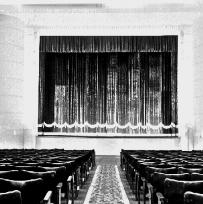
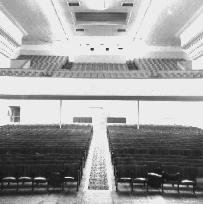
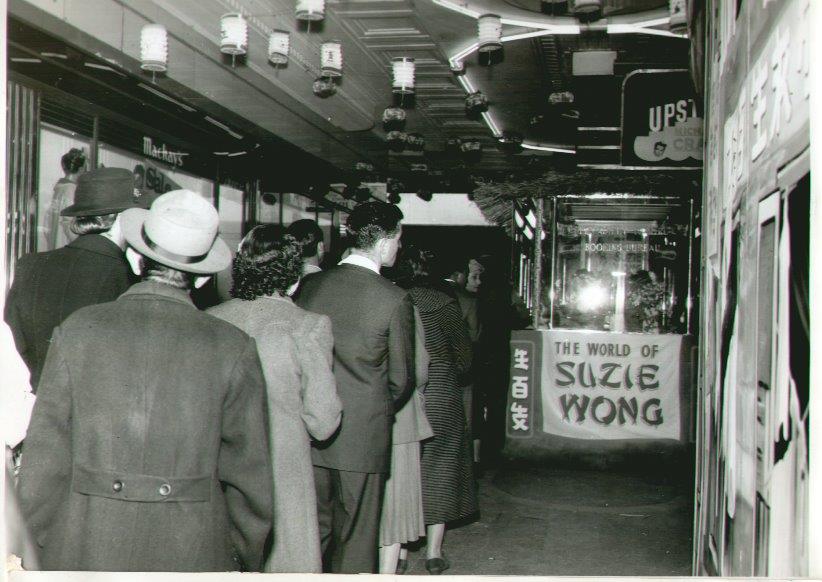
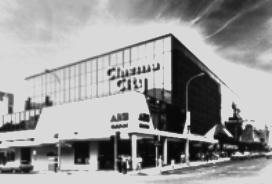
Producer of Opening of Cinema City. I designed and had built in TVW workshop 10 special night floats and arranged many Dancing groups for the street parade, also a special 20 strong Dixieland marching Band, afterwards I produced and decorated the Special after show party in Perth Town Hall.
Commenced Tutoring Studio Cameramen at evening classes Mt Lawley Tech Collage This I did for 4 years in the MLTC TV studio
Moved to special warehouse Premises at Malaga for the building of special sets for Miss Universe stage at the PEC. We also housed and constructed many new Christmas floats. We also constructed all the 5000 audience seating stages, which were designed for traveling to other locations in Australia and overseas. We remained there for over a year before the quest.
Planed with Tourist Department officers the use of special F28 aircraft to carrying production and excuitives to OB locations throughout the state. Including proposed North West locations.
Miss Universe Quest 1979 Associated producer, coordinator all staff and talents on in-
state travel by cars and coaches driven my TVW staff members, with Entrant Girls,
North West locations.
Miss Universe Quest 1979 Associated producer, coordinator all staff and talents on in- state travel by cars and coaches driven my TVW staff members, with Entrant Girls, Devised special UHF radio control system for all daily 25 car movements.
After Miss Universe became TVW 7 Promotions Manager
Manager Group Colour: Installed new Cibachrome printer, purchased special Film Printer 8mm to 16mm, arranged hugh giant full colour backgrounds for news studio colour printed in Brisbane.
Moved to half of Group Colour to Western Mail building in Perth, it was the first colour lab and camera studio in an air conditioned building
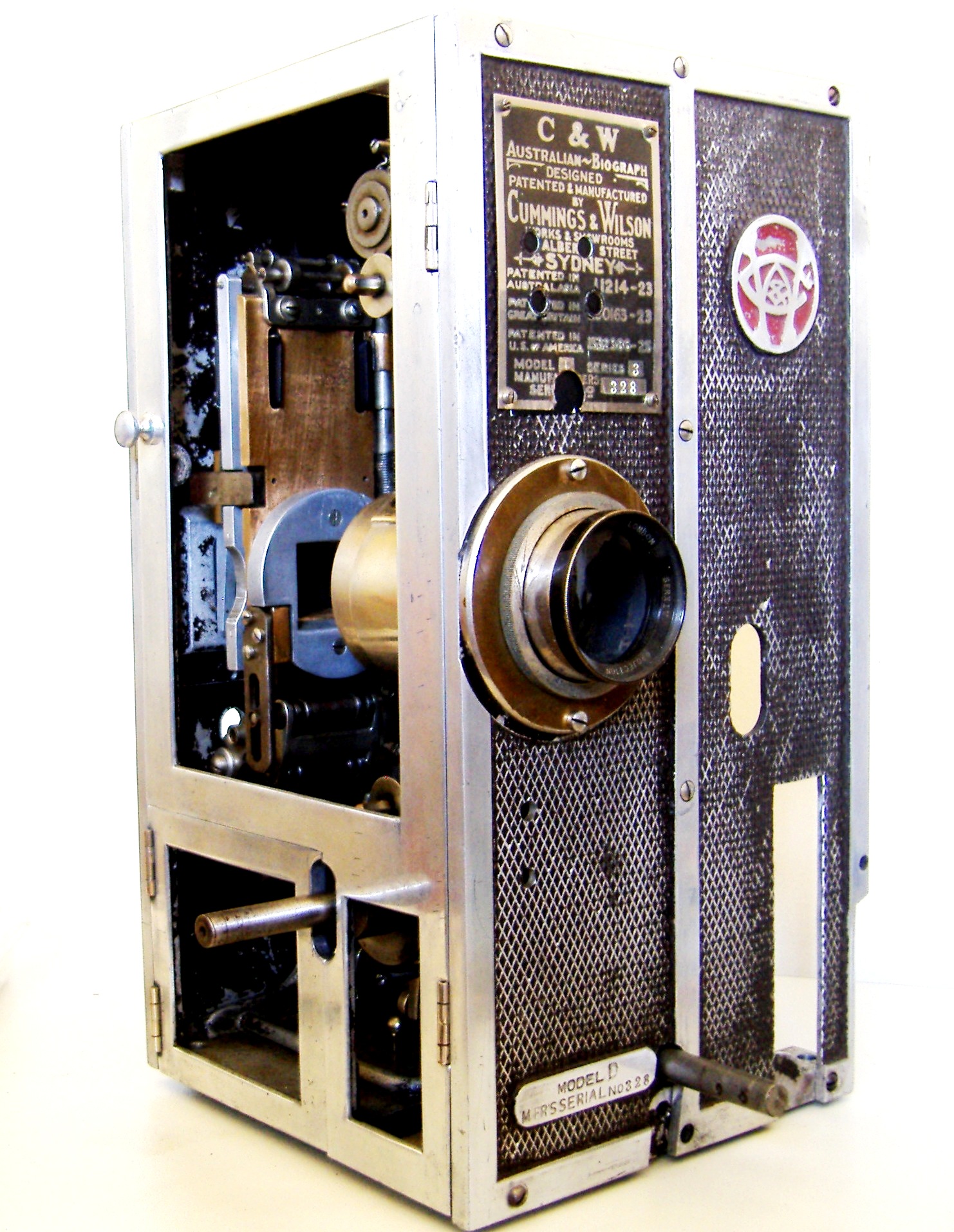
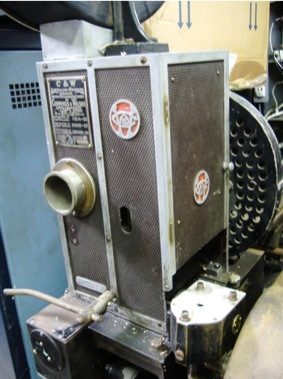
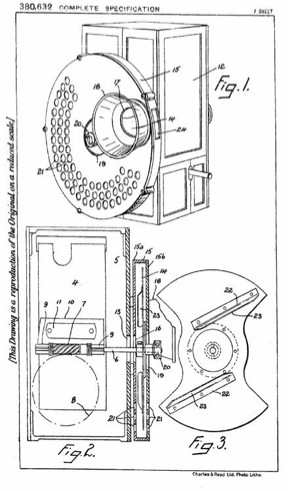
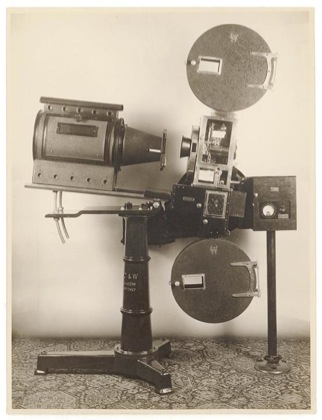
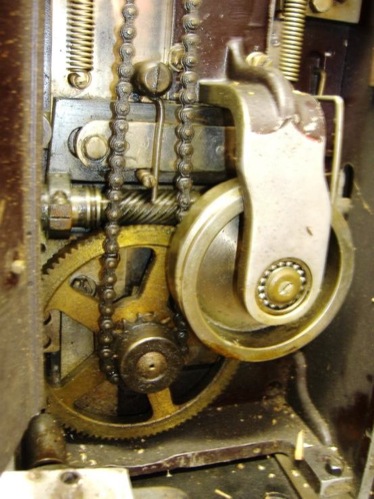
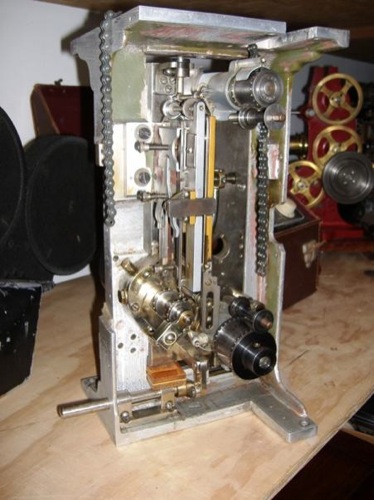
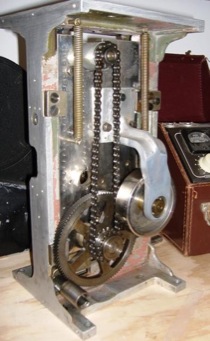
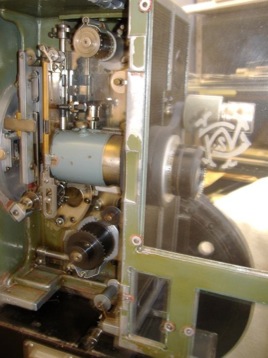
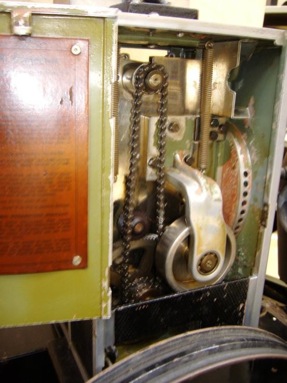
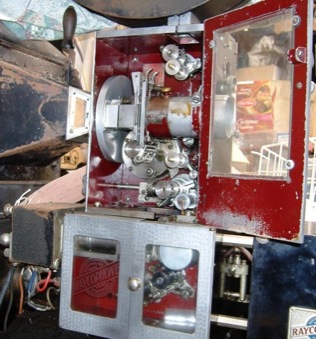
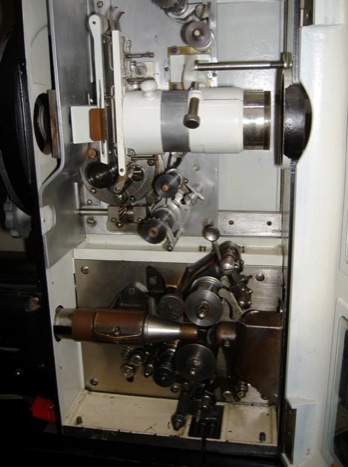
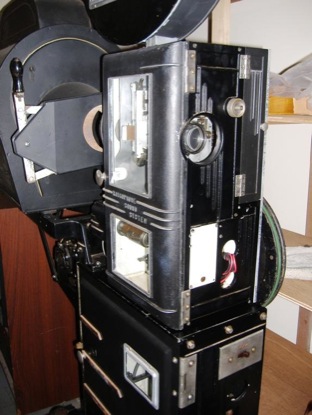
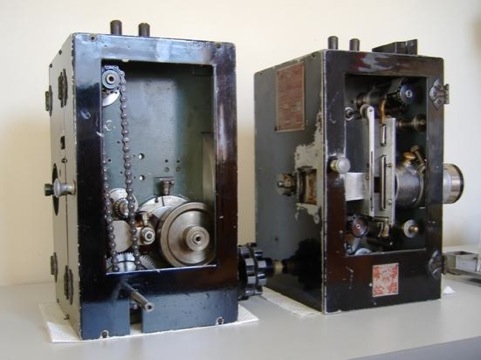
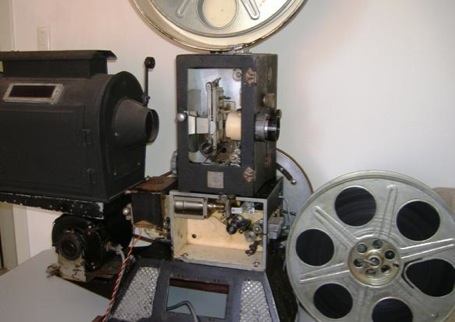
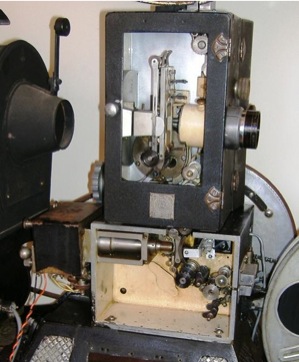
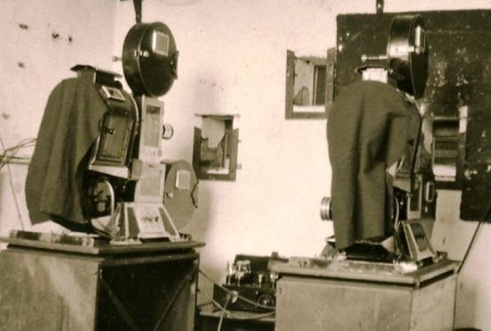
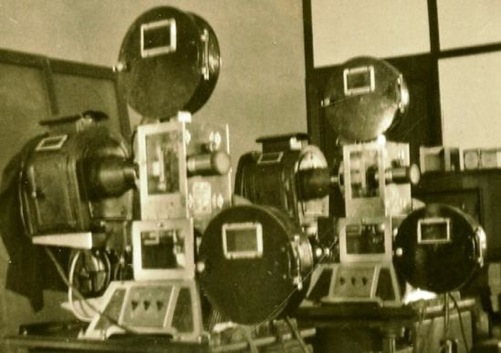
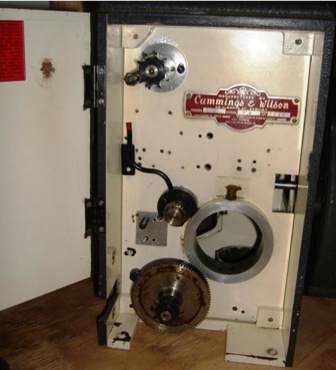
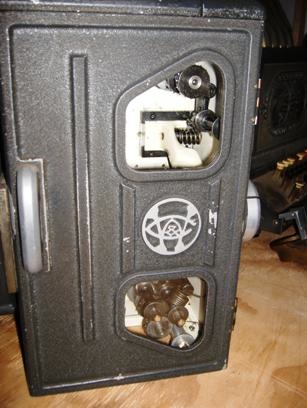
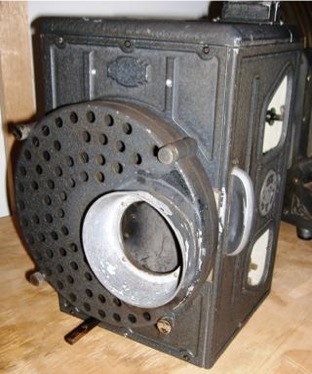
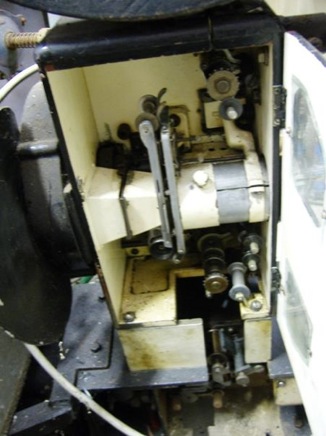
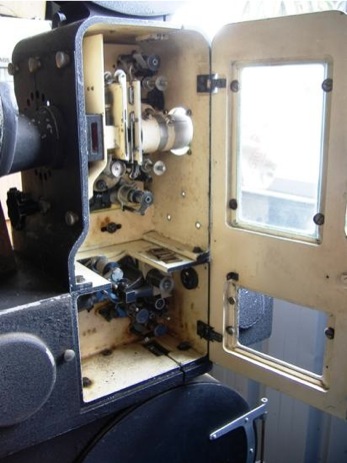
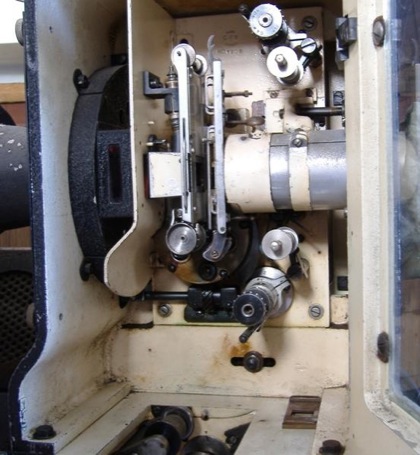
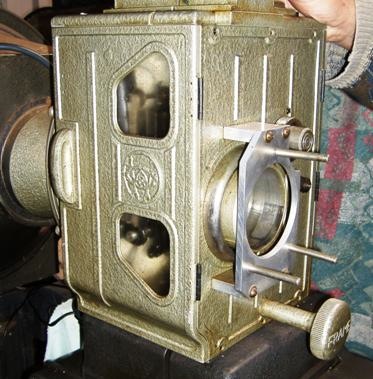
Curator of Channel 7 Vintage film Camera and City Theatres 35mm camera collection, and many other museum items including channel 7 Vintage car collection
Became Chairman of MLTC Advisory Committee developing new courses for the Tech.
Wrote a small Dictionary of Terms and Meanings used in TV and the theatre, including Staging and Lighting principals
Arranged and coordinated all the many on studio walls and picture displays including the canteen throughout the Channel 7 building
Sales Department Golf days displays arranger at many golf courses
Stills photographer for nearly every episode of the 72 National wide teenager series of The Bush Patrol. Filmed in the Darling Range and near Perth and at specially constructed film sets in studio one at TVW.
Still Photographer for publicity and sponsors, donors as well as Artist appearances in studio for Telethon last 10 years up 1999
Some Special Event promotions that didn’t eventuate
Tall Ships arrival at Fremantle, The first Rotto Swim, the First City to Surf ,
Other Telethon events that didn’t get a start were, The Great Lawnmower Race and the Telethon Hay Stack Challenge. All of these events were well into the ideas or planning stages, but for various reasons were not proceed with.
Interesting to note that Vern Reid who worked with me on some special events. He eventually designed the symbols for the the new Dockers football team at Fremantle. He arranged their opening at Subiaco Oval including their song and the big anchor float and flags the purple colours.
This is a photograph of a truck delivering our locomotive for the museum at Channel Seven.
The Karringup Bowl outside broadcast , where we had the Mini Moke with the portable Ampex 2 inch VCR and camera.
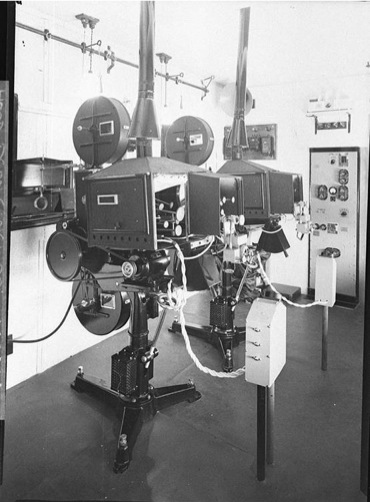
The telecine equipment at Channel Seven when we replaced the individual consoles by building the equipment into a single curved console, making operation better by a single person.
The first two inch video recorders installed at Channel Seven- RCATRTIBI.
Coralie Condon on set in Studio 2.
In the next photographs we see the panel for patching the lighting that John had designed and constructed by Wesco Electrics, then the dimmer panel and control panel for the lighting. And the camera control units and the technical directors console followed by the initial consoles and monitor tracks for Studio One.
This is possibly the first Christmas card from Channel 7 sent to staff with the photograph of the building when it opened in 1959.
Invitation to an Hawaiian Luau 1972
Photograph of the first outside broadcast van at Channel 7 using an Austin 245 shuttle and bodywork by Scarborough Bus Company to John’s design with his fit out with the assistance of Bert King ready for the British Commonwealth and Empire Games using 3 cameras from the studio.
The photos below show the construction of the outside broadcast van for Channel Seven. Above is the mock up frame being made up to the inside dimensions of the van by Fred from Channel 7.
We used this as an inside template for the construction of equipment racks and desks by John Quicke and Burt King. The above photo shows the start of that frame with some of the desk type construction finished.
The above photo shows the camera control unit desk and monitor frame made from aluminium extrusions DIY type with knocking
corners ready for panels as required.
The photo below shows the van as it was with the original logo on the side.
The photo below shows an early shot from a “test”OB, which was to cover the arrival of a Boing 707 aircraft. This was the first one to arrive at Perth Airport.
Above is the completed inside of the van from the producers console and the photo shows the monitors for the 3 cameras and the off air monitors as they look to the Director.
Below is a photo at the front of Channel 7’s building with Dorothy Baker, an entertainer from GTV9 in Melbourne. She came to Channel 7 on several occasions and this publicity shot was taken in my first car- a powder blue MGA with the white wall tyres.
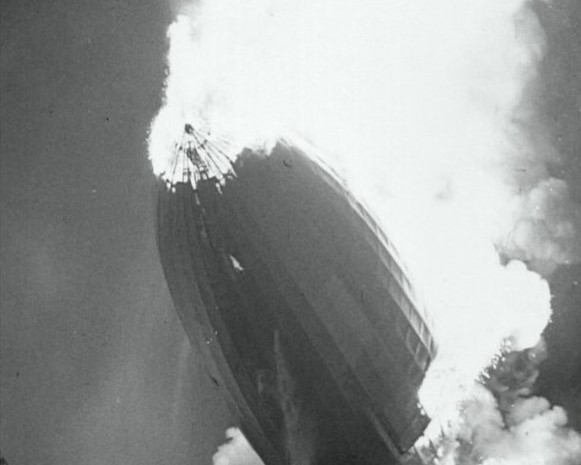
The Birth of the News. A fascinating introduction to the history of the pioneering newsreel company British Pathé which documented all aspects of everyday life in Britain and around the world in the 20th century.
BRITISH PATHÉ’S STORY
Before television, people came to movie theatres to watch the news. British Pathé was at the forefront of cinematic journalism, blending information with entertainment to popular effect. Over the course of a century, it documented everything from major armed conflicts and seismic political crises to the curious hobbies and eccentric lives of ordinary people. If it happened, British Pathé filmed it.
Now considered to be the finest newsreel archive in the world, British Pathé is a treasure trove of 85,000 films unrivalled in their historical and cultural significance.
Pathé Before British Pathé: 1896 to 1910
The earliest footage in the British Pathé archive today dates from as early as the 1890s. Much of it is short and features little in the way of plot. Nevertheless, many are well worth a watch as typical examples of early cinema. Film was still new, the first motion picture images having been captured by Louis Le Prince in 1888 in Leeds. Short, every-day subjects still had the power to thrill (such as in the famous Lumière film The Arrival of a Train at La Ciotat Station). But this was also an era of great experimentation and innovation, as can be seen in the rather marvellous work of Georges Méliès and Robert W. Paul.
Charles Pathé.
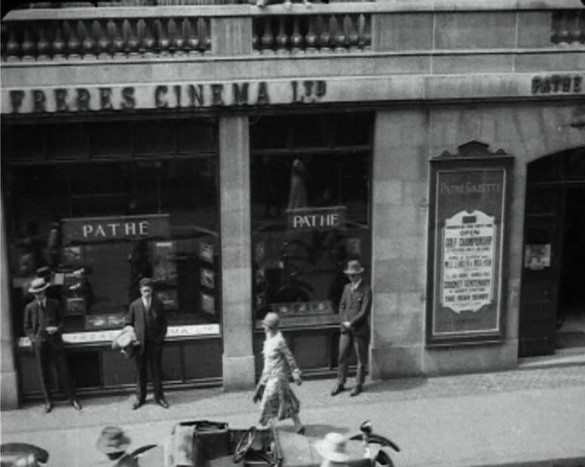
It was in this context that Charles, Emile, Théophile and Jacques Pathé founded Société Pathé Frères in France in 1896 and began film production. The glimpses of Victorian and Edwardian life they captured are as fascinating today as they were when they were shot – then because the technology involved was so new, and today because the footage is so old. The Victorian era was the first to be documented in moving images, yet still with a rarity that makes viewing them an awe-inspiring experience.
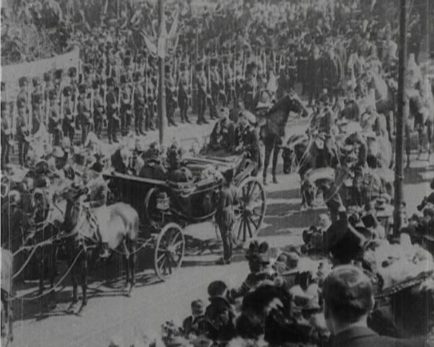
In 1897, Société Pathé Frères went public under the, rather lengthy, name Compagnie Générale des Etablissements Pathé Frères Phonographes & Cinématographes (or CGPC). Doubt remains about some of the clips in the archive from the early CGPC era in terms of their locations and dates. Records were either not made at the time or have been lost. The material which can be identified with at least some confidence is often of great historical interest. There is the funeral of William Gladstone, footage of the Boer War, and the coronation procession of Edward VII. The archive also contains film of Queen Victoria at a garden party, her Diamond Jubilee, and her funeral. Material from the Edwardian period includes the 1906 San Francisco Earthquake and the 1908 London Olympics.
Queen Victoria in Dublin.
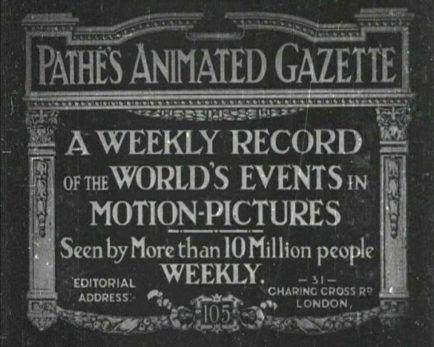
CGPC continued filming for many years, distributing films and expanding its theatre empire across much of the Western World. It was not, in fact, until 1908 that the company invented the newsreel. The first was Pathé-Faits Divers in France, though it was renamed Pathé Journal in 1909. The following year, CGPC launched an American newsreel arm to produce Pathé News, as well as opening a newsreel production office on Wardour Street in London. The first UK newsreel was thus produced, under the Pathé’s Animated Gazette brand, in February 1910. The French, British, and American newsreel arms would often share footage with their colleagues overseas. For this, British Pathé can be thankful, for it placed pre-1910 material in the hands of the UK newsreel staff, who often made good use of it by producing retrospectives.
True Beginnings: 1910 to 1933
Many of the early newsreels are sadly missing. One of the earliest still within the archive is believed to be the departure of the Terra Nova, Captain Scott’s famous ship that took him to the Antarctic. It was a section of the 87th newsreel package, released in cinemas in December of 1910, and was one of eight stories that included flooding in Worcester and a railway crash in Willesden. Other early footage of note includes the coronation of George V and the death of suffragette Emily Davison.
The Pathé Building on Wardour Street, London.
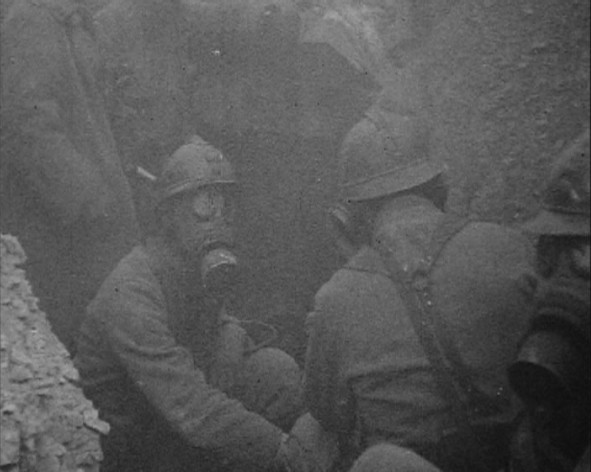
The archive also contains an extensive collection of World War One material, much of which remains unidentified, with dates and locations often unclear. Cataloguing is not helped by a lack of clarity over which events have been captured as they occurred and which are staged. Regardless, the material remains incredible to view. Though silent, grainy, and black-and-white, the footage is often awesome and sometimes harrowing. The faces of the daring recruits, huddled in their trenches, many about to die, are preserved for posterity. It is a shame that we cannot put a name to them.
Footage from the Western Front … probably.
In this case the faces of the soldiers are chillingly hidden by gas masks.
From 1918, CGPC began to be run as two separate divisions, with Pathé-Cinema (films and newsreels) under the control of Charles Pathé, and Pathé Records (music) overseen by brother Emile Pathé. This was the first step towards the eventual splintering of the company that can cause endless headaches for anyone attempting to trace the history of the Pathé brand:
– The USA Pathé-Cinema arm (including Pathé News) was sold in 1921. It was run by Pathé Exchange and then RKO Radio Pictures, which shut down the film production arm. Warner Brothers purchased the newsreel arm in 1947 before selling it to Studio Films. Pathé News disappeared from cinemas in the 1950s. Its archive is now owned by the Sherman Grinberg Film Library.
– In 1927, CGPC also sold the UK arm of Pathé-Cinema, which included both the film production office and the newsreel office, to First National, forming First National-Pathé.
– In 1928 CGPC sold the French and UK arms of Pathé Records to the British Columbia Graphophone Company. The USA arm of Pathé Records was sold the following year to the American Record Corporation. Its assets now lie with Sony.
– The remaining assets of CGPC (such as the French film production arm, the international cinema chain, and the French Pathé Journal newsreels) were taken over by Bernard Natan to form Pathé-Natan. It changed hands a few times after that before becoming the present-day film company “Pathé”. Pathé Journal continued until 1981. Its newsreel archive now lies with Gaumont-Pathé.
This was the complicated process by which the UK newsreel company became divorced from its overseas parent and sister companies, never to be reunited. Pathé-branded newsreel and film production in the UK was now on its own.
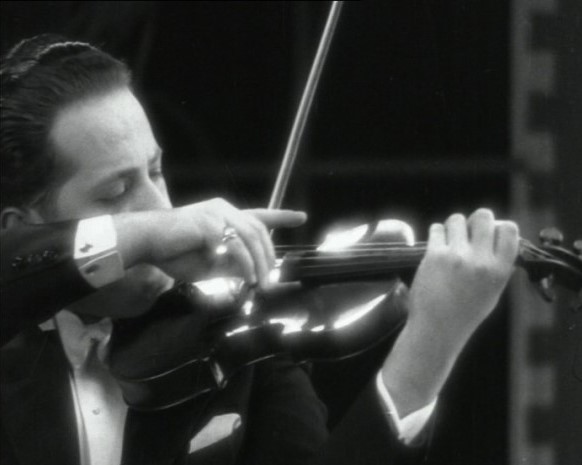
Audiences could watch – and, thanks to the introduction of sound, hear – Albert Sandler playing “Hungarian Dance” by Brahms in this 1930 edition of Pathetone Weekly.
As First National-Pathé, newsreels were released under the name of Pathé Gazette and an internationally-distributed newsreel was produced from Wardour Street – Pathetone Weekly. But the great innovation of this period was, of course, the introduction of sound in 1930. This brought a new immediacy and reality to the footage, despite the limitations of early technology.
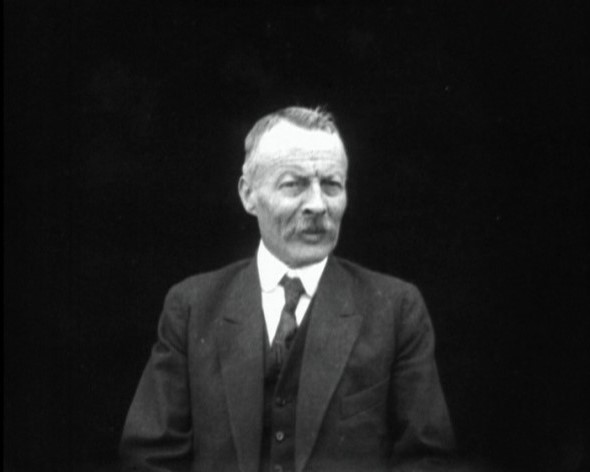
Sound also allowed newsreels to start including interviews, and one early interviewee was the Editor of the Pathé Gazette himself, upon the occasion of the UK newsreel’s twenty-first anniversary. In the clip, the Editor takes the opportunity to look back on what his company has achieved so far and on the recent history that has been captured by the Pathé cameramen. We may not be able to witness the Norman Conquest or the Great Fire of London, the Editor says, but we can relive history which has been preserved through the magic of newsreels: “One of cinema’s greatest privileges is to be able to bring back the past.” The company had proven its worth.
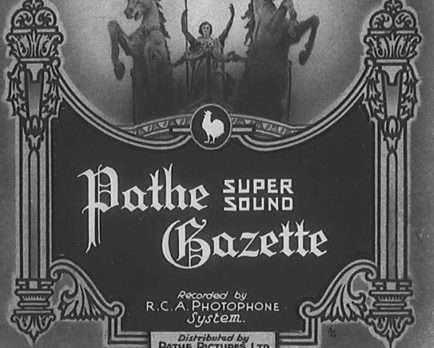
A title card from a Pathé Super Sound Gazette.
But in 1931, Warner Brothers purchased First National and formed Warner Brothers-First National and the future of the Pathé brand looked uncertain. That is, until 1933, when the golden age of British Pathé really began.
A Golden Age: 1933 to 1958
In 1933, British International Pictures purchased the Pathé newsreel and feature film brand from Warner Brothers-First National. Associated British-Pathé was born, under the umbrella of the Associated British Picture Corporation, and soon the Pathé brand was enjoying something of a golden age in the United Kingdom.
In the 1930s, the newsreel staff became increasingly ambitious, providing audiences not only with quantity (one only needs to see News In a Nutshell to know that audiences were enjoying this regular dose of news enough to warrant 340 episodes of it), but also with variety. Would You Believe It?, for instance, is a little-known gem assorting footage of various unusual things from around the world, such as oddly-named streets, strange animals, and bizarre technological breakthroughs. At the same time, Feminine Pictorialities continued the company’s trend of providing for all audiences that had begun with Eve’s Film Review in the 1920s. This “special selection for the ladies” covered bathing and hat fashions, hairstyles, and women’s sport.
Following the war, despite having been completely separate companies for two decades, the newsreel companies Associated British-Pathé (UK), Pathé Journal (France), and Pathé News Inc (USA) began a unique partnership. In a move celebrated by President Truman, these organisations began sharing footage and cameramen in order to enable news to be more easily distributed worldwide. Pathé Gazette also rebranded itself – from 1946 until 1970, it would be known simply as Pathé News. One of the major stories from this period was the Korean War, that sometimes criminally-forgotten conflict that claimed an estimated 2.5 million lives.
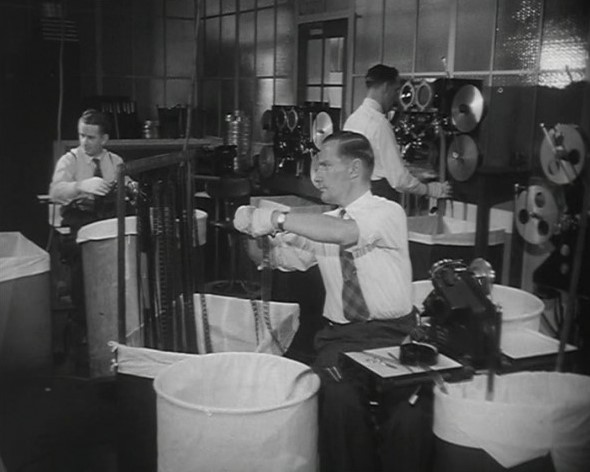
Newsreel staff at work in 1953.
Associated British-Pathé was also busy producing feature films and commercials, and even expanding into the television market. One such production was Film Fanfare, a charming 1950s film magazine show that presented viewers with footage from recent glamorous premieres as well as featuring in-studio interviews, quizzes, and reviews of what are now classic motion pictures. However, the most impressive example of the television work done was the company’s involvement in Peter Baylis’s Time To Remember. This epic series touched on all aspects of life in the first half of the Twentieth Century, using the original newsreel footage, and was narrated by celebrated actors, including Sir Michael Redgrave and Sir Ralph Richardson. Its charm was such that in 2010, the BBC re-edited and re-broadcast the series for a modern-day audience, retaining much of the original commentary.
But television posed more of a threat than an opportunity for the company, especially for the newsreel staff. They could release the Queen’s coronationin glorious colour, and even film it in 3D(!), but it was not a live broadcast like that of the BBC coverage. Viewers were increasingly not willing to wait. The newsreel format was also beginning to look tired, with outdated patriotism at odds with the postcolonial attitudes of the British public (particularly during the Suez Crisis). By the end of the 1950s, Pathé News was already struggling to compete. The 1960s would witness a shift in the nature of the company’s output as it tried to survive.
Decline and Transformation: 1958 to 2008
In 1958, Warner Brothers merged with Associated British Picture Corporation (parent company of Pathé-branded newsreel and feature film producers, Associated British-Pathé) to form Warner-Pathé. It was around this time that colour was introduced into regular news production (it had hitherto been saved for special documentaries such as Elizabeth Is Queen). But the company needed more than colour in order appeal to consumers who were increasingly getting their hard news from live television. Other newsreel brands went out of business, and the company needed to adapt if it was going to survive. The answer it found was to focus on the quirks of humanity.
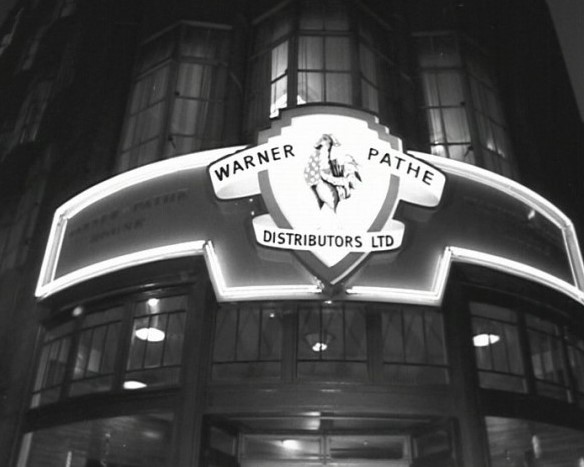
Warner-Pathé offices on Wardour Street, 1963. Warner-Pathé was a jointly-owned subsidiary of the Associated British Picture Corporation and Warner Brothers.
“Cinemagazines” were not an invention of the 1960s. They actually date right back to 1913 and the Kinemacolor Fashion Gazette, though it was Pathé-Cinema which perfected the form with 1918’s Pathé Pictorial. But the 1960s were the cinemagazine’s heyday. Colourful, quirky, and fun, they were also light on information and hard news. In some ways, this footage is more valuable today than when it was filmed. At the time, mere light entertainment, it now serves as a window into the leisure activities of the British people in the 1960s. Indeed, the collection was used extensively in the 2012 BBC Four series British Passions on Film.
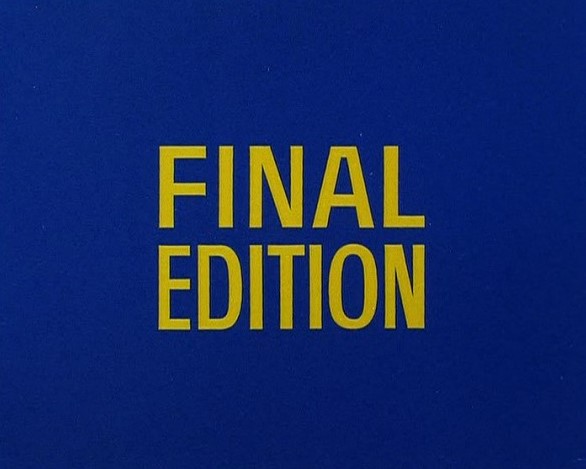
The opening of the final edition of Pathé News in February 1970.
Regardless of the merit of the output, the company simply could not compete with the rise of television. Its parent, Associated British Picture Corporation, was itself producing quality TV and owned a majority share in Thames Television, founded in 1968. The next year, the final Pathé Pictorial cinemagazine was released, shortly followed by the last edition of Pathé News. This was when Associated British-Pathé went through a radical transformation, from an active production house, into a film archive.
As the staff on Wardour Street were wrapping up their long history of news and feature film production, they were purchased by EMI (which later became Thorn EMI). The cameras in Wardour Street may have stopped rolling, but an archive of historic importance remained. The value of its content was immediately clear and television programmes, such as ITV’s Clapperboard, featured visits to the archive. The collection was now available to be mined by future generations of filmmakers and documentarians, and licensing became the chief occupation of the archive staff.
The Archive under EMI ownership.
After a long period without much change, a significant development took place in the later 1980s. Thorn EMI was purchased by The Cannon Group in 1986, which sold the Associated British-Pathé newsreel archive the following year. Cannon did not, however, sell the assets of the feature film arm of Associated British-Pathé. Thus, for the first time, the Pathé-branded UK feature film and newsreel arms were separated, as they remain today. (The feature film assets now lie with StudioCanal.) By 1990, the archive was operating as British Pathé News. It was at this time that the company produced the series A Day That Shook the World and Twentieth Century Hall of Fame, as well as Year to Remember, which is still popular on DVD today. Co-productions with such respected partners as the BBC enabled staff to work with material filmed after Pathé News closed its doors.
1995 marks an important year in the recent history of the archive. Firstly, British Pathé News was purchased by the Daily Mail and General Trust. Secondly, the name was shortened to British Pathé (plc, later Ltd). From 2003 to 2009 the archive was represented by ITN Source and became a respected resource for filmmakers, museums and educators. During this time, the entire archive was digitised in an effort funded partly by the National Lottery. This has allowed the British Pathé collection to be placed online for everyone to explore.
The Independent Archive: 2008 to the present day
Upon its split from the Daily Mail in 2008, British Pathé Ltd became, in essence, an independent archive (as opposed to a part of a larger corporation) for the first time in its history. This new era saw the introduction of a museum subscription service, an increase in licensing and programming (notably including The Story of British Pathé, a four-part BBC Four series), and an expansion in the company’s online presence (the entire archive is available to view online for free on both the British Pathé website and YouTube channel. It is complemented by presence on numerous social media channels). In 2012, the archive was awarded “Footage Library of the Year” at the Focal International Awards – and again in 2017.
For the foreseeable future, British Pathé looks set to remain a remembered and respected brand within the British cultural consciousness.
As of 2018, British Pathé also represents the Reuters historical collection, which includes more than 136,000 items from Reuters-owned news agencies Gaumont Graphic (1910-1932), Empire News Bulletin (1926-1930), British Paramount (1931-1957), and Gaumont British (1934-1959), as well as Visnews content from 1957 to the end of 1984.
While I was in Melbourne, the filming of the feature movie On the Beach was being shot. If you look carefully at the Elizabeth Street scene where Ava Gardener gets out of the tram and walks into the building, you make catch a glimpse of me. People were asked to come into the city for the crowd scene, and to be the backdrop of this bustling scene which was normally not that way on a Sunday morning. The scene couldn’t be done during the week so Sunday morning was the only time that produces could tie up part of the centre of Melbourne, we went in to be sticky beaks, but, became part of the scene. The movie On The Beach was all about nuclear warfare and what would happen to last people after a nuclear war had taken place. Nuclear warfare at the time was on everyone’s lips. Ban the Bomb was the catch cry. During 1958 television in Melbourne was now becoming part of everyone’s life, and in many ways advertising agencies were quickly coming to grips with the new medium. Our agency appointed a TV executive to look after our clients. He had his time cut out looking after it all, as most of the large clients were keen to advertise on the new medium. This was also due to the fact that a lot of advertising was done live to air, as at that time there was no video recording of commercials, and videoing of programs was only just about to start. In fact I was present at GTV9 when the first recording of Bert Newton new Teen-time show was recorded on a brand new Ampex video tape machine recently arrived from America. Most of the TV commercials were made on film by independent film companies and in many cases the cost was beyond all but the biggest budget clients. Many of our clients wanted live ads in programs because they had product to sell that constantly changed. One case in point was Tip Top Bread, they had bought a spot in Channel 9’s Women’s session in the afternoons, we had engaged singing and stage show artist Eve Hayes to do the Tip Top commercials. When the ad went to air someone from the agency had to be there, to take out the script, arrange for the bread on the set and approve rehearsal. After the commercial went to air the bread and other consumables was devoured by the studio crew. Our TV chief couldn’t keep this constant supervision up, and as this was one of my boss’s clients, he would mostly send me. Having no car, it was a tram ride to town, then on the tram to Richmond. Sometimes we would have two or three clients on Channel 9 in any one day which meant staying at 22 Bendigo Street, Richmond, till the evening to look after them, sometimes till late the In Melbourne Tonight show with TV commercial spots hosted by Hal Todd, Bert Newton and Graham Kennedy. We had quite a few clients with commercials on that and other programs. Eating occasionally in the Channel Nine cafeteria I got to know a few people, this helped me to find my way the industry, which was at that time only some three years old, so everyone including me were on a learning curve. It was very good experience, and started me thinking of a career in the industry. On one occasion at GTV9 I met Rex Heading, who was to become the new station manager Adelaide television. He was looking for a design for a logo the new to commence TV station in Adelaide, NWS 9. I produced a couple of sketches and then a layout, this showing the letters coming out of the face of a TV set, it look quite smart. I was pleased because it was adopted, and was used for some time when they first went to air. Also at GTV9 I met Albert Porges, he was publicity and public relations manager. Chris Whitehorn, who was now working as publicity photographer at Channel 9 and Albert and I all became friends together for many years. Even now because Albert and his wife Paula live in Como, we often catch up and phone and often talk to Chris in Adelaide or in his caravan somewhere in Australia. He has become a ham radio operator. In the early days for fun we concocted a call sign for ourselves; we called it DAD Channel 3. ‘Dad,’ was I bit of a craze at the time; everyone called each other ‘dad.’ And we use it to this day to introduce ourselves to each other on the phone. 1959 Strangely, our Agency had only a few clients telecasting on Melbourne’s Channel HSV 7, but I did get to know people there too. One was TV director Ian Jones; he was probably the greatest help in my learning the industry. Ian was related to the Crawford family, he directed the Late Show which was hosted at the time by a very young Bert Newton, and this was well before Bert went to work at GTV9. Ian would let me stay in the control room for the show at the assistant producer’s desk. I got to be a bit of the furniture around the place, it was an amazing learning experience. Unfortunately, Ian was killer in a horse riding accident, a sad loss to the TV industry and of course his family. Also to help with the learning experience I enrolled in the production techniques course at Melbourne Technical College. They had a small but full equipped studio, set up with proper studio cameras, video switchers and audio control room, as they were also teaching TV technicians. This were I met Lloyd Lawson who was also doing the same TV course; he perchance had already accepted a position as production manager back in Perth at the soon to be on air TVW7. He was like me, a Perth boy. He had worked in Melbourne radio and was currently announcing and station manager with radio station 3UZ. The technical school course was a good one; it allowed me to get my hands on real TV cameras. Both Lloyd and I progressed well, we even had some success at directing and vision switching. The course and the TV commercial producing at GTV9 and HSV7 was helping too. Lloyd knew I was from Perth and later suggested to me to call Jim Cruthers the new chief of the station for TVW7 Perth saying it might be worth trying for a job back home. Lloyd told me that Jim was currently in Melbourne, so I bucked up courage and from the phone box up the street from the boarding house on Toorak Road called his hotel, and was put through. I told Jim what I had been doing in Melbourne, he told me they were looking for people, and, if I was in Perth they would look favourably on WA born people who had at least some TV experience. This was some time in the last weeks of August. TV was expected to commence in WA later in the year. Well that was it, back home I would go and pretty quick too.
Settling up in Melbourne, I resigned from the agency, said goodbyes to friends, including Chris Whitehorn, and with my last £18, I bought a train ticket to cross the Nullarbor and back to Perth. So much for a working trip around Australia. Mum got a big surprise as I walked around the side of the house passed the old fig tree, and said hullo through the kitchen window at 65 The Esplanade South Perth. I had not been a terribly good correspondent, and telephoning in those days was too costly and out of the question, so she didn’t know I was coming home. I’m glad they had a bed and a bit of tucker for me, as I was stony broke.
Pretty quickly I got myself an interview, and, Lloyd had arrived back to take up his position, helped. I also saw where auditions were being held in a “get-up” studio in the photographers department at WA Newspapers in St Georges Terrace.
These auditions were being run by Beverly Gledhill and Coralee Condon. Bev was from the ABC in Sydney and Coralie was a writer and produce from Perth. Many Perth acts and performers showed there talents.
I volunteered to run a TV camera for them for a few days. This freed up the technician to be able to go back to installation work at Tuart Hill, because equipment was arriving daily, and the building was nearly finished. By September 16 I was on the staff, and told to report for work at of all places the Transmitter at Bickley!
TVW 7 Transmitter tower and TX building under construction
My job was to help with the installation, run test signals, and trade transmission telecasts from a Telecine chain which had been unpacked and set up there. This equipment was able to show films directly into the transmitter, because the microwave link from the studio had as not yet been established, there was no vision and sound transmission yet capable of coming from Tuart Hill, but that quickly came. Oh, I also unpacked and recorded the large stock of transmitter valves and all the spare parts.
I had borrowed some funds from Mum and bought a Vespa motor scooter to be able to get to work. It was quite a trip each day for the next two weeks, South Perth to Bickley and back. I hadn’t yet even seen Tuart Hill studio’s yet.
What a pleasant surprise I got when I bumped into George Baker, my old friend from school days, who was installing electrician at the site. He had been working virtually on every aspect of the construction and installation since the first rock had been blasted at the site at Bickley. So at least I knew someone amongst all the technicians and other workmen.
There were about ten technicians and engineers working on the installation, some of them when finished would be transferred to the studio. Leaving a permanent staff of seven to man the transmitter, while it is on air. Not so today, there is no-one there, not even a Caretaker, and the transmitter, which is now on air 24 hours a day, is monitored from the studio, or now 40 years later from Melbourne I suspect, but that’s another story.
TVW 7 Transmitter tower at Bickley
While I was there, quite some interesting happenings at the site took place. Although the transmitter aerial radiators themselves are bolted to the top of the over 400 foot high tower, there were many other things that had to be fixed to the tower; this included what was known as a passive reflector. This is grill looking large frame, which had the purpose of reflecting the microwave signal from Tuart Hill, carrying the television picture and sound, down to the main transmitter building below. It was like an electrical mirror, reflecting the microwave signals to the two receiving microwave dishes, aiming up at it. These were set in a room in the roof of the transmitter hall.
The technicians at the studio had turned the signals on at the Tuart Hill end, but no signal was being received. Technicians at the 150 foot level, where the passive reflector hung precariously off the side of the tower, were valiantly pushing it side to side, and up and down trying to get the right angle to no avail. Then someone had the bright idea of bolting the staff changing room mirror onto the face of the reflector, and with a man lying on his back on the roof of the micro wave room, looking at the mirror through a pair of binoculars, called the men up the tower to push the slotted rods back and forth and up and down, hoping the distant scene of Tuart Hill would come into his view. It didn’t work, and soon it became to dark to continue.
The following day success was achieved, but I wasn’t there to see it, signals were now able to be passed from the studio to air from Tuart Hill.
The two large TV transmitters sat in the main hall of the building like two sets of very tall grey coloured filing cabinets; except for the cooling fans at the top they made no noise. Every so often white coated technicians would walk along these two rows and note all the electrical measurement readings. It was all very clinical. Looking back through the control room windows one could see the pictures and hear the sound being broadcast. The transmitters put out some punch, each powered the signal to 10 kilowatts and the aerial multiplied the signal to an effective radiation of 100 kilowatts, that’s about the power of one thousand five hundred 75 watt light globes!
The time went quickly at Bickley, with the hustle and bustle of installation, trade transmissions to air morning, afternoon and some times early evening, and a lot of Perth people had already bought TV sets from electrical retailers ready for the start. Retailers reported that TV sets were walking out the door like hot cakes; the trade transmissions were helping sales. TV was on everyone’s minds. At the transmitter at Bickley emergency power supply units were installed, the caretaker’s house completed, and a myriad of small items taken care of, so that by the middle of the second week I was told to report to the studio. I did however get to climb the tower, but only to the 150 foot level, it had an outstanding view, even from that first level. But it was a fearful experience, climbing the caged iron ladder up the side of the tower, you were considered to be chicken if you didn’t do at least that part of the climb. I couldn’t understand how people overcame their fear of heights, some of the techs would climb right to the 500 odd feet level to make adjustments to the aerial or change the red aircraft anti-collision lights.
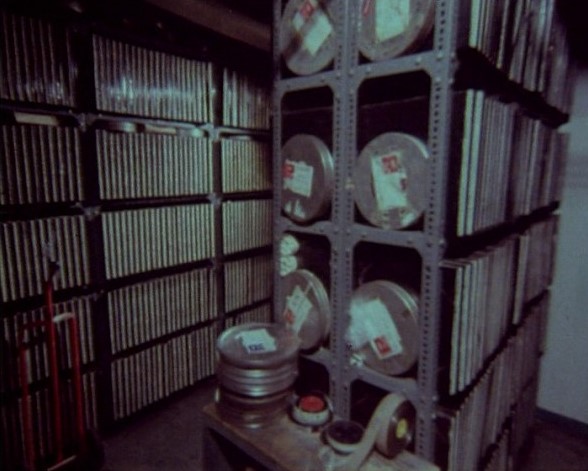
My first ride to the studio on the Vespa was from the transmitter. It was quite a journey for the little machine. Clearly if I was going to travel from South Perth to Tuart Hill daily things were going to have to change. There was no Narrows Bridge as yet, so one was obliged to go via the Causeway. The last little bit of road along Osborne Road was still dusty limestone to the studio, and a lot of the internal roadways around the studio were just getting finished, including the car park. My first look at the place showed one of organised ciaos. Everyone was rushing about getting their little bit ready. Crates were being unpacked, equipment installed, office desks delivered, stores including Cafeteria stoves and fridges. Program and sales people arriving from St Georges Terrace with there office files and then loads of film cans arrived and were stored to the film vault. New people started arriving every day, film people, cleaners, production, record library, news photographers, and journalists. Many of these people had been working in Perth, some for many months. The switchboard was commissioned, and the teleprinters installed. The builders and painters were barely finished before someone rushed into that room they had just vacated, with their equipment or office furniture. The car park was finally bituminised and then almost as a last thought, the becoming rougher by the day, limestone road to the studio was finished. One couldn’t have the Governor Sir Charles Gardiner and his party and other visitors arriving on something akin to bush track, and then what about the couple of hundred invited guests to the opening ceremony, all in there dinner suits and fine dresses.
Rolf Harris rehearsing for Opening night in studio 2 I’m on camera one Gordon McColl camera two, Steve Lumsdaine on the microphone boom.
Our three studio cameras were unpacked and already up and running, the tech’s had seen to that. Apart from me, one other cameraman had been appointed and one other a lighting man. They were both experienced chaps from Sydney at ATN 7.
Gordon McColl was head cameraman and Steve Lumsdaine was lighting, he could run cameras too. I was the trainee! Frank Evans, who was from the ABC Radio, had been appointed Floor Manager. Frank was a photographer too, so in a pinch he could run cameras. We all settled down to some pretty intense training, for all of us were new to this new type of TV camera. Because tech’s had to help run the cameras from camera control units behind the scene’s, a bit of arm twisting went on to drag them away from the last minute installation work to turn on the cameras for us.
They too were pretty green with the camera controls, but they were keen to rehearse. There were plenty of people to train with; everyone wanted to rehearse in this new medium. Newsreaders, children session hosts, the tonight show “Spotlight” cast too. Then there was the opening ceremony, I can’t remember how many times we rehearse that but I’m glad we did.
It was announced that TV would start on October 16. 1959. That was less then two weeks away. Two weeks to get ourselves into a team. The other best decision that was made in my opinion at the time was that, we would rehearse for one week prior, as if we were on air. That is, everyone would carry out their jobs as if we were actually on air. Opening, closings, the programs, the commercials, the news, the weather, the children’s session, the sport show on Saturday night, everything and in the sequence and the scheduled time. Even the studio clocks were reset.
It was the best thing that could have happened; we ironed out all the problems as they happened, so that on the night we would be perfect. Well, nearly so.
Studio 2 rehearsal Jeff Walker Channel 7 newsreader, me running camera one
This new job changed my life, I was no longer a nine to five person, and for one thing I now started work at 4 pm and finished at midnight, and worked on the weekends. I was to do this, on and off, for the next 8 years.
Opening Night Channel 7 October 16 1959. State Governor Sir Charles Gairdner declares television is now On the Air. Left to right: Sir Charles’s ADC, Chairman of TVW Ltd. Mr. C G Friend,
the Governor and General Manager Jim Cruthers (later Sir James)
Getting to and from Tuart Hill was quite a task for the Vespa. The trip via the Causeway then through to Mount Lawley, then up Flinders Street and along Cobham Ave to the station and back was quite a journey. The trip home at night was quite hazardous with just a little light on the front of the bike; the intensity of this head light very depended on the engine revs. And to make matters worse the bike was a brute to start and occasionally suffered from slipping clutch.
Clearly something had to be done. Many of the other staff either lived close to work or had good car. George Baker had an Austin A40, he had miles to travel back and forwards to Gosnells, a couple of the other chaps had Holden’s, and Colin Gorey had an FJ Holden. The Holden seems that would be the one to go for, my knowledge of cars at the time was a little bit light on. I started trying to work out the budget. Dad held by introducing me to Mr Tapping, manager at the at the R & I Bank Georges Terrace branch. I had been at the branch in my younger days when I worked at COR.
I had always been keen on sports cars ever since knowing Ken Hill. He had an open Lancia Lambda model at the time, and I had ridden many times in Jim Dyer’s dad’s 1933 Lagonda a big sports machine. I think Ken suggested talking to another old mate John Croft. Ken said he was going to quit his MG TC for more family type car. I call on John who said yes he would be willing to part with it for £500. At that stage a 12-year-old TC for £500 was a bit much, but after a test drive it was “MG’s forever.” Mr Tapping at the bank must have thought I was crazy, but he gave me the loan, and soon the car was mine! I parted company with the Vespa to my sister Sandy’s friend Topsy who like my sister wanted a scooter to get about. Sandy had Lambretta scooter.
The MG was tops, it needed a little bit of work internally with the trim but mechanically it was very sound. In fact I learned from John that five years earlier the chassis and engine had been the basis of John Walker’s TC supercharged special racing car that he had raced on the old Caversham circuit, and from couple of years in 1956 and 1957 held the State 1500cc Championship. In that form it had been known as the Byfield MG, a very smart bright red open wheeler body built of aluminium.
My first car MG TC No. 6497
There were 10,000 TC’s made between 1945 and 1949. Mine was number 6497, made between September 17 and 28 in 1948. After its racing exploits it was put back to standard and licensed for the road, and the supercharger was taken off, but it still had the racing wheels 15 inch size. It looked very sporting; TC’s at the time had 19 inch wheels, very spindly. The small wheels with the big tires are still on the car today, and the car is still in the family, my brother Bruce purchased it in 1962 when I was going to trade it in on a new MGA. But more of that later.
The MG solved the travel to and from work problem, of course the new, soon to be opened, Narrows Bridge would help too. Because work was mostly started from 4 p.m. and finished at midnight, I had quite a lot of time on my hands during the day and the TC had a lot of TLC, polishing and cleaning inside out. At one stage I even cleaned the body with Brasso.
I also used the MG in doing some volunteer work at lunchtime with the Meals on Wheels, two days a week. The deliveries were mostly around Victoria Park and South Perth. You should have seen the car, the passenger seat and behind the seat stacked up with canvas carrying bags which held the metal containers full of “tucker.” Later on with a few changes of shifts, the meals on wheels deliveries had to go. But I did meet a lot of nice old folk in the district. There was one old chap who lived in a small house down by the Causeway. He was always pleased to see one. His house was of the older type, very early construction with a small well kept garden. Inside the place was spotless too, everything, the wooden floor, the varnish skirting boards it was like new even though the place probably would had been made 72 to 100 years ago. The most impressive thing was in the very tidy small kitchen, it was an old- fashioned wood fire cooking stove. The whole thing was spotlessly clean, highly polished with an old-fashioned lead cleaner, it was magnificent to behold.
1960.
After the initial flush and excitement of TV starting, programs started to settle down to a steady pace. The children session Children’s Channel 7 was now live for days a week, Harry Butler now introduced talks on wild animals. Len McKenna did a great hobbies segment. Many other local programs were introduced. A new program called Viewpoint was introduced; a panel of interested people in various subjects and issues of the day was telecast. The TV writer for the West Australian Keith Flannigan reported that television production which much smoother now. During 1960 other hosts were added to the children’s program. One of them was Judy Lee a bright young girl with a lot of talent she helped out Rolf Harris. Another children’s programme segment was introduced called the Mickey Mouse Club it was hosted by Carolyn Noble, she was to become the children’s hostess in many TV programs for the next 10 years. On Wednesdays during the afternoon another program started. Televist was for women’s interests and hosted by Joan Wilson.
Hosts Joan Wilson and David Farr show Perth models latest fashions on TV Televisit.
She was helped out by another pretty young woman called Pam Leuba. Pam had super voice and went on to read the News and became the first lady newsreader in
Australia. Geoff Walker our main newsreader also made appearances on the program. Another program was telecast on Saturday afternoons at 5:25. It was called Teenbeat originally hosted by David Farr, a young chap called Ken Hiscock took over the program. It featured many local bands and singers, featuring songs from the hit parade. Occasionally big-name eastern states groups came to the studio to be part of the program which went to where live. And groups of young people came to jive and early rock ‘n’ roll in front of the cameras to the music.
On Saturday, October 15, 1960 the first year of television birthday was celebrated. A special program called house party went live to wear to celebrate well-known Melbourne singer Dorothy baker came over as a special guest for the show which was hosted by Jeff Walker. Melbourne musical director Max Bostock accompanied Dorothy, he conducted the small orchestra. The local entertainers or on the program including singers Lyn Sly and Jim Willis, the Rhythm Spinners were also featured. Max must have liked the place and decided to stay and went on to work at Channel 7 the many years. In all it had been an exciting, interesting year. The Postmaster General’s Department announced that there were 50,797 TV licences in WA. We must have had many people viewing.
In the world news late in the here on November 9, John Fitzgerald Kennedy won the US presidential election. We remember his famous saying. “It is not what the country could do to you, but what you can do to your country.” Three years later JFK is slain by assassin and Dallas Texas his name is Lea Harvey Oswald.
1961.
In April, 27-year-old Soviet cosmonaut Yuri Gagarin is the first orbit the earth in his for a half ton Russian-made spacecraft. He was followed by the 26-year-old first woman cosmonaut in the space on June 16 1963; she was Valentia Tereshkova of the Soviet Union.
Me. 26 years old.
1962.
Me having my say from behind a studio camera
Program coordinator. Commonwealth Games Perry Lakes Stadium.
Colonel John Glenn on February the 20th makes the first orbital flight in space when he encircles the earth in the spaceship called Friendship seven. The Lord Mayor of Perth Howard called for all citizens to put on their lights so that Glenn could see Perth from space after he had crossed the Indian Ocean. John Glenn acknowledged the lights and thanks the people of Perth. We should also note the unfortunate death of famous film star Marilyn Monroe who dies in this year in San Francisco in the USA. On April 12 the first passenger train from Sydney using the new uniform gauge line arrives in Melbourne. The new golden blue locomotive pulls the passenger train and the service is called the Southern Aurora. At Newport Rhode Island on September 26, the Australian challenger, built by Sir Frank Packer, called Gretel after his wife, loses the series for the America’s Cup to the American yacht Weatherly four to one.
1963.
During the year at TVW I had become very keen on a pretty girl who worked in Managing Directors office. Ronda and I had been out to parties, the drive-in movies and other functions and had much enjoyed each others company. We only had a short engagement and decided to marry, there was no reason to prolong matters the date was set. I asked her mum Great Nan, and she had agreed.
Ronda and I were married on January 31 1963 this year at the registry office in Perth.
Ronda and I back from the registry office in the back yard at south Perth
We found a small flat in Ruby Street North Perth and set up house there.
New MGA, New House, Ruby Street North our first home
1964.
At Channel 7 on March 5 1964, the new look Children’s Channel 7 television programme was hosted by Carolyn Noble and Jim Atkinson, Jan Bedford and Gary Carvolth also took part in a segment they called Starship Seven. Jan Bedford was an Olympic gymnast. On Saturdays and Gary Carvolth now hosted Club7Teen
Left to right: Senior cameraman Gordon McColl, Program Director John Brown and Me acting the goat during a break in rehearsal.
March 23 1964 the night time variety programme Tonight on Seven was hosted by Eric Walters with a special made from Bullen Brothers circus acts. Bob Dyers Pick a Box telecast at seven o’clock was a popular program; on this night’s programme a WA woman wins £5000.
The West Australian newspaper announced on Tuesday March 24 1964 that agreement had been reached between the two TV stations and the W A. Football league, that extra TV coverage of the football had been arranged. Channel 7 would show half an hour or football on Saturday nights which was a substantial increase on last season’s. TVW7 and ABW2 announced yesterday that they had decided to accept the terms of the offer. Channel 7 would show videotape recordings of the last quarter of a selected match at 1030 on Saturday night, and this would be repeated in the world sport program on Sundays commencing in April 11.
On July 17 1964 on Lake Eyre in South Australia, Donald Campbell, British world land speed record holder, established a new world land speed record of 403 mph. In the coming December Campbell expects to lift the present world water land speed record to 260 miles an hour in his Bluebird hydroplane.
1965.
Ronda and my first son was born at St. John of God Hospital, Wembley in April 16 1965. In those days St Johns was run strictly by the Nun’s, they considered the men were not necessary at the berthing, so I was sent home to wait. Ronda had quite a quick birth and I was hardly home when old Doctor Gollow called on the phone to say it was a boy. We called him Westly Richard.
The new little chap Westly
He was a dear little bloke and Ronda was a devoted mother and because I worked quite a evening life he quickly fitted in with the night time routine. We still kept up our social life with parties at the flat and West fitted in with all the party goers.
My script assistant Jean Hunsley, Me standing in front of the vision mixer unit looking into the studio and the studio camera picture monitors, with my technical director Ross McDonald
Here is an indication of what it feels like just before going to direct a television programme which is going live to air a live TV production of a night time musical and chat program of an hour in half’s duration. It was called In Perth Tonight. I was television director for the 1965 season. Sitting next to me on my right, is my script assistant, and on my left is the studio supervising technician and then a camera control unit operator, alongside him is the lighting director and his assistant. All looking at their TV screens in front of them, all are making last minute adjustments, to the lighting levels, and to the brightness and contrasts of the camera pictures.
The little talkback speaker at the back of the switcher, announces to you.
“60 seconds to you in the studio one.” “Thank you” I respond, pressing the Master Control talkback button, on the right of video switching panel.
I glance up looking through to the studio, through the double glazed control room windows. The glow of the studio lights attached to be lighting grid is showing, below that are the hundreds of lamps, all pointing in different directions, at the various sets and settings, artists and production people and presenters below them in the studio proper. Added to that is the large studio audience.
My script assistant, using her talkback, announces calmly to all the studio crew, including our floor manager, who are all listening on earphones. “Stand by studio, one minute, stand by for the opening cue’s.”
I glance down at my script, the words all look a bit of a blur, you wonder briefly what you left out, anything missed, it’s too late to correct any anything now. You look back up to at that the bank of monitors in front of you. Each shows the pictures that you had called for, according to the script, the first of the shots that you have rehearsed with the cameras and cameramen. They are ready too. They too feel nervous, somehow you can sense their feelings, you can sense the feelings of just about everyone in the studio.
They too feel nervous, somehow you can sense their feelings, you can sense the feelings of just about everyone in the studio, especially the talent, who are about to appear to the thousands of viewers sitting patiently in their homes waiting for their favourite hosts and artists to appear, ready to enjoy the next hour and a half.
My script assistant calmly reads out the next sequence of events which will commence the program. “Shot one camera two, wide shot of the curtain area.” She is saying. She has been working on the script all-day, and has sat through all rehearsals, making notes and corrections to the script and into the music cues. The little talkback speaker announces. “30 seconds to you studio.” The full studio audience is quiet now; they had just been entertained and coached by the warm up announcer. They have been seated in the studio for about 30 minutes, they have practiced laughing, and they have practiced clapping. They know now when to do this because, hanging from the lighting grid is a large illuminated sign, when on cue from me all my script assistant, flashes the word “applause” from your cue.
The program host, who has come quietly into the studio, is now standing behind the curtains, ready to come through on cue. He has been in the makeup room and his own dressing-room getting ready since the last rehearsals about 40 minutes ago. BroomeThe orchestra of eight to ten musicians is sitting quietly looking at the music stands holding their instruments at the ready; they have just come into the studio after a short break in the prop area. Their conductor is now standing poised, holding his batten, looking towards the floor manager for his music cue. He and his musicians are ready to play the opening theme. I guess the conductor and his musicians have that excited nervous feeling too.
Over to my own right, through a glass separation window is my audio operator. The panel in front of him contains all the faders controlling the many microphones in the studio.
He has microphones on the band, the host set, and on the end of the microphone boom, which is poised aloft over the position where the host will make his opening remarks. My soundman has been through all rehearsals and sound checks with us. I guess he’s a little nervous too.
The talkback from Master Control squawks. “Ten seconds…nine…eight…seven.”
The floor manager is now standing out of camera range just behind the silver threaded curtains across from the bandstand area. He is saying quietly to the conductor “six…five…four…three” then holds his finger up, and on zero drops it and points directly at him. The conductor, who has had his batten raised, drops it now in rhythm to the opening theme music of the program, and the small orchestra plays away.
My opening vision, wide shot of the curtain area, has been switched to air and can now be seen on the studio’s off air monitor, as I bring up the vision fader on the opening title graphic showing the words.
In Perth Tonight. And I superimpose it over the camera two’s vision using the vision mixing switcher. The opening theme starts and I now cue the studio announcer. He is tucked away in announcing booth, behind the audio operator. My soundman reduces the sound slightly of the studio orchestra. Jim Atkinson opens his microphone and announces with gusto.
“In Perth Tonight…your popular Friday night variety show … and here is your host for this evening… Gary Meadow’s.”
I have changed the vision is switcher to superimpose the next graphic card showing the hosts name, and as he steps through the curtain I slowly fade the graphic card away, and my script assistant presses the button flashing the applause sign hung over the audience.
The last notes of the orchestra’s opening theme finished with a flourish. The audience microphones are open now, so their applause his heard to the viewers at home. The boom microphone lowers a little to catch Gary’s the first words.
“Thank you…thank you… and good evening… On tonight’s program…”
We are underway; a lot of nervousness has slipped away as we now concentrate for the next hour or so, but the excitement is still there. It is quite nerve wracking going live to air.
The In Perth Tonight program ran on Friday evenings for many years. It had a number of different hosts and many guests, from locally in Perth and from the eastern states and overseas.
1966.
Our second son Jeremy James was born on November 29 1966.
The Family: Me, Westly, Dad holding Jeremy and Ronda in the backyard at South Perth
The census was taken this year and the population of Australia increased 11.5 million and they were just over 80,000 for blood aboriginals.
On January the 20th after 16 years of Prime Minister Sir Robert Menzies retires and hands over to his successor Harold Holt. Later in the month Adelaide police now mount huge search for three small children who disappeared yesterday from the Glenelg.
This year sees the Australian racing driver Jack Brabham take the world drivers title. Prime Minister Harold Holt who had supported the war in Vietnam’s pledges to United States Government that we would go “All the way with LBJ”. President Lyndon Baines Johnson received a rousing reception when he visited here in October of 1966 but many Australians were not happy with the visit and in Melbourne paint is thrown over his car despite the fact that 750,000 people turned out to meet him.
1967.
The cult flower power starts in San Francisco. Colour television starts in England with the BBC on the first of July broadcasting the Wimbledon tennis in colour. England and Europe have adopted the 625 line PAL system of television broadcasting which is considered superior to the 405 line NTSC system of America. It will be eight years before colour TV comes to Australia. It’s this year that I was appointed senior producer director at Channel 7 televising sport and variety shows and directing parts of the first Telethon charity program, to raise money for a foundation for research into children’s medical problems and care. This year saw the arrival of a system for editing videotape. Previously if a mistake was made during the videotaping of an actual item it would have to be started again. Videotape editing would change the way many programs and commercials would be put together. John Dee and I produced to short demonstrations which were shown to clients…. Bill Gill on piano… the new valiant car commercial…
Speedway telecasts, . .. Moving to Dianella.
1968.
Now with many Australians fighting in Vietnam’s we see the massive Tet offensive taking place between the north and the south. And we mark with sadness, the murder of black American activist Martin Luther King.
Because a big shareholder in TVW 7 was the Catholic Church, and as part of our reason for holding a TV licence we were to telecast certain portion of program material which had to be of a religious nature.
On one occasion we mounted an Outside Broadcast of the Catholic Easter Service. The OB truck which was built up by the technicians at TVW was used. We took over the Alter and other parts of St Mary’s Cathedral with the usual scaffolds, lights and cameras, with the OB van parked as usual out in the street.
Producing the OB was Coralie Condon who was of the faith, and me directing who was not, toghter we ran the telecast. Between us both we had the ceremony all worked out, and the service and telecast got under way.
The Austin OB truck was not very big so we had audio operator, Coralie and me at the Video switcher on the upper level, and the camera control units in front us but lower down. Half way through the service at one stage I called “ready camera two wide shot please”… then “Take camera two, on you two” and I punched the Cam 2 button on the vision switcher, and the camera picture went to air. However as I took my finger off the lighted button, the end, which had a spring loaded return, flew off out over my right shoulder. “Hell” I think I said, or worse, forgetting we were closed to God. The Technical Director who was behind me dived to the floor and in the semi dark started to quickly search for the end of the button.
But the savoir was one of the CCU operators; he promptly stood up from in front reached over and stuck a pencil in the empty hole left on the VMU so that we could switch again, pushing the pencil.
1969.
The frantic efforts of the United States of America attempt and to catch the Russians up as far as space travel was concerned this sees Neil Armstrong Edwin Buzz Aldrin landing on the moon from their spacecraft Apollo 11. Neil’s famous words greeted listeners and viewers on television round the world saying, “Tranquillity base here, the Eagle has landed… One small step for Man and one giant step from Mankind.” Michael Collins was pilot of the Apollo 11 spacecraft circled the moon while they were on the moon surface at Tranquillity Base. He was ready to pick them up again and make the 238,000 mile triumphal journey back to earth to a huge welcome.
Apollo 11 landing on the moon. Tranquillity Base. One small step for mankind.
I was fortunate to be the television director in charge of the program leaving Channel 7 to go on air while the Apollo crew landed on the moon. Thinking later about the event I suppose that was one of the highlights of my years of work in the TV industry.
1971.
Kristy Gay Ashton
Our daughter Kristy Gay was born at Osborne Park Hospital on June 24, 1971.
I commenced flying lessons at Civil Flying School on December 11 1971. As far as all this flying about was concerned, it must have got into the system for two other friends at Channel 7 had just started too. Because it was so expensive in those days $18 per hour, it took till October 20 1976 for me to finally get my restricted license. When I finally let my license elapse, I had amassed a total of 103.88 hours of flying time in command, this was in August 1978. It was just too expensive and there were other family pressures on the finances. My other two Channel 7 flying friends, Norman O’Locklin and Tim Thunder eventually gave up too flying, probably about the same reason.
Civil Flying Services Charlie Tango Foxtrot Piper Cherokee PA 28 one of my aircraft.
Me and Neville Wynne TVW 7 workshop manager enjoy a flight together.
Flying 1500 foot circuits at Jandakot air field.
Still enjoying a flight in Tim Boase’s Channel 7 helicopter TVG
More flying fun later in when we flew up north with Pollack’s Flying Circus. And later in the Australian air race, with Don Pollack
We should note here for 1971 the enormous success of the stage musical Jesus Christ Superstar which, this year commenced its record-breaking season in New York. As far as television was concerned the enormously popular Doctor Kildaire and Sergeant Bilco, Mod Squad, The Naked City and the very popular long-running series Days of our Lives entertained us. Local production saw Stephanie Quinlin’s Today show telecast and the popular weatherman Jeff Newman commenced hosting the schools quiz program Its Academic. With the enormous popularity of cartoon characters such as Humphrey B. Bear we at Seven decided to create our own children’s character, to be called Fat Cat. Fat Cat remained a very popular children’s character personality even to this day, he was designed by Judith Byrne wife of Greg Byrne Channel 7’s sales manager. Several suits were made before we got the final one right. Inside the suit was Reg Whiteman who played the character for the next 20 years. Reg was a dancer, he with four others danced on the opening nights variety show called Spotlight on Channel 7 in October 16 1959.
The first time a Disney on Parade arena show that had been produced outside America was done by Channel 7 Perth. It was the brainchild of Brian Treasure. He had succeeded in convincing the Disney organization that we at Channel 7 could produce and mount, with their cooperation and expertise a Disney on Parade arena show which would tour Australia. Michael Edgley, the Bullen Brothers the Circus people and many other smaller investors joined in to finance the project too.
Naturally there were a lot of Americans involved, the head of each department designing, costuming, choreography, stage direction and presentation were all done by Americans. However many Australians, and many Western Australians would join the production in key roles.
Many Australian and local dancers and cast members would join the principal American cast for the show. Some of especially acts would come from America complete. For example Goofy’s comedy car and old ramshackle T Ford which, amongst other humorous antics, driverless, chaste Goofy around the stage.
Goofy’s Comedy Car on the Disney on Parade stage in the TVW big tent.
But most of the costumes were made and sewn by local seamstresses, under their direction of course. And a great number of props and parts of the sentence scenery were made here too. All the music was played and recorded in America, as were all the film introductions of the Disney stories that were used to start each of the separate parts of the program. The complete soundtracks were recorded in USA and assembled in a large purpose-built audio control room which was full of multi-track playback machines. This control room was virtually a giant sea container which could be quickly packed up for touring.
All the lighting was hired in Australia, but some of the grid work which hung inside the big tent was imported from USA, because mainly it contained flying cables for aerialist acts, and some special lighting and visual effects.
The whole Disney on Parade arena show was housed in a giant tent owned by the Bullen Brothers the Circus people, which I think seated, some 5000 people around a huge thrust stage.
Interior of the Disney on Parade tent erected over the Perry Lakes rugby oval
Later Channel 7 purchased an even bigger tent which had been used in South Africa. It was even bigger and could accommodate 10,000. This was used for the Peter Pan shows.
It was quite an achievement for us at Channel 7 too to pull off such a contract, and quite a feather in Brian Treasure’s hat for convincing Disney’s American producers to mount and stage the show for Australia in Perth. And quite a feather in the cap and showed the forward thinking of the Channel 7 Board for agreeing to join the project. I would think the Board and the other investors also had one eye on the bottom line. The other important feature was perhaps, the employment of large cast Western Australian dancers, actors and staging personnel, who would have employment for a least the next 12 months of the tour. We would all gain heaps of experience.
It was going to be a great show, and a great achievement. It would set the stage for other Disney programs, and for the Hannah Barbara organization to also mount arena shows, produced in Perth for Australia and Asian tours. Mickey and Minnie Mouse, Snow White, Cinderella, Alice in Wonderland and the story of Jungle book were all featured in the first Disney on Parade. And in later shows of Fred Flintstone and Barney Rubble from the Flintstones, Yogi Bear. They were at the peak of their popularity.
Because Brian Treasure was such a dominant and forceful character everyone was a bit fearful of him, especially when they were called to into his office. When called in on this occasion my first thought was, what have I done wrong this time, flashed through my mind?
As I entered his office he had the visitor with him, it was Mike Grilikies the American producer here to make a TV special of the Disney on Parade arena show for the American network. With a handshake we were introduced. BT as we called him, not to his face, continued saying. “We need a Unit Manager for the American TV special. …and that’s you!” He said. After a little more in the job description department, Brian handed me a bunch of cards.
They were applications to join the Theatrical Employees Union for all the staff that were about to transfer and work on the TV special. As he explained some of the people weren’t keen about joining the union but many more were insisting on it. So I was to keep it quiet, fill out forms for all our people and forward them on with a joining fee to the union office, quietly.
With the door closing behind me, I stood there for a second, probably with my mouth open, with Treasure’s secretary quizzically looking at me. Now back to my office I realize that I had suddenly much more to do. Much of the local live TV production had been much reduced because of our work with Disney. A lot of our TV props workshop was taken up with building scenery every available space seemed to have people working in. In fact we had hired a prop building workshop in Osborne Park were all the small props were being made. Many seamstresses were working in strength too with their sewing machines whirring madly in any available spots. Costuming dummies were everywhere, with the hundreds of costumes already sewn, covered with plastic awaiting fittings. The whole place was in a real buzz.
Now, on top of everything else we were doing, including the advanced unit doing shows at shopping centers, we were to now make a TV special! That meant more props more scenery, especially for the TV show. More staff were arriving from America connected with the TV program. A specialist TV group was also coming from TCN Channel 9 Sydney. They were to bring a specialist film recording unit to be used to film for the production. This later proved to be of no value, mainly because the light level on the thrust stage was too low, and extra lighting in the tent would impractable and too disruptive. The colour television system incorporating what was now very new to us, would be used. Colour television cameras were adapted and the TV show would be recorded using the American colour NTSC system. Dual recorded videotapes would also be recorded in both the American standard and the Australian 625 line PAL system, and an edited version of the program would be made for Australia.
The experiment on which the decision was to be made, whether to use film or videotape was in part due to my television camera work, of which I was quite proud. Because so many of our studio crews were being used in other areas and in the every day running of the TV station, I was about the only one left who could manage to operate the special colour TV camera, with its amazing low light level performance, and its special zoom lens. Only the one camera would be used for the test, I think from memory it was the only one in Australia at the time. More cameras would come later for the TV show recording.
Scene from Cinderella segment Disney on Parade American TV special
A platform was constructed just to the side of the thrust stage for me, I was glad that I had seen a number of performances and rehearsals of the show so that I had a pretty good idea of what it looked like and what had to be recorded. This helped me to anticipate the various entrances and exits of the acts. And the positioning on the stage of the various routines and dancers and the lighting effects that made the show such a wonderful success. My earphones were connected to the stage and lighting manager’s cues, and I also had the music and sounds in my earphones too.
Disney on Parade Cinderella segment of the show.
With the help of video recording technicians, I was able to record the complete program. And, even though it only showed one camera angle, I must say it was complete success, proving that the video recording would be far superior to the costly and more time consuming film unit system from Sydney.
The poor Sydney people from TCN were a bit crestfallen when they saw the result of my recording. But they agreed that videotape was best. I got quite a few pats on the back for that effort, it proved again to me, that one of the great loves of my life was, running a live television camera and that I was good at it.
Much of my role now as Unit Manager would be with the crews and stage people, although I didn’t have a very good idea of my complete task. But it sure kept Me on my toes.
Once quickly finishing my normal tasks at Tuart Hill, I would go down to our office that we had set up at Perry Lakes. It was here that I fixed up any the problems and I also spent much time liaising with the Americans and helping them solve their problems and requests, dealing with local people and suppliers.
The Disney producers had chosen Kurt Russell, a new rising star to host the TV special. The American producers had adapted parts of the arena show for the 55- minute TV special. The shows writers had adapted the script and written hosting parts for Russell. He was a pleasant young chap, I think only about 16 years old time. On a couple of occasions I sat with him in the sun outside the tent, occasionally chatting and helping him learning lines, while he waited for his call for next sediment of the TV special being recorded inside.
There were quite some interesting and funny episodes dealing with the American producer’s. One such incident showed the great difference in what they thought was the cost of things and the differences between Australian and American dollars. The American Director early one Sunday afternoon during the recording, wanted to change a camera angle to be high above the seating at the back of the stage. He wanted a scissor lift. I found the suppliers and came back to him saying, yes it’s available but it was, what I thought terribly expensive, seeing it was Sunday and on short notice.
He said. “How much?” I told him expecting he would reject the idea. Instead he just said. “Man, that’s free.” Meaning that was cheap, it was something like $100 an hour plus travel time. So we hired a unit and its operator for all of Sunday afternoon. He mostly sat near his machine but enjoyed seeing the shows recording too. At one stage the Director wanted a real low angle shot late during one evenings recording, much lower than a small tripod could handle, the lens was to be level with the ground surrounding the stage. We bought in a bobcat and without asking anyone’s permission, dug about a two meters square hole about 1.5 meters deep in the middle of the Perry Lakes Rugby field over which the show tent had been erected. Once the shot was taken we filled it in again and kept our mouths shut about the experience. I hope the shots were worth it. Whether they got into the show I can’t remember.
Nobody was very keen to have the Americans driving themselves around in Perth because they drove always started on the wrong side of the road, and got lost so that many of their crew were always driven. Many of the off duty Channel 7 staff and parts of the sales and other department staff gave up time and sometimes holidays to drive the fleet of cars, driving around the Americans, they all had fun doing it. They and their families all got tickets to see the show.
An interesting aside was that, when the American producer Mike Grilikies and his Director finished recording the TV program, they both flew back to the States on different aircraft and the second copies of the hundreds of videotapes were also separated into two lots, and sent back on different aircraft, it was said that if one aircraft went down they wouldn’t lose the show!
The Bullen Brothers tent crews, augmented with extra hands, were hired for the TV special as stagehands. Some of the shows stage settings had to be taken down for the TV program, and this invariably happened after the show, and after the patron’s had gone home. Late one Saturday night I was instructing the Bullen crew to set up the Cinderella scenery ready for the TV show recordings to be started early Sunday morning. The leading stagehand came to me and said the crew would not start the setup until they had been paid. That really “foxed” me and I found myself knocking on Stafford Bullen’s caravan door at about midnight. The Bullen Brothers, like most of their crew all lived in large caravans on the Perry Lakes site. The door opened, and I told Stafford what the crew had said. He sort of snorted and pushed past me, and quickly walked across to the tent, jumped up onto the stage were all the men had assembled. He bellowed instructions and words to the effect that they would be paid after the set had gone in and not before! After the tongue lashing the men look crestfallen, because it was not a good idea to challenge their boss, and they got quickly to work. There was something about circus people.
About an hour in half later, when all was finished and the setting was in place, Stafford appeared with the huge role of notes in his hand, and proceeded to peel of them are off one by one and give them to the men.
He turned to me and said, “If we’d pay ‘em before, we would have had problem, they’d have gone off and got drunk.” He turned and went back to his caravan and to bed, leaving me standing there with my mouth open. It was quite an experience working as Unit Manager on the TV program.
Not all experiences with the TV show recording were bad. There were many fond memories, and it was a great show, nothing like it had been seen for done in Australia before and yet we were doing it from Western Australia, here at Channel 7. The staging and dancing was colourful and spectacular, and of course the Disney tunes were memorable. The Dumbo Circus segments and the staging were well done. Snow White and the House of Cards dancing and costumes were very special. And the Cinderellasegment was great entertainment. The sequences with the humorous segment of Cinderella’s Ugly Stepsisters bought the house down. The whole show was a real winner.
Mickey Mouse arrivers in the Perry Lakes Stadium
I nearly forgot Mickey Mouse Birthday. It was decided to hold a giant birthday party in the main stadium of the Perry Lakes Stadium itself in which all the Disney characters arrived and had a party, including the of course you know who would cut a giant birthday cake and they would be much singing and dancing. The show was a great success, over 40,000 people turned up to celebrate and join in the fun. It was great publicity for the show too, because from the stadium you could look across to the rugby field and see the giant tent ready to stage the actual show, which incidentally was lit at night in spectacular fashion.
In my thoughts about the experience, it was sad that it was finished and the Americans had all gone home. But I was glad in another respect that MY workload was greatly reduced, and we got back to our core business television, and to our new special events department. It did however give me a greater insight into the expectation of what we would be involved in the future when Channel 7 took on the construction of the Perth Entertainment Centre on the old railway land along Wellington Street to be opened in 1975. That opened in spectacular fashion with the second Disney program featuring Peter Pan.
By that stage, Channel 7 had bought our own big tent, and Peter Pan arena show, later followed by the Flintstones show which all toured Australia and then Southeast It was very much great experience, leading up to the Bob Hope Down Under TV program from America, followed by The Miss Universe Quest project much later in 1979 for the 150th Anniversary Celebrations for the State of Western Australia. But we’ll get to those projects a little later on.
In 1972 Channel 7 had put together a department called Special Projects, later to be known as special events. As the title suggested the projects we would be involved in would be large promotions which would help to promote Channel 7 and show our community involvement, and hence encourage more viewers two only watch seven giving us a better rating. I was transferred to it. My partner in this new department was Ron Christie. Ron was a senior television producer who had transferred to Perth from our sister station very SAS10 Adelaide. As a producer in Adelaide at NWS9 he was producer for the very popular Ernie Sigley’s Adelaide Tonight show. He and I were to produce special projects and promotions for Channel 7 these included the introduction of the annual Christmas Pageant, Bath Tub Derby, and the very successful Bird Man Rally. This was an event in which people were invited to fly at least 50 metres in an un-powered aircraft.
One of the very successful Birdman Rally held at Two Rocks Marina Yanchep
Ron eventually transferred back to South Australian has production manager for SAS10, later to become Channel 7 Adelaide.
My new partner in crime was Vern Reid who transferred from the news department. Vern was later to be involved in Channel 7’s charity fund raiser Telethon, including the Telethon Trust, the group responsible for giving out funds for the various medical projects to better children’s lives. Telethon’s major contributor was to the Princess Margaret Children’s Hospital. Much later Vern resigned from television to become general manager for the new Fremantle Football Club called the Fremantle Dockers. I’m sure all his skills learnt in the special events department were put to good use to promote the “Dockers.”
We in special events department put together and produced many other things including the AFI Awards, a very large production at the Entertainment Centre. And introduced many characters including Sunny Sandgroper. By 1975 we produced many programs and promotions. One such program was the Introduction of Colour TV into Western Australia and we also produced the opening of the Perth Entertainment Centre Boxing Day 1974. We produced programmes like the Celebrity Challenge in conjunction with the production department. Our department gradually changed perspective by the late seventies joined the special unit away from the studio in a special factory unit set up for the purpose in the production of the American TV special Bob Hope Down Under, culminating in 1979 with 150th Anniversary of Western Australia. Our, that is Channel 7 contribution was the Miss Universe Pageant, with a live TV program being broadcast by satellite to America and many other countries around the world. We’ll catch up a lot more with this later as we go through the next 10 years.
1975.
AFI awards. Sunny Sandgroper intro. Intro to colour TV 1975.
My 10,000 helium filled balloons fly from the balcony at the 1974 opening ceremony of The Perth Entertainment.
Dancers from Perth’s dancing’s show their skills at the opening of the P E C.
The First Bath Tub Derby was held in 1967 in Canada. It was a fun event conducted from Nanaimo on the island of Vancouver Island 60 km (36 Miles) from Vancouver British Columba Canada. The novelty idea was to cross from the island in 8 hp outboard motored Bath Tubs. Each entrant had to accompanied by a support boat.
Louise Borsje general manager and special projects secretary took part in TV personality weatherman Jeff Newman’s Bath tub racer in the Ladies Race
The first Bath Tub Derby was held South Perth foreshore of Perth water. Note the TVW 7 outside broadcast van in the back of the crowd on the South Perth foreshore . From Memory we conducted three Bath Tub Derby’s in each case the winners prize was to represent WA in the Australia final conducted on Sydney harbour. I had the good fortune to travel across to Sydney with each of the winners to make sure that they were looked after. All entrants in the Sydney event had to be registered with the Maritime services board and to pass a test to say that they could start in the Sydney event. Also to arrange accommodation and make sure that their bath tub arrived in Sydney and that a rescue boat for each entrant was available to our Perth contestant.
All went well in each event but none of our Western Australian contestants managed to win the Sydney event the prize for winning was a trip to Canada for the world championships. One of ours winners was a young chap called Rowley Goonan, his bath tub was a very good one, and we practised for several days across the heads to Manly and back again with our support boat picking up quite a wash as you can see from the photograph. Rowley used the wash to literally surf down the waves, which was the way the Sydney entrance with doing it. He didn’t win but could have because the quality of the support boat skipper was not as good as others.
My picture taken from the stern of our support boat shows Rowley’s Bath Tub skilfully surfing down the waves on one of the legs coming back from Manly
The Channel 7 Christmas pageant was another event that we conducted through Perth streets. One year it was estimated that 300,000 attended and lined the streets to see the colourful floats, clowns, marching bands, and many bright costumed dancing girls from many of Perth’s leading dancing Academy’s. it was a very popular special event enjoyed by Perth children and adults
My not so well fitting Official cap as Chief Marshall for the parade.
My design of Father Christmas Float is still in use to this day.
The five reindeer and Father Christmas sections are separate hinged trailers. The reindeers were made by MG Car Club’s Patron John Goff. This float for the first time had stereo sound from speakers under each float section. It was a sheer delight this year Father Christmas was played by Fat Cat.
Gulliver’s Travels float
The idea was that Gulliver was captured by the Lilliputians and was held down
with ropes on either side.
Noel Dixon for the workshop built and carved the body and head of Gulliver.
He scaled measured from me lying along his carpenter’s bench.
TVW 7 Stores Manager Ross Mathews as one of the Parade Marshalls guides a small dancing group in the parade Many of TVW senior staff always helped out
I convinced the Disney people in Sydney to let us have the Snow White costumes including the Seven Dwarf to come to Perth for the Christmas Pagent
One of my float designs Mississippi Steamer
TV Personality Tell Bull plays the Crooked Man
Channel seven senior floor manager and producer John Easton always played Father Christmas
Tent touring shows for Disney, Flintstones on Parade, Peter Pan.
Australian Air Race. October 20 1976
1976.
Me playing Fat Cat with Don Pollock and Peter Condon
1977.
Elvis Presley the King of Rock ‘n’ Roll died this year aged 42. It was a sad loss for the many millions of fans he had around the world. But another star was rising on the music scene his name was John Travolta. He became famous for two musical hits Greece and Saturday night Fever in which he co-starred with Australian-born Olivia Newton-John. 1977 was famous for three other things Queen Elizabeth the seconds Jubilee celebrations in England. George Lucas premiered his famous movie Star Wars, and Stephen Spielberg produced one of his best movies, Close Encounters of the Third Kind.
1978.
Max Bostock my boss is appointed TVW Channel 7 Chief Executive Officer and Bill Mckenzie is made Group General Manager of both TVW and SAS 10 Adelailde.
Bob Hope is encouraged the made a TV Special in Western Australia. The show wasl called Bob Down Under, and of course we are all involved.
Any overseas visiting star could easily make the eastern seaboard for a big entertainment show, but to get over to Perth and Western Australia for major overseas artists and star like Bob Hope was a real achievement. For me as one of the team of TVW people to make it happen was quite a highlight. As usual I seem to be the coordinator of transport to the American crew that arrived to do the show, plus a few other tasks with locations, props etc.
For me as one of the team of TVW people to make it happen was quite a highlight. As usual I seem to be the coordinator of transport to the American crew that arrived to do the show, plus a few other tasks with locations, props etc. We didn’t let American visitor drive themselves, they had a tendency to get lost and drive on the wrong side of the road.
Although a substantial part of the staging and construction was done at TVW workshop with local people…crews, cameras, sound, direction and production were also our local people from TVW and Perth Entertainment Centre, supplementing the small group of American producers, writers and staff.
A number of local video items were planned to be put into the show to give local flavour, showing parts of Perth and WA that would be of interest overseas. Bob Hope had bought with him a number of other stars and entertainers who would take part in the show. Florence Henderson, Barbara Eden and the comedienne Charo were stars in their own right and very much an attraction themselves.
Babara Eden and Charo joking with Bob Hope
Perhaps the highlight of me was the custom sketch in which the vivacious Charo played an Australian Customs officer, and with Bob dressed in an outrageous outback short pants safari suit, the sketch brought the house down in a hilarious uproar. One of the highlights for us were the preliminaries to the daily briefing held in Marion Leyer’s Suite on the third floor at about half past eight each morning.
Gradually people would wander in after breakfast if you were living in. This meeting included many of the American folk, three of them were Bob’s writers, they would group chairs around the central coffee table in the suite, and then they would start their jokes. More of us would gradually come in, so that by a couple of minutes all that were there were all in tears laughing. Joke after joke flowed round the table it was fantastic, laughing tears roll down until eventually someone called the meeting to order and we got the day under way.
Barbara Eden and Charo joking with Bob Hope
It is interesting that one of the writer for Bob was David Letterman. Apart from the show itself, which was videotape recorded at the Perth Entertainment Centre, a few local segments were videotaped on location to be inserted into the show.
One of these was a boating segment recorded at Crawley Bay in which a very humorous boating skit was made. A recording segment was also made at the Royal Perth Yacht Club were Bob and a bevy of good-looking Perth girls joined him for a river trip.
Florence Henderson and Bob Hope on the Swan River
The trick at the Parmelia was to know when Bob was on the morning move, we would get a telephone signal, drivers and others were up and racing to the lifts in an attempt to beat Bob from getting to the foyer first. I think he did it as a joke on us. Occasionally he won.
Just then Bob Hope dresser ran up from the dressing rooms backstage, he was in quite a state, “Bob’s teeth, Bob’s teeth…they have be left behind.” we both rushed to the car and we were off back to the Parmelia to get them. He was in quite a flat. Thankfully not much traffic was about at that time of day as we flew a Milligan Street, rounded into St George’s Terrace, then a right turn into Mills St to the Parmelia. Bob dresser raced through the foyer to the lifts, much to the surprise of the Commissioner and check-in staff. Up went the lift to the Penthouse and soon he was back clutching a small box on his hand.
We did a smart U turn in Mill Street, left into the Terrace, just caught the right-hand lights at Milligan Street back to the Entertainment Centre. Bob’s chap was quickly out of the car and raced inside, the whole round-trip had taken just over 7 minutes. Panic over.
Verbal credit by Bob Hope at the end of the show was Jim Cruthers, also Joe Sweeney, and Keith Mackenzie and Max Bostock, and Brian Smith and Diana Keen, Marion Leyer, Jeff Sinclair, David Wyman, Nola Bosoni, Keith Spice, Dick and Vern and their drivers. Bob Alberti and the orchestra
Part of the packed audience at the Perth Entertainment Centre
On his final day, after the concert recording, Bob and his party were on their way back to the airport. We had gathered at his car at the Parmelia front door to say goodbye. He walked around the small group and shook our hands, and then pressed into our palms a pair of his silver cufflinks, which had a small crest of his smiling face. It was a great gesture.
Back at studio at Tuart Hill for the wash up, I assembled with Bob’s cue card writer a huge stack of cue cards he had used for the show, plus a large pile he had bought with him from USA. It was a massive stack on a palette, over 1 metre high and weighed a ton, too heavy for transport by air. Thinking he would say, ah, just junk them. To my surprise he said. “Oh just send them back on a slow boat via China.” He wants to keep them all.
How Max Bostock did it was quite a miracle, but there again we had a great team at TVW. It was a great warm up for what was to come in 1979
Part of the packed audience at the Perth Entertainment Centre
Was the year of Western Australia is 150th anniversary celebrations. Virtually on all year of events of every description, from re-enactment of Captain Stirling voyages of the Swan River from Fremantle to success hill Bassendean, to Garden and Street parties held in local streets by members and friends in celebration. As far as Channel 7 was concerned we helped in publicity for the many events that were held. We also televised many events, but perhaps our greatest contribution was the staging and presentation for world TV of the Miss Universe Quest. July 1979
We hire our own F28 from MMA to take the American Crew around WA looking for Suitable sight to do visual segments with the Girls in the contest
Looking for the dinosaur footprints on peninsular at Broome L to R: Proctor and Gamble publicity man Harold Glassier president of Miss Universe and Max Bostock
The American Miss Universe crew look at the unusual Sloping Lake at Whitenoom
Miss Universe 1979 winner Maritza Sayalero from Venezuela July 17 1979
The Miss Universe TV program went to some hundred and 50 TV stations live around the world. Some TVW production team worked on the quest for over a year, a separate department was established to look after the program. We even took over a warehouse away from the station to set up and make the props sets and scenery which would be re-assembled in the Entertainment Centre for the television programme. This new department handle the thousand and one jobs necessary to make a success of the venture. This included publicity, printing of sponsors proposals right down to be printed programs, coordinating air travel both interstate and overseas, transport in the city and around the State. It was a mammoth undertaking and was perhaps the brain child earlier of Channel 7 senior executive Max Bostock. Many American specialists came to help out with a show including lighting men, staging experts, producers and directors. There were other specialist too including experts on satellite program transmission, we had interpreters and every contestant cool had a chaperone assigned to her. Many of the chaperones came from local and countries from which the girls were chosen to take part. We have accommodation specialist too, people who knew about hotels and bookings, and specialist meals for overseas visitors. Then there were the stars, TV hosts and entertainers who would arrive to be part of the show. Huge support was given to the project by the West Australian Government and various departments including police, tourism, and customs to name just a few there were major sponsors to like General Motors who supplied all vehicles, Qantas who looked after the air travel, and many more.
Back in January 1979, due I like to suspect, of my good work on the previous years special events and probable the Christmas Pageant, TVW’s managing director Jim Cruthers suggested to Max that the company should give me an overseas trip, possibly New Zealand. Back in 1978 several other production people had gone with Max to Mexico for four weeks to view the organisation and seal the deal for us to host the TV broadcast to the world of the Miss Universe Quest. Mexico was the host that year.
I didn’t get a berth on that trip; we still had to have some production people back here. When Max told me of the New Zealand trip I ask weather it could be USA? I mentioned that it would better for me to see the Disneyland float parade than the snow of the south island even for all its beauty. He agreed, even though it would mean extra cost, and he also said Ronda should come with me! The trip would perhaps be a bonus for 20 years work with channel 7.
March would be the best time, the lightest load for us to go. Nanna and Grandad would move in to our place and mind Kristy, West and Jeremy for the 30 days we would be away. So with a big family good bye team at the airport we flew to Sydney and then 707 on to San Francisco via Honolulu. Qantas didn’t have rights to land at LA. This in many ways was a good thing because it meant getting to there would mean internal travel in the United States.
Ronda enjoyed her interest gambling in the casino at Harrah’s Reno Nevada
Reno Nevada Harrah’s Amazing motor museum
Ronda with Mickey at Disneyland
Pirate Galleon lake at Disneyland
The new decade starts with film star Ronald Reagan winning the presidential election. He becomes president of the United States of America at aged 69. But we learn of the tragedy of the death of Beatle John Lennon he dies as the victim of a violent attack in New York, millions of his fans mourn his death.
1980 Sees the operating profit of TVW Enterprises for the year increase 8.1% to $4.600.000 and declare a dividend of 30%.
Sir James Cruthers AO Jim Cruthers closing Telethon
For the good work Jim Cruthers and the TVW staff had done he was given a knighthood, and Max Bostock MBE
As far as I was concerned I was appointed manager of the special projects division when we all moved back from a Malaga. I also started tutoring television camera operators at the Mount Lawley technical College.
1981
This year sees the first flight of the space shuttle Columbia, it last two days and is piloted by astronauts John Young and Robert Crippen
Space Shuttle Columbia in April 12 1981orbited the earth 36 times
This year August 12 1981 sees the first IBM personal computer arrive on the market.
The first IBM Personal computer No. 51150
Westly gets a job as junior film cameraman at TVW7 past of the news room staff
Sir James Cruthers retires from TVW Enterprises and shortly after Robert Homes a Court take over as major shareholder and appoints himself chairman, most senior executive started leaving TVW. Howard Shepherd and Joe Sweeney 1981, Max Bostock and Bill McKenzie 1982, Russel Perry, Alf Binks and Ken Kemp in 1983, Marion Leyer and Bob page in 1985. And the instability starts and we at promotions and publicly departments are asked to help promote Bell Recourses and other Homes a Court companies. This from now onward starts to take away the support the core business of TVW 7. Homes a Court now starts his take over of many English theatre companies like Lord Lou Grade film productions too.
Later in the year Jeremy gets a job at TVW in the sound recording department. Some of his first work was at the Perth Cup. Jeremy had taken up a sound engineering study with a engineering tech school. He also did Public Address with Jansen Audio
TVW and SAS are now no longer a Public companies after the purchase by the Bell Group owned by Robert Homes a Court. In 1983 Bell Group buys machinery company Wigmores
At 5:20 PM and 45 seconds, on September the 26th 1983 USA time, Australia II won the America’s Cup. 132 years of history of the Americans holding and successfully defending the cup was broken, and it made yacht racing history. The historic sailing event was sailed off Rhode Island sound off the coast from Newport. Australia to was skippered by John Bertram who defeated Dennis Conner’s yacht “Liberty.”
Alan Bonds Bond Corp buys control of STW Channel 9
I was made manager of Group Colour division of Channel 7. This department was responsible for all film and some video processing and printing for Channel 7.
Film lab to city for Western mail Newspaper. Still tutor Mt Lawley Tech Collage. Chairman advisory council.
This was the year of the Los Angeles Olympic Games. 7000 athletes from 15 nations took part. Part of the opening ceremony we saw 84 grand pianos playing Gershwin’s Rhapsody in Blue.
The opening Ceremony of the 1984 Olympic Games Los Angeles
Chairman of the Advisory Council for the Mount Lawley Technical College. On January the 28th disaster strikes NASA as space shuttle Challenger explodes on takeoff killing all onboard. In other aviation news an experimental aircraft circles the globe non-stop. Staying aloft for the 25,000 mile journey the aircraft called Voyager has a crew of two, and uses 1500 gallons of fuel. Voyager takes nine days to complete the journey.
Robert Homes a Court makes an unsuccessful bid for Melbourne’s Herald and Weekly times which of course HSV Channel 7. But he fails and Murdock moves in and buys it for $ 1.8 billon, which meant that he now has a controlling interest in
The turmoils continues
This is the historic year for world peace when the President of the United States Ronald Reagan and the general secretary of the Soviet Union Gorbachev signed the historic treaty between United States and the Soviet Union on arms control. The treaty calls for the elimination of ballistic and cruise missiles. The following year 1988 president Reagan makes a historic visit to Russia.
Now in 1987 back in Perth Alan Bond buys the two Channel nine networks TCN 9 and GTV 9 from Kerry Packer. With Murdoch purchase of the Herald and Weekly times group he divests his interest in The West Australian newspaper and sell it to Homes a Court.s Bell Group.
In October 1987 the stock market takes a massive downward fall, the financial pressure on Bell Group leads them to eventually accept a take over by Bond Corp. This comes to finality next year.
The American elections for the President of the United States are held and George Bush senior sweeps to a 40 State victory and becomes President.
The tumult in the Western Australian TV industry goes on
Due to the takeover by the Bell Group of the West Australian newspapers, the Western Mail of which we at Group Colour were now part of we had been integrated with them. The West Australian newspapers management just flooded in followed by their senior photographic staff and just took over. Most of the Western Mail journalists and technical staff were retained. They had to keep people who knew about the new technology. A lot of the sales staff were lost, and I and nearly all of our staff were out too, We were all made redundant. It was all a bit strange really because my pay cheque was still coming from TVW7 at Tuart Hill. In fact that didn’t dawn on me till much later. Had I realise this I probably could have said that it was not up to them to put me off but the management of TVW Enterprises.
The redundancy was terribly cleverly organised, we were ushered into an office one by one given the paperwork and a pay check, and said thanks very much for your work over the last 30 years with the company. It was the usual computer-generated letter with the gap left to insert the years of service. With my mouth open, I stood up and was shown the other door. It happened to all my eight staff in a similar manner. Only one was retained, he was our production manager; they had needed to have someone to run the lab. I knew the West Australian newspapers were going to move into the building, there was plenty of room; we had so many empty floors. They could now use our modern machinery and computers to print their paper.
The Western Mail typesetting and photography was on the leading edge of technology, our lab’s colour printing and processing was the most modern Australia and the West Australian’s was quite out of date. They were still using wet darkrooms and were still printing in black-and-white, where as, we and the press photographers for the Mail were shooting all in colour, processing and printing it, and most cases it was used and printed in the paper in colour.
I was told later that the West Australian did not want to have a colour photo lab which had outside customers; they were only interested in the press photo work.
They should have retained outside customers as it would have offset the costs of a colour lab. It was a backward step in my view and very short-sighted.
At the time, over that Christmas New Year period my mind was just blank, we had all work so hard getting the Western Mail established and running in the new building over the city for past two years, I think my mind was worn out and I was pretty mentally exhausted. We had one week to wind up the lab, tell all our customers that were no longer a business, and to give their business to another photo lab. I spoke to nearly all of them personally, because most were our friends. I referred them on to Custom Colour, a professional lab in Leederville with whom we were quite friendly. When I spoke to Malcolm McDonald at Custom Colour about what I was going to do,
they were happy and they eventually took on two of my staff, and other labs took on the others. They were very experienced professional colour printers and would be much sought-after. We had two staff photographers and quite a lot of their time was spent working to Channel 7. The two staff photographers said that that they were going out on their own. Eventually two of my staff started a photo lab and professional photographic studio in Bunbury. They did some work for the Bunbury TV station; they also did portrait work and some wedding photography. Jeff Paynter was also an underwater photography specialist, later he was the main instigator of sinking the redundant warship of Dunsborough for diving work.
Western Mail’s closed on January 2 1988 with a 10 year loss over $ 50 million. I did nothing from a month and was very crestfallen and depressed. But I realised that Channel 7 would have no one to look after their publicity photographic work. I approached the studio about this and they quickly agreed that they would need somebody to look after it. So earlier in the February 1989 I returned as a casual, working at Tuart Hill as stills photographer for publicity and promotions department. I was also doing display work. Initially it was the two days a week, sometimes three. I retrieved a lot of the photographic material and cameras from the Western Mail and set up a small studio. I also retrieved the huge stock of Channel 7 negatives and files of proofs from the city and installed them back Tuart Hill.
I made contact again with Custom Colour in Leederville and offered them some Channel 7 work, the main bulk of the work would now be down in Channel 7 Adelaide because they still had the colour lab working and there was a fast overnight bag system which we would use.
With Alan Bonds take over of Bell Group and of course The West Australian. Now Bond sells TVW 7 and SAS7 to Christopher Skase and the Quintex Group.
Brian Treasure, Jack Bendat and Kerry Stokes
In May 20 1988 a third commercial station entered the Perth market NEW10. Former TVW co-founder Brian Treasure’s West Coast Telecasters, funded by Kerry Stokes and Jack Bendat, was the successful applicant, though the company was sold to Frank Lowy’s Northern Star Holdings before they went to air, as a result of a change in government policy. A number of key ex TVW management and staff were involved with the new channel. These included Bill McKenzie (Managing Director), Stuart Joynt (founding News Director), Marion Leyer (Director of Production) and Glenys Gill (Program Manager).
Member RFBYC flying fifteen yacht Magic Pudding. 1989.
Last 10 years back ay TVW 7. Three or four days a week casual work. Publicity and promotion work too. Arranging Displays, Exhibits, Royal Show appearences, Publicity photographer. I also spent the best part of the year downing private weddings photography. This was not profitable, working weekends I came out of it even which seemed to be a waste of time.
Bond Corporation announces $980 million loss and goes into receivership and in October 2 also collapses after an unsuccessful take over of MGM in America.
On the world scene we read of the huge ecological disaster when the 987 foot long or wheel tanker Exxon Valdez steaming south from Alaska strikes rocks and spills 11,000,000 gallons of crude oil. This causes a major ecological disaster to wildlife, birds, fish and animals and the massive cleanup commences. The costs are huge. On October 19 a massive earthquake devastated is the San Francisco area. 200 a dead, the cause’s putdown to the movement of the San Andreas fault.
On September 22 1989 songwriter who had been booming passes away and in Los Angeles famous actress Lucille Ball dies on April the 26th. In the June the very popular Batman movie starring Jack Nicholson premiers.
This year sees three popular and well-known personalities pass away. Film star Ava Gardener was 68 years old and Sammy Davis Jr. was 64. Sammy died of throat cancer. Sammy had been a wonderful Telethon guest on two occasions. And West Side Story composer and orchestra leader Leonard Bernstein dies aged 72.
On the world scene Iraq’s President Saddam Hussein instructs his army to invade Kuwait on August 2. This angers the world and operation Desert Storm commences in the next year 1991. The United States Army led by General “Stormin” Norman Swartscoff… he and his fighting teams free Kuwait and fights on towards Baghdad.
Back in Perth Robert a Court succumbed to a heart attack and die intestate, under WA law his estate is devided equally among his wife Janet and his Children
The Walt Disney Co. sets up the Magic Kingdom in France for a European Disneyland.
The new American president Bill Clinton beats George Bush (senior) in the presidential election on November 4. His inauguration takes place in 1993.
This is the year. Perry Mason actor and TV star dies at the aged 76.
1995
Kerry Stokes acquires a dominate stake in TVW 7
1996
Alan Bond jailed for 30 months after a jury convict him of dishonesty relating to ASIC investigations of Rothwell’s on 1997 he is again jailed after pleading guilty of deceptively siphoning $1.2 Billion from Bell Resources.
Atlanta Olympics USA. A large group of TVW 7 staff go to the games for the TV coverage.
In many ways there has been a merging of the technologies as computers, the internet and digital technology reshapes the landscape. Younger generations no longer have a connection to the printed word that their parents experience. Emailing replaced letter writing, then social networking, online chat, forums, blogs, twitter and SMS messaging revolutionised communications.
We now find that the Global internet giants are crushing Australian media.
Newspapers, Television and to a lessor degree Radio are having the life squeezed out of them by the giants of the digital age, such as Google, Facebook and Instagram.
In 2018, the global media/technology players are expected to take a 35-40 per cent share of the total pool of approximately $14 billion in Australian ad revenues.
Now Netflix plans to make more movies than all the major Hollywood studios combined. This comes at a time when box office receipts are in decline, and the DVD publishing of films that traditionally supported the studios is drying up.
The Free to Air networks are fighting back against streaming services like Netflix by slackening the Commercial TV code, which was drafted by the networks, and has now been approved by the Australian Communications and Media Authority (ACMA).
Roy Morgan data, released in September 2017, that there is estimated to now be more than 7.6 million Australian Netflix users. Meanwhile, Netflix was recruiting some of TV’s most successful producers and writers with the aim to become the world’s largest creator of entertainment.
In 2016, Netflix released an estimated 126 original series or films, more than any other network or cable channel.
By January 2016, Netflix was available in over 190 countries.
2015 Nine Perth’s 50th Birthday
2015 Rick Ardon and Susannah Carr celebrate 30 years reading Seven News together.
2014 Coralie Condon, the Grande Dame of Perth theatre and the First Lady of Western Australian Television, died peacefully at Castledare Nursing Home on 24 December, 2014, aged 99.
2013 Netflix entered the movie and television production business.
2010-2011 the demolition of the former ABW Channel 2 Television studios in Perth, Western Australia.
2010 The Australian Broadcasting Corporation launched Australia’s first free-to-air 24-hour television news channel.
2010 ABW Channel 2 turned Fifty.
2009 TVW Channel 7 turned Fifty.
Meanwhile, cinemas were addressing the new challenges by introducing digital and 3D projection and luxury viewing facilities with food and beverage catering.
2008 TV shows first appear in the Australian iTunes Store. At first only US ABC Studios, Australian Broadcasting Corp, Disney Channel, Nine Network and MTV were available for purchase and download.
2008 Introduction of ABC iView the video on demand and catch up TV service.
2007 The National Indigenous Television (NITV) began transmissions in July 2007.
2007 Netflix expanded its business with the introduction of streaming media.
In June 2007, STW Channel 9 shareholders approved the sale of the station to 45% shareholder WIN Corporation for $163.1 million.
2005 The ABC moved from their Adelaide Terrace studios to to Fielder Street, East Perth. They had been in Adelaide Terrace from 1960, which coincided with the launch of ABC television in WA.
In 1995, Kerry Stokes acquired a dominant stake in the Seven Network (initially around 20% but subsequently increased to over 40% through purchases and share buy-backs).
During the 1990s the first subscription television services were introduced to Australia. The first license was issued to Galaxy Television, which started in 1993, providing services to most metropolitan areas by 1995. Other major providers include Foxtel, Optus Television and AUSTAR, all of which were introduced in 1995.
From June 14th 1991, SBS TV was permitted by the government to broadcast five minutes of advertising per hour, as a form of additional funding.
1989, Qintex collapsed after an unsuccessful takeover of the Hollywood film studio MGM/UA, that was repeatedly bought and sold by Kirk Kerkorian. The Qintex collapse left TVW in the hands of receivers.
1989 Bond Media sold STW Channel 9 to Sunraysia Television for A$95 million. Bond Media was forced to sell due to the Federal cross-media ownership laws, which restricted the level of national reach for media owners.
1988, Christopher Skase and his Qintex group bought TVW7 (Perth) and SAS (Adelaide) from Robert Holmes à Court.
1988 NEW Channel 10 opened on May 20, 1988. Former TVW co-founder Brian Treasure’s West Coast Telecasters (funded by Kerry Stokes and Jack Bendat) was the successful applicant, though the company was sold to Frank Lowy’s Northern Star Holdings before they went to air, as a result of a change in government policy. A number of key TVW management and staff were involved with the new channel. These included Bill McKenzie (Managing Director), Stuart Joynt (founding News Director), Marion Leyer (Director of Production) and Glenys Gill (Program Manager).
1988 The financial pressure placed on Robert Holmes à Court’s Bell Group eventually led to a takeover by Bond Corporation Holdings Ltd.
October 1987, the stock market crashed.
1987 Alan Bond bought two key Nine network stations TCN9 in Sydney and GTV9 in Melbourne from Kerry Packer.
1986 The introduction of a new, domestic satellite called AUSSAT, and by the end of 1986 the Australian Broadcasting Corporation was broadcasting both television and radio to remote areas of Australia.
1984 Television stereo sound broadcasting started officially in Australia in 1984, though test programs were broadcast earlier with programs such as ‘Hey Hey Its Saturday’.
1984 STW Channel 9 became the first station in Perth to broadcast 24 hours a day on 17 April 1984.
1983 The Australian Broadcasting Commission becomes the Australian Broadcasting Corporation.
1983 Alan Bond’s Bond Corporation bought a major share holding in STW 9.
1982 Robert Holmes à Court and his Bell Group bought full control of TVW 7.
1980 Cinema City movie theatre complex built by TVW Enterprises. Cinema City served the community for 27 years from 6th November 1980 to 17th October 2007.
1978/79 Jack Bendat and Kerry Stokes gained control of South West Telecasters (owner of BTW/GSW) and changed the company’s name to Golden West Network. (Golden West Network (GWN) is now a subsidiary of Prime Television Limited)
1978 Bob Hope Down Under TV Special
1977 to 1979 Kerry Packer’s World Series Cricket
1977 GTW11 Geraldton launched in 1977.
1975 When colour television was introduced, there were penetration levels of 1% in 1975 and 20% in 1976. It did not reach 50% until 1977.
1974 GSW10 Southern Agricultural (servicing Albany blind spot) launched August 1974 – translator on Mt Clarence in Albany (via Mt Barker)
In 1972 it was announced that all stations would move to colour television in 1975, which was officially introduced at midnight on March 1st 1975, using the European PAL standard.
1968 GSW9 Southern Agricultural (servicing Albany and Great Southern) launched 29 August 1968
TX at Mt Barker (co-sited with ABC)
1967 Our World – Pioneering Satellite TV Program Exchange
Our World was the first live, international, satellite television production, which was broadcast on 25 June 1967. 14 countries participated in the production that was transmitted to 24 countries with an estimated audience of 400 million people. The program was coordinated by the BBC in London. The Soviet Union and several other Eastern bloc countries pulled out a few days before the broadcast to protest the west’s support for the Six-Day War. Western Australia missed out on this live event, and had to be content to view a replay after the videotape was air freighted to Perth.
1967 BTW Channel 3 Bunbury launched 10 March 1967. TX at Mt Lennard (co-sited with ABC)
1966 First Australia to UK Satellite Hook-up
The historic first satellite telecast between Australia and England took place on Friday, November 25th, 1966. The ABC had a hook up with the BBC, whilst TVW Channel 7 hooked up with the UK commercial station ITN.
All Perth television stations started operations with the same brand of PYE telecine chains with Philips 16mm projectors and 35mm slide projectors. Caption scanners were also employed to display artwork on either postcard or A4 sized cards. Seven and Nine at first employed RCA videotape machines, whilst the ABC used the AMPEX brand. The first studio cameras used by Seven and Nine were PYE manufactured, whilst the ABC used EMI equipment.
1965 STW Channel 9 commenced full program broadcasts on June 12th, 1965.
1963 Television viewers in WA armed themselves to assist the police capture a fugitive Brian William Robinson after a police officer and a member of the public had been shot dead and that the offender had abducted a taxi driver in his taxi and was in the Gnangara Pine Plantation. Brian William was charged with 2 counts of wilful murder. Robinson was sentenced to death and hanged at Fremantle Gaol on 20 January 1964. TVW won the Television Society of Australia award for best “Television News Item – MANHUNT” in 1963
When TV began in WA the equipment was primitive by today’s standards. Almost everything was thermionic valve driven, bulky, power hungry and in constant need of adjustment and a higher maintenance risk. Each time TVW took the PYE image orthicon cameras out on an outside broadcast there was a high likelihood of component faults. TVW’s original RCA TRT-IB videotape machines required constant server alignment as did each videotape played.
The early black and white studio cameras were equipped with a turret of fixed focal length lenses with a selection of any 4 from the 2, 3, 5, 8 or 12 inch lenses available, and, maybe a small zoom lens with a ratio of 5-1 or 10-1. Turret Lenses were changed from one to the other by pressing a switch or, on earlier model cameras, by turning a handle.
The original Newsreaders at TVW Channel 7 as told by Darcy Farrell
The Australian Museum of Moving Picture and Television, Western Region, will present a program of films and videos from its collection which illustrates aspects of Perth’s cultural heritage.
The rare vintage film material was originally published in the decades from the early 1950’s through to the 1980’s as part of Western Australian Government immigration, informational, educational and tourism strategies.
The digital material covers some similar ground and also a variety of television material that illustrates Perth’s growing and vibrant cultural history from the early days of Perth television until quite recently.
We can relive the era of the big dance studios in Perth with Channel Seven’s “Invitation to The Dance”, which was produced and directed by Brian Williams, with Sam Gilkison as his associate producer. This 1963 one-off special involved the Perth dance studios and dance community at that time. The prominent ballroom dance studios were the Gilkison and the Wrightson dance studios.
This program marked a point in TVW’s history with the opening of Studio 1 in 1963. Its a musical documentary on 400 years of dance up until Rock ‘n RolI, and was the first program made in that studio. The show utilised a vast number of dancers from all Perth dance studios, with everyone dressed in the costumes of each era. It is probably something that would be too expensive to try today? Prior to that, the studio was used as a garage for Seven’s first outside broadcast van, leading up to the 1962 Perth Commonwealth and Empire Games.
Another Seven program being screened is the 1992 colour documentary of Susannah Carr in the Genevieve 500 – a history making road race from Perth to Albany. The car was the twin-cylinder 10/12 hp Darracq built in Paris in 1904, that was made famous in the 1953 British comedy film, named “Genevieve”, starring Kenneth More and Kay Kendall.
To finally mark the end of Seven’s Studio 1 and the whole television complex at Tuart Hill, there will be the Richard Ashton video shows the presenting of the last News from that site. This gives a rare behind the scenes glimpse of what happens on the studio floor and in the control rooms as the program goes to air.
When television first started in Australia in 1956, the four commercial licenses were granted to newspaper proprietors, in both Sydney and Melbourne.
Channel Nine, Sydney, went to Frank Packer’s The Daily Telegraph.
Channel Seven, Sydney, went to a subsidiary of Fairfax, which owned the Sydney Morning Herald.
Channel Nine, Melbourne, went to a consortium which included two newspapers, The Argus and The Age.
Channel Seven, Melbourne, was originally owned by The Herald and Weekly Times Limited, owners of The Herald and The Sun.
Then in 1959, Brisbane, Adelaide and Perth got their turn.
Channel Nine, Brisbane, went to Fairfax.
Channel Seven, Brisbane, went to Queensland Press, owned by the Herald group.
Channel Nine, Adelaide, was owned by Rupert Murdoch, who also owned The News newspaper.
Channel Seven, Adelaide, was owned by the Advertiser Newspapers, then controlled by The Herald and Weekly Times.
Channel Seven, Perth, went to a West Australian Newspapers subsidiary.
The “Greed is Good” notion took over business ethics in the 1980s, which led to the stock market crash of 1987. A great upheaval that caused corporate raiders to come unstuck, empires to be lost and fortunes to vanish.
Meanwhile, Government legislative changes, and reduced regulation, had a big impact on the media, allowing it to be more concentrated with less owners. Then new technology helped centralise program distribution in Sydney and Melbourne, with an increasing tendency for content production to be concentrated there also.
The influence of Sir James Cruthers, Brian Treasure, Robert Holmes a Court, Alan Bond, Christopher Skase and even Laurie Connell will be covered. The NEW-10 licence fight will also be covered along with all the players.
On Wednesday the 20th April, 2016, The Australian Museum of Motion Picture and Television (AMMPT) will conduct a presentation that will track how the transition in television ownership took place during the 1980s. Much of it determined by political decisions and business opportunities for the powerful elite. This brought about a restructuring of the industry. A process that continues to this day, influenced by the party in power and the lobbying power of the media moguls.
One person who faired poorly out of the NEW-10 licence application was Ross McDonald, who had established TIAMAC as a television facility with three studios for commercial production.
In 1983, Ross built a three-studio complex in North Perth for 5.7 million dollars, for his Taimac Video Corporation, which merged with the Shepherd Baker Studio, formed by former West photographers Mike Baker and Don Shepherd. Together they formed Taimac SBS, with Ross McDonald as the Chairman.
Then came the Federal Government’s decision to grant a third commercial television licence in Perth.
The Australian Broadcasting Tribunal received submissions from four applicants for the third commercial licence: West Coast Telecasters, Now Television, Perth Television and Western Television.
The high cost of maintaining expensive legal counsel had forced two of the initial applicants out of the race.
It took 117 days of hearings and around $6 million – most of it on lawyers’ fees – to reach a conclusion.
With the lawyers’ bills mounting to around $900,000, Taimac took a controlling partner, local merchant banker Laurie Connell.
This dragged on in part due to the points of order raised by and the court challenges mounted by the existing licensees to the validity of the Tribunal hearings.
These challenges had been made possible by the uncertain legal status of the Tribunal as a quasi-judicial body. It had also been due to the added complication that the Tribunal had to decide on whether the licence be allocated on the VHF or UHF band.
TVW proposed the establishment in Perth of a “localised non-profit community television station, owned through a government commission or statutory body and drawing upon members of the community to direct and establish operating policy”.
The submission envisaged that, existing commercial licensees, government and sponsorship arrangements would combine to finance the alternative station.
Brian Treasure’s West Coast Telecasters, funded by Kerry Stokes and Jack Bendat, was the successful applicant, defeating Ross McDonald’s Western Television.
However, NEW-10 was sold to Frank Lowy’s Northern Star Holdings before they went to air. The reason for this was a change in government policy.
Ross McDonald is understandably bitter towards the Federal Government and a hearing system which allowed a company to win a licence on the basis of certain promises, which it then avoided by selling the licence.
Ross was prepared to honour his commitment, but he lost out on two accounts when Laurie Connell adversely impacted on his company.
During the 1980s, Laurie Connell started acquiring numerous local businesses through aggressive takeovers before setting himself up as a deposit taker for investors under the name of Rothwells Merchant Bank, which had begun its life as a Brisbane-based menswear chain.
Taimac was one of these companies.
Immediately after the October 1987 stock market crash, there was a run on the bank from local investors.
Connell put together a rescue package involving numerous Australian businessmen and approached the premier, Brian Burke, who provided a 150 million dollar government guarantee to provide short-term relief.
Rothwells ultimately went into liquidation, causing heavy losses to the government and Rothwells investors.
The fallout from Laurie Connell’s business dealings, led to the WA Inc Royal Commission, and ultimately claimed or marred at least three premiers — Ray O’Connor, Brian Burke and Peter Dowding. For Dowding organised the 400 million dollar purchase of a non-existent petrochemical company, part held by Connell.
This is only part of the NEW Channel 10 licence application story, which will be told in full on Wednesday the 20th April, 2016, when the Australian Museum of Motion Picture and Television (AMMPT) will conduct a presentation that will track how the transition in television ownership took place during the 1980s. Much of it determined by political decisions and business opportunities for the powerful elite. This brought about a restructuring of the industry. A process that continues to this day, influenced by the party in power and the lobbying power of the media moguls.
Here are a number of newspaper articles that deal with the epic Broadcasting Tribunal hearing which resulted in Kerry Stokes’ West Coast Telecasters winning the Channel TEN licence in Perth… then to sell the station before it opened.
The Australian Broadcasting Tribunal received submissions from four applicants for the third commercial licence: West Coast Telecasters, Now Television, Perth Television and Western Television.
The high cost of maintaining expensive legal counsel had forced two of the initial applicants out of the race.
It took 117 days of hearings and around $6 million – most of it on lawyers’ fees – to reach a conclusion.
West Coast Telecasters, however, was sold to Frank Lowy’s Northern Star Holdings before it went to air.
This is only part of the NEW Channel 10 licence application story, which will be told in full on Wednesday the 20th April, 2016, when the Australian Museum of Motion Picture and Television (AMMPT) will conduct a presentation that will track how the transition in television ownership took place during the 1980s.
Jan Vermazen was one of the original Channel Seven Perth employees, and a very important person during the film era.
Early news staff included not only Darcy Farrell as News Editor, but also journalist Ross Cusack, cine cameramen Peter Goodall, Digby Milner, Tom Hall, Lu Belci and film editor Jim Healy, with Jan Vermazen playing a vital role processing the 16mm news film.
George Baker and Jan Vermazen with Jim Healy installing the Houston Fearless film processor
Jim Healy & Jan Vermazen in the News film processing lab working on the Houston Fearless
Jan remained with Seven for over 21 years until his retirement in the late 1980’s. He worked for both TVW in the motion picture department and for the TVW subsidiary, Group Color.
Film was an essential factor of the early days of television in Western Australia.
It was a time before videotape was introduced here in 1962, so there were only two alternatives: Live images from an electronic camera or content provided on film.
All recorded shows came on film, whether they be from the big Hollywood Movie Studios, who were now turning their hand to making television series, or shows coming from the big three American television networks of that time (ABC, CBS and NBC). The US Network shows came as kine-recordings (a film recording taken from a high persistence TV monitor of live US variety shows). British television productions often came as kine-recordings, though there were a number of shows made on film.
News footage was also provided on film until Electronic News Gathering (ENG) was pioneered during the 1970s, to be perfected and become the norm today.
Film had a number of shortcomings when it came to the inherent delay between shooting, transporting the film back, processing the film and then editing it. ENG could either be broadcast live as an outside broadcast or video recorded. The recorded signal was then edited electronically, rather than using the manual splices of film.
In the black and white days it generally took about an hour from shooting, transporting, processing (20 minutes) and editing before a film story could be presented to the telecine section for broadcast. A process known as ‘reversal’ was used to save time as this enabled the film shot in the camera to be the film projected by telecine, bypassing the need for an intermediary negative stage, then a positive print with additional processing. Reversal was also used for colour film, once colour TV was introduced in 1975.
The Houston Fearless 16mm reversal film processor
It was not long before ENG started making inroads, though heavy and cumbersome at first, the equipment has trimmed down over the years.
Until electronics took over from celluloid and the chemical processes, Jan was an integral part of film at Seven, whether that be in the developing laboratory or the quality control oversight of assembling film reels, that contained the shows and commercials for daily screening. He was a highly valued and well respected senior member of staff.
Retirement dinner for Frank Moss in 1979 Back row, from left: D’arcy Biesot, Darcy Farrell, Greg Byrne, Dick Ashton, Kevin Bicknell, Max Bostock, Syd Donovan, Rolf Lindsey, Bernie Roddy, Wally Staniforth, John Hunn, Jan Vermazen, Alf Binks. Front row: Bill McKenzie, Joe Sweeney, Jim Cruthers, Frank Moss, Jack Donovan, Ken Kemp, Charles Hugall.
Richard Ashton points out how helpful Jan was when TVW staff were engaged in the making of promotional videos. This involved assisting production staff as they spent an hour or more previewing shows stored in the film vault, on a Steenbeck film viewing machine.
Steenbeck
Eventually, TVW bought Group Color (WA) Pty. Ltd., where Jan had an important role in the colour film processing activities. When its founder, Ray Irvine left, former WA Newspapers Head Photographer Doug Burton became the manager, and when he retired Richard Ashton took over as the manager
The Group Color Team Left to right standing. Steven White, Francis Joseph, Ingrid Bergsma, Lisa Iley, Rina Passeretto, Richard Ashton. Front seated, Robin Page, Geoff Paynter, Jan Vermazen, Laon Klecha.
Richard details Jan’s work with Group Color…
“After the advent of colour where all the news film cameras shot colour film, Group Color was built with new processing facilities. Even Channel 9 sent up their news film to be processed. Jan was in charge of this news film processor. The news cameraman would bring back their morning’s work and hand it to Jan who would quickly staple it altogether in the darkroom and at 12:30 PM press the start button on the processor. As soon as this was happily working away, he would get his neat little lunchbox and a chair and have his lunch sitting next to the film drying cabinet. It was regular as clockwork and done with much precision, which I think Jan enjoyed.
“The news film editors, Ken Alexander, Norm O’Locklin and others would take Jan’s processed film back to edit it for the nightly news broadcast.
“Jan other tasks were the printing of film and I will remember us purchasing a new American printer that copied 8mm and super eight film to 16mm prints, not only for the news but for private customers who came to group colour for this service.
Jan also supervised the other staff members who became involved in copying onto VHS videotape customers eight and 16mm films.
“Jan loved his film work and his old NSU car.”
A glimpse of Jan’s beloved NSU Prinz is shown to the right of the above picture
When Robert Holmes à Court gained control of TVW, he moved Group Color into Perth to service the colour photography needs of his Western Mail newspaper, but when he gained control of the West Australian, he disbanded Group Color. Thus ended Jan’s link with the company he had served so well for many years.
Sadly, Jan passed away on April 11th 2015, after suffering an massive stroke the previous week.
His stepson Wido Peppinck kindly advised that Jan was a very private man, who remained immensely proud of his Channel Seven days.
It is rare that an unassuming diminutive person leaves an indelible mark on their work associates and in some small way on the history of Western Australia, but a slightly built motion picture technician has left a legacy in the television history of Western Australia when film was the paramount medium for recording and broadcasting of programs.
This was an era when skills were required in all facets of film making, from camerawork, processing, editing to the use of telecine equipment, and the very success of each local broadcast such as News required the combined services of all involved, not just the presenters. The high quality of his backroom talents in the film processing has left Channel Seven’s archives, as well as other producers, with high standard much valued imagery, that survives better than the early videotape, which has since been rendered not only fragile, but obsolete, as emulsions deteriorate and the ever changing technology of recording television pictures make replay of vintage videotape recordings a precarious affair.
The film that Jan processed has ended up all over the world as News and important events passed through his hands before distribution. These events included the devastating Dwellingup bushfires, 1962 Commonwealth and Empire Games, Eric Edgar Cooke, the award winning Manhunt stories and many other News breaking reports. Though he was never in the limelight and in fact, never sought it, his rare skills and demeanour contributed significantly to the early success of Channel 7.
Jan was to remain at Channel 7 from its establishment in 1959 until his retirement in the late 1980s.
It was never going to be this way, for he was a classic example of the adage that life happens to people while they are busy making other plans. Born in 1924 in the Dutch East Indies (now Indonesia), spending his last 60 years or so in Australia would never have entered his mind, for he nurtured a dream from his early teenage years to join the merchant Navy and establish a career sailing the world. His dream was thwarted when his poor eyesight and the need to wear glasses rendered him ineligible for service in the Dutch merchant Navy.
His father was a senior Dutch Colonial bureaucrat in a mountain town called Bandung where Jan spent his first nine years in the cooler region of the colony. When his father completed his term of appointment and decided to return his family to Holland in 1933, Jan and his two sisters enjoyed a marvellous adventure when their trip to Holland from the Indies took them through the Suez Canal. Before returning to settle in the quaint Dutch town of Zeist, the family enjoyed a wonderful nine-month stay in the Swiss City of Montreux on the shores of Lake Geneva. Not only would young Jan had experienced the wonders of snow, but he recounted years later that on many occasions he watched the Orient express hurtling past Lake Geneva on its way to its exotic destination.
After returning to Holland and adjusting to the very different lifestyle, the family’s situation seemed very good for shortly after their return, Jan’s father was elected as a City Councillor with rumoured prospects of even greater success in public life. He had the status of a successful Colonial bureaucrat and seemed destined for bigger and brighter recognition.
However, not only did the ominous developments in Germany after Adolf Hitler’s rise to power have a profound impact on Holland, but the situation was made infinitely worse by the fact that Jan’s father had passed away suddenly and unexpectedly in 1937 leaving his young widow and three children under the age of 11. When the German military invaded Holland in May 1940, the area where Jan lived was plunged into chaos. Many inhabitants in the area were to subsequently die as a result of poor living conditions, and mistreatment as their German occupiers plundered the countryside, for labour, food and resources. Young Jan, then a spindly youth of 16, qualified for conscription as forced labour, and with his slight frame and stature there was great concern in his family of his ability to survive the rigorous treatment and conditions that forced labour may bring. Jan and his mother thus made concerted efforts to avoid him being pressed into service for the Germans.
Notwithstanding the enormous risks, Jan’s mother was able to arrange for him to take refuge on a farming property not far away from the German controlled areas. It was whilst Jan was in hiding that he celebrated his 16th birthday. Knowing her son’s love of anything to do with ships, his mother had given him a metal cover for a wooden cigarette box depicting a copy of a painting of one of the many sea battles fought between England and the Dutch republic in the 17th Century. He was to treasure it for the rest of his life and years later, had the item silver plated and having his name inscribed on the back.
In the early stages of the war, the Germans were content to allow the farming community to continue with little interference to their activities. Nevertheless, his situation was a dangerous one for both Jan and the farmer sheltering him due to the fact that the Germans were known to execute those who avoided the labour conscription to go into hiding. As well, any other the Dutch citizen who protected the “onderduikers”(as they were termed) was also shot immediately. As the war progressed and the Germans suffered significant losses and reversals, the shortage of labour meant that the need for conscripted labour became more pressing. Raids in the cities and countryside grew in regularity and intensity making Jan’s hiding position even more dangerous amidst the ever present threat of exposure by collaborators as well as the enemy troops.
The experiences of war were to have a lasting effect on Jan for the rest of his life. Like many who lived through that period of deprivation and fear, he never talked about the war but the legacy of the austerity required to survive during those years made him parsimonious in expenditure, making do with little and seldom throwing away utensils or papers, long after they had served their purpose. An unusual legacy was that again for the rest of his life, he never indulged in having a hot shower. Whether it was winter or summer, freezing or just cold, Jan had a cold shower every morning and every night. In his final years, the gas hot water system was not even turned on.
As if his life in Holland during the war had not been hard enough, the economy of post-war Holland offered little to a youth who was then only just 21 years of age. With no prospects of joining the merchant Navy and with no career thus far, Jan relied heavily on the promises of a wealthy Uncle in the United States who had successfully gained some influence within the Hollywood film industry. The young Jan thus concentrated heavily on learning film craft in the Netherlands with the aim of qualifying and gaining employment in the United States as a film technician. Sadly, his dreams of travel to and success in the United States never eventuated. As Jan was completing his technical studies and gaining experience, his uncle’s fortunes and career faltered. Soon afterwards, his uncle passed away unexpectedly, effectively ending any prospects of employment or a career in the United States. Undaunted, Jan achieved employment in the Dutch film industry within Holland and soon developed a solid career.
However, having spent many of his formative years in the Dutch East Indies and with the continuing post-war gloom in the Dutch economy, Jan took a giant leap of faith, and in the early 1950s, boarded a ship to the Dutch East Indies. He was single, self-reliant and believed in his own abilities. Again, world events again impacted on dreams, for shortly after his arrival, independence was granted to Indonesia resulting in lost job opportunities for Dutch citizens in the former colony. Jan thus faced the prospect of returning to Holland or seeking to make a fresh start elsewhere.
The decision by Jan to seek a new life in Australia was to chart the rest of his life. It was to result in a successful and challenging career and ultimately, to bring him into contact with the love of his life.
In the early-1950s, Australia was a very different country in both its population composition and in its attitude towards migrants. Regardless of qualifications or experience, migrants were required to undertake any work allocated to them and to abandon any hopes of merely continuing on in their areas of expertise. The heavily Anglo-Saxonized authorities had little interest in migrants from other European countries and thus assigned those particular migrants to areas deemed suitable.
Having made the decision to leave the new country of Indonesia, Jan boarded a vessel, which regularly plied its trade between Indonesia and Australia. Arriving ironically in Fremantle, Western Australia but then making his way to Victoria in late 1951, Jan launched his new life in Australia. Together with numerous other immigrants, he was subsequently sent to a large Migrant Labour camp in Bonagilla, Victoria near the Twin cities of Albury/Wodonga where he spent a short time.
Fortunately, Jan’s skills and expertise were recognised at an early stage after his arrival and he was assigned duties as a technician working at the Yallourn Power Station. This was indeed fortuitous for after a short period of employment at Yallourn, he made his way to Melbourne in an effort to gain more meaningful employment.
For once, the world stage assisted him in his quest for a career and success. Melbourne was on the verge of staging the 1956 Olympic Games and the talents and technical expertise of many immigrants was finally being recognised. Given his experience in the Dutch film industry in both Holland and in the Dutch East Indies, Jan’s technical abilities made a favourable impression which catapulted him to the forefront of selection in motion picture production of the Olympic events. He had expertise and high-quality experience not only in the medium of black and white film but also was considered to be an expert in the processing of colour film. Given his skills, he was snapped up to provide significant technical expertise which would enable television and movie studios to distribute film footage of the 1956 Olympic Games throughout the world.
His successful participation in the technical production of film footage during the Melbourne Olympic Games provided the launch pad for Jan to further his dreams of a career as a film technician in some of the leading world film centres. Continued to fine tune his skills and abilities is that the learning is evident to all who came into contact with him. He read avidly and absorbed every new technical development with a voracious appetite to succeed. Even if he had remained in Melbourne, his credentials and reputation would stand him in good stead for a comfortable career in that location.
It was the very success that he had engendered during his employment for the Melbourne Olympic Games in 1956 that caught the attention of recruitment personnel sourcing staff for the opening of Western Australia’s first television channel scheduled for a 1959 opening. Not only were “front of house” celebrities being recruited, but also staff with significant technical expertise to ensure success of the new television venture. Jan was thus approached and subsequently employed to provide technical expertise for the fledgling television station known as TVW Channel 7.
Notwithstanding his solid contribution to the initial success of TVW7, Jan continued to harbour dreams of international success as well as wishing to develop his technological expertise, and thus made overtures for employment elsewhere. His efforts were rewarded for early in 1961 he was offered employment in London, and thus made a decision to leave Channel 7. He crafted and submitted his letter of resignation and agreed to work out the remaining notice period before departing to London. He made plans to sell his quaint NSU Prinz vehicle that he had bought soon after arrival in Western Australia. It was a new production vehicle built in Germany and in many ways, unsuitable for use in Western Australia. Sales of the vehicle never took off in Western Australia, but for many Channel 7 employees, it was viewed as being “typically Jan” and identified strongly with him.
As a bachelor and living in West Perth, his nightly meals were more often than not at restaurants around the area where he resided. Whilst he had a well-rounded liking for most cuisines, he was partial to Italian food and ate regularly at a restaurant in Hay Street called “The Venezia”. It was there that he was to meet the love of his life and his companion for the next 33 years.
Annie Peppinck (as she then was known) was a waitress in the restaurant, and also being of Dutch origin struck up a conversation with the debonair customer during one of his regular visits. The conversation blossomed into romance and shortly over a year later, they were married.
Jan now faced a predicament in that he had already resigned from Channel 7 and was in fact booked to fly to London only a few weeks later. With his clinical view of life, he approached his boss and asked if it were possible to withdraw his resignation. His request was granted with the result that Jan remained with Seven for over 21 years until his retirement in the late 1980’s. During that period of employment he worked for both TVW in the motion picture department and for the TVW subsidiary, Group Color.
At no point in his later life did Jan express any regrets in not having pursued his dreams of an international career. He loved his work and colleagues at channel 7, and strived to remain competent and relevant in his work particularly when rapid changes in technology brought significant challenges in his later working life.
In his personal life, his decision to remain in Western Australia and his marriage in 1962 brought stability he had not previously enjoyed. Annie changed her name to Annette, and brought to the relationship two teenage sons and the challenges of parenthood. The family relocated to Inglewood from where Jan made the daily trek to Tuart Hill. Jan and Annette took to the social activities offered by Channel 7 and were regulars at the annual TVW Ball for a number of years. Jan continued his personal development and commenced learning the Russian language at night school as an adjunct to his busy day routines.
Wife Annette with Jan at the 1964 TVW Ball
After renting for a period of years, Jan and Annette finally purchased a home which they had built in Greenwood and were to remain there for not only the rest of their married lives but also for the remainder of Jan’s life. Annette was a keen gardener and lovingly tended the garden resulting in an oasis of greenery and colour. Jan provided the handyman skills to facilitate her plans and as a result, the garden thrived prolifically.
The peaceful and blissful existence that they had created during the 1960s continued throughout the 1970s as Jan and Annette undertook a number of overseas trips to the land of their birth and Malaysia. Like Jan, Annette had been born in the then Dutch East Indies and sentimental journeys to the place of their birth in Indonesia were regular occurrences. They were adventurous and planned trips to various “out of the way” places. Their daily cuisine even at home was heavily slanted towards the Dutch Indonesian style food and their banquets of “ “Rijst-tafel” for friends and family were comprehensive and unforgettable. The joy of “grandparent-hood” commenced in the late 1970s and continued through into the 1980s and 90s with both savouring the contact with their grandchildren.
After the advent of colour television hit Western Australia in 1975, all news film cameras shot colour film. TVW’s subsidiary Group Color had a significant role to play in processing of that footage as not only did the company process news film footage for Channel 7, but rival television Channel STW 9 sent their news film to be processed as well. At the time, Jan was in charge of the news film processor. Jan was scrupulously fair in his commercial activities and maintained the utmost integrity in the manner this work was conducted. He gave priority to the job that was submitted first, rather than disadvantaging others to the benefit of TVW alone and thus treated Channel 9’s submissions with the same importance accorded to Channel 7.
During the 1980s, rapid technological change in the film and television industry meant that ENG started making inroads into the production area, thus rendering the film processing technology utilised in the 1950s and 1960s almost obsolete.
For Jan, this technological change impacted heavily on his potential for contribution to news film footage as video techniques took over.
When Robert Holmes à Court gained control of TVW Channel 7, he moved Group Color to Perth to service the colour photography needs of his Western Mail newspaper, but when he gained control of West Australian Newspapers, he disbanded Group Color. This effectively ended Jan’s career and the unbroken link with Channel 7, the company he had served so well for many years. Jan retired soon afterwards.
Sadly, the halcyon days and unforgettable domestic bliss between Jan and Annette came to an end in 1994 with the passing of Annette. She had undergone surgery for a heart valve replacement early in 1981 but as the decade ended, the pig’s valve which had been inserted had begun to fail. Annette had been in poor health for some time and continued to deteriorate dramatically during the early 1990’s.
After her death, Jan lived a simple and frugal lifestyle. He remained in the house and in many ways retained the decor and garden as a tribute to her. Ever the practical man, he continued to tend the garden but never with the same flair or enthusiasm that she had brought to her passion but nevertheless the regular watering and maintenance had it looking as neat and tidy as in her day.
The twilight years of Jan’s life were thus a mixture of happiness punctuated by the sadness of losing his life companion and soulmate, Annette. The two had continued to travel until her failing health had rendered this impossible and they had continued to revel in the close relationship with Annette’s sons who had gained strong careers as a diplomat for Australia and a Corporate Lawyer.
Jan enjoying a drink in 2013
During his last twenty years of life, Jan developed a passionate interest in antiques and in particular, ceramics. Many of his days were spent attending auctions to purchase items which he considered would be family heirlooms for the ever-growing family he had inherited. He was a mentor and guide to his stepchildren and grandchildren, an individualist, a listener and a thinker. Above all, he cherished his memories of Annette.
Jan was a very private man, who remained immensely proud of his Channel 7 days. Though he did not attend regular reunions, he retained the paraphernalia associated with the reunions and poured over the lists of those who were invited or attended.
Jan’s health was to be a source of inspiration to his family. He had never played sport in his younger days, yet was fitter than most even then. Throughout his life, he only took cold showers and until 2012, walked 5km daily. He was seldom ill and cursed himself, when at the age of 88, he was hospitalised for the first time. He had fallen whilst climbing a few stairs at the back of his house and it had resulted in a broken shoulder bone. He spent six weeks in hospital and made a full recovery to the extent that he was able to resume his daily walking routine with ease.
Jan remained active in his life, and walked 30 minutes daily until the day of the stroke.
“His self discipline was amazing and is now family folklore. Everything from the quantity of his breakfast cereal and the amount of wine consumed each night was carefully measured. He required an annual motor test to retain his licence in later years, and visited the Morley area beforehand to familiarise himself with the road layouts (that worked for him until his 88th birthday), and until the day of the stroke, walked 15 minutes to the shop and 15 minutes back carrying his self imposed limit of 2kgs. He was a remarkable man who still trained to the library weekly from Greenwood to research his passion area of antiques.
The last photo of Jan in good health was taken only a week before his passing. Wildo and his partner Alison had taken him to the Swan Valley for an outing and he seemed as peaceful and contented as he had always been.
Sadly, Jan was in his 91st year when he passed away on April 11th 2015, after suffering an unexpected and massive stroke the previous week. Following the stroke, he had lapsed into a coma. It offered no quality of life and the prognosis was that he was unlikely to recover. Mercifully the Lord came quickly to take this ordinary, yet extraordinary Dutch-born Australian, the sort of person you pass in the streets, who still bids you good-morning, stands in the supermarket queue and gives you a smile. Ordinary, good natured, one of “us,” but underneath it all, an exceptional man.
As a testimony to his intense determination and character, it was only after his death that family became aware of the significant charitable donations he made to organisations such as the Salvation Army, Smith family and CBM. They were regularly made and received by the organisations with gratitude.
We will miss him.
Stepson Winfred added the following observations….
“There was to be no funeral, no flowers. His last written instructions to me were to be “Let Prosser Scott do their job without interference”. He was a very private man like that….
“With his neatly trimmed white beard, dark hair and stern looking glasses, this diminutive, dapper, demure Dutchman, changed all our lives as he moved into them. We called him “Panda Bear” and it stuck for ever. If the fact of turning his back on London, while at the technological cutting edge was gone forever, it appeared not to bother him at all. He became a naturalised Australian, took the reprobate teenagers and moulded them to appreciate finery, dress, manners and the pursuit of education. My brother becoming a highly successful corporate lawyer and me a diplomat who finished up as an adviser in a Royal Court in Bahrain, staying for a decade. We owe Panda everything.
“We shall remember him not just as a father figure, for he was bigger than that. He was a mentor and guide, an individualist, listener and thinker. Panda was generous to his family, yet parsimonious in himself.
“He wanted no funeral service, he’d already planned and paid for it, long ago. He was that sort of man. We will miss him mightily. Vale Panda.
Johan (Jan) Karel Vermazen,
Born; Bandung, Indonesia, 10th September, 1924
Died; Sir Charles Gardiner Hospital, Perth 11th April 2015
Adoring husband of Annette (dec), much loved step-father of Winfred and Wido, Wendy and Alison, Judy, Helen, “Opa” to Adam, Bradley, Sasha and Julian, revered great-grandfather, loved Uncle of Veronique and Edith, friend to many in his neighbourhood. Will be greatly missed for his wisdom and guidance.
Beryl Demasson remembers that before the war Alf Peterson screened at Agnew, in an open air venue beside the hotel. Once a week, cars would drive in and face the screen, with sound broadcast from loudspeakers. These screenings were being presented at least in 1938 and may have started as early as 1935, but they stopped when Alf enlisted. When he returned from the war in 1946, he tried to start up again, and is listed in the 1947 Post Office Directory and the 1948/9 Film Weekly as exhibitor at Agnew Gardens. But the venture was not so successful this time, and he moved on to Leonora and Laverton and other nearby townships.
Boronia Gardens Albany 1988This drive-in was located on the western side of Troode St, Collingwood Park, opposite the intersection with Wright St. It was built by Albany Theatres to counter the third drive-in announced for Albany – the Central 70. It was operated by Phil Smith who also operated the Orana. Once the Boronia was opened in January 1964, screenings ceased in the Middleton Beach Hall. The last advertisement for the Boronia was on 22 March 1967, only three years after it opened.The site was purchased by the Christian Family Church, and in 1997 nothing was left of the drive-in.
Sources: Film Weekly Directory 1965/6 – 1966/7
Public Health Department, building permit, Battye 1459
Max Bell, Perth – a cinema history, The Book Guild, Lewes,Sussex, 1986, p.131
Albany Advertiser , 1964 – 1965
Daily News 7 February 1968
Interviews (Colleen Pead): Ron Crisp (1986), Ron Woods (1986) Photos: exterior, 1988, Roy Mudge
CENTRAL 70 DRIVE-IN Barker Rd, Albany
Central 70 Albany 1988This drive-in opened on 26 December 1964, on the western side of Barker St, opposite the intersection with Stead Rd. It was called the Central 70 because it was the most centrally located of the three drive-ins in the town and the only one to have 70mm projection facilities. It was built for Albany Investments Pty Ltd, a local syndicate with R. W. Wood as secretary, Lindsay Day and Fred (or Syd?) Moore as directors, and Ron Crisp as manager of the cinema. Dorsets later bought out Day, Moore and Woods, and by 1981 Albany Investments was run by John Barnsby. It had provision for 480 cars and 180 seated patrons. In 1982 Orana Holdings took over the Central 70 lease, and ran it from 7 October 1982 to 10 February 1983, when the Siemiginowski family bought Orana Holdings, including the Central 70 lease, and immediately closed the Central 70. They held the lease for only a few weeks before the land was sold, and subdivided for an industrial estate. City Theatres bought the Central 70 equipment and Alan Crew installed it in the Beechline.
Sources: Film Weekly Directory 1965/6 – 1971
Public Health Department, building permit, Battye 1459
Max Bell, Perth – a cinema history, The Book Guild, Lewes, Sussex, 1986, p.132
Albany Advertiser, 1964 – 1965
Interviews (Colleen Pead): Ron Crisp (1986), Ron Woods (1986)
Interview (Ina Bertrand): Alan Crew (1997)
Informant: Ron Siemiginowski (1997)
CREMORNE GARDENS Stirling Tce, Albany
The Royal George Hotel was built on the north side of upper Stirling Terrace between York St and Spencer St. On 28 November 1896, the Cremorne Gardens opened behind the hotel, with Edward Reynolds registered as proprietor and W. B. Warner as lessee. The venue had been the yard of the hotel, and the local newspaper reporter was impressed with the transformation:
Entering under the archway from Stirling-terrace, visitors pass up a gravelled walk festooned with Chinese lanterns, illuminated with numerous gas-jets, and bordered with flower beds. Passing the entrance door, the full effect of the improvements is at once seen. In the background is a convenient stage, with scenery, wings, festoons of drapery, and flags. The side walls are cleverly painted by Mr H.Tassell, who has depicted mountains, lakes, thick bush and partial clearings, winding rivers and stately gullies, in a decidedly effective manner. The middle of the gardens has a fountain, whose falling waters give refreshing suggestions to eye and ear. In one corner stands a cleverly-arranged piece of rockery. Flower beds and borders have been filled with pot plants in bloom, including fragrant musk, gaudy phloxes, carnations, pansies, chrysanthemums, dahlias, lilies, ferns, and native plants. These in a short time will be thoroughly established, and even at present relieve the newly formed parterres from nakedness. Long branches of bright borganvillia (sic), pendant from fountain and vases, look decidedly handsome as floral decorations, and the full-leaved almond tree in one corner fits in with the new surroundings admirably, and supplies a welcome shade for occupants of rustic seats. The entire area has been turfed, and at necessary places neat gravelled walks bisect the lawn. [At night]… Fairy lamps, Chinese lanterns, and brilliant gas jets in fancy globes have, by Mr A. Reeve’s mechanical skill, been placed in advantageous places, and shed sufficient light for comfort and effect. (Albany Advertiser, 1 December 1896)
It was a live venue, with various entertainments available in the gardens setting, and a section for theatrical performances which was part-roofed in 1897 to allow the season to extend.On 11 January 1906 the Theatre Gardens re-opened after a long break, under the direction of Gerald Shaw. From February 1906, travelling film exhibitors screened there occasionally, for instance the Great American Vitascope Co from 10-17 February 1906, and the Ada Delroy Co with the London Bioscope in April that year. These screenings were conducted in competition with others at the Town Hall and the Princess Pavilion. The Cremorne Gardens was damaged by fire in 1910 and never returned to use as a motion picture venue.
Sources: Max Bell, Perth – a cinema history, The Book Guild, Lewes, Sussex, 1986, p.105
Donald S.Garden, Albany: a panorama of the sound from 1
DOWNTOWN CINEMA, 96 Stirling Tce, Albany
Albany Downtown Cinema 1981
On 9 January 1980, when the only remaining film venue in the town was the Orana drive-in, a new hardtop cinema appeared – the Downtown Cinema, built inside a shopping arcade in Stirling Tce (now Proudlove Ave) and with only 200 seats. By 1982 the lease was owned by Orana Holdings, and so was sold to the Siemiginowski family when they bought Orana Holdings. They operated the Downtown till November 1987, when they transferred to Cinema One in the Town Hall.In 1997, the building was Stirling Terrace Arcade, containing shops and a restaurant.
Sources: Informants: Ron Siemiginowski (1997), Ron Woods (1986) Photos: 1 exterior, 1981, colour, Bill Turner
1 exterior, 1985, colour, Robert Newton
MIDDLETON BEACH TEA ROOMS, Middleton Beach, Albany
Edgar Green owned Greens Hall in the v formed by the intersection of Marine Drive and Adelaide Cres, Middleton Beach. In the fifties, 16mm films were screened in Greens Hall six nights a week by Ron Crisp, but screenings ceased when the Orana Drive-in was opened. In 1997, Greens Hall was used as the Beachside Restaurant.
Sources: Interviews (Colleen Pead): Ron Crisp (1986), Ron Woods (1986)
Interview (Ina Bertrand): Len Lambert (1997)
ORANA DRIVE-IN Albany Hwy, Albany/ ALBANY TWO/ ALBANY THREE
Orana 1987
Orana Drive In Albany 1980’s
Orana Drive In Albany 1980’s
During 1959, Albany Pictures (which was already operating the two hardtops in the town – the Empire and the Regent) began to investigate the possibility of building a drive-in. But another company (R.S.Couper and Associates) was similarly interested, so the two companies combined into Albany Drive-in Cinemas Ltd and built the Orana, the first of Albany’s three drive-ins, on land already acquired by Coupers. It opened, on the western side of the highway, opposite the intersection with Anson St, on 12 April 1960, with provision for 374 cars:
Built on a steeply-sloping site on the outskirts of the town, the drive-in has a dual road system serving the 10 ramps and a 70 by 40 foot screen. (Film Weekly 31 March 1960 p.9)
It was managed by Phil Smith, and when Kanzlers wished to sell in 1972 Smith set up Orana Holdings with other shareholders and bought out the Kanzlers’ business, which included the freehold of the Orana and the lease on the Downtown. Orana Holdings continued to run the Orana, including installing Cine-Fi sound in November 1978. Then in 1982, after protracted negotiations which included Orana Holdings taking over the lease of the Central 70, the Siemiginowski family bought Orana Holdings. They continued to run the Orana, in conjunction with the screenings at the Downtown Cinema or Cinema One in the Town Hall, but by then the effects of television and later video were eating into drive-in business, and the screenings at the Town Hall were not as productive as they would wish.
So in 1991 they decided to build a twin cinema on the Orana site. They had to persuade the Council to change the Town Planning Scheme to allow them to build outside the CBD, till in April 1993 the Albany 2 opened, with 120 seats in one cinema and 180 seats in the other. They opened with three sessions per day in both theatres and at least four different films showing each day, so average screenings went up to 50 per week. The third cinema opened July 1997, with 144 seats in the same space as the larger of the first two cinemas. The average number of sessions per week went up to 60 over the three cinemas, even though the small one is now used mainly for crossovers and arthouse product.
In 1997, the cinema was the only venue screening in the town and doing well.
Sources: Film Weekly Directory 1960/61 – 1971
Public Health Department, building permit, Battye 1459 Max Bell, Perth – a cinema history, The Book Guild, Lewes, Sussex, 1986, p.138-9
Max Bell, Kino, no.13, September 1985, p.15 Film Weekly 7 January 1960 p.3; 31 March 1960 p.9 West Australian 12 April 1960 Informant: Ron Siemiginowski (Albany, September 1997) Photos: 1 exterior, colour, 1987 (Graeme Bertrand) 2 exterior, sepia, 1980’s, Max Bell
PRINCESS PAVILION/ EMPIRE, 126 York St, Albany
Albany Old Empire 1980’s
Albany Princess 1985
Albany Princess Pavilion 1985
Albany Princess 1978
Empire Pictures began screening regularly at the Princess Pavilion in 1906, another venue which was also used as a skating rink. In 1911, West’s (managed in Perth by Thomas Coombe) announced their intention to build on this site the state’s first purpose-built cinema in a rural area – the Empire, Albany:
It is the intention of West’s Picture Co. to proceed to erect on the site a fine picture palace, with suitable refreshment stalls and winter garden for ladies at a cost of £5,000. The building will have a spacious dress circle, and, with the ground floor, will accommodate over 1,000 people. The construction will be on the latest American principle, having large windows all round which can be opened on hot nights… The whole of the materials, with the exception of the red leather tip-up chairs, will be bought in Albany. It is West’s intention to show every night in the summer and probably three nights a week in the winter. (Albany Advertiser 30 August 1911)
The Empire theatre was designed by Tom Anthoness and built by Ashman and Warner. It opened on 31 October 1912, in York St, next to the Empire Building on the north-east corner of the intersection of York St and Stirling Terrace, screening six nights a week (not on Wednesday) and a Saturday matinee for children, with three changes of programme each week. The first manager was Mr Merrick and from September 1913 it was F. Clarke-Cottrell, director of Empire Pictures in Perth. The first pianist was Mr Duncan. At some stage, possibly when the returned servicemen took over the Town Hall, King’s Pictures transferred here. In 1918, when the competition at the Town Hall was advertising that the business was run by ex-servicemen, the Empire proclaimed that they were ´the only theatre in Albany where the OPERATOR (Mr Frank McDonald) is a returned soldier’ (Albany Advertiser 28 December 1918).
H.E.Lambert bought the picture lease from King’s in 1919, and operated there as well as at the Town Hall in the early twenties. At that time, the theatre held 780 seats. But Lambert’s problems of insecurity of tenure at both venues convinced him to build the Regent, which opened in 1925. Soon after this, the owners of the Empire (Drew, Robinson and Co) leased the building to Harry Wiley, and at the end of his lease in October 1927 they announced plans to renovate the theatre. The renovations were designed by architect Harry Jefferis, built by Harry Wiley and the building was re-opened on 26 July 1928, leased to H. E. Folkard. The local community was proud of the result, and particularly grateful that it produced work for local people at the height of the depression:
The interior of the theatre has indeed taken on a new appearance. A greatly increased dress circle is a feature of the scheme. This is fitted with tip-up chairs, upholstered in leather, and the maximum of comfort is afforded patrons by their arrangement.
In like manner has the body of the theatre been treated, new seats of similar design replacing the old order. These are so ranged as to afford every person an uninterrupted view of the screenings.
The chairs are the products of the factory of Hearn Bros and Stead, of Victoria Park, Perth. It is thus noteworthy that they were made by white labor in our own State – a principle worthy of emulation in every direction possible.
Particularly restful and pleasing to the eye is the color scheme and decorative effect achieved, this being on a par with the latest work carried out in Perth and at other important centres. M.E.Rew has eclipsed all past efforts in this direction and both he and his co-worker (Mr Chopping) have indeed bestowed of their best in an artistic sense. The electric fittings, furnished and installed by Mr W.Johns, of Albany, give added beauty. Mr H.E.Folkard, the lessee of the theatre, is now in possession of an entertainment house worthy to rank with those of much larger centres than Albany. (Albany Advertiser, 26 July 1928)
Soon after this renovation, Lambert won the lease back again and by the end of the decade was screening in all three venues (Regent, Empire and Town Hall), till in 1933 Drew Robinson leased the Empire picture rights to H.F.Kanzler, who retained them from then on.
During World War 2, the Empire was listed as having 400 seats, and after the war Kanzlers’ Albany theatres were managed by Ron Crisp. The cinema interests of H.F.Kanzler were taken over on his death by a public company known as Albany Pictures, which from 1954 ran the Empire, the Regent, and the Middleton Beach Hall, and later built the Orana and the Boronia drive-ins. When a third drive-in was opened in competition, Albany Pictures decided to rationalise – they did not renew the lease of the Empire when it expired in June 1965 and closed the cinema in October 1965. It was later used as a skating rink, a youth amusement centre, a live theatre, and most recently a nightclub.
Sources: Film Weekly Directory 1940/41 – 1964/5
Building plans and tender documents, dated December 1930 – held by Albany Historical Society
Post Office Directory , 1921, 1924-1949
Max Bell, Kino, no.13, September 1985, p.14
Max Bell, Perth – a cinema history, The Book Guild, Lewes, Sussex, 1986, p.99, 109
Albany Advertiser, 26 October 1912, 30 October 1912, 2 November 1912, 28 December 1918, 26 July 1928, 1 October 1965
Everyone’s, 23 October 1929, pp.18-19
Film Weekly, 11 November 1965, p.3
Interviews (Colleen Pead): Ron Crisp (1986), Ron Woods (1986)
Interviews (Ina Bertrand): Len Lambert (1997), Colin Langley (1997) Photos: 2 1 exterior, approx 1900 (site of Princess Pavilion), b&w, Albany Public Library, Local History Collection
2 exterior, 1978, colour (Bill Turner)
4 exterior, 1985, colour (Robert Newton) exterior, Max Bell, sepia, 1980’s
REGENT, 134 York St, Albany
On 5 February 1925, H.E.Lambert opened the Regent Theatre in York St inside the former St Alban’s Buildings on the western side of York St, just south of the Frederick St intersection. One of the shops in the previous building was gutted to form the downstairs foyer. The large interior was designed to be as much as possible like the Prince of Wales in Perth, even to copying some of the plaster ornamentation. There were no local builders capable of this kind of work, so Mr H. J. Ives was brought up from Perth. In the planning stage, it was described like this:
The plans provide for a building of entirely modern lines, designed to give a seating capacity of 1070 persons. Of these the dress circle will seat 230 and the ground floor 840. The building is to be of brick, with cavity walls and concrete foundations. The main floor will measure 65ft. by 54ft. and seating, as in the dress circle also, will be arranged on the semi-circular plan; the whole of the chairs will be of the tip pattern, and those in the circle will be upholstered in brown plush. The maximum of space has also been allowed between rows, and as the wooden floors are graded patrons will enjoy every comfort and obtain uninterrupted views of the screenings. Two private boxes will flank the ends of the dress circle. These each have a capacity of eight persons. The confectionery establishment of the Strand Cafe will be transferred to other quarters in the building and the spacious shop utilised as a vestibule, with a double window ticket box in the centre. Entrance to the stalls will be through doors on each side of a marble stairway leading to the dress circle. A landing 17ft. in width will be fitted half-way up the stairway to serve as a lounge for circle patrons. The walls of this theatre have a height of 24ft. 6in. The ceilings will be of fibrous plaster, panelled with jarrah mouldings, modelled on the plans of the Prince of Wales Theatre in Perth. Indeed many features of that palatial house have been embodied. The interior walls will be panelled to a height of 3ft. 6in. and the floor of the vestibule tiled in black and white. Electric radiators will be empanelled in the walls, ensuring warmth in winter. A special feature has also been made of ventilation. Oscillating fans will be installed throughout, and specially constructed air pipes fitted. The operating box will be constructed of reinforced concrete and occupy a position under the circle stairway. The circle is fitted with a special exterior exit stairway, and double escape doors are also provided on the ground floor at the front and rear of the building. Designed essentially as a picture house, the theatre has nevertheless been fitted with a commodious stage, sufficiently large to allow of the presentation of modern vaudeville turns. (Albany Advertiser 3 September 1924)
On the opening night, it was described as ´a handsome and comfortable place of entertainment’, seating nearly 900 (Albany Advertiser 5 February 1925). Australtone sound equipment was installed in December 1929. Lambert operated this venue till he sold the business to the Kanzler brothers in 1935, shortly before Lambert’s death in 1936. During the war, the Regent was operating seven nights each week, with 760 seats, and after the war the Kanzlers bought the building outright.
The cinema interests of H.F.Kanzler were taken over on his death by a public company known as Albany Pictures, with Joel Moss as first managing director. From 1954 the company ran the Empire, the Regent, and the Middleton Beach Hall and later built the Orana and the Boronia drive-ins. When a third drive-in was built in competition with all these, Albany Pictures decided to rationalise. They closed the Empire in October 1965, but remodelled the Regent, which re-opened on 22 July 1965 with a Gala Charity Film Preview of 55 Days at Peking:
The main entrance from York St has undergone major change. The central stairway to the dress circle has been removed, and so has the island ticket box.
A new ticket kiosk is placed against the north wall, and a new stairway has been (sic) on the southern side of the entrance lobby.
The new stairway of reinforced concrete, is built on the cantilever principle, with no support on the outer side.
A wooden grille, extending from floor to ceiling beside the stairs, gives the illusion of support, but the stairs are in fact tied solidly into the concrete wall with steel girders.
The walls of the entrance lobby are covered with plastic vinyl wall covering in willow shade, applied like wall paper. The end wall below and beyond the big mural, is covered with a similar material in hibiscus shade.
The wall coverings contrast pleasingly with the ceiling, which has been painted in Burmese gold. The floor is covered with vinyl tiles.
Access from the street is through full length metal and glass swinging doors.
Instead of leading directly into the dress circle, the stairs from the lobby now give access to a pleasant upstairs foyer. It and the stairs are carpeted with red bycroft carpet laid over a sponge rubber base. Comfortable easy chairs upholstered in green make the foyer a comfortable place to relax during intermissions. Wall heaters make the foyer cosy in colder weather. A small snack bar has been created off the foyer. (Albany Advertiser 23 July 1965)
The mural referred to above was a huge series of Rigby cartoons which stretched across the full width of the wall of the entrance lobby, over the stalls entrance, and depicted the history of Albany from the founding settlement to the present. The theatre was favourably compared with city theatres, but Albany Pictures found that they were now barely holding their own, running the Regent and two drive-ins, and in 1967 made a loss for the first time in thirteen years. They closed the Boronia Drive-in in February 1968 and came back into profit, but the Regent was also closed, and demolished in September 1969. In the nineties, a red brick building occupies the site, containing in 1997 a boutique and a TAB office.
Sources: Film Weekly Directory 1940/41 – 1966/7
Post Office Directory 1926-1949
Public Health Department, building permit, Battye 1459
Max Bell, Perth – a cinema history, The Book Guild, Lewes, Sussex, 1986, p.99, 120
Donald S. Garden, Albany: a panorama of the sound from 1827 , Nelson, 1977 p.311
Albany Advertiser 3 September 1924, 5 February 1925, 3 September 1925, 21 October 1925, 23 July 1965
Interview (Ina Bertrand): Len Lambert (1997) Photos: 1 interior (auditorium), b&w, 1936 (source not known, photocopy held by Len Lambert) interior (foyer), b&w, 1938, Albany Advertiser 28 November 1938 (inside front cover) ,1 exterior (demolition), b&w, 8 Sept. 1969, held by Albany Historical Society
TOWN HALL York St, Albany
Albany Town Hall 1997
The splendid Albany Town Hall was opened on 1 June 1888, in York St, on the north-west corner of the intersection with Grey St. Despite its distance from Perth, Albany was well-served with visiting shows in the early years, probably because it was on the coastal steamer route, so touring companies could break their journey on the way to Fremantle, and the Town Hall was the obvious place for such performances.
These touring companies included some featuring film screenings, and in fact the first such screening in Albany was presented here by illusionist Carl Hertz, fresh from a triumphant tour of the eastern states in which he had presented the very first commercial film screenings in Australia. His Albany screening, on 14 August 1897, was reported to have been a great success:
The piece de resistance of the evening – the Cinematographe – was then exhibited; A large number of views were shown, including, “Persimmon winning the Derby”, “Entrance to Hyde Park”, “The Widow’s Kiss”, “Bathing at Brighton”, “The Serpentine Dance”, “A Bad Night”, “The Haunted Castle”, and a number of others. Many views had to be repeated and several were shown in colors. These presented a beautiful appearance, the colors being perfect. In this class the best view was “The Serpentine Dance”, where the various changes of the limelights were given as if real. (Albany Advertiser, 17 August 1897)
The American Cinematographe Co screened at the Town Hall, on 14 and 15 September 1897, and Hertz returned for one night on 7 October. In June 1898, the Salvation Army presented a show that was composed of hymn singing to lantern slides, and kinematographs that flickered so badly that the reviewer considered all the characters seemed to be “afflicted with Saint Vitus dance” (Albany Advertiser 23 June 1898): by the time the Army revisited the town in February 1904 the problem of flicker had been completely solved ( Albany Advertiser 17 February 1904). Other companies to visit Albany and to screen at the Town Hall included the Payne family (1900), Heller’s Mahatma Co (1900 1901, and 1906), the Royal Bioscope Entertainment Co (1900), Barker’s Grand Animatograph (1904), Stevenson’s Royal Biograph (1904, 1905 and 1906), Spencer’s American Theatrescope (1906), World Bio-Tableau (1906), Milner’s Pictures (1906), Bartlett’s Biograph and Blind Entertainers (1906), and the Corricks (1907 and 1909).
By now, a quite sophisticated and complex entertainment was being offered by these showmen:
Subjects and all phases of life are illustrated by means of the biograph, and as the pictures are exhibited Mr Stevenson gives a running commentary of the ground passed over. On Wednesday, for instance, “London, by day and night” was depicted in a marvellous collection of still and animated photographs, among which some of the night scenes were especially impressive, including as they did the Thames Embankment, the Hotel Cecil, Leicester and Trafalgar Squares, and the exteriors of the Empire and Alhambra music halls. More wonderful still were the exhibitions of stage productions within these two of the world’s best variety theatres. Whole performances were depicted and individual acts shown. The entertainment was relieved at intervals by appropriate songs from Miss Ettie Reid. On Thursday an hour was occupied with the bioscope production of scenes from “East Lynne”, and the lucid explanations of Mr Stevenson enabled even those unacquainted with the novel to follow the fortunes of Lady Isabel. Miss Reid here again contributed to the general effect by singing with great sweetness some pathetic songs. The second half of the entertainment contained quite a long list of startling novelties. One of the prettiest was Miss Reid’s rendering of “If all the Stars were Mine”, illustrated with a charming biograph picture. But probably the greatest draw of the evening was the introduction of a long series of Russo Japanese war films, which were both very interesting and exciting. During the last war scene Miss Reid sang with delightful effect “Blue Bell.” The closing scene, “The husband’s return from the club at 2 in the morning,” fairly brought the house down. Last night an entire change of programme was presented. (Albany Advertiser 31 December 1904)
The Taits brought The Kelly Gang, complete with searchlight, in July 1907, and Robbery under Arms in January 1908. In 1908, the British and American Biograph visited in February, and the Musical All-Blacks and Page’s Supreme Pictures in March. These occasional screenings continued, even after regular screenings began.
The first such regular screenings were conducted on Saturdays by King’s Pictures from 1906, and on Monday, Tuesday, Thursday and Saturday from 29 November 1909 for more than four years. The films were advertised to be the same as those presented by Cozens Spencer at the Theatre Royal in Perth, and Otto Berliner, principal of Albany Grammar School, was the piano accompanist. In August 1911 West’s Pictures advertised screenings every Thursday, while they waited for their own Empire theatre to open in October 1912.
In 1913, the Town Hall was repainted throughout, and a gallery and two external escape staircases added. The gallery was constructed in jarrah inlaid with sandalwood, and provided with raked rows of shield-back opera chairs upholstered in maroon velvet. The official opening took place on Saturday 18 January 1913, with a screening of Queen Bess by King’s Pictures. In 1913 also, the Council passed a by-law imposing a fine of £2 on ladies whose hatpins were not covered or guarded. In 1918 part of the tower was converted to a bio-box, and the business was being run by a consortium of returned soldiers, in fierce competition by 1921 with H.E.Lambert at the Empire.
This competition convinced Lambert that he needed to have the picture lease at the Town Hall as well, so in 1922 he took on the Town Hall lease as well as the Empire. It was the loss of the Town Hall lease in 1923 that convinced Lambert to build the Regent to have security of tenure in his own premises, but then he won the Town Hall lease back again and for some years at the end of the twenties was screening in all three venues (the Town Hall, the Empire, and the Regent). However, he decided that it would not be economical to install sound equipment at the Town Hall, so his screenings ended there at the end of the silent era.
No further regular screenings were conducted in the Town Hall until Ron Siemiginowski closed the Downtown Cinemas in November 1987 and opened in the Town Hall as Cinema One on 7 January 1988, with Travelling North. By this time, the hall was a very difficult venue: new sound wiring could not be installed because it was a heritage building; it was very expensive to run because of rental costs per session and limitations such as the requirement to employ contract cleaners; a complicated projection set-up was necessary because of the lack of a built-in bio-box. Also films could only be run on nights when the hall was not booked for other things, which meant that films were screened on less than half the Saturday nights, and an average of only 4.5 screenings per week, during the time the company screened there. The Town Hall ceased to be used for film screening from March 1993, when the company opened its new Albany Twin, on the site of the former Orana Drive-in.
Sources: The Heritage of Western Australia: the Illustrated Register of the National Estate, Macmillan 1989, p.61
Max Bell, Perth – a cinema history, The Book Guild, Lewes, Sussex, 1986, p.99
Donald S.Garden, Albany: a panorama of the sound from 1827, Nelson, 1977 p.273
Les Johnson, Heart of a town, no publisher listed.
Albany Advertiser 17 August 1897, 31 December 1904, 8 May 1912, 22 January 1913, 4 June 1913, 28 December 1918
Alluring Albany, W.F.Forsters 1912
Limelight Picture Show Tours, http//:www.abc.net.au/limelight/docs/tours
Everyone’s, 9 May 1928, p.34
Informant: Ron Siemiginowski (Albany, September 1997) Photos: 1 exterior, Duke of Windsor’s visit 1920, b&w, Albany Public Library Local History Collection
1 exterior, n.d., b&W, Albany Public Library Local history Collection
1 exterior, b&w, 1912, Alluring Albany, W.F.Forsters 1912
1 exterior, colour, 1997, Graeme Bertrand
3 exteriors, b&w, various dates, Les Johnson, Heart of a town, no publisher listed.
1 exterior, b&w, n.d., The Heritage of Western Australia: the Illustrated Register of the National Estate, Macmillan 1989, p.61
APPLECROSS
APPLECROSS HALL, Canning Bridge, Applecross
Applecross Hall 1981
Interior of hall 1981
The Applecross Hall, holding 300 patrons, was officially opened by the Lieutenant Governor (Sir James Mitchell) on 15 September 1934. It cost £3,750, was of modern construction and was intended from the start as a venue for pictures, so provision was made for a bio-box and amplification. Bart Mott’s Star Entertainments was screening here in 1940/41, regular screenings are listed in the Film Weekly Directory from 1945, till at least 1958 (after the Teneriffe Gardens opened), and possibly till 1961 in conjunction with the Teneriffe Gardens. In the fifties, one operator in this hall was Mrs McKenzie (whose first husband was James Stiles, who had owned the Gaiety, Hurlingham and Como Theatres).
Sources: Max Bell, Perth: a cinema history, The Book Guild, Lewes, 1986 Jack Honnibal, “The cinemas of South Perth”, typescript, held in South Perth Heritage House
Film Weekly Directory 1940/41, 1945/6 – 1960/1
Film Weekly 20 September 1923, p.38 Photos: 1 colour, 1981, interior (Bill Turner) ,1 colour, 1981, exterior (Bill Turner)
TENERIFFE GARDENS, Applecross.
This open air picture theatre, not a real ‘gardens’, opened in 1954 and closed around 1960.
Sources: West Australian 1954-1960
ARMADALE
ARMADALE CINEMA, Armadale
In 1996 Max Bell reported an ´open air cinema now screening regularly’… In 2002 Tony Paulsen reports that it is no longer operating.
Sources: Kino no.56, June 1996, p.31
Informant: Tony C. Paulsen (2002)
The Armadale drive-in, accommodating 220 cars, was built by independent operator, N.J.Woods, who also screened at Hamilton Hill and later Hilton Park (as well as at various country venues). It opened in (August?/near Christmas?) 1966, and in 1973 it was absorbed into City Theatres, and renamed the Daleline to fit into their ‘Line’ circuit. It was a very basic venue, with just bitumen ramps and a concession which supplied sweets and drinks but not meals. However, in the early days it was very popular, usually full and often cars could not get in: in later years audiences dropped off and one informant can remember being in the only car to watch Doctor Doolittle. The venue closed in November 1984, and was sold for use by the Congregational Church and Dale Christian School.
Sources: Film Weekly Directory 1966-1971
West Australian 1966-1984
Interview (Ina Bertrand): N. J. Woods (1985?), Arthur Stiles (1985)
Informants: Armadale-Kelmscott Historical Society Photos: 2 exterior, sepia, 1980’s ,Max Bell
GOLDEN NUGGET THEATRE, cnr Albany Hwy & South West Hwy, Armadale
Golden Nugget Theatre 1980’s
Newspaper advert 1989
Pioneer World was a theme park, containing a street of buildings like those in a small township of the last century. On a prominent corner site within this complex was the Golden Nugget Theatre, opened officially on 10 April 1981. This is a two-storey, red brick building, with impressive copper doors, and seating 250 people.
The complex has had several owners, and been used in different ways. At one stage, in 1989, 16mm black and white films were regularly screened in the theatre: it is not clear when these screenings ceased, or who operated them. Dennis McKenna presented screenings there for some months. In 1990 Max Bell listed the venue as recently refurbished and now up for sale. In 1997 the theatre had been closed for some, and, though the park was still open, only some of the other premises were open for business.
Sources: Kino no.29, September 1989, p.23; no.31, March 1990, p.23
West Australian 1989
Informant: Chris Simmons (2002)
Newspaper cutting and photograph, AMMPT archives
MECHANICS INSTITUTE/ARMADALE HALL AND GARDENS, Jull St, Armadale
Armadale Hall and Gardens 1997
Armadale Hall c 1980
Armadale Hall c 1980
The first hall in Armadale was the Mechanics Institute, a small timber hall on the south-east corner of Church Ave and Jull St. This was probably where the Salvation Army Biorama Company screened on their October 1904 tour. In December 1926, G. Devereux’ Armadale-Gosnells Pictures screened on alternate Friday and Saturday nights: it is not clear whether he was screening in both places, but if he did screen in Armadale it was probably in the Mechanics Institute. In January 1927 a second operator, brothers L.L and E.F.Mackey tried to establish a rival show in Gosnells, also on alternate Saturday and Friday nights, and in February they took over Gosnells from Devereux, though they do not appear to have screened in Armadale as well. It is not clear whether Mr Devereux continued screenings in Armadale, or who followed him, but it may have been Mr Roach.
In 1936, an impressive new red brick hall with a tile roof was built on the same site, to the design of architects Oldham, Boas and Ednie-Brown. The main hall could hold about five hundred people, and had a stage and gallery and a built-in bio-box: there were also a lesser hall and kitchens. The complex was used for community activities, including dancing, as it had a good timber floor.
During the planning stages for the new hall, the Road Board entered into a contract with A.C.Hart, to allow him the right to screen on Saturday nights, and on those Monday nights which were public holidays. This agreement, dated 26 March 1936, is annotated ´expires 1939′ so perhaps Hart screened there for the first few years: however, it is also annotated ´terminated through non-observance of conditions’, so maybe he did not even start to screen there. The Road Board then contracted with R.R.Perrie, for regular screenings in the hall, and these provided enough rent to pay for the maintenance of the hall as a community facility (Popham, p.149). The date of the start of Perrie’s association with the hall is not clear, but he was there from at least 1939 and possibly earlier. Armadale became the centre of his small chain of cinemas in the southern suburbs, which included also Gosnells, Kelmscott and Roleystone.
In 1954 Perrie added a gardens seating 400, on the opposite side of the road: this was a simple structure, fenced all round with corrugated iron, and with the usual deckchairs on a gravel surface. Locals remember how the boys would wait until the girls had left their seats at interval, then lift the bar of the deckchair and wind the canvas up on it, to give the girls a fright when they sat down again.
Cinemascope projection was introduced in 1958, but television arrived soon after. In a letter to the Shire Council dated 14 September 1961 Perrie requested that he be released from his contract, saying: ´I knew that with the advent of TV I could expect a fall off in patronage, but certainly did not anticipate it would fall off to the shocking level that it has’, causing him to operate at a loss. The Council was sympathetic, the Shire Clerk replying: ´The Council regret the severage of our business relations, your tenancy of the hall over such a long period has been a mutual benefit to both parties. However, the advent of TV has affected our whole way of life and it is something we cannot alter.’ So Perrie’s twenty-year hall tenancy came to an end in September 1961, though he continued to screen in the gardens till his film contracts expired at the end of the following summer.
Sources: Armadale-Kelmscott Road Board records, Armadale-Kelmscott Historical Society
City of Armadale, Municipal Heritage Inventory, AO2
Daphne Popham, First stage south: a history of the Armadale-Kelmscott district, Town of Armadale 1980, p.149
H.L.Pyke, ´Family cinema in Armadale: “Armadale Pictures” from the Armadale District Hall’, typescript, December 1996 (held by Armadale-Kelmscott Historical Society)
Film Weekly Directory 1943-1962
Swan and Canning Times 3 December 1926, 7 January 1927, 4 February 1927
West Australian 1951 – 1962
Limelight Picture Show Tours, http//:www.abc.net.au/limelight/docs/tours Photo: 1 exterior, colour, 1997, Graeme Bertrand
1 exterior, colour, n.d., City of Armadale, Municipal Heritage Inventory, AO2
2 interior , colour, c 1980 , Roy Mudge
MULTIPLEX, Albany Highway, Armadale
Plans were announced in 1999 for a $7.5mill complex, to be built for Ace Theatres on the corner of South-Western Highway and Albany Highway.
Sources: Kino, no.70, Summer 1999, p.35
ARRINO
ARRINO Hall
The Arrino Hall was opened in 1922, built by a committee which had raised funds over many years. The committee passed the control of the hall over to the Roads Board about 1937, after which it was renovated and lined with plaster board. Isabel Stokes remembers films in the hall and in the open air nearby, for which her mother, Mrs Maley, played the piano. She is not sure when these screenings began or ended, but believes they continued for part of the twenties and thirties. After that, people from Arrino went into Three Springs to the pictures.
Sources: Helen Antonia Crake, ´Carridena’: a history of the Three Springs area, Three Springs Shire Council, 1979
Informant: Isabel Stokes (1997)
ARTHUR RIVER
ARTHUR RIVER HALL, Albany Highway, Arthur River
Arthur River Hall 1997
The original Arthur River hall was built of stone with brick quoining and an iron roof in about 1890. It was 35′ by 20′, and in 1935/6 a T-section was added across the front, in similar stone. In the fifties, a new, larger hall was built of timber and cement sheet beside the old hall, which was then used as a kitchen and supper room.
The Arthur River hall was on Paddy Baker’s circuit: he stopped in many different towns on several routes, but one of his favourites was the one that ended with Arthur Williams Wandering Home (i.e., stopping in the towns of Arthur River, Williams, and Wandering, then home to Perth).
Sources: John Bird, West of the Arthur, West Arthur Shire Council 1990
Shire of West Arthur, Municipal Heritage Inventory, no.19
Interview (Peter Morris): Paddy Baker (1978) Photo: 1 exterior, colour, 1997, Graeme Bertrand
AUGUSTA
Augusta Town Hall 1986
Augusta Town Hall 1986
The late Allen Jones screened films here in the 1950’s.
Sources: Photos; 2 exterior, colour, 1986 , Max Bell
In the late forties and early fifties, Fitzgerald’s Circuit Pictures regularly visited Baker’s Hill. Sources: Film Weekly Directory, 1948/9 – 1950/51
BALCATTA
GLENWAY DRIVE-IN THEATRE ,Wanneroo Rd, Balga
Glenway Drive In 1981
Glenway Drive In 1981
The Glenway drive-in, with provision for 300 cars, was built for Ace Theatres in 1967, on the western side of Wanneroo Rd, Balga (now part of Balcatta). It was closed and demolished in 1985, and is now the site for the Stirling Gate shopping centre.
Sources: Public Health Department, building permit, Battye 1459
Max Bell, Perth – a cinema history, The Book Guild, Lewes, Sussex, p.127
Film Weekly Directory 1966/7-1971
West Australian 1967-1984
Interview (Ina Bertrand): Arthur Stiles (1985)
Photos: 2 colour exteriors, 1981 (Bill Turner)
BALINGUP
AGRICULTURAL HALL/ ROADS BOARD HALL cnr Jayes Rd and Roberts St, Balingup
The Agricultural Hall was built about 1905 with a government grant to the Farmers and Settlers Association. The Municipal Heritage Inventory describes it in 1996:
This red brick building has flat gauged arches above the windows. The mortar joints have been painted white, which gives the whole building a very striking checkered appearance. A double jarrah door entrance is on Jayes Rd side, with a single door on Robert St. The open fire place has been converted to a servery from the kitchen, with narrow ramps each side leading to the kitchen area. The ceiling is of T&G pine (Cedar), while the interior walls are rendered and painted.
In 1930 the old hall became the supper room for the new hall, built on its west side. In 1996, this complex is described in the Municipal Heritage Inventory:
Situated on the corner of Robert Street and Jayes Road, and incorporating the original Agricultural Hall into the design, a new red brick hall was built, using stone foundations because of the sloping site. It has an iron roof, wide cement ramp entrance, ticket box, large jarrah double doors into the entrance foyer, double jarrah doors to the mail hall, double doors on the eastern side to the supper room (old hall), and double doors on the west side exit. At the southern end is a wooden stage area with stairs on both sides. Behind the stage, with a weather board and fibro exterior are storage and dressing areas. Leading off the main foyer are a powder room and therapy room. Next to the entrance ramp is a separate office, now the library, formerly the Roads Board Office and Shire Office. Above the library is the old projector room, with access from outside by stairway (since removed). Internal/external toilets are connected to the hall. There is also an honour roll for armed service personnel.
Local historian A.C.Frost describes how these halls were used from very early for motion pictures:
Mr Rob Lukis can remember when the first pictures were screened in Balingup in 1906. It was a biograph operated by Bartlett’s pictures. As a young boy Mr Joe Bovell remembers the time he used to turn the handle of Mr Fred Leach’s cinematograph which he brought from Donnybrook to Mullalyup. For this service young Bovell was allowed in free. These shows operated only spasmodically. (p.49)
He also explains how a district with such a small and dispersed population came to have two pictures shows:
When the new hall was built in 1930 the Board had several requests for a screening of pictures, which by then had reached a much higher standard than the early ´flicks’. Three operators, H. Delavale, F.West and E.Hawter were given the right to screen pictures once a month on a rental charge of 35/- a night. Two years later this arrangement was rescinded. Talkies were introduced and F.E.West was given the right to screen once a fortnight. Pictures were screened on a Saturday night and as this was the night when most local organisations wanted to conduct dances, concerts and such like functions, there was inevitable conflict between the two interests. West had a disagreement with the Board and decided to build his own hall and screen pictures independently. In March 1936 he submitted plans and specifications for a hall on Lot 16 and these were signed by the chairman, W.M.Jenkins. This brought loud cries of protest and a special ratepayers’ meeting was convened to protest at the Board’s action in granting permission for a hall to be erected in opposition to the district hall. The chairman justified the action by explaining that it was not the Board’s policy to interfere with private enterprise.
In the meantime Gray and Friend were granted the sole right to show pictures in the district hall fortnightly at £2 per night. Gray himself took over the contract in April 1927 and by then West was showing in his own hall. Inevitably this led to a clash of dates for picture nights despite the fact that ´talkie’ pictures were enjoying a boom at this time, The result was that in June 1939 West took over Gray’s picture contract and the Board was left without a tenant. In September the Board invited Goldfields Pictures to rent the hall for pictures but eventually S. Jeffries took over the picture rights for the district hall. (pp.49-50)
Film Weekly Directory lists Balingup on A.H.Jeffries’ circuit from 1958/9-1964/5.
Sources: Film Weekly Directory 1958/9-1964/5
Shire of Donnybrook/Balingup, Municipal Heritage Inventory, Place nos. 48, 48(a)
Max Bell, Perth, a cinema history, The Book Guild Ltd, Lewes, Sussex 1986, p.100-101
A.C.Frost, Baylya-Balinga: a history of Balingup, Donnybrook-Balingup Shire Publishers 1979, pp.49-50
WEST’S HALL , Forrest St, Balingup
Balingup already had a large and commodious public hall in 1930, when Fred West decided to build his own hall for use as a picture theatre. The Municipal Heritage Inventory describes West’s like this:
The Balingup Picture Theatre Hall was built in 1936. The owner, Fred West, screened pictures there until 1958 when he sold the business to Mr Wilfred Walter, who leased the premises to Mr Henry Gruber. The picture theatre is a large weatherboard and iron roof hall, 30 x 60 ft, lined with 18″ jarrah skirting board and jarrah dado approximately 6ft. The continuation of the building has cardboard fibre board walls and ceilings in panels with jarrah battens. The frontage consisted of an enclosed ticket office (west side) and projector room (east side, with outside steps). Between double entry doors two sets of double doors exists. Four sets of upright windows separated outside toilets at far boundary on laneway (now demolished) facing Forrest Street.
The vacant land adjoining building is the site of the outdoor theatre also operated by Mr West. The projector viewing area was from the east side of the projector room. The screen was placed on the eastern boundary of lot 16. A wooden planked fence on the street side screened this from public viewing. Deck chairs from the theatre were used. Mr West had his own power plant for the theatre before being connected to the town SEC supply.
Local historian, A.C.Frost, describes how a district with such a small and dispersed population came to have two pictures shows:
When the new hall was built in 1930 the Board had several requests for a screening of pictures, which by then had reached a much higher standard than the early ´flicks’. Three operators, H. Delavale, F.West and E.Hawter were given the right to screen pictures once a month on a rental charge of 35/- a night. Two years later this arrangement was rescinded. Talkies were introduced and F.E.West was given the right to screen once a fortnight. Pictures were screened on a Saturday night and as this was the night when most local organisations wanted to conduct dances, concerts and such like functions, there was inevitable conflict between the two interests. West had a disagreement with the Board and decided to build his own hall and screen pictures independently. In March 1936 he submitted plans and specifications for a hall on Lot 16 and these were signed by the chairman, W.M.Jenkins. This brought loud cries of protest and a special ratepayers’ meeting was convened to protest at the Board’s action in granting permission for a hall to be erected in opposition to the district hall. The chairman justified the action by explaining that it was not the Board’s policy to interfere with private enterprise.
In the meantime Gray and Friend were granted the sole right to show pictures in the district hall fortnightly at £2 per night. Gray himself took over the contract in April 1927 and by then West was showing in his own hall. Inevitably this led to a clash of dates for picture nights despite the fact that ´talkie’ pictures were enjoying a boom at this time, The result was that in June 1939 West took over Gray’s picture contract and the Board was left without a tenant.
The Board then invited other exhibitors, who continued to screen in opposition to West’s hall. But West’s continued till 1958, when the premises were used as a packing shed, and then as a residence.
Sources: Film Weekly Directory 1940/41 – 1957/8
Shire of Donnybrook/Balingup, Municipal Heritage Inventory, Place no.36
Max Bell, Perth, a cinema history, The Book Guild Ltd, Lewes, Sussex 1986, p.100-101
A.C.Frost, Baylya-Balinga: a history of Balingup, Donnybrook-Balingup Shire Publishers 1979, pp.49-50
BALLIDU
HALL
Ray Dean sold his circuit to Neil McKee and Dave Cox in the fifties. They screened in Ballidu fortnightly, and this continued after Vic Basham bought McKee’s share of the business. After Basham and Cox separated, Basham continued fortnightly screenings in Ballidu, till they ceased once drive-ins began to open in the area.
The town that grew up around No.2 State Mill was later named Banksiadale. It was owned by State Building Supplies, and was the most modern mill town of its time, the only one with electricity. It survived the 1961 fires that burned out nearby Dwellingup, but in 1963 the mill was sold to the Hawker Siddeley Group in England. On 24 June 1963 the mill itself was razed by fire. Company Secretary M. Ledingham was quoted as saying: the fire ´neatly removed the main building… Thousands of pounds worth of sleepers and other stock was nearby, some of it within ten yards of the mill. Yet this was untouched.’ (West Australian 24 June 1963) The townsfolk were suspicious of this fire, even though the company promised its 110 employees that they would be re-employed and the mill rebuilt. Instead, the workers were re-employed by adding an extra shift at Dwellingup: the Banksiadale mill was never rebuilt, 34 mill houses were relocated to Dwellingup, and businesses closed down, leaving the town almost deserted, but some older residents stayed on till they were forced to leave. For this town was submerged under the South Dandalup Dam, opened 8 February 1974 as part of the water supply system for Perth.
While the town was still alive, films were regularly screened in the Centennial Hall, which could seat 250 people: for instance, W.A.Redman is listed as screening there one night per week from the early forties to the early sixties. This was another of those country towns where young boys would ride round on their bikes ringing a bell to warn of the arrival of the picture show that night.
Sources: Film Weekly Directory 1940/41 – 1962/3
Elsie Turner, ´Death of a mill town’, Countryman, 10 September 1970, p.46, West Australian 24 June 1963, p.1
This was numbered 194 Old Perth Rd, at the time that the venue opened in 1927 (It may have opened as Bassendean Picture Gardens earlier than this – 1925?). From the Post Office Directory, it seems to have been built on the north side of Guildford Rd, west of Wilson Street, and in the middle of a strip of shops: the entrance may have been between the shops, with the picture gardens located behind the shops. It was a simple open air pictures, without a hardtop, and was run by the Snook family, who also ran the Lyric (Maylands): however, the nearby Town Hall was used for an indoor venue in cold or wet weather, when this did not conflict with the screenings by the regular Town Hall exhibitor. The Wonderview closed in 1946, and the site was later used for a shopping arcade.
Sources: Jennie Carter, Bassendean: a social history 1829 – 1979, Town of Bassendean, Perth WA, 1986, pp.196-7, 265, Post Office Directory 1927 – 1946
Interview (Ina Bertrand): R. Yelland (1985)
WEST GUILDFORD HALL/ TOWN HALL AND GARDENS/ARCADIA AND GARDENS, 48,54 Old Perth Rd (now Guildford Rd), Bassendean
Bassendean was at first the west ward of the Shire of Guildford. The first films screened in the district were probably in the West Guildford Hall, built on the north side of Guildford Rd, east of Wilson St. Screenings may have begun in 1913, and certainly one early screening took place on Boxing Day 1914. Bob Yelland remembers that Mr Flood, who also operated the Vaudeville Theatre in Guildford Town Hall, provided film screenings in the West Guildford Town Hall in the early silent period (at least from around 1910).
So, regular screenings in the Town Hall seem to have been running before the Wonderview was opened in the next block: early proprietors of the Town Hall pictures were Mr Jones of the Majestic Picture Company, then Frank Piaggio and later Paddy Baker. Bob Yelland was an operator for both the latter, then took over the business himself, at first in partnership with Cameron and later on his own (as Greater X-L Tone Amusements). In the silent days the show had a seven-piece orchestra.
In approx. 1937, a new gardens, with lawns and trees, was built next door to the hall, and named the Arcadia Gardens. For some time both the Arcadia and the Wonderview open air venues co-existed, but the Arcadia was the longer-lived, surviving till 1963.
The Bassendean Town Council buildings are now on the site of the early hall, and the Senior Citizens centre on the site of the gardens.
Sources:Max Bell, Perth – a cinema history, The Book Guild, Lewes, Sussex, 1986, p.20
Jennie Carter, Bassendean: a social history 1829 – 1979, Town of Bassendean, Perth WA, 1986, pp.196-7, 265
Film Weekly Directory, 1943 – 1962
Post Office Directory, 1926 – 1949
West Australian, 26 December 1914; 1937 – 1963
Interview (I. Bertrand): R. Yelland (1985)
BAYSWATER
BAYSWATER HALL AND GARDENS 7 Slade St, Bayswater
Bayswater Hall 1981
The first Bayswater Roads Board Hall was opened in 1898, but the current building was opened 24 September 1914, and soon was used for a regular weekly picture show, operated first by a Mr Nielsen, then Mrs Jones, then Mr Robinson. Screenings ceased for a while in the early days of talkies, but resumed in 1936 when this venue was part of R.R.Perrie’s circuit, which also included Gosnells, Armadale, Queens Park and Rivervale. The hall held 350 people, and in 1953 a gardens seating a further 400 was added, next door to the hall. Screenings continued till 1967. In 1997 the hall was used as a church, and the gardens site was a carpark.
Sources: Max Bell, Perth – a cinema history, The Book Guild, Lewes, Sussex, 1986, p.20
Max Bell, ‘Bayswater cinema’, Kino 74, Summer 2000, p.31
Film Weekly Directory, 1940/41 – 1966/7
Post Office Directory, 1940 – 1949
West Australian, 1954 – 1967
Photos: 1 exterior (old hall visible behind new front section), colour, 1981 (Bill Turner)
BECKENHAM
WAVERLEY DRIVE-IN THEATRE ,cnr Camberwell & William Sts, Beckenham
The Waverley drive-in, with provision for 530 cars, was built by a consortium, of which Goldfields Pictures was the largest shareholder. It opened 31 December 1964, on the corner of William, Camberwell and Sevenoaks Sts: this location between the Albany Highway and the railway line allowed easy access both by car and, for those still without such transport, by train, as it was next to Beckenham station. It was operated at first by Alan Larkin, using mainly Metro product, then in 1971 it was absorbed into the Ace group. In 1985 it was leased on a monthly tenancy to an independent operator, but it closed in May 1989 and the site was cleared for a housing estate (though nothing had been built there by mid-1997).
Sources: Public Health Department, building permit, Battye 1459
Max Bell, Perth – a cinema history, The Book Guild, Lewes, Sussex, p.129
Film Weekly Directory, 1964 – 1971
Kino no.25, September 1988, p.23; no.29, September 1989, p.23
West Australian, 26 February 1964, 29 July 1964, 31 December 1964, 1964 – 1988
Interview (I. Bertrand): Arthur Stiles (1985)
BEDFORD
BEDFORD PARK GARDENS, Walter Rd, Bedford
This site was bought by the manager of the Capri cinema, but he died soon after and the land was sold to Goldfields Pictures. They built the gardens in 1955 on the corner of Grand Promenade, and sold it in 1960.
Sources: Max Bell, Perth – a cinema history, The Book Guild, Lewes, Sussex, p.55
West Australian, 1957 – 1960
Interview (I.Bertrand): R. Elsegood (1985)
This drive-in was the 83rd in the state, and the 17th in the metropolitan area. It is technically in Ballajura, but the area is popularly described as Beechboro, and the drive-in draws its name from that suburb. It was built on the north-west corner of Marshall Rd for City Theatres, at a cost of $250,000, and opened 24 February 1971/2.
The cinema was designed by architects Broadhurst, Ryan and Evans, with provision for 500 cars:
The Beechline Drive-in is the first in Western Australia with a cafeteria specially designed for self-service. The screen is equal to the biggest in the State, with an area of 96 feet by 43 feet. The most modern equipment has been installed and this can be adapted for 70mm. A sit-in area can accommodate 40 patrons and the 13 acre site allows for future expansion.
The drive-in will be landscaped and a children’s playground is to be built. (Australasian Exhibitor, February 1972)
In 1983, City Theatres bought the 70mm projectors from the Central 70 when that drive-in closed in Albany, and had them installed in the Beechline. The venue seems to have ceased screening in 1985. In 1988 Hoyts took over City Theatres, and immediately closed all six drive-ins: the Beechline was put on the market for $300,000, but was slow to sell. In 1997, Potter’s House Christian Centre was located on the site.
Sources: Film Weekly Directory 1971
Public Health Department, building permit, Battye 1459
Kino, no.25, September 1988, p.23; no.26, December, p.23
West Australian, 1972 – 1985
Interview (Ina Bertrand): Alan Crew (1997)
Photos: 2 exterior, colour, 1981 (Bill Turner)
BELLEVUE
HALL
Film Weekly Directory lists Bart Mott’s Star Entertainments circuit as screening in Bellevue 1951/2-1952/3, then A.E.Randell’s circuit 1953/4-1957/8.
Sources: Film Weekly Directory 1951/2 – 1957/8
BELMONT
BELVEDERE GARDENS, Belvedere St, Belmont
This gardens, built on the eastern corner of Belvedere and Gardiner Sts and holding 200 patrons, was run by the Fitzgerald family. It opened in 1948 and closed in 1961.
Sources: Film Weekly Directory, 1948 – 1962
West Australian, 1953 – 1961
EASTWAY DRIVE-IN THEATRE, Golf St, Belmont
Eastway Drive In 1981
This drive-in was part of the Ace chain. It was built between Harold and Golf Streets, and opened 20 July 1959, with a capacity for 460 cars, which was later increased till it could cater for 590 in 1971. It closed for three years in the eighties, then opened again (no ads after 1985?). In 1988 the site was sold for use as a public car market.
In 1997 it was a housing estate. The highway had been remade (Resolution Drive added) and an entirely new subdivision had obliterated all traces of Harold and Golf Sts, which were approximately where Lakewood Ave and Crake Sts are now.
Sources: Film Weekly Directory 1959/60 – 1971
Public Health Department, building permit, Battye 1459
Max Bell, Perth – a cinema history, The Book Guild, Lewes, Sussex, p.126
Vyonne Geneve, ´William Leighton, architect’, Kino, no.25, September 1988, pp.7 – 15
Film Weekly, 23 July 1959, p.3
Film Weekly Directory, 1960-1971
Kino, no.23, March 1988, p.23; no.25, September 1988, p.23
West Australian, 1959 – 1985
Interview (I.Bertrand & Bill Turner): John Pye (1981)
Photos: 1 exterior, colour, 1981 (Bill Turner)
READING CINEMAS BELMONT, Belmont Ave, Belmont
This $13m ten-cinema complex within the Belmont Forum, was opened by Readings in December 1999, despite earlier opposition from Hoyts (which claimed the Council had not taken parking into consideration when granting the permit).
This small drive-in, holding only 75 cars, was built on shire land at the southern end of Monger St. It was operated by J.M.Tilka of Perth, and opened in 1964/5? John Marsden took it over in the late seventies, until it was partly dismantled in 1980, then completely demolished to make way for the Shire Caravan Park which now occupies the site.
Sources: Film Weekly Directory 1966/7 – 1971
Public Health Department, building permit, Battye 1459
Max Bell, Perth – a cinema history, The Book Guild, Lewes, Sussex 1986, p.131
Max Bell, Kino, no.13, September 1985, p.14
F.H.Broomhall, Mount Marshall: a history of its people from earliest times to 1942 , Shire of Mount Marshall, 1983 Interview (Ina Bertrand): John Marsden (1997)
Photos: 3 exterior & 1 interior, 1980’s, Max Bell.
1 interior and 1 exterior, colour, 1987, Roy Mudge
MOUNT MARSHALL ROAD BOARD HALL/ MOUNT MARSHALL SHIRE HALL, Monger St, Bencubbin
Mt Marshall Road Board 1997
The first Bencubbin Hall was built in 1921, of weatherboard and iron, before the Mount Marshall Roads Board was officially constituted in 1923. The first pictures shown there were by Delavale and Nelson, touring through regularly from 14 March 1922.
Soon after, Paddy Baker’s silent film circuit included Bencubbin, screening fortnightly on a Monday. Baker remembered it like this:
I first started showing pictures in the Mount Marshall district about the time the first hall was built in Bencubbin on a block behind the pub. I remember this hall particularly – it had a room at each corner of the building. The projector would be between the two rooms at one end of the hall, while the car would be positioned outside. I had a 1914 Dodge at first, then a T-model Ford, ran the projector off the rear wheel – jacked up one wheel. Another time I had a Silver Anniversary Buick and used to drive the projector off its gear box. (quoted in Broomhall, p.244)
The new hall was built for the Roads Board on the eastern corner of the intersection of Monger and Rupe Streets and opened on 30 July 1927. It was a stone and brick building with a symmetrical facade: the roof was corrugated iron on the hall section and tiles on the front office section. It had a floor space 60ft x 40ft and toilets and landings were added at the rear of the building in the fifties.
Early in 1928 Baker had a fire in the projector, but extinguished it promptly by closing the fireproof door of the bio-box, much to the relief of patrons. Perhaps it was to re-establish his reputation with the locals that in 1929 he donated a handsome cover for the panatrope machine, used to provide mechanical music for the dances also held in the hall. He introduced sound films to the town in 1932:
I ran a show called ´The Robe’ at Bencubbin in the then new Road Board hall, with sound. To make it good I had two big speakers. It was raining a gale that night with rain beating on the windows in a continual roar. When it came to the point where Judas says “I have betrayed him”, I turned those loud speakers on full belt and what with this noise inside and the rain roaring outside there was quite a sensation. One lady who had a miscarriage shortly afterwards blamed me and my sound pictures for it! (quoted in Broomhall, p.244)
It is not clear when screening in the hall ceased, but probably by the mid-sixties.
Sources: Film Weekly Directory 1940/41 – 1964/5
Mount Marshall Shire, Municipal Heritage Inventory, MM 02
Max Bell, Perth – a cinema history, The Book Guild, Lewes, Sussex 1986, p.131
Max Bell, Kino, no.13, September 1985, p.14
F.H.Broomhall, Mount Marshall: a history of its people from earliest times to 1942, Shire of Mount Marshall, 1983
Photos: 1 exterior, b&w, n.d, Mount Marshall Shire, Municipal Heritage Inventory, MM 02
1 exterior, colour, 1997, Graeme Bertrand
This was Western Australia’s first drive-in, opened by the Lord Mayor of Perth at a gala preview screening of The Greatest Show on Earth on 13 October 1955. It was built for Ace Theatres to the design of architects Hobbs, Winning and Leighton. Building was hampered by unseasonal weather – high winds and heavy rain, which made problems for contractors not yet accustomed to such forms of construction.
It had a permit for 650 cars on its fifteen acres, but began more modestly with 500 at first: this was soon increased, and by 1971 it could hold 712. Because of its novelty, it was necessary to explain to potential patrons just what they could expect from such a place:
The theatre, which is only 5½ miles from the Perth G.P.O., is designed for family entertainment.
Services offered will include a trained nurse to care for infants.
The screen will be erected 18ft. above the ground, and will be 50ft. long and 36ft. deep.
All vehicles will be equipped with individual microphones, and customers will be able to regulate the sound-track volume to their own requirements.
By pressing a button on the microphone – which hooks onto the car dashboard – patrons will receive prompt service.
Cinemascope and other modern film equipment will be installed.
Cars will have easy access to the theatre, customers paying at a turnstile-type entrance, and exits will allow for a rapid flow of traffic.
All patrons will receive a good view of the screen because of the installations of drive-over ramps, which give the vehicles added elevation.
(West Australian, 19 February, 1955)
A further explanation was given in a short film shown early in the programme to those first patrons. The screen when finally erected was actually 42ft by 62ft. – the largest in Western Australia at that time. A permanent caretaker lived in a house on the site, and a 500-car holding area was provided as well as a children’s playground, a crazy golf course, food service right to your car, as well as a restaurant that served full meals. A uniformed staff attended patrons, just like those in the first-run hard-top venues. The venue was a great success and as people became accustomed to the idea other drive-ins proliferated.
The Highway was twinned in 1986 in anticipation of the closure of the Mellway, but closed in September 1994 and the site was sold for $2.5 mill, for housing development (a motel and housing estate had been built by 1997).
Sources: Public Health Department, building permit, Battye 1459
Max Bell, Perth – a cinema history, The Book Guild, Lewes, Sussex, p.127
Daily News, 6 March 1958
Film Weekly, 20 October 1955
Film Weekly Directory, 1955 – 1971
Kino, no.48, June 1994, p.32; no.49, September 1994, p.31
West Australian, 19 February 1955, 24 October 1955, 1955 – 1985…
Interview (I.Bertrand): Arthur Stiles (1985)
Photo: 1 exterior, b&w, n.d., Stage, Screen and Stars, West Australian, n.d. (1997?), p.44
MELODY GARDENS, Queen St, Bentley
This simple open air cinema opened in 1953/6?, introduced cinemascope in 1957, and closed 1964.
Sources: Max Bell, Perth – a cinema history, The Book Guild, Lewes, Sussex, p.60
West Australian, 1956 – 1964
BEVERLEY
BEVERLEY DRIVE-IN 18 Hunt Rd, Beverley
Graham Ford built this drive-in in Hunt Rd on the east corner of Taylor St, on Council land, and opened it in 1965 (Bell says May 1966).
In 1966, Peter Thomson (the eight-year-old who had earlier assisted Ford at the hall screenings) took over the lease, while Graham Ford went north working on refrigeration. When Thomson shifted to Kambalda in 1967, he left the Beverley drive-in in the care of his brother George, but still organised film supply. They were running only one night a week, but Ford wanted it open more than that, so took the lease back. Brian Richard assisted Ford in Beverley, then in other drive-ins on Ford’s circuit, before taking over Kulin drive-in himself.
Facilities from the Beverley drive-in were transferred to Hyden in 1975. The site is now used by Lotex Carriage Works.
Sources: Film Weekly Directory 1965/6 – 1971
Public Health Department, building permit, Battye 1459
Max Bell, Perth – a cinema history, The Book Guild, Lewes, Sussex 1986, p.131
Interviews (Ina Bertrand): Peter Thomson (1997), R.Yelland (1985)
TOWN HALL AND GARDENS, Vincent St, Beverley
Beverley Town Hall 1997
Beverley Gardens 1998
Beverley Gardens 1998
Beverley Gardens 1998
The Salvation Army Biorama Company visited the town in October 1900 and again in September 1902, and they may have used the old Town Hall, on the west side of Vincent St, not far down from Hunt St, which burned down. The new Town Hall was built on the same site, with the foundation stone laid on 1 September 1938.
Beverley was surprisingly well-served by the early travelling shows. Stevenson’s Royal Biograph appeared there in December 1904 and January 1905 on the way to and from Albany, and the Corrick family, with Leonard’s Beautiful Pictures, visited in July 1907 and again in October 1909. In July 1907, the Taits brought the Kelly gang film and in January 1908 they screened Robbery under arms. The Musical All-Blacks and Page’s Supreme Pictures visited in April 1908. Alf Wheat (later of Geraldton) began his career in pictures operating a circuit which included Beverley in 1913-14, before he went to the First World War.
Percy Lambert ran the power plant and took on the picture show as well. When he went to World War 1, his brother Ernie Lambert supervised the business, and installed Mr L. Swan as manager. Percy Lambert returned from war with consumption and moved to Albany, selling the business to Swan, who operated there till at least 1928.
The next person to run the picture show in the old hall was probably Selby Ford, who was certainly there when the new hall was built. But Bob Yelland remembers that Consolidated Theatres won the tender, established an open air gardens beside the new hall, but closed early (1941?). MPDA records show Ford and Ford as proprietors of the Town Hall and Gardens 1942-44, screening two nights per week. So, it seems like that the show in the hew hall was run first by Selby Ford, then Yelland, then Selby and Graham Ford before they opened the drive-in. Peter Thomson, later of Coastal Cinemas which controlled the cinemas of Fremantle and Rockingham in the nineties, entered the industry as an eight-year-old, assisting Graham Ford on the slide projector in Beverley.
Sources: Film Weekly Directory 1940/41 – 1964/5
Max Bell, Perth – a cinema history, The Book Guild, Lewes, Sussex, 1986, p.101
Everyone’s, 1 February 1928, p.16
Interviews (Ina Bertrand): Peter Thomson (1997), R. Yelland (1985)
Limelight Picture Show Tours, http//:www.abc.net.au/limelight/docs/tours
PALAIS AND GARDENS/ HALL AND GARDENS 107-8 Pitt St, Big Bell
The Big Bell gold mine, 29 km west of Cue, opened first in 1904 but only for a short time. In 1913 it was re-opened by Jim Chesson and Bill Heydon, who worked it till 1926. From 1933 there were moves to re-open it and in 1935 the American Smelting and Refining Company took up the option.
The mine was declared open again on 2 October 1937, celebrated in the Palais Music and Dance Hall, with a glittering Hospital Ball. A special train brought the state Governor from Perth, with three hundred guests in full evening dress, dancing to Ron Jenkins’ popular dance band, and returning next morning at 3 a.m. The town of Big Bell soon became a thriving centre, with a hospital, hotel, post office, ice works, power house, many shops, and a Catholic Church.
Consolidated Theatres were screening in the Palais in 1938, and in the adjacent gardens. Both venues held 250 people, and one or the other was screening twice a week, depending on the weather. But within twelve months the building had burned down, and, as no insurer had been willing to take the risk on a cinema in a town without a reticulated water supply, the company had to bear the loss itself. Temporary premises were used – at first in the open air, then in a small hall – but the Big Bell cinema was never again of the quality of the first Palais.
In 1939, the town voted in a referendum to decide whether to build a new hall, and support was not universal as the shopkeepers in particular resented the additional rates that would be levied. However, the measure went ahead and the levy of seven pence in the pound funded the new hall. The second hall and gardens were of similar design to that in Cue. The simple corrugated iron hall had a built-in ticket box which could serve both venues. The gardens was built alongside, surrounded by a high corrugated iron fence, with entry beside the hall, under the bio-box which the two venues also shared. The concession servery was located in the front corner of the gardens, on the far side from the hall. The venue was used for other purposes as well as pictures: for instance in February 1940 a public meeting about the hospital was held there. The mine closed during World War 2, from 1943 to 1945, but the town survived this and revived after the war.
Bill Pigdon was the projectionist from his return from World War 2 in 1946 till the venue closed: Consolidated Theatres still owned the venue, which offered screenings on Monday, Wednesday and Saturday until the mine closed in 1954. George Yelland, who was cinema manager, was reputed to have green fingers – he made the open air venue look like a real gardens, with trees and shrubs along the back and side walls. Seating was on five-seat wooden-framed deckchairs.
After the mine closed, the town was deserted and gradually disappeared, though the venue continued to be listed in the Film Weekly Directory until 1960/61. In 1987, Australian Consolidated Minerals re-opened the mine and began open-cut operations the following year, but no town has grown up around it. In the nineties, Big Bell is a ghost town, with only some remains of the hotel and church left, and no sign of the cinema.
Sources: Film Weekly Directory 1940/41 – 1960/61
Ann Paterson, The history of Big Bell, Graylands College 1965
Interview (Ina Bertrand): R.Yelland
Informant: Jean Pigdon (1997)
BINDOON
HALL
Regular screenings were conducted here from the late thirties to the early sixties: Ray and Keith Martin remember pushing bikes seven miles from Chittering to see the pictures in the mid-1940s. Fitzgerald Circuit Pictures were in Bindoon from at least 1948 to about 1953, then Lew Punch from the late fifties to the early sixties, then J.Tilka. John Marsden showed twice in Bindoon, in about 1969/70, but abandoned the screenings in the town because of an unreliable power supply. Still later, Steve Marvin screened there occasionally on 16 mm.
Sources: Film Weekly Directory 1948/9 – 1950/51, 1952/3 – 1953/4, 1958/9 – 1962/63
Max Bell, Perth – a cinema history, The Book Guild, Lewes, Sussex, 1986, p.102
Interview (Ina Bertrand): John Marsden (1997), Roy Mudge (1997)
Informant: Valma Martin (1997)
BODDINGTON
BODDINGTON HALL AND GARDENS, Johnstone St, Boddington
Boddington Hall 1997
Interior Boddington Hall 1980
Interior Boddington Hall 1980
Boddington Bio Box 1977
Boddington Screen in the Gardens 1977
Local historian John Ferrell describes how the first Boddington hall came to be built by a local committee, opening in 1923. It was a timber hall, holding 350, and with a built-in asbestos bio-box. It was on several circuits operated over the years by different people, including ´Roch’ Evans up to about 1939, then Charlie Legg, who opened a gardens next door. From 1944, Legg and R.H.Gordon held the power concession in Boddington, and soon after this Gordon relinquished his share. As happened in so many country towns, Legg supplemented the income from the powerhouse with the profits from the weekly picture show, in either the hall or the gardens.
In the forties responsibility for the hall was taken over by the Marradong Roads Board, and in the fifties discussions began about the need for a new hall, which was eventually built on the same site – the north-east corner of the intersection of Johnstone and Wuraming Sts, Boddington. This opened on 10 March 1956, again with a built-in bio-box, ready for film screenings, and tenders were called for these. The Council accepted that from Jimmy Punch, above the established exhibitor – Charlie Legg, but Punch did not succeed in establishing himself in the town (he is listed in the Film Weekly Directory for 1960/61 to 1962/63) and Legg returned. The Council did not support his building a new gardens, so he purchased land two streets away and built there. All the seating was on grass, with Koolama chairs around the sides and deckchairs in the middle. Poplar trees were planted along the sides, and the venue was very pleasant in summer: whole families would come along, parking babies in prams beside the aisle. Legg continued to screen in Boddington Hall and gardens into the early sixties, after he had sold the rest of his circuit.
The gardens site is now vacant. The hall, however, is now on the Suburban Pictures circuit, operated by Steve Marvin, so in the nineties pictures still occasionally come to Boddington Town Hall.
See also the Marradong Agricultural Hall
Sources: Film Weekly Directory 1940/41 – 1962/3
John Ferrell, Becoming Boddington, Shire of Boddington 1992
Interviews (Ina Bertrand): Charles Legg (1997), Roy Mudge (1997)
Photos: 1 exterior (hall), colour, 1980, Roy Mudge
12 interiors (hall), colour, 1980, Roy Mudge
4 interiors (gardens biobox), b&w, 1977, Roy Mudge
3 exteriors (gardens – screen), b&w, 1977, Roy Mudge
3 exteriors (gardens – biobox), b&w, 1977, Roy Mudge .1 exterior (hall), colour, 1997, Graeme Bertrand
BOLGART
BOLGART MEMORIAL HALL, George St, Bolgart
The first Bolgart Hall was built at the earlier site of the township, known as Bolgart by the Bog. It was also used as the schoolhouse, and continue to be so used after the new townsite was established in 1914. This hall burned down in January 1932, forcing the authorities to finally build a school. The new hall was opened in January 1933, with a ball attended by three hundred people, and this became the social centre of the district: the Fitzgerald circuit screened there from 1950 to 1952. However, by then the hall was too small for the community’s needs.
Local historian Rica Erickson explains:
Funds were raised by contributions of wheat and in 1952 the Culham Hall was bought and dismantled, the bricks cleaned and all materials carted to Bolgart by voluntary effort. An old newpaper under the foundation stone recalled that the Culham Hall had been built in April 1899, and someone remembered that on the opening day the Victoria Plains cricket team came and thrashed the home side. The old bricks were used to extend the Bolgart Hall with a modern front. A bronze plaque was inserted as a memorial tablet to those who lost their lives in war. Anzac Day ceremonies at Bolgart in the future were to be held at this spot. (p.175)
Bolgart Memorial Hall was opened in 1953 on the north-east corner of the intersection of Emanuel and George Sts. The walls and the gabled roof are of corrugated iron: the bio-box is built above the rendered brick flat-roofed front section, and extra ports allow screening out into a gardens beside the hall. Mrs Thiel remembers Vic Basham screening in the open air beside the Hall on a Sunday. Basham had bought Neil McKee’s half interest in Ray Dean’s circuit, with Dave Cox, and continued to screen fortnightly in Bolgart after the partnership with Cox was dissolved. He put permanent equipment into the hall, but screenings there ceased when drive-ins made the smaller towns uneconomic for the showman.
Sources: Film Weekly Directory 1950/51 – 1951/2, 1961/2 – 1962/3
Rica Erickson, The Victoria Plains, Lamb Paterson, Osborne Park 1971, pp.101, 130, 175
Interview (Ina Bertrand): Vic Basham (1997)
Informant: Mrs Thiel (1997)
BOORAGOON
HOYTS GARDEN CITY, Risely St, Booragoon
Hoyts announced plans in 1987 to build a multiplex inside the Garden City shopping centre, on the south-west corner of Risely St and Almondbury Rd, Booragoon, in a joint venture with CIC (Cinema International Corporation). It opened 17 June 1997. The shopping centre carpark held 3,500 – ample even if the cinemas were filled to their capacity of 1,947 patrons. The whole complex is spacious and modern, and the cinemas are within easy reach of other entertainments (such as Timezone games) and food outlets.
Sources: Max Bell, ´Hoyts Garden City Booragoon’, Kino no.62, Summer 1997, p.33
Kino, no.17, September 1986, p.24; no.52, June 1995, p.30; no.58, December 1996, p.31
West Australian 14 June 1997, 1999
BORDEN
HALL, Borden
Film Weekly Directory lists S.Bennett’s Columbia Talkies as screening in the town of Borden 1940/41.
Sources: Film Weekly Directory 1940/41
BOULDER
BELLEVUE GARDENS, 43 Burt St, Boulder
The hotel known as the Australia Bar was built in 1900 and the building still exists at 43 Burt St. The Bellevue Gardens is listed in the Post Office Directory as between the Australia Bar and Wills and Co on the north side of Burt St, and appears to have been operated behind the Australia Bar, probably with an entrance through the bar or along the side of the building. Boulder City rate books record this site (from at least 1907 to 1922) as ‘hotel and gardens’, without ever mentioning film screenings. However, the venue advertised Sunday night concerts including films from 31 July 1908 to October 1911: it may have operated before and after this date, and this was also probably the location of the Bellevue Gardens advertised in 1917-18. John Morris remembers this site as the Queens Gardens, ‘attached to’ the Australia Bar, though the period of which he is speaking is not clear. By 1924 the building had reverted to a house, and it was later used as Polkinghorne’s garage.
Sources: Boulder City Rate Books 1907-1922
Post Office Directory 1916-1919
John Morris, Boulder, city of the Dreamtime, Artlook Books, Perth 1984, p.12
Chris Wood, Kalgoorlie Historical Society
Kalgoorlie Miner 1908-1911
BIJOU/ THEATRE ROYAL, Lane St, Boulder
The Bijou theatre opened in 1902, as a live venue, though films were sometimes shown there, for instance ´Olympia, the Passing Show’ in November 1906. The building was renamed the Theatre Royal in 1908, and in 1910 Jno. Shea bought the property. Electra Pictures operated there in the winters of 1910 and 1911, moving on to the Palace Gardens in Burt St for the summer season. Lyric Pictures operated at the Theatre Royal occasionally (e.g. in June 1915, May 1917, and again in 1918 – possibly when the Mechanics Institute was not available) and the premises may have been used irregularly for other film shows. The building (which may have been the one John Morris refers to as attached to the Broken Hill Hotel, south of Boulder) was blown down in a cyclone.
Sources: John Morris, Boulder, City Of The Dreamtime, Artlook Books, Perth 1984, pp.12-13
Chris Wood, Kalgoorlie Historical Society
Kalgoorlie Miner 24 June 1910
LYRIC PARAMOUNT PICTURE GARDENS, Lane St, Boulder
This garden was located on the west side of Lane St, between Moran St and a laneway. A.Valmedre opened this venue on 21 November 1917, and at first appears to have operated it in addition to his premises in Burt St, though it is not clear when he closed either of these venues. The Lane St Lyric was certainly in operation from 1920-1925, managed by D.Bunker.
Sources: Chris Wood, Kalgoorlie Historical Society
Kalgoorlie Miner 10 November 1917, 21 November 1917
MECHANICS INSTITUTE/ THE GLIDEAWAY/ LYRIC GARDENS, Burt St, Boulder
The Mechanics Institute, on the south side of Burt St, in the middle of the block between Lane and Hamilton Sts (or possibly between Lane and Brookman Streets), was the venue for Pathe pictures, shown by West’s in November 1907. From 1909, a gardens and skating rink known as the Glideaway was operating next door, between the Mechanics Institute and the Workers (A.W.U.) Hall.
King’s Pictures inaugurated their Boulder screenings at the Town Hall early in 1909, then moved later in the year to the Glideaway (in summer) and the Mechanics Hall (in winter), weekly at first, and later more often. In 1913, Attinio Valmadre renovated the Glideaway, renamed it the Lyric Gardens, and opened it with The Modern Girl on 23 October:
The Lyric Gardens, Burt St, Boulder were opened last evening, and judging by the heavy initial attendance this is destined to prove an exceedingly popular open air amusement resort throughout the summer nights. Owing to the enterprise of Mr Valmadre the premises have been tastefully renovated throughout, and now present an exceedingly ornate appearance, while in the matter of seating accommodation the comfort of patrons has been well catered for. (Kalgoorlie Miner, 24 October 1913)
The Mechanics Institute continued to be used in winter when the gardens did not offer sufficient protection from the weather. Valmedre opened a second venue (the Lyric Gardens in Lane St) in 1917, and appears to have operated it in addition to his premises in Burt St. The Mechanics Institute burnt down on 12 February 1925: the area was cleared and it became White City, a venue for all kinds of entertainment, including dancing, gambling and sporting contests. By 1997, the St John Ambulance had an office on the site.
Sources: Max Bell, Perth, a cinema history, The Book Guild Ltd, Lewes, Sussex 1986, pp.109-110
John Morris, Boulder, city of the Dreamtime, Artlook Books, Perth 1984, pp. 8, 26
Chris Wood, Kalgoorlie Historical Society
Kalgoorlie Miner 1900-1925
The first purpose-built cinema in Boulder was the Palace Gardens, erected by Mr J. P. Butler, in Burt St, on the north-west corner of Brookman St. It was leased by Electra Pictures, and opened on Wednesday 2 November 1910. The Kalgoorlie Miner (3 November 1910) explained that it was ´built along the same lines as the Stadium [Kalgoorlie] with the exception that, for the time being, there is a gravel floor, but otherwise the place is well fitted up’. On opening day, they described the premises:
The gardens are most complete and up-to-date. Seating accommodation is provided for 2000 persons, in the shape of garden seats, built up seats, and a large gallery. At one end of the grounds is a fine stage, having an opening of 24 feet. The operating box is constructed of asbestos, and is fireproof. Everything has been provided for the safety and comfort of visitors. (Kalgoorlie Miner 2 November 1910)
In winter, Electra Pictures screened in either the Theatre Royal or (diagonally opposite the gardens) in the Town Hall. Palace Gardens Skating Rink operated on this corner site 1912-1918, and King’s Pictures screened there from 1912-14. In 1915 the premises were taken over by Butler’s Palace Pictures, and in 1916 by Powell’s Palace Pictures.
The story of the hardtop Palace Theatre, which later operated in conjunction with the gardens is more cloudy, with sources providing contradictory information.
In May 1916, a New Palace Theatre was reported to be nearing completion, beside the gardens in Brookman St:
Although not quite completed, the theatre furnished enough comfort to permit of it being thrown open to the public. The theatre is built on modern lines, having a sloping floor and special theatre chairs, and when totally finished will present an elaborate appearance. (Kalgoorlie Miner 17 May 1916)
´Appropriate music’ was provided by the Palace orchestra.
From 1918-1920, the gardens on the corner facing onto Brookman St was known as the Lyric Theatre, perhaps while it was managed by Harrie Delavale. From 1920, now operated by R.Millbank, the name reverted to Palace Gardens, but Palace Theatre & Gardens continues to be advertised right through the period. In 1922-3 Watts was manager, and in 1924-5 he was joined by Smith.
Mrs Nelson played piano for film screenings here, and when the exhibitors (presumably Watts and Smith) could not pay her she took over the show, initiating the Nelson chain of cinemas that expanded into Kalgoorlie and beyond.
A second explanation of the construction of the Palace Theatre is that, when the hotel next door to the gardens in Burt St became vacant, it was converted into a theatre, and opened in 1927, with the gardens still operating on the corner next door. This places the building where it now stands in Burt St, but still does not explain why the Heritage Inventory lists it as being built in 1937: the present building also does not look like a converted hotel.
Descriptions of the theatre in the thirties are clear: the rear seating was ramped, and the biobox was located in the corner, where it could be swung around to project through the wall out into the gardens: the theatre was used in winter and the gardens in summer. In October 1929, a Raycophone sound system was installed. In 1933 Goldfields Pictures bought the Palace Theatre and Gardens from R.M.B.Nelson. In 1942 the theatre and the gardens had 1100 seats each, and the premises were screening six nights each week. In the sixties, it was operated by Selby Ford of Beverley, but reverted to Goldfields, who sold the theatre in 1975. In the nineties the building was still standing, in use as a skating rink.
Sources: Boulder City Rate Books 1907 – 1939
City of Kalgoorlie-Boulder, Draft Municipal Heritage Inventory, June 1995
Post Office Directory 1924-1929
Public Works Department, building permit, Battye 1459
Max Bell, Perth, a cinema history, The Book Guild Ltd, Lewes, Sussex 1986, p.118
Vyonne Geneve, ´The vulnerability of our Art Deco theatres’, Kino, no.28, June 1989, pp.6-12
Vyonne Geneve, Significant buildings of the 1930s in Western Australia , Vyonne Geneve, June 1994, National Trust of Australia (WA)/ National Estate Grants Programme 2 vols
John Morris, Boulder, city of the Dreamtime, Artlook Books, Perth 1984, pp.12-13
Chris Wood, Kalgoorlie Historical Society
Everyone’s 23 October 1929, p.18-19
Film Weekly Directory 1940/41 – 1971
Kalgoorlie Miner 1910-1925
Interviews (Ina Bertrand): R.Yelland (1985), Ron Elsegood (1985)
Interviews (Colleen Pead): Ted Moore (1986), Noel Dunning (1986)
Photos: 1 exterior (Palace Gardens, audience), b&w, n.d., Museum of the Goldfields no.2508
1 exterior (Palace Theatre), colour, 1990s (Robert Newton)
1 exterior (Palace Theatre), b&w, 1988, Kino, no.28, June 1989, p.11 (Lynne Robins)
TOWN HALL , cnr Burt and Brookman Sts, Boulder
Boulder Town Hall 1997
The Salvation Army Biorama Company visited Boulder in October 1900, October 1902, March 1904 and November 1904, but it is not clear which venue they used. Boulder Town Hall was designed by Oswald Wilson and opened on the south-east corner of the junction of Brookman and Burt Sts on 23 June 1908. The balcony running around all three sides was supported on pillars, with a decorative cast iron balustrade. The pressed-metal ceiling was most impressive, and the hall was generously proportioned.
It was used primarily as a community facility, but that included occasional use for live performances, and even sometimes for films: for instance, in April 1909 King’s Pictures conducted an extended season here, and in the winter of 1911 Electra Pictures moved here from their Gardens in Burt St.
Sources: The Heritage of Western Australia: the Illustrated Register of the National Estate , Macmillan 1989, p.83
City of Kalgoorlie-Boulder,Draft Municipal Heritage Inventory, June 1995
Kalgoorlie Miner 1908-1919, 1 June 1911
Limelight Picture Show Tours, http//:www.abc.net.au/limelight/docs/tours
Photos: 1 interior (performance on stage), b&w, 23 June 1908, Robert Pascoe & Frances Thompson, In Old Kalgoorlie, West Australian Museum, 1989, p.188
1 exterior, b&w, n.d., Martyn Webb & Audrey Webb, Golden Destiny: the centenary history of Kalgoorlie-Boulder and the Eastern Goldfields of Western Australia, City of Kalgoorlie-Boulder, 1993, p.600
1 exterior, colour, 1997, Graeme Bertrand 3 interiors, b&w, n.d. (1920s?), Museum of the Goldfields nos. 335, 1418, 1447
BOYANUP
BOYANUP HALL, Boyanup
The Boyanup Hall was on the west side of the main Boyanup-Donnybrook Rd, in the middle of town (near where Simmons St enters on the east side of the highway).
This hall was on Allan Jones’ circuit out of Busselton from the forties to the sixties. He visited Boyanup on Monday and Capel on Tuesday, so anyone who missed the screening in Boyanup could go the next night to Capel. The Boyanup hall seated about one hundred on rows of wooden seats with padded seat and backs: children sat in the front rows, or, if the room was crowded, on the floor. Refreshments came from the Greenery Tea-rooms, which provided school lunches during school terms and opened on Mondays just for the pictures trade.
The old hall was demolished and the Hugh Kilpatrick Memorial Hall was built at the back of the site, with its carpark where the old hall once stood. There is no bio-box in the new hall and it is not used for film screenings.
AGRICULTURAL HALL, cnr Abel & Bridge Sts, Boyup Brook
Boyup Brook Agricultural Hall 1997
The Agricultural Hall was built in the V-intersection of Abel and Bridge Sts, opened on 27 April 1910. It is a small brick and rubble stone building with a corrugated iron roof, and has been extended at both ends. It was used for all community activities, including film screenings, and is now the Tourist Centre.
Sources: Municipal Inventory, Shire of Boyup Brook, pp.17,26-7
A.Schorer, History of the Upper Blackwood , 1968, pp.175-6
Photo: 1 exterior, colour, 1997, Graeme Bertrand
TOWN HALL, cnr Abel and Cowley Sts, Boyup Brook
Boyup Brook town hall 1997
The foundation stone of the Boyup Brook Town Hall was laid on 1 June 1936, listing the Architect as W.H.Jefferis, and contractor as O.A.Doran, and the hall was officially opened on 16 August 1936. It was built on the V-intersection of Abel and Cowley Streets, constructed of brick and cement rendered.
Films were screened here from the thirties, when the town was in the fortnightly circuit of Modern Photoplays. In 1939 Goldfields Pictures (founded in 1933 in Kalgoorlie) bought out the local operators and included Boyup Brook in their new circuit: a program was sent out from Bunbury by manager Ron Elsegood and was switched among Harvey, Donnybrook, Bridgetown, Greenbushes and Boyup Brook, screening in Boyup Brook weekly on Fridays. Goldfields left the town in about 1945, and South West Picture Co (A.H.Jeffries) arrived shortly after and stayed till the early sixties, after the Bridgetown Drive-in was opened.
Sources: Film Weekly Directory 1940/41-1945/6, 1948/9-1964/5
Municipal Inventory, Shire of Boyup Brook, pp.17,28-9
Informant: Ken Alexander (1986)
Photo: 1 exterior, colour, 1997, Graeme Bertrand
BRENTWOOD
BRENTWOOD PICTURES, Brentwood
Advertisements appear for this in 1959-1960 – but it is not clear which cinema is being referred to.
Sources: West Australian, 1959-1960
BRIDGETOWN
BRIDGETOWN DRIVE-IN, Les Woodhead Ave, Bridgetown
Bridgetown Drive In early 1980’s
Bridgetown Drive In early 1980s
Bridgetown Drive In early 1980s
Bridgetown Drive In 1988
Bridgetown Drive In 1988
The Bridgetown Drive-in was built on shire land in the V-intersection of Les Woodhead Ave and the Bridgetown-Boyup Brook Rd. It opened in 1960 with a permit for 200 cars, and leased to Alan Larkin. As it served both Bridgetown (with a population of 2200 at that time) and Boyup Brook (with a population of 1899 at the time), eighteen miles away, screenings in halls in both these townships ceased soon after the drive-in opened.
Bridgetown Drive-in had been closed for three months at the end of Larkin’s 20-year lease before Roy Mudge took on the lease: his first screening was The Boat on 31 December 1982. He screened there on Fridays and Tuesdays, closed it for ten months in 1983 after opening the Town Hall, then opened it again over the summer of 1983-4. The drive-in was finally closed on 27 January 1985: it never re-opened and was eventually demolished and the site used as a BMX track.
Sources: Film Weekly Directory 1961/2 – 1971
Public Health Department, building permit, Battye 1459
Max Bell, Perth, a cinema history, The Book Guild Ltd, Lewes, Sussex 1986, p.131
Max Bell, Kino, no.52, June 1995, p.31
Interview (Ina Bertrand): Alan Larkin (1985), Roy Mudge (1997) Photos ; 3 exterior sepia, 1980’s ,Max Bell 2 exterior colour , 1988, Roy Mudge
MECHANICS INSTITUTE/ BRIDGETOWN TOWN HALL, Hampton St, Bridgetown
Mechanics Institute, Bridgetown Hall 1997
Side view Bridgetown Hall 1997
The Municipal Heritage Inventory describes the Town Hall complex:
The town hall was constructed on the site of the previous Mechanics Institute constructed in 1877 of local bricks with a shingled roof. This building was extended in 1908 to include a reading room and library… The Mechanics Institute was demolished in 1932 to make way for the new Town Hall which was opened in 1935 by Mr A. Doust. The Town Hall consisted of a hall, board offices, lesser hall, ladies rest room and banking chambers occupied by the Commonwealth Bank, and cost 7,000 pounds to construct. The Commonwealth bank moved out of the building in 1964.
In 1990 the building was remodelled and extended. The extensions included the addition of an upper floor on the Hampton Street elevation and alterations to the administrative areas of the building. The extensions designed by Lynne Sheen and Associates complements the original building with similar detailing and finishes. The original entry to the building had been closed.
The Town Hall is a two storeyed rendered brick building with face brick detailing which addresses the Hampton, Steere Street corner in the centre of Bridgetown. The style of the building is typical of the inter-war period with an emphasis on the horizontal in the external form and detail of the building.
The Mechanics Institute was the venue for early film screenings. Bridgetown was visited by the Salvationa Army Biorama Company in October 1904, and was one of the towns visited in 1906 by Heller’s Mahatma Company, from India, mostly screening Boer War films. In August 1907 and again in 1909, the Corrick family visited, with Leonard’s Beautiful Pictures. Films were screened intermittently over the years, but by the sound period in the thirties there was a regular weekly screening by a local operator (A.Jefferies?).
In 1939 Goldfields Pictures (founded in 1933 in Kalgoorlie) bought out the local operators and established a circuit, which included Harvey, Donnybrook, Bridgetown, Greenbushes and Boyup Brook, using a program sent out from Bunbury by manager Ron Elsegood and switched among the five venues. A resident operator (A.Jefferies?) screened in Bridgetown two nights per week.
In 1947, Alan Larkin bought the Bridgetown and Harvey picture businesses from Goldfields, converted them to Cinemascope and was screening two or three nights per week, commuting each week from Perth. The Film Weekly Directory lists Goldfields returning in 1962 and opening a gardens which lasted only two years. When these screenings ceased after the drive-in opened in 1960, the projection equipment remained in the bio-box in the hall for twenty years, because there was no market for secondhand apparatus in the wake of the collapse of film exhibition throughout the state.
Roy Mudge re-opened regular weekly screenings at Bridgetown Town Hall on 16 May 1983, starting with The Slipper and the Rose. Screenings were on Friday nights till Mudge also re-opened at Katanning, and after that the Bridgetown screenings were on Sunday nights. These weekly screenings ceased on 22 June 1985, and Mudge resumed screenings on 10 December 1994, with Lion King, continuing every three weeks till 14 July 1996 (the last film in this series was Dunstan checks in). Steve Marvin of Suburban Theatres then took on the venue and in 1997 was screening there irregularly, but this has now ceased.
Sources: Film Weekly Directory 1940/41 – 1964/5 Shire of Bridgetown/ Greenbushes, Municipal Heritage Inventory, HCWA No.12 0249 . Office Directory 1924-1949 Max Bell, Perth, a cinema history, The Book Guild Ltd, Lewes, Sussex 1986, p.103
Interviews (Ina Bertrand): Ron Elsegood (1985), Alan Larkin (1985), Roy Mudge (1997) Informant: Tony C.Paulsen (2002) Photos: 2 exteriors, colour, 1997, Graeme Bertrand
BROOKTON
BROOKTON DISTRICT MEMORIAL HALL,Whittington St, Brookton
Brookton Hall 1997
The first Brookton hall was built on the north side of Whittington St, east of the White St corner. A second hall was then built on the west side of this, parallel with Whittington St. Finally, a still larger hall was built right up to the north-east corner of the intersection: the foundation stone for this final structure is dated 9 May 1956. The first hall became a general purpose room, the second became known as the Lesser Hall.
It was probably the first hall which was used by the Corricks when they stopped at Brookton, in November 1909. The second was visited by Columbia Talkies around 1940, and it and also the final building would have been used by Paddy Baker when the town was on his circuit, from the early forties to the late sixties.
Sources: Film Weekly Directory 1940/41, 1942/3 – 1966/7
West Australian 1909
Informant: Norman Apthorp (Brookton 1997) Photo: 1 exterior, colour, 1997, Graeme Bertrand
BROOME
SUN PICTURE GARDENS, Carnarvon St, Broome
Broome c 1980’s
Sun Picture gardens 1999
Seating and Screen 1999
Broome Ticket Office 1999
Outside Theatre 1999
There are more photographs and drawings and paintings of this venue than of any other in the state. In the Broome Museum (in the old Customs House) there are many relics of the theatre, including one of the original cast iron and wooden ceiling fans, glass advertising slides, wooden ticket dispensers and (most important of all) the original architect’s drawings in 1916. There is also a great deal written about it. The whole story is told in a small booklet available for $5 in all the tourist outlets of Broome: Maria Mann, Reflections of the Sun: a short history of the Sun Picture Gardens, Sun Pictures (Broome 1991). This story is summarised below.
The first regular screenings in Broome began at the Roebuck Hotel and the Continental Gardens Hotel, screening in alternate weeks until the rival operators had a falling out. Then in 1916 Sun Pictures was built for Ted Hunter, who had bought from the Yamasaki family a mixed business in Chinatown. Architect Lance Burton of Oldham, Boas and Ednie-Brown, prepared the plans, suitable for the tropical climate. The ‘shopfront’ appearance was retained, with a double hip roof above a long verandah on the street front. Behind was a simple ‘tin shed’, with the rear wall permanently open, so that the front half of the venue (closest to the street) was under cover and the rear section (closest to the screen) was open to the stars. It could hold nearly 600, and was often full. The cane chairs in the centre were reserved for the most important people of the town, with wooden bench seats for the rest, and careful racial segregation was maintained till 1967. Till 1930, movie patrons could ride the train from the Customs House to town for the movies.
In the first half of the twentieth century, the ports were the largest population centres in the far north of the state, and the natural places for cinemas to open. By the thirties, the State ships that went regularly up the coast carried films as deck cargo, packed in 40 gallon drums, delivering first to Carnarvon, then to Hedland, Broome and Derby. On a regular run, the films would be away from Perth for five months. In the fifties, Exmouth was added to this run.
In 1924, the Sun Pictures business was sold to Harry Milner and Leonard Knight, and the management was later taken over by Milner’s eldest son Jim. Milner and Knight added a mobile stage, which could be rolled in for live shows, including local school concerts as well as the occasional visiting performance. In 1948, the premises were bought by Mr and Mrs Walter James Anderson, and in 1953 by Alf Morgan, who leased them to Jean and Peter Haynes. Their daughter June Haynes writing in 1984, describes how, until a levee bank was built by the Shire, the King Tides would flood the main street of the town three times a year, so that patrons who walked in to the cinema would find that they had to wade out, or be carried out piggy-back to higher ground. This, and the effects of salt air and battering by cyclones, led to major repairs to the structure, but without much change to its appearance. She also remembers with affection -the beautiful marble soda fountain and a confectionery bar in the foyer’, which -became redundant as trade built up in Carnarvon Street.’
In July 1981, the Haynes family reluctantly closed the cinema, and put it up for sale. It was closed for some months before being bought by Lord Alistair McAlpine in 1982, and re-opened in 1983. There were a number of lessees during this period, none staying for very long. McAlpine’s chauffeur on his buying spree in Broome was a young Tony Hutchinson, who then returned to Perth to study Real Estate and came back to Broome in 1987 to begin work both in Real Estate and as projectionist at the Sun Pictures. In 1987 he bought the business from McAlpine with his fiancee Marisa Ferraz, and the two continued to operate the picture show while Hutchinson also worked as a Real Estate agent. By 1988 the cinema was screening seven nights a week and advertising as -the world’s oldest operating picture garden.
In 2000, it is still screening nightly, usually with two sessions each night. Old equipment and posters are on display in the foyer and around the entrance. So, the best way to find out about Sun Pictures is to visit it: it is well-patronised by both the tourists and the locals. In 1995 the cinema was nominated for the WA Register of Historic Places, and the planned renovations are intended to preserve its heritage value. It continued to operate after the new twin cinema was built, and is – and hopefully will remain – an important part of the state’s movie history.
Sources: The Heritage of Western Australia: the Illustrated Register of the National Estate, Macmillan 1989, p.128
Film Weekly Directory 1940/41 – 1971
Kino no.6, December 1983, p.17; no.46, December 1993, p.30; no.53, September 1995, p.31; no.80, Winter 2002, p.54
Post Office Directory, 1917 – 1949
Ina Bertrand, �Going to the pictures in the Kimberley�, part 3, Kino 74, Summer 2000, pp.39-41
Colin Bowles, Nights in the Sun Penguin 2003 (This is a work of fiction, based around the Sun Picture Gardens and the town of Broome as it was in 1926)
Bill Bresser, Broome Reflected: pencil sketches of Broome, BJ Publications, Canberra 1986, p.4
Raymond Gill, �Cinema among the bougainvillea’, Age, Melbourne, 2 October 1993
Jean Haynes, unpublished reminiscences
Jean Haynes, Kevin Lawton, �The oldest operating picture gardens in the world: Sun Pictures’,Shire of Broome Community Information Directory 1987-88
Maria Mann, Reflections of the Sun: a short history of the Sun Picture Gardens, Sun Pictures, Broome 1991
Russell Scott, �The Sun always rises�, Kino, no.70, Summer 1999, pp.30-31
Stage, Screen and Stars, West Australian, n.d. (1997?), p.49
Interview (Ina Bertrand): Alan Larkin (1985)
Photos: 1 interior, b&w, 1928 Everyone’s, 27 June 1928, p.14
1 interior, b&w, 1930 (racially segregated audience), Battye 3680B (also in Stage, Screen and Stars, West Australian, n.d. (1997?), p.49)
1 interior, b&w, 1953 (section of audience) Battye TB 764
1 interior, b&w, 1953 (section of audience, prams parked beside seats) Battye TB 765
1 exterior, b&w, 1983?, Kino no.6, p.17 (G.England, courtesy John Williams)
1 exterior (pencil sketch), 1986, Bill Bresser, Broome Reflected: pencil sketches of Broome, BJ Publications, Canberra 1986, p.4
1 interior (ticket box), colour, 1988 (Margot Tucker)
1 interior (screen & seating), colour, 1988 (Margot Tucker)
3 interior (seating and biobox), colour, 1988 (Margot Tucker)
1 exterior, colour postcard, no date, copyright Northern Territory Souvenirs, photograph by Wayne Zerbe
2 exterior, colour, 1988 (Bill Turner)
2 exterior, colour, 1988 (Margot Tucker)
1 exterior (night), colour, 1988 (Margot Tucker)
1 exterior, b&w, n.d., The Heritage of Western Australia: the Illustrated Register of the National Estate, Macmillan 1989, p.126
1 exterior, colour, 1994 (Robert Newton)
2 interior (seating and screen), colour, 1994 (Robert Newton)
1 exterior, colour, 1999 (Graeme Bertrand)
3 interiors, colour, 1999 (Graeme Bertrand). 1 exterior Max Bell 1980’s
BROOMEHILL
BROOMEHILL HALL/ MECHANICS INSTITUTE, Journal St, Broomehill
Broomehill Hall 1997
The Broomehill Hall was built on the southern corner of Jasper St, but facing Journal St. It was completed on 20 April 1898, and was opened with a ball on 1 July 1898. It was a small brick building with an iron roof, used for many community activities, and later known as the Mechanics Institute. It was the only hall in the town till about 1910, so till then any films in the town must have been shown there. It was consecrated as a church in 1929 and became the town museum in 1979.
Sources: Film Weekly Directory 1950/51 – 1951/2
Shire of Broomehill, Municipal Inventory
Informant: S.MacDonald (1997)
Photos: 2 exteriors, b&w, n.d., Shire of Broomehill, Municipal Inventory
2 interiors, b&w, n.d., Shire of Broomehill, Municipal Inventory
1 exterior, b&w, 1997, Graeme Bertrand
SHERIDAN’S HALL/ TOWN HALL, Jasper St, Broomehill
Broomehill Hall 1997
This hall was built about 1910, on the southern side of Jasper St, in the middle of the block west of Journal St. It was at first known as Sheridan’s Hall:
This galvanised iron hall was built for Mrs Kathleen Sheridan (Imperial Hotel licensee) by George Green. It was used as a skating rink as well as a hall. The brick front was added in 1928 for the Broome Hill Road Board as offices and a boardroom. (Municipal Inventory)
It may have been here that Tivoli Pictures presented their films in Broomehill on 18 June 1914. There is a bio-box in the hall and local people still remember pictures there from the twenties to the late forties. One member of the Historical Society remembers being taken to see “Uncle Tom’s Cabin” about 1926, but she cried so piteously that she was taken outside. Frank Greenslade remembers Star Talkies in the Broomehill Town Hall once a month in 1937/8 when he was a boy. He says the red truck would drive into town and the boys would rush to be first to be given the task of washing the vehicle, in return for a free ticket to the pictures. The screenings by the Kanzlers were also probably here, when the town was on their circuit around 1950.
Sources: Film Weekly Directory 1950/51 – 1951/2 Frank Greenslade (at Maylands Historical Society, July 1997)
Shire of Broomehill, Municipal Inventory
Great Southern Herald, 13 June 1914
Photos: Shire of Broomehill, Municipal Inventory .
1 exterior, colour, 1997, Graeme Bertrand
BRUCE ROCK
DURHAM HALL, Johnson St, Bruce Rock
Durham hall early 1980’s
The first hall in Bruce Rock was opened 25 July 1917, but was quickly outgrown and replaced by a new hall, opened 28 July 1920. The brick offices in front were replaced with a new two-storey frontage, opened 5 January 1929.
The Durham Hall stands prominently in Johnson St, only one building block south of the junction with Parry St, and next to the hotel of which it seems to have been a part. It is a stone building, with a corrugated iron roof, and the bio-box is still visible inside.
In 1921, West’s Touring Pictures visited the town. In 1928 Athol Pearmine was screening at Bruce Rock. From 1929 to 1949 the business was operated by Stanley Lonsdale and later by his widow Mrs H.M.Lonsdale, then Stanley Lonsdale jnr. The hall held two hundred, and screenings were offered once or twice a week, except for a short period after it burned down on 7 January 1937: the hall was rebuilt and screenings continued into the sixties.
In 1997 Durham Hall was in use as a restaurant, and no-one could remember how long ago films were last screened there.
Sources: Film Weekly Directory 1940/41 – 1964/5
Post Office Directory 1929-49
Max Bell, Kino, no.46, December 1993, p.30
Max Bell, Perth – a cinema history, The Book Guild, Lewes, Sussex, 1986, p.103
John K. Ewers. Bruce Rock: the story of a district, Bruce Rock District Road Board 1959, p.48
Everyone’s 7 March 1928, p.18
Photo: 1 exterior (Road Board offices and hall), John K. Ewers. Bruce Rock: the story of a district, Bruce Rock District Road Board 1959, Plate XXII
1 exterior (Durham Hall), colour, 1997, Graeme Bertrand . 1 Exterior , Max Bell no date.
ROCKVIEW DRIVE-IN, Noonajin Rd, Bruce Rock
Rockview Drive In, Bruce Rock 1987
Rockview Drive In, Bruce Rock 1987
Rockview Drive In, Bruce Rock 1987
This small drive-in opened in 1964, on the southern side of Noonajin St, opposite where Johnson and Butcher Sts meet Noonajin St. It was operated by Stanley Lonsdale jnr, and had a capacity for 155 cars at first, later increased to 208, with a section for seated patrons:
Council borrowed a $24,000 self-supporting loan to enable Mr Lonsdale to build the theatre but unfortunately he was forced to abandon the project in 1977 because of a fall off in patronage due to newly constructed theatres in neighbouring towns.
Council then took over the running of the theatre for twelve months before leasing it to G.F.Ford of Merredin who carried on with the operating until the screen was destroyed by a bad storm in early 1981.
As patronage had dwindled to a large extent and the theatre was uneconomic it was decided not to replace the screen and to close the drive-in. The only activity at the drive-in since closure was a tractor-pull demonstration organised by the Bruce Rock Apex Club in 21 July 1981 which raised $16,000 for a local indoor recreation centre project. (Bell, p.132)
In 1997 the road entry and ticket box were still standing, but the site was a private residence.
Sources: Film Weekly Directory 1964/5 – 1971 Public Health Department, building permit, Battye 1459
Max Bell, Perth – a cinema history, The Book Guild ,Lewes, Sussex, 1986, p.131-2
Merredin Mercury (check before Nov.1965)
Interview (Ina Bertrand): Alan Larkin (1985)
Photos; 3 exterior, colour, 1987, Roy Mudge
BRUNSWICK JUNCTION
MEMORIAL HALL, Ridley St, Brunswick Junction
Memorial Hall 1997
The Brunswick Memorial Hall is constructed on the corner of Ridley St and the highway, with the main and lesser halls facing Ridley St and an entrance named Memorial Hall on the highway. There seem to be three halls here, and the middle one (the one with the bio-box) is dated 1936.
The town was on the Kanzler’s circuit out of Albany in the forties, on Allan Jones’ circuit out of Busselton in the fifties, and on A.H.Jeffries’ South West Pictures circuit in the early sixties. In the middle sixties, John Marsden started screening there. He was working six nights a week at the Mayfair, Bunbury, and had been screening on Sunday nights in Capel Town Hall for a year when he decided to shift these screenings to Brunswick Junction. At first he screened every Sunday night, then he opened also in Dwellingup and alternated Sunday nights in the two towns, continuing even after he moved back to Perth to screen at the Windsor, Nedlands.
It is not clear whether anyone else screened at Brunswick Junction after Marsden left.
Operated by R.Morris and N.V.McDougall, the Bullfinch, opened in late 1940s. Seating capacity of indoor cinema was for 350 patrons on one level. Seating capacity for the adjoining gardens was the same but with canvas deckchairs. The venue ceased operating in 1965.
The Film Weekly Directory suggests that S.Bennett’s Columbia Talkies may have screened here in the thirties. By the late forties, there was a gardens as well as the hall, and the town was on Morris’s circuit out of Marvel Loch, and this continued till the middle sixties, when it was taken over by Stanley Lonsdale junior, who continued till screenings ceased in 1965.
Sources: Film Weekly Directory 1940/41, 1948/9 – 1964/5
Max Bell, Perth – a cinema history, The Book Guild, Lewes, Sussex, 1986, p.103
BULLSBROOK
HALL, Pearce RAAF Base, Bullsbrook
Valma Martin remembers:
“Outsiders” (people other than RAAF personnel) who lived nearby could attend pictures on the base. You only had to slow down at the gate and were waved through in your vehicle. You parked near the theatre, which was small, probably held about 100. This was early 1950s.
The Pearce RAAF Base hall was listed as holding 300, in the Film Weekly Directory of 1971.
Sources: Film Weekly Directory 1971
Informant: Valma Martin (Swan View 1997)
OPEN AIR PICTURES, Bullsbrook
Ruth Talbot remembers that Mr Angel of Bullsbrook used to show pictures in the open at the Bullsbrook school in the early 1950s.
Sources: Informant: Valma Martin (Swan View 1997)
BUNBURY
BEDFORD HALL/ EMPIRE THEATRE/ HALL, Bunbury
The foundation stone of the Bedford Hall is now held in the King Cottage Museum. It records the opening of the building on 27 September 1906 by Sir Frederick Bedford.
It is not clear where films were screened in the town before that date, but Bunbury was the major location for companies touring the southwest from very early in the century. The Payne Family Concert and Cinematograph Co presented films of the Boer War in Bunbury for two nights as early as May 1900, with great success. The Salvation Army Biorama Company visited the town in October 1900, August 1902, January 1904 and October 1904.
After the Lyric opened in 1905 and the Bedford Hall in 1906 the touring companies continued to come, and the advertisements do not always make clear where they held their screenings. So Heller’s Mahatma Company, from India, but screening mostly Boer War films still, toured the area later in 1906, stopping for a night or two in Bunbury among others in July 1907. A month later, the Corrick family, with Leonard’s Beautiful Pictures, came through Bunbury, and made a return visit on their way back to Perth. They visited again in 1909. Edison’s Popular Pictures reached Bunbury in August 1908, and Moore’s Marvellous Moving Pictures arrived only a month later. The tour of the Musical All-Blacks brought them to Bunbury in April and September 1908. Vic’s Pictures also visited Bunbury regularly for some time in the following years. All of these may have been in the Bedford Hall, though that is not certain.
In November 1910, Spencer’s Pictures were presented by the Gaiety Picture Co, definitely in the Bedford Hall. On 30 December 1918, local entrepreneur Gunning (Spot) Davis opened the converted Bedford Hall as the Empire Theatre. A mixed programme of pictures and vaudeville was presented there up to three times a week until at least March 1919. It is not clear what happened to this venture – but Davis left Australia in 1920 to tour America with a four-legged chicken, so if the Empire continued it was probably under the direction of someone else.
The hall was demolished.
Sources: South Western Herald 1906-1918
South West Times 16 April 1997
EMPIRE PICTURE GARDENS, Wellington St, Bunbury
On 12 February 1911, the first purpose-built cinema in Bunbury was opened next to the Rose Hotel in Wellington St. The local paper commented:
The gardens, newly-formed though they be, are exceedingly pretty and comfortably appointed. (Bunbury Herald 9 February 1911 p.3)
J.B.O’Neill directed the proceedings, screening International Pictures from the J.D.Williams Co, every night over the summer months. The Gardens opened again over the summers of 1912-13 and 1913-14, but was not advertised after this, though it was listed in the Post Office Directory in 1920.
Sources: Post Office Directory 1920 Bunbury Herald 9 February 1911 p.3
South Western Herald 1910-1919
ENTERTAINMENT CENTRE
This large complex is primarily a live venue, for concerts and theatrical performances. It was built in 1990 by the City of Bunbury, at a cost of $5.5million, funded by endowment lands. Continuing funding for the Centre’s operation is provided by the City, with assistance from state government grants: in 1997 there was some controversy over whether this funding was sufficient and why the state government could not find the additional $100,000 per annum required to keep the venture solvent.
At that time, films were screened there from Thursday to Sunday each week, mainly arthouse product. The programming policy differed from the commercial fare at the Grand Cinemas next door, but was in competition with it nonetheless, and that competition was blamed for the difficulty the complex had in keeping afloat.
Sources: Anthony J.Barker & Maxine Laurie, Excellent connections: a history of Bunbury, Western Australia, 1836-1990 , City of Bunbury 1992
Informant: Barry Lee (1997)
FORREST THEATRE & GARDENS, Spencer St, Carey Park, Bunbury
Goldfields Pictures had a monopoly of cinema in Bunbury in 1951, when Mr Arthur Dunn, a former employee of Goldfields, opened the Forrest Theatre, in Spencer St, Carey Park on 14 December. This was a small hardtop cinema, designed by R.M.Neal and Allen, with provision for around 500 patrons. It was described in the South Western Times as ´modern in conception both inside and out’ (13 December 1951), with modern lighting, comfortable chairs, and – most innovative of all – a crying room. In 1954, a gardens was added alongside.
When Dunn and Ace Theatres opened the Forrest Drive-in, in September 1963, the Forrest Theatre closed. The Forrest Gardens lasted one more summer season, then it too was closed, and a BP service station was built on the site.
Sources: Film Weekly Directory 1952/3 – 1964/5
Public Health Department, building permit, Battye 1459
Max Bell, Perth, a cinema history, The Book Guild Ltd, Lewes, Sussex 1986, p.109
South Western Times 13 December 1951
Photos: South Western Times 13 December 1951
GRAND CINEMAS, Victoria St, Bunbury
Grand Cinema 1997
Jimmy Stiles’ Grand Theatre Co had been a force to be reckoned with in the thirties in Perth city and suburbs. Later the company became City Theatres, was taken over by TVW7 and in 1988 the theatres were sold to Hoyts. But the Stiles family retained their interest in moving pictures, and in the nineties formed a new Grand Theatre Co and opened the Warwick 8 in suburban Perth.
Their second venture, this time in partnership with the Key West group, was a multi-plex in Bunbury on a site bounded by Victoria St, Blair St and Clifton St. The main entry was on Victoria St, but an equally imposing facade along Blair St echoed the pillars and rounded lines of the Entertainment Centre next door. The complex opened on 22 November 1996, with four cinemas – two holding 188 and two holding 238. All were equipped with the latest digital sound, were very modern in design, and provided wheelchair access.
They screen seven days a week, with daytime as well as evening screenings, and at least one new film each week. In 1997 the manager was Barry Lee, who began his career at Cinema City, Perth. In 1998, plans were announced to add a further two cinemas, each holding 193 patrons.
Sources: Kino, no.56, June 1996, p.31; no.59, March 1997, p.31; no.62, Summer 1997, p.35; no.66, Summer 1998, p.30.
Informants: Barry Lee (1997), Arthur Stiles (1998)
Photo: 1 exterior (Blair St facade), colour, 1997, Graeme Bertrand
LYRIC, Victoria St, Bunbury
Bunbury Lyric 1938
Bunbury Lyric 1985
Local halls were usually multi-purpose venues. The earliest real theatre in the area was Bunbury’s Lyric Theatre, built on the south-west corner of the intersection of Victoria and Symons Sts for the Weiss Brothers in 1905:
The arrangement of the building consists of a principal entrance from Victoria St, which is obtained through a spacious vestibule with tiled floor. Through a handsome pair of wrought-iron gates access is given to the ticket office and staircase hall, while flanking the sides of vestibule are two large shops. Immediately opposite the vestibule is the entrance to the hall, which latter strikes one as being finely proportioned. Its dimensions are 72ft long by a width of 49ft, and from the floor to the highest point of the ceiling 28ft. Extending round the sides and at the back of the hall is a gallery, the supporting pillars of which are so arranged as to secure an uninterrupted view of the stage, as well as forming the least possible encroachment on the dancing space. The gallery is reached by a broad staircase leading up from the left of the principal entrance, and has seating accommodation for 250 persons. The view of the stage from all parts of the gallery is uninterrupted; in fact the best seats in the hall so far as the stage view is concerned are on the back gallery. Special attention has been given to ventilation. The whole of the cove at the intersection of the ceiling and the wall is battened, and forms a ventilating shaft, while four exhaust shafts have been provided in the ceiling. The lighting in the hall is by means of eight large semi-circular windows, which give a good light and provide a striking feature. The roof is of iron, the constructional parts of which are exposed. Leading from the stairs and before entering the gallery, is a large crush hall, from which entrance is obtained to the cloakroom and to a lounge or refreshment room, which has a balcony spanning the footpath over the main entrance to the theatre. By the same means the asphalted roof gardens over the two shops are approached, on which it is proposed to place seats and provide ornamentation with pots, ferns etc. These pleasant lounges are sure to be much appreciated. The bold moulded proscenium opening measures 20 x 18, and the stage, which is provided with galleries and gridiron for fixing and manipulating the scenery, measures 40 x 20 feet… (Bunbury Herald, 3 April 1905)
Stage and backstage facilities were provided on a level quite lavish for a provincial theatre, and it was obviously intended to be the venue for visiting companies as well as for local dramatic groups, dances and other community occasions. Local resident Verna Glossik recalls that Paddy Doyle used to play the pianola there.
Though not specifically built to screen films, it was obviously ideally suited for this purpose, and was soon in demand from travelling showmen. In April 1909, King’s Pictures began a weekly circuit that brought their programmes to the Lyric every Thursday and a month later, West’s initiated a similar circuit, which screened in the Lyric every Monday till August 1912 when they shifted to Thursday.
In 1923 the Princess opened, but the Lyric, bought by A.D.Swanson in 1926, continued to screen films, and for some time the competition was so fierce that both the Lyric and the Princess spent large sums on advertising in the local paper, in ever more lavish displays, and in employing vaudeville artists to outshine their rivals. This was clearly not a viable situation for either management, and in 1933 Swanson bought the Princess lease and for a short time ran both venues. In 1936, however, he sold out to Nelsons, who at first also continued with both theatres. Though the older of the two, the Lyric was the prestige venue – the one with the superior Western Electric sound equipment (installed in 1929), with the best programmes from the largest Hollywood studios, and with the occasional high-class supporting live entertainment. However, on 1 April 1937 a fire severely damaged the front section and the rear was affected by smoke and water.
It was then remodelled to a design of William Leighton, turning it from an all-purpose building into a purpose-built cinema. The stage was removed, the proscenium enlarged, and additional seating provided in the stalls in the extra space thus opened up. The pillars holding the gallery were removed, and girders were added to take the weight of the upstairs section. The wings of the gallery were demolished, and the rest of the gallery turned into a sloping dress circle. The windows, praised when first constructed, were now described as ´unsightly’, and were replaced with plaster grilles, to ensure the continuation of the ventilation they provided, but in a manner more aesthetically pleasing to thirties’ tastes. The whole interior was repainted and refurnished, including carpets in the lounge foyer. Outside, the alterations were equally dramatic. The verandah was replaced with a cantilever structure, the facade modernised and simplified, the entrance provided with swinging glass doors with chromium fittings, and the shopfronts altered in keeping with the general design. The turret tower, however, was retained, and was used to hold the new neon sign for the cinema.
The New Lyric opened with Sonja Henie in Girl in a Million on 6 July 1937, but later that year both the Lyric and the Mayfair were bought from Nelsons by Goldfields Pictures. They turned the Princess into a dance hall at first, then, despite the recent re-fitting of the Lyric, they decided that a more modern theatre was warranted in the town. The Lyric continued to screen, while the Princess was demolished to make way for the spectacular Mayfair Theatre, which opened on Friday 4 August, 1939.
The Lyric closed in December 1939, was first leased to Colin Smith as a dance hall, then converted into shops, and was sold by Goldfields in 1946. In the fifties the building was used as a dance hall, and in the eighties and nineties by Browns Furniture: the structure is still clearly visible, from both inside and outside.
Sources: Max Bell, Perth, a cinema history, The Book Guild Ltd, Lewes, Sussex 1986, p.113
Vyonne Geneve, ´William Leighton, architect’, Kino, no.25, September 1988, p.12
Jenny Staines, ´The Lyric Theatre down through the ages’, typescript, 1987>
Verna Glossik to A.E.Wiliams, June 1985
Bunbury Herald 3 April 1905
South Western Times 3 July 1937
Interviews (Colleen Pead): Ron Elsegood (1986), Jack Everett (1986)>
The Mayfair Drive-in, designed by Kenneth Broadhurst for Goldfields Pictures in Glen Iris, a suburb of Bunbury, opened on the 9 December 1958, with The Girl in the Red Velvet Swing. Drive-ins were so new that it was thought necessary to educate people about what to expect. The public was invited to ´Come as you are in the family car’. A four-page supplement in the local paper provided an introduction to every aspect of the new premises:
Orthodox theatres take film entertainment into the families. Drive-ins bring family life into the theatres.
In your own car, in whatever clothes you wish to wear, and in complete privacy, you can enjoy the same films you would see at any theatre. As with any drive-in, Bunbury’s Mayfair provides each car with an internal speaker so that the complete soundtrack comes to you clearly and uninterrupted.
The Mayfair’s giant screen ensures that each carload of patrons receives a perfect view of the pictures, and the entire parking area is scientifically ramped to place each car in a position from which the screen is perfectly visible…
Here, at the Mayfair Drive-in, a novel and pleasing feature is possible – modern entertainment in homely comfort, with the unsurpassable background of the Australian bush at night. (South Western Times 4 December 1958)
The venue held 300 cars when it first opened, but was soon enlarged to 400. In 1985, Goldfields no longer ran their drive-in themselves, but leased it and were looking for a buyer. It was then purchased by the Grace Christian Centre Apostolic Church for use as a school site: the ticket box and entry road were incorporated into the school grounds, and the screen still looked down on the playing fields till it was demolished, late in 1998.
Sources: Film Weekly Directory 1959/60 – 1971
Public Heath Department, building permit, Batty 1459
Max Bell, Perth, a cinema history, The Book Guild Ltd, Lewes, Sussex 1986, p.137
Kino, no.29, September 1989, p.23; no.66, Summer 1998, p.30.
South Western Times 4 December 1958
Interview (Ina Bertrand): Ron Elsegood (1985)
Photos: 1 exterior, entrance, colour, 1985, Robert Newton
2 exteriors (ramps and screen, children’s play area) South Western Times 4 December 1958
PRINCESS/ MAYFAIR, Stephen St, Bunbury
Bunbury Mayfair 1938
Interior on Opening Night
The Princess was built for local entrepreneur (and at that time Mayor of Bunbury) J. (Jack) Hands, on the south side of Stephen St, and opened on 31 October 1923, with seating for one thousand people:
There are no posts in the theatre, so that all can have the same view of the pictures without any interruption whatever.
The operating box is probably unique in Western Australia. It is absolutely fireproof, being built of re-inforced concrete, in sliding panels to automatically shut instantaneously at a moment’s notice. The operating machine itself is the latest Simplex model and has evoked the warmest praise from cinema experts all over the world. It can be driven by motor or by hand.
The advertising machine is a separate instrument, so as to ensure to advertisers the best possible value for their announcements, some of which, by the way, are quite novel for this part of the state.
The lighting of the theatre is controlled from the operating box besides, independently, whilst owing to a special arrangement, the supply of electric current is continuously assured – only limited by a complete breakdown at the same time in the municipal lighting system.
As to the risk of fire, besides the absolute fireproof construction of the operating box, there are five exits from the building – more than required under the regulations governing this matter at places of public entertainment. (Bunbury Herald and Blackwood Express, 30 October 1923)
Clearly, since the opening of the Lyric nearly twenty years earlier, the needs of film had been recognised as being specific and rather different from the needs of legitimate theatre. Nevertheless, the Lyric, bought by A.D.Swanson in 1926, continued to screen films in competition with the Princess, and for some time that competition was so fierce that each spent large sums on advertising in the local paper, in ever more lavish displays, and in employing vaudeville artists to outshine their rivals. This was clearly not a viable situation for either management, and in 1933 Swanson bought the Princess lease and for a short time ran both venues. In 1936, however, he sold out to Nelsons, who at first also continued with both theatres.
When the New Lyric opened in 1937, the Princess ceased showing films, and was turned into a dance hall. In 1939, both leases were bought from Nelsons by Goldfields Pictures, and despite the comparatively recent re-fitting of the Lyric, they decided that a more modern theatre was warranted in the town. The Lyric continued to screen, while the Princess was demolished to make way for the spectacular Mayfair Theatre, which opened on Friday 4 August, 1939.
The Souvenir Programme of the Gala Opening of the Mayfair was as extravagant in its claims for the theatre as those issued for the opening of city venues:
…In the construction of the Mayfair Theatre the first consideration has been for the comfort and convenience of patrons, and we feel that not only has this been accomplished but that we have been instrumental in having erected a building in the South-West which is more modern than in any provincial district throughout the Southern Hemisphere…
Taking twenty weeks in the construction, the Theatre is one of the largest buildings in the South-West and is capable of seating 1200 persons.
Three hundred and sixty yards of sand, 150 tons of metal, 50 tons of steel and 85 tons of cement were used in the reinforced concrete work in the building while 204 thousand bricks were required to build the walls.
The entire interior of the building has been lighted with Neon tubing and this is the first theatre in a provincial town in Australia to be so treated. Altogether more than 2,000 feet of Neon tubing were utilised….
With the ceilings painted in shades of autumn tints the effect of this Neon lighting is a sight to behold. Constructed in strips the length of the ceiling the tubing exudes its soft light over the whole of the interior, picking up and reflecting the autumn tinted colour scheme…
…provision has been made for large sections of the wall to be opened to allow of free access of the sea breezes which are a feature of the summer evenings in Bunbury.
Large roller shutters have been built into the walls of the theatre to cover these apertures in the winter, but during the warmer weather they can be rolled up into a recess near the ceiling…
We feel confident that this ´natural air conditioning’ will meet with the immediate approval of all patrons…
All seats in the Lounge and Dress Circle are of padded Dunlopillo: the very latest in seating comfort. The seats are generously wide, with large sprung arms…
Commencing at the entrance to the main foyer carpets have been provided to cover the entire flooring of the staircases, lounge foyer, lounge and dress circle. In fact patrons of the dress circle and lounge will be on carpet from the time they enter the building till they depart.
It is clear from this description that the standards of comfort which by 1939 were simply taken for granted in city theatres and were standard even for most suburban theatres were still remarkable for the country patron. The management of the Mayfair did not intend to let the citizens of Bunbury forget that here was a theatre that could offer country people some of the luxury associated with the distant metropolis.
Even the outbreak of war only a month after the opening, though it required the blacking out of the windows, did not dim the fortunes of the theatre. In fact, when the town became a centre for U.S. marines on furlough, business boomed, sometimes to the chagrin of the locals. One evening some regular patrons were distressed to find that they could not obtain their usual seats because a marine had bought 55 seats – the whole back row – so that he could be alone with his girl.
Under the combined effects of television and the competition of two drive-in theatres (one of them their own) Goldfields closed the Mayfair Theatre in 1967, and when the lease expired in 1969, the property reverted to the Hands estate, and is now the site of the Commonwealth Bank.
Sources: Film Weekly Directory 1940/41 – 1966/7
Post Office Directory 1924-1949
Public Health Department, building permits, Battye 1459
Max Bell, Perth, a cinema history, The Book Guild Ltd, Lewes, Sussex 1986, pp.114-5
Mayfair souvenir programme , Friday 4 August 1939
Bunbury Herald and Blackwood Express, 30 October 1923
Interview (Ina Bertrand): Ron Elsegood (1985)
Interview (Colleen Pead): Jack Everett (1986)
Photos: 1 exterior, Mayfair 1938, b&w, Ron Elsegood
1 interior, foyer, opening night, Mayfair 1939, b&w, Ron Elsegood
BUNTINE
HALL
Buntine, 17km. north of Wubin on the Perenjori Rd, was on the Fitzgerald circuit around 1950, then on Lew Punch’s wheatbelt circuit till about 1959. As this was before the hall was built, these screenings may have been open air.
The hall, built in 1958, is large, with a rendered brick facade. In the late fifties, Vic Basham bought Neil McKee’s half interest in Ray Dean’s circuit, and continued to work the circuit with Dave Cox. After the partnership broke up, Basham continued to provide Buntine with fortnightly screenings, until drive-ins made screenings in the smaller towns uneconomic.
BARNARDS HALL/ (CONVENT HALL)/ BUSSELTON PICTURE GARDENS/ REGAL & GARDENS/ ALLAN CINEMA/ CINEMA 1, Albert St, Busselton
Busselton Allan Theatre 1985
Busselton Allan Theatre 1980’s
Busselton Allan Theatre 1980’s
Busselton Allan Theatre 1980’s
In 1907, the Corrick family, with Leonard’s Beautiful Pictures, came through Busselton, and there were occasional films screened in those very early days by other touring companies, including the Salvation Army in October 1904. All these may have been held in Barnards Hall, which had been built about 1900 in Albert St, next to the Commercial Hotel which stood on the north-east corner of the intersection of Albert and Queen Streets.
The first regular film screenings may have been those of Jack Bignell (or was it Victor Kruger?), in the Dining Room of Bignell’s Esplanade Hotel. Bignell then began a weekly Saturday night screening in Barnards Hall. In the twenties, this venture was operated by G. L. (Gomer) Edwards, who renovated the hall, including the installation of a bio-box. But the venue was still rather primitive: seating was on 79 chairs and twelve backless forms, until additional seating arrived from Sydney in 1923. Edwards introduced sound films – first on disc, then sound-on-film.
This business, known as Regal Pictures, was bought out by Allan Jones in 1935. At the same time, Jones bought out Edwards’ competitor, who was screening at the Convent Hall. He amalgamated the two shows, continuing to screen in Barnard’s Hall, and re-negotiated contracts for the town.
Two years later Jones added the Busselton Picture Gardens, also on the north side of Albert St, but across the Queen St intersection. This had 350 seats, and ran during the summer in conjunction with the hall, which also had 350 seats. The whole enterprise was known within the trade as the Regal and Gardens. At the time, this was the only open air show in the south-west, as the weather was not as enticing here even in the summer months as it was in Perth and further north. But it was a real gardens, with deck chairs and trees and shrubs surrounding the seating area. In typical fashion with such seating, the canvas was likely to rot, and to let the patrons down unexpectedly: Jones learned to play the national anthem at the end of the programme, rather than at the beginning when he risked having all the patrons sitting down hard at the same moment as soon as it finished! Against all expectations, even of the locals, the gardens was quite successful.
Nevertheless, in April 1958 the gardens closed and in November 1958 the Allan Theatre opened on the gardens site and screenings ceased in the hall, which was demolished in 1969. As attendances dropped after television reached the district, Jones curtained off one side of the cinema as a display area for movie equipment and memorabilia, and opened it to the public as a museum. Attendance diminished during the seventies, and rowdiness became a problem among younger patrons.
When Allan Jones died in May 1982, his cinemas were taken over by a family company – Jones’ Cinewest Drive-ins. Though Allan had been the figurehead, the family had always been closely involved in the running of the cinemas – Mrs Jones managed the cinema in Busselton for more than thirty years, and two sons had worked with their father from as soon as they were able. The company continued to run the drive-ins at Busselton and Margaret River, as well as the cinema at Busselton, now known as Cinema 1.
In 1983 they curtained off the sides of the cinema right to the ceiling (not just halfway like the museum curtain), and installed Dolby stereo sound and new seating. The sound was again upgraded in 1995. Attendance revived slowly in the eighties and nineties till in 1997 the cinema was screening Friday to Sunday, and sometimes on Wednesday night all through the year, with many more screenings during school holidays, and many fund-raising screenings as well.
Sources: Film Weekly Directory 1940/41 – 1966/7
Public Health Department, building permit, Battye 1459
Max Bell, Perth, a cinema history, The Book Guild Ltd, Lewes, Sussex 1986, pp.95-98, 99, 101
´Chandem’, ´The cinema at Busselton’, Busselton Historical Society Newsletter, March 1967, vol.2, no.2
Allan Jones, Reminiscences of a Travelling Picture Showman , Busselton 1974
Interview (Ina Bertrand & Irma Whitford): Allan Jones (1978)
Limelight Picture Show Tours, http//:www.abc.net.au/limelight/docs/tours
Photos: 1 exterior, Barnard’s Regal Theatre 1940, b&w, Allan Jones, Reminiscences of a Travelling Picture Showman, Busselton 1974, p.12
1 exterior, Picture gardens 1939, b&w, Allan Jones, Reminiscences of a Travelling Picture Showman, Busselton 1974, p.12
1 exterior, Allan Theatre 1958, b&w, Allan Jones, Reminiscences of a Travelling Picture Showman, Busselton 1974, p.7
1 exterior, Cinema 1 1986, Kino no.19, p.12, Max Bell
1 interior of museum, Cinema 1 1986, Kino no.19, p.12, Max Bell>
1 exterior Cinema 1, 1985, colour, Robert Newton 3 exterior Max Bell 1980’s
BUSSELTON DRIVE-IN, Bussell Highway, Busselton
Busselton Drive In 1985
Busselton Drive In in the 1980’s
Busselton Drive In in the 1980’s
Busselton Drive In in the 1980’s
Allan Jones built a drive-in on the southern side of the Bussell Highway in the Busselton suburb of Broadlands, on the south-east corner of Bent Drive. It opened 17 December 1961, with provision for 150 cars, but was later enlarged (to 450?). When he died in 1982, his cinemas were taken over by a family company – Jones’ Cinewest Drive-ins, which continued to run the drive-in.
In 1997 it was operating in the summer months, screening every night in warm weather and school holidays, then tapering off as the weather gets colder. The gardens were still trim, and FM stereo sound was introduced in the summer of 1996-7, though the speakers had been retained in case any car had no radio or had trouble with it.
Attendance was improving, particularly among the tourists. The snackbar was refurbished in 1996 and in the summer of 1997-8 it opened for tea before the show because the previous season cars were lining up outside well before opening time. More families were coming by then, so the management deliberately programmed family films: the back rows where the young people used to gather were by then usually empty.
This drive-in was successful, but its future was not assured: in 1997 there were plans to replace it with a multiplex some time in the future.
Sources: Film Weekly Directory 1961/2 – 1971
Public Health Department, building permit, Battye 14592
Max Bell, Perth, a cinema history, The Book Guild Ltd, Lews, Sussex 1986, pp.132
Allan Jones, Reminiscences of a Travelling Picture Showman, Busselton 1974
Film Weekly, 5 January 1961, p.7
Interview (Ina Bertrand & Irma Whitford): Allan Jones (1978)
Informant: Ron Jones (Busselton, September 1997)
Photos: 3 exterior (entrance gates and billboards) , colour 1985, Robert Newton 3 exterior Max Bell 1980’s
BYFORD
BYFORD PICTURES, Byford
Byford was a small country town when Roch Evans’ Modern Cinemas circuit visited the town fortnightly in the thirties, with Ken Alexander as projectionist. In the forties and early fifties it was on Bart Mott’s Star Entertainments circuit, then till the sixties on A.E.Randell’s circuit. In 1960-61, Jim Punch ran Byford Pictures in a local hall seating 150 people.
Sources: Max Bell, Perth – a cinema history, The Book Guild, Lewes, Sussex, 1986, p.21
Film Weekly Directory, 1940/41 – 1960/1
Interview (Colleen Pead): Ken Alexander (1986)
Vic Basham introduced films to Cadoux, screening fortnightly in the hall and building a gardens in the late fifties. He ceased screening in the town after the hall was destroyed by an earthquake.
Calingiri townsite was officially gazetted in January 1917, and the community constructed a hall, using voluntary labour, very soon after. It opened in November 1918, but at the end of 1923 a violent storm so damaged the building that extensive repairs were needed. Nevertheless, films were screened there in 1924. In January 1926, another cyclone destroyed the hall completely, and a new building was opened, on 14 October 1926 – still a small timber hall, without a built-in bio-box. Films were screened here too, though it is not clear when screenings began, and they may have ceased for a time in the thirties and early forties. The hall was on Fitzgerald’s circuit in the late forties and early fifties, then briefly on Lew Punch’s circuit in the middle fifties, and it is not clear when screenings ceased.
That hall was demolished before the new Recreation Hall was opened in Yulgering Rd on 29 March 1980. The Shire Caravan Park now stands on the site of the old hall.
Sources: Film Weekly Directory 1948/9 – 1956/7
Rica Erickson, The Victoria Plains, Lamb Paterson, Osborne Park 1971, pp.114-5, 119-120
Max Bell, Perth – a cinema history, The Book Guild, Lewes, Sussex, 1986, p.103
Photos: 1 interior (old hall), colour, n.d., Shire of Victoria Plains
1 exterior (old hall), colour, n.d., Shire of Victoria Plains
CANNINGTON
CANNINGTON PUBLIC HALL, Albany Hwy, Cannington
Canning Road Board was founded in 1871, and in 1907 divided into Queens Park Road Board and Gosnells Road Board, with also some of the district going to Belmont and Darling Range. The (Queens Park) Town Hall, with new offices adjoining, was built in 1909, but there must have been a hall in the district earlier than this, where Stevenson’s Royal Biograph exhibited ´40 biographs and 50 limelight views’ on 10 October 1904 (perhaps the Agricultural Hall?).
The Board was renamed Canning District Road Board in 1921, and in 1926 the old offices were demolished and new ones built in front of the Town Hall, which was also extended.
Local historian Fred Carden explains (p.127) how regular film screenings came to this venue:
Mr F.V.Hodges commenced showing ‘pictures’ in the Town Hall around 1923 and continued until the early 1930s. In March 1924, the C.R.B. granted him sole rights to screen pictures for the following twelve months, and later that year Mr Hodges’ offer of 200 tip-up seats was accepted by the Board and a new agreement drawn up re theatre rights. This form of entertainment required the seats to be fixtures on the floor and thus curtailed the hall’s future use for dancing. From this time onwards the Agricultural Hall, East Cannington Hall and Queens Park Memorial Hall became the venue of dances and balls.
There may have been a gap in the early years of sound, but from well before 1940 to the late fifties Bart Mott’s Star Entertainments was screening there regularly. Exhibitors in later years included A.E.Randell, Vic Lucas, and the Varne family. Screenings were suspended in 1961 because of lack of patronage: the lease was revoked, though it was announced that occasional screenings may occur in future.
Sources: Max Bell, Perth – a cinema history, The Book Guild, Lewes, Sussex, 1986, p.21
F.G.Carden, Along the Canning: a history of the Shire of Canning district, WA, Shire of Canning 1968
Film Weekly Directory, 1940 – 1962
Film Weekly, 9 February 1961, p.3
Kino, no.48, June 1994, p.21
West Australian, 10 October 1904; 1943 – 1961 Photos: F.G.Carden, Along the Canning: a history of the Shire of Canning district, WA, Shire of Canning 1968, opp.p.8
Hoyts 8, a joint venture of Hoyts and CIC (Cinema International Corporation), opened in the Carousel shopping centre in Cannington on 28 June 1990. The venue cost $10 million, was designed by Hames Sharley Australia and was immediately successful, drawing very large crowds. In 1996, it was rumoured to be about to be extended to twenty screens, and the following year this rumour had risen to 24, including a Cinemotion cinema, but planning permission was not given. Eventually, the building was extended to 14 screens, opening on 28 October 1999. Of these, eleven were Cinemax, with Dolby digital sound and stadium seating, and three were La Premiere, providing luxury seating on two-seater couches, complimentary popcorn, and a licensed area from which patrons were permitted to take drinks back to their seats. This was Hoyts’ answer to the GU Megaplex in Innaloo, which had more screens but was not as luxurious.
Sources: Max Bell, ´Hoyts 8 Carousel’, Kino no.47, March 1994 p.26
Kino, no.17, September 1986, p.24; no.27, March 1989, p.23; no.33 September 1990, p.23; no.34, December 1990, p.24; no.57, September 1996, p.31; no.59, March 1997, p.31; no.63, Autumn 1998; p.34, no.70, Summer 1999, p.35.
West Australian, 1991 – 2000 Photos: 2 exteriors, colour, 1997 (Graeme Bertrand)
CAPEL
CAPEL HALL , Forrest St, Capel
The Capel Hall was first built in 1911, on the north-west corner of Forrest St and Roe Rd. It was constructed of timber, 80′ by 30′, with a supper room and portable stage, but no bio-box. Neville Chinnery was operating there in the thirties, and may have been there earlier still.
One of the earliest of Allan Jones’ four picture show vans operated for a time out of Capel at first, before being based at Busselton. This van travelled through Margaret River, Nannup, Boyanup, Cowaramup, Dunsborough, East Witchcliffe, Jarrahwood, Karridale and Augusta: Tuesday night was picture night in Capel, from before 1940 to about 1964.
In the middle sixties, John Marsden branched out on his own while working six nights a week at the Mayfair, Bunbury. On the seventh night each week he would screen at Capel Hall, using J1 portable projectors, and AC carbon rods. His first show was Laurence of Arabia – attended by only five people and one dog. Nevertheless, he continued at Capel for about a year on Sunday nights, before closing at Capel
and moving to Brunswick Junction, leaving Capel without films once again
In 1972 the hall was burnt down when two small boys were playing with matches, and a new hall opened on the same site on 13 July 1974. The new hall had no bio-box and pictures were not screened there.
Sources: Film Weekly Directory 1940/41 – 1964/5
Post Office Directory 1922/4 – 1935/6
Interview (Ina Bertrand): Alan Jones (1978), John Marsden (1997)
Informant: Clive Reed (1997)
CARDIFF
CARDIFF HALL, Shannon St, Cardiff
This weatherboard building with a corrugated iron roof was built around 1920. In the days of silent pictures, Edward Ernest Wheeler (father of Eddie Wheeler who later ran the Bow cinema in Collie) and Bert Dyer (father of Noel Dyer, who later became projectionist at the Royal, Collie) ran a regular screening in this hall, with a hand-cranked projector. For instance, on Sunday 30 October 1921, Hearts of the World was screened there. In the sound period, it was on Fred West’s circuit, but that ceased about 1936.
Sources: Collie Municipal Heritage Inventory, no.130
Collie Mail 7 October 1921
Interview (Ina Bertrand): Eddie Wheeler (1997)
Photo: 1 exterior, b&w, n.d., Collie Municipal Heritage Inventory, no.130
CARLISLE
ARCHER AND GARDENS, 234 Orrong Rd, Carlisle
Photo 1981, now shops
1981, back of shops
The Archer gardens, holding 450, was built in 1954 in Orrong Rd, for Eric Nichols and Jack Gynn, both of whom were working as projectionists for Hoyts at the time. This was so successful that in 1958 it was enlarged to a capacity of nearly 1000, and a theatre holding a further 560 was built in front of the gardens, in Archer St. By this time, however, television and drive-ins were providing stiff competition. The premises were sold in 1969 and became a supermarket and car park.
Sources: Max Bell, Perth – a cinema history, The Book Guild, Lewes, Sussex, 1986, pp.19, 54
Film Weekly Directory, 1954 – 1970
West Australian, 1954 – 1968, 30 May 1969
Interview (Ina Bertrand): Ken Booth (1978)
Interview (Ina Bertrand & Bill Turner): Jack Gynn (1981) Photos: 2 exterior (now shop and car park), colour, 1981 (Bill Turner)
BICKFORD MEMORIAL HALL AND GARDENS, Rutland Ave, Carlisle
The Briggs family operated in this hall, holding 200, from about 1953 to 1961.
Sources: Film Weekly Directory, 1954 – 1961
West Australian, 1957 – 1958
Interview (Ina Bertrand & Bill Turner): Jack Gynn (1981)
CARNAMAH
BROADLANDS DRIVE-IN, McPherson St, Carnamah
Carnamah Drive In 1987
Carnamah Drive In 1987
In 1963, a company comprising Bob Yelland’s Consolidated Theatres and local shareholders built the Broadlands drive-in on Council land on the north side of an unnamed street with access from McPherson St, off King St, next to the caravan park. It held 211 cars. The first manager was Kevin Sear, then Dick Evans, then Ron Chapman, then Wally van Leen. At first it was screening four nights each week (Wednesday, Friday, Saturday, Sunday), two different programmes each showing for two nights.
It was a very basic venue, with no playground or sit-in section, and the only plants were some oleanders edging the driveway. From 1965-1969, while her husband was managing the venue, Bridie Evans worked in the ticket box and/or the shop: there she learned to make beef and bacon burgers from the cook whose specialty they were. The Evans children were required to clean up the mess around the ramps the next morning – a task they resented. Bridie Evans cannot remember the venue ever being full enough that anyone had to be turned away, nor any particularly rowdy behaviour. She does remember that the septic system was often blocked, caused by the cleaner’s overenthusiastic use of disinfectant.
The arrival of television in the town brought about a downturn in drive-in patronage, particularly after GWN arrived in 1986. P.R.Heydon describes it like this:
The Broadlands Drive-in Pictures had been operating since 1963 but had fallen on bad times and the Council decided in August 1973 to purchase some of the equipment and carry on under Council management, but it was soon realised that running a Drive-in Theatre, purchasing films, etc, was a specialist business, and proved a worry to the Shire Clerk. The facilities were let to a travelling picture company who were servicing the surrounding areas [this is probably a reference to Ray Dean’s company], and they carried on for a time until Television started to have a big impact on attendance figures, then the video boom added to the manager’s woes. Finally, the touring company were using the facilities at no charge to the Council, who were also paying the electricity charges to provide the facility for townspeople. But this did not help, and the venture folded up. (Heydon, p.105)
The drive-in closed, though in 1997 the ramps and ticket-box and speaker-stands were still there, and so was the concession/ biobox building which had been used by the P&C as a tuckshop for the local school and by the Buffs Lodge as a meeting place. The projectors were returned to the Shire Hall, with the intention of starting up screenings there again, but to 1997 this had not happened.
Sources: Film Weekly Directory 1963/4 – 1971
Public Health Department, building permit, Battye 1459
Max Bell, Perth – a cinema history, The Book Guild, Lewes Sussex 1986, p.132
P.R.Heydon, Westward to the sea: reminiscences and a history of Carnamah District 1861 – 1987, Carnamah Historical Society, 1988
The Showman, 16 September 1963, p.19
Interviews (Ina Bertrand): Alan Larkin, Ray Dean (1997)
Informant: Bridie Evans (1997)
Photos : 2 colour , Roy Mudge 1987
SHIRE HALL AND GARDENS , McPherson St Carnamah
Carnamah Hall 1997
One of the early items of business discussed by the Carnamah Roads Board was a request on 21 September 1926 from Mr Walker-Taylor that a bio-box be installed in the planned Roads Board Hall. Instead, ´Permission was granted for Mr Taylor to show pictures once a month, but he had to erect his own asbestos box.'(P.R.Heydon, p.97)
The Roads Board Hall was built in 1929 – a solid stone structure, on the north-east corner of the junction of Caron and McPherson Sts. Wednesday night was picture night. Bridie Evans can remember the excitement of walking two and a half miles into town once or twice a year with her older brother when she was about nine years old to attend the pictures at this venue in the mid-thirties. At that time the screen was on the stage and the bio-box above the entrance to the hall. The hall had columns supporting the roof, so patrons sought to avoid the seats with poor sightlines.
In the forties, Ray Dean’s ´West Talkies’ included Carnamah on its circuit, and this was one of the towns taken over by Vic Basham and Dave Cox in the fifties. They built a gardens behind the hall, along Caron St. This had metal-frame deckchairs in rows of four or five, and one resident can remember how the children in the late fifties would run across the tops of the rails from the back to the front of the cinema… At this time, the bio-box seems to have been re-sited onto the stage of the hall, so that projectors could be swung round to serve the gardens through ports in the back wall of the stage. This put the screen at the front of the hall and allowed seating to be placed on the stage – highly-valued seats, similar to the dress circle in a purpose-built cinema, so there would be a scramble to fill these first. When the partnership of Basham and Cox split up, Cox continued in Carnamah.
The building was demolished and replaced with a new Shire Hall in 1962. This hall had a bio-box, but, as the drive-in had been opened by then, regular screenings were never provided in the new hall. After the drive-in closed, the projectors were returned to the bio-box in the new hall, with the intention of starting screenings again, but by 1997 this had not yet happened.
Sources: Film Weekly Directory 1940/41 – 1950/51
Shire of Carnamah, Municipal Inventory, 1995
P.R.Heydon, Westward to the sea: Reminiscences and a history of Carnamah District 1861 – 1987, Carnamah Historical Society, 1988
Informant: Bridie Evans (1997)
Interview (Ina Bertrand): Vic Basham (1997) Photos: 1 exterior (Roads Board Hall), b&w, n.d., P.R.Heydon, Westward to the sea: Reminiscences and a history of Carnamah District 1861 – 1987, Carnamah Historical Society, 1988, p.98
2 exteriors (Roads Board Hall), b&w, n.d. (held by Shire Offices)
1 exterior (Shire Hall), b&w, 1995, Shire of Carnamah, Municipal Inventory, 1995
1 exterior, colour, 1997, Graeme Bertrand
CARNARVON
BOOR’S THEATRE, Robinson St, Carnarvon
J.A. (John Arthur) Boor was born in England in 1869 and emigrated to Western Australia as an adult. He lived first in Bunbury, but moved to Carnarvon, where he became a Town Councillor and eventually Mayor.
Boor’s Drapery store, on the north-west corner of the intersection of Robinson St and Alexandra St, is clearly visible in several early photos of the town, one as early as 1902 (Cecily Miller, vol.3, p. 2) and two taken during the 1909 flood (Cecily Miller, vol.4, p.1). The building was a simple unlined, two-roomed timber frame clad with iron: the front room was the draper’s store and the back room was converted for use as a theatre. It could be cleared for dances, or filled with seats for a performance or screening: there was a stage at one end for live theatre and a screen at the other for films, and the seats were reversible.
The first film screening in this theatre took place on Saturday 6 February 1915, in competition with Mr Louden’s Star Pictures at the Masonic Hall. Soon after, Louden took out a lease on Boor’s Theatre and transferred his plant there, though he probably retained the aluminium screen that Boor had proudly advertised. Films were delivered by the ships on the coastal run to Darwin.
On 7 March 1922 the theatre was gutted by fire and Louden’s projection apparatus destroyed. For some months the town was without a picture show, until on 23 September 1922 Louden opened his own “Picture Palace”, further up and on the other side of Robinson Street.
Sources: Cecily Miller, Photographical History of Carnarvon and the Gascoyne Region, Cecily Miller, Carnarvon, 7 vols 1996-7
Rica Erickson, A bi-centennial dictionary of Western Australia p.260
Northern Star 6 February 1915, 13 February 1915, 11 March 1922
Discussion at Lighthouse Keeper’s Cottage, Carnarvon, 27 July 1997, with members of Carnarvon Historical Society Photos: Cecily Miller, Photographical History, vol.3, p.2; vol.4, p.1
1 exterior, b&w, about 1908, R. Scott Memory, A town grows: Carnarvon, Western Australia, Service Printing CO, Perth July 1967, opp.p.164
CAMEL LANE THEATRE, Robinson St, Carnarvon
Camel Lane Theatre 1997
The goods shed, which was part of the storage facilities connected with the One Mile Jetty, was built in 1904 in Robinson St, on the south-west corner of Stuart St. It was renovated in 1966 and used as a Civic Centre till it was demolished in 1990.
The new Civic Centre buildings were completed on this site in November 1990, and officially opened 22 February 1991. These included the Camel Lane theatre, used both for live performances and weekly film screenings. The complex cost $400,000, and is used as a community facility, also containing the Tourist Bureau.
Sources: Max Bell, Kino, no.36, June 1991, p.24
Discussion at Lighthouse Keeper’s Cottage, Carnarvon, 27 July 1997, with members of Carnarvon Historical Society
Photo: 1 exterior, colour, 1997, Graeme Bertrand
CARNIVAL OPEN AIR THEATRE, Egan St, Carnarvon
By the end of the fifties the district had begun that expansion which culminated in the space-tracking station and various exploration activities. On 30 April 1960 local residents Fred Ross and Homer Glaris opened the Carnival Open Air Theatre on the southern side of Egan St. This block was between Robinson and Rushton Sts, on land behind the house in Rushton St. owned by Nick Glaris, Homer Glaris’s father and a well-known identity in the town (the local SP bookmaker as well as a business-man). The gardens could seat 5-600 and was operated in competition with the Memorial Theatre.
The premises were described as ´the most modern picture gardens outside the metropolitan area’ (Northern Times 5 May 1960), with tubular steel deck chairs with canvas covers, a modern kiosk and a children’s playground. However, in other ways it was a rather functional structure, with sheet metal walls, a gravel floor and little adornment. The screen was on the east wall, and the bio-box near the entrance in Egan St. Unlike so many other locations, the gardens continued after the drive-in was built, and the two venues advertised together for many years (till at least 1977).
In 1997, parts of the walls were still standing, but the site was derelict.
Sources: Film Weekly Directory 1961/2 – 1971
Max Bell, Perth – a cinema history, The Book Guild, Lewes Sussex 1986, p.104
Jack Valli, Gascoyne Days, St George Books, Perth 1983
Jack Valli, correspondence with Colleen Pead
Northern Times 1960-1977
Interview (Ina Bertrand): R.Yelland
Discussion at Lighthouse Keeper’s Cottage, Carnarvon, 27 July 1997, with members of Carnarvon Historical Society
On 7 March 1922 Boor’s Theatre was gutted by fire and Mr Louden’s projection apparatus destroyed. For some months the town was without a picture show, until Louden had time to construct his own “Picture Palace” . Immediately after the fire (the lease was registered on 29 March 1922), Louden took out a lease for five years on Town Lots 178 and 179 owned by Herbert Thomas Jackman, on the south side of Robinson Street, in the middle of the block between Francis St and Olivia Tce, next to the old Post Office. He must have contracted local builder Hubert Green (known as Huey Green) to construct the premises, which opened on 23 September 1922.
It was a simple open air theatre, which screened weekly as Louden’s Picture Palace until early 1924. The rumour is that Louden was unable to pay Green for the building work, and that Green must have foreclosed to cover the debt. In any case, Green owned the premises from 1924, and opened it weekly from 2 April, in addition to his regular work as carpenter and undertaker for the town. He renamed it the Swansea Picture Palace, and introduced an innovation much appreciated by the patrons – the availability of cushions for a small hire charge, for use on the hard seats. In the early thirties, Thelma Tonkin and Thelma Daulby (then sixteen years old) were employed to hire out these cushions at 2d each before the show and collect them afterwards, and at interval to work in the concession selling sweets. They were not paid for this, except in free tickets to the show and a gift at Christmas. Other young people did similar service in the theatre over the years.
The Green family left Carnarvon briefly in 1929, but lessees Hastie and Skipworth were not successful so Huey Green returned only a year later. At that time, shops were built in front of the theatre, and a roof added: entrance to the theatre was now through a passage between the shops, with the ticket box and cushion window on one side and the bio-box on the other.
In May 1933 an XL-Tone sound system was installed and Daddylonglegs was the first sound film presented, the acoustics of the building having been improved by a myriad of crepe paper streamers hanging from the roof. Except for that short period in 1929-30 when the theatre was leased to others, Green operated the Swansea till 1948.
After World War 2, the town was considering how to commemorate the contribution of local members of the armed forces just at the time that Green placed the Swansea on the market: it was suggested that purchasing the theatre on behalf of the whole town would make a fitting memorial. The venue was then bought by Henry Butcher and Cyril Cornish in trust for the newly-formed Carnarvon-Gascoyne Memorial Theatre, which officially took over the venue in its own right in 1964. Through all this time, it continued to be operated as a cinema, run by various managers employed by the Theatre Trust, and now renamed the Memorial Theatre.
Local historian Jack Valli describes the cramped and stuffy local lock-up, located opposite the theatre. A sympathetic sergeant of police often allowed the prisoners a short walk before being locked up for the night. Some would take advantage of this to buy a ticket for the pictures, even if their stay was necessarily short. One night, when a prisoner had overstayed his leave, the rest of the audience were amused to see a message scrawled on a slide on the screen: “If Mr… is not back in his cell in five minutes he will be locked out.”
Valli also described how the local community watched the 1969 moon landing ´live’ in the theatre, courtesy of NASA, in recognition of the contribution of the NASA station in Carnarvon to that historic event.
The RSL record books indicate that the Memorial Theatre was still screening films up to 1969, but those records then cease. The last advertisement for films at the Memorial Theatre is on Thursday 3 April 1973, when The Last Picture Show (starring Timothy Bottoms and Jeff Bridges) was to be screened. The building was later demolished (except for the concrete wall of the bio-box with portholes and flume, still visible upstairs and incorporated within the new structure), and replaced with shops on the street frontage, and offices and a new RSL clubrooms upstairs.
Sources: Registers of titles (copies held by Gascoyne Historical Society)
Film Weekly Directory 1940/41 – 1969/70
Shire of Carnarvon, Heritage Inventory , C63
Max Bell, Perth – a cinema history, The Book Guild, Lewes ,Sussex, 1986, p.102
Cecily Miller, Photographical History of Carnarvon and the Gascoyne Region, Cecily Miller,Carnarvon, 7 vols 1996-7
Jack Valli, Gascoyne Days, St George Books, Perth 1983
Jack Valli, correspondence with Colleen Pead
Northern Times 1919-1973, 19 April 1973
Interviews (Ina Bertrand): Des Abermardie, Alan Larkin, R.Yelland
Interview (Colleen Pead): Harry Green (August 1986)
Discussion at Lighthouse Keeper’s Cottage, Carnarvon, 27 July 1997, with members of Carnarvon Historical Society
RSL Gascoyne Branch record books Photos: 2 exterior, late thirties, b&w, H.Green
2 interior, late thirties, b&w, H.Green
1 exterior (Anzac Day 1950-52), b&w, Dal Crake (Cecily Miller, vol.3, p.4)
MASONIC HALL, Francis St, Carnarvon
Masonic Hall 1997
The first known screening of moving pictures in Carnarvon took place in the Masonic Hall, on the west side of Francis St, between Johnston and Robinson Sts. This was a season of Brete’s Pictures, which commenced on Tuesday 16 February 1909.
In January 1915, Mr H. Louden was screening there regularly, and he was still there when A.J.Boor began film screenings in his new Boor’s Theatre. Some time after that, Louden took a lease of the picture business in Boor’s Theatre and regular film screenings in the Masonic Hall seem to have ceased.
The hall was later acquired by the Anglican Church and became known as the Parish Hall, and in 1997 it was still standing, in use as a commercial premises with the signs (Masonic Hall/Parish Hall) covered over.
Sources: Northern Times 20 February 1909, 23 January 1915
Discussion at Lighthouse Keeper’s Cottage, Carnarvon, 27 July 1997, with members of Carnarvon Historical Society
Photo: 1 exterior, colour, 1997, Graeme Bertrand
RIVERSIDE DRIVE-IN, Robinson St, East Carnarvon
Riverside Drive In 1968
The success of the Carnival Gardens led Fred Ross and Homer Glaris to enter into partnership with R. (Bob) Yelland to build the Riverside drive-in, which opened 10 April 1964. It was located on the north-west corner of the intersection of Robinson St with Marmion St. The competition to name the drive-in was won by Carol Barrett (later Carol Black).
It had provision for 260 cars, and both the concession building and the screen were designed to withstand cyclones of up to 140 miles per hour. The 26ft by 60ft screen was constructed so that the asbestos sheets would pop off in a high wind, leaving the expensive basic structure intact. To patrons, such things were less obvious than the ripple sign illuminating the toll box, and the car marshalls so smartly dressed in white overalls and maroon berets. In other ways it was very functional, with no playground, few trees, and a simple concession building.
In its later years it was operated by the Sharps, and it closed about 1980. In 1997 only the concession building was still standing, looking derelict in a sea of tall grass.
Sources: Film Weekly Directory 1969/70 – 1971
Max Bell, Perth – a cinema history, The Book Guild, Lewes, Sussex, 1986, p.140
Jack Valli, Gascoyne Days, St George Books, Perth 1983
Jack Valli, correspondence with Colleen Pead
Northern Times 16 April 1964
The Showman, 16 September 1963, p.19
Interview (Ina Bertrand): R.Yelland
Discussion at Lighthouse Keeper’s Cottage, Carnarvon, 27 July 1997, with members of Carnarvon Historical Society
Informant: Thelma Coombs (Carnarvon 1998)
Photos: 1 exterior (rear of screen), colour, 1981, Bill Turner
1 exterior (rear of screen), b&w, 1968, C.A.Miller
CHANDLER
HALL, Chandler
In the forties, Rupert Morris’s Marvel Loch Pictures regularly visited Chandler, north of Merredin, on a circuit which also included Nungarin and Mukinbudin. The town has since been abandoned.
Sources: Film Weekly Directory 1942/3 – 1951/2
Post Office Directory 1946-47, 1949
CHANNAR
OPEN AIR CINEMA, Channar
One of the most recent of the cinemas constructed by mining companies for their workers was that opened in Channar, near Paraburdoo in 1987/8. The equipment was installed by Eddie Wheeler, for Jim Woods who was contracted by the company. Primitive seating (plastic chairs bolted together) was provided for two hundred patrons, and the projection room was a portable office.
By the end of the nineties, there was no sign of this cinema. One local resident explained:
Channar is another mining operation just at the back of Para’s mine. But they have no drive-in or cinema. What they did have was an extra TV station for films and videos. I don’t think they have anything now, as the workers live in town and travel each day to the mine about 1 hr 30 mins I think.
Sources: Max Bell, Kino, no.26, December 1988, p.23
Interview (Ina Bertrand): Eddie Wheeler (1997)
Informant: Judy McIlhenney (1999)
CHIDLOW
HALL, Chidlow
In 1941, Charlie Legg bought Roch Evans’ Modern Cinemas circuit, and added several towns to it, including Chidlow. He ran it as a monthly circuit at first, then dropped the towns further away from Perth to condense it into a fortnightly circuit, and then a ten-day circuit. His wife would meet him at Chidlow on Thursday nights to collect tickets at the door, and would get home to Dalkeith about midnight.
Chidlow was also on the Fitzgerald’s circuit in the late forties and early fifties.
In 1949, Charlie Legg sold his business to Lew Punch, who developed two travelling circuits – one in the wheatbelt (Dalwallinu, Williams, Wandering, Jarrahdale, Serpentine, Buntine, Kalannie, Wubin, Chidlow) and one in the north (as far as Bindoon).
There was never a gardens in Chidlow – only the local hall.
Sources: Film Weekly Directory 1948/9 – 1964/5
Interview (Ina Bertrand): Charles Legg (1997)
Correspondence with Judy Love, Mundaring & Hills Historical Society, 19 June 1997, including notes of interview with Lew Punch
CHITTERING
HALL, Chittering
The first Chittering Hall was built by the local community, and opened about 1920: it was a simple timber structure with a corrugated iron roof, a stage at the rear, and a supper room and kitchen built along the side. Films were screened there from about 1934, and this necessitated alterations to the hall: ´patrons entered from the rear door and a cloth screen was hung across the front wall’ (Pollock, p.27). The last exhibitor may have been Fitzgerald’s circuit, which is listed in Film Weekly Directory as screening in Lower Chittering from 1948/9 – 1951/2. The old hall was demolished when the new hall was built in 1967.
Sources: Film Weekly Directory 1948/9 – 1951/2
Graeme Pollock, “Chitta-chitta”… valley of citrus, Veritas Publishing Co, Bullsbrook 1987
CHRISTMAS ISLAND
CLUB SETTLEMENT CINEMA, Christmas Island
Christmas Island lies off the coast of Western Australia, and is most famous as a source of phosphates. The mine was operated by the British Phosphate Commission till 1981, then by the Mining Company of Christmas Island Ltd, and in 1985 the island had a population of about 1,100.
The earliest record of a cinema listed in the Film Weekly Directory is in 1968: the venue was said to seat 360 and be operated by the mining company for its employees.
However, Max Bell in 1985 told a rather different story:
On this unique and quite attractive island, repose three open air cinemas, which are operated by the mining company. The cinemas were first built in 1950, one at South Point, one at Drumsite and the other at Settlement. The whole locality at South Point was dismantled in 1968 to make way for further mining operations and has now disappeared into the jungle. The original Settlement Cinema was also dismantled to make way for other buildings, but a newer cinema is still operating there.
The cinema situation in 1985 is that two outdoor theatres are still operating, Settlement and Poon San. Both of these formerly screened 35mm films but were discontinued five years ago because of operational problems. The units were Simplex with Calder automatic arcs, manufactured by a Sydney company, J & W Bunt and Co. Two new Bell and Howell 16mm projection units were installed at both of Settlement and Poon San, where films are screened twice a week to an average audience of 100 persons. Each cinema seats 300, mainly on wooden forms.
Films were previously hired from Cathay Films in Singapore when the 35mm units were operating, and from Australasian Film Hire in Perth, but presently films come mainly from Amalgamated Films in Sydney and are normally in English, but there are some spoken in Malay and Mandarin.
The appearance of the open air cinemas is quite interesting and pleasing to the eye, with neatly built bio boxes, graduated seating and well designed cinema screens. They are well maintained and it is most obvious that the company presents the entertainment with quite some pride for their employees.
The disused 35mm projectors are shortly to be moved to a new home, very appropriately in Western Australian, where they will be put on display in the Allen Theatre, Busselton, which has a unique cinema museum in the upstairs foyer. (Max Bell, ‘Christmas Island’, Kino, no.17, p.12)
Sources: Film Weekly Directory 1968/9 – 1971
Max Bell, ‘Christmas Island’, Kino, no.17, p.12
Photos: 1 exterior (screen and seating, Settlement open air cinema), b&w, 1985, Max Bell (Kino, no.17, p.13)
1 exterior (dilapidated screen, disused open air cinema, Drumsite), b&w, 1985, Max Bell (Kino, no.17, p.13)
1 exterior (Poon San open air cinema), b&w, 1985, Max Bell (Kino, no.17, p.13)
Precise location of this venue is not clear, and it is possible that it is identical with the Princess Hall (see Princess Theatre, Claremont). It may have been the location for very early screenings in Claremont (e.g. Stevenson’s Royal Biograph, 10 November 1904), and it was certainly the venue for Bartlett’s New Electric Biograph in February 1907, and the Canadian Bioscope Co in May 1909. Globe Pictures began screening there regularly from early in 1912, to at least early 1913, and possibly to 1918.
Sources: Post Office Directory, 1914
West Australian, 3 November 1904, 22 February 1907, 14 May 1909, 1912 – 1918
During 1914, the Princess Hall in Claremont was screening regularly, and put on a special show on 18 August for the War Patriotic Fund. The Claremont Picture Gardens seems to have opened on the south-west corner of Gugeri St and Bayview Terrace, Claremont, in 1914?, and to have been operating till 1916.
The relationship between these and the long-lasting Princess Theatre and Claremont Gardens is not clear: possibly there is no more relationship than the transfer of the names. However, by 1920 a new Picture Gardens, holding about 900 patrons, had been built near the north-east corner of Bayview Tce and what was then called Claremont Ave (now Stirling Highway), with its entrance on the highway. This was usually called the Claremont Gardens in advertising, but listed as Summer Gardens in the Post Office Directory. Soon after, the Princess Theatre with accommodation for 900 was opened behind the gardens with entrance from Bayview Tce.(first ad for Princess Theatre seems to be 21 February 1920?) These premises were joined only at the back of each: another building was located right on the corner, used for part of the time as a bank. The theatre and gardens had separate bio-boxes, with high quality Pacent equipment in the theatre but only Australs in the gardens. In 1920, the Princess featured Mr Palmer’s orchestra, at least on Saturday nights, though on weeknights they usually had only a piano, and later a pianola.
The two venues were operated in conjunction, at first by Charles Stewart’s Claremont Picture Theatres. In 1923, Charles Legg was employed by Stewart to ride his pushbike between the Princess and the Roads Board Hall on Saturday nights, switching the film reel by reel. At this time, Stewart was also screening at Claremont Asylum, on a single hand-cranked projector, and providing occasional screenings for schools. He then sold both the Princess and the Swanbourne theatres to Suburban Theatres (operated by Nelsons of Kalgoorlie, who also ran the Nedlands Pictures, Cottesloe Picture Gardens and Cottesloe Beach Town Hall).
In 1942 the Princess Theatre and Claremont Gardens were screening seven nights a week, but by the middle of 1959 this had dropped to three. The site was sold in 1964 and converted to a shopping arcade, though retaining a small theatre holding approximately 500.
Sources: Max Bell, Perth – a cinema history, The Book Guild, Lewes, Sussex, 1986, pp.22-3, 56
Max Bell, ´Looking back’, Kino, no.41, September 1992, p.16
Post Office Directory, 1915 – 1949
West Australian, 18 August 1914, 1920, 1924 – 1963
Interview (Bill Turner): Arthur Hatfield (1981)
Interview (Ina Bertrand): Charles Legg (1997)
Photos: 3 exteriors (converted premises – shops on Stirling Hwy, and along the lane that used to link the cinema and the gardens, and car park at the rear with access to the shops, showing the roof of the old cinema building), colour, 1981 (Bill Turner)
SWANBOURNE THEATRE, 136 Railway St, Claremont
Swanbourne Theatre, Exterior , 1981
This Railway St site is officially in Claremont, because it is on the south side of the railway line, but it is right opposite the Swanbourne railway station, and on the border of East Cottesloe. The Swanbourne Picture Theatre, holding approximately 600, opened there in 1927: it had no gardens, and was a simple cement brick building constructed as cheaply as possible. It was built by Charles Stewart, and later sold with the Princess (Claremont) to Suburban Theatres. During the summer months, when the Princess theatre was closed, the company advertised their programmes for the Swanbourne Theatre and the Claremont Gardens (i.e. those associated with the Princess Theatre). After the Swanbourne theatre closed the building was used by the Police Boys Club. In 1989 it was reported to be about to be demolished.
Sources: Film Weekly Directory, 1943 – 1961
Kino, no.28, June 1989, p.23
Post Office Directory, 1927 – 1949
West Australian, 1927 – 1963
Interview (Bill Turner): Arthur Hatfield (1981)
By 1949, this venue was listed in the Film Weekly Directory as part of the circuit operated by W.J.Anderson (Derby, Broome and Cockatoo Island). In 1952 the Rowells took over this circuit, renamed it Derby Pictures, and operated it till the early seventies, but I have been unable to find any further information about these connections.
Cockatoo is a very beautiful island, which, from the sixties till 1985, was owned by BHP. They constructed a company town on two small hills, to house their mine workforce, which, because of the isolation, was a very tight-knit community. In the sixties there were approx. 50 families and maybe 150 single men, making a total of around 500 people. The company provided the open air theatre, built as an amenity in the middle of the town. It held about 150, but was only really full occasionally, for a popular movie like “Klute” or an Elvis movie.
Margaret McKinlay remembers that in the early sixties:
There were not many single girls: there were only two of us, I think. When I came home from boarding school, the plane would land and they could see from the power house who was getting off the plane. And if there were pictures that night the numbers would go up, they’d want to check out who the bird was who had got off the plane. Then it would quieten off. We went with friends, usually in a group, unless you paired off with a fella and went with your boyfriend.
The seats were on tiered ground, each tier concrete-edged and surfaced with gravel. There was no fence, so the venue was easily accessible from all directions. To ‘company films’, the entry fee was extremely low (some remember it as 20c), and collected by someone sitting in the side aisle, on an honour system: these screenings were provided twice a week in the late sixties/seventies. For some time in the late sixties, the P&C ran additional regular 16mm screenings, using one projector, set up on a stand in the middle of the seats: on these occasions, patrons were expected to enter at either the NE or SW corner, where someone waited with a money bag to collect the fees. At the rear of the venue was a building housing two shops: a newsagent/deli which sold cool drinks and icecreams, and the P&C kiosk which sold sweets for the P&C funds. Above this building was the biobox, and the screen was positioned at the bottom of the slope, providing a natural rake.
It was never really cold in that climate, so screenings continued throughout the year, interrupted only in the event of a real thunderstorm. In the wet season, if patrons wished to stay till the end of the movie despite the rain, they would put a rug up over their heads or congregate under the verandah above the walkway in front of the shops.
Films arrived by air, in Dick Bennett’s plane from Derby. Cockatoo Island and Koolan Island were only one mile apart, and a little barge, called the Wandi, ferried between the two islands, carrying people or cargo such as films.
On Cockatoo, the cinema was the main social activity for the whole town in the sixties and seventies: most people attended occasionally, and some were there for every new film. Traditionally, young single people (teenagers) sat on the right side (facing the screen) and near the front, couples and families sat in the centre and towards the back, and single and older men sat on the left side. Children would gather on the lawned area just in front of the screen, where they could play together or fall asleep on the family rug if the movie was not to their liking. Richard Ensor remembers a bushy tree on the right-hand side of the screen, always full of glow-worms, which would light up as the darkness fell.
Andrew Ensor remembers that when an R-rated movie came to town, the absence of a fence meant that parents were supposed to monitor the children’s viewing. But he was one of six children, so had ways of evading his parents. One night he and several friends were hiding in the scrub above the venue watching The Godfather. Vic Cox kept crocodiles in his backyard, and they had been known to escape, so on this night, when the children heard rustling in the bushes behind them, and realised that Mr Cox’s property was in that direction, they all took off – Andrew straight through the picture theatre, past the 16mm projector and off into the middle of town! They learned later that a drunk had missed the road in the dark and had rolled down the slope…
BHP closed the town in 1985, and it was deserted for some time. Then it was bought by Alan Bond, who turned it into a resort village. There was a plan to restart the cinema, screening films purchased by the management: with an ever-changing clientele, they would have needed only a few films, to be screened in rotation. I have no further information about whether this plan was implemented, or what happened to the cinema after Bond’s empire collapsed.
Sources: Film Weekly Directory 1958/9 – 1971
Ina Bertrand, ‘Going to the pictures in the Kimberley, part 2′, Kino 73, Spring 2000, pp. 26-27
Informant: Andrew Ensor (1999)
Interviews (Ina Bertrand): Richard Ensor (2000), Margaret McKinlay (2000), Terry Walters (2000)
Photos: 1 exterior, colour, 1960s, Andrew Ensor
COLLIE
AMUSU, 66 Johnston St, Collie
Collie Amusu, now Collie Canvas 1997
In 1925 the Amusu Theatre was built on the north-west corner of the intersection of Johnston and Prinsep Sts. The building was owned by Harry Carlisle and the picture show was first run by Neville Lukey, who presented the official opening on 25 April, promising ´An up-to-date show with good seating and a grand orchestra’, and that half the proceeds of that first night would be given to the new hospital fund. In 1925 and 1926, three shows each week were presented at the Amusu, in competition with the Tivoli and the Lyceum or Coliseum. By 1927, Dyer had joined Lukey in presenting films at the Amusu, and they continued even after the Theatre Royal opened on 18 May 1928. But the number of screenings at the Amusu dropped back, until, even though admission was considerably cheaper at the Amusu than at the Royal, screenings there ceased on 18 July 1928.
The building continued to be used for dancing and theatre, and as a social club, and was even used for 16mm film screenings on Sunday nights in the early fifties, before the Bow Cinema opened. It still stood in 1997, in use as commercial premises (a canvas and camping warehouse and shop). The building had been covered in aluminium cladding, but the basic structure was still clearly evident.
Sources: Post Office Directory 1928-1939/40
Max Bell, Perth, a cinema history, The Book Guild Ltd, Lewes, Sussex 1986, pp.100, 105
H.W. Williams, One day in Collie, Shire of Collie 1979, p.98
Collie Mail 1925 – 1928
West Australian 20 February 1920
Interview (Ina Bertrand): Eddie Wheeler
Photo: 1 exterior, colour, 1997, Graeme Bertrand
COLISEUM, Wittenoom St, Collie
The Coliseum hall faced Wittenoom St, behind the Federal Hotel, which faced Throssel St, between Pendleton and Burt Sts. It was built and owned by Mrs Bradbury. There are occasional mentions of the venue from about 1910, but the first time pictures were advertised there was on 14 January 1911, when Star Pictures, under the direction of H. E. Bradbury, began screening every Friday, accompanied by a local orchestra. These Friday screenings continued, even after Shaftesbury Pictures began Monday screenings in the Coliseum in July that year.
Star continued to advertise to November, when the venue was renamed the Coliseum Picture and Skating Palace, screening films every Sunday, Tuesday, Thursday, and Friday, and providing skating on the other nights each week.
At this period, there were three picture venues in town – the Coliseum, the Tivoli, and the Mechanics Institute – all vying for custom, sometimes screening on the same nights of the week and sometimes on different nights. The screenings at the Coliseum were run by Coliseum Pictures till August 1912, then International Pictures began screening in the Coliseum in addition to the Mechanics Institute, and they finally took over the venue completely in December. They then ceased screenings in the Mechanics Institute and the town now had two competing venues – the Tivoli and the Coliseum. When Union Pictures opened the Mechanics Institute again in June 1913, Coliseum Pictures ceased, leaving the Tivoli the only competitor with Union Pictures.
For several years, the Coliseum reverted to live performances only. When tenders were invited in February 1920, for the lease of the hall for dancing or pictures, it was described as having floor space of 100 ft by 66 ft, and seating accommodation for 600. In December 1921 L. F. Kelly began presenting films again on Saturday nights only, in competition with the Tivoli, which was at that time screening six nights each week. The number of Coliseum screenings each week rose to three in June 1922, and by January 1923 R. E. Walker had taken over both venues, and continued to run them as one enterprise. By January 1924, the Tivoli was screening six nights per week and the Coliseum only on Saturday night. In January 1925, W. D. Hall was the operator of this enterprise, and he ceased screenings at the Coliseum and re-opened the Mechanics Institute (renamed the Lyceum) in conjunction with the Tivoli.
The Coliseum was again in use only for live shows, but it was burned down on Sunday 24 January 1926, and never rebuilt.
Sources: Post Office Directory 1928-1939/40
Max Bell, Perth, a cinema history, The Book Guild Ltd, Lewes, Sussex, 1986, pp.100, 105
H.L.William, One day in Collie, Shire of Collie 1979, p.98
Collie Mail, 1910 – 1926, 28 April 1960
West Australian 20 February 1920
DRIVE-IN, Laurie St, Collie
The Collie drive-in was built on the north side of Laurie St, at the intersection of Prinsep St, with room for 249 cars. It was constructed for West Australian Drive-ins, in which Goldfields Pictures was a major shareholder, as was Alan Larkin who eventually bought out Goldfields and ran the cinema himself for over a year, before selling to the Shire Council. It opened on 23 November 1961 and closed on 31 March 1984. The site was cleared and in 1997 was still vacant.
Sources: Film Weekly Directory 1961/2 – 1971
Public Health Department, building permit, Battye 1459
Max Bell, Perth, a cinema history, The Book Guild Ltd, Lewes, Sussex 1986, p.133
Collie Mail, 1961 – 1984
Interviews (Ina Bertrand): Ron Elsegood (1985), Alan Larkin (1985)
GAIETY GARDENS, Forrest St, Collie
The Gaiety Gardens was constructed on the north side of Forrest St, between Prinsep and Harvey Sts, on land owned by chemist Len O. Siggs. Local children could view the pictures from the railway footbridge, and Eddie Wheeler remembers seeing Naughty Marietta that way. The Gaiety ran in conjunction with the Royal for perhaps two summer seasons, but closed because the weather in Collie was not suitable for such outdoor recreations.
Sources: Interview (Ina Bertrand): Eddie Wheeler (1997)
MECHANICS INSTITUTE AND GARDENS/ EMPIRE/ LYCEUM THEATRE/ BOW CINEMA, Throssel St, Collie
In Collie, the Mechanics Institute was built on the south-west corner of the intersection of Patterson and Throssel Sts, and this may have been the venue for the presentations of the Salvation Army Biorama Company which visited the town in October 1900, August 1902, January 1904 and October 1904. In August 1908, improvements were reported to the building: it was painted inside and out and a drop scene with local advertising was painted for the rear of the stage. Many activities were held in the hall, including skating, public meetings, and dances, and the library was important to many people.
In October 1908, the hall was used for the performances of the Musical Gardners and Vincents Empire Pictures, which visited the town under the management of Alex F. Wood for two weeks. A month later, when West’s pictures were rained out of the Tivoli Gardens, they screened at the Mechanics Institute, and this began a long run of weekly screenings on Tuesday nights by this company. But this did not stop other companies also using the hall for picture screenings. So Morriss’s Electric Pictures screened in early 1909, and from 16 April 1909 King’s Pictures (like West’s, a major Perth company) began regular screenings on Friday nights. These were organised by the committee of the Institute, which felt the need to defend this breaking of West’s monopoly in the town:
The committee recognise that the people of the town should have an opportunity of utilising the hall and its conveniences – which, by the way, entirely belong to them. The proceeds will be used for further improving the Institute.
It is also the committee’s intention to make the block of land adjoining the Institute into a “summer garden” where outdoor entertainments may be given during the summer months. (Collie Mail, 10 April 1909)
The paper does not report the opening of these gardens, but they must indeed have opened, as over the years more pictures were advertised in this venue.
King’s Pictures moved to Saturday night on 22 May 1909, and ceased advertising in June that year. West’s Tuesday night screenings continued, but moved to the Union Hall from August to November 1909. When they resumed at the Mechanics Institute they renamed the gardens next door West’s Picture Gardens. They continued to screen at this venue every Tuesday night in either the hall or the gardens till their Tuesday night screenings were taken over by International Pictures in September 1912. But from December 1910 Delavale’s Pictures and concert company had begun a long run of Sunday screenings in the Mechanics Institute. In December 1911, the following cryptic report appeared:
Mr Delavale has asked us to announce that he has now entered into arrangements with the Collie Band to show in conjunction with that body. This will mean that in future there will only be one Sunday night show, and that will be held in the open-air gardens, attached to the Mechanics’ Institute. The Band contradicts this. (Collie Mail 30 December 1911)
In November 1912 International Pictures took over both West’s Tuesday nights and Delavale’s Sunday nights, and in December they moved to the Coliseum. For a while, no films were screened at the Mechanics Institute – either hall or gardens.
Then, in June 1913 the Miners’ Union revived screenings in the Mechanics Institute in winter and the gardens in the summer: these Union Pictures screened on Tuesdays, Fridays and Sundays. When Union Pictures moved to the Tivoli gardens over the summer season of 1914-15, the screenings at the Mechanics Institute on Tuesdays, Fridays and Sundays were operated by Mechanics Pictures, with A. Butler as operator, Mrs Harris at the piano, and J.Dailly as manager. This happened again over the following summer, but Union Pictures continued to screen every week (in the Tivoli in summer and the Mechanics Institute in winter).
This suggests that the Mechanics Institute Gardens closed at the end of the 1912-13 summer season, but it was not until 5 July 1919 that an advertisement appeared in the Collie Mail, calling for tenders for the purchase of all the galvanised iron and timber on ´that piece of land known as Mechanics Institute Gardens, Throssell St, Collie, also for flat iron and timber on screen and one operating box in gardens.’
Screenings in the Mechanics Institute hall continued till late in 1916, then on 16 December 1916 the first advertisements appear for Spot’s Pictures and Vaudeville, on Saturdays, Sundays, Tuesdays and Wednesdays. An advertisement on 6 January 1917 explains that ´The Hall has been darkened so we can continue showing at 8 as usual. Punkas are being installed for the Benefit and Comfort of our Patrons’. The venue seems to have been the Mechanics Institute renamed the Empire, and operated in competition with the Tivoli. This is the first show in the town run by Gunning Davis, nicknamed Spot after his white horse S.P.O.T. (pronounced Esspeeohtee). The two were a familiar sight as Davis rode around the streets of the town, playing his trumpet to advertise his shows. In addition to the films, the whole Davis family performed in the vaudeville segments, and the enterprise was very successful. Then, on one occasion, while Davis was riding around on S.P.O.T. he noticed a four-legged hen in a backyard, and persuaded the owner to sell it to him for ten shillings. He added it to the variety bill and it was so successful that he toured the state with it, making enough money to take the whole family to America, where they stayed, still exhibiting the hen in fairgrounds.
After Davis left the town, the lease of the Mechanics Institute hall was advertised in January 1920 ´with Piano, Picture Machine, and Screen complete, and all furniture and appliances.’ On 21 May 1920 the venue re-appeared under the name of Lyceum Pictures, run by Les Brooks who also ran the picture shows at the Tivoli Theatre. He continued to operate both concurrently until November 1920, then closed the Lyceum till 10 June 1921, when a ´Grand re-opening’ was announced.
The advertisements for the Lyceum after that were infrequent, and more often for live shows than for pictures, but they continued irregularly: for instance on 2 January 1925 and on 5 June 1925 the Lyceum was advertising its regular screenings on Saturdays and Wednesdays. By the following year the name ´Lyceum’ had faded away.
When the Davis family left for America in 1920, one daughter remained behind to marry her coalminer sweetheart, Edward Ernest Wheeler, and set up house in nearby Cardiff. So, there is a certain symmetry to the fact that it was Spot Davis’ grandson, Eddie Wheeler, who re-opened the Mechanics Institute for films on 17 October 1956. The rear section of the building had been re-modelled as the Bow Cinema, so named after the three original partners – Butcher, O’Dwyer and Wheeler. These three had begun by screening 16mm films on Sunday nights in the old Amusu building, then used as the Griffin Social Club. But they hoped to open a proper cinema, so took a lease on the Mechanics Institute. The bio-box, which had been there from the earlier days, was called into use once again, and new seating and projection apparatus was acquired from other theatres. Because they were setting up in opposition to an established operator (Goldfields Pictures at the Theatre Royal) the new venture had considerable difficulty at first in obtaining product from the major distributors. But eventually Universal Films agreed to give them a three months contract and they supplemented this with the product of independent distributors like Lionel Hart, and the occasional film that Goldfields did not want. Soon they were screening very successfully seven nights a week, with Sunday still their most profitable night. The partnership did not survive very long: Butcher bought out early, O’Dwyer disappeared (under some sort of cloud apparently), and Wheeler continued alone with the venue until it closed just before Christmas 1971.
Sources: Film Weekly Directory 1940/41- 1966/7
Max Bell, Perth, a cinema history, The Book Guild Ltd, Lewes, Sussex ,1986, p.102-3, 115, 124
Collie Mail, 1908 – 1971
Everyone’s 21 March 1928, p.28
West Australian 22 January 1920
Interview (Ina Bertrand): Eddie Wheeler (1997)
Limelight Picture Show Tours, http//:www.abc.net.au/limelight/docs/tours
POLICE AND CITIZENS YOUTH CLUB, Forrest St, Collie
The PCYC building is on the south side of Forrest St, near the eastern corner of Prinsep St. Here Eddie Wheeler (formerly of the Bow Cinema) installed 35mm projection equipment from the Finucane Island venue, and began organising occasional screenings, fitting into the rest of the Club’s programme. He also began to train the young people in projection, including how to make up a programme. These screenings were doing well, but the opening of the Grand cinemas in Bunbury in 1996 cut into audiences, and by 2002 screenings were only offered occasionally.
Sources: Interview (Ina Bertrand): Eddie Wheeler (1997)
Informant: Tony C.Paulsen (2002)
THEATRE ROYAL, 33 Forrest St, Collie
The Royal was erected by Thomas Cooley, in partnership with his brothers (and apparently with some input also from the proprietor of the Premier Hotel, Mr Ferguson). It was built in Forrest St, between Harvey and Steere Sts, and opened by the Mayor on Wednesday 16 May 1928. It was described as ´an edifying structure’:
…erected on the most modern architectural lines. Nothing whatever has been overlooked in the matter of comfort, the building being brilliantly illuminated, tastefully furnished and artistically finished in its colour effect. There is seating accommodation for 1,200 persons on the sloping ground floor and in the circle, many of the chairs being upholstered and of the newest design (Collie Mail & W.A.Coalfields Miner, 18 May 1928)
The theatre was very similar to the Oxford, Leederville, as both had been designed by S. Rosenthal. A striking feature of the design was the iron gates, which opened that first day to allow the children of Collie, who had patiently endured the Mayor’s opening address, entrance to their free matinee – the management’s way of making sure they were impressed with the pleasures to be found within on future (paying) visits.
It soon became the major cinema in town, so that the Amusu closed in July 1928. In November 1928 Hall and Callagher were running both the Theatre Royal and the Tivoli, and the management of both passed to Peter Hall in May 1929. In November that year he ceased screening films at the Tivoli, making the Theatre Royal the only picture venue in the town.
The Royal ran in conjunction with the short-lived Gaiety Gardens in the early thirties.
The theatre was added to the Goldfields Pictures chain in 1937, and at this time new projectors and seating were installed. By the outbreak of war it was again the only cinema still in operation in the town, but that changed when the Bow began in October 1956. The Royal closed on 11 November 1967, after the opening of the drive-in. It was later sold to the Collie Shire, but when public opinion prevented its conversion to a library and Civic Centre, it was sold to the R&I Bank, demolished and a bank building (now BankWest?) was put on the site.
Sources: Film Weekly Directory 1940/41- 1966/7
Post Office Directory 1929-1949
Max Bell, Perth, a cinema history, The Book Guild Ltd, Lewes, Sussex 1986, p.123
Collie Mail & W.A.Coalfields Miner , 18 May 1928
Interviews (Ina Bertrand): Ron Elsegood (1985), Eddie Wheeler (1997)
Photos: 1 exterior, b&w, Collie Museum
1 usherettes of the Royal, b&w, Collie Museum
TIVOLI THEATRE, Forrest St, Collie
The Commonwealth (now the Club) Hotel was built at the western end of Forrest St, on the north-east corner of Atkinson St. The Tivoli Gardens were constructed next door, in Forrest St (where the bottle shop now stands). It is not clear when the Tivoli was built, but it was advertising in October 1908 as De Pedro’s Tivoli Gardens.
The first regular film screenings in Collie were to have been held here from November 1908, when West’s advertised that they had taken a lease on the gardens, and that ´after considerable expense they are now in splendid order and should become a favourite resort every Tuesday night, under the style of West’s Picture Gardens’. The screenings were, however, rained out on the first night, and so moved to the Mechanics Institute, commencing a long association of West’s with that venue. But they returned to the gardens in December 1908 and again the following summer, still screening on Tuesdays, which became West’s regular picture night in the town. On other nights, the venue was used for other purposes, reverting to the name Tivoli when it was used, for instance, for skating. By the summer of 1910-11 the Mechanics Institute Gardens was in operation and West’s moved out of the Tivoli permanently.
In June 1912, a prospectus was published in the Collie Mail for Tivoli Theatre Ltd, a company formed to purchase the lease (11 yrs) of the Tivoli rink. By September 1912, the first advertisements for Tivoli Pictures began to appear, screening on Tuesday, Friday and Sunday in December 1912, and from this time on the venue is referred to as the Tivoli Theatre (which suggests that at some stage it was roofed). In June 1913 the screenings were advertised as managed by Hamilton Brown, who later made his mark in major Perth city theatres. By June 1914 pictures were only on Tuesdays, and skating on Thursdays and Saturdays. By the end of 1914 Union Pictures had moved from the Mechanics Institute to the Tivoli, and were screening there every Tuesday, and for a short time in 1916 the Tivoli seemed to be the only entertainment venue in the town – used for skating and pictures and many other things as well.
Then films resumed at the Empire (the Mechanics Institute) and by July 1919 the name of Les Brooks appeared as the lessee of both the Tivoli and the Empire, which he renamed the Lyceum. By December 1921, the Tivoli was the main picture venue in the town, screening six nights per week, and this continued from 1922 to 1924, though now R.E.Walker was the proprietor, and the second venue that he ran in conjunction with the Tivoli was the Coliseum. In 1925 W.D.Hall had both the Tivoli and the Coliseum: even after the Amusu was built and the Coliseum burned down, the Tivoli remained the most important picture venue.
When the Theatre Royal was built the two managements competed fiercely at first, but by May 1929 both were under the control of Peter R. Hall, and on 22 November 1929 the Tivoli showed its last films. It then became an all-purpose venue, used for wrestling in November 1929, and in December having a new dance floor installed.
Sources: Post Office Directory 1928-1937/8
H.L.William, One day in Collie, Shire of Collie 1979, p.98
Collie Mail 1908 – 1929
Everyone’s 9 May 1928, p.34
Interview (Ina Bertrand): Eddie Wheeler (1997)
UNION HALL, Collie
The Union Hall seems to have been a hall attached to the Colliefield Hotel, and managed by A.P.Brophy, so it was occasionally referred to as Brophy’s Union Hall. Pictures were first screened there by West’s in February 1909, under the management of Albert Clark: it is not clear why they moved from the Mechanics Hall to the Union Hall at this time, but they stayed till April, moved back to the Mechanics Hall for a few months then returned to the Union Hall from August to November, before re-opening in West’s Picture Gardens (the Tivoli Gardens).
For a while, the Union Hall was used for other things, such as skating, but in July 1910 the Gaiety Picture Co opened there, screening pictures from Cozens Spencer’s Perth agency on Monday and Friday nights, and continuing with skating on Tuesday, Wednesday, Thursday and Saturday. This enterprise was managed by Harry Delavale, and proudly advertised as ´purely a local concern’ (Collie Mail 2 July 1910). On 17 December 1910 Delavale ceased screenings in the Union Hall and moved his Sunday screenings to the Mechanics Institute.
There is no further mention of pictures at the Union Hall, and when Union Pictures begins to advertise it is a venture operated by the Miner’s Union in the Tivoli Theatre.
Sources: Collie Mail 1909 – 1910
COMO
COMO AND GARDENS/CYGNET AND GARDENS/ CYGNET, 16 Preston St, Como
Cygnet, Como 1983
Cygnet interior 1986
Cygnet interior 1983
Cygnet 1983
Cygnet 1983
Cygnet 1983
The Como theatre, with its adjoining gardens, was the third of the chain of cinemas in the South Perth area built for James Stiles. At its opening on the 8 December 1938, the theatre and gardens each held approximately 700. The hard-top was jauntily nautical, with an art moderne flavour, and was one of the few suburban cinemas to contain a crying room for the use of mothers with small children. The gardens was considered particularly fine:
The 150 trees and shrubs used to beautify the theatre have been planted almost fully grown. Pencil pines and poplars give tall effect, and the sides are clothed with flowering climbing creepers and shrubs. Lawns and a central bed of flowering cannas have been planted outside, with shrubbery on the eastern side and dwarf-clipped hedges in front.(West Australian, 12 Dec. 1938)
Ross Thorne (p.237) describes the gardens like this:
The bitumen covered ground on which was placed exceedingly uncomfortable deck chairs was slightly raked towards the screen. The brick wall of the sister hard-top cinema was at one side; this was partially covered with creepers while wisteria covered the remaining fences constructed of lattice-work. The projection box was a side extension to the one used for the enclosed auditorium; until a second pair of projectors was obtained the one pair was moved from one auditorium to the other by means of their being mounted on rails.
The piece-de-resistance of Como Gardens was the screen. In an attempt to be theatrical (!) the flat iron was painted as a stage in perspective. Between lattice pylons the white screen was painted within a painted set of curtains reaching down to a floor painted on the vertical surface in perspective as black and white tiles.
Easy access was provided between the gardens and the hard-top so that, in case of wet weather, the patrons could all be moved from one to the other within five minutes.
After Stiles’ death the cinema was operated by South Perth Theatres Pty Ltd, which was absorbed into City Theatres in 1968. At that time it was air-conditioned and extensively remodelled, to hold only 510, and re-opened as the Cygnet on 4 July 1968.
The Festival of Perth used the adjoining gardens for the 4-5 week summer season, until they closed in 1971 – the last of the suburban gardens until the revival of the nineties. The Cygnet Cinema was the venue for the Perth International Film Festival from 1972 to 1976, and acquired an art-house reputation around that time. However, it returned to regular commercial fare, and did very well with second release films, often in long seasons, in the eighties.
The lease was acquired by Hoyts when that company took over City Theatres in 1988, and in 1989 it passed to Glen Darlington of Classic Cinemas, then to Ron Moody and finally the venue was purchased from the Stiles estate by Eddie Herbert and Cliff Boekemann. In 1991 it had been in trouble, with falling patronage, but after extensive renovation this picked up in the nineties, till it became once again a major suburban venue, with a rather art-house flavour. In 1995, the building was listed by the National Trust, and was nominated for the WA Register of Historic Buildings: in 1997 it was listed for inclusion in the Register of the National Estate.
Sources: Building permit, Battye 1459
Max Bell, Perth – a cinema history, The Book Guild, Lewes, Sussex, 1986, pp.23-4, 56-7
F.K.Crowley, Westralian suburb: the history of South Perth, Western Australia, Rigby, Perth 1962, p.89
Vyonne Geneve, ´William Leighton, architect’, Kino, no.25, September 1988, pp.7 – 15
Vyonne Geneve, ´The vulnerability of our Art Deco theatres’, Kino, no.28, June 1989, p.6
Vyonne Geneve, Significant buildings of the 1930s in Western Australia, Vyonne Geneve, June 1994, National Trust of Australia (WA)/ National Estate Grants Programme, vol.1
Jack Honnibal, “The cinemas of South Perth”, typescript, held in South Perth Heritage House
Stage, Screen and Stars, West Australian, n.d. (1997?), p.40
Australasian Exhibitor, 23 May 1968, p.5; 30 May 1968, p.5; 6 June 1968, p.5
Film Weekly, 11 July 1968, p.8; 18 July 1968, p.1
Film Weekly Directory, 1943 – 1971
Kino, no.23, March 1988, p.23; no.25, September 1988, pp.10,12; no.28, June 1989, p.23; no.36, June 1991, p.24; no.52, June 1995, p.30; no.53, September 1995, p.31
Post Office Directory, 1938 – 1949
West Australian, 12 December 1938, 1939 – 2000
Ross Thorne, Cinemas of Australia via USA, p.237
Interview (Ina Bertrand): Arthur Stiles (1985)
1 exterior (Como), b&w, Community News, South Perth Community Centre Association Inc, vol.5, no.2, Feb.1951
1 exterior (Cygnet), b&w, Film Weekly 18 July 1968, p.1
1 exterior (Cygnet), colour, 1981 (Bill Turner)
2 exteriors (Cygnet), colour, 1983 (Roy Mudge)
18 interiors (Cygnet), colour, 1983 (Roy Mudge)
1 exterior, b&w, 1986 (Max Bell, Perth – a cinema history, p24)
1 exterior (Cygnet), b&w, 1988, Kino, no.28, June 1989, p.6 (Lynne Robins)
1 exterior (Cygnet), b&w, 1986, Kino, no.25, September 1988, p.10 (Byron Geneve)
PIER PICTURES, Como
It is not clear whether Pier Pictures screened at Como or in Perth or Fremantle, but they seem to have been presenting films around 1910-1911 and to have been in Como in January 1911.
Sources: West Australian, 10 December 1910, 2 January 1911
COOLGARDIE
CREMORNE AND GARDENS, Bayley St, Coolgardie
Cremorne Gardens 1997
The Cremorne Hotel was built in 1897, on the south side of Bayley St, between Ford and Renou Streets. It was a two-storey red brick building, which had a balcony in front of the second storey. The associated Cremorne Theatre and Gardens opened in 1899 at the back of the hotel and survived to 1928 (there is one reference to a Cremorne Gardens, 2 March 1901). Before the hotel closed, the theatre closed and was burnt down.
In the nineties the Cremorne Hotel was a private residence.
Sources: Shire of Coolgardie, Municipal Inventory, site no.14
Post Office Directories 1899-1928
Kalgoorlie Miner 2 March 1901
West Australian 1985
Photos: 1 exterior, b&w, 1995, Shire of Coolgardie, Municipal Inventory, site no.14
1 exterior, colour (Cremorne Hotel), 1997, Graeme Bertrand
THEATRE ROYAL, Woodward St, Coolgardie
The Theatre Royal opened in 1897 on the north side of Woodward St, between Hunt and Ford Sts. It seems to have lasted only till 1899? It is not clear whether films were ever screened there.
One story is that this building was transferred to the Christian Aboriginal Parent-directed School: this is located on the east side of Moran St, between Lindsay and Sylvester Sts, and is classified by the National Trust.
Sources: Shire of Coolgardie, Municipal Inventory, site no.53
Post Office Directory 1897-1898
TIVOLI, Bayley St, Coolgardie
The Tivoli Building is recorded on the west side of Bayley St, between Ford and Hunt Sts in 1899, and this may have been where the Tivoli Theatre opened in 1900. It was used mainly as a live venue, presenting vaudeville and other performances, but it did occasionally screen films, until it closed in 1935?
Sources: Post Office Directories 1900-1935/6
Kalgoorlie Miner 1903, 1914
TOWN HALL AND GARDENS, Bayley St, Coolgardie
Town Hall and Gardens 1997
Coolgardie Town Hall and Gardens
The Coolgardie Town Hall was built in the 1890s on the north side of Bayley St, between Moran and Lefroy Sts and near the Lefroy St corner. The hall was timber-framed and clad in corrugated iron, and in 1903 red brick Road Board offices were built in front, two rooms deep.
In the early years, occasional film screenings were presented there, and it may have been the venue for the presentations of the Salvationa Army Biorama Company, which visited the town in October 1900, October 1902, March 1904, November 1904 and December 1904. Screenings were sometimes presented by the Roads Board itself, sometimes by commercial companies such as Electra Pictures (from Boulder), which screened here in June 1910.
An open air theatre was added later. There was a small garden on the corner of Bayley and Lefroy Sts next to the Roads Board building which at that point was only two rooms deep. The open air theatre extended from Lefroy St, behind the small garden and across the back of the Roads Board building, with the bio-box built just behind that building. The hall and gardens both held about 300 – 350. In the forties, this was the only venue in Coolgardie presenting regular screenings, and that only one night a week. It seems to have been operated for one year in 1948/9 by P.Dewar, then till the late fifties by Doulas & Sheed. Screenings may have continued into the sixties, sponsored in the later years by the Roads Board itself.
In 1999, the biobox was still standing, though no longer in use.
Sources: The Heritage of Western Australia: the Illustrated Register of the National Estate , Macmillan 1989, pp.84-5
Shire of Coolgardie, Municipal Inventory, site no.27
Film Weekly Directory 1940/41 – 1968/9
Post Office Directory 1946-1949
Max Bell, Perth, a cinema history, The Book Guild Ltd, Lewes, Sussex 1986, p.105
Kalgoorlie Miner, 1 June 1910
Photos: 1 exterior, b&w, n.d., The Heritage of Western Australia: the Illustrated Register of the National Estate, Macmillan 1989, p.84
1 exterior, b&w, 1995, Shire of Coolgardie, Municipal Inventory, site no.27
2 exteriors(biobox behind town hall, showing picture gardens location), colour, 1997, Graeme Bertrand
COOROW
HALL (AND GARDENS), South St, Coorow
The first Coorow Hall was opened on 11 January 1923. It was a large, timber building, with a corrugated iron roof, and a tiny porch extending in front. Inside, it was lined only halfway up, and had no built-in bio-box. Pictures were projected through holes in a temporary wooden screen erected in the body of the hall (or perhaps through portholes cut in the double doors?), onto a white-painted screen. Screenings were weekly, on Brigg’s circuit round the district. There is anecdotal evidence that Briggs conducted open-air screenings in the enclosure beside the Coorow Hotel: Fred Croft can remember seeing The Squatter’s Daughter there, but it is not certain that that screening would have been at the time of the film’s first release in 1933. Perhaps Briggs used that enclosure as the summer venue, and the old hall in the winter, but it is not clear when these arrangements began or ended. At some stage, Coorow came onto Tom Nulsen’s circuit which was purchased in 1940 by Ray Dean.
The hall was demolished after the new hall was built in Main St in 1956.
Sources: Film Weekly Directory 1940/41 – 1950/51
Shire of Coorow, Municipal Inventory, place no.3
Interview (Ina Bertrand): Ray Dean (1997)
Informant: Fred Croft (1997)
Photos: 1 exterior, b&w, c.1924, Shire of Coorow, Municipal Inventory, place no.3
HALL AND GARDENS, Main St, Coorow
The new Coorow hall was opened on 4 August 1956. It is described in the Municipal Inventory like this:
A medium size rectangular hall with central roof and two lean-to roofs each side. The side walls have brick buttresses and are rendered to one metre height. Windows along each side of the building are timber framed and double hung. The entry porch has a flat roof leading via steps to double entry doors. Standing metal letters ‘Coorow District Hall’ are situate above the entry porch.
The hall was funded by a loan raised by Carnamah Road Board on behalf of the Coorow Ward ratepayers, as Coorow did not become a separate Shire until 1963. It had a built-in bio-box, and screenings began almost immediately after it opened.
Ray Dean transferred his film screenings from the old hall to the new one and built an open air theatre on the east side of the new hall. This consisted of a permanent bio-box and screen, but the area was left unfenced and chairs were taken out of the hall when necessary and returned there after use.
Coorow was one of the towns on the section of Dean’s circuit that he sold to Dave Cox and Neil McKee, with Vic Basham taking over from McKee shortly afterwards. When that partnership split up, Cox operated in Coorow on his own, with Rodney Croft as projectionist for some years. Ray Dean then returned, until drive-ins forced the closure of halls in the smaller towns.
Sources: Shire of Coorow,Municipal Inventory, place no.2
Interview (Ina Bertrand): Vic Basham (1997), Ray Dean (1997)
Informant: Fred Croft (1997)
Photos: 1 exterior, b&w, 1995, Shire of Coorow, Municipal Inventory, place no.2
CORRIGIN
CORRIGIN DRIVE-IN, Centenary Ave, Corrigin
Corrigin Drive In 1989
Corrigin Drive In 1989
Corrigin Drive In 1989
Corrigin Drive In remains 1980
Paddy Baker replaced his hall show with a drive-in, on the east side of Centenary Ave, near the junction with Larke Crescent. It opened on 22 October 1965, with provision for 150 cars and deck chairs provided for walk-in patrons. Baker sold it in about 1978, to Kevin West, who operated it till it closed in 1983.
Brian Richard, who assisted West for the last few years, remembers that the best film at Corrigin was in about 1979, when Gone with the wind filled the venue to overflowing for two nights: this was the only time they ever turned cars away. He also remembers people starting to use two-way radios in the drive-in, which overrode the speakers and made it impossible for people to hear the film, so a notice was put over the microphone to stop or leave!
In 1997 the ticket box and the driveway light stands were still there, and the concession/bio-box was used as a residence and business office for Quality Breeding Services.
Sources: Film Weekly Directory 1968/9 – 1971
Public Health Department, building permit, Batty 1459
Max Bell, Perth – a cinema history, The Book Guild, Lewes, Sussex, 1986, p.133
Merredin Mercury, 20 October 1965
Interview (Peter Morris): Paddy Baker (1978)
Informant: Brian Richard (1997
Photos; 1 exterior, colour, 1980, Max Bell
3 exterior, colour, 1989, Roy Mudge
TOWN HALL, Corrigin
Corrigin Town Hall 1997
Corrigin Town Hall 1996
Corrigin Town Hall interior 1996
Athol Pearmine was screening at Corrigin in the twenties, but it is not clear where.
The Town Hall was officially opened on 20 March 1929. The large hall has a gable roof of corrugated iron, and a flat-roofed section at the front, with a decorative facade which hides the original bio-box built on the flat section: the original staircase to this has been removed, so access to this is now only through a manhole in the ceiling. A second bio-box was built later on the ground floor level.
This hall was on Paddy Baker’s circuit, visited occasionally at first, then regularly, from at least 1940 to the mid-sixties.
The building is still in use, but the projectors have been removed from the bio-box.
Sources: Film Weekly Directory 1940/41 – 1964/5
Everyone’s 7 March 1928, p.18
Interview (Peter Morris): Paddy Baker (1978), Roy Mudge (1997)
Informant: Brian Richard (Corrigin, 24 August 1997)
Photos: 1 exterior, colour, 1997, Graeme Bertrand
1 exterior Roy Mudge, 1996
1 interior Roy Mudge, 1996
COTTESLOE
LIDO GARDENS, Forrest St, Cottesloe
This gardens, holding 550 patrons, was the third venue in the Cottesloe area operated by Lewis M. Hatfield. It was constructed in 1935 at the corner of Forrest St and Marine Parade, overlooking the ocean and behind the Lido Tea-rooms, which were later removed in pieces and relocated to Rockingham as a weekend cottage. The Lido Cabaret was then built on the corner in front of the gardens. The gardens was called a Chinese Gardens, because the construction had a chinese flavour. The gardens closed in 1960 and the Cabaret in 1966, after which the site was again used for a restaurant – the Mandarin, which was sold in 1996.
Sources: Max Bell, Perth – a cinema history, The Book Guild, Lewes, Sussex, p.59
Max Bell, ´Looking back’, Kino, no.41, September 1992, pp.16-17
Film Weekly Directory, 1948 – 9
Post Office Directory, 1936/7 – 1949
Post, 12-13 October 1996, p.6
West Australian, 1935 – 1960
Informant: Peter Thomson (Fremantle 1997)
WELLS HALL/ COTTESLOE THEATRE AND GARDENS, 114 Stirling Hwy, Cottesloe
On 16 January 1912 a picture stadium seating 1000 was opened in Swanbourne Tce (now Marine Pde), Cottesloe Beach, between Pearse and Jarrod Sts, where the golf course now is. It was advertised as “Right on the cliffs, where ocean breezes blow” (West Australian, 13 Jan.1912), and was the first purpose-built cinema premises in the suburbs.
An indoor cinema had already been started in Wells Hall on the north-east corner of the intersection of Leake St with (what is now) the Stirling Highway. This had been built round the turn of the century by Walter Wells, a contractor and partner in a local grocery store. Local historian Ruth Marchant describes it like this:
Wells Hall was a prominent two storey building on the corner of Leake Street and the Perth-Fremantle Road, this site where years later the Hatfield family built their cinema and picture gardens is now dominated by today’s Grove Shopping Centre. The ground floor of the Wells Hall housed several shops, one of these was occupied by well known grocer, S.J.Luce. Gawned’s dining room (the ‘Cottesloe Hall’) and a small confectionery shop stood next door. The building also included a number of offices and meeting rooms, upstairs consisted of a large hall complete with stage and dressing conveniences and space used by the Freemason’s Boronia lodge. Wells Hall, being so centrally positioned, was the venue for local concerts, charitable Fetes and Balls.
Films were screened there as early as November 1904, when Stevenson’s Royal Biograph visited for two nights on tour. From 8 August 1910 regular weekly screenings were held in the hall, and this was later extended to two nights a week, and then three. On other nights of the week the hall was used for dances or meetings of local groups.
For a period of several months in 1913 the film programmes at Wells Hall were running in competition with Cottesloe Picture Gardens. However, by 1920 the business was being run by Claremont Picture Theatres (Frank? Buxton in partnership with Charles Stewart, who also ran the Princess Theatre and Claremont Gardens), and it was probably they who resited the gardens in Stirling Hwy, round the corner from the hall, the performance being in one or the other depending on the weather. This was certainly how the business was run in 1923, when the building was purchased by Stewart’s brother-in-law, L.M.Hatfield. They continued in partnership for some time, until Hatfield bought Stewart out, and formed Cottesloe District Pictures, running the Cottesloe Gardens, the Lido Gardens and Mosman Park Gardens. Alterations costing more than £3,000 were undertaken in 1928, and in 1937 the hall was completely remodelled and became purely a cinema. At this stage the hall and gardens each held 900. In the sixties, the company bought up surrounding properties until they had enough to interest a development company, which demolished everything on the site and constructed the Grove Shopping Centre.
In 1996, Hoyts were reported to be interested in installing cinemas within the Grove Shopping Centre…
Sources: Max Bell, Perth – a cinema history, The Book Guild, Lewes, Sussex, 1986, pp.23, 57
Max Bell, ´Looking back’, Kino, no.41, September 1992, p.16
Ruth Marchant James, Heritage of Pines: a history of the town of Cottesloe,W.A., Town of Cottesloe Council, 1977, p.94
Robert Pascoe, West Australia’s capital suburb: Peppermint Grove, OUP 1983, pp.77, 109, 129
Everyone’s, 25 April 1928, p.26
Film Weekly Directory, 1943/4 – 1961/2
Kino, no.58, December 1996, p.31
West Australian, 1910 – 1920, 17 January 1912, 1961 – 1962
Interview (Bill Turner): Arthur Hatfield (1981)
Interview (Margaret Howroyd): Peter Thomson (1994)Photo: 1 exterior, n.d., Stage, Screen and Stars, West Australian, n.d. (1997?), p.43
COWARAMUP
SHOWGROUNDS/ HALL, Cowaramup
Owen Terry and Bert McLean ran a circuit which included Cowaramup as well as Augusta, Karridale, Witchcliffe and Margaret River. In the twenties they screened in a shed in the Cowaramup showgrounds. Their circuit was purchased for a short time by Mr Barnes, then by Fred West.
The Cowaramup Hall was opened in 1930 and was used for film screenings from the beginning. It was part of Allan Jones’ circuit from the forties to the early sixties, but it is not clear when these screenings ceased.
Sources: Film Weekly Directory 1940/41 – 1964/5
Gail J. Cresswell, The light of Leeuwin: the Augusta-Margaret River Shire History , Augusta-Margaret River Shire history Group, 1989Photo: 1 exterior, b&w, 1930, Gail J. Cresswell, The light of Leeuwin: the Augusta-Margaret River Shire History , Augusta-Margaret River Shire history Group, 1989, p.218
CRANBROOK
CRANBROOK MEMORIAL HALL, Gathorne St, Cranbrook
Cranbrook Memorial Hall 1997
S. Bennett’s Columbia Talkies circuit visited Cranbrook in 1940. By the middle forties, the town was on Joe Rourke’s circuit, out of Kojonup, and around 1950 – 1952 it was visited by the Kanzler circuit.
The Cranbrook Memorial Hall was built on the north side of Gathorne St, between Gordon and Dunn Sts. It opened on 31 August 1957, incorporating earlier halls, including the earliest
which is now in use as a surgery.
Sources: Film Weekly Directory 1940/41, 1945/6 – 1951/2
Informant: Mrs Rourke (Bullcreek 1997), Phil Smith (1998)
Interview (Ina Bertrand): Brian Rourke (1997)
Photo: 1 exterior, colour, 1997 (Graeme Bertrand)
CRAWLEY
SOMERVILLE AUDITORIUM, Howard St, Crawley
In 1927, trees were planted within the grounds of the University of Western Australia to form the skeleton of an outdoor theatre, based on the nave and transcript plan of a cathedral. The boundaries of the site were marked by a thicket of Western Australian peppermint, rather than the clumsy and often unsightly walls required by more exposed open-air venues. Two rows of Norfolk Island pines were planted to represent pillars within the cathedral, and have now grown to a great height, shading the grassy seating areas. The only buildings have been various versions of stage and screen at one end of the clearing, and of a bio-box at the other. Seating was at first on the grass, then later on canvas deckchairs.
Live performances began there in the twenties and the first film screened was in January 1947. Between 1952 and approx. 1959 films were regularly screened there by the Adult Education Board, and part of the early Festival of Perth was staged there. Summer seasons have continued most years since then, as part of Perth’s International Arts Festival which in 2003 celebrated its 50th year of operation.
Sources: Max Bell, Perth – a cinema history, The Book Guild, Lewes, Sussex, p.48
Max Bell, Kino, no.27, March 1989, p.14-15
Ross Thorne, Cinemas of Australia via USA, p.237
Film Weekly Directory, 1952/3 – 1966/7
Kino, no.39, March 1992, p.25; no.40, June 1992, p.26; no.63, Autumn 1998, p.34; no.83, Autumn 2003, p.43.
West Australian, 1952 – 1959
Cue was the centre of the very rich Murchison goldfields, exploited from the late 1880s. A sign of the wealth that this brought to the town is the very impressive government buildings still standing in the main street, built in 1894, and the fact that twenty-five police were stationed in the town by the turn of the century. There is a panoramic photo of the town in 1906, showing just how large and prosperous it had become, and also clearly showing the first Town Hall, in splendid isolation in Dowley/Victoria St.
The early history of pictures in the town is cloudy. The Salvation Army Biorama Company visited the town in September 1900, September 1902, January-February 1904 and December 1904. The Murchison Bioscope Co presented a programme in January 1911, but it is not clear whether this was one of a series. The postcard (listed below, from the Allan Osborne Cinema Collection) was dated 15 August 1908, and shows that Page’s Pictures toured with the All-Blacks. Bob Yelland says that, in the days when the Great Fingall mine (at nearby Day Dawn) was closed during World War 1 because it was owned by Germans, the hall and gardens in Cue were run by Herbert and Trefry. From 1920 to 1924 Gill and Pratt were registered in Film Weekly Directory as exhibitors at Cue, and in 1936/7 the registered exhibitor was G.E.Prendergast. Ray Dean remembers working for a circuit operator in Cue in 1930, but cannot remember his name.
The story becomes clearer from 1939, when Consolidated Theatres began screening one night per week in the public hall and the gardens next door, each with a capacity of 250 people. George Yelland managed the business (along with that in Big Bell), till he left the town about 1958. Screenings took place on Wednesdays and Saturdays.
The hall was on the south-east side of Dowley St (north of Robinson St, in a section of the road that may have been called Victoria St), and was a simple corrugated iron structure, later lined with plaster board. It had a stage, with a piano for the silent films, and a small concession shop on the left side of the entrance. Seating, for both the hall and gardens, was on individual, wooden-framed, canvas-covered deckchairs.
The gardens was on the south side of the hall, surrounded by a high corrugated iron fence. The ticket box was in the middle of the front wall, with entry gates on either side, and the toilets at either side of the screen on the back wall. All seats cost the same and patrons could sit where they liked: some people had their favourite seats, and children tended to cluster towards the front. There was also a ´back stalls’ – on the hill behind, where those who could not afford the entrance fee (including most of the aboriginal people in the town) would gather. The floor was gravel, and there was no attempt to beautify the venue with trees and shrubs.
The bio-box was above the hall entrance, with access up an external staircase in the gardens, as it served both the hall and the open air theatre. In the thirties, children would be given 6d for the pictures and 1d to spend, and could purchase lollies (2 for 1d) from the serving tray taken around by a girl. The children would also gather up the bottles after the screening to earn a few pence from the refunds.
This hall was struck by lightning and burnt down on 5 March 1955: heavy rain was not enough to stop the hall burning, but did stop the fire spreading to fences, trees and the picture screen in the gardens. When the hall site was cleared of rubble, the screenings continued in the gardens (presumably with a makeshift bio-box?), even in winter, when people drove their cars onto the site like a primitive drive-in, and heard the sound broadcast from loudspeakers.
The new hall was the men’s change and shower room transported from the Big Bell mine, which had closed in 1954. It was officially opened during the Cue Race Club’s October meeting in 1957, and screenings continued in this hall for some years just as they had before the fire.
In the late fifties, however, the town declined dramatically and screenings ceased, in both hall and gardens. In later years, films were occasionally screened in the fire brigade hall and in the aboriginal hostel, but there were no further regular screenings in the town. The hall survives in excellent condition, and the grassed area fenced off to the south side, on the site of the former gardens could very easily be used again for that purpose.
Sources: Post Office Directory 1920-1924, 1936/7
Film Weekly Directory 1940/41 – 1960/1
P.R.Heydon, Just a century ago: a history of the Shire of Cue, Hesperian Press, Victoria Park, 1987
P.R.Heydon, Gold on the Murchison: a tale of twin towns – Cue and Daydawn – of people, progress and gold, Hesperian Press 1986
Interview (Ina Bertrand): R. Yelland
Informants: Thelma Zadow, Jean Pigdon (1997)
Limelight Picture Show Tours, http//:www.abc.net.au/limelight/docs/tours
Photos: 1 exterior (bandstand in Cue, advertising Page’s Pictures in 1908, from the Allan Osborne Cinema Collection), b&w, n.d., photographer not known
1 exterior (gardens site), colour, 1999, Graeme Bertrand
1 exterior (hall), colour, 1999, Graeme Bertrand
1 exterior (hall), b&w, 1982, Cue Tourist/History Brochure
CUNDERDIN
CUNDERDIN DRIVE-IN, West Main St, Cunderdin
Cunderdin Drive In 1981
Cunderdin Drive In 1981
Cunderdin Drive In 1981
Cunderdin Drive In 1981
Local historian Joseph Stokes (p.246) explains:
Early in 1963 it was announced that the site for Cunderdin’s modern drive-in cinema would be just west of the townsite, on land belonging to James Stokes. The drive-in would have all facilities – latest projection equipment, cafeteria and lounge deck. The company formed to manage the drive-in was chaired by Steve Lundy with J.Stokes, N.Robinson, P.Baker, H.Jasper and E.H.Harris as directors. The President of the Cunderdin Shire Council, G.F.(Pat) Dennis, officially opened the drive-in on 24 January and the first night proceeds were donated to the Hospital Fund.
It held 200 cars at first, later increased to 260, and was operated by Paddy Baker after screenings in the hall closed. The drive-in closed in May 1986, and in 1989 was purchased by a church group for use with aboriginal outreach. It was later added to John Marsden’s chain of country drive-ins, but was not in use and had been vandalised in 1992.
In 1997 it was occupied by Trufab Engineering. The screen was still standing and appeared to be in good condition, and the perimeter lighting was still in place. But a large corrugated iron building now occupied the middle of the site, and the concession/bio-box building was in use as an office.
Sources: Film Weekly Directory 1963/4 – 1971
Public Health Department, building permit, Battye 1459
Max Bell, Perth – a cinema history, The Book Guild, Lewes, Sussex, 1986, p.133
Max Bell, Kino, no.15, March 1986, p.22; no.30, December 1989, p.23; no.41, September 1992, p.27
Joseph Placid Stokes, Cunderdin-Meckering: a wheatlands history, Hyland House, South Yarra, 1986
Interview (Ina Bertrand): Alan Larkin (1985)
Interview (Peter Morris): Paddy Baker (1978)
Photos: 2 exterior (ramps and screen), colour, 1981, Roy Mudge
2 exterior (entrance), colour, 1981, Roy Mudge
ROADS BOARD HALL/ SHIRE HALL AND GARDENS, Main St, Cunderdin
Cunderdin Hall 1997
Cunderdin Hall interior 1997
Cunderdin Hall interior 1997
The Roads Board hall was constructed of brick with a cement facing, and consisted of a hall, a supper room, and a scullery with stove and copper. It was officially opened in October 1910 and the first film screenings were held there in 1916, though at first the hall did not have a bio-box. Later a bio-box was constructed on pillars just inside the entrance, with a wall joining the pillars so that entry was now through the main hall doors and then right or left to either side of the wall. At this time, the screen was on the stage. Local historian, J.P.Stokes, explains:
Miss K.Whitmore had played the piano for six of the eight years her father ran “the silents” in the hall and she had given pleasure to countless people trying to forget the Depression. The first talkie shown was Joan Bennett in “Hush Money” and just one week later the Hon.J.Scaden MLA, Minister for Industry, officially opened the Cunderdin talkies.
The hall, which held 400 patrons, was on Paddy Baker’s circuit, which started in the late twenties. It was run by the Roads Board in the forties, by Vince Lucas in the fifties, and it was operated just before it closed by N. Robinson.
At some stage (date not clear) an open air theatre was constructed behind the hall, with the screen at the end furthest from the hall. At this time, the bio-box within the hall was re-located to the back of the stage, so that it could be swung round to project out through ports in the back wall of the stage into the open air theatre. Inside the hall, the screen was now on the wall of what had been the bio-box, and the old bio-box became a storeroom.
Entrance to the open air theatre was along the right side of the hall, with the ticket box located at the back of the hall at the entrance to the open air venue. The external toilet blocks were used by patrons in either the hall or the open air theatre.
The hall and gardens both closed after the drive-in was built.
Sources: Film Weekly Directory 1940/41 – 1963/4
Shire of Cunderdin,Heritage Inventory, site 35
Max Bell, Perth – a cinema history, The Book Guild, Lewes, 1986, p.107
Joseph Placid Stokes, Cunderdin-Meckering: a wheatlands history, Hyland House, South Yarra, 1986>
Informant: Ken Pettit (1997)
GRAND CINEMA COMPLEX, cnr Marmion Ave & Shenton Ave, Currambine
This megaplex (the third of the new Grand Cinemas, after Warwick and Bunbury) opened with six screens on 1 June 1999. It included two megascreens, the larger of which was the only cinema in the state with a sound system fully equipped for screening Star Wars 1 (The Phantom Menace) in 1999.
Sources: Kino, no.69, Spring 1999, p.35
West Australian 1999 – 2000
The Bijou Theatre was built in August 1896 (over a period of only 31 days) on the west side of Dempster St, near William St. It was officially opened on 5 September 1896. The Esperance Municipal Heritage Inventory describes it like this:
The size of the original building was 93ft x 32ft, height 22ft, auditorium 55ft x 32ft with stage 17ft x 30ft. The floor was pine. Two backdrop scenes were painted by H Gough, one of West Beach and the “Grace Darling” entering the harbour and the other scene of a drawing room. Patrons were seated on wooden stools and chairs. Illumination was by six large kerosene lamps.
The building had been owned originally by the Adelaide and Esperance Land Company and was managed for them by E.J.McCarthy. In 1947 it was purchased by the R.A.O.B.: in 1971 they sold it to Esperance Repertory and built the new grey brick meeting hall behind the Bijou.
The Bijou had a weatherboard facade, but was mainly built of corrugated iron over a timber frame. It was a multi-purpose community building, used occasionally for film screenings in the early days and more regularly (under various proprietors) from the thirties to the mid-sixties.
This was where ‘Ilham the Afghan’ conducted his occasional screenings of silent pictures in the twenties. He travelled with a horse-drawn caravan, carrying a portable power plant, just powerful enough to run the carbon arc but not to also run a projector. So he hand-cranked the projector – Philip Hancock suggests he was perhaps ‘an early candidate for R.S.I.’ (letter to Neville Mulgat). Because his visits were irregular, he needed to be able to let the town know when a screening was to take place: so he employed a custom common at the time, of a boy from the local school acting as ‘Town Crier’, walking round the streets ringing the bell and calling out the slogan for the films.
Cran Smither reminisces:
All preparations completed the single cylinder engine outside was cranked up and Mr Ilham brought the two carbon rods together and with a bright flash and sizzle an intense white light was made. The projector was hand turned all night by Mr Ilham at a very steady speed. By turning too fast the image on the screen was speeded up and if too slow the nitrate film was set on fire so Mr Ilham had a pair of scissors very handy to snip the film and therefore save the top reel from catching fire.
At this stage of film screening the projector was in the middle of the hall and the audience, so the use of scissors was the only safety device known. When the film was cut or a break occurred it had to be re-threaded through various cogs and gates and it was local custom for all the kids to count the break out: ten, nine, eight, seven, six, five, four, three, two, one, OUT!! as is done now on space launches. This custom was also applied to a love scene (kissing only those days). The kiss was counted down and OUT. So the silent flicks of our early lives were not always silent…
Round about Mr Ilham’s visit to Esperance the hunt for empty beer bottles became keen (half penny each), the bigger kids hunted rats because the local Road Board paid a bounty on ears and tail so the streets became neat and tidy, free of vermin with the resulting few pennies going towards “the flicks”.
In the thirties, Les Anderson moved from Boulder to Esperance and by 1940 he was the owner of the Bijou. He screened films only once a week in winter and kept his income up by opening the hall for roller skating, but in summer he screened to good houses three nights a week. He also operated the power station, which meant he had to rush off at interval every night to regulate the power supply, while his wife Molly was showing advertising slides. Anderson sold out to Jack Scholey in 1946, who operated the business as Esperance Talkies, till he too sold it in the late forties to E. McFetridge, who in turn sold in the early fifties to Mick Lalor. From the late fifties till it closed in the mid-sixties it was operated by Esperance Theatres. No-one can remember any outdoor screenings in conjunction with the Bijou – perhaps it was just too cold in Esperance?
Brian (Bunny) Dunn went to the Bijou in 1937, when his uncle Reddie McCudden was operator. At that time they had two projectors and screened on Saturday night only, with the projectors on the balcony and the screen on the stage. When Mick Lalor owned the projectors, people would book for the pictures at Lalor’s shop. Patrons would come down from Kalgoorlie to the Bijou at Christmas, and Lalor would pack them in on extra deckchairs – with the ever-present danger of canvas tearing or frames giving way! Deckchairs were used in the hall because they were simple to move in when a screening was on, or out when the hall was needed for something else (such as badminton). After Lalor opened his drive-in, regular film screenings at the Bijou ceased.
The slide projector and slides from the Bijou are currently housed in the Esperance Museum. The Municipal Heritage Inventory describes the theatre today like this:
Today the Bijou retains the original facade but it now has raked seating, consisting of 160 padded fold up seats. A rear balcony accommodates stage lighting and sound operations. A bar/kiosk has been built inside the small entrance foyer. Steps either side lead up to the auditorium.
Sources: Film Weekly Directory 1940/41 – 1964/5
Shire of Esperance, Draft Municipal Heritage Inventory, place no.3
Max Bell, ´Esperance Bijou’, Kino, no.29, September 1989, p.17
Max Bell, Perth – a cinema history, The Book Guild, Lewes Sussex, 1986, p.101
R.C.Bridges, Footprints in the sand, self-published, n.d.
Informants: Brian (Bunny) Dunn (Esperance, 17 August 1997); Elaine Siemer (Esperance, 17 August 1997)
Letter, Philip Hancock to Neville Mulgat, November 1995
Letter, Peter & Cran Smither to Neville Mulgat, 23 January 1996
Notes of interview (Neville Mulgat): Molly Anderson (1996)
Phil Blake, http://members.westnet.com.au/dakota/INTRO and bijou
The large Civic Centre, including a hall, was built in Council Place, off Jane St, and opened in 1981. The Shire of Esperance brochure describes the venue in glowing terms: the setting among native plants and with ample parking space, the driveway with covered entry to the building, the auditorium with raked seating that can be converted to a flat surface by retracting the tiers on which the seats stand, the spacious stage with professional quality lighting and sound capacity, and the reception centre for smaller functions.
From 1981 it was occasionally booked by travelling film shows, using portable 16mm equipment. Then Christopher Baldwin and David Hayter initiated more regular commercial 35mm screenings there: with assistance from an experienced operator in Perth, they bought a second-hand 35mm projector and a screen. In 1995, David Hayter left the cinema, and Chris Baldwin brought in Phil Blake as weekend projectionist. Dolby Surround Sound wsa introduced in 1997, installed by Ron Tutt from Perth.
Because the venue was owned by the Shire, and no-one could have a monopoly on civic facilities, they were only able to book one month ahead, but occasionally, if they wished to book a blockbuster and the distributor required more than one month’s notice, that requirement was waived. In 1997, they did not screen every week – sometimes there were other events that booked the venue on a weekend. But when it was available, they screened on Friday and Saturday, 6 and 8 p.m. each day, with extra screenings (maybe 2 and 4 p.m. on Saturday) when they had a particularly popular film. They advertised in the Esperance Advertiser on a Thursday, and put up posters in the town.
Neville Mulgat in the Shire Office considered that the screenings were a boon to the town: they were popular with the young people, and rent to the Shire kept the Civic Centre viable, allowing it to make a profit in 1996. Popcorn made a mess, and the young patrons were sometimes very noisy, but that was a small price to pay for a valuable social activity. Regular screenings ceased in the Civic Centre when the new cinema complex opened in 2002.
Sources: Shire of Esperance, Draft Municipal Heritage Inventory, place no.8
Shire of Esperance, Esperance Civic Centre (brochure)
Max Bell, Kino no.21, September 1987, p.22
Phil Blake, http://members.westnet.com.au/dakota/ESPERANCE.htm
Informant: Neville Mulgat (Esperance 1997)
Photos: 1 exterior, b&w, n.d., Shire of Esperance, Draft Municipal Heritage Inventory, place no.8
exteriors and interiors, b&w, n.d., Shire of Esperance, Esperance Civic Centre (brochure)
1 exterior, 3 interiors, colour, n.d., http://members.westnet.com.au/dakota/ESPERANCE.htm (Phil Blake)
ESPERANCE DRIVE-IN, Sinclair St, Esperance
Esperance Drive In Bio Box 1980’s
Esperance Drive In screen 1980’s
Esperance Drive In Ticket Box 1980’s
Mick Lalor had had the land for a drive-in for some time but had not proceeded with the building. The locals began to lose faith that he would ever build, so they approached Perth businessman Alan Larkin. A syndicate was formed, including Larkin and Goldfields Pictures as well as several Esperance businessmen. The company began construction, but so did Mr Lalor, and his Pink Lake Drive-in was already open when the Esperance Drive-in opened at the end of January 1966 in Sinclair St, on the corner of Fisheries Rd. At first it had places for 355 cars on seven acres, but the site was ten acres, allowing room for later expansion. The locally-made screen was 70ft by 34ft, and a playground and planting campaign were planned. W. Churchill moved from Norseman as manager.
It closed in the early eighties, re-opened over the summer of 1985 for three nights a week, but closed again the following year, permanently this time.
The Esperance Museum now holds one of the Gaumont Kalee Model 21 projectors and the Carbon arc slide projector in use at the Esperance Drive-in from 1967 to 1986.
Sources: Film Weekly Directory 1965/6 – 1971
Public Health Department, building permit, Battye 1459
Max Bell, Perth, a cinema history, The Book Guild Ltd, Lewes, Sussex ,1986, p.135
Max Bell, Kino, September 1985, no.13, p.14
Phil Blake, http://members.westnet.com.au/dakota/ESPERANCE.htm
Esperance Advertiser, 28 January 1966, p.6
Interviews (Ina Bertrand): Alan Larkin (1985), Ron Elsegood (1985)
Phil Blake describes how this 3-cinema complex was ‘built by a group of local residents along with two Victorian Cinema owners. The site on which the complex was built has historic importance being the site of the local legendary doctor John Fenwick who served the town for many years’. It opened 7 December 2002.
Sources: Phil Blake, http://westnet.com.au/dakota/PINKLAKE.htm
Kino, no.83, Autumn 2003, p.43
My father Cecil ‘Pop’ Hancock operated a picture theatre in ‘Hancock’s Hall’, Andrew Street from about 1926, so far as I can recall…
The theatre was a reconstruction of a shed which had previously served as a garage cum barn which became a dance hall and picture theatre. In earlier times the front of this place bore sign-painted evidence of the diverse and multiple skills of one, George Hearne, later to become store owner, funeral conductor and story teller. As a lad I calculated he was some 4 to 500 years old and had travelled adventurously and extensively throughout the then known world…
The hall seating consisted of a number of bentwood plus other chairs from the early Esperance Hotel, later delicensed. The front seating consisted of forms made up from the original shed flooring. The planks were about 15cm. wide and the forms when made up were appx. 20 cm. wide and 2½ m. in length.
The projection room was an asbestos construction. The Arc-lamp illuminated projection machine was driven and powered by a five horse power, petrol fed, Gardner upright single cylinder engine, with a long-belt coupled generator. The engine was water-cooled. Neither the dynamo nor the engine were satisfactorily bedded, being mounted on relatively light timber frames restrained by bags of sand against excessive vibration. The floor of the area was packed sand. Engine start was achieved by pulling on the belt to turn the motor, a dirty and somewhat hazardous arrangement. Under these ´Heath-Robinson’ conditions with leaking fuel, flooded engine, loose timing rods, poor insulation and with ´Pop’ dropping lighted papers into the plug hole in vain endeavours, the re-starting of the power supply would outperform any pantomime one could imagine. Sometimes patrons attending a showing on Saturday night would be issued passes to return on Monday evening and eventually complete the film Tuesday.
The exit door near the front stalls enabled access to such toilet facilities which, for want of suitable description, hardly existed. This door also enabled the many frantic trips to keep the plant operating. Another useful purpose was to allow ingress of ´Pop’s’ many aboriginal acquaintances. The usual idea was for the door to be opened after lights out so that when lights came on the scene was a bit different from before. Fleas were not at all uncommon.
The films of course were silent, in black and white. They arrived by rail Friday night, were wound joined and spooled by the operator big brother, Cecil. After display films were repaired, rewound and railed out Wednesday nights. From memory the hire cost per programme totalled in the vicinity (in today’s currency) of four to ten dollars. Except for the Christmas and Easter holiday periods, return from patronage was about the same. Admittance was, including 2 cents tax, 15 cents. The only justification for the display, given by ´Pop’ was that it brought people up to the shopping area, and gave a bit of life to the town.
The projector was operated by big brother Cecil who stood by the open door. It was his part to join the arc-light and see the film did not jam, if it did he was obliged to protect the frame thru which the film passed to prevent the flammable material bursting into flame from the heat intensity. He also changed to big reels after each two part section was completed. My own job was situated underneath the machine winding the expired film onto matching big reels, then quickly placing the reel of film into the steel fire proof box provided. There was an obvious incentive in performing the requirements quickly and carefully, I was not nearly close enough to the door.
The musical accompaniment was provided by ´POP’ Cecil Hancock who was I am sure a gifted musician. He would faithfully follow the action or mood of the film throughout, excepting that portion immediately preceding interval, at which point sound would stop. The reason for this would become apparent when on interval, those thirsty patrons repairing to the nearby inn would find that jovial musician already breasting the bar. ´MUM’ Emily Hancock sat at the entrance door and was cashier.
The Esperance Echo (8 August 1929) carried an advertisement for The Talkies, one night only, with full supporting programme of silents, but gave no indication of who the exhibitor was or where the presentation would take place. The very favourable review the following week still did not provide these details, but both Philip Hancock and Cran Smithers remember it as being in Hancock’s Hall: Philip Hancock found the sound-on-disk synchronisation very inadequate!
‘Pop’ Hancock’s own screenings ceased after sound-on-film was successfully demonstrated in the town and it became obvious that he could not afford to acquire quality sound equipment. Hancock’s Hall became Mick Lalor’s hardware store in the fifties, but it was later demolished and in the nineties the BP Service Station stands on the site.
Sources: R.C.Bridges, Footprints in the sand, self-published, n.d.
Informant: Brian (Bunny) Dunn, Esperance, 17 August 1997
Letter, Philip Hancock to Neville Mulgat, November 1995
Letter, Peter & Cran Smither to Neville Mulgat, 23 January 1996
PINK LAKE DRIVE-IN, Freeman St, Esperance
Esperance Pink Lake Drive In 1985
The Pink Lake Drive-in, with a capacity of 300 cars, was opened in Freeman St, beside the High School, on 15 December 1965. It was built for Mick Lalor, who had operated out of the Bijou, and continued to operate both venues for some time. It had a 90ft x 42ft screen, and buildings of the latest design:
All three buildings at the drive-in – ticket box, concessional building, and projection room are of American design.
The projection building is 20 feet square. It is built with Ravensthorpe stone.
It has a low flat-topped roof which enables people immediately behind it to see over the top.
The projection building is 300 feet from the screen.
The concession building, built of cream bricks, is about 65 feet long by 25 feet wide.
It contains a cafeteria and office.
The ticket box, a 19 feet by eight feet brick building, is well off the road to avoid congestion of cars outside the drive-in. (Esperance Advertiser, 17 December 1965, p.15)
Trees and shrubs were planted to beautify the venue, and a children’s playground was also planned, but the site was never sealed.
Phil Blake began his cinema career there as an assistant projectionist in 1977. On his web-site he describes the effect of video on audiences: declining patronage led to a brief closure in 1983, re-opening under a consortium that was also operating the Twin City Drive-in in Kalgoorlie, then final closure in 1985, after it had been operating in the summer months only. By 1986 the venue had been sold and the land was used for a private house, with some of the buildings converted.
Sources: Film Weekly Directory 1964/5 – 1971
Public Health Department, building permit, Battye 1459
Max Bell, Kino, September 1985, no.13, p.14
Max Bell, Perth, a cinema history, The Book Guild Ltd, Lewes, Sussex 1986, p.139-140
Phil Blake, http://westnet.com.au/dakota/PINKLAKE.htm
Esperance Advertiser, 17 December 1965, p.15
West Australian 1985 – 1986
Interview (Ina Bertrand): Alan Larkin (1985)
Interview (Colleen Pead): R.Yelland (1986)
Jack Valli remembers the start of the drive-in like this:
The then Civil Commissioner of Exmouth, Colonel J.P.K.Murdoch made a successful approach to Greater Union Theatres, and in late 1967 the Exmouth Drive-in Theatre opened for business in Murat road.
Colin Hatfield, who was running the small Panorama Drive-in at Roleystone in the late sixties, remembers that at that time television was starting to impact on drive-in audiences in the Perth suburban area. He says the town of Exmouth decided to investigate the possibility of a drive-in, and approached him for advice. He agreed to supply all the fittings and projection equipment, closed the Panorama in April 1967, transported the speakers and projection equipment to Exmouth and installed them on the prepared site. The screen was not ready, so the program he had brought with him could not be shown, and he returned to Perth.
Around Christmas 1967 Exmouth Shire Council approached Jim Woods with a request for his co-operation in the drive-in theatre venture. He agreed: the Council provided the venue and Woods provided the programming (coming up on the coastal ships from Perth, as they did to Derby, Carnarvon and Port Hedland). The venue was a combined gardens and drive-in, with provision for 104 cars, and 250 seated in the gardens. After television reduced the audience even here, Woods left (in around 1978-9) and the site was sold to a developer.
Jack Valli remembers the end of the drive-in like this:
As was the case around the nation, the Exmouth drive-in suffered a major blow when television came to the area, with the advent of the video striking a deathblow.
The property was sold to a developer in 1983.
For a while it was used as a storage yard for boats.
Sources: Film Weekly Directory 1968/9 – 1971
Public health Department, building permit, Battye 1459
Max Bell, Perth: a cinema history, The Book Guild, Lewes, Sussex, 1986, p.135
Max Bell, Kino, no.15, March 1986, p.22
Jack Valli unpublished reminiscences
Interviews (Ina Bertrand): Colin Hatfield (1997), Alan Larkin (1985), N.J.Woods (1985)
HALL/NAVAL BASE THEATRE, Exmouth
Around 1965, at the peak of construction of the US Naval Communication Station at North West Cape, the work force exceeded two thousand. In the absence of any community facilities in the nearby town of Exmouth, this isolated community had no opportunities for social gatherings except in their own homes. Jack Valli (in unpublished reminiscences) remembers it like this:
Two supervisors, Australian Jack Valli and US civilian Harrison Waite, enlisted the support of the Resident Officer in Charge of Construction, Commander R.E.Dunnells, C.E.C, U.S.N., to introduce movies to the area.
Permission was received from the US Naval Motion Picture Exchange in Hawaii to have films shipped to the base on the weekly Military Airlift Command plane which serviced the base from Honolulu. An unused navy warehouse became a temporary theatre, and for the first time in Australia, pre-release Hollywood movies were shown on a nightly basis to an invited audience.
A single Bell and Howell 35mm projector was used, and the audiences quickly became used to periodic intervals as the reels were changed. The audience supplied their own seating, which ranged from empty fuel drums to reclining chairs.
Due to animosity from hundreds of uninvited workers, the management of second prime contractors Koppers-Clough made arrangements to provide their own theatre. Mr Jack Poon, principal of the catering contractors Poon Bros. set up a second theatre in the outdoor area adjacent to the camp, and movies were shown at both locations until the base was commissioned on 16th September 1967.
The N.M.P.X. movies were then taken over for use at the base theatre and entry was restricted to US citizens, to the chagrin of other nationalities. The then Civil Commissioner of Exmouth, Colonel J.P.K.Murdoch made a successful approach to Greater Union Theatres, and in late 1967 the Exmouth Drive-in Theatre opened for business in Murat road.
The commercial enterprise enjoyed considerable success over the years, with the “House Full” sign being a common sight. For several years the youth of Exmouth were also catered for due to the enterprise of the local Catholic priest Fr. Noel Tobin. His Saturday afternoon matinees at the Exmouth community hall were welcomed by the children and parents alike.
As was the case around the nation, the Exmouth drive-in suffered a major blow when television came to the area, with the advent of the video striking a deathblow.
The property was sold to a developer in 1983. Only the US Naval theatre remains as a film venue at North West Cape.
Sources: Jack Valli, Unpublished reminiscences
FINUCANE ISLAND
OPEN AIR CINEMA, Finucane Island
Finucane Gardens Island Drive In
Finucane Gardens Island 1978
Bio Box Finucane Gardens Island 1980
Jim Woods set up a venue here for the mining company, and when the company closed its operations Eddie Wheeler moved the projectors to the PCYC in Collie.
On 17 November 1955, less than a month after the Highway Drive-in introduced the drive-in concept to Perth, Hoyts opened the city’s second such venue – the Skyline. It was designed by Hobbs, Winning and Leighton, and was built on public land inside Bold Park, leased by Hoyts from the Perth City Council. Like the Highway, this offered a playground for the children and a snack bar and barbecues for the evening meal before the programme began, with the added attraction of a valet service for delivery of food direct to the car. It could accommodate 753 cars on opening, and this was later increased to 790. In July 1959, the lease was taken over by City Theatres, and the cinema became the first of their chain of drive-ins. The lease was not renewed on expiry in April 1986, but the cinema had a short reprieve while it was used as a viewing point for Halley’s Comet. It was then left dark till demolished in 1988, and the City of Cambridge Shire Offices now occupy the site.
Sources: Film Weekly Directory, 1955/6 – 1971
Max Bell, Perth – a cinema history, The Book Guild, Lewes, Sussex, pp.128-9
Kino, no.16, June 1986, p.23; no.24, June 1988, p.23; no.49, September 1994, p.25
West Australian, 1955 – 1985, 2 June 1966, 20 July 1966
The Parkline was built for City Theatres, at a cost of £60,000, and was opened on 20 February 1964. Like the Skyline, it was designed by Hobbs, Winning and Leighton. It had provision for 400 cars:
The Parkline is in a beautiful setting with a background of pine trees and orchards and with nurseries nearby.
A creek runs through the property.
The drive-in itself occupies 15 acres but it has been set in an area of 40 acres to protect its surroundings and outlook….
It has been built to serve the hills districts and the foothills, new areas which are growing rapidly….
The Parkline has its cafe, projector unit and ticket bureau all in salmon bricks.
The cafe has modern equipment, special cooking appliances and a cool room.
It will serve a varied menu from 6.30 p.m.
Car attendants and cafe assistants will be drawn largely from nearby districts…
A modern sit-in area is adjacent to the cafe. (Sunday Times, 16 February, 1964)
In 1988, Hoyts took over City Theatres and immediately closed all six drive-ins: the Parkline was then sold for $950,000. In 1997 the land was used for a housing estate and shops.
Sources:Film Weekly Directory 1963/4 – 1971
Public Health Department, building permit, Battye 1459
Max Bell, Perth – a cinema history, The Book Guild, Lewes, Sussex, p.128
Vyonne Geneve, ´William Leighton, architect’, Kino, no.25, September 1988, pp.7 – 15
Kino, no.25, September 1988, p.23
Sunday Times, 16 February 1964
West Australian, 1965 – 1988
Photos: 3 exterior, Max Bell 1980’s
FREMANTLE
BEACON AND GARDENS, 91 Hampton Rd, Fremantle (Beaconsfield )
After successes at the North Fremantle Town Hall and the Swan Picture Theatre and Gardens in Palmyra, Swan Suburban Pictures (James McKerchar and J. Veryard) built a new theatre and gardens in Hampton Rd at a cost of nearly £5,000. Designed by Samuel Rosenthal, it opened 17 August 1937 with Small Turn. The building permit was for ‘a stadium type theatre seating approx. 800’, and the gardens seating 500 were beside the theatre. Alterations were made in 1958, but it still closed in 1961 and was converted into a supermarket for Stammers Foodstores, its cinema origins still visible in the facade. In 1993 it was put on the market, and eventually sold, but, despite rumours of demolition and redevelopment, the gutted building remained on the site and was renovated in 1996-7, with parts of the frontage used for a chemist shop and then a video store. In 1999 a rumour was circulating that it was to be re-opened as a live entertainment centre, but in 2000 that had changed to a health and community centre.
Sources: Max Bell, Perth – a cinema history, The Book Guild, Lewes, Sussex, 1986, pp.20, 55
Vyonne Geneve, Significant buildings of the 1930s in Western Australia, Vyonne Geneve, June 1994, National Trust of Australia (WA)/ National Estate Grants Programme, vol.1
Public Works Department, Building approval 11 March 1937 (Battye Library 1459)
Kino, No.10, December 1984, p.10; no.45, September 1993, p.31; no.50, December 1994, p.35; no.53, September 1995, p.31; no.57, September 1996, p.31; no.62, Summer 1997, p.35; no.67, Autumn 1999, p.31; no.73, Spring 2000, p.35.
Max Bell, Perth: a cinema history, The Book Guild, Lewes, 1986 pp.20, 55
Vyonne Geneve, ‘The vulnerability of our Art Deco theatres’, Kino, no.28, June 1989, p.6
Interview (Mark Turton): James McKerchar (1978)
Photos: 1 exterior, Kino, No.10, December 1984, p.10 (Max Bell); no.28, June 1989, p.10 (Byron Geneve); no.32, June 1990, p.19 (Byron Geneve)
1 exterior, colour, 1981 (Bill Turner)
CINE 2, 6 Elders Place, Fremantle
Opened in 1983, this was one of two cinemas operated by Club Adult Cinemas (the other being in Barrack St, Perth), screening non-stop adult movies. It was still operating in 1997.
Sources: West Australian 1985, 1988
EAST FREMANTLE TOWN HALL, Canning Highway, Fremantle East
In 1899, Sir John Forrest laid the foundation stone for this building designed by architect J.F.Allen, and additions housing the Library and Mechanics Institute opened in 1902. Many different educational and entertainment programmes took place in the hall, occasionally including moving pictures, but it was never used as a regular film screening venue.
ESSEX CINEMAS 1 & 2/ LUNA ON SX, Essex St, Fremantle
Two big showrooms had been built in the car park behind the food hall in Essex St, Fremantle – with access from a laneway running between Essex and Norfolk Sts. Peter Thomson, then operating the Capri in Perth, took on the lease to these buildings, and remodelled the premises into the Essex twin cinemas, which opened in September 1987. The two separate buildings were joined by what is now the entrance and foyer, and the showrooms converted to cinemas, the whole costing £250,000. Seating was provided for 330 in Essex 1 and 192 in Essex 2, and they were very successful. This was Thomson’s first venture into Fremantle, and he went on to establish Coastal Cinemas, with a monopoly in Fremantle and Rockingham.
In 1994, Coastal Cinemas bought the premises outright and in 1997 plans were announced to demolish the two cinemas and build a four-plex on the site, but (after zoning problems) the Millenium cinemas were built instead and the Essex continued as a twin, operated by the Luna company (which had begun in Oxford St, Leederville). They were reported to have opened two new screens on the site in February 2004.
Sources: Kino no.21, September 1987, p.22; no.22, December 1987, p.22; no.59, March 1997 p.26; no.87, Autumn 2004, p.38
Interview (Margaret Howroyd): Peter Thomson (1994)
Interview (Ina Bertrand): Peter Thomson (1997)
West Australian 1988 – 1997
Photo: Kino no.22, December 1987 (Max Bell)
HOYTS FREMANTLE/ ORIANA, 177 High St, Fremantle
Oriana
Oriana Foyer 1938
Oriana Theatre 1938
Oriana Theatre Remodelled 1949
Staff at Oriana Theatre 1950’s
Staff Oriana 1953
Oriana 1969
Fremantle Oriana 1969
Fremantle Oriana 1969 interior
Bio box 1969
On the site of the old ‘Rose and Crown’ Hotel (and later also the Fremantle Grammar School), on the corner of High St and Queen St, Hoyts built a new theatre which they considered calling the ‘Crown’, but finally named simply Hoyts Fremantle. The architects were H. Vivian Taylor and Soilleux, in conjunction with Messrs. Oldham, Boas and Ednie-Brown. The Gala Opening (a screening of Snow White and the Seven Dwarfs and Love on a Budget) was held on 4 August 1938:
Convenience for patrons has been the keynote in the construction of the new theatre, and the quaintly shaped ticket office allows easy access from all sides. The circular foyer is spacious and is designed to prevent any overcrowding. One moves naturally towards the various stalls entrances and cloakrooms and to the ample staircase leading to the dress circle and lounge. The various fittings have been carried out to harmonise with the decoration scheme, in which pastel shades of green predominate. Entrances and all floors of the theatre have been richly carpeted, and noteworthy features of the theatre include a crying room, in which mothers may take recalcitrant children without spoiling their own entertainment and without interfering with the pleasure of other patrons.
Special attention in the theatre has been paid to the acoustics and an unusual (and attractive) ‘ripple’ roof aids the sound equipment. Streamlined ‘fins’ extending from the proscenium to the circle railing also play their part in giving faithful sound recording. The interior decoration of the theatre is carried out in toning pastel shades and curtains, lighting and other fittings have been made to conform. The ‘floating screen’ is a new departure in screen entertainment which adds to the enjoyment of programmes. During intermissions patrons will enjoy the quiet luxury of the lounge, in which comfortable furniture harmonises with the decorative scheme. (West Australian, 5 August, 1938)
Among congratulations received on the opening night were messages from Samuel Goldwyn, Gary Cooper, Walt Disney and Shirley Temple, quite overshadowing the local dignitaries. When it opened, the theatre had provision for 1376 patrons, and was controlled by the Board of Hoyts, Fremantle Ltd, chaired by S. (Stan) W. Perry.
But not all patrons appreciated the luxurious surroundings. In September 1939, two teenagers were convicted of ‘rowdyism’ in the cinema, and fined for disrupting the screening. Mr W.F.Samson, then Secretary of Hoyts Fremantle, brought the charges, saying that:
These young people come armed with whistles and other contraptions to make hideous noises for the sole purpose of spoiling other people’s amusement. They come like lambs, and as soon as the lights go out they become jackals. (West Australian? Fremantle Gazette? 1 Sept. 1939)
The cinema continued to be known as Hoyts Fremantle till 1961, when it was taken over by City Theatres and renamed the Oriana. Renovations in 1967 reduced the seating capacity to approx.1000, and a new 70mm screen was installed as late as May 1968. But the cinema closed 4 December 1971, was demolished in March 1972, and the new building on the site used by Walsh’s Menswear.
Sources: Fremantle Library, cuttings collection
Max Bell, Perth: a cinema history, The Book Guild, Lewes, 1986 pp.38-9
Max Bell, ‘Fremantle’s Theatre of Distinction’, Kino, no.65, Spring 1998, pp.30-31; no.66, Summer 1998, p.7.
Vyonne Geneve, ‘William Leighton, architect’, Kino no.25, September 1988, p.7.
Vyonne Geneve, ‘The theatres of the 30s in Western Australia’, Kino no.32, June 1990, p.18
Australasian Exhibitor, 16 May 1968 p.8
Film Weekly, 13 Aug. 1959, p.6
Film Weekly Directory, 1943/4 – 1971
Fremantle Advocate, 4 Aug. 1938
Post Office Directory, 1938/9 – 1949
West Australian, 5 Aug. 1938 p.4, 1938 – 1971
Interviews (Ina Bertrand): Ken Booth (1978), Chris Spivey (1978), Arthur Stiles (1978)
Interview (Ina Bertrand & Bill Turner): Jack Gynbn (1981)
Interiors (Oriana auditorium, foyers, staff , bio box ) b&w, various dates (Roy Mudge)
1 exterior (Hoyts), colour n.d.
MAJESTIC, 115 (formerly 137) High St, Fremantle
Majestic 1981
Majestic Fremantle.n.d
The Connolly syndicate built and ran the Majestic theatres, opening first in Perth, then in Fremantle and Kalgoorlie. The Fremantle Majestic seated 1000, and was described as ‘a fine, imposing structure of generous proportions’ (West Australian, 9 December 1916), when it opened on 23 December 1916, after the official ceremony had been postponed for a day because of a power failure. In August 1918 the lease was taken over by J.C.W. Films, and in 1927 it became a Hoyts theatre, which it remained till it closed on 25 July 1938, in anticipation of the opening of Hoyts Fremantle. In fear that the Majestic lease would be taken over by another company who might operate in competition with their new theatre, Hoyts employees destroyed the fixtures and fittings on the day they vacated the premises, and opened the next day in the new theatre. The site was then occupied by a Homecrafts store, but the logo (MT) was still (at least to 1997) visible in the wrought iron of the balcony railings.
Sources:City of Fremantle, Rate Books
Fremantle Library, collection of cuttings
Public Works Department (Battye 1459)
Max Bell, Perth: a cinema history, The Book Guild, Lewes, 1986 p.32
Hoyts Screen News, 1931 – 2
Post Office Directory, 1917 – 1938/9
West Australian, 2 Jan.1920 – 20 June 1920
Interview (Ina Bertrand): Ken Booth (1978)
Interview (Ina Bertrand & Bill Turner): Jack Gynn (1981)
1 exterior ( Majestic) , b&w, date unknown, from the AMMPT archives
MILLENIUM CINEMAS, Essex Lane (off Collie St), Fremantle
Fremantle Millenium 2001
Fremantle Millenium 2001
The size of audiences at the Queensgate complex was noticeably affected by the opening of the Booragoon multiplex in the middle of 1997. The attraction was the megascreens, so fashionable in the mid-nineties, but the Queensgate complex could not be remodelled to include these. In anticipation of this problem, plans were developed in 1996 to convert the Essex St cinemas for such presentations, but Council approval was withheld because of the effect on the old mill site nearby. So Coastal Cinemas took an option on another site, on the southern side of Essex Lane, between Collie and Essex Sts.
Approval was obtained for a complex including four screens, of which two would be Megascreens. It was planned to open in June 1999, but building problems delayed opening till September 1999. In 21 December 2001, Hoyts took over this venue.
Sources: Interview (Ina Bertrand): Peter Thomson (1997)
Kino, no.63, Autumn 1998, p.34; no.66, Summer 1998, p.30; no.69, Spring 1999, p.35; no.70, Summer 1999, p.35; no.75, Autumn 2001, p.35.
West Australian 1999 – 2000
ODDFELLOWS HALL/GAIETY/BIJOU, William St, Fremantle
The Oddfellows Hall in William St was described in 1889 as ‘a miserable place without convenience of any kind and for which extortionate terms were asked’ (Lt M.Rose, Inquirer and Commercial News 21 August 1889). It was renovated in 1890 and became known first as the Gaiety Theatre and then from 1898 to 1910 as the Bijou. The building was demolished around 1925 and the site was not again used as a theatre.
As the Oddfellows Hall, it was a multi-purpose building, and as the Gaiety or the Bijou usually a live theatre, but occasionally films were screened there. It is significant for this database because it was the site for a season of Harper’s Biograph Vaudeville Co, from 8 – 13 November 1897, that is, one of the earliest film screenings in Fremantle.
Sources: Fremantle City Council rate books 1867 – 1925
Inquirer and Commercial News, 21 August 1889
West Australian, 13 November 1897
Photos: 1 interior (Bijou Theatre), b&w, John Corrick?
OLYMPIA, Leake St (off 110 High St), Fremantle
Victoria Hall 1981
The Olympia Roller Skating Rink on Lots 403-405 Leake St, was converted into a moving picture venue by the Star Amusement Co, and opened under the direction of C.Sudholz on 11 December 1909. The building was huge and cavernous, and in the conversion attempts were made to soften this effect:
The roof is being taken off the building in order to make the auditorium as cool as possible. Another feature is the new complete electric lighting plant which the company are installing to provide especially powerful light for their new machines. The Olympia Orchestral Band is rehearsing for the opening. (West Australian, 4 December 1909)
…the building has been structurally altered and the seating accommodation so arranged as to enable patrons to obtain a clear and uninterrupted view of the concert platform and screen. (West Australian, 15 January 1910)
The films were the same as those screened by the company at the Star Rink in Perth the previous week. Renovations further expanded the capacity of the building in March 1910, and for several years it presented films from August to the end of March, and skating for the rest of the year.In August 1913 an experiment was tried (advertised as ‘The very latest craze from London’, West Australian 2 Aug. 1913) of combining films and skating, but that does not seem to have lasted long. The advertisement for the ‘Grand Re-opening’ of Cecil’s Y.A.L.Pictures on Saturday 4 October 1913 was also the last advertisement for films in the venue. Later, the premises were used as a warehouse and offices.
During that part of the year when films were not shown at the rink, Olympia Pictures presented their programmes in the Victoria Hall.
Sources: Post Office Directory, 1913 – 1917
West Australian, 4 Dec. 1909 – 4 Oct. 1913
Perth Institute of Film and Television was formed in April 1971 when a group of people involved in film, television, education, the arts and the professions came together at a meeting held at the University of Western Australia to develop film and television as an art, an industry and as an educational tool.
Projects were subsequently initiated in West Australian Schools and at the University of Western Australia and work began on raising finance to develop the Film Institute in the Old Boys School in Fremantle as a centre. (Gateway, Spring, 1974)
In July 1974 PIFT moved into the school on a 20-year lease from Fremantle City Council, and converted the premises into offices and a 142-seat theatrette with the £400,000 raised for the purpose.
The building also housed the Community Education Centre, until the Princess May School renovations were completed, and the Centre moved in next door. After that, the Old Boys School building was shared with the W.A. Film Makers’ Co-operative, the W.A. branch of the Australian Council for Children’s Film and Television, and Community Radio. By March 1975, regular programmes of children’s films were being offered twice a week – after school on Fridays, and on Saturday afternoon. Adult seasons were at first provided only for members of the Co-op, but in October 1975 these were opened to the general public. The building became the W.A. home of the National Film Theatre of Australia, and later still of the Australian Film Institute. But as well as these institutional activities, the cinema operated as a commercial exhibitor of specialist programmes, particularly of local Western Australian productions, and other programmes unlikely to gain exposure through the normal commercial circuits.
During 1976 the Tavern opened on the site, independent of the cinema, but providing a congenial social focus for the complex.
On 14 October, 1977, Cinema 16 opened in a section of the downstairs hall, as ‘a new venue for the screening of innovative 16mm films’ (West Australian 14 Oct.1977), the opening programme being Pure S and Red Nightmare. Cinema 16 used canvas deck-chairs, of the type popular in the open air theatres of earlier days.
In 1984, the organisation was renamed the Film and Television Institute (FTI), and they later moved their films screenings to Perth, taking over the Entertainment Centre cinemas (the old Academy Cinemas) and renaming these the Lumiere.
Sources: Daily News, 5 Mar. 1975
Gateway, Spring 1974, vol.3, no.2, n.p.
West Australian, 27 Nov. 1975, p.24; 6 Apr. 1976, p.5; 17 Dec. 1976; 9 July 1977, p.28; 2 Nov. 1978, p.28,
The Palladium Theatre was built by a syndicate headed by book- maker Bill Lean, on the site of shops. It opened on 1 December 1914 with a policy of ‘Continuous Pictures’, from noon to 11 p.m., like Perth theatres at the time. On opening night, patrons were shown to their seats by ‘a number of daintily garbed maidens’, and ‘A special programme was presented, including war, dramatic, and comedy pictures, these being screened in a crisp, clear light which augers well for future entertainments’ (West Australian 2 Dec. 1914). Included on that first programme were local productions: ‘films descriptive of the embarkation of Western Australian troops and the opening of the South Beach for the present season’. The building could hold 800-1000 patrons, and cost more than £1,500. While Lean operated the show, Miss Gillam played the piano accompaniment, and sometimes children were enticed to attend daytime screenings by the promise of ‘free lollies’ (West Australian 1 Jan. 1918).
In June 1918 it was acquired by Sir Thomas Coombe and became one of the Union Theatres chain, which it remained till it was closed in 1925. Gardens were opened round the corner in Bannister St, in 1917, but were not very successful. They were closed, then re-opened for a short time from 1923 till 1925, before being used for other purposes (including more recently a plumber’s store and workshop).
Sources: Max Bell, Perth: a cinema history, The Book Guild, Lewes, 1986 p.39
Fremantle Boys School Magazine, 15 Dec. 1914
Grand Gazette, nos.9-12 (3 – 24 Aug. 1918)
Post Office Directory, 1916 – 1925
West Australian, 2 Dec. 1914; 6 May 1976
Interview (Ina Bertrand): Chris Spivey (1978)
Interview (Mark Turton): James McKerchar (1978)
Photos: 1 interior (balcony of gardens), b&w, West Australian, 6 May 1976
1 exterior (cinema entrance was where Reg Holland’s shop is in the picture), colour, 1981 (Bill Turner)
PORT CINEMA/ PORT CINEASTE, 86 Adelaide St, Fremantle
Port Cinema 1981
Port Cinema interior 1981
Port Cinema screen 1981
Port Cinema seating 1981
Bio Box Port Cinema 1987
Bio Box Port Cinema 1987
On this site, a service station was demolished to build a £978,000 complex comprising offices, shops and undercover parking facilities. It was financed by the Fremantle City Council, from trust funds, so the Council were able to assure ratepayers that they would not have to carry any financial burden for the cinema within this complex. This cinema was named the Port, was leased to City Theatres, and opened on 17 December 1976:
In line with Council policy on new buildings, the building has been designed to blend with existing buildings, in this case the restored schools which are now PIFT and the Community Education Centre.
The Port Cinema is a plushly appointed, 400-seat theatre with the most modern and efficient projection equipment available.
The big first floor foyer overlooks the Princess May Park and a coffee shop on the ground floor actually spills into the park….
City Theatres plan to make the Port Cinema an important part of the life of Fremantle – and they have started with a policy of using new releases of films with a wide entertainment appeal.
The Fremantle City Council built the cinema after the constant demand by people in the city for a commercial cinema showing general films. (Daily News, 16 December 1976)
City Theatres was later taken over by a consortium, which sold all their theatre interests to Hoyts in 1988. In the rationalisation of Hoyts cinemas which followed, the lease of the Port was taken over by Peter Thomson of Coastal Cinemas, who also operated the Essex St cinemas and those in Queens Gate. It was then called the Port Cineaste, and new seating was installed in 1993. In 1997, after the FTI cinema moved to the Lumiere in Perth, it was the nearest thing Fremantle had to an arthouse cinema. However, when the Millenium Cinema opened in September 1999, the Cineaste was closed for conventional screenings, and used for previews and trade screenings only, until the lease expired in 2001, when the cinema went dark permanently.
Sources: Public Works Department, Building approval 29 Mar. 1976 (Battye Library 1459)
Max Bell, Perth: a cinema history, The Book Guild, Lewes, 1986 p.39-40
Daily News, 16 Dec. 1976
Fremantle Gazette, (10 Dec. 1975?), 2 Dec. 1977
Kino, no.33, September 1990, p.23; no.43, March 1993, p.31; no.69, Spring 1999, p.35; no.78, Summer 2001, p.55
West Australian 1977 – 1997
Interview (Margaret Howroyd): Peter Thomson (1994)
Interview (Ina Bertrand): Peter Thomson (1997)
2 interior, colour, bio box, 1987, Roy Mudge
1 exterior, b&w, Max Bell, Perth: a cinema history, The Book Guild, Lewes, 1986 p.39
PRINCESS, 32 Leake St, Fremantle
Fremantle Princess 1981
Princess interior 1969
1969
On the corner of Market St – next to the Terminus Hotel on the corner of Pakenham St, and opposite the Olympia skating rink – an old warehouse was demolished, to make way for West’s Princess theatre, opened on 21 December 1912, the first purpose-built hardtop in the suburban area. Seating 1850 persons, the new theatre was managed by T. M. (later Sir Thomas) Coombe till August 1914, when West’s opened another cinema at Subiaco and transferred their suburban operations there. Fullers vaudeville then operated the Princess for some time, till in March 1917 Coombe took over the theatre in his own right and brought it with him into the Union Theatres chain. Sound was introduced to the theatre in August 1929, and in 1935 it was taken over by the Grand Theatre Co, which employed William Leighton to design extensive renovations, including reducing the seating to 1540. This had been further reduced to 1200 by the time the theatre closed on 26 June 1969, a victim of the television boom. Peter Thomson describes how the cinema was showing four times a day Monday to Saturday and once on Sunday night before television: then screenings were reduced to twice a day and eventually closed altogether. The building was sold to a car repairer and gutted for use as a workshop, retaining the basic structure, including the balcony, and the entrance into Market St. In 1985 it was used as a market, and in 1989 by an icecream manufacturing company.
Sources: Fremantle City Council ratebooks 1910/11 – 1913/14
Max Bell, Perth: a cinema history, The Book Guild, Lewes, 1986 p.41-2
Rodney I. Francis, ´The Coombe family of Perth’, Kino no.34, December 1990, pp.12-17
Rodney I.Francis, ‘Thomas Melrose Coombe: a pioneer from vaudeville to talkies in Western Australia’, Kino no.80, Winter 2002, pp.46-48
Vyonne Geneve, ‘William Leighton, architect’, Kino no.25, September 1988, p.7
Vyonne Geneve, Significant buildings of the 1930s in Western Australia, Vyonne Geneve, June 1994, National Trust of Australia (WA)/ National Estate Grants Programme, vol.1
Daily News, 27 July 1967; 2 July 1969
Everyone’s, 4 September 1929, p.32
Film Weekly Directory, 1943/4 – 1968/9
Grand Gazette, nos. 9-11 (3-17 Aug. 1918)
Post Office Directory, 1912 – 1949
West Australian, 10 Mar. 1961, 1912 – 1969
Interviews (Ina Bertrand): Ken Booth (1978), Lou Starr (1985), Arthur Stiles (1985)
Interview (Margaret Howroyd): Peter Thomson (1994)
Photos: 1 exterior, b&w, 1969 (Roy Mudge)
10 interior, b&w, 1969 (Roy Mudge)
1 b&w reproduction of cover of programme for gala re-opening 29 March 1941 (Arthur Stiles)
1 publicity stunt, b&w, Everyone’s 29 January 1930 p.18
Daily News took photos of Princess when it was opened as markets in 1983
Fremantle Library prints 964 – 967
1 exterior, b&w, Max Bell, Perth: a cinema history, The Book Guild, Lewes, 1986 p.41
QUEENSGATE, William St, Fremantle
A sixplex was planned here, within the Queensgate shopping complex, built by Fremantle City Council. Negotiations for the lease of the cinema complex fell through, first with Hoyts in 1989, then with Greater Union, and construction was delayed by industrial disputes. By the time it finally opened, on 29 May 1990, the lease had been taken on by Peter Thomson’s Coastal Cinemas, which was already operating the Essex St twin.
This was the first suburban multiplex, and has had to be remodelled several times to keep up with the competition as more such complexes were built. For instance, in 1995 the sloping floors were replaced by stadium seating, and further remodelling is planned. But the structure cannot be remodelled to accommodate the megascreens of the later nineties, so the Millenium complex was built nearby for this kind of presentation.
Coastal Cinemas went on to acquire a monopoly of cinema in Fremantle and Rockingham, operating the business out of Queensgate, until Hoyts took over their venues on 21 December 2001.
Sources: Kino no.25, September 1988, p.23; no.27 March 1989, p.23; no.31, March 1990, p.23; no.33, September 1990, p.23; no.75, Autumn 2001, p.35.
West Australian 1990 – 2000
Interview (Margaret Howroyd): Peter Thomson (1994)
Interview (Ina Bertrand): Peter Thomson (1997)
RICHMOND AND GARDENS, 149 Canning Rd, Fremantle East
There is some suggestion that the Richmond started as a gardens on the north side of Canning Rd, opposite the Swan gardens. However, a building permit was issued for the Silas St corner on 21 May 1934, and records state that the theatre and gardens was completed on this site in December 1934 and operated by the Richmond Theatre and Gardens Co, which also operated the Swan\Mayfair (Palmyra). In the forties, the Richmond theatre and gardens each held approx 800, though in the latter years of its history this was reduced slightly to 750 each. It closed in 1961 and was demolished in 1979 to make way for a shopping complex.
In 1973 Jack Lee reminisced:
My father built the Richmond theatre and shopping centre in Silas St and a similar complex at the corner of Petra St and Canning Rd. The Richmond theatre and the open air section alongside it were later converted into a grocery supermarket. The Mayfair theatre is now a bingo centre and store. (Jack Lee, This is East Fremantle, Perth 1973, p.143)
Sources:Film Weekly Directory, 1943/4 – 1960/61
Post Office Directory, 1935/6 – 1949
Max Bell, Perth: a cinema history, The Book Guild, Lewes, 1986 pp. 46,66
Jack Lee, This is East Fremantle, Perth 1973, p.143
SHARPE’S PENNY PICTURES, Holland St, Fremantle East
George Sharpe began a penny picture show in the backyard of his shop in January 1930. Attendance grew from 70 at the first show to as many as 250 for a Chaplin movie. The fire brigade forced the closure of the show as a fire hazard in 1933.
Ref: Sunday Times 21 March 1976
TOWN HALL/VIC´S PICTURES, High St, Fremantle
Fremantle Town Hall 1981
The Fremantle Town Hall was opened 22 June 1887. It was the location for the first screening of moving pictures in Fremantle, when Frank St Hill presented a programme on an Edison machine for one night only – Wednesday 16 December 1896. After that, touring companies presented occasional film programmes or short seasons there irregularly, and there were also occasional Sunday Rational Concerts presented, till West’s moved there from the King’s Theatre on 24 April 1909, to start the first permanent season. Irate citizens protested at their hall being leased in this fashion:
Money may be scarce with the civic fathers but that fact surely does not justify the ratepayers and many societies in Fremantle being deprived of the right to use the Town Hall on reasonable notice…
Apparently even the Mayor cannot have the Town Hall to convene a public meeting in. (letter to the editor, from Reuben Bailey, Baptist Manse, Fremantle, West Australian, 26 April 1909)
West’s continued to screen in the Town Hall, however, till the lease was taken over by Vic’s Pictures, a local company named after Victor Newton, one of the four partners in the business. They opened on 24 October 1910, and continued to screen there till 7 January 1919, by which time the company had expanded into the central business district of Perth and into other suburbs.
For many years, in the boom days of cinema in the district, when there were plenty of purpose-built venues available, the hall was used only occasionally for films. In the seventies, when there was no other venue available, it was revived by Peter Thomson and then taken over by local film-maker Daryl Binnings, who conducted mainly children’s matinees on Saturdays and special school holiday seasons. These screenings were sufficiently successful to persuade the Council that renovation to improve acoustics was justifiable, but the film screenings did not become permanent, and faded out in the eighties.
Sources: Fremantle Library, Collection of programmes and cuttings
Max Bell, ‘Fremantle Town Hall’, Kino no.51, March 1995, p.17
Max Bell, Perth: a cinema history, The Book Guild, Lewes, 1986 pp.26-28
John K.Ewers, The Western Gateway: a history of Fremantle, Fremantle City Council 1971
J.K.Hitchcock, The History of Fremantle: the front gate of Australia 1829-1929, Fremantle City Council n.d.
Post Office Directory, 1912 – 14, 1918
West Australian, 14 Dec. 1896 – 1 Mar. 1919; 22 Aug. 1973
Interviews (Ina Bertrand): Ken Booth (1978), Peter Thomson (1997)
Interview (Margaret Howroyd): Peter Thomson (1994)
Limelight Picture Show Tours, http//:www.abc.net.au/limelight/docs/tours
Photos: 1 exterior, colour, 1981
1 exterior, b&w, circa 1910 (from Fremantle Library collection)
1 exterior, b&w, J.K.Hitchcock, The History of Fremantle: the front gate of Australia 1829-1929, Fremantle City Council n.d. Hitchcock p.9
1 exterior, b&w, John K.Ewers, The Western Gateway: a history of Fremantle, Fremantle City Council 1971, opp. p.145
1 exterior, b&w, Kino no.51, March 1995, p.17
TOWN HALL/ARCADIA, 222 Queen Victoria Rd (Stirling Highway), Fremantle North
Arcadia 1981
This imposing bluestone building holding around 400 patrons was constructed in 1902, and was used by touring film companies from at least 1906, when Bartlett’s Electric Biograph performed there. Permanent seasons appear to have started there during World War 1, under several different managements, none of which were particularly successful. James McKerchar had been employed by the BB Picture Co in Scotland (‘BB Pictures are Beautiful and Bright’), and by the railways in Western Australia before signing up for active service during World War 1. When he returned from the front in 1918 he spent his demobilisation pay to buy the plant and goodwill of the Town Hall picture show from a Mr Jones, and worked hard to build the business up. The patronage of the children was assured by screening serials, and of community groups by arranging fund-raising nights. As McKerchar only screened twice a day on Fridays and Saturdays, he was often able to obtain the services of Mrs Anderson on the piano, on her days off from the Palladium. Special competitions and entry prizes also helped, so that by the time he left in 1922 (for other venues in Palmyra and Fremantle East) the North Fremantle Town Hall venue was thriving.
There may have followed a period without a permanent management, until the Arcadia Pictures opened in September 1936, under the management of partners F. L. Martin, W. Sweeney and A. L. Cooper. It was operated by Martin and M.Corkhill (Corkell?) for some years, until Martin died in 1946. His (son/wife?) F. H. J. Martin continued briefly, then the business changed hands several times. Around 1951, Jimmy Barton was the operator when Peter Thomson worked as a tray-boy for a shop across the highway from the hall: working on commission, on Wednesday, Friday, Saturday and Sunday, he was able to earn about £1 a week – big money for an eleven year-old at that time!
The venue reverted in 1952 to the name North Fremantle Pictures, a name which remained till 1961 when film screenings ceased because the requirements of the Health Department for major renovations of the toilets could not be met. After a period of use by a local ballet group, the hall was taken over by the Fremantle Town Council (which had merged with North Fremantle Town Council) and sold to an antique company, which completely renovated the premises. In 1995 the hall was again put on the market.
Sources:The Heritage of Western Australia: the Illustrated Register of the National Estate, Macmillan 1989, pp.28-9
Max Bell, ‘North Fremantle Town Hall’, Kino no.50, December 1994 p.15; no.51, March 1995, p.31.
Letter from Mrs K. Melancon (daughter of Mr Martin), 16 April 1978, held in Fremantle Library
West Australian, 30 October 1975
Interview (Mark Turton): James McKerchar (1978)
Interview (Ina Bertrand): Peter Thomson (1997)
Photos:1 exterior, colour, 1981 (Bill Turner)
1 exterior (foundation stone), colour, 1981 (Bill Turner)
1 exterior, b&w, Kino no.50, December 1994 p.15 (Max Bell)
1 exterior, b&w, n.d. The Heritage of Western Australia: the Illustrated Register of the National Estate, Macmillan 1989, p.29
YE OLDE ENGLISHE FAYRE/PAVILION/DALKEITH OPERA HOUSE/KING�S/ TIVOLI/KING�S, 66 South Terrace, Fremantle
Ye Olde English Fayre 1981
Ye Olde Englishe Fayre was a summer pleasure gardens in South Terrace, beside the Freemasons Hotel. Fremantle rate records list the Pavilion Theatre in 1899 – 1903 as on the same site, but it is not clear whether the Pavilion was within the Fayre or the two names were alternatives for the same enterprise. The Fayre was opened by Court and Butcher in October for the 1897 season, was apparently dark the next summer and was re-opened by Jones and Lawrence for the summers of 1899-1900 and 1900-1901. Jones and Lawrence introduced films to the site, as an occasional part of their vaudeville programmes in both summer seasons, but their programmes did not feature films as was done at the similarly-named site in Perth itself.
In 1904 the Dalkeith Opera House, later known as the King’s Theatre, was built on the site. It was designed by F.W.Burwell and built by Mr James Brownlie for entrepreneur James Gallop. At that time this was the most prestigious theatre in Fremantle. In 1909 The Official Guide to Western Australia (p.202) described it thus:
A handsome structure, built for the proprietor, Mr James Gallop, was opened on September 27, 1904. The theatre is situated in South Terrace, and adjoins the Freemason’s Hotel. The building, which is in the Renaissance style of architecture, has a neatly designed facade, and can accommodate about 1,200 persons, apart from the gallery. The building consists of one gallery only, viz. the dress circle, with accommodation for 300 persons; the auditorium is 68 ft. 6 ins. by 57 feet, with a height of 33 feet. The ceiling is furnished with ornamental ventilators, which can be rolled away; the sliding roof is also sufficient to leave an open space of about 10 feet square. The stage is 60 feet by 40 feet, with fly galleries at 26 feet and gridiron at 52 feet from the floor. The whole of the building is well provided in case of fire, there being 13 escape doors scattered throughout the theatre.
Later, architectural historian Warren Kerr (p.90) explained:
The main entry to the theatre was between shops at street level. This opened into a foyer through which the audience passed to the stalls in the auditorium. A staircase also led from the entry to supper rooms situated over the shops. From this on one side, the dress circle was accessible, while on the other, doors opened onto a balcony situated over the pavement, from which views of the ocean were possible. This promenade was 90 feet in length and lighted with �handsome’ gas lights.
It was, however, not without its critics, including Sydney-based entrepreneur Geo. Musgrove, who, while visiting the West damned the new theatre with faint praise, saying that it had three faults:
…the floor has been constructed without any slope at all, the second is that you are lighting it with gas, and the third is the horseshoe construction of the gallery. Never mind it is a really good theatre. (West Australian, 16 September 1904)
Almost at once, films were included in many of the programmes presented at the theatre, though it remained a predominantly live venue. Cozens Spencer, for a three-night films season in September 1905, advertised that he would instal:
a 220 volt 60 Ampere Dynamo, driven by 35 Horse power steam engine, which will supply a 3,000 Candle-power arc – a light that will enable Senora Spencer to reproduce and project the Company’s selection of the World’s ACME OF ANIMATED ART. (West Australian 21 September 1905)
Local Fremantle subjects were occasionally shown here, including film of the Perth versus East Fremantle football match on 29 September 1906. Leonard Davis introduced regular film screenings by various companies on Sunday evenings from 10 November 1906, the first such shows in Fremantle. These continued, with other screenings irregularly on weeknights, till West’s opened their permanent Fremantle season there on 31 October 1908. They shifted to the Town Hall in April 1909, but returned to the King’s in October 1910. In both sites, these ‘permanent’ seasons were occasionally interrupted for other uses of the premises, so the company must have been relieved when they took over the newly-constructed Princess in December 1912. After this, the Young Australia League conducted the regular screenings in the King’s theatre, but only on Saturday and Monday, while Davis continued to present the Sunday concerts. For a short time from April 1914 it was called the Tivoli, but soon reverted to the name ‘King’s’. The rash of purpose-built cinemas during and after World War 1 brought too much competition to the King’s: it returned to its original policy, and from 1919 presented only vaudeville till it was closed permanently in the late twenties.
In February 1921, the following news report appeared in the West Australian:
A PEANUT STRIKE
The latest body to be affected by industrial unrest is that of the boys employed to sell peanuts at the King’s Theatre, Fremantle. An altercation arose among the boys as to the method of working the theatre, and authority in the person of their employer descended upon them and “sacked” two of their number. A stop work meeting was held immediately, and the extreme element gaining control a strike was called. It was not long however before the familiar cry of “Peanuts, lollies, and chocolate” was heard ringing through the hall, and the extremists were informed that they “could have the strike all on their own.”
The building was converted for use as a panel beating shop. A plan by Sir Benjamin Fuller to reopen the theatre as a vaudeville venue after World War 2 fell through. In 1979 the building was converted into an ice skating rink, and in 1984 it was in use as an unlicensed disco. Another plan to renovate the building as a cinema in the late eighties also fell through, and in 1997 it was in use as shops and offices, though the facade was still impressive. After renovation, which earned a heritage award from Fremantle City Council, it became the Metropolis nightclub, which was the venue for a celebration of the centenary of the building, on 8 October 2004.
Sources: Fremantle City Council ratebooks 1898 – 1928
The Heritage of Western Australia: the Illustrated Register of the National Estate, Macmillan 1989, p.21
Max Bell, �Fremantle Opera House/ Kings Theate’, Kino no.59, March 1997, p.26
Louise Dumas, �Fremantle’s seaside opera house’, Fremantle Gazette, 26 October 1978, p.3
Jack Honniball, ‘Two theatres fit for a king’ Kino, no. 90, Summer 2004, pp.8-9
Warren Kerr, Architecture in Fremantle 1875 – 1915, the author, 1973, pp.89-92
Everyone’s, 20 March 1929, p.37
Mail, vol.1, no.164, 9 July 1904
Official Guide to Western Australia, Wigg & Sons, December 1909
Post Office Directory, 1899 – 1937/8
West Australian, 22 February 1904; 16 September 1904; 21 September 1905; 21 February 1920; 20 March 1920
Interview (Ina Bertrand): Ken Booth (1978)
Photos: 1 exterior, colour, 1981 (Bill Turner)
1 exterior (Dalkeith Opera House), The Heritage of Western Australia: the Illustrated Register of the National Estate, Macmillan 1989, p21
2 exteriors (sketch 2004, photo undated), Kino, no.90, Summer 2004, p.8
Local historian F.H.Broomhall credits Paddy Baker with being the first to show films in Gabbin, probably in the town’s first small hall, certainly on 21 August 1922. He screened again later that year, and irregularly for some time after that. Sources: F.H.Broomhall, Mount Marshall: a history of its people from earliest times to 1942 , Shire of Mount Marshall, 1983, pp.212, 244.
GERALDTON
BLUFF POINT DRIVE-IN/ GERALDTON DRIVE-IN, Strickland & Mitchell Sts, Bluff Point (Geraldton)
Geraldton Bluff Point Drive In 1981
Geraldton Drive In , 1989
Geraldton Drive In , 1989
The third drive-in built in Geraldton was the Bluff Point Drive-in, on the south-east corner of the Strickland St and Mitchell St intersection, built by Jim Cook for a company in which Goldfields Pictures had a 25% interest, but run by Alan Larkin. It was opened soon after the Ozone (about 1965?) and was the only one still operating in 1986, closed in 1988. In 1997, the screen was still standing in an overgrown wilderness, still surrounded by a cyclone fence, and the land was advertised for sale.
Sources: Film Weekly Directory 1968/9 – 1971
Public Health Department, building permit, Battye 1459
Max Bell, Kino, no.24, June 1988, p.23
A.G.Wheat correspondence with Colleen Pead 1986
West Australian 1973 – 1985
Interview (Ina Bertrand): Alan Larkin
Photos: 1 exterior, colour, 1981, Bill Turner
2 exterior, 1989, Roy Mudge
The King’s Hall had been built in 1911 by Dick Cordelier, next door to the Shamrock Hotel, on the north of Fitzgerald St, just up from the corner of Marine Terrace. By 1913 there were occasional film screenings or weekly seasons in the hall, and after the war a syndicate of local businessmen set up “Soldiers Pictures” in King’s Hall, now called the King’s Theatre, using the proceeds to assist the rehabilitation of returned servicemen.
In 1921 Alfred Wheat arrived in Geraldton to manage this business, and some time later (before 1930) he bought out the syndicate and renamed the enterprise “Radio Pictures”, though still operating from the King’s Theatre. He then consolidated the screenings (which had been in both the King’s Theatre and Queen’s Hall), and he had a monopoly in the town by 1930 when the changeover to sound occurred. Raycophone sound gear was installed, additional seating was provided, and “flowing curtains… were suspended at vantage points around the hall” (Geraldton Guardian 23 Dec.1930) for the inaugural presentation, on Saturday 20 December 1930. The Guardian reporter explained the delay in the arrival of the new technology as a result of the proprietor’s desire to provide the very best equipment, and the full house which enjoyed Bulldog Drummond and Tanned Legs on the opening night seemed well pleased with the result.
In fact, the business prospered sufficiently for a new Radio Theatre to be included in a major development on the corner of Fitzgerald St and Marine Terrace. When this opened in April 1937, the old theatre building was absorbed into the motor vehicle business of the Wheat family, the interior stripped and modified as a workshop. The building was still standing when it was sold in April 1986, and in 1997 was in use as an indoor archery centre. The entrance was once down a lane off Marine Tce, but is now in Fitzgerald St, behind shops.
Sources: A.G.Wheat correspondence with Colleen Pead 1986
Geraldton Express, 27 September 1924
Geraldton Guardian and Express, 10 April 1937
Geraldton Guardian, 23 December 1930
The Oasis was the first country drive-in in the state. It opened on 13 May 1957, on twelve acres on the west side of the North West Coastal Highway, opposite Place St and First Ave, in Wonthella, a northern suburb of Geraldton. The land cost £1,500, and all the planning and surveying for the site was done by the owners, brothers Noel and John Glass, who then employed contractors to do the earth moving and construction. The aspect of the venue most vulnerable to the weather, and particularly the high winds that had prevented earlier open air premises in this district, was the screen:
The screen, designed to permit the showing of Cinemascope films, measures 38ft x 80ft and is supported on a frame 58 feet in height. The frame is composed of 6-inch and 5-inch tubular steel pipes, with 1 1/2 inch braces. To it have been attached timber girts which hold the sheets of zinc anneal forming the screen itself. These have been given four coats of paint on the theatre side, the final one being “screen white”. The whole structure weighs in the vicinity of twenty tons and supports are anchored in 100 tons of concrete. (Geraldton Guardian, 11 May 1957)
But it was also necessary to explain to potential patrons, who could not be expected to have ever seen a drive-in theatre before, just what the experience might be like. Noel Glass addressed the Rotarians on the subject, and the local paper explained further:
There are two entrance roads to the theatre, these passing on either side of the ticket box and leading to the terraces. These terraces are so constructed that the cars occupying them have the front section slightly elevated so that occupants have a direct view of the screen which, incidentally, leans forward to the extent of two feet. From any portion on the terraces, those in the cars will have a completely uninterrupted view of the films and this will not be marred either by cars or pedestrians that may move between them and the screen.
Each vehicle will be provided with its individual in-car speaker, which can be adjusted by the users. The only sound that will be heard from the theatre when it is in operation will be from the speakers provided for patrons sitting in the lounge and those within the concession building. (Geraldton Guardian 11 May 1957)
The locals, however, found the presence of the drive-in an unexpected asset. In the Geraldton Guardian of 17 April 1958, the President of the Wonthella Progress Association (G.K.Allen) was reported to have said that “without the theatre not so much work would have been done on the roads at Wonthella”. He may not have been so pleased on the first anniversary of the opening of the venue, when the crowd for the birthday celebrations caused a traffic jam in surrounding streets.
The Oasis had a permit for 450 cars and 200 seated patrons. It opened with a capacity for 289 cars, on seven ramps, and seating for about sixty walk-in patrons in the downstairs section of the concession building. However, it was so successful that that capacity was increased – to 354, to 450 and finally to 615 on twelve ramps by the end of 1963. It was completely filled to capacity only once – for Shenandoah, with James Stewart.
The venue closed on 15 May 1985, and the land was sold to Bunnings who built a hardware and garden store there.
Sources: Film Weekly Directory 1957/8 – 1971
Public Health Department, building permit, Battye 1459
Max Bell, Perth – a cinema history, The Book Guild, Lewes Sussex 1986, p.138
Max Bell, ´Drive-ins of Western Australia’, Kino, no.46, December 1993, p.28
Film Weekly 28 May 1959, p.11
Geraldton Guardian 2 March 1957; 11 May 1957; 14 May 1957, p.8; 16 May 1957, p.10; 17 May 1957, p.2; 15 May 1958, p.10; 17 April 1958, 17 September 1964; 3 June 1977, p.5; 5 February 1985, p.1, 14 February 1985, p.1
Interviews (Ina Bertrand): Ron Elsegood, John Glass (1997)
Photos: interior, biobox, b&w, Max Bell, ´Drive-ins of Western Australia’, Kino, no.46, date, p.28
1 exterior, b&w, Geraldton Guardian 11 May 1957, p.1
exterior, b&w, approx.1958 (colour copy taken from photo held by John Glass)
OZONE DRIVE-IN, Blencoe Rd, Utakarra (Geraldton)
Geraldton Ozone Drive In
The Glass brothers opened Geraldton’s second drive-in, the Ozone, on the south-east corner of the intersection of Blencowe Rd and Utakarra Rd, on 21 September 1964. There was room for 245 cars on the ten-acre block, which was beautified with trees and shrubs, providing some wind protection. The block had a slight slope and the screen was four feet wider than that at the Oasis. The opening night was offered as a benefit to two local groups – St John Ambulance, and the Men’s Hockey Association. The Ozone was the first of Geraldton’s three drive-ins to close, in (1977?). In 1997, the concession building and screen were still standing in a wilderness of grass and overgrown shrubs, and the land, which was still owned by the Glass family, was for sale.
Sources: Film Weekly Directory 1964/5 – 1971
Public Health Department, building permit, Battye 1459
Max Bell, Perth – a cinema history, The Book Guild, Lewes Sussex 1986, p.138
Max Bell, ´Drive-ins of Western Australia’, Kino, no.46, December 1993, p.28
A.G.Wheat correspondence with Colleen Pead 1986
Geraldton Guardian 17 September 1964
West Australian Magazine, January 1996
Interview (Ina Bertrand): John Glass (1997)
Photos: interior, biobox (date?), b&w, Max Bell, ´Drive-ins of Western Australia’, Kino, no.46, p.28
exterior, biobox (date?), b&w, Max Bell, ´Drive-ins of Western Australia’, Kino, no.46, p.28
1 exterior , colour, Roy Mudge
QUEEN’S HALL, Cathedral Ave, Geraldton
This hall was built/owned by Dan Marsh who operated a woodyard on the corner. By 1913 there were occasional screenings or weekly seasons of films in this hall and by the middle of the year regular screenings were being provided by Perth exhibitor H. E. Seguy. Live shows and skating were also presented in the hall at this time. By the end of World War 1, Seguy’s business had been taken over by the Marsh family, who were in turn bought out by Alfred Wheat who amalgamated the screenings with those in the King’s Theatre.
In later years, Queen’s Hall had a reputation as a ´flea pit’. When the building was sold, Bennett’s Elite drapery built there, and no trace of the original building now remains.
Sources: Max Bell, Perth – a cinema history, The Book Guild, Lewes, Sussex, 1986, p.118
A.G.Wheat, correspondence with Colleen Pead, 1986
Geraldton Guardian 1913 – 1919
QUEEN’S PARK THEATRE, Cathedral Ave, Geraldton
Geraldton Queens Park Theatre 1997
The Queen’s Park Theatre was built on the northern corner of Maitland St, for the City of Geraldton, with some financial support from the State government and the Shire of Greenough. It was designed by architects Hill, Parkinson and Harris to seat 660 patrons, and opened with a spectacular season of live musical and theatrical performances from 27 March to 4 April 1982.
Films were at first screened irregularly, then regular seasons began, interrupted whenever a live performance required the venue. In early 1996 it was reported that the management proposed the addition of a 250-seat cinema and 150-seat theatrette on the Maitland St side of the existing building.
Sources: Max Bell, Kino, no.34, December 1990, p.24; ´Dongara-Geraldton trip: Western Australia’, No.56, June 1996, p.30
Souvenir programme, opening season, March 1982
Queen’s Park Theatre file, Geraldton Library, Local History Collection
West Australian, 27 March 1982
MWT, 24 January 1996
Photos: 1 exterior, colour, 1997, Graeme Bertrand
RADIO THEATRE, 207 Marine Terrace, Geraldton
Geraldton Radio Theatre 1997
Radio Pictures, in the old King’s Theatre, prospered sufficiently for Alfred Wheat to decide it was time for new premises. He persuaded the trustees of the T.G.Kitching Estate (which owned the land on which both the old and new theatres stood) to include a cinema in a major development on the north-east corner of the intersection of Fitzgerald St and Marine Terrace:
The new block of buildings with its two storied frontage, finished in plaster, presents an attractive appearance. It comprises the theatre, a service station, motor show rooms, and two shops, whilst on the upper storey there are four modern flats. (Geraldton Guardian and Express, 10 April 1937)
The old theatre was gutted and used for a motor vehicle business. The new Radio Theatre, designed by S. Rosenthal and built by Richard Cardilini, cost £12,500, and was leased to Wheat. It opened on Friday 9 April 1937:
The vestibule is wide and is fitted with swing doors as a protection from the weather. Within the vestibule is the glass-enclosed ticket office, and flanking the vestibule there is the office on one side and on the other a ladies rest room and a room for parking perambulators, a convenience which will be greatly appreciated by mothers. The circle is reached by a wide staircase, and at the top on either side there are lounges, comfortably furnished with chairs and couches, whilst there is also a retiring room for ladies. The interior of the theatre has been designed to afford the maximum comfort possible, and it will provide accommodation for nine hundred people…The seats are all of the tip up variety, nicely upholstered in leather. A facility that will be much appreciated will be the marked slope, both of the auditorium and the circle, which will enable everyone to obtain a good view, which was not always possible in the old building. In addition, much greater space has been provided between the rows of seats, a consideration which will also be viewed with favour, whilst the seats are also wider. The lighting has received special attention, and is afforded by lights in the ceiling of the auditorium and circle. The walls and ceilings have been enriched with fibrous plaster, the general effect being very striking and cool looking. The ventilation…is effected by means of roller shutters, which will meet summer as well as winter requirements, whilst carpets in the lounges, staircases, aisles and other floor furnishings all combine to add an air of comfort to the building. (Geraldton Guardian and Express, 10 April 1937)
The theatre also had full stage facilities to enable use for live shows, both local productions and visiting companies. The red neon sign was not only the first such sign in Geraldton, but was considered by some to be a danger to shipping – though it was regarded affectionately by others as a landmark. After World War 2, when the building was again renovated, it was the first to introduce fluorescent lighting to the district. By the time Wheat sold out the business to Goldfields Pictures in 1951 he was recognised as one of the pioneers of the film industry in the state.
At the same time as they bought the goodwill of the Radio Theatre, Goldfields bought land next door with the intention of constructing a picture gardens. The locals advised against it, but it was not till W.R.Clemenger himself spent a week in the town, and felt at first hand the strength of the southwesterly winds, that he agreed that a gardens was impractical and Goldfields sold the land. They continued screening in the theatre till 29 October 1971. About 1983?/6? plans were made to re-open the theatre, installing seats from the old Cremorne Theatre in Kalgoorlie, and this was done under a syndicate headed by Dan Cunningham. However, in 1988 it closed again soon after its fiftieth birthday, and was sold for conversion into a pool parlour, which entailed demolition of the gallery. In 1990 it was classified by the National Trust, and in 1996 it was used by Potter’s House Christian Community.
Sources: Film Weekly Directory 1940/41 – 1971
Post Office Directory 1930-1949
Max Bell, Kino, no.24, June 1988, p.23; ´Dongara-Geraldton trip: Western Australia’, no.56, June 1996, p.30
Max Bell, Perth – a cinema history, The Book Guild, Lewes Sussex 1986, p.119-120
Vyonne Geneve, Significant buildings of the 1930s in Western Australia, Vyonne Geneve, June 1994, National Trust of Australia (WA)/ National Estate Grants Programme 2 vols
A.G.Wheat correspondence with Colleen Pead 1986
Geraldton Guardian, 3 April 1971, 28 October 1971, 16 June 1988, 12 April 1990, 1 May 1990
Geraldton Guardian and Express, 10 April 1937, October 1971 (check October 1971 – not seen)
Interview (Ina Bertrand): Ron Elsegood
Geraldton was visited by the Salvation Army Biorama Company (September 1900, August-September 1902, February 1904, December 1904) and by Heller’s Mahatma Company in February 1901, but it is not known where these screenings took place. They were not in the Town Hall, which was built in 1907, in time to be the venue for the Musical All-Blacks and Page’s Supreme Pictures in July 1908, and the Corricks in October 1909. In June 1913, the Municipality of Geraldton were calling for tenders for the lease of the hall for picture shows or vaudeville three nights a week, and there were certainly films there for some time in 1915. Soldiers Pictures began at the Town Hall in October 1919, but moved almost immediately to the King’s Hall.
In 1951/2, Paddy Baker was registered in the Film Weekly Directory as the exhibitor in the Town Hall, and from 1951/2 to 1961/2 Goldfields Pictures were listed at the Town Hall. In the fifties, the hall held around 650, and was operating in competition with Alfred Wheat’s Radio Theatre. Then Goldfields announced plans to develop a drive-in (which may have been the Bluff Point Drive-in). Screenings in the Town Hall ceased once the third drive-in was open. In the nineties, the old Town Hall was used as an art gallery.
Sources: Film Weekly Directory 1951/2 – 1960/61
A.G.Wheat correspondence with Colleen Pead 1986
West Australian 1901-1909 Photo: 1 interior, set up for Corricks 1909, b&w, John Corrick
GINGIN
HALL, Gingin
The Gingin Agricultural Hall was built in the 1890s, as a simple timber-framed corrugated iron building, with a stage at one end. Improvements and additions (including a Supper Room) were made in 1912, and the venue was administered by a local committee.
Local historian, Hazel Udell, explains:
Moving picture shows were also very popular; the Star Picture Co, Hazell’s Pictures and Spencer’s Picture Co. all made regular visits to Gingin. The Committee decided that a fireproof cabinet was a necessity, so that the projectors could be housed with safety in a permanent position in the hall and Mr W.R.Turner was engaged to erect this projection room. During 1914, the Committee also agreed that an acetylene gas plant should be installed at the hall though nothing was done immediately. Several years later Mr Pearse Herbert purchased a gas plant from the Church of Christ in West Guildford. A shed had to be erected to protect the gasometer – the total cost was £14 including installation. (pp.236-7)
But the cost of maintenance of the hall became too much for the committee. They sold the gas plant, and in 1925 gave up responsibility for the hall to the Road Board, which made substantial repairs in 1933 and 1938. By the thirties, Gingin had a lesser hall and a main hall, with the bio-box on pillars outside – in winter the wind would make the whole structure sway. Alan Larkin was listed as the exhibitor in the late fifties, followed briefly by W.G.Wyles.
In the middle sixties, John Marsden was working at the Windsor, Nedlands, and screening on his night off on his own behalf. He had tried Brunswick Junction, Dwellingup and Lancelin, before he closed all these and moved his Sunday night screenings to Gingin, where he stayed for about thirteen months.
Sources: Film Weekly Directory 1958/9 – 1960/61, 1968/9 – 1969/70
Hazel Udell, A history of Gingin, 1830 to 1960, Gingin Shire Council 1979
Interview (Ina Bertrand): John Marsden (1997)
GNOWANGERUP
AGRICULTURAL HALL, Gnowangerup
The foundation stone of this hall was laid on 28 March 1910 and it was completed by 20 May 1910. It was used for all community activities until the Memorial Hall was opened in 1923, so this was probably the location for the screening of the Tivoli Picture Co of Katanning, which visited the town in 1915-16.
Sources: Patricia Penfold, ´’Public halls: a display of settlers’ optimism’, Gnowangerup Star, 30 March 1995 Gnowangerup Star 1915-16
GNOWANGERUP/AYLEMORE? DRIVE-IN
Gnowangerup , 1980s
Gnowangerup Drive In 1977
This drive-in was built on the north side of the highway, opposite the junction with Walsh Rd.
The first advertisements for Gnowangerup Drive-in appear in August 1964, but without any notice of an official opening date. It seems to have been built by Les Kanzler, operated by him, by his wife after his death and by various lessees. It was run in conjunction with Katanning Pictures – films were shown first at Katanning, then the next day at Gnowangerup. It opened and closed several times in the seventies, when Jack Tilka leased it from Ramsays of Subiaco. After it closed, the property was sold, and in 1997 the site was used for a house, with no sign that a drive-in ever existed there.
Sources: Film Weekly Directory 1964/5 – 1971
Public Health Department, building permit, Battye 1459
Max Bell, Perth – a cinema history, The Book Guild, Lewes, Sussex, 1986, p.135
Max Bell, Kino, no.13, September 1985, p.14
Great Southern Herald 14 August 1964
Interview (Ina Bertrand): Roy Mudge (1997)
Photos: 8 interiors (biobox, concession), b&w, 1977, Roy Mudge
12 exteriors, b&w, 1977, Roy Mudge,
1 exterior, b&w, 1980s, Max Bell
MEMORIAL HALL, Yougenup Rd, Gnowangerup
Gnowangerup Hall 1997
The Memorial Hall was built in 1923, funded by local donations as a memorial for the veterans of World War 1. It is located in the main street, flanked by the Post Office on one side and the Lesser Hall on the other. It was opened in August 1923 and the Municipal Heritage Directory describes it as constructed of ´sandstone blocks with brick batts around the doors, front is bricked with iron roof, timber floor and stage inside’.
In the twenties Pratt’s Pictures (operated by Albert Pratt) presented weekly screenings, in the thirties the town was on Bart Mott’s Star Entertainments circuit, and by the forties, P.J.(Joe) Rourke’s circuit operating out of Kojonup, visited Gnowangerup for a short time, before Rourke sold the business to D.C.Thornton. From the early fifties to the mid-sixties, it was on the Kanzlers’ circuit out of Albany, and screenings in the hall ceased when the Kanzlers opened the drive-in.
In the eighties, first Roy Mudge of Perth, then Frank Terry of Wagin occasionally visited the town, but these screenings also ceased.
Sources: Film Weekly Directory 1940/41 – 1964/5
Shire of Gnowangerup, Municipal Heritage Directory
Post Office Directory 1929-1944
Max Bell, Perth – a cinema history, The Book Guild, Lewes, Sussex, 1986, p.110
Pearl Marshall, Gnowangerup – the town: my story, Pearl Marshall 1993, p.41
Everyone’s 9 May 1928, p.34
Gnowangerup Star, 30 March 1995, p.3
Interviews (Ina Bertrand): Charles Legg (1997), Roy Mudge (1997), Brian Rourke (1997), Frank Terry (1997)
Informant: Mrs Rourke (Bullcreek 1997)
Photos: 4 exteriors, b&w, 1923 and later, Shire of Gnowangerup, Municipal Heritage Directory
1 interior, b&w, 1930, Shire of Gnowangerup, Municipal Heritage Directory
1 exterior, colour, 1997, Graeme Bertrand
1 exterior, b&w, n.d. Merle Bignell, The fruit of the country: a history of the Shire of Gnowangerup, Western Australia, Shire of Gnowangerup, 1977, opp. p.231.
GOLDSWORTHY
GOLDSWORTHY GARDENS /DRIVE IN
Goldsworthy Gardens, 1980
Goldsworthy Gardens, 1980
Goldsworthy Gardens , 1980, Bio Box
The town of Goldsworthy was the first of the new closed mining towns in the Pilbara, built by Goldsworthy Mining Ltd/ Hammersley Iron Ore Co. In 1967 the company built an open air picture venue, and N.J.Woods, who specialised in providing film screenings in the isolated communities of the north, contracted to supply the programming. 250 people could sit on canvas deckchairs, and cars could park behind the seats. Sound for both the cars and the seated audience was provided by loudspeakers. Screenings thrived, despite the provision of closed-circuit television to the town from as early as 1969. In 1980, Woods was supplying film to the Tom Price circuit which included Finucane Island and Shay Gap, as well as Goldsworthy. All these screenings were provided free to company employees.
Sources: East Pilbara Shire Community Directory 1981-1982, p.37
Film Weekly Directory 1968/9 – 1971
Max Bell, Perth: a cinema history, The Book Guild, Lewes, Sussex, 1986, p.110
Showman, 15 June 1967, p.16
Interview (Ina Bertrand): N.J.Woods (1985)
Photos: 2 exterior, sepia, 1980, Max Bell,
1 interior, sepia, 1980, Max Bell
GOOMALLING
MECHANICS INSTITUTE/ GOOMALLING WAR MEMORIAL HALL, Hoddy St, Goomalling
Goomalling War Memorial Hall , 1996
Goomalling War Memorial Hall , 1996
Goomalling War Memorial Hall , 1996
Goomalling War Memorial Hall , 1996, Projection area
The Mechanics Institute Hall was opened on the corner of Hoddy and Quinlan Sts in 1911 and the War Memorial Hall replaced it on the same site in 1922. The new hall had a built-in bio-box, and Reg Mee showed films there every Saturday night: he opened the power station in 1922 and put in a special 80 volt power line for the films.
From 1926 to the end of 1929 Mee had competition from the open air pictures behind Turner’s garage. Both screened on Saturday night because that was late night shopping – till 9 p.m., so the film programme did not start till 9 p.m. either. People came in to town for shopping, ate in town, went on to the pictures: at that time there were many contractors in the district as well as the farming people. Reg Mee screened a two-night season of For the Term of his Natural Life in Goomalling in 1928, with great success. After the open air venue closed, Mee continued in the Town Hall till his death in 1934.
For some years, there were no films screened in the town, then Paddy Baker screened weekly in 1943, till the regular screenings were taken over by two local men – Pitman and Brewerton.
Ray Pitman was a power station engineer, who had bought the power station from Mee. Pat Brewerton was a farmer. From 1943 they went into the pictures together, at the Town Hall. They made improvements to the hall, such as metal frame deckchairs to replace the wooden seats (deckchairs were placed down the middle of the hall, wooden seats on either side). Rowdy teenagers used to gather in the permanent seats in a back corner. In 1946 it was usual to book seats at Garnet Royal’s chemist shop, and some people had permanent bookings, such as Charlie Johnson who sat on the aisle with his peanuts.
Pitman and Brewerton considered putting in a drive-in beside the hall, modifying the bio-box to be able to screen out through the side wall – but did not proceed with this idea.
Screenings in the hall ended in the early sixties: Roy Mudge purchased the projectors and installed them in turn in Boddington, Albany, Bridgetown, Midland, Waroona and back to Boddington (the most travelled projectors in the West?).
Sources: Film Weekly Directory 1940/41 – 1961/2
Public Works Department, correspondence over building permit, Battye AN 7/10 AC 1004 2069/26
Post Office Directory 1947, 1949
Everyone’s 28 March 1928, p.28
Informants: Col Eaton (Goomalling, 25 August 1997), Frank Schell (Goomalling, 25 August 1997) , Roy Mudge (1997)
Photos: 1 exterior, sepia, 1996, Max Bell, 3 interior, sepia, 1996, Max Bell
OPEN AIR PICTURES, Throssell St, Goomalling
Goomalling Open Air Pictures opened behind Turner’s garage in Throssell St on 22 December 1926 in spite of the fact that Health Department requirements had not been met. Negotiations continued over the summer over the lining and ventilation of the biobox, then the cinema stopped operating for the winter and the inspector reported that it may not be re-opened because the premises might be used for another purpose. Final approval was granted 14 December 1927, and it was indeed re-opened for the next two summers.
The venue had the usual high corrugated iron wall and deckchairs, and it screened on Saturday night in competition with the Town Hall. Because that was late night shopping which closed at 9 p.m., the screening did not start till 9 p.m. either, after the contractors and farmers had completed their shopping and had their dinner in town.
The open air venue closed about the end of 1929 – though the screenings in the Town Hall continued.
Sources: Public Works Department, correspondence over building permit, Battye AN 7/10 AC 1004 2069/26
Informants: Col Eaton (1997), Frank Schell (1997)
GOSNELLS
GOSNELLS HALL AND GARDENS, Wheatley St/Dorothy St, Gosnells
Gosnells hall was built in Wheatley St – a timber and galvanised iron boatshed, moved in 1912 from Mongers Lake. A local committee had raised £200 by debentures to cover the cost of building materials, and local people contributed the labour for re-erection in a ´Busy Bee’. It was a 40ft by 80ft unlined building lit by kerosene lamps hung from oregon beams. Mr Griffiths (secretary of the committee) sat behind the screen providing sound effects for the silent movies, and power for the projector was provided by a 20hp kerosene engine. The first seating was planks on milk crates. The screenings were used to raise money for the cost of the hall and for improvements. In 1917, Curtis and Co. bought the iron cladding and replaced it with weatherboards. Later the hall was lined and a supper room built, and still later a ´lesser hall’ was added.
In December 1926, G. Devereux screened in Armadale and Gosnells on alternate Friday and Saturday nights. In January 1927 a second operator, brothers L.L and E.F.Mackey tried to establish a rival show in Gosnells, on alternate Saturday and Friday nights, and in February they took over from Devereux, their first screening in the hall being White Sister on 5 February 1927.
Cyril Mackey remembers the construction of the gardens:
My father and my older brothers Len and Eric constructed a large picture screen and control room at each end of what was then the side lawn approximately 34 metres long by 18 metres wide, furnished with deck chairs. It became the first open air movies in Gosnells and opened in the Spring of 1928. With the innovation of talking films, the cost of amplification was prohibitive for open air movies and the entire unit was moved to the Public Hall in Wheatley Street and was later taken over and managed by Mr Len Martin.
Before 1943, R.R.Perrie, who had a small chain of venues in the southern suburbs, started screening in the hall, which by then held 250 people. In 1953 the management passed to Consolidated Pictures, who upgraded the building to hold 400 and redecorated, including new seating, carpets and neon lighting. Usherettes in blue and gold uniforms showed patrons to their seats on Wednesday, Friday and Saturday nights, and there was a matinee on Saturday afternoons. Around the corner, behind the hall, a gardens holding a further 400 was opened by the end of 1954, with its entrance in Dorothy St.
In February 1960, the Roads Board agreed to waive rental on the gardens site for two years because income had declined dramatically over the previous five years: in addition to television, the impact of the drive-in was noted and also the move towards hire purchase which had altered families’ financial commitments. By December 1962, Consolidated Theatres wanted to pull out of the lease altogether, and further negotiations allowed them to do this without paying back rental. The lease was terminated and Consolidated vacated the premises by March 1964.
In 1997, there was no sign of where the hall had stood.
Sources: Max Bell, Perth – a cinema history, The Book Guild, Lewes, Sussex, pp.58, 66
Coastal Districts Star 18 June 1953, 25 June 1953, 2 July 1953
Film Weekly, 2 July 1953, p.3
Film Weekly Directory, 1943/4 – 1961/2
South Western Advertiser 6 October 1949
Swan and Canning Times 3 December 1926, 7 January 1927, 21 January 1927, 4 February 1927, 4 March 1927, 11 March 1927, 6 January 1928, 14 March 1930
West Australian, 1953 – 1962
Informant: Cyril Mackey (letter to Gosnells City Council, 4 June 1997)
OPEN AIR CINEMA, Albany Hwy, Gosnells
From the early fifties, Bart Mott had a picture gardens in Albany Hwy. In January 1955 he opened a drive-in beside the gardens: patrons drove their cars onto the site and the sound was broadcast. Westrex installed amplifiers for this, and later also car speakers, but the venue never had properly-built ramps and Mott was constantly in dispute with the local council over building regulations. There were some seats under cover as well, so the cinema was able to open winter and summer. Parking problems resulted from the proximity of this venue to the screenings in the hall.
Sources: Film Weekly Directory 1951/2 – 1957/8
Coastal Districts Star, 27 January 1955
Interview (Ina Bertrand): Alan Crew (1997)
GRANT’S PATCH
HALL, Grant’s Patch
Grant’s Patch is another of the boom towns of the eastern goldfields. It was founded after the discovery of gold there in 1893, but by 1933 the population had shrunk to only 65, nearly doubling to 125 in 1947, then slowly disappearing by the 1960s, till in the 1990s there was no sign that the town ever existed. Tourists still visit it as one of the district’s ghost towns, and to fossick for gemstones in a rich area nearby.
Don Hancock (in the 1990s, publican at Ora Banda) grew up in Grant’s Patch, and can remember that the hall there was built of corrugated iron over an oregon timber frame, and that it had a bio-box. He can remember regular screenings there, and himself saw Lassie Come Home there. Eileen Moroney remembers hearing that ‘an Afghan’ (probably George Ilham – see also Esperance) occasionally visited in the days of silent films – perhaps every six months. The building was pulled down in the mid-1950s.
Sources: Tourist brochure
Informants: Don Hancock (1999), Eileen Moroney (1999) Photo: not shown (Goldfields Historical Society?)
GRAYLANDS
GRAYLANDS GARDENS, Graylands
This simple gardens opened in 1952 and was closed by the early sixties.
Sources: Film Weekly Directory, 1953/4 – 1960/61
West Australian, 1952 – 1956
GREENBUSHES
MINERS INSTITUTE HALL/ GREENBUSHES DISTRICT HALL, Blackwood Rd, Greenbushes
Greenbushes Hall 1997
The Miners Institute Hall was built at the far end of Blackwood Rd, on the east side, in 1897. The Municipal Heritage Inventory describes it like this:
..It was constructed of jarrah weatherboards on a timber frame with a corrugated iron roof. The building had a new brick front section added in 1959 and also steel portal frame structure added to the rear section for additional structural support. The building shows evidence of a bio-box and stairs added at the front and was probably used for showing movies from the 1920s or 30s.
In fact, there is evidence that movies were screened there much earlier. The Salvation Army screened in the town in October 1900 and again in October 1904. Heller’s Mahatma Company (from India, but screening mostly Boer War films) screened in the hall in 1906, and the Corricks brought Leonard’s Beautiful Pictures in August 1907 and again in 1909.
Greenbushes hall was on the fortnightly circuit of Modern Photoplays in the thirties. In 1939 Goldfields Pictures (founded in 1933 in Kalgoorlie) bought out the Greenbushes operator and included the town on their circuit, which also included Harvey, Donneybrook, Bridgetown, and Boyup Brook, using a program sent out from Bunbury by manager Ron Elsegood and switched among the five venues. Mrs Elsegood travelled out from Bunbury with an operator from Harvey one night per week. In 1947-8 Goldfields sold to Allan Jones, and the town became part of his second Manjimup circuit. But the locals decided they could do it themselves, and asked Jones to leave. They continued screening, but with such poor equipment that the distributors became reluctant to supply them with films. When they realised they needed expert advice they asked Jones to resume, but he refused. From 1948 to 1965, the town is listed in the Film Weekly Directory as part of the circuit of A.H.Jeffries, known as South West Picture Co., but it is not clear just when screenings ceased.
Sources: Film Weekly Directory 1940/41 – 1945/6, 1948/9 – 1964/5
Shire of Bridgetown/ Greenbushes, Municipal Heritage Inventory, HCWA no.12 0269
Interview (Ina Bertrand): Ron Elsegood (1985)
Interview (Ina Bertrand & Irma Whitford): Allan Jones (1978)
Informant: Ken Alexander (1986)
Limelight Picture Show Tours, http//:www.abc.net.au/limelight/docs/tours Photo: 1 exterior, colour, 1997, Graeme Bertrand
GREENOUGH
ST CATHERINE’S HALL ,Old Highway, Greenough
St Catherine’s Hall , Greenough, 1997
St Catherine’s interior 1997
Greenough Historical Hamlet was opened to the public on 19 May 1979. It is a collection of carefully-restored buildings on either side of what was once the highway, but is now a cul-de-sac running beside the Brand highway. In the nineties, services were still held in the churches, and some of the buildings were rented for weddings and other activities, but it was virtually a ghost town, operated as a tourist attraction by the National Trust.
The earliest screening in the town seems to have been a presentation of the Salvation Army Biorama Company, which visited in September 1902, but it is not clear which venue was used for this screening. St Catherine’s Hall is close to St Catherine’s Anglican Church. It was built in 1914, and in the mid-nineties was the venue for a monthly dance. It has a sprung timber floor, a kitchen and toilets, and no stage now (though it did have one in the early days). It was used occasionally for silent film screenings, though it did not have a built-in bio-box. After sound arrived, screenings ceased, and the local people travelled in to Geraldton for pictures. During World War 2 occasional films were screened there by the army.
Sources: The Heritage of Western Australia: the Illustrated Register of the National Estate, Macmillan 1989, pp.118-121
Max Bell, Perth – a cinema history, The Book Guild, Lewes, Sussex, 1986, p.110
Informants: Joy Freytag-Clinch, Ian Clinch (1997)
Limelight Picture Show Tours, http//:www.abc.net.au/limelight/docs/tours
Photos: 1 exterior, b&w, n.d., The Heritage of Western Australia: the Illustrated Register of the National Estate, Macmillan 1989, p.120
1 interior, colour, 1997, Graeme Bertrand
1 exterior, colour, 1997, Graeme Bertrand
GUILDFORD
GUILDFORD TOWN HALL, James St, Guildford
Guildford map
This hall was built on the south-east corner of the intersection of Johnson and James Sts and opened in 1936. In the early years it was only occasionally used for film screenings because of the competition of the Regent Theatre.
In 1986, Max Bell opened it as a film venue on behalf of Family Films WA, which had unsuccessfully tried to run the Lakeway drive-in as a venue for G-rated films. Max Bell described the hall as:
unusual and quite nostalgic, with a large stage, oval shaped proscenium, and a ceiling with very interesting plaster design, seating 200 people. It is also fitted with a large catering area, has a proper biobox, with 102 foot throw to the screen. (Kino no.16, p.23)
The screenings were successful for a short time, then ceased.
Sources: Max Bell, ´Looking back’, Kino, no.41, September 1992, p.17
Kino, no.15, March 1986, p.22; no.16, June 1986, p.23
REGENT THEATRE AND GARDENS, 131 James St, Guildford
Guildford Regent Hall 1997
Regent Open Air Pictures opened in the twenties beside the Vaudeville Theatre: taking into account the buildings that were already there, this may have been either at the rear of the theatre (facing onto Meadow St, where the hotel car park now is), or between the hotel and the theatre (on James St, where a narrow garden now is).
In 1927 when the Vaudeville was closed, the owner (George Hall) built the Regent Theatre, designed by Rosenthal, further along the street, near the south-west corner of Johnson St, and continued to operate the gardens in conjunction with the new hard-top. The latter was a simple building, with a balcony accessed from stairs on either side of the ground floor foyer. Margaret Tanner remembers that upstairs seats were more expensive and more prestigious, but, as she never sat downstairs, does not know whether they were any more comfortable than the stalls. Australtone sound equipment was installed in 1929. In 1937, the business was taken over, as was Bassendean Town Hall and Gardens, by Greater X-L Tone Amusements. The theatre held 450 when it was built, and this capacity was increased to 617 in 1945.
A small shop next door, built at the same time as the theatre, was used as a confectioner’s shop, opened during regular business hours but also for the theatre patrons. During World War 2, this shop was let to the Red Cross on Thursdays, and, under the direction of the wife of Mayor Devenish, sold pies and other goodies for the war effort: it may have been used by other groups on other days of the week.
Margaret Tanner can remember one dramatic incident during World War 2, when members of her family were attending a screening with the Johnson children. A message appeared on the screen: ´Would the Johnson family please go home’. They all knew immediately that something was wrong, so all hurried to the Johnson home to find that one son had gone missing over the British channel.
The Regent theatre closed in 1966, and in the nineties the building was the Slovenian Club.
Sources: Public Health Department, building permits, Battye 1459
Max Bell, Perth – a cinema history, The Book Guild, Lewes, Sussex, 1986, pp.45-46
Vyonne Geneve, Significant buildings of the 1930s in Western Australia, Vyonne Geneve, June 1994, National Trust of Australia (WA)/ National Estate Grants Programme, vol.1
Everyone’s, 9 May 1928, p.34; 23 October 1929, pp.18-19
Film Weekly Directory, 1943/4 – 1964/5
Post Office Directory, 1937/8 – 1949
West Australian, 1937 – 1966
Informant: Margaret Tanner (Guildford, September 1997)Photo: 1 exterior (Garne Hall), colour, 1981 (Bill Turner)
1 exterior, b&w, n.d. (Max Bell, Perth – a cinema history, p.45)
1 exterior, colour, 1997, Graeme Bertrand
VAUDEVILLE THEATRE, 161 James St, Guildford
Guildford Vaudeville Theatre 1981
Guildford Vaudeville Theatre 1981
This was one of the few legitimate theatres outside the metropolitan areas of Fremantle and Perth, and held about 500 patrons. It opened on 28 December 1897, well before films were important to the entertainment scene, and was, as its name suggests, a vaudeville theatre primarily, but used for most social events in the district. Local historian Geoff Peel describes it as ´the heart of the town’.
So it was also used for occasional film screenings, including a performance of the multi-media event Soldiers of the Cross, by Commandant Booth of the Salvation Army on 11 October 1901, as well as other visits by the Biorama Company (October 1900, September 1902, February 1904). It was a huge barn-like ‘tin shed’ beside the Guildford Hotel, cold in winter and hot in summer, and not comfortable at any time. Ownership of the building changed whenever the hotel was sold, however the management of the film screenings changed independently of this. When Arthur Nielsen ran the picture business from about 1908, screening one or two nights each week, the hotel (and therefore also the Vaudeville Theatre) was owned by George Hiscock, who also owned the Freemasons Hotel in Midland Junction and the theatre connected with that. From at least December 1910, the films were run by Wilson’s Pictures, and eventually by George Hall, who closed the Vaudeville in 1927 when he opened the Regent Theatre further up the street.
The building remained, however, used at first as a social centre for clubs like the United Kingdom Natives Association and later the Bohemian Club, then as a billiard hall. The slide down-market continued: in 1947 it became a furniture factory, then stood empty for some time before in 1966 being used as a panel beater’s workshop, which continued into the nineties. The corrugated iron construction, including the flytower at the rear, was intact except for a brick facade built after the front wall was weakened by a fire in the seventies. Inside, the bio-box was removed when the front wall was rebuilt, but much of the original sprung timber floor that was so much admired by dancers remained, and part of the proscenium arch (also damaged by the fire) was still visible.
Sources: West Australian, April 1920
Max B. Grace, “Ercildoune”: Guildford reflections 1906-1925, Access Press, Northbridge 1992, pp.52,58
Barrie E. King, ´The Vaudeville Theatre, Guildford, WA’, Kino no.63, Autumn 1998, pp.16-17
Interviews (I. Bertrand): Arthur Nielsen (1978), R. Yelland (1985)
Informants: Geoff Peel (Guildford, September 1997), Margaret Tanner (Guildford, September 1997)
Limelight Picture Show Tours, http//:www.abc.net.au/limelight/docs/tours
Photos: 2 exteriors, colour, 1981 (Bill Turner)
2 exteriors (rear), colour, 1997 (Graeme Bertrand)
1 exterior (runners lining up for start of a race in front of the Vaudeville), b&w, 27 June 1914, Guildford Historical Society
1 exterior, 1897, b&w, Barrie E. King, ´The Vaudeville Theatre, Guildford, WA’, Kino no.63, Autumn 1998, p.16
1 exterior, 1970, b&w, Barrie E. King, ´The Vaudeville Theatre, Guildford, WA’, Kino no.63, Autumn 1998, p.17
1 exterior, 1997, b&w, Barrie E. King, ´The Vaudeville Theatre, Guildford, WA’, Kino no.63, Autumn 1998, p.17
GWALIA
A.W.U. HALL AND SUMMER GARDENS, Kane St, Gwalia
Gwalia Bio Box In Disrepair c 1970
The township of Gwalia grew up around the Sons of Gwalia mine, quite close to the township of Leonora, with a steam tramway linking the two from 1903. Gwalia was mainly a dormitory town for the mine, while Leonora was the commercial centre, but there were times when the population of Gwalia was higher than that of Leonora.
Films were screened in both towns very early. The earliest recorded is a visit of the Salvation Army Biorama Company in October 1902. In November 1910, the King of the West Picture Show was screening regularly (probably weekly) in the Summer Gardens, next to Gwalia’s A.W.U.Hall. In December 1910, a local man (Harry Bradshaw) announced that he had bought a projector and would be screening regularly in both Gwalia (at the A.W.U. Hall) and Leonora, with W.Fletcher as his operator. By January 1911 the Excelsior and the Olympia pictures were in competition – apparently Excelsior (Bradshaw) in Gwalia and Olympia in Leonora, but by January 1913 it seemed that the Excelsior group had won the contest by putting on additional screenings in Gwalia.
Bradshaw continued to dominate in Gwalia, till in 1920 he relinquished ownership and operation of his picture shows in both Gwalia and Leonora to Peoples Pictures, a local committee which purchased Bradshaw’s projector, and announced that profits would be paid into a Distress Fund for needy local people. They continued to screen as usual on Saturday nights in Gwalia, but also screened on Tuesday nights at the Glideaway Skating Rink in Leonora. The first sound films were screened in Gwalia in early 1929, and on Saturday, 31 August 1929, Gwalia saw The Jazz Singer, very soon after the film was seen in Perth. By 1930, Bert Harris was Manager, Secretary and Box Office man for the group, and George Turnbull was Machine Operator and Programme Organiser. By 1936 films were screened twice a week, on Wednesdays and Saturdays, and in 1948 Gwalia Co-operative Pictures sold the business to Consolidated Theatres, who sold it to Alf Peterson, who had moved to Leonora from Agnew after World War II. The venues remained fairly stable throughout all these changes of management.
The AWU hall stood beside the Co-operative Stores, and was constructed of corrugated iron over a timber frame, with a gable roof, no lining, and no ceiling. There may not have been a stage, or a bio-box: the screen probably hung on the end wall. There was no heating: patrons would bring rugs and cushions, and mothers brought their babies in prams and parked them in the aisles. Volunteer fire brigade members were on duty every night: they would walk up and down the aisles, which incidentally also kept the children in order. Different young girls in the town sold the tickets: there was no usher to show patrons to their seats. In the fifties, Alf Peterson or Ken Winter would be the projectionist (while the other was operating at Leonora), and films were switched between the two venues. Refreshments were provided from the café run by Beryl Demasson in Leonora at each interval, and patrons would go over to the cafe after the show for coffee or hamburgers.
Gwalia Gardens was built on the south side of the hall, sharing side walls with the hall and with a shop. There was a high corrugated iron wall across the front of the site, and a lower one across the back. The iron-clad bio-box was free-standing in the middle of the block, and seating was all in deckchairs. As the photo shows, this venue was more an open air show than a true ‘gardens’. In the first week in April the show moved into the hall, because after that the weather was judged too cold for open air presentations.
The show closed in 1960, when the Leonora drive-in opened. By 1966, the population of the town of Gwalia had shrunk to 47.
This was the first drive-in to be built for Northland Developments. It was built on the west side of Odin Rd, between Corr Place and Amelia St. It had provision for 500 cars when it opened on 31 December 1964, and this was increased to 677 in 1965. By this time, drive-in design was fairly standardised, but there were refinements available which could be presented as progress:
The drive-in has car speakers featuring a new design and cushioned in sponge rubber to completely eliminate any vibration in sound.
The speakers also have rubber protectors to stop windows from being damaged.
In the operating box, the big arc lamps will project a bright, clear picture onto a screen that towers 63ft into the air and is 90 ft wide. (Sunday Times, 27 December 1964)
The usual cafe and playground facilities were also available.
The cinema was purchased by the City Theatres/TVW group in 1979. Around 1985, they considered putting a hard-top on the site (as had been done at the Metro), but a feasibility study showed it would have been uneconomic so they dropped the idea. In 1988, Hoyts took over City Theatres and immediately closed all six drive-ins: the Odin was then sold for $1.34 million, and presented its last screening in July 1988. It was demolished and the land used for a housing estate.
Sources: Film Weekly Directory 1960/1 – 1971
Public Health Department, building permit, Battye 1459
Max Bell, Perth – a cinema history, The Book Guild, Lewes, Sussex, p.128
Kino, no.25, September 1988, p.23; no.26, December 1988, p.23
Sunday Times, 27 December 1964
West Australian, 3 April 1964, 4 August 1965, 20 July 1966, 1965 – 1988
Interviews (Bill Turner): Ray Cooper (1985), Alan Chester (1985)
Photos: 2 exteriors, colour, 1981 (Bill Turner)
OPEN AIR PICTURE CINEMA/ MAVERN STAR CINEMA, Thomas St, Hall’s Creek
Hall’s Creek 1994
Hall’s Creek 1967
Gordon Buchanan (grandson of explorer Nat Buchanan) ran a weekly screening in the late forties and early fifties, probably in the old town because he left the district in 1951. There was no town hall, so screenings took place at the back of the Roads Board office, outdoors, with the audience sitting on the ground or in their vehicles. Around 1950, the town started to be moved to the present site, but the new townsite had no picture show for several years, till school-teacher Graham Russell began screenings for the P&C in the school grounds about 1955. If the weather was bad, these screenings took place under the verandah of the adjoining AIM hostel (run for children attending the school from outback stations).
In the mid-sixties, Mavis and Ernie Bridge negotiated with the P&C to take over these screenings, and constructed a new picture gardens on a block of land they owned in Thomas street, opposite the school. This simple Picture Gardens was built for them in 1967 by Don King. It was fenced with wire mesh, with a timber bio-box built above the entrance, and brick toilet blocks on either side of this. The stage was a wooden platform on a metal frame, under the screen: this was used for concerts or other performances, because the town did not have a large enough hall. Country and western performers were particularly popular, and one photo (taken before the venue was quite complete) shows an ad for Buddy Williams above the entrance. Seating was wooden planks on steel frames.
It was called the Mavern Star Cinema, and screened twice a week. The town diary in 1969 lists Mavern Pictures on Fridays and Mondays, and School Pictures on Wednesday and Saturday, which suggest four nights of pictures for the town for at least part of its history. All these were commercial films, not educational films, for instance on Wednesday 1 October 1969 the School Pictures programme included Francis Joins the Navy and Pardners.
When Ernie Bridge entered parliament in 1980, the Bridge family moved to Perth, and the venue became very run-down: so much so that, when a screening did happen, people brought their own planks to sit on. Derek Keene and Malcolm Edwards leased it in late 1981, and spent $5000 on improvements. They bought steel frames from Kununurra Picture Gardens and had canvas made up in Perth, enough to seat about 150 people. They extended the cover from the brick toilet blocks so that there was some shelter if it rained. They painted everything, put in new toilets, and painted the screen. They ran two programmes a week, on Friday and Sunday, with films travelling from Perth and back on the Gascoyne’s trucks. They found that the audience preferred fight films above all else.
A laneway ran between the picture theatre and Thomas’ store, which Keene and Edwards also leased at that time. The laneway land was owned by the theatre, so they installed gates at either end: this allowed them to close off the laneway during screenings, and open the servery they had installed in the side wall of the store, so they could sell out onto the lane. This worked very well as a concession: they sold hot food and drinks and icecreams: on one memorable Friday night they sold 105 milk thick-shakes! Screenings could be washed out by a thunderstorm, but otherwise they ran in all seasons: people brought rugs and cushions in cold weather, and just put up with the discomfort in the heat. The venue had two Bell and Howell projectors – but no slide projector, so there was no advertising. There was nothing growing inside the fence, except one tree planted in the early days, which grew mightily after the sewerage was installed in the men’s toilets.
Keene and Edwards ran the venue till early 1983: there were 350 people at their first screening, but attendance dropped off steadily till there were only about 20 at the last one. By then, video had arrived in the town. However, the venue was not demolished till 8 September 1994. Unfortunately the available photos show the cinema incomplete (before the biobox was built) or just before demolition (in very poor repair). Sources:Public Health Department, building permit, Battye 1459
MGM contract with G.A.Buchanan, 10 May 1949
Max Bell, Kino, no.50, December 1994, p.35
Ina Bertrand, ‘Going to the pictures in the Kimberley’, part 3, Kino 74, Summer 2000, pp.39-41
Interview (Ina Bertrand): Derek Keene (1999)
Interview (Stella Files): Ernie Bridge (1999) Photos: 1 exterior, colour, 1967, Derek Keene
3 exteriors, colour, 1994, Derek Keene
HAMEL
HAMEL HALL, Cornucopia St, Hamel
Hamel Hall 1997
In Hamel, a small settlement just south of Waroona, the hall was first used as a dormitory for a penal outstation, which was closed in 1907. The building was then passed over to local trustees for use as an agricultural hall, and in 1920 relocated to its present site. It is a small timber structure, unlined and with a corrugated iron roof. It has no bio-box, but was used for films before the Memorial Hall was built in Waroona.
Sources:Laurie Snell, Drakesbrook Days and Waroona Years, Shire of Waroona 1986, pp.162-4 Photo: 1 exterior, colour, 1997, Graeme Bertrand
1 exterior, b&w, 1977, Laurie Snell, Drakesbrook Days and Waroona Years, Shire of Waroona 1986, pp.162-4
HAMILTON HILL
HAMILTON HILL HALL AND GARDENS, Rockingham Rd, Hamilton Hill
Hamilton Hill Hall 1981
Hamilton Hill Hall Interior 1981
Hamilton Hill Memorial Hall was built on the corner of Carrington St in 1925, and films were regularly screened there from 1943, when W. S. Palmer was registered as the exhibitor, screening three nights each week. It was a small hall, holding at first 365 seats, but seating was reduced to 260 in 1958, and to 150 in 1960. The Palmer family were connected with the business till at least 1958, then it was taken over by N. J. Woods, and in 1960 was advertised as Hamilton Hill Gardens, but it seems to have closed that year.
South West Cinemas (operated by A.H.Jeffries of Bridgetown) built the Harvey Drive-in on the east side of Young St, opposite the junction with Minella Rd. It had a permit for 200 cars, and opened on 12 March 1963. This led to the closing of screenings in the local hall. The drive-in closed 17 August 1984, and the land is now Percy Dewe Park and a housing estate.
Sources: Film Weekly Directory 1965/6 – 1971
Public Health Department, building permit, Battye 1459
Max Bell, Perth, a cinema history, The Book Guild Ltd, Lewes, Sussex 1986, p.135>
Interview (Ina Bertrand): Alan Larkin (1985) Photo: 1 exterior, colour, 1980’s , Max Bell
TOWN HALL, Young St, Harvey
Harvey Town Hall 1997
Harvey Town Hall 1997
Below is a link to the drawing plans of the Harvey Town Hall.
On their 1909 tour the Corricks visited Harvey, but it is not clear where they performed.
The hall was built on the north-east corner of the intersection of Uduc Rd and Young St, facing onto Young St. It was initially built in 1914, extended 1935. The building is constructed of red brick, with a corrugated iron roof, and a bio-box above the entrance foyer. There is a lesser hall beside the main hall along Young St, and the original Shire Offices were built beside the hall in Uduc Rd.
It is not clear when regular screenings commenced in the hall, but probably from the twenties. In 1939 Goldfields Pictures (founded in 1933 in Kalgoorlie) bought out the local operators and established a circuit, which included Harvey, Donneybrook, Bridgetown, Greenbushes and Boyup Brook, using a program sent out from Bunbury by manager Ron Elsegood and switched among the five venues. The Harvey hall was operated by Mrs Elsegood, who ferried the films and the operator to and from Bunbury. Goldfields Pictures sold out their interest in the circuit in 1946-7, with Alan Larkin buying Bridgetown and Harvey. He converted the Harvey hall to cinemascope and screened two or three nights per week, commuting from Perth each week. After Larkin left, the hall was taken over by A.H.Jeffries’ South West Cinemas, who operated it until they built the drive-in.
On 12 September 1997, the first movies for thirty years were presented in the hall: Suburban Pictures included the Harvey Hall on their circuit, screening Mr Bean.
Sources: Film Weekly Directory 1940/41 – 1967/8
Interviews (Ina Bertrand): Ron Elsegood (1985), Alan Larkin (1985), Steve Marvin (1997)
This is listed in the Film Weekly Directory as a venue run from the late forties by D.Briggs, with 150 seats, then in the early fifties by Bart Mott’s Star Entertainments and then on A.E. Randell’s circuit. Screenings seem to have ceased by the mid-fifties, but little is known about them. Sources: Film Weekly Directory, 1948/9 – 1953/4
HILLARYS
GREATER UNION 6/WHITFORD, Whitfords Ave, Hillarys
Whitford City 1997
Whitford City interior 1997
Greater Union’s sixplex in Whitford City shopping complex on the south-west corner of Whitfords Ave and Marmion Ave, was opened in November 1996. The entrance is in Whitfords Ave, opposite Dampier St. In 2000, it had one Senstadium.
Sources: Kino, no.53, September 1995, p.31; no.54, December 1995, p.35; no.59, March 1997, p.31
West Australian 1997 – 2000 Photos: 2 interiors, colour, 1997 (Graeme Bertrand)
HILTON
HAMILTON HILL PICTURE GARDENS/HILTON PARK GARDENS, cnr Carrington & South Sts, Hilton
The Army Camp at Melville was used during the post-war housing shortage as temporary accommodation for the State Housing Commission. In the Camp Hall, which held 200, Ken Booth, Jim Woods and a Mr Long began screening for the residents of the camp and surrounding district. Later Booth and Woods shifted this enterprise to Hilton Park and built a Picture Gardens with accommodation for approximately 1000 near the corner of Carrington Street and South Street. In 1955 Booth moved to the Centre Gardens at Willagee, and Woods carried on at Hilton Park till the gardens closed in 1964, under the combined competition from television and the nearby Starline Drive-in.
Sources: Film Weekly Directory, 1952/3 – 1961/2
West Australian 1961
Interviews (Ina Bertrand): Ken Booth (1978), N.J. Woods (1985)
STARLINE DRIVE-IN THEATRE, Carrington St, Hilton
Hilton Starline 1981
Hilton Starline 1981
City Theatres and Goldfields Pictures jointly bought out Hoyts’ interests in the Oriana (Fremantle) and the Skyline Drive-in Theatre, and looked for further drive-ins to add to their chain. A new company (Star Drive In Theatre Pty Ltd) was formed, in which City Theatres had a controlling interest and Goldfields Pictures had a quarter interest, to build the Starline Drive-in, in Carrington St, on the south-west corner of Jeffery St. The land was leased from the Fremantle City Council, who planned to put the proceeds towards development of the Hilton Park recreation reserve opposite the site. The drive-in was one of three for the company designed by William and Garry Leighton. By the time it opened with facilities for 350 cars, on 18 November 1960, the rash of suburban cinema closures had already begun, and the company announced that the building of the Starline was a sign of its faith in the future of the industry. Nevertheless, as insurance, they also announced that the venue would be developed into an entertainment complex for the whole family, with a swimming pool and dance floor, rather than only a cinema. Mr H. Enright moved from the Princess (Fremantle) to manage the new drive-in, which was enthusiastically greeted:
The trend at the Starline is for a smaller audience.
There will be space for 400 cars.
And there will be no need for cars to bank up on the road. There is a holding area between the road and the main gate which can accommodate about 80 cars.
When the cars enter the drive in proper they are confronted with a sign containing two arrows pointing in opposite directions.
The flow of traffic can be controlled by illuminating either of the two arrows.
Cars are directed to turn right or left, according to the volume of cars in different parts of the drive-in.
Apart from the space for about 400 cars there is an area in front of the dining and toilet block which has garden seats for 100 people.
Because the drive-in is near the sea – you can see Rottnest and Garden Island from your car – the accent in the food department will be on fish and seafood.
The company hopes to build up a reputation for this type of food. With its compact modern kitchen the drive-in can serve 1000 meals a night. (Sunday Times, 20 Nov. 1960)
The ambitious plans to develop the site were not realised, but accommodation was increased to 390 cars in 1965, and the cinema still operated in 1986. In 1988 the site was sold by Hoyts for £1mill, and by 1997 a housing estate occupied the site.
Sources: Film Weekly Directory 1960/61 – 1971
Public Works Department, Building approval 21 Dec. 1961 (Battye Library 1459)
Max Bell, Perth: a cinema history, The Book Guild, Lewes, 1986 p.128
Vyonne Geneve, ´William Leighton, architect’, Kino, no.25, Sept.1988, p.14
Daily News, 18 Nov. 1959
Kino, no.25, Sept.1988, p.23
Sunday Times, 20 Nov. 1960
West Australian 1960 – 1988
Interview (Ina Bertrand): Arthur Stiles (1985)
Photos: 2 exterior, colour, 1981 (Bill Turner)
HYDEN
HYDEN DRIVE-IN, Hyden
This was the last of the conventional drive-ins (with car ramps and speaker stands) to open. In 1975, the Beverley drive-in was dismantled, transported to Hyden on semi-trailers and re-erected at the eastern entrance to the town. Kondinin Shire were not particularly helpful in this, even to the extent of not connecting the electricity till 4 p.m. on the opening night (which may have been in 1975, though the first advertisements to appear are on 1 July 1976). The venture was initiated by a local syndicate, and the venue was managed by Graham Ford (who also operated at Merredin, Bruce Rock, and Narrembeen). It operated successfully two nights a week (Friday and Sunday) at first, but started to lose money when Hyden first received television, and behaviour at the drive-in deteriorated. It was closed in March 1985, demolished and a motel was built on part of the site (though the concession building is still recognisable nearby).
Sources: Public Health Department, building permits, Battye 1459
Shire of Kondinin, Municipal Inventory of Heritage Place, no.154
Merredin Mercury 1 July 1976, 14 October 1976
West Australian 30 July 1997, p.7
Informants: Pat & Bob Clayton (Hyden, 22 August 1997), T.J.R.Mouritz (1987)
HYDEN MEMORIAL HALL, Marshall St, Hyden
Hyden Memorial Hall 1997
Hyden Town hall 1996
Hyden Town Hall seating 1996
Hyden Town Hall stage 1996
Hyden Town Hall 1996. Candy bar
The Hyden Memorial Hall is built on the north-west corner of the junction of Marshall and Lynch Sts. The Municipal Inventory describes it thus:
The red face brick structure has a corrugated iron gable roof which has been clad over with decramastic tiles. The front facade is symmetrical about the hall proper and extends on the south to link with the front wall of the CWA building. The stepped parapet steps down to the CWA. The hall proper has a central double entry which is flanked by a set of two windows each side. A flat concrete roof covers the entry and forms an “eyebrow” over the windows. The roof is supported by brick piers with small columns. The facade has been rendered to window sill height. Wandoo floor, Hyden bricks for the interior walls. Inferior Japanese roof iron which was painted sheet by sheet on both sides prior to laying on the roof.
The townsite was established in 1933, but the hall was not built till much later: the foundation stone was laid in November 1952. Time had been spent in raising funds within the community, and in making the bricks locally because of post-war shortages of building materials. There was also delay while the local committee was established as the legal entity to build the hall. However, it was officially opened with a debutante ball on 12 May 1953.
It had a built-in bio-box, as film screenings were one of the intended purposes for the hall. Bart Mott’s circuit had occasionally operated as far south as Hyden in the early days, but it was Paddy Baker who moved his regular weekly screenings from the sports pavilion to the new hall as soon as it opened.
There were frequent breakdowns, marked by slow hand-clapping from the audience. Babies were left in cars outside the hall, the mothers taking turns to check: there were no fears for their safety, and this co-operative system made it possible for everyone to enjoy the screenings.
Basil Colmer took over screenings in 1963 and continued to about 1968, ceasing well before the drive-in opened.
Sources: Film Weekly Directory 1940/41, 1954/5 – 1967/8, 1971
Shire of Kondinin, Municipal Inventory of Heritage Places, no.12
Informants: Pat & Bob Clayton (1997)
Photos: 1 exterior, b&w, n.d., Shire of Kondinin, Municipal Inventory of Heritage Places, no.12>
1 exterior, colour, 1997, Graeme Bertrand
1 exterior, colour, 1996, Roy Mudge
3 interior, colour, 1996, Roy Mudge
INGLEWOOD
CIVIC THEATRE AND PICCADILLY PICTURE GARDENS, 919 Beaufort St, Inglewood
Civic Theatre 1985
The Piccadilly Picture Gardens was built in 1926. It had a lattice fence covered with creepers, and was attractively laid out. Seats and draperies were destroyed in a fire on 5 January 1928, but the theatre itself was not damaged and it soon re-opened. In approximately 1937, the Civic Theatre was built next door on the corner of the site, and the venue was referred to either as the Civic and Gardens or as the Civic Theatre and Piccadilly Gardens. The theatre and gardens each held 1000. In 1941, the operator was Percy Tyler. This was one of the suburban venues taken over in the forties by Goldfields Pictures. Film screenings here ceased in 1962, and in 1969 the building was converted for use as a nightclub.
Sources: Public Health Department, building permit, Battye 1459
Max Bell, Perth – a cinema history, The Book Guild, Lewes, Sussex, 1986, pp.24-5, 62
Vyonne Geneve, Significant buildings of the 1930s in Western Australia, June 1994, National Trust of Australia (WA)/ National Estate Grants Programme, vol.1
Everyone’s, 11 January 1928, p.36
West Australian, 1933 – 1962
Interviews (Ina Bertrand): Ron Elsegood (1985), Lou Starr (1985), John Marsden (1997)
Interview (Ina Bertrand & Bill Turner): Graham Norton (1981) Photo: 1 exterior, colour, 1981 (Bill Turner)
1 exterior, b&w, 1986 (Max Bell, Perth – a cinema history, p.25)
INNALOO
INNALOO GARDENS, Barnes Rd, Innaloo
This gardens was situated in Barnes Rd, next to the Morriss Hotel. It opened in 1957 and closed in 1963. Sources: West Australian, 1960 – 1963
METRO DRIVE-IN/ INNALOO CINEMA/ GREATER UNION 8/ GREATER UNION MEGAPLEX INNALOO, 8 Liege St, Innaloo
Innaloo 1997
Innaloo Interior of Theatre 1981
Metro Drive In 1981
Metro Drive In 1981
Metro Drive In 1961
On 20 April 1957, M.G.M. opened the Metro Drive-in with a gala screening of High Society, attended by more than 300 notables: according to the West Australian (18 April 1957) this included ‘members of Parliament, civic leaders and heads of the commerce, industry and theatrical sections of the community’. The venue was claimed to be at that time the largest in the country, with provision for 950 cars, and a holding area at the rear for a further 600 waiting for the next session. It had a four-lane entrance to the 22 acre site, and seating accommodation for 400 walk-ins. The screen was advertised as one of the two largest in Australia, at 72 feet high, and bolted into 500 tons of concrete foundation, to withstand winds of up to 80 miles per hour. A nurse was employed to supervise the children’s playground, which was securely fenced. There were even attendants to treat windscreens with a water-repellant solution so the screen would remain clearly visible despite rain. Restaurant patrons could eat while they viewed through the glass windows and heard the sound broadcast over speakers. Parents could heat up baby food or bottles, and infants’ changing facilities included provision for washing and drying nappies
Capacity was increased in 1968 to over 1000 cars. In the early days, nearby residents found living with a drive-in rather uncomfortable, and there were many complaints of noise and traffic congestion, but these eventually settled down.
After the drive-in was taken over by Ace Theatres in 1971, the Innaloo Cinema seating 400 was built further along the street at no.57 Liege St, and opened 13 December 1973, the first new hard-top in the metropolitan area for twenty years. It was of octagonal design, with the whole of the front facet in glass. The auditorium was also octagonal in shape. Interiors favoured simplicity, with exposed brick walls, but comfort was suggested also by lavish carpeting extending up some of the vertical surfaces. The cinema was sited away from the road, on a rise which made it visible from the surrounding district, and with plenty of car-parking space.
In 1984, the drive-in was twinned and all three sections of the venue continued to operate. Then on 16 December 1990 Greater Union opened an eight-plex on a corner of the site, closing the old hard-top while it was refurbished and incorporated into the multiplex, but continuing to run the smaller twin drive-in beside it. The drive-in closed in November 1993, and the site was cleared for use as a car park for the multiplex next door. In 1994 the multiplex added three more screens, bringing it to a total of eleven – the largest number in a single complex in Australia at that time. One was a Megascreen Cinema, 20 metres wide, seating 560 patrons. The old Innaloo Cinema, now incorporated into the development, became Cinema 4. Then in 1996 plans were announced to add ten screens to the eleven already in operation! The final result was a little more modest, but still the largest complex in the state at the time: in late 1998, the complex re-opened with 16 screens, including 3 Megascreens and one Senstadium. In 2003 it was reported that ‘Greater Union has spent in excess of $3 million on the now updated cinemas including the conversion of another two screens to Gold Class’ (Kino, no.85, p.43)
Sources: Film Weekly Directory 1957/8 – 1971
Public Health Department, building permits, Battye 1459
Max Bell, Perth – a cinema history, The Book Guild, Lewes, Sussex, 1986, pp.29-30, 127-8
Max Bell, ´Greater Union 8′, Kino, no.37, September 1991, p.16
Vyonne Geneve, ´William Leighton, architect’, Kino, no.25, September 1988, pp.7 – 15
Australasian Exhibitor, 5 July 1956; 29 November 1976
Daily News, 11 December 1957; 11 December 1973, p.21
Kino, no.22, December 1987, p.23; no.25, September 1988, p.23; no.29, September 1989, p.23; no.35, March 1991, p.24, no.36, June 1991, p.24; no.42, December 1992, p.32; no.47, March 1994, p.31; no.48, June 1994, p.32; no.49, September 1994, p.31; no.57, September 1996, p.31; no.63, Autumn 1998, p.35; no.85, Spring 2003, p.43.
Film Weekly, 25 April 1957, p.1
Film Weekly Directory, 1957/8 – 1971
West Australian, 18 April 1957, 13 December 1973, 1957 – 2000
Photos: 1 exterior (Greater Union 8), b&w, Kino, no.37, September 1991, p.16 (Max Bell)
1 exterior (Innaloo cinema), b&w, (Max Bell, Perth – a cinema history, p.30)
1 exterior (drive-in), b&w, n.d. (Max Bell, Perth – a cinema history, p.127)
1 exterior (drive-in), colour 1961, Kevin Hooper
1 exterior (Greater Union Megaplex), colour, 1997, Graeme Bertrand
2 exteriors (Metro Drive-in), colour, 1981 (Bill Turner)
1 exterior (Metro cinema), colour, 1981 (Bill Turner)
1 interior (Metro foyer), colour, 1981 (Bill Turner)
WALDORF GARDENS AND SCARBOROUGH PICTURES, 16 Muriel Ave, Innaloo
In 1948 regular screenings were begun in the Innaloo Hall, which held 150 people. Later that year, the gardens holding 4-500 patrons were opened and the screenings moved there, under various names, including Scarborough Pictures, and Waldorf Gardens. After the gardens closed in 1965, a liquor store was built on the site.
Sources: Film Weekly Directory, 1948/9 – 1964/5
West Australian, 1956 – 1960 Photo: 1 exterior, colour, 1981 (Bill Turner)
JARDEE
HALL, Struggle St, Jardee
Jarnadup mill was one of the major timber-processing plants in the south-west, with a small settlement for mill workers built around it. The hall was built in 1912, at the foot of Struggle St, where the log truck route swung round. It was of timber, with a corrugated iron roof and was used as a school as well as for all of the town’s social activities. Local historian Doreen Owens (p.61), describes early films in this hall:
Jones and Tate brought ´the pictures’ to Jarnadup on Friday night – hand-operated machine and carbide lights. ´We kids used to fight for the chance to go round the streets ringing a cowbell and calling “Pictures tonight” and the name of the film’, said Norm Jeffree, son of the mill foreman. The advertising boys would then get in free while others paid the 3d entry fee. Arch Tickle played the piano for the silent movies, often with great gusto.
In 1924, the name of the settlement was shortened to Jardee, and it grew slowly, as timber prospered. The mill was burned out twice (in 1948, and again in 1955), but rebuilt each time, and the second time electrified. This enabled electricity to be provided throughout the town, including the hall, and the P&C committee purchased a 16mm projector. Doreen Owens (pp.181-2) explains:
For quite some time the P&C added to its funds by showing pictures in the hall. Eventually, the local commercial cinema considered that it was suffering from the competition so the P&C shows were discontinued. The Sunday school, however, was able to show programmes of a religious nature on Sunday nights, until the advent of television.
The Film Weekly Directory lists Allan Jones as the commercial exhibitor here from 1940 to 1958.
Sources: Film Weekly Directory 1940/41 – 1957/8
Doreen Owens, Jardee: the mill that cheated time , UWA Press 1994
Photo: 1 exterior, b&w, n.d., Doreen Owens, Jardee: the mill that cheated time, UWA Press 1994, p.37
JARRAHDALE
MECHANICS INSTITUTE/ HALL, Munro St, Jarrahdale
Jarrahdale was a mill town, with a small timber hall, built in 1914.
At the turn of the century, when films first arrived in Western Australia, Jarrahdale was a rural area, but still close enough to Perth to occasionally see films. So, Heller’s Mahatma Company visited Jarrahdale on their way south as early as February 1901, and the Salvation Army Biorama Company in October 1904. The English and American Kinetoscope appeared in Jarrahdale in August 1908 and Vincent’s Empire Pictures were there in October 1908.
The first regular circuit to visit Jarrahdale seems to have been Bob Perrie, replaced later by Roch Evans’ Modern Cinemas circuit, which visited fortnightly with Ken Alexander as projectionist. This circuit was purchased by Charlie Legg in 1941, who tells the story of how one night during a film screening a fire broke out in the town, and the whole audience rushed outside to watch, the film suspended until the excitement died down and people returned to the hall.
In 1947, administration of the hall passed to the Road Board. In 1949, Legg sold the business to Lew Punch, who developed two travelling circuits – one in the wheatbelt (Dalwallinu, Williams, Wandering, Jarrahdale, Serpentine, Buntine, Kalannie, Wubin, Chidlow) and one in the north (as far as Bindoon). He, too, provided his own power plant, and travelled with his wife, who sold the tickets.
The last exhibitors in the hall seem to have been J. Tilka, who was listed in the Film Weekly Directory from 1958/9 to 1960/61, and R.M.Holland listed in 1960/61.
Sources: Film Weekly Directory 1940/41 – 1960/61
Neil J.Coy, The Serpentine: a history of the Shire of Serpentine-Jarrahdale, Shire of Serpentine-Jarrahdale, Mundijong 1984, p.113
Interview (Ina Bertrand): Charles Legg (1997)
Interview (Colleen Pead): Ken Alexander (1986)
Correspondence with Judy Love, Mundaring & Hills Historical Society, 19 June 1997, including notes of interview with Lew Punch
Limelight Picture Show Tours, http//:www.abc.net.au/limelight/docs/tours
JARRAHWOOD
HALL, Jarrahwood
One of Allan Jones’ travelling picture show vans visited Jarrahwood in the forties and fifties, though it is not clear where he screened or when these screenings ceased. Sources: Film Weekly Directory 1940/41 – 1957/8
Interview (Ina Bertrand and Irma Whitford): Allan Jones (1978)
JERRAMUNGUP
JERRAMUNGUP TOWN HALL, Memorial Rd, Jerramungup
Jerramungup Town Hall 1997
Settlement in the area dates back to 1848, but the township of Jerramungup was not established till 1957, less than two years after the first soldier settlers took up land nearby. So it is remarkable that a Town Hall was built as early as 1958. It is a large building, metal-framed with corrugated iron cladding, recycled from local shearing sheds. It was built with funds raised by the community, and had a biobox from the beginning – built on pillars on the front of the hall with entrance to the hall underneath it.
Films were screened there in the fifties and sixties by circuit showmen, including Basil Colmer in the late sixties.
In the eighties, Frank Terry toured sometimes through Jerramungup. For the screening of The Man from Snowy River he had 226 people in a venue that had only 173 chairs, with the rest of the audience finding somewhere to sit on the floor. But in the nineties there were no screenings in the town.
Sources: Film Weekly Directory 1965/6 – 1967/8
Shire of Jerramungup, Municipal Inventory
Informant: Lyn Parker (Lake Grace, 21 August 1997)
Photos: 1 exterior, b&w, n.d., Shire of Jerramungup, Municipal Inventory
1 exterior, b&w, 1997, Graeme Bertrand
The state government owns the land on which the suburb of Joondalup is built, and enters into joint ventures with commercial enterprises to supply goods and services to this new area. Greater Union had such an arrangement to open a multi-plex in the Lakeside shopping centre. In 1995 it was said to be eight screen and in 1996 ten screens, but on 28 November 1998 it opened with six screens, including 2 Senstadiums. These were described as having ‘stadium seating, multi format Digital Sound, and high-back couple-seats with lift up arm rests.’
Sources: Kino, no.41, September 1992, p.27; no.49, September 1994, p.31; no.54, December 1995, p.35; no.63, Autumn 1998, p.34; no.67, Autumn 1999, p.31; no.77, Spring 2001, p.27.
West Australian 1999 – 2000
Early film screenings took place in the Roads Board Hall. Maddington Centenary Hall was opened 18 January 1930: ´The hall is a splendid building and is a monument to those responsible for its erection. Men may come and men may go but the hall will be there for ever.’ (Swan Leader 17 January 1930) In March 1930, screenings began regularly on Thursday nights, but these ceased early the following year when Mr Stout the proprietor could not pay the rent on the hall, which may have been one local manifestation of the world-wide depression. By 1934, the Hart brothers were providing the weekly Thursday night screening, then from at least 1940 to about 1952 it was Bart Mott’s Star Entertainments, followed from 1953 to about 1958 by A.E.Randell, then by F.Waldron to about 1961. Despite that earlier press claim of immortality, the hall was demolished in 1983 to make way for McDonalds.
Sources: Film Weekly Directory 1940/41 – 1960/61
Swan Leader 17 January 1930; 24 January 1930; 14 March 1930, 28 March 1930; 20 March 1930; 28 September 1934
Photos: Swan Leader 24 January 1930
TWILIGHT DRIVE-IN THEATRE, Dellar Rd, Maddington
This was built in 1972 by an independent exhibitor, T.M.Rainch. In the late seventies and early eighties it survived by specialising in R-movies, and it is not clear when it closed. By 1997 the land had been cleared, and part of it had been used for a housing estate.
Sources: Public Health Department, building permit, Battye 1459
West Australian, 12 August 1970, 23 September 1970, 1972 – 1985
MANDURAH
AGRICULTURAL HALL, Pinjarra Rd, Mandurah
The Agricultural Hall was built on the south side of Pinjarra Rd, east of the bridge. This was a stone building with a brick facade and a corrugated iron roof, substantially altered over the years. It was used for film screenings in the very early years, before the Hotham Valley Hall was used for this purpose. It still stands, in use by the Council (in 1997 as the Rangers Office).
Sources: Peel Region, Heritage Inventory, p.105
AMBASSADORS THEATRE AND GARDENS, Mandurah Terrace, Mandurah
The Ambassadors Theatre and Gardens was built in Mandurah Tce, on the north side of the intersection with Smart St. It was run by the Tuckey family, or leased to others, and both the theatre and gardens did well, screening up to 6 nights per week in the summer months. The gardens seated 300, on about a quarter acre block of deckchairs on grass. The theatre closed in about 1962, and the gardens continued for a further three or four years, closing in the late sixties.
Sources: Film Weekly Directory 1940/41 – 1966/7
Max Bell, Perth, a cinema history, The Book Guild Ltd, Lewes, Sussex 1986, pp.99-100
Interviews (Ina Bertrand): Alan Larkin (1985), N.J.Woods (1985)
Interview (Colleen Pead): Owen Tuckey (1986)
Informant: Linda Bowron (1997)
BOARDWALK 6, Ormsby Rd, Mandurah
In 1987 it was announced that a small twin cinema would be built in Mandurah, but nothing came of that proposal. Some years later a $23 million performing arts centre was built in Ormsby Rd, in a spectacular location overlooking the water. It contained an 800 seat theatre with flytowers for live performance.
In 1997 a new six-cinema complex was built for Readings Cinemas, next door to – and facing – the Performing Arts Centre, but not quite as spectacular in location.
Sources: Max Bell, Kino, no.22, December 1987: p.23 no.52, June 1995, p.30; no.59, March 1997, p.31; no.63, Autumn 1998, p.35
West Australian 1999-2000
HOTHAM VALLEY HALL, 9 Pinjarra Rd, Mandurah
The first permanent film show in Mandurah was conducted by Mrs Lanyon in the Hotham Valley Hall, on the south side of Pinjarra Rd, east of the Agricultural Hall. This was a small red brick and stone hall, built in 1898. It had a good dance floor, so was used for dancing and other social occasions as well as for pictures.
In 1928, Mrs Lanyon moved on to the Capitol and sold the Hotham Valley hall to the Tuckey family, who renovated the building and placed the date (1928) prominent on the facade. The first sound films in Mandurah were screened here and the Tuckey family continued to screen here until the fifties. The Hotham Valley Hall has since been demolished.
Sources: Ronald Richards, Murray and Mandurah: a sequel history of the old Murray district of Western Australia , Shire of Murray and City of Mandurah, 1993, p.493
Informants: Linda Bowron & Beryl Slade (Mandurah, September 1997)
Photos: 1 exterior, b&w, approx.1930, Ronald Richards, Murray and Mandurah: a sequel history of the old Murray district of Western Australia, Shire of Murray and City of Mandurah, 1993, p.493
MANDURAH DRIVE-IN, Dower St, Mandurah
Mandurah Drive In 1989
Mandurah Drive In 1989
Mandurah Drive In 1989
Mandurah Drive In 1989
Mandurah Drive In 1989, Projection Room
Mandurah Drive In 1980’s
Mandurah Drive In 1980’s
Mandurah Drive In 1980’s
Local exhibitor Owen Tuckey, and Alan Larkin of Harvey and Bridgetown were shareholders with others in Mandurah Drive-in Pty Ltd, the company formed to build the drive-in. It opened in Dower St on the north-east corner of Pinjarra Rd in September 1960, with provision for 344 cars.
In January 1981, Colin Langley became manager, and was there when the venue closed in August 1989. In 1990 it was put up for sale, was reopened in 1993 by Coastal Drive-ins and closed again in June 1994, shortly after the biobox was gutted by fire. The carpark of the Forum Shopping Centre is now on the site.
Sources: Film Weekly Directory 1960/61 – 1971
Max Bell, Perth, a cinema history, The Book Guild Ltd, Lewes, Sussex 1986, p.137
Kino, no.29, September 1989, p.23; no.31, March 1990, p.23; no.43, March 1993, p.31; no.49, September 1994, p.31
West Australian 1961 – 1962
Interviews (Ina Bertrand): Colin Langley (1997), Alan Larkin (1985)
Interview (Colleen Pead): Owen Tuckey (1986)
Photos: 4 exterior, colour, 1988, Roy Mudge
1 interior of bio box 1989 colour, Roy Mudge
3 exterior, sepia, 1980’s, Max Bell
MEMORIAL THEATRE/ CAPITOL HALL & GARDENS, cnr Sutton & Pinjarra Rds, Mandurah
Soon after selling the Hotham Valley Hall in 1928, Mrs Lanyon built a new hall and began screening in competition with the Hotham Valley Hall till the outbreak of war. The Capitol was located on the north side of Pinjarra Rd: from the Anglican Church on the corner of Sholl St to Sutton Rd there was a picture gardens, a house and a hall, all owned by Mrs Lanyon. The hall opened in 1928 and was used for many community purposes, including film screenings, for many years: in 1931, she built a gardens next door. Mrs Lanyon conducted a touring picture show, which included the Capitol and gardens in its circuit, then the screenings were run by Mr Waters.
At the end of the thirties, this venue was operated in the summer months as part of Bart Mott’s Star Entertainments circuit. For one summer, Charles Legg, who had injured his arm and was unable to go on the circuit as usual, screened there on his own behalf: he did not do very well, except with Dad and Dave, which he screened on a wet Saturday night.
The building was demolished and now a small shopping centre runs through the site from Pinjarra Rd to Church Rd.
Sources: Post Office Directory 1935/6-1949
Ronald Richards, Murray and Mandurah: a sequel history of the old Murray district of Western Australia, Shire of Murray and City of Mandurah, 1993, p.494-5
Interview (Colleen Pead): Owen Tuckey (1986)
Photos: 1 exterior, b&w, approx.1938, Ronald Richards, Murray and Mandurah: a sequel history of the old Murray district of Western Australia, Shire of Murray and City of Mandurah, 1993, p.494
OPEN AIR PICTURES, Mandurah Terrace, Mandurah
Mrs Nel Blakeley (nee Lanyon) provided local historian Ronald Richards with a photo of an open air picture gardens, dated about 1925, which she described as ´built on land next to the Brighton Hotel’. The photo clearly shows that the gardens is next to a two-storey building, though there is not enough detail to clearly identify the hotel. Ronald Richards describes how mosquitoes were controlled in this venue by smouldering cow dung. It seems that this gardens was located where the hotel beer garden is located in 1997, and possibly was run in conjunction with the Hotham Valley Hall, which means it probably closed in 1928 when the Tuckeys purchased the hall.
Sources: Ronald Richards, Murray and Mandurah: a sequel history of the old Murray district of Western Australia , Shire of Murray and City of Mandurah, 1993, p.493-4
Photo: Ronald Richards, Murray and Mandurah: a sequel history of the old Murray district of Western Australia , Shire of Murray and City of Mandurah, 1993, p.493
MANIANA
MANIANA HALL, Maniana
Screenings were being offered at the Maniana Hall over the summer of 1959-60, and possibly longer than this. Plans for a gardens adjacent to the hall were approved, but there is no record that this was ever opened.
Sources: Film Weekly, 7 January 1960, p.3
West Australian, 1959 – 1960
MANJIMUP
MANJIMUP DRIVE-IN, Pritchard St, Manjimup
Manjimup Drive In 1988
Allan Jones built the Manjimup Drive-in on the southern side of Pritchard St, opposite the junction of Rose St. It opened in 1961 with provision for 200 cars, and was very successful. After Allan Jones’ death in 1982, the family company Jones Cinewest Drive-ins, continued to operate this venue along with others, but it was open only intermittently by the time the site was sold in 1993. The land was subdivided for an industrial estate.
Sources: Film Weekly Directory 1961/2 – 1971
Max Bell, Perth, a cinema history, The Book Guild Ltd, Lewes, Sussex 1986, pp.136-7
Kino, no.19, March 1987, p.10; no.52, June 1995, p.30
Informants: Ron Jones (Busselton, September 1997), Margaret McIllhatten (Manjimup, September 1997)
Photo, 1 exterior, colour, 1988, Roy Mudge
ROBBIES HALL, Ipsen St, Manjimup
Robert (Robbie) Robinson was born in 1862 and arrived in Australia in 1908. He came to Manjimup with his family in 1910 and soon after built ´Robbie’s Corner’, a cafe on the north-west corner of the intersection of Giblett and Ipsen Streets. Behind the cafe, and separated from it by a narrow entrance lane, he built Robbies Hall, which extended along Ipsen St to another, more substantial, laneway. This was a timber hall, with a timber floor and corrugated iron roof, and entrance was in the lane at the back of the cafe. It had a built-in bio-box and rows of unpadded, fold-up wooden seats. Robinson screened the first regular silent films in the district in this hall, on Friday and Saturday nights each week. As he also owned the cafe next door, this would have been the place to buy refreshments at interval (unless he also had attendants in the theatre who sold from trays).
In the twenties, Mr Chinnery screened in Robbies Hall, (which may have been then owned by Davis and Davis, who owned the draper’s shop next door), in competition with Allan Jones at the Town Hall. In the fifties, Jones screened for several years in both the Town Hall and Robbies Hall, before building the Roxy.
Sources: Film Weekly Directory 1952/3 – 1957/8
Manjimup-Warren Times 29 August 1956
Informant: Mrs D. Jones (Busselton 1985), Margaret McIllhatton (Manjimup, September 1997)
ROXY, Rose St, Manjimup
Allan Jones built the Roxy Theatre, in Rose St, near the north-east corner of the intersection of Rose and Brockman Streets. It was designed by R.M.Neal and Associates of Perth, seated three hundred, and was opened on 24 August 1956:
Terrazzo steps lead to the theatre foyer off Rose-street. The floor is tiled with a pleasing red and buff design by Foys of Manjimup. In the right-hand corner is a small confectionery stall, with a slat-front and shelving which matches the ticket counter opposite. The screen across the main entrance is of the same design. Conveniences for both sexes and a baby pram park, lead off from the foyer, which is decorated in delightful tonings of coral rose, camellia and pottery blue..
The sloping floor has a fall of two feet from back to front…
There are side aisles and fixed blonde-wood seating, with arm rests, bucket backs and Dunlopillo upholstery which highlight the comfortable seats made by Peaker Bros. of Busselton…
Two special high fidelity speakers have been positioned into a recess in the rear wall and they are ample for the theatre which has overall measurements of 95ft. x 40ft.
The proscenium is tinted camellia, while the walls are coloured mushroom and lime yellow and the ceiling in tango. Racophone(sic) projectors are installed in a fire-proof bio-box and a Cinemascope plastic screen measures 29ft x 14ft. The large drape curtains are electrically operated.
The “Roxy” is well ventilated with rows of louvres along each wall, fitted with three feet long aluminium blades. Concealed updraught ventilation runs the full length of the ceiling and where too, special illumination has been installed. (Manjimup-Warren Times, 29 August 1956)
This theatre was the site of Jones’ only fire emergency: an inexperienced operator was about to throw blazing film out of the bio-box onto other films stacked in the corridor, when Jones intervened and smothered the blaze, probably saving the whole theatre. It closed in July 1972, and was sold to Woolworths, who used the site for a shopping complex.
Sources: Film Weekly Directory 1958/9 – 1966/7
Max Bell, Perth, a cinema history, The Book Guild Ltd, Lews, Sussex 1986, pp.97-8, 121
Allan Jones, Reminiscences of a Travelling Picture Showman , Busselton 1974, pp.8,9
Mrs D. Jones to Colleen Pead (1985)
Blackwood-Warren Sentinel 30 August 1956
Countryman, 30 August 1956
Manjimup-Warren Times 29 August 1956
TOWN HALL, Rose St, Manjimup
Manjimup Town Hall 1997
The Manjimup Town Hall was opened in June 1927, on the south-west corner of the intersection of Rose and Brockman Sts.
It is not clear whether silent films were screened here, and if so by whom. But Allan Jones was certainly screening here by the early thirties, and after installing sound at Pemberton, he installed X-L Tone at the Manjimup Town Hall, which became the headquarters for Jones’ circuits, eventually acting as the host for two of his four travelling vans. The first sound film to be shown in the town was Diggers, screened in June 1932. The hall screened three nights per week in the thirties, and four in the forties, before Jones built the Roxy and ceased screening at the Town Hall.
In the nineties, occasional screenings resumed, conducted by the Manjimup Arts Council.
Sources: Film Weekly Directory 1940/41 – 1957/8
Allan Jones, Reminiscences of a Travelling Picture Showman , Busselton 1974, pp.8,9
Informant: Margaret McIllhatton (1997)
This was a simple open air cinema, with an imposing brick facade on the street frontage. It opened, opposite the shopping centre in Welwyn Ave, on 23 November 1956 and closed in 1963. It was operated by the Judge family.
Sources: Max Bell, Perth – a cinema history, The Book Guild, Lewes, Sussex, p.59
Jack Honnibal, “The cinemas of South Perth”, typescript, held in South Perth Heritage House
West Australian, 1956 – 1963
Photo: 1 exterior, b&w, West Australian, 21 November 1956
MARBLE BAR
PIONEER AND GARDENS/ AMBASSADORS GARDENS/ MODERN GARDENS/OPEN AIR PICTURE CINEMA, Marble Bar
Gold was discovered at Marble Bar in 1891, and the town grew fast, building a Miner’s Institute in 1898. There was no evidence of films in this building, which was badly damaged in a storm in 1914, and finally demolished in 1918. A new hall was not built until 1925, and was completely paid for by 1930, but again films were not regularly screened there.
This is not as surprising as it seems. Marble Bar has a reputation for being the hottest town in Australia, with a record of 106 consecutive days of temperature higher than 37.8 degrees. Watching movies in a hall, even with windows and doors open, was not comfortable in the days before air conditioning. Even outdoor entertainment, such as offered in an open air picture gardens, was difficult to sustain in the town.
Nevertheless, open air screenings seem to have been offered at least from 1940. One open air cinema was located (at the Comet Mine?) over a mile from town, and operated from 1941-44 by E.J.Jeffreys / E.N.Woods.
Within the town itself, from 1943 to 1951 an enclosure was in use behind the house belonging to A.J. (Sandy) Thompson, who also ran the garage. This enclosure had timber side walls, and a bio-box standing between the Thompson’s yard and the cinema seating, which was in rows of canvas-covered deckchairs. During the war, the cinema, which could hold about 150, was often full, attendance boosted by the men from the RAAF base.
From 1951 S.H.Stubbs operated a new open air venue in the area bounded by Bohemia St, General St, Nicholls St and the Shire Yard. A permit for alterations was granted in 1966, and these screenings continued till about 1973, when Stubbs withdrew. The venue was taken over by Alf Potter, who looked after the booking and projecting while his wife looked after the food. They bought their own (second hand)16mm projectors, but found the cost of films prohibitive, particularly transport costs. If the films came by road, the exhibitor had to pay for a week’s hire even though screening only once: if the films came by air, freight costs were more expensive, but hire was only for one night because the film could be returned next day. So, when the Health Department became insistent about renovating the toilets, the Potters closed the venue, in the early 1970s.
Soon after, Hawkstone Minerals wanted a show for their workers. They agreed to pay film hire and freight, if Potter screened for them, takings to be shared between Potter and the Hawkstone Social Club. Brian Shelton and Alf Potter did it on this basis for about one year, then Hawkstone moved out, so film screenings in the town closed again.
The next screenings in the town were at the school, around 1982-3. These weekly programmes were provided mainly for the school children, using one 16mm. projector, with breaks for reel changes. Bob Kelly was projectionist for about one year then Alf Potter for another year.
This stop-start history of movies in the town finally finished absolutely when TV arrived, in the mid-80s.
Sources: Kathleen Mallett, To the bar bonded: a history of early Marble Bar , East Pilbara Shire & Hesperian Press, 1993
Film Weekly Directory 1940/41 – 1971
Post Office Directory 1941/2-1944
Public Health Department, building permit, Battye 1459
Informants: Len Lever (Marble Bar 1999), Alf Potter (Marble Bar 1999) Photo: 1 exterior (picture gardens), 1944, b&w, Kathleen Mallett, To the bar bonded: a history of early Marble Bar, East Pilbara Shire & Hesperian Press, 1993, p.309
MARGARET RIVER
HALL, Wilmott Ave, Margaret River
The first public hall in Margaret River was built in 1912 and extended in 1923. It was here that Owen Terry and Bert McLean ran silent pictures in 1929/30: McLean said “We used to have the bio-box up the back of the old hall and used to have to go up steps to it. Films came down on the train from Perth and we ran the projectors from a little lighting plant” (quoted in Cresswell, pp.229-230). Terry and McLean sold their business to a Mr Barnes, who sold in turn, less than a year later, to West’s circuit, which probably introduced talkies to the town.
In 1936 a new hall was built in Willmott Ave, and the old hall was relocated in Gloucester Park and used by local organisations. The first electricity in the town was provided by a private contractor from 1937, which made life easier for cinema showmen like Allan Jones from Busselton, who began showing pictures once a week in the new hall from 23 November 1938.
That hall was demolished to make way for the present Shire Hall in Townview Terrace, beside the Shire Offices, opened in 1955, and Jones’ screenings probably transferred to the new hall until the drive-in opened in 1965.
Sources: Film Weekly Directory 1940/41 – 1964/5
Gail J. Cresswell, The light of Leeuwin: the Augusta-Margaret River Shire History , Augusta-Margaret River Shire History Group, 1989
Interview (Ina Bertrand & Irma Whitford): Allan Jones (1978)
MARGARET RIVER DRIVE-IN, Bovell Ave, Margaret River
Margaret River Drive In 1985
Margaret River Drive In 1980’s
Margaret River Drive In 1980’s
Margaret River Drive In 1980’s
Allan Jones built a drive-in for 150 cars on the south side of Bovell Ave, just off the Bussell Highway. It opened in 1965, and after Jones’ death in 1982, it was one of those venues taken over by the family company – Jones’ Cinewest Drive-ins. In 1997 it opened over the summer months and in school holidays, like the Busselton Drive-in: first release product was shown first for a week in Cinema 1 in Busselton, then for a second week at the Busselton Drive-in, then for the third week in Margaret River. The company planned to introduce FM stereo sound in time for the 1997-8 summer season.
Sources: Film Weekly Directory 1965/6 – 1971
Public Health Department, building permit, Battye 1459
Max Bell, Perth, a cinema history, The Book Guild Ltd, Lewes, Sussex 1986, p.137
Kino, no.19, p.10
Interview (Ina Bertrand & Irma Whitford): Allan Jones (1978)
Informant: Ron Jones (Busselton, September 1997)
Photos: 1 exterior (entrance), 1985, Robert Newton
1 exterior (ramps and screen), 1985, Robert Newton
Northland Developments (in which Alan Chester and Graham Norton were involved) built the Marmion and Odin Drive-in Theatres, and ran them till they were purchased by the City Theatres/TVW group. The Marmion drive-in, which held 600 cars, was opened on the south-west corner of the intersection of Harmon Rd and Marmion Ave, on 30 January 1975, and closed in 1984. By 1997, the land had been used for a housing estate.
Sources: Public Health Department, building permit, Battye 1459
West Australian, 1975 – 1984
Interview (Ina Bertrand & Bill Turner): Graham Norton (1981)
Interview (Ina Bertrand): Arthur Stiles (1985)
Interview (Bill Turner): Alan Chester (1981)
Photos: 1 exterior, colour, 1981 (Bill Turner)
MARVEL LOCH
HALL, Marvel Loch
Film Weekly Directory lists T.H.Enright as the exhibitor here in 1940/41, then Rupert Morris’ circuit operated here from the late forties to the early fifties.
Sources: Film Weekly Directory 1940/41, 1948/9 – 1953/4
A Picture Gardens was advertising in Eighth Ave, Maylands in February 1920, but it is not clear if that is the same venue as the Lyric, which opened as a semi-open-air theatre at 47 Eighth Ave, in 1924, with a capacity of 600 patrons, operated by Thomas Snooks. In 1928 a hardtop theatre accommodating 1000 was built by Thomas Coombe (probably on this site). It was a beautiful building, with an impressive staircase and red carpet. Members of Maylands Historical Society recall that it was not possible to book seats at the theatre, but that certain people always sat in the same seat: if anyone else tried to sit there, there would be a great fuss!
In 1933, the Roxy Gardens opened at 240 Guildford Rd with seating for 900, built by H.R. Robinson (who later became Perth Shire Council president) and his sister Miss M.I. Robinson. The cheaper seats in this venue were wooden benches on bitumen, the dearer seats were deckchairs on grass. The screen was located at the rear of the site, and poplar trees were planted along the side wall. In the days of pan toilets, it was possible for the adventurous boys of the district to open the back of the men’s toilet, push the pan aside and crawl in through the hole, replace the pan and so gain free entry to the pictures.
The Lyric Theatre and Roxy Gardens were owned and operated by separate managements till 1934, when the Robinsons took over the operation of the theatre as well as the gardens, which they still owned outright. After that, despite the distance between them they were operated as a single enterprise, with screenings in one or the other depending on the weather. This continued until the Lyric closed in June 1961, and its fittings were dispersed at auction. The Lyric building became first an electrical goods showroom, then a growers’ market, and in 1997 was a Red Shield Op-shop. The upstairs pool parlour was leased out as a flat in recent years. The Roxy closed a year later than the Lyric, in June 1962: the site became a used-car yard, and in 1997 was a Coles supermarket.
Sources: Max Bell, Perth – a cinema history, The Book Guild, Lewes, Sussex, 1986, pp.31, 59, 66
Max Bell, ´Maylands (WA), Lyric’, Kino, p.30, December 1989, p.22
Australasian Exhibitor, 12 December 1957
Daily News, 25 January 1962, 8 June 1962
Post Office Directory, 1924, 1932/3
West Australian, 3 March 1920, 1933 – 1961
Maylands Historical Society, July 1997
Informant: Michelle Valdrighi (2001)
MAYLANDS TOWN HALL, cnr Guildford Rd & Eighth Ave, Maylands
Maylands Town Hall 1981
Members of the Maylands Historical Society recall silent film screenings in the Town Hall, which was built in 1920. Robert Hatfield had his first permanent picture show in the Maylands Town Hall, starting in about 1928. Locals remember a fire in the hall connected with the picture screenings, and this may have been the one caused by Hatfield’s pianist, Jack Jones, who was a chain smoker. Hatfields moved on in 1930 and screenings in the hall did not continue after sound arrived.
Sources: Maylands Historical Society, July 1997
Interview (Ina Bertrand): Colin Hatfield (1997) Photo: 1 exterior, colour, 1981, Bill Turner
PICTURE GARDENS, Whatley Cres, Maylands
Members of the Maylands Historical Society recall a picture gardens in Whatley Cres, one house-block up from the corner of Ninth Ave. It was operating after the first world war, and possibly into the twenties. Oral tradition says that the local children used to climb a tree opposite to look over the fence, or climb over the roof of the lavatory at the back to sneak in.
The shops are still there, and until the mid-nineties a sign was barely visible on the side indicating where the gardens was located, but that has now been painted over.
Sources: Maylands Historical Society, July 1997
MECKERING
PUBLIC HALL, Johnson St, Meckering
The Meckering Public Hall was built on the south-east corner of the intersection of Johnson and Dempster Streets. In August 1928 it was reported that Carter and Collins of Meckering had to abandon the pictures when the hall burned down, and it was to be rebuilt ready for re-opening in December. By the forties, Lucas Touring Pictures visited Meckering, Toodyay and Gingin, weekly. Around 1950, the Fitzgerald circuit visited the town, and in the fifties Graham Ford of Beverley (assisted by eight-year-old Peter Thomson on the slide projector) screened weekly on a Monday night.
It is not clear when the screenings ceased, possibly as early as 1961: they had probably stopped before an earthquake measuring 6.9 on the Richter scale destroyed the town on 14 October 1968. The Public Hall was one of the buildings badly damaged by the earthquake and demolished after it. No photos exist of the hall before the earthquake, though it appears in some of the photos taken of the earthquake damage.
The town was rebuilt west of the original site, and a new Town Hall was constructed there in 1970, but it is unlikely that pictures have been screened there.
Sources: Film Weekly Directory 1948/9 – 1960/61
Everyone’s 22 August 1928, p.14
Joseph Placid Stokes, Cunderdin-Meckering: a wheatlands history, Hyland House, South Yarra, 1986
Interview (Ina Bertrand): Peter Thomson (1997)
MEDINA
MEDINA THEATRE AND GARDENS, Pace Rd, Medina
This imposing theatre and gardens was built on the northern side of Pace Rd for Medina Pictures Ltd., a company controlled by Joel Moss (of the Mayfair Theatre, Perth), Neil Robinson (WA Manager for RCA Photophone and also of the Regal Theatre, Subiaco) and Duncan Glasfurd. The gardens opened on 26 November 1954 and the theatre on 30 August 1955.
The building cost more than had been expected, and the population of the locality was not yet sufficient to support such an establishment, so it suffered a loss in the first year of operation, began breaking even towards the end of 1956 and made a small profit in 1957. But, under the impact of television, this recovery was only temporary, and the company, after making a loss in the financial year 1959-60, went into liquidation 31 October 1960.
The gardens was sold and became the site for a new Post Office. But in those days of cinema depression, the theatre building was difficult to sell, so liquidation proceedings were drawn out over many years (not fully wound up till 1971) while attempts were made to find a buyer at a reasonable price. In the meantime, Robinson kept the company going with the proceeds of occasional hiring of the premises, including – at least in 1963-4 – occasional use as a cinema, though seating was reduced in the theatre from 800 to 450.
One tenant was the Police Boys Club, which in 1970 applied for permission to once again use the premises for the screening of films. The fate of the building became a major local controversy, but it was not again used for regular film screenings. It was demolished and a tavern built on the site: the new Medina Memorial Hall was built by the shire just next door, on the north-west corner of the intersection of Pace Rd and Harley Way.
Sources: Battye Library file: ´Medina Pictures’
Max Bell, Perth: a cinema history, The Book Guild, Lewes, 1986 pp. 32-34, 59-60
West Australian, 14 Oct. 1960, 1962 – 1964 Photos: 1 exterior, b&w, April 1957 (Battye TB1754)
MEEKATHARRA
REGAL/ROYAL AND GARDENS, Main St, Meekatharra
Meekatharra Hall 1999
Meekatharra Picture Gardens 1997
Meekatharra Picture Gardens 1997
Meekatharra Picture Gardens 1997
Meekatharra Picture Gardens 1997, Projection room
On 3 November 1910, the Australian Workers Association hall was opened on the east side of Main St, between High St and Savage St. It was constructed – as so many of the halls in this area were – of corrugated iron over a timber frame, with a beautiful polished jarrah floor, much appreciated for dances. Unlike many similar halls, it was lined (with pressed metal), and it had a bio-box very early, though possibly not from the start. After the demise of the AWA, the hall was taken over by the Australian Workers’ Union.
On 6 December 1913 the Royal Hall was opened, also on the east side of Main St, but a block further north, between High St and the creek. It was next to the Royal Mail Hotel, separated from it by a wide lane. It was very similar in construction to the AWU Hall, but slightly bigger, and was later used as a Town Hall.
Films were screened in both these structures, occasionally before World War 1, and regularly (twice a week) from 1914. An open air venue was also established on the north side of the Royal Hall. This was a simple enclosure: 10ft high corrugated iron walls all round, entrance in the centre of the front wall, ticket windows opening onto the pavement from the office on the hotel side of the front wall, with the bio-box located above this office. Inside, there was a gallery, providing tiered seating on wooden planks on the southern (entrance) end: these were the cheapest seats, often used by the children. There were also wooden seats (with cushions) along the sides, also cheap, but used by adults. Finally, the dearer seats, the ones that could be booked off a seat plan, were the deckchairs in the centre of the flat front section.
Prams were often parked in the aisles, usually with the hood facing the screen, to shield the child from the flickering light off the screen. Jim Young remembers that on one occasion his youngest son was in his pram in the aisle, when some youngsters threw down a bottle of fizzy drink from the gallery, shaken till it exploded on impact. A piece of glass lodged in the baby’s eye, and the sight was saved only by the skill and quick thinking of the local doctor.
The Royal Hall could accommodate 350 and the gardens 400, though the population of the town was still small. In the very early years, Mr Cook was reported to have attracted his audience to the picture screenings with a technique more common in the city – filming in the town, developing the film and screening it some time later, so bringing into the audience all those who hoped to see themselves on the screen. From at least the twenties, the AWU ran the pictures, employing various managers, charging low admissions and returning the profits to the community. Summer screenings were always in the gardens, but the winter screenings shifted several times over the years, between the AWU Hall and the Royal Hall: there seem to have been disagreements between the AWU Board (who ran the picture show throughout these years), and the hotel management, which had control of the largest hall in town.
In 1930, Ray Dean entered the film business as an assistant at Meekatharra, and when the projector operator abandoned the position Dean took over and was employed by the AWU. He travelled down to Perth to purchase an XL-Tone sound projector for the venue, but moved away from the town in 1931. There were several projectionists employed over the years, but the venture was run from the 1930s to at least 1950 by Tommy Ryan, who conducted it like any commercial venue, except that the profits went back to the community. Ryan was followed by Vic Myers, who ran the show on similar lines. In the late fifties, the Hotel notified the AWU committee that the pictures could no longer be screened in the Royal Hall and gardens as these were to be pulled down to make way for hotel extensions. Around the same time, plans were being discussed for the old Shire Offices to be demolished to make way for a new swimming pool. A public meeting was held, at which it was debated whether to construct a drive-in (which would take five years and cost more) or a new gardens (which could be operating very quickly), and a new gardens won. In 1958, AWU Pictures passed control over to the Meekatharra Picture Fund, which continued to run the show for the public benefit, the first beneficiary being the new swimming pool. They were still registered as screening in 1971, when the Film Weekly Directory ceased publication.
The new gardens was constructed on Shire land on the opposite side of Main St, where it still stands. For a few years, this was the only picture venue in the town, so screenings ceased during winter. Then the new Shire Hall was opened, and screenings again shifted seasonally between the new gardens and the new hall.
Television arrived in the town in 1981, and almost immediately the picture gardens became uneconomic. The affairs of the Picture Committee were wound up and about $30,000 was made available for investment to support the local Ambulance. The unused gardens venue slowly deteriorated.
Then Graham Ford arrived in town to work at the Power House. He came of a film industry family: his father had run the pictures in Beverley and he, himself, had spent a lifetime in various venues, ending with several country drive-ins. He had sold all these off, but was delighted to find the old Picture Gardens still in the main street, and – to his surprise – with the projectors still there and retrievable. He completely renovated the venue: cleaned it up, repaired and re-opened in 1988.
The gardens still stands on the west side of Great Northern Highway, opposite the entrance to Meehan St, at the north end of the town. The ten-foot high corrugated iron fence is painted cream, and has a large sign across the front – ´Meekatharra Picture Gardens – movies showing weekly’. Screenings take place on Friday and Saturday nights, weather permitting. Inside the high fence is a large concrete slab, originally installed for roller skating, but now providing the cement floor on which stand the metal-framed and canvas-covered deckchairs, each seating three people. The screen is white-painted flat iron.
Graham Ford died 12 October 1997, and the following tribute appeared the next day in the West Australian:
It is with great regret that the people of Meekatharra note the passing of Graham Ford. His interest and skill in keeping alive the motion picture enterprise in Meekatharra gave immense pleasure to so many people over the years. He also served the community with ability and integrity in his professional capacity as senior officer with Western Power.
President, Members and Staff of the Shire of Meekatharra.
His partner at the Power Station was Andrew D’Arcy-Evans, who in the later years, as Graham became too ill to manage the picture show on his own, also became a partner in the pictures. After Graham Ford’s death D’Arcy-Evans bought his share of the business. The venue was still owned by the Shire, which had originally built and equipped it: D’Arcy-Evans negotiated a new deal with the Shire Council, that they would maintain the venue and he would own and maintain the equipment, but he insisted on exclusive use. This was agreed to (the young people by now had the new sports centre in which to skate), and the improvements which Graham Ford had begun were continued – extending the screen, obtaining one new projector and new sound equipment, till the quality of the picture and sound in 1999 was as good as any city cinema.
In 1999, Andrew D’Arcy-Evans was keen to continue screenings in the town, and even to extend the business to a circuit, perhaps including Mount Magnet and up to Tom Price.
Sources: Film Weekly Directory 1040/41 – 1971
Post Office Directory 1949
Max Bell, Perth – a cinema history, The Book Guild, Lewes Sussex 1986, p.121
Margaret Pinnock, The golden decade: a historical survey of Meekatharra 1909-1919, Teachers College Claremont, 1959
West Australian, 30 July 1997
Interviews (Ina Bertrand): Andrew D’Arcy-Evans (1999), Ray Dean (1997) Alan Larkin, R. Yelland, Jim Young (1999)
Informant: Mrs Ford (1997) Photos: 3 exteriors (Meekatharra Picture Gardens), colour, 1997/9, Graeme Bertrand
1 interior (Picture Gardens bio-box), colour, 1999, Graeme Bertrand
1 exterior (Royal Hall), b&w, 1941, P.R.Heydon, Meekatharra: “end of the earth”, Dominion Mining Ltd & Hesperian Press, 1994, p.360
1 exterior (Meekatharra Picture Gardens), colour, 1997, West Australian 30 July 1997 p.7
1 interior (bio-box), colour, 1997, West Australian 30 July 1997, p.7
1 exterior (Meekatharra Shire Hall), colour, 1999, Graeme Bertrand
MELVILLE
MELLWAY DRIVE-IN, 44 Rome Rd, Melville
Melville Melway Drive In 1981
On a ten-acre site in Rome Rd (on the south-east corner of Kitchener St), Melville Drive-in Theatres Pty Ltd constructed a drive-in theatre designed by William and Garry Leighton, and opened 14 March 1958 with provision for 536 cars. In March 1961 the company petitioned the Melville Roads Board to drop the rateable valuation on the property because the cinema had suffered a decrease of 61.7% in attendance over the past year, since the inception of ABW Channel 2 in May 1960 (Australasian Exhibitor, 23 March 1961, p.4). However, the drive-in survived this crisis to become part of the Ace circuit, and its capacity was increased in 1969 to 610 cars. It closed in 1985, and the site is now occupied by a housing estate.
Sources: Film Weekly Directory 1959/60 – 1971
Public Works Department, Building approval 11 Mar.1958 (Battye 1459)
Max Bell, Perth: a cinema history, The Book Guild, Lewes, Sussex, 1986 p.128
Vyonne Geneve, ´William Leighton, Architect’, Kino, no.25, Sept.1988, p.14
Australasian Exhibitor, 23 March 1961, p.4
West Australian 1958 – 1985
Photos: 1 exterior, colour, 1981 (Bill Turner)
ROADS BOARD HALL, Stock Rd, Melville
The first regular screenings in Melville were those of South Perth Pictures in 1953. However, the Roads Board Hall was not opened on the corner of Canning Hwy and Stock Rd. till 16 February 1963, so it is not clear which hall the South Perth Pictures were using in the fifties.
Refs: Uren, Malcolm, The City of Melville: from bushland to expanding metropolis, Melville City Council 1975, pp.124-5
MENZIES
TOWN HALL, Shenton St, Menzies
Menzies Town Hall 1999
Menzies is another of the boom towns of the eastern goldfields, founded after the discovery of gold in 1894. By the time it was gazetted as a town in 1896, it had stores, hotels, public buildings and even a newspaper. Though most of the residents lived in timber-framed houses, with internal walls of canvas and external of hessian, painted for water-proofing, the public buildings were more substantial – mostly of local stone. The first section of the Town Hall was built in 1896, and in 1900 the building was extended, providing more space for the municipal offices across the street front, and the Mechanics Institute Hall relocated and extended behind. The building still stands: a hall restoration programme was begun in 1985, and the restored hall was officially re-opened in 1991.
The most famous element of the building was its clockless tower. For many years, the story circulated that the clock was ordered from England, but sank with the S.S.Orizaba: however, no order can be found in municipal records and there is no clock on the list of cargo salvaged from the Orizaba, so the story may simply have been a way to justify the clock’s absence when the money ran out. The tower finally received its clocks in time to start the new millenium (on 1 January 2000).
The earliest screenings in the town were probably those of the Salvation Army Biorama Company, which visited in October 1900, October 1902, March 1904 and December 1904. There is no external evidence of a bio-box, but local residents can remember regular screenings in this hall, sometimes monthly, sometimes as often as every two weeks. One older resident recalls that: ‘Travelling circuses always included the goldfields in their itineraries and a travelling picture show came to town once a month. Saturday night was the “big” night. People thronged the streets. All the shops were open – the band played in the main street and the hotels did a roaring trade.’
In the 1990s, the town is the centre of the vast Shire of Menzies, with a total population of only 500, 140 of whom live in the town itself.
Sources: Tourist brochure
Shire of Menzies, Municipal Inventory of Heritage Places, December 1996, pp.23-25
Informants: Jenna Henderson (1999); unidentified and undated reminiscences, provided by the Shire Offices.
‘Time won’t stand still in Menzies’, Golden Mail, 24 Sept.1999
Limelight Picture Show Tours, http//:www.abc.net.au/limelight/docs/tours
Photo: 1 exterior, colour, 1999, Graeme Bertrand
MERREDIN
CUMMINS THEATRE, Bates St, Merredin
Merredin Cummims Theatre 1997
Merredin Cummins Theatre 1980’s
Merredin Cummins Theatre 1980’s
Merredin Cummins 1988
Merredin Cummins Theatre Interior 1988
Merredin Cummins Theatre Interior 1988
Merredin Cummins Theatre Interior 1988
Merredin Cummins Theatre Bio Box 1988
The Cummins Theatre was built on the east side of Bates St, between Coronation and Mitchell Sts. It opened on 4 October 1928, constructed of bricks from hotels demolished in Coolgardie, and containing the stage, decking and seating from the old Tivoli Theatre in Coolgardie. It could seat 700 on the lower level, and 300 in the circle, and was equipped with a Krupp-Ernemann projector and with auditorium lighting capable of being dimmed just like Hoyts’ city theatres. Their first talkies were screened 4 November 1929, and these were so successful that they increased screenings from three to five nights each week till the novelty wore off.
James Cummins, who built the theatre, had come from Kalgoorlie, but he leased the premises to locals, William and Susan Brown. They ran a regular film show here, in competition with Hobbs’ show at the Town Hall, until ill health forced Brown to surrender the lease, giving Hobbs the opportunity to buy out his competitor. This was probably just as well, as the town could ill afford two picture shows. Hobbs closed the Town Hall and continued in the Cummins Theatre till the Road Board took over the electricity production for the town and Hobbs sold his interest in the cinema to M. R. Smalpage, who continued to operate it till 1973, when the building was purchased by the Shire of Merredin.
The building was restored in 1992 and additions made backstage to make it more suitable for live performances, and it was managed by Merredin Repertory Club Inc. In the mid-nineties both Dennis McKenna and Steve Marvin presented screenings there, and 16mm projection equipment was installed in 1996, but in 1997 all projection equipment had been removed, in anticipation of a cinema being constructed further up the street. Instead of this, however, they purchased a projector and platter from the Northam Cinema and were running movies again in 2002.
Sources: Film Weekly Directory 1940/41 – 1966/7
Shire of Merredin, Municipal Inventory, 78/18
Public Health Department, building permit, Battye 1459
Max Bell, Perth – a cinema history, The Book Guild, Sussex, 1986, p.107
Max Bell, Kino, no.13, September 1985, p.14
F.A.Law, The history of the Merredin district, Merredin Roads Board 1961, p.105
Kino, no.60, June 1997, p.35
Merredin Mercury , 1928-29
Informant: Chris Simmons (2002)
Photos: 1 exterior, b&w, n.d. Stage, Screen and Stars, West Australian, n.d. (1997?), p.48
1 exterior, b&w, 1997?, Shire of Merredin, Municipal Inventory, 78/18
1 exterior, colour, 1997, Graeme Bertrand
2 exterior, sepia, 1980’s , Max Bell
1 exterior, colour. 1988, Roy Mudge
4 interior, colour, 1988, Roy Mudge
MERREDIN DRIVE-IN, South Ave, Merredin
Merredin Drive In 1987
Merredin Drive In 1987
Merredin Drive In 1987, Projection Room
The Merredin Drive-in was built in 1960 on the south east corner of the intersection of South Ave (the Bruce Rock road) and O’Connor St. It was constructed for M. R. Smalpage, of the Cummins Theatre, and had room for 250 cars. When Smalpage died, the drive-in was leased to Graham Ford who left the town in 1988. It was acquired by John Marsden in 1989, who installed an improved sound system and upgraded the venue, but it closed again in March 1992, the site was cleared and the equipment put into storage.
Now only the fence remains, and a house has been built on the site.
Sources: Film Weekly Directory 1960/61 – 1971
Max Bell, Perth – a cinema history, The Book Guild, Lewes, Sussex 1986, p.137
Kino, no.27, March 1989, p.23; no.41, September 1992, p.27; no.36, June 1991, p.24; no.41, September 1992, p.27
Merredin Mercury
West Australian 30 July 1997, p.7
Interview (Ina Bertrand): Alan Larkin (1985)
Photos: 2 exterior, colour, 1987, Roy Mudge
1 interior, projection room 1987, Roy Mudge
RATEPAYERS HALL/ DISTRICT HALL/ TOWN HALL/ HOBBS PICTURE GARDENS/ OLYMPIA GARDENS, Merredin
Merredin Ratepayers Hall 1997
The original wooden Ratepayers Hall was built on the north side of Mitchell St, between Bates and Queen Sts. It opened on 23 April 1913, with a Grand Ball and Banquet attended by “all of Merredin’s beauty and chivalry”. It was 60ft by 40ft and films seem to have been screened there from the beginning: Olympic Pictures advertising from 14 May 1913, Hazell’s from 2 September 1913, and H. J. Chegwidden’s Star Pictures from 2 February 1914 to October 1915. J. H. Page, who also ran the town’s electricity supply, obtained the hall lease for pictures in 1921, and renewed this annually, continuing in the hall after renovations in 1925.
At this time, a brick building with a tiled roof was added to the front of the hall, used for Roads Board offices. This opened on 20 May 1925, the whole structure now known as the District Hall. The Heritage Inventory describes it thus:
The building… is symmetrical with the entrance at the foot of the tower and office accommodation either side. The tower has clocks on three sides, gablets on two sides and the words “Merredin District Hall” centrally placed. The date “1925” appears over the entrance, beneath a curved canopy.
When Messrs Hobbs took over the electricity concession they also ran Star Pictures, screening at the Olympia gardens in the summer months, and the District Hall in the winter. It is not clear where the gardens were located, but they could have been beside the hall. Competition from the Cummins Theatre, which opened in 1928, forced Hobbs to go into partnership with E.P.Nelson. The new company refurnished the District Hall with Wilton carpets and electric radiators, and Nelson’s contacts in the film business improved the company’s film supply. Greater Town Hall Pictures opened 11 July 1929, and on 26 August 1929 screened the first talkies in Merredin, on Australtone equipment, though the audience was reported to be only fair. It is not clear when this company ceased operation.
In 1997, only the brick front section remained, used as offices.
Sources: Shire of Merredin, Municipal Inventory, 78/16
F.A.Law, The history of the Merredin district, Merredin Roads Board 1961, p.105
Everyone’s, 23 October 1929, pp.18-19
Merredin Mercury , 1928-29
Photo: 1 exterior, b&w, 1997? Shire of Merredin, Municipal Inventory, 78/16
1 exterior, colour, 1997, Graeme Bertrand
MIDLAND
MIDLAND THREE EASTSIDE/ REGENT, 3 The Crescent, Midland
Midland Regent 1997
This three-plex was opened on 23 June 1995, and sold to new owners, who re-opened the venue as the Regent on 4 April 1996. There were plans to add two screens by September 1997.
Sources: Kino, no.41, September 1992, p.27
West Australian 1993 – 2000
EMPIRE HALL/ EMPIRE PICTURES, Helena St, Midland Junction
In 1910 the Empire Hall was built in Helena St, by the owners of the next-door Freemasons Hotel. It was a large building, used primarily as a skating rink, but also for boxing matches, badminton and other entertainments. It was mentioned irregularly as a film venue between 1910 and 1918, and may have screened films up to the thirties, operated by Ernest and Bert Kanzler (later associated particularly with Albany). After that it remained empty for many years, and was – in turn – a furniture showroom, an extension of the hotel lounge, and finally a showroom for Atkins Carlyle electrical goods. In 1990, renovations to the hotel (now called the Junction Hotel) entailed demolishing the old Empire and incorporating the site into the hotel’s beer garden and car park.
Sources: Max Bell, Perth – a cinema history, The Book Guild, Lewes, Sussex, 1986, pp.25-6
Post Office Directory, 1914, 1918
Reporter 1 December 1992
West Australian, 1910 – 1916
Informant: Valma Martin (Swan View 1997)
Photo: 1 exterior, b&w, 1910, Betty Harris, Centenary of Midland 1886-1986
1 exterior, b&w, 1986, Betty Harris, Centenary of Midland 1886-1986
RENOWN THEATRE AND OPEN AIR PICTURES, (Old) Great Northern Highway, Midland Junction
From 1916 to 1926 People’s Pictures, run by Alf Herbert and Gilbert Trefry, screened in Midland Town Hall. Then in 1927 they built the Renown Theatre and Gardens, each holding 8-900.
The theatre faced what was then known as Newcastle Rd, later Great Northern Highway, and then Old Great Northern Highway (on the west side of the road, slightly further down from the corner than the Anglican Church, opposite the Council Club Hotel).
As a purpose-built cinema, it had a raked floor in both stalls and circle, and fixed theatre seating throughout. The timber floors were bare, until matting was later run down the aisles. Prams (sometimes occupied with a sleeping baby) would be left in an alcove beside the entrance door. Valma Martin remembers the venue fondly:
The Renown had character. Built as a Picture Theatre, in the late 1920s, after the warships Renown and Prince of Wales had visited WA. The inside of the theatre was painted pale green with a pink trim. It had large drop down windows, and when they did not get stuck Mr Alf Herbert or Mr Gilbert Trefry would come around with a long pole with a hook on the end and drop them down on a hot night to let the cool night air in.
In the very early days, before the talkies, Annie Fahey (later Plews) would play the piano to accompany the picture being shown. She sat at the piano down near the screen and watched it carefully so as to play either fast or slow music, dramatic or happy music. Jessie Pearson worked in the ticket box, her black curls bobbing around. The ticket box was a free-standing box set in the middle of the front of the foyer. There was a fancy steel grille that used to be pulled across when the theatre was not open.
Before the pictures started, music was played. Always the Cuckoo Waltz…(Valma Martin, “Memories” 1980)
Jessie Pearson took over the piano after Annie Fahey married and moved to Meekatharra, and Miss Nyland ran the ´lolly shop’, built within the foyer of the theatre but accessible only from the street. The theatre continued to screen during World War 2, with all the windows covered to meet blackout requirements.
The gardens was built behind the theatre, fronting onto Spring Park Rd. It closed during World War 2, when blackout restrictions made open air screening impossible, and the disused site became more and more rundown. Then it was cleaned up, repainted and re-opened about 1950-53, with the traditional rows of canvas deckchairs for seating. There were aisles both along the outside of the seats and down the centre, but parents would seek out the seats beside the side aisles, where parking of prams was allowed. It was a very popular venue on hot summer nights:
Not even the lattice placed around the top of the fence could stop the local lads from seeing the pictures. They would climb the box trees along the fence line, in the ground of the Church of the Ascension, and watch the pictures. You could hear them talking and laughing up in the trees. (Valma Martin, “Memories”, 1980)
Consolidated Theatres (R.Yelland) leased the venue from 1 July 1954, and redecorated the theatre building soon after:
When it re-opened, it had been painted cream with a red trim. The steel folding grille doors across the front of the theatre had been replaced with folding wood and glass doors. Carpet had been laid on the stairs to the circle. Then the theatre was very popular. It became necessary to make a booking for Saturday night shows. “Sound of Music” was one of the first films to be shown after renovation. (Valma Martin, “Memories”, 1980)
At this time, a door was also opened from the foyer into the sweet shop. Consolidated Theatres operated the venue till it closed on 31 January 1968. The building was then used as a furniture store, till later demolished. In 1997, Good Sammy’s clothing store was on the site.
The gardens closed in the 1960s.
Sources: Max Bell, Perth – a cinema history, The Book Guild, Lewes, Sussex, pp.46, 64
Valma Martin, “Memories”, mss 1980
Film Weekly Directory, 1943/4 – 1966/7
Post Office Directory, 1918 – 1926, 1928, 1936/7 – 1949
Reporter, 8 December 1992
West Australian, 1955 – 1967
Informant: Valma Martin (Swan View 1997)
Photos: 1 exterior, b&w, n.d., Reporter, 8 December 1992
SWANWAY DRIVE-IN THEATRE, Muriel St, Midland
Swanway Drive In 1981
This was one of the Ace Theatres’ circuit, and could hold 450 cars. It opened on 17 December 1964 on a site selected for the natural sound barriers provided by the trees and shrubs growing on three sides: however, one boundary was the Blackadder Creek, which meant that mosquitoes were a problem, particularly in summer, which was the most popular time for the drive-in. It had the usual cafe and playground facilities, and cost £85,000. It closed around 1984 and was purchased by La Salle College, which raised the level of the ground and used it for a football oval.
Sources: Film Weekly Directory 1964/5 – 1971
Public Health Department, building permit, Battye 1459
Max Bell, Perth – a cinema history, The Book Guild, Lewes, Sussex, p.129
Sunday Times, 13 December 1964
West Australian, 1964 – 1983
Informant: Valma Martin (Swan View 1997)
Photos: 1 exterior, colour, 1981 (Bill Turner)
TOWN HALL/ EMPIRE PICTURES/ PEOPLE’S PICTURES/ STAR ENTERTAINMENTS, Newcastle Rd, Midland Junction
Midland Town Hall Interior 1993
Midland Town Hall 1993
The first Midland Junction Hall was built in 1893 facing Helena St, on the south-west corner of the junction with Newcastle Rd. This may have been where the Salvation Army screened in September 1902, February 1904, October 1904 and December 1904. From 1904 this hall was used for occasional commercial film screenings, until a new hall was built and the old hall became the Carnegie Library (then was demolished and replaced by the Carnegie Garden). When the new Town Hall, holding 5-600 people, was opened early in 1907, on the north-east corner of the junction of Newcastle Rd (later Great Northern Highway, and later still Old Great Northern Highway) and the Great Eastern Highway, screenings transferred there.
Regular Monday night screenings began on 15 February 1909, conducted by King’s Pictures. These were originally managed by Mr Sudholz, then by a succession of managers who took over after he left the company. At some point, these became separated from the parent company and independent of it, but the name ‘King’s Pictures’ continued to be used, screening from September 1910 in the Empire Hall. Meanwhile, West’s Touring Company had inaugurated weekly screenings in the Midland Town Hall also, commencing in May 1909. These, also, continued for several years, but on a Saturday, so now the area had access to films two nights each week. Swan Pictures took over from King’s, and from 1914-1918 Empire Pictures apparently took over both circuits. From 1916 to 1926 People’s Pictures screened here regularly, before building the Renown. It is not clear who operated the venue after that, but Mrs May Pilmoor remembers going to the pictures in the Town Hall in 1936. Star Entertainments opened up in the Town Hall in 1943, and this was taken over soon after by V. C. Lucas who ran it till 1959.
In the forties and fifties, the seating on the level ground floor was on slightly-padded wooden benches, which could be moved to the side of the hall when it was used for other purposes, such as dances. Upstairs, the fixed theatre-type seats were slightly more comfortable, and raked to provide a better view. Pictures were shown on Friday and Saturday nights. Children were admitted at a cheaper rate through side doors to the roped-off front six rows of the stalls: as soon as the lights went out, however, they would slip into better seats further back. Babies were left in prams in the foyer, beside the front entrance, in the care of the usherettes.
Roy Mudge screened in Midland Town Hall, one season in school holidays 1-12 October 1990. He planned to screen there regularly, then found out that the Callisthenics Association also planned regular screenings in their theatre, so he gave away the idea. In 1995, the Midland Town Hall was nominated for the WA Register of Historic Places, and underwent extensive restoration work, but films are no longer screened there.
Sources: Max Bell, Perth – a cinema history, The Book Guild, Lewes, Sussex, 1986, pp.25-6
Max B. Grace, “Ercildoune”: Guildford reflections 1906-1925, Access Press, Northbridge 1992, p.58
Betty Harris, Centenary of Midland 1886-1986
Film Weekly Directory, 1943/4 – 1958/9
West Australian, 1905 – 1916, 1943 – 1959
Informant: Valma Martin (Swan View 1997)
Limelight Picture Show Tours, http//:www.abc.net.au/limelight/docs/tours
Photos: 8 interiors, colour, 1980 (Roy Mudge)
MIDVALE
MIDVALE HALL AND GARDENS, Hooley Rd, Midvale
Apparently this cinema was run from at least 1955 (possibly as early as 1936) till 1963, by Vince Lucas in the local hall, which held 200, and in a gardens next door with a capacity for a further 450.
Sources: Max Bell, Perth – a cinema history, The Book Guild, Lewes, Sussex, p.60
Film Weekly Directory, 1958/9 – 1964/5
West Australian, 1955 – 1963
The Swan Park Cinema opened December 1990 in Swan Park, Gray Drive, off Morrison Rd, in what is now the Callisthenics Centre. Eddie Wheeler installed the equipment there for N.J.Woods, and screenings were held during school holidays.
In 1992, a new five-plex was opened in what had been the Ten-Pin Bowling Centre, also in Swan Park, but closer to Morrison Rd (postal address 181 Morrison Rd), with the entrance still in Gray Drive. This was called the Midland Five, and the equipment from the Callisthenics Centre was re-located there. On 1 April 1999, two additional Megastadiums were opened, and the venue was renamed the Ace Midland Cineplex.
Sources: Jack Honnibal, ´The theatres of Perth 1939 – 1993′, Kino no.45, September 1993, p.28
Kino, no.35, March 1991, p.24; no.41, September 1992, p.27; no.43, March 1993, p.31
West Australian 1991, 1993 – 2000
There may have been films screened here around 1940, but the first regular screenings were by the Fitzgerald circuit at the end of the forties and beginning of the fifties, followed by Lew Punch from about 1952 to 1958. Punch had ceased these screenings when he sold his circuit to Vic Basham in the sixties, and Basham re-introduced fortnightly screenings to Miling, when he expanded the circuit that he had bought from Neil McKee and Lew Punch. These screenings ceased when the spread of drive-ins made hall screenings uneconomical in the smaller towns.
This small drive-in (capacity 150 cars) was opened in May 1965 by Ray Dean, on Council land, and operated for him by Rod Croft. It was located at the southern boundary of the town, opposite the primary school.
Esme Campbell sold tickets there, and remembers one occasion when the first patron was an echidna who waddled in off the road, and another when a mother plover led her three chicks across the road in front of the drive-in entrance, so the queue of cars was held up until she had safely passed. It was a very functional venue, with basic facilities of toilets and a concession, where light meals were served as well as sweets and drinks. The venue opened early enough that patrons could eat there before the screening, but they were expected to eat in their cars as no lawns or tables were provided. A sit-in area inside the concession held thirty seats, but was later closed because of the rowdy behaviour of the young people who usually sat there. Alcohol was prohibited, but was often brought in unofficially, and it was not unusual for one of the young men to climb up on the screen and be noticed in the middle of a film hanging by his toes from the top of the picture.
The venue closed in 1984, and none of the buildings remain. Tussock grass or shrubs have grown up in rows through the holes in the bitumen left by the speaker stands. The land is still owned by the council.
Sources: Film Weekly Directory 1968/9 – 1971
Max Bell, Perth – a cinema history, The Book Guild, Lewes Sussex 1986, p.138
Mingenew Historical Society, Mingenew 1846 – 1986, Hesperion Press 1988, p.94
Interviews (Ina Bertrand): Ray Dean (1997), Alan Larkin
Informant: Esme Campbell (1997)
Photos ; 2 exterior, colour, 1987 , Roy Mudge
OPEN AIR THEATRE, Railway Pde, Mingenew
The first open air venue in Mingenew was located in Railway Pde, between the Mingenew Hotel (on the south-west corner of Shenton St and Railway Pde) and a shop. It was surrounded by a corrugated iron fence, and was a simple open air venue. It was operated by Mr Walker-Taylor in the twenties, and in the winter he screened in the hall, with Mrs Walker-Taylor playing the piano for the silent movies.
It is not clear when this opened, but Mr Taylor-Walker died in 1928, which was probably when it closed. Local people cannot remember there ever being two venues in competition, so this gardens must have closed before screenings began in the new gardens beside the Agricultural Hall.
ROADS BOARD HALL/ AGRICULTURAL HALL/ OPEN AIR THEATRE/ MINGENEW HALL, Victoria St, Mingenew
The first Agricultural Hall was built in 1895, but it burnt down and was probably never used for film screenings.
The earliest recorded screening in Mingenew was a visit by Vincent’s Empire Pictures in November 1908, which probably took place in the first Roads Board Hall, built in 1906 on the east side of Victoria st, in the middle of the block between King and Irwin Sts. This tiny building still stands next to the Shire offices, and is cared for by the Historical Society.
In 1917, a new Agricultural Hall was built a little further north in Victoria St, its foundation stone laid on 17 December 1917. In 1935, this building was extended to house the Shire Offices, with the original foundation stone re-located into the new facade. A. F. (Tom) Nulsen, of West Touring Talkies, leased exclusive rights to show pictures in the hall once each fortnight, and in 1940 sold his business to Ray Dean, who was screening five nights each fortnight in the hall in the early forties.
In 1948, Dean opened an open air pictures, behind the Roads Board Hall, with entrance still from Victoria St between the Roads Board Hall and the Agricultural Hall/Shire Offices. He began screening there in summer and in the hall in winter. The open air theatre had a gravel floor, on which stood rows of metal-framed deckchairs, each seating four or five people, and the screen was at the eastern end. The only plants were some poplars, along the south side of the high galvanised iron fence. The gardens had a projection booth quite separate from that in the hall.
On 6 March 1959 a completely new Mingenew Hall was opened, still further north in the same block. Screenings in the hall ceased in the mid-sixties, when the drive-in was built.
Sources: Film Weekly Directory 1940/41 – 1964/5
Mingenew Historical Society, Mingenew 1846 – 1986, Hesperion Press 1988, p.94
Informant: Esme Campbell (1997)
Interview (Ina Bertrand): Ray Dean (1997)
The Heritage Inventory describes this hall, built in 1925, like this:
Located within 50 metres of the banks of the Arthur River just SW of the Moodiarrup Bridge on the Arthur-Dinninup Road. The hall is a long building with a gable roof. Attached to the north east is the kitchen and a porch coves the western entrance. Large Marri trees dominate the landscape on the south of the hall. Built on a flat terrain the surrounding area was used for sports meetings, tennis courts and bowling green.
The builders Charles (Ted) Nordstrom and T. V. Williams were prominent personalities in the West Arthur District – Williams as a Moodiarrup farmer and Nordstrom as a builder, renovator and with his hobbies as a photographer and gardener.
Films were screened there, as described by local historian John Bird (p.171):
Travelling silent picture shows used to come to Duranillin and Moodiarrup at one time. A hessian screen would be put up in the bush, or in a hall if one was available, and the picture shown to the accompaniment of expressive music played by the travelling show’s pianist. The rival travelling showmen Paddy Baker, and Nelson and Mc Cracken used to travel from Perth to Albany and back, stopping each night at a different place to show their films. Duranillin was favoured with a visit by one or other of these showmen, once a month. Later the star talkies replaced silent moving pictures, in the travelling entertainers’ repertoire.
Sources: Shire of West Arthur, Municipal Heritage Inventory, no.5
John Bird, West of the Arthur, West Arthur Shire Council 1990
Photo: 1 exterior, b&w, n.d., Shire of West Arthur, Municipal Heritage Inventory, no.5
MOORA
MOORA DRIVE-IN, Dandaragan St, Moora
Moora Drive In 1988
Moora Drive In 1988
The Moora Talkie Committee decided to start a drive-in as well as the screenings they already ran in the hall and gardens. Moora Drive-in Theatres Pty Ltd was formed for this purpose. The Moora Talkie Committee bought half the shares, and set up the Moora Talkie Trust to look after these shares and administer the funds. The other half of the shares were owned by a consortium of Paddy Baker and Neil Robinson from Perth, and local Eric Rule who put up the land, bounded by Bishop and Stafford Sts, on the south side of Dandaragan St.
Robinson selected and hired the films, which travelled up by train or road. The venue opened on 21 July 1961, with provision for 244 cars.
Williams from Merredin bought the drive-in from the MTT in 1983: at the time it was still fully functioning, though TV was starting and audiences were declining. Tony Wilmot, also from Merredin though now in Albany, bought it from Williams later.
It is not clear when it closed, but in 1997 the land was vacant, sub-divided into farmlets and up for sale.
Sources: Film Weekly Directory 1961/2 – 1971
Shire of Moora, Municipal Inventory of Heritage Places, reference no.6
Public Health Department, building permit, Battye 1459
Max Bell, Perth – a cinema history, The Book Guild, Lews, Sussex 1986, p.137
Max Bell, ´Moora Town Hall and Gardens’, Kino, no.45, September 1993, p.7
Maxine Laurie, Tracks through the Midlands: a history of the Moora District , Shire of Moora, 1995
Interview (Ina Bertrand): Alan Larkin (1985)
Interview (Peter Morris): Paddy Baker (1978)
Informant: Ross Cockman (1997)
TOWN HALL AND GARDENS, Moora
Moora Town Hall 1997
Moora Hall interior 1993
Moora Hall interior 1993
Moora Hall projection room 1993
The earliest film screening advertised for Moora was Vincent’s Empire Pictures, screened in November 1908, probably in the Agricultural Hall, known as the Lesser Hall after the new Town Hall was built. The new hall was designed by W. A. Nelson and built by D. W. Griffiths, and was officially opened on 11 June 1913. The Municipal Inventory describes the hall like this:
The entire place is a brick construction with a corrugated iron roof. The front section is the entry foyer, former offices, and associated spaces, behind which is located the hall. The front is classical in proportion with the central entry portico protruding from the front facade. Double classical columns support the portico’s rendered pediment with the name detailed. The building corners are quoined in render in contrast the majority of face brick. The bricks and sandstone were from Griffiths property.
The hall has a sprung timber floor and a stage, making it suitable for many kinds of social gatherings as well as films. In fact, films were not anticipated in the original design, so no provision was made for a bio-box: discussion began in 1916 about the need for one, but it is not clear when it was eventually built, as a fire in 1922 destroyed the relevant municipal records. An early screening at the new Town Hall was The long chance, screened on 9 September 1916. But the first regular screenings were by Mr Flood. Fred Croft (now living in Coorow) remembers being employed by Mr Briggs who ran the screenings in the early twenties, to walk the streets ringing the bell and shouting: “Pictures tonight in Moora Town Hall, the Best of All”.
Moora Hospital Committee was then formed to raise funds for the District Hospital by screening films, but when the hospital came under the control of the State Health Department it was necessary to keep the finances of the voluntary committee separate, to avoid interfering with government grants for the Hospital. So they formed Moora Talkies Committee, conducted screenings in the Town Hall using voluntary labour, and continued to pass on most of the profits to the hospital.
It was the Moora Talkies Committee which started films in the gardens next door, on the south side of the hall. Hall chairs were taken out there when needed, and the children sat on blankets on the couch grass floor. The gardens was surrounded by a high tin wall, and projectors in the hall could be swung round to project through the side windows onto the screen at the south end of the gardens. Screenings took place every Saturday night.
While the Shire generated power for the town, it would close down or break down about 10.30 or 11 p.m., often before the screening was finished. The patrons would then go to the RSL hall and finish the evening with a dance (some-one would always be able to play the piano). This did not happen after the SEC power came to the town in 1970.
Screenings in the hall and gardens continued for about a year after the opening of the drive-in, then ceased, and the gardens was dismantled. The two Raycophone projectors were bought by Graham Ford when he re-opened Meekatharra Open Air in 1988. But in 1993, Vic Basham began to visit the town about once a month in the summer, screening in the hall. These screenings are not as successful as those which Basham provided in Wongan Hills: the Moora hall had poorer acoustics and no heating, and the Moora community had been affected by several tragic events in recent years.
In 1997 the hall was still in excellent condition and in use as a community facility. Moora Talkie Trust also still exists: it has invested the profits from its previous activities, and still distributes the interest around various local charities.
Sources: Film Weekly Directory 1940/41 – 1966/7
Shire of Moora, Municipal Inventory of Heritage Places, reference no.6
Max Bell, Perth – a cinema history, The Book Guild, Lewes, Sussex 1986, p.116
Max Bell, ´Moora Town Hall and Gardens’, Kino, no.45, September 1993, p.7
Maxine Laurie, Tracks through the Midlands: a history of the Moora District , Shire of Moora, 1995
Interview (Ina Bertrand): Vic Basham (1997)
Informants: Ross Cockman (1997)
Photos: 1 exterior, b&w, n.d. (before biobox was built), Shire of Moora, Municipal Inventory of Heritage Places, reference no.6
1 exterior, b&w, n.d. (before biobox was built), Maxine Laurie, Tracks through the Midlands: a history of the Moora District , Shire of Moora, 1995, p.83
1 exterior, b&w, 1978, Max Bell, ´Moora Town Hall and Gardens’, Kino, no.45, September 1993, p.7
1 exterior, colour, 1997, Graeme Bertrand
3 interior, colour , 1993, Roy Mudge
MORAWA
DRIVE-IN, Valentine St, Morawa
This small drive-in, at the far end of Valentine St, was built by the Shire and leased to Ray Dean. The local Parents and Citizens arranged to operate the kiosk, to provide funds for local schools.
The venue opened in 1965 with a capacity of 128 cars. There was not much room inside the fence: Rae Madden remembers that “If you were in the back row and got over-enthusiastic you went right over the bank and into Burton’s place – or into the drain…” Patrons came from all around to the weekly screenings, until other drive-ins were built in nearby towns, such as Perenjori.
In the sixties, the town boomed with the growth of Western Mining Corporation’s activities. But after this closed, the population declined, from a peak of about 27,000 down to about one thousand in the Shire and only four hundred in the town in 1997. The passenger and freight service of the railways closed in 1974, leaving only the movement of the wheat from the silos. Television reached the town also: the ABC tower became operative on 8 March 1973, and GTW (now GWN) on 22 December 1986.
So patronage at the drive-in (which had never been as popular as the open air venue) declined in the seventies until it became uneconomical for Ray Dean. The Shire continued to screen for a short time (perhaps two years) before they too gave it up and the venue closed.
The site is now used for a tree nursery: 600,000 trees are now being raised on part of the site, and expansion over the rest is planned. The matched pair of Photophone projectors and Peerless lamphouses is held by the Historical Society, which is planning to display one in the expanded museum currently being built, and hopes to sell the other.
Sources: Film Weekly Directory 1965/6 – 1971
Public Health Department, building permit, Battye 1459
Max Bell, Perth – a cinema history, The Book Guild, Lewes Sussex 1986, p.138
Interviews (Ina Bertrand): Ray Dean (1997), Alan Larkin
Informants: Rae Madden, John Pulbrook (1997)
OPEN AIR THEATRE, Solomon Tce, Morawa
Some local people can remember an open air venue on the south-east corner of Solomon Tce and Evans St, but there is doubt about just when it opened. It may have been circuit operator Mr Walker-Taylor’s first venue in Morawa, from which he later moved to the old Town Hall, or which he used in conjunction with winter screenings in the Town Hall. He toured round the district (showing also in Perenjori, Three Springs, Mingenew and perhaps other places) with a Chevrolet 4 Van and his own generator for power. One resident remembers that the first movie shown there was Sunshine Suzy and it rained all night. The seating was in deckchairs in banks of four, and the walls were hessian.
It probably closed in 1928 when Mr Walker-Taylor died and George Tilley opened his own open air venue next to the old Town Hall.
Sources: Informant: Rae Madden (1997)
TOWN HALL AND GARDENS, Winfield St, Morawa
Morawa’s first Town Hall was a timber building on the north-west corner of the intersection of Prater and Winfield Sts, where the Post Office stands in 1997. This may have been where Mr Walker-Taylor screened in the twenties (after the open air venue in Solomon Tce, or in conjunction with it), with his wife playing the piano accompaniment for the silent movies.
There were three vacant blocks beside the Town Hall in the twenties, then Arnold James’ newsagency and billiard room. Behind these was a laneway, and behind the vacant blocks, facing into Dreghorn St, was G.H.Tilley’s power supply business. When Mr Walker-Taylor died in early 1928, Tilley bought the projectors and Cecil Lucas continued the screenings on Tilley’s behalf, in the hall and in an open air theatre, which Tilley opened in the vacant block. Screenings took place in the hall in winter and in the open air in the summer. Don Fallon remembers paying 3d to sit on the ground to watch the movies there in the thirties.
In 1933 Nulsen’s West Touring Talkies began exhibiting in the town. It is not clear whether Tilley continued till then, and if so, whether he moved his winter screenings to the new Town Hall, built in 1930. Perhaps Tilley was not prepared to invest in the new talkie equipment?
The Tilley family maintained their connection with pictures. Son Ray became a projectionist and worked at the Astor, Mount Lawley. Son Ken later screened (16mm?) films for friends in the gardens of his home in Morawa, obtaining his films from Shell Oil, Kodak, BP and Castrol.
Sources:Informants: Rae Madden, Don Fallon, John Pulbrook, Ken Tilley (1997)
TOWN HALL AND GARDENS, Prater St, Morawa
Morowa Town Hall and Gardens 1997
The Shire Offices were on the south-west corner of the intersection with Dreghorn St, when a new Morawa Town Hall was built in 1930, slightly further west, with some vacant land between the two buildings. The new hall was designed for film screenings: the built-in bio-box extended past the wall so that the same projector/s could be used for the gardens. The open air venue was then built with an entrance in Prater St between the two buildings, and the seating behind the Shire Offices, along Dreghorn St. Part of the walls of the gardens were provided by the two buildings and the rest was a high galvanised iron fence. It was known locally as the Gardens Theatre, but there was no planting and the deckchairs stood on a simple gravel floor.
It is not clear who were the first to screen there, but it may have been George Tilley at first, or Nulson’s West Touring Talkies from the beginning. West’s was bought by Ray Dean in 1940 and this Hall and Gardens was on Ray Dean’s circuit in the forties and fifties, when he travelled in his Ford V8 36 truck, around a wide circuit. The Morawa hall and gardens was later managed by Ray Dean jnr, and closed only when the drive-in opened.
The Town Hall has now been extended, covering part of the site of the gardens. It is still an imposing building, with the older section still visible and the new front section rendered and painted cream. The bio-box has become a storeroom for the Shire, so is no longer used when films are shown there. In 1997, monthly screenings were organised by the Anglican Church – charging for a ´sumptuous supper’ instead of an entrance fee. The 16mm? projector and the screen are placed on the floor of the hall for these screenings, but they were very popular as no other film screenings were by then available in the town.
Sources: Frank Goldsmith, The history of Morawa, Morawa Shire Council 1961 p.49
Film Weekly Directory 1940/41 – 1964/5
Interview (Ina Bertrand): Ray Dean (1997)
Informants: Rae Madden, Don Fallon, John Pulbrook, (1997)
Photo: 1 exterior, colour, 1997, Graeme Bertrand
MORLEY
ACEWAY DRIVE-IN THEATRE, Beechboro Rd, Morley
Aceway Drive In 1981
Aceway Drive In 1981
Aceway Drive In 1981
Aceway Drive In 1980’s
Aceway Drive In 1980’s
When a property development company bought the Wirrina Drive- in, and announced plans to develop the site as a shopping complex, Ace Theatres took over the lease of the Wirrina and operated the cinema till they had constructed a replacement a short distance away – the Aceway, which opened in 1980 at the south-east corner of Beechboro and Benara Rds. It was demolished in March 1988, to make way for a shopping complex at first known as the Carramah Community Centre, and in 1997 called Beechboro Central.
Sources: Kino no.24, June 1988, p.23
West Australian, 1981 – 1987
Interview (Ina Bertrand): Arthur Stiles (1978)
Photos: 3 exteriors, colour, 1981 (Bill Turner)
2 exteriors, colour, 1980’s, Max Bell
GREATER UNION 8, Galleria, Old Collier Rd, Morley
Morley Greater Union interior 1997
Morley Greater Union exterior 1997
A multi-plex with eight screens opened in September 1994 in the Morley City shopping centre, the Galleria. Built by Village in conjunction with Greater Union, the cinema entrance is at the foot of Wellington St, facing Walter Rd. In March 2000, 2 Senstadiums opened within the complex.
Sources: Kino, no.24, June 1988, p.23; no.25, September 1988, p.23; no.27, March 1989, p.23; no.41, September 1992, p.27; no.43, March 1993, p.31; no.48, June 1994, p.32; no.50, December 1994, p.35; no.51, March 1995, p.31
West Australian 1995 – 2000
This was built on the corner of Walter Rd, Collier Rd and Johnsmith St, by Metropolitan Cinemas Pty Ltd, a local company of which R. Yelland was a major figure, independent of both the major drive-in chains of the time – City Theatres and Ace Theatres – and opened on 24 March 1959. The name was said to be an aboriginal word meaning ‘somewhere to go’, and the cinema was designed by W.G.Bennett and Associates.
A projection box and control room built above the concession building and a 600-seat lounge building for the convenience of nearby residents and riders of motor scooters are among the unique features of the 500-car Wirrina Drive-in…
Seating in the lounge is positioned to give maximum view while the high-sited control-room allows drive-in officials to keep a close watch on the functioning of every part of the theatre and to correct any problems which may arise without delay.
Spacious concession building backs the patron lounge and provides a wide variety of foodstuffs and confectionery, etc.
A receptionist is also on duty to provide reading and writing materials for patrons.
Children’s playground is located near the concession building for utmost convenience and includes a miniature train among its attractions for youngsters…
Color tones throughout Wirrina are attractive, an unusually effective touch being provided by the foam rubber seating in the lounge with its green backs and red seats.
Dominating the Wirrina scene is the screen which stands 60 ft above the ground and is stressed with steel and concrete.
Measuring 32ft by 90ft it is believed to be the only screen of its type in Australia and is designed to give the brightest and sharpest picture possible. (Film Weekly, 2 April 1959)
However, the property was purchased by a developer, and the lease taken over by Ace, who continued to run the cinema till their replacement was built – the Aceway. The equipment was then transferred to the new drive-in and in 1980 the Wirrina was closed permanently. The Myers carpark of the Morley Galleria shopping complex is now located on the site.
Sources: Film Weekly Directory 1959/60 – 1971
Public Health Department, building permit, Battye 1459
Max Bell, Perth – a cinema history, The Book Guild, Lewes, Sussex, p.129
Australasian Exhibitor, 19 October 1967, p.6
Film Weekly, 19 March 1959, p.3; 2 April 1959
West Australian, 1959 – 1980
Interview (Ina Bertrand): Arthur Stiles (1985)
Photos: 4 exterior, colour, 1981 (Bill Turner)
MORNINGTON MILL
HALL, Mornington Mill
The Salvation Army Biorama Company visited the town in October 1904, but regular screenings did not begin until this venue was added to Allan Jones’ circuit, then passed on to the Kanzlers in the early forties, then South West Pictures (A.H.Jeffries) from the late forties to the late fifties.
Sources: Limelight Picture Show Tours, http//:www.abc.net.au/limelight/docs/tours
Film Weekly Directory 1940/41 – 1944/5, 1948/9 – 1959/60
MOSMAN PARK
COTTESLOE BEACH TOWN HALL/ BUCKLAND HILL PICTURE GARDENS/ MOSMAN PARK AND GARDENS/ CAMELOT OUTDOOR CINEMA, Lochee St, Mosman Park
Mosman Park Hall 1997
The Cottesloe Beach Town Hall was built in Lochee St, on the south-west corner of Solomon St: it was a two-storey red brick box – functional, but not very attractive. The official opening took place on 4 April 1921, with a free picture night in the main hall for ratepayers. Films had already been shown in this 450-seat venue from 19 March, when the regular weekly show had commenced, managed by Tom Platt.
Jack Platt (Tom’s son) recalled later:
Thirty-three years ago, on March 19th, 1921, my late father and his partner presented to the district the first picture programme in the new Town Hall. The programme was a Paramount picture ‘We Can’t Have Everything’ which starred now forgotten favourites Kathlyn Williams, Sylvia Breamer, Theodore Roberts and Raymond Hatton. Those were the silent days – a full orchestra was in attendance with overture at 8 p.m. The feature film was supported by a Mack Sennett two reel comedy, Burton Holmes Travelogue, Paramount Magazine and Paramount Newsreel. Admission in those days Adults 1/- (plus 1d tax) Children 6d.
The Management ran two nights weekly – Wednesday and Saturday. The first Wednesday showed a small profit, but every Wednesday after a dead loss, in fact Saturday’s profit had to pay for Wednesday’s loss. After several months’ trial Wednesday screenings had to be dropped… On the opening Saturday night 245 adults and 194 children were present, but afterwards the average audience comprised 150 adults and 90 children. Possibly the seating helped to reduce the audiences. They were hard jarrah forms with back rest, in fact the children of those times referred to them as 6d jarrahs.
…The late Mr F.L.Martin and myself were projectionists at the show. Laurie Martin had taught me to project pictures at Claremont in 1920. The projection room…was so small that he had to get out of the room to let me in alongside the machine and then get back himself.
At the end of 1922 the Platts lost the lease, and it is not clear who carried on in the Town Hall, while the Platts moved to the Alexandra Hall in January 1923. Their new premises had fewer (350), but more comfortable, seats than the Town Hall, so the venture was successful, and eventually the two shows amalgamated their management, continuing to screen in both venues until the introduction of sound.
Then the Town Hall venue closed for a few years, re-opening with sound in 1932, and now leased by L.M.Hatfield, who was already running the Cottesloe District Pictures and was able to programme for the two venues (and later for the Lido Gardens as well), even switching programmes among them. In 1933 Hatfields also opened the Buckland Hill Picture Gardens, next door to the hall: this had been renamed Mosman Park Picture Gardens by 1939, when the hall was renovated, using the popular art moderne style on the facade and converting the interior of the main hall into a cinema. The hall ceased to be used as a cinema some time after television arrived in Perth, until Peter Thomson, who had worked at assistant or relieving projectionist for the Hatfields at Mosman Park, re-opened the gardens on his own behalf as a hobby. He did this for three summers, up to 1962/3. The Mosman Park Council continued to use space in the building for municipal offices, until in 1965 they moved to a new Administrative Centre, and the hall was again renovated. As the Mosman Park Reception Centre, or Camelot Lodge, it was leased to a catering firm (Camelot) and for use as a place of worship for a local church. Mosman Council considered restoring the building as a theatre, or as a Town Hall with projection facilities, or as a live theatre with meeting rooms and the adjacent gardens site used for screening films or for live theatre and other functions…
The final decision was an arts centre in the hall and pictures in the gardens. While the gardens was under reconstruction and the hall being renovated, a fire in Council storage facilities destroyed some of the theatre artefacts that were to have been replaced in the theatre building. However, the theatre re-opened in 1993 for live performances, and the gardens re-opened with a short film festival in February 1995. A new screen was erected in the gardens in early 1996 in anticipation of the introduction of regular screenings. In 1996, when these began, the venue was called Camelot Outdoor Cinema, and it has opened for the summer each year since then. The gardens area is a really delightful setting, with restaurant facilities.
Kino (no.71) reported a new development in the summer of 1999-2000:
A special small venue for screening 16mm films has commenced in the upstairs dress circle area in the Camelot hardtop. The original bio box ports were reopened, allowing two machines to throw pictures on a screen painted on the wall separating the dress circle from the rest of the theatre. Future screenings planned.
Over the summer season 2001-2, the Camelot Outdoor Cinema screened weekly change programmes, adverising with the Outdoor Next Door (to the Luna, Leederville).
Sources: Max Bell, Perth – a cinema history, The Book Guild, Lewes, Sussex, 1986, pp.35-6, 60-61
Max Bell, ‘Mosman Park Pictures’, Kino, No.8, June 1984, p.21
Jack Platt, ‘Memory lane… and movies’, Mosman Park Review, June 1954, pp.13 – 15
Elizabeth Tuettemann, Between River and Sea: a history of Mosman Park, W.A., Town of Mosman Park, 1991
Community, 27-31 December 1996, p.2
Film Weekly Directory, 1936/7 – 1960/61
Kino, no.28, June 1989, p.23; no.31, March 1990, p.23; no.34, December 1990, p.24; no.39, March 1992, p.25; no.40, June 1992, p.26; no.44, June 1993, p.36; no.45, September 1993, p.31; no.46, December 1993, p.30; no.51, March 1995, p.31; no.52, June 1995, p.30; no.55, March 1996, p.31; no 56, June 1996, p.31; no.63, Autumn 1998, p.34; no.70, Summer 1999, p.35; no.71, Autumn 2000, p.35.
Post Office Directory, 1936/7 – 1949
West Australian 1963 – 1965, 2000
Interview (Bill Turner): Arthur Hatfield (1981)
Interview (Ina Bertrand): Peter Thomson (1997)
Photos: 1 exterior, b&w, Kino, No.8, p.21 (Max Bell)
1 exterior, colour, 1981 (Bill Turner)
1 exterior, b&w, 1986 (Max Bell, Perth – a cinema history, p.35)
2 exterior, colour, 1997, Graeme Bertrand
1 interior (Camelot Outdoor Cinema), colour, 1997, Graeme Bertrand
1 exterior (Mosman Park Hall 1921), 1 exterior (Alexandra Hall, 1925), 1 interior (Alexandra Hall 1924) Jack Platt, ‘Memory lane… and movies’, Mosman Park Review, June 1954, pp.13 – 15
MOUNT BARKER
MOUNT BARKER DRIVE-IN, Dean St, Mount Barker
Mt Barker Drive In 1977
Mt Barker Drive In 1986
Screenings in the Mount Barker hall had suffered from the opening of the drive-in in Albany – the novelty had drawn patronage south. So the Mount Barker drive-in was built on Shire land on the east side of Dean St, opposite the intersection of Nunarrup St. It was leased by Joe Rourke, who had been screening in the hall, and opened in July 1963. There was room for 150 cars, but the ramps were too steep: drivers had to put the nose of their car over the hump to watch the screen comfortably, and this meant putting the speaker in the back window. There was a small sit-in area under a roofed section of the concession building, and take-away food was served from the cafe before the show and at interval. This concession was operated at first by Keith and Rhonda Gillam, then by Eric and Pat Randell. Irwin Simons operated the gatehouse, and Norman Mills moved from the hall as operator, also acting as cleaner the day after each screening and putting up the weekly posters.
The venue had Simplex projectors with 14″ arcs, and a screen built by Melville Engineering. It screened four nights a week, with three changes of programme (Wed, Fri-Sat, Sun), till 1965 when television reduced patronage and so the number of screenings each week. Terry Scott took over from Norman Mills as operator in 1965, then in 1972, after Rourke’s death, the lease was taken on by Albany Investments. But the town was too close to Albany to survive the competition from the (by now) three drive-ins in the larger city: Mount Barker drive-in closed for a time, then was re-opened for about 12-18 months in the mid-eighties by an elderly man from Denmark (possibly Mr Courtney), before closing permanently. The bitumen of the ramps was ripped up and the land slowly reverted to bush: in 1997 it was for sale as a housing estate.
Sources: Film Weekly Directory 1963/4 – 1971
Public Health Department, building permit, Battye 1459
Max Bell, Perth – a cinema history, The Book Guild, Lews, Sussex, 1986, p.137
Kino, no.19, March 1987, p.10
Great Southern Herald , 10 April 1964
Informants: Norman Mills (1998), Max Paget (1998), Mrs Rourke (Bullcreek 1997), Irwin Simons (1998), Phil Smith (1998), Dorothy Williss (1998)
Interview (Ina Bertrand): Brian Rourke (1997)
Photos: 4 exterior, b&w, 1977, Roy Mudge
1 exterior, colour, 1986, Max Bell
PLANTAGENET HALL, Muir St, Mount Barker
Mt Barker Plantagenet Hall 1997
Plantagenet Town Hall 1980’s
Local historian, Rhoda Glover, says the first hall was a timber building, relocated from Torbay, and opened on 27 September 1893. However, the photo captioned as this hall in 1898 is of a corrugated iron hall, like the one Glover later describes as the Agricultural Hall, built in 1900. It is not clear whether films were screened in either of these halls.
In 1927 a new hall was built on the same site, and altered several times over the years, as described in the Municipal Heritage Inventory:
…a large hall with brick walls and corrugated iron roof. The facade is finished with roughcast mortar. It has side balconies that have been enclosed for storage. The foyer was added prior to 1957. There is a local soapstone wall built on the front of the foyer. Inside there is a stage, dressing room, kitchen and lower hall.
Certainly films were being screened from the beginning in this hall, with Tom Pickles playing the piano. It had no bio-box at first, till one was built out into the hall on pillars above the entrance, with the stairs leading down into the auditorium. Seats were in ranks of three, made of wood and meagrely padded: there were cushions for hire (in the fifties these were eighteen inch squares of foam rubber), but people avoided them as ´fleabags’.
In the thirties and forties, screenings in this hall were only held on Saturdays, except for an occasional season of two nights on a big film. The hall was usually full, particularly if a technicolour film was anticipated, and the screenings were the highlight of social life in the town. Seats were often booked permanently, or could be booked each week at the newsagent or at Warn’s (formerly Haworth’s) bakery and tearooms. In the early days Haworth’s tearooms would open for interval, selling drinks, sweets and icecreams. Then Les Bavin began selling from a tray in the hall, and later still Mr & Mrs Len Rowe began a small kiosk, between the hall and the railway, which was continued by Barbara Wallis.
Usherettes showed patrons to their seats – young women, smartly dressed but not in uniform, including over the years Olga Haese, Gladys Crisp, Dorothy Young, Millie Thorn, Joan Duckett and Phyllis McMeekin. Some people had the same seats each week, held for them with a ´reserved’ sign. Busloads of people would come in from Porongarup, where there were two guesthouses (Karribank and Bolganup), full of visitors during summer and school holidays. During the war, the land girls (dressed in their best) would be brought in on the back of farm trucks, with the family seated in relative comfort in the front.
Raycophone projectors were in use, and local advertising slides were accompanied by a record, played on a turntable.
Bert Kanzler of Albany owned the show from the early thirties at least, employing Billy Millons as operator and Roy McCallum as doorman, till at least 1939. Les Tucker came in to help Millons then took over from him as operator and worked there till he died in August 1953. Phil Smith, who had moved to Mount Barker as newsagent, was by then the manager of the picture show, which was now screening Wednesday and Saturday, with an occasional extra night on a Friday for a big film. Norman Mills came in to help Tucker as operator and took over in 1953. Both Tucker and Mills worked at the farmers co-operative in charge of the coolstores where the apples were kept, and therefore also of the power plant: till the fifties, the Shire bought electricity from them for the town. Joe and Kath Rourke of Kojonup bought the show from the Kanzler family in about 1940, and screenings continued in the hall till the drive-in opened in 1963.
Sources: Film Weekly Directory 1940/41 – 1964/5
Post Office Directory 1935/6
Shire of Plantagenet, Municipal Heritage Inventory, no.29
Max Bell, Perth – a cinema history, The Book Guild, Lews, Sussex, 1986, p.116
Rhoda Glover, Plantagenet: ´Rich and beautiful’…: a history of the Shire of Plantagenet, WA , Shire of Plantagenet, 1979
Interview: Plantagenet Historical Society members (14 September 1997)
Interview (Ina Bertrand): Brian Rourke (1997)
Informants: Norman Mills (1998), Max Paget (1998), Connie Perry (1998), Mrs Rourke (1997), Terry Scott (1998), Phil Smith (1998), Dorothy Williss (1998)
Photos: 1 exterior, colour, 1997, Graeme Bertrand
1 exterior, b&w, (1898? – see comment above), Rhoda Glover, Plantagenet: ´Rich and beautiful’…: a history of the Shire of Plantagenet, WA , Shire of Plantagenet, 1979
2 exterior, b&w, 1996, Shire of Plantagenet, Municipal Heritage Inventory, no.29
1 exterior, colour, 1980’s, Max Bell
MOUNT HAWTHORN
MOUNT HAWTHORN PICTURE GARDENS/RITZ AND GARDENS, Oxford St, Mount Hawthorn
The Mount Hawthorn Picture Gardens opened in 1925 in Oxford St, near the then bus terminus. In 1937 this venue was renamed the Ritz Gardens.
Some time later, a theatre was built on the south-east corner of the intersection of Oxford St and Scarborough Beach Rd. New gardens were then opened diagonally across the intersection, beside Edinboro St. Both theatre and gardens now held 1000, and both closed in May 1960.
Sources: Max Bell, Perth – a cinema history, The Book Guild, Lewes, Sussex, pp.46-7, 64
Film Weekly Directory, 1943/4 – 1958/9
Post Office Directory, 1925 – 1949
West Australian, 1927 – 1961
Interview (Ina Bertrand): Alan Crew (1997)
MOUNT HELENA
MOUNT HELENA HALL
On the far western outskirts of the Perth metropolitan area, the tiny hamlet of Mount Helena had regular screenings in the hall from possibly as early as 1948 to 1961. These were run by G.M.Blinco.
Sources: Film Weekly Directory, 1948/9, 1955/6 – 1960/61
MOUNT LAWLEY
INGLEWOOD PICTURE GARDENS, 763 Beaufort St, Mount Lawley
This venue was situated on the east side of Beaufort St, between 2nd and 3rd Avenue, so is clearly not to be confused with either the Piccadilly Gardens, or the Lyceum. It was a ´gardens’ only in name, being rather a vacant quarter-acre building block between shops, with a cyclone fence along the street frontage, allowing passers-by to look through at the screen. It was opened in 1925 by Mr Dunleavy, and carried on by James McKerchar who was later to be connected with theatres round Fremantle, but it closed during 1928.
Sources: Post Office Directory, 1926 – 1928
Interview (Ina Bertrand): Lou Starr (1985)
Interview (Mark Turton): James McKerchar (1978)
LYCEUM/ STATE/ ASTOR, 663 Beaufort St, Mount Lawley
Astor exterior 1981
Astor facade 1962
The Lyceum was opened on 5 November 1919:
This building, the Lyceum Theatre, at the corner of Beaufort and Walcott streets, which was opened last night, measures 100ft by 45ft, by 26ft. 6in in height. Comfortable seating accommodation has been provided for 1,060 persons – 300 in the dress circle, and 760 below, and liberal space has been allowed between the rows of seats. Mr Alexander, who was his own architect and builder, has paid particular attention to ventilation, by a liberal supply of windows, inlet vents in the walls, and large exhaust vents in the ceiling, and he claims to have produced the coolest building in the State. (West Australian, 6 November 1919)
The owner, Simon Bremner Alexander, then leased the theatre to the Wheatleys, and an open-air venue was developed next door. In 1920, the theatre was available for hire on Tuesday and Thursday nights for dancing: floor space of 45feet square was offered, as well as the services of the theatre orchestra under Harold Betteridge. But by 1928 this was no longer possible, as it was one of only four venues in the suburban area screening films every week-night. Silent pictures continued in the gardens after the introduction of sound to the theatre.
In 1930 the venue was renamed the State Theatre and State Summer Gardens, and towards the end of the decade the theatre was completely renovated, to a design of architects Baxter-Cox and Leighton. The souvenir programme for the re-opening on 12 May 1939, was full of superlatives:
The spacious entrance foyer
Facing Beaufort Street one enters the spacious entrance hall, some 60 feet deep by 30 feet wide. The walls are of stippled texture in a soft dove grey tone with silver relievings, while the ceiling is in fawn with tonings of Eau de Nile. The whole of the floor is in mosaic tile. Booking offices are on either side. Chromium bordered display announcement boards, with their bright posters add just a colour (sic). The lighting is soft, being obtained from ceiling well lights and decorative box lights.
The circle stairway
The Dress Circle and Dress Circle Lounge are reached by a richly carpeted stairway leading up from the right of the entrance hall. The wall effects are similar to the main hall and heavy chromium plated handrails add just the right amount of brightness.
A luxurious lounge…
On reaching the top of the stairway one enters the luxuriously appointed Dress Circle Lounge. It is almost as spacious as the main hall, but is carpeted with a rich pile carpet, of a lightly patterned Indian red tone. Two modern long quarterised windows, reaching to the floor face into Beaufort Street. Luxuriously upholstered lounge suites and easy chairs are an invitation to patrons to adjourn to this restful lounge for a smoke or a talk during the period of interval. Palms and soft toned window treatments with the soft lighting from artistic diffused lights create an atmosphere for comfort and relaxation. An open air balcony extends from the lounge overlooking Beaufort Street.
The Dress circle
This is entered from the lounge and is spacious and well arranged. Every seat is fully upholstered in brown toned Genoa velvet and being well set back are particularly comfortable and restful. The circle rises to the back affording a full unobstructed view of the screen.
The main theatre
On entering one appears to look down over a sea of seats, due to the fact that the floor descends to the front of the theatre, so that those at the back may have an unobstructed view of the screen. The walls are constructed of a special acoustic tile, to ensure perfect sound reproduction in every part of the theatre. The main aisle is covered with heavy pile carpet and soft lighting is obtained from inset well lights in the fawn toned roof of the building. The seats in the main theatre are all upholstered in leather, well set back for comfort, are of full standard width and isolated from each other by arm rests…
Sound and projection equipment
The projection and sound equipment room is situated above the Dress Circle, being reached from a stairway from the Dress Circle Lounge. From here the very latest Raycophone dual projection apparatus, installed by Harringtons Ltd in conjunction with Raycophone Sound Equipment operates. Clear, brilliant and particularly sharp pictures are obtained by the use of the latest automatic motor driven high intensity arcs, a relatively new feature in screen production. Adding greatly also to the clearness and brilliance of the picture is the use of a specially imported Sonora cellular screen. Set behind this special screen is the latest Raycophone multi-cellular horn reproducing from the synchronised sound system. Both the projection of the picture and the clarity of the sound from this modernly equipped control room is a revelation of the progress that sound and projection engineers have achieved since the first installation in the old State Theatre.
In 1941, in response to a decree of the state government, that no private company could use the term ´State’ in its title, the venue was again renamed and it became the Astor Theatre and Gardens. In 1941, the venue was operated by Frank Tyler, and the assistant projectionist was Ray Tilley. Goldfield Pictures took over the lease in the late forties, knowing it had only a short time left to run, but believing that they could win an extension. However, Stan Perry (at that time resident manager in West Australia for Hoyts) won it instead, and set up screenings in co-operation with the owners, the Alexander estate. Goldfields, however, did not relinquish their film contracts to the new lessees. Instead, they bought the Rosemount, North Perth and took the Astor film supply to that venue, switching between North Perth and the Civic, Inglewood, which they also operated. Perry had entered this venture on his own behalf, not as a Hoyts employee, and soon found that he could not get product. After only six weeks he asked Goldfields to take it over again, and they operated it until City Theatres acquired it from them in 1969.
Extensive alterations at this time reduced the capacity of the theatre to 540, though the gardens remained at 880. The gardens were closed in 1970, but the theatre continued, sometimes screening films (foreign-language films, for instance Italian films in early 1978, and some repertory film seasons), and sometimes housing concerts and other live shows. It was twinned during 1982, and the Astor 1 became an adult cinema, specialising in R-rated films, while the Astor 2 specialised in Italian-language films. The venue closed in 1985, with the lower hall being used for bingo, but was refurbished during 1986 reverting to a single theatre with stalls (seating reduced to accommodate a karate school), lounge and dress circle. In 1988 screenings ceased once more, and it seemed likely that the cinema would be demolished. A public outcry prevented this, and the venue was eventually purchsed by Sydney businessman Ron Regan. Screenings began again on 27 July 1989 after extensive reconditioning, that seems to have continued over several years.
For in 1991, the theatre was completely refurbished again, to the design of Philip McAllister, for new owners Howard and Miriam Altman. Its art deco elements – not mentioned, or even recognised as such in the programme description above – made it particularly attractive for such a development, and the project was architecturally a great success. In 1992, it was proposed to twin the theatre by building an additional cinema inside the dress circle, and this was reported to be screening by June 1993, seating fifty patrons, but by the end of the year the whole building and adjacent shops were up for sale. It is not known if they were sold at this time, but they were again advertised as for auction in May 1997, and still advertised for sale in July 1997. Late in 1997, Palace Cinemas merged with Ace, and the Astor twin began screening as a Palace Cinema.
Sources: Max Bell, ‘Astor’, Kino no.72, Winter 2000, p.25
Vyonne Geneve, ´The vulnerability of our Art Deco theatres’, Kino, no.28, June 1989, p.6
Vyonne Geneve, ´The refurbishment of the Astor Theatre, Mount Lawley’, Kino, no.36, June 1991, pp.4-7
Vyonne Geneve, Significant buildings of the 1930s in Western Australia, Vyonne Geneve, June 1994, National Trust of Australia (WA)/ National Estate Grants Programme, vol.1
Philip McAllister, ´The Astor, Mount Lawley’, Kino, no.36, June 1991, pp.4-7
Stage, Screen and Stars, West Australian, n.d. (1997?), p.40
Everyone’s, 8 February 1928, p.27; 14 August 1929, p.18; 5 February 1930, p.20; 12 February 1930, p.25
Film Weekly Directory, 1943/5 – 1971
Guardian Express, 19 November 1985
Kino, no.14, December 1985, p.23; no.15, March 1986, p.22; no.18, December 1986, p.24; no.21, September 1987, p.22; no.22, December 1987, p.23; no.25, September 1988, p.14; no.26, December 1988, p.23; no.27, March 1989, p.27; no.28, June 1989, p.23; no.29, September 1989, p.23; no.31, June 1990, p.23; no.42, December 1992, p.32; no.43, March 1993, p.31; no.44, June 1993, p.36; no.46, December 1993, p.30; no.53, September 1995, p.31; no.60, June 1997, p.35; no.62, Summer 1997, p.35
Post Office Directory, 1921 – 1949
West Australian, 1919 – 2000, 9 January 1920, 28 February 1920
Interviews (Ina Bertrand): Ron Elsegood (1985), Arthur Stiles (1985)
Conversation: Ken Tilley, Morawa
Photos: 1 programme, Lyceum Theatre and Summer Gardens 14 January 1922, b&w (Battye?)
1 exterior (Astor), colour, 1981 (Bill Turner)
1 exterior (Astor facade), b&w, undated (1962? Mexico Olympics) (Arthur Stiles)
1 interior (undated), 1 exterior (1980), Kino no.72, Winter 2000, p.25 (Max Bell)
2 interiors (Astor), b&w, 1991, Kino no.36, June 1991, p.7 (L. R. Tod)
1 exterior (Astor), b&w, 1991, Kino no.36, June 1991, p.7 (L. R. Tod)
1 exterior (Astor), b&w, 1988, Kino, no.28, June 1989, p.9 (Byron Geneve)
1 exterior, 1 interior, b&w, 1980, Kino, no.72, Winter 2000, p.25 (Max Bell)
MENORA GARDENS, 362 Walcott St, Mount Lawley
Menora Gardens 1981
The Menora Gardens opened at 348 Walcott St, next to the Walcott St Hall, in 1947, with seating for over 1000. The theatre, holding a further 800, was added, opening in August 1954. The theatre and gardens were operated by the Machlin family (father Abraham, sons Jack, Amos and Max). By the time the theatre and gardens closed in late 1961, the capacity of the gardens had been reduced to 800 also. In the sixties the building was converted for use as a squash court, and in the 1980s it was a restaurant.
Sources: Public Health Department, building permit, Battye 1459
Max Bell, Perth – a cinema history, The Book Guild, Lewes, Sussex, 1986, p.32
Max Bell, ´Menora cinema and gardens’, Kino no.58, December 1996, p.29
Film Weekly Directory, 1948/9 – 1961/2
Post Office Directory, 1947, 1949
West Australian, 1947 – 1963
Photos: 1 exterior, colour, 1981 (Bill Turner)
2 exteriors, b&w, 1954 and 1960s, Max Bell, ´Menora cinema and gardens’, Kino no.58, December 1996, p.29
MOUNT MAGNET
HALL AND GARDENS, Hepburn St, Mount Magnet
Mt Magnet 1997
Mt Magnet Hall 1986
Mt Magnet Gardens 1986
Mt Magnet 1986
Mt Magnet 1986
Mt Magnet Gardens projection room 1986
Mount Magnet is one of the older towns in the area, but its fortunes still rise and fall with the fortunes of the mines. In the main street, on the south-east corner of the intersection of Hepburn and Naughton Sts, a building was constructed in 1896 for the Miners’ Institute. The land was donated by the government, who also provided £500 of the £600 it initially cost. It was some time before the interior was completely finished, but the hall became the centre of the town’s social life, used for dances and meetings, and eventually for the new moving pictures. This was probably where the Salvation Army Biorama Company screened in September 1900, September 1902, January 1904 and December 1904.
In 1934, the Anzac Memorial Hall was built with the former Miners Institute incorporated into the complex as a Lesser Hall. Ray Dean remembers working for a circuit showman whose route took in Mount Magnet in 1930 (though he cannot remember his name – Maurice Gait?). Consolidated Theatres opened in Mount Magnet in about 1937, and constructed a gardens beside the hall. The hall and gardens could each accommodate 250 people, and screenings were twice weekly in the mid-forties. From 1944-46 Les Hill was registered as the exhibitor. At various times in the sixties and seventies the Shire is listed in the Film Weekly Directory as the operator of the picture show, in either hall or gardens: at other times Consolidated Theatres was listed.
On 3 December 1969, a fierce fire completely destroyed both the Memorial Hall and the Lesser Hall (Miners Institute) despite the efforts of the Volunteer Fire Brigade. When the next hall was built, the gardens was retained behind an extension of the red brick facade. One side wall of the gardens is the brick wall of the new hall, the other side and the back are corrugated iron. The entrance is in the middle of the front wall, in a small section set back from the street, dark and cavernous because the bio-box is built over it.
In 1997, both the hall and the gardens still belonged to the shire. The hall was hired out for weddings and other social events: there was no longer a projector there, though there was still a screen (described by one local as ´not fit to use’).
The gardens was leased to Basil Colmer, who had been running monthly screenings there since 1993: he lived in Perth, but travelled across from Leonora where he worked. He still used one of the two original projectors, modified to take a full film so there was no need for a second projector. Seating was on metal-framed deckchairs in ranks of four but with individual canvas seats. It has held up to 150 people on a good night.
Local historians, Lorna Day and Karen Morrissey, provide more detail about the cinema:
In Mount Magnet, Sunday night came to be known as “esky night”, when the workers from Leightons attended the movies. On cold nights, large drums of timber are set alight in 44 gallon drums to keep patrons warm.
Mount Magnet has on occasion been known to lend special effects to some movies. Twice in one year, while a thunderstorm raged on the screen, a thunderstorm brewed over Mount Magnet. Thunder and lightning crashed overhead and as the rain poured down in the movie, rain drenched the patrons of the cinema who, undaunted, remained until the end of the movie. On another occasion, Crocodile Dundee was being screened. As scenes of the remote and rugged Territory filled the screen, a duststorm swirled through the cinema. To add to the animated effects of that night, many of the filmgoers were related to one of the movie’s main stars, Ernie Dingo, who was greeted with cries of “Uncle Ernie” whenever he made an appearance. (p.249)
This must have been a reference to ´Crocodile’ Dundee II (1988), as Ernie Dingo was not in the original Crocodile Dundee (1986).
Posters on the front wall of the gardens warn people in advance of a screening, but there had been none for several months before August 1997 and the weeds were taking over the gravel floor inside the fence. The Mount Magnet Future Directions Committee is interested in encouraging the venture. They hope to build a pergola at the entrance, to enhance the street-scape and hopefully attract patrons, which would then make the venue more viable and provide funds for further improvements inside.
Sources: Film Weekly Directory 1940/41 – 1971
Shire of Mount Magnet,Municipal Inventory, place no.20 (Outdoor Picture Theatre)
Post Office Directory 1944-46
Lorna Day & Karen Morrissey, Drawn to Mount Magnet: Wannars, Dolly Pots, Shears, Shire of Mount Magnet, 1995
Max Bell, Perth – a cinema history, The Book Guild, Lewes Sussex 1986, p.116
Interviews (Ina Bertrand): Ray Dean (1997), Alan Larkin, R. Yelland
Informant: Marilyn Eastland (1997)
Limelight Picture Show Tours, http//:www.abc.net.au/limelight/docs/tours
Photo: 1 exterior, colour, 1997, Graeme Bertrand
4 exterior, colour, 1986, Roy Mudge
MUCHEA
HALL, Muchea
Fitzgeralds Pictures screened here from about 1948 to about 1951.
Sources: Film Weekly Directory 1948/9 – 1951/2
MUKINBUDIN
MUKINBUDIN DRIVE-IN, North Rd, Mukinbudin
Mukinbudin Drive In 1980s
Mukinbudin Drive In 1980s
Mukinbudin Drive in Feb 1987 before reopening
Mukinbudin Drive in Feb 1987 before reopening
Mukinbudin Drive In Oct 1987 reopening
Mukinbudin Drive In Oct 1987 Candy bar
Mukinbudin Oct 1987
Mukinbudin Oct 1987 projection room
The story has it that there was first a drive-in like those reputed to be at Dunsborough, Koorda and Wyalkatchem: cars were driven onto the recreation ground and grouped around a screen, with the sound broadcast from loudspeakers. Confirmation of this is still needed.
However, in 1964 a more conventional venue was opened on Shire land, north of the town, with facilities for 150 cars and fifty seated patrons. It was operated by J. Tilka, and closed in the early eighties, but was kept in good repair and was re-opened for occasional use in October 1987 by Steve Marvin (who also ran the drive-in occasionally at Koorda). Later Dennis McKenna ran this venue seasonally, with monthly screenings in summer on a Friday night (the projectionist then moving on to Koorda on the Saturday night). Chris Simmons reports that the site is now owned by the local TeleCentre, and that he ran movies in both Koorda and Mukinbudin over the summer of 2000-2001.
Sources: Film Weekly Directory 1968/9 – 1971
Public Health Department, building permit, Battye 1459
Max Bell, Perth – a cinema history, The Book Guild, Lewes, Sussex 1986, p.138
Kino, no.13, September 1985, p.14; no.22, December 1987, p.23
Informant: Chris Simmons (2003)
2 exterior, black and white, 1980’s Max Bell
5 interior and exterior , colour, 1987, renovations , Roy Mudge
MUKINBUDIN MEMORIAL HALL, Shadbolt St, Mukinbudin
Mukinbudin Memorial Hall 1997
The Memorial Hall and Community Centre is a prominent red brick building in Shadbolt Street, in the middle of the block between Conway and Ferguson Streets. The foundation stone was laid on 11 October 1935, the architects Hobbs, Forbes and Partners and the building contractor W. Baxter and Sons.
Between the wars, Paddy Baker’s travelling circuit visited Mukinbudin, and during the Second World War, the town was on Charles Legg’s circuit for a short time. Rae Madden (now of Morawa) remembers that in the hall in the forties the children sat on the floor and the adults on chairs. After World War 2, Rupert Morris’s circuit included Mukinbudin, Nungarin and Chandler to about 1953, and in the mid-sixties J.Tilka screened here for a few years.
Screenings in the hall ceased after the drive-in opened, and the building is used in 1997 for a senior citizens centre and offices.
Sources: Film Weekly Directory 1940/41, 1948/9 – 1953/4, 1963/4 – 1966/7
Informant: Rae Madden (1997)
Interview (Ina Bertrand): Charles Legg (1997)
Photo: 1 exterior, colour, Graeme Bertrand 1997
MULLALOO
OPEN AIR, Mullaloo
Ned Crisafulli remembers that his family screened in the Centenary Hall in Wanneroo, the Yanchep Hall and ´for the campers at Mullaloo in the summer on other nights’:
The Mullaloo show attracted a good many campers from Whitfords too. People would gather under the stars and within the sound of the waves in a hollow on the Mullaloo foreshore to watch the movies.
Our biggest crowd would have been about 300 I suppose for the Mullaloo show. (Daniel & Cockman, p.77)
Sources: Greg Daniel & Margaret Cockman, The story of Wanneroo, Shire of Wanneroo 1979
MULLALYUP
HALL, Mullalyup
This hall was opened in 1907 (and used by Fred Leach who also screened in Donnybrook).
Sources: Max Bell, Perth – a cinema history, The Book Guild, Lewes, Sussex, 1986, pp.116-117
MULLEWA
DRIVE-IN, Stock St, Mullewa
Mullewa Drive In 1987
Mullewa Drive In 1987
Ray Dean built this drive-in on Council land on the east side of Stock St, north of Stokes St, in 1966. It held around 130 cars, and screened twice a week at first, but this dropped back to once a week.
In 1997, the roadside sign, fence, ticket box, concession building, speaker stands and the frame of the screen were all still in place, but the venue was derelict, and the site in use as a store for road gravel and metal.
Sources: Film Weekly Directory 1965/6 – 1971
Public Health Department, building permit, Battye 1459
Max Bell, Perth – a cinema history, The Book Guild, Lewes Sussex 1986, p.138
Interviews (Ina Bertrand): Ray Dean (1997), Alan Larkin
Informants: June Morgan, Paddy Barden, Faye Keefe (1997)
Photos; 2 exterior, colour, 1987, Roy Mudge
TOWN HALL, Maitland Rd, Mullewa
Mullewa Agricultural Hall 1997
The Agricultural Hall was built in 1912 and in 1913 was taken over by the Roads Board and renamed the Mullewa Town Hall. The earliest pictures in the town seem to have been in the Agricultural Hall, presented fortnightly by the Pioneer Picture Co in 1919.
The foundation stone for the new Mullewa Town Hall, on the south-east corner of the junction of Maitland and Jose Sts, was laid on 26 June 1935. Bill Oliver, who ran the power house before the town was put onto SEC power, ran pictures in this hall, with George Chappell working for him, but it is not clear when. It was on A.F.Nulsen’s West Touring Talkies circuit in 1938, purchased by Ray Dean in 1940, and operated by Dean from then till the mid-sixties. For most of this time, screenings took place twice a week.
The Lesser Hall was built on the right hand side of the main hall, in Maitland St in the late fifties.
By then, there was an open air theatre built on the other side of the Town Hall, in Jose St. It was surrounded by a high corrugated iron fence, and had deckchairs for most patrons, with hard seats for the aboriginal patrons at the back. The entrance was in the middle of the front wall, with the bio-box on the right of this and up some external stairs. There was no food sold, but families would make a night of it by coming in from the farms and eating in the town before going on to the pictures. Paddy Barden remembers boxing matches being staged in the venue because they were not allowed in the Town Hall. He also thinks the floor was probably couch grass, which grew easily in the district. Demand was always high, so it was wise to book ahead at Nora Cox’s Livewire Firm (a drapery and general business).
This venue was used in the summer months and the Town Hall in the winter, until Dean built the drive-in.
The Shire Offices were later extended beside the hall, into the gardens site. The bio-box is still there, but is not usuable. In 1997, the Mullewa Association for Progress was running films fortnightly in the Town Hall to raise money to pay for the professional painting of murals in the town. These screenings were on 16mm, with the projector and a temporary screen put in place each time.
Sources:Film Weekly Directory 1940/41 – 1964/5
Max Bell, Perth – a cinema history, The Book Guild, Lewes Sussex 1986, p.117
Bert Keeffe, Eastward Ho: to Mullewa and the Murchison, Mullewa Shire Council and Bert Keeffe, 1995
Interview (Ina Bertrand): Ray Dean (1997)
Informants: June Morgan, Paddy Barden, Faye Keefe, Graeme Brittain (1997)
Photo: W.D.Barden, Mullewa through the years 1861-1961, front cover photo, b&w
1 exterior, colour, 1997, Graeme Bertrand
MUNDARING
HALL AND GARDENS, cnr Nichol & Jacoby Sts, Mundaring
In the late thirties, Bob Perrie’s circuit included Mundaring. Then Modern Cinemas circuit, operated by Roch Evans, covered Mundaring, as well as Boddington, Williams and Chidlow. Evans sold before World War 2 to Charlie Legg, who developed the circuit till it covered from Mukinbudin to Albany, screening fortnightly in each location.
In Mundaring, the hall had only backless forms at first, then later chairs, and patrons went to Henderson’s shop for refreshments at interval. Legg provided his own power with a Swift car engine coupled to a DC generator placed outside. The projection box was above the entrance to the hall.
In 1949, Legg sold the business to Lew Punch, who developed two travelling circuits – one in the wheatbelt (Dalwallinu, Williams, Wandering, Jarrahdale, Serpentine, Buntine, Kalannie, Wubin, Chidlow) and one in the north (as far as Bindoon). He, too, provided his own power plant, and travelled with his wife, who sold the tickets. In Mundaring, he built an open-air venue on the block behind his house at 2 Craig St, and next to the Harts’ shop in Jacoby St, where patrons of the cinema bought their sweets at interval. He screened either in the open air venue or in the Hall depending on the weather. Both venues held 160 seats, and by then refreshments were provided by the Misses Digby who trundled ´across Great Eastern Highway with icecream in big padded canvas bags, plus lollies on a trolley and cool drinks.’ (Judy Love)
In the fifties, Mrs Lawson, who lived at Mundaring Weir, would walk five miles to Mundaring Hall for pictures, with her baby in the pram and a toddler walking beside her. She calculated it took 20 minutes per mile provided the toddler was prepared to walk: she would also carry her good shoes to change in to when she arrived, because this was a special occasion which required being dressed in your best.
In 1958 Punch sold the business to J. O. (Johnny) Irwin, but it was never the same once television was available in the district, and closed about 1961.
Sources: Film Weekly Directory 1940/41 – 1960/61
Correspondence with Mrs Judy Love, Mundaring & Hills Historical Society, 19 June 1997 (including notes of interviews with Charlie Legg and Lew Punch)
Informants: Mundaring & Hills Historical Society (3 September 1997)
Interview (Colleen Pead): Ken Alexander (1986)
KOOKABURRA GARDENS, Hills Forest Activity Centre, Mundaring
After a lifetime in the movie business, Lindsay Morris decided in the mid-1990s that the time was ripe for a revival of open air screenings. He looked around for suitable land near Mundaring, and considered other sites in the State Forest before leasing land from CALM, in part of the Hills Forest Activity Centre, on the opposite side of the road from the amphitheatre. The buildings on the site had been used occasionally for a children’s camping ground in the past, and were then being used as a resource centre for school groups.
The development of the Kookaburra Open Air Picture Theatre on the site started with two existing buildings: the bush pole garage was lined to serve as a ticket box, the A-frame shelter had a concrete floor put in for use as a foyer. When they are not in use for the cinema these buildings are still used as a resource centre. The bio-box is a big garden shed at the back of the site. There is natural bush on one side and a huge wistaria and jacaranda at the back. The final touch on this rustic setting is the resident flock of grey kangaroos, which hop down to the fence at night, much to the delight of the tourists. During the second summer, when the heat had dried out the grass outside the fence, the roos were all aware that the grass on the inside was greener, and some of the younger ones would find their way through or under the fence during a screening, so that when the lights went up both audience and roos were astonished to find they had unexpected company.
The Kookaburra opened 4 January 1997, but in a normal year screens November to April, as the weather in the hills stays warmer longer than near the coast. There is comfortable seating for about two hundred. Many patrons bring a picnic, some sitting at the log tables provided, others on the grass. Gates open at 6.30, and the film starts at 8 p.m. Seating is on deckchairs, some of which came from other open air cinemas no longer operating.
In the early, experimental stages, the venue did not have a fixed programming policy. It was very successful in its first season. Some films, like Shine, were shown soon after their city release. Others were revivals and archival screenings. In that first summer, a retrospective season of Australian film brought mixed results: Jedda went better than Picnic at Hanging Rock, and other popular titles were For the Term of his Natural Life and Smithy. Mr Reliable did particularly well, after two week’s promotion on the ABC’s Sunday morning radio program Australia All Over. The programme usually included a newsreel or featurette as well as the main feature, and patrons look forward to this nostalgic aspect. In the second season (the summer of 1997-8), patronage leaped, particularly for The Full Monty and (to a lesser extent) Titanic. The best Australian film that season was Paradise Road.
This is a small venture, largely a one-person operation: Lindsay Morris is projectionist and manager, with occasional help from his family. He uses a pair of 1935/6 Simplex projector heads, Westrex sound heads of similar vintage, 10″ Australian-made arcs, and a slide projector that once served at the Highway Drive-in. He adapted the second-hand screen, till it is wide enough for Widescreen or Cinemascope and the image can be cropped for Academy ratio.
It is becoming an accepted part of the Mundaring community, but also draws patrons from the wider area, looking for a night out with a difference. Programme details are published in a mail-out and on the cinema’s website at kookaburra@gidgenet.com.au
Lindsay Morris (email 10 Jan.2002) sums up recent developments:
We are now into season 6 and are going quite well and the older projection gear is about to be replaced by a single projector (Century) with a Xenon lamp and MUTT long play system I have purchased. This will all be installed over the coming winter in readiness for season 7 next November. What is driving this is the switch to Cyan coloured sound tracks rather than the traditional black and white and the fact that now we run 4/5 nights per week and it is more practical to run a single machine on a continuous basis rather than the two doing 20 min reel changes. The cost of upgrading the sound system for two machines to cater for the Cyan track shift was not justified as I had some doubt that the older photo-cells would not cope well with a red LED light source so I would also have to change them as well and then we started getting into an expensive area.
The seating is now at a capacity of 310 and many improvements have taken place over the last 5 years and our patronage has steadily increased … so we are justifiably very pleased with our efforts.
The first pictures in Mundijong may well have been Queen’s Pictures, which toured through Brunswick, Waroona, Mundijong and Armadale in June 1909, when all these were small country communities.
By the twenties, Ivan King was touring through the town, using the services of a local pianist. The Mundijong hall was constructed of timber with a brick frontage, and a bio-box inside the hall.
Roch Evans’ Modern Cinemas circuit included Mundijong fortnightly in the thirties, with Ken Alexander as projectionist around 1937-8. This circuit was taken over in 1941 by Charlie Legg, who did very well with weekly screenings in the town, particularly while the army camp was located there during the war years. Legg continued to visit the town until 1949, when he sold that part of the circuit to Lew Punch, who operated two circuits – one in the wheatbelt and one further south towards Bindoon. The Hatfields (of Cottesloe) later took over these screenings, and at the end of the fifties Alan Larkin was exhibitor here.
Sources: Film Weekly Directory 1940/41 – 1960/61
Interview (Ina Bertrand): Charles Legg (1997)
Correspondence with Judy Love, Mundaring & Hills Historical Society, 19 June 1997, including notes of interview with Lew Punch
Armadale-Kelmscott Historical Society
ACADEMY TWIN CINEMAS/ACADEMY WEST END ALTERNATIVE CINEMAS/ LUMIERE, Wellington St, Perth
Entertainment Centre 1981
In the late seventies, TVW Enterprises, the company running the television channel TVW 7, built the huge Entertainment Centre on a large site on the north side of Wellington St near the Perth Railway Station. The complex (which contained a vast entertainment stadium, convention facilities and restaurants) was officially opened on 27 December 1974, and the two cinemas on its ground floor were opened on 17 January 1975. These were named the Academy Cinemas, One and Two, and were leased to City Theatres, which had been from February 1973 owned by a consortium of which TVW Enterprises was a major shareholder. In August 1978 TVW Enterprises bought out the other shareholders, leaving the management of the Academy Cinemas with those employed previously by the consortium.
Three-D was shown briefly in 1985, then in June 1986 the cinemas became the Academy West End Alternative Cinemas, programming for the “film buff”, the kind of audience catered for by the Perth Film Festival and the Windsor (Nedlands) and New Oxford (Leederville). However, the arthouse policy survived only for a short time, and the cinemas closed 1 July 1988, after Hoyts took them over. They were then taken on in 1989 by James Woods and leased to the Film and Television Institute (WA), which had formerly screened only in Fremantle.
They renamed the venue the Lumiere. In 1993 it was listed as having 405 seats in Cinema 1 and 373 in Cinema 2, and to be presenting live performances as well as films. However, it closed on 28 June 1996, and the lease was not again taken up. In 2002, there were rumours of demolition, bitterly apposed by heritage lobbyists. In 2003, it was reported that ‘Multiplex (the company) has secured an option to buy the mothballed Entertainment Complex for $25 million. A $40 million redevelopment is proposed.’ (Kino no.86, p.42) Further reports suggest that any redevelopment will no longer accommodate cinema: ‘A $50 million redevelopment of the closed Perth Entertainment Centre has been proposed which will feature a retractable roof to allow the centre to compete for more tennis and other big events.’ (Kino, no.87, p.38)
Sources: Max D. Bell, Perth: a cinema history, The Book Guild, Lewes, Sussex, 1986, p.73
Jack Honnibal, ´The theatres of Perth 1939 – 1993′, Kino, no.45, September 1993, p.29
Bob Parkinson, ´Field report’, Kino, no.41, September 1992, p.13
Kino, no.17, September 1986, p.24; no.25, September 1988, p.23; no.29, September 1989, p.23; no.31, March 1990, p.23 no.38, December 1991, p.27; no.45, September 1993, p.31; no.57, September 1996, p.31; no.62, Summer 1997, p.35; no.80, Winter 2002, p.54; no.81, Spring 2002, p.39; no.86, Summer 2003, p.42; no.87, Autumn 2004, p.38
West Australian, 27 December 1974, 1974 – 1997
Interview (Ina Bertrand): Arthur Stiles (1985)
Photos: 1 exterior, colour, 1981 (Bill Turner)
1 exterior, 3 interiors, b&w, West Australian, 27 December 1974
AMBASSADORS/HOYTS CINEMAS TWO AND THREE (AND FOUR)/HOYTS CENTRE, 629 Hay St, Perth
Perth Ambassadors 1963
Perth Ambassadors 1963
Perth Ambassadors 1963
Perth Ambassadors Theatre
Perth Ambassadors Theatre
The programme of the opening night of the Ambassadors, on 29 September 1928, proclaimed:
There is but one Ambassadors. Never was a theatre so beautiful, or its glory so dearly bought but that it fades into insignificance beside this Florentine garden of music, of picture, of song which you see tonight for the first time.
This purple prose overlooked the fact that the Ambassadors was the third, and the smallest, of the atmospheric theatres built by Union Theatres in the state capitals of Australia in the twenties, the others being the Melbourne State and the Sydney Capitol. It was designed by Bohringer, Taylor and Johnson, who had also designed the Melbourne State.
Nevertheless, it was a first for Perth, and the theatre was able to compete successfully with Perth’s other great picture palaces of the decade – the Regent, the Capitol and the Prince of Wales. It was built under the guidance of Sir Thomas Coombe, the last thing he contributed to Union Theatres’ empire in Western Australia, before retiring.
To prepare those first-night patrons, the programme explained what an ´atmospheric’ theatre was, and what they might expect from this particular example:
Overhead in the sky you see stars twinkling in between the clouds that float, light as thistledown, across the heavens. It will be hard for you to believe that above them is a roof and that walls really surround you. For the ´atmospheric’ theatre, as its name implies, creates an atmosphere – an atmosphere where there is a very desirable feeling of intimacy and illusion to calm excited nerves, and prepare one and all to receive entertainment in ease and comfort. To secure this atmosphere, that you see here now, sculptors, painters, color artists and students of history, and many others, have been organised in Australian workshops.
Despite the appreciation shown to the local craftsmen who installed the interior, much stress was also placed on the widely scattered sources of the decorations themselves, from Paris, New York, Vienna, Berlin, Rome, Madrid, Chicago, Naples and London, among others. The exotic decor included stuffed pigeons and peacocks from Durban, South Africa, and reproductions of statuary from the great museums of Europe. Care was taken in the programme to point out the bona fides of these works of art, such as the Venus de Medici, ´signed by Cleomenes, son of Apollodorus, the Athenian, and …at present in the Uffizi Museum, Florence’: perhaps the patrons needed to be re-assured of the respectability of an environment in which they were surrounded by nude statues.
As well as the picture programme, the patrons could expect fine musical accompaniment, both from Bert Howell’s orchestra and from the Wurlitzer organ played on opening night by Les Waldron, in the glare of a spotlight as he rose on a stand from below the orchestra pit. The Ambassadors ballet, of eight local dancers under the direction of Estelle Anderson from the J.C.Williamson’s company, worked in conjunction with the orchestra to present prologues and other terpsichorean interludes.
Like most theatres in Perth, the Ambassadors claimed to be the coolest, and if the temperature was too unpleasant you could even walk up onto the roof and sit among the potted trees and shrubs of the Florentine Roof Garden. Much stress was also placed on the technical installations, both for the safety and comfort of patrons (lighting, ventilation, fire precautions) and for the quality and ease of viewing of the picture. A particular feature was the red velvet curtain, embossed with a peacock (now held by Ivan King).
Continuous pictures were no longer fashionable by 1928, though they continued at some of the cheaper venues like the Majestic and the Grand. Instead, the Ambassadors advertised four sessions daily. The doors opened at 10 a.m., with patrons entertained by the Wurlitzer till the 11 a.m. session, referred to as the ´early shopping session’. At 2.15 a session identical with the evening one commenced, then at 5 p.m. came a slightly shorter session ´for those remaining in town’. The main night session contained all the elements of the Unit entertainment – double feature films (or main feature and short features), with orchestral accompaniment, perhaps a stage prologue or interludes, and the Wurlitzer before the show and at interval.
The first sound films at the Ambassadors were on disc, opening about a year after sound had arrived in Perth. On one occasion, nearly 300ft of film was mangled in the projector and it was necessary to add exactly the right amount of replacement film, so that synchronisation with the disc was not lost. An ingenious solution was found. Instead of the piece of black film that was traditionally used, local film producer ´Dryblower’ Murphy was asked to make up the appropriate length of the words of the song that Colleen Moore was singing on the disc, and the audience never realised that it was meant to be any other way.
However, the theatre had sound-on-film equipment from the beginning as well, as they screened Movietone News. So it was comparatively simple to switch over to that system entirely when it became the accepted standard. The Ambassadors also maintained its orchestra and stage shows to accompany films longer than did other city theatre, and the mighty Wurlitzer remained a drawcard, even after the Ambassadors Orchestra was finally disbanded.
During 1931, when Union Theatres was in financial difficulties, a decision had to be made which of their two large showcase cinemas in the central city area would be closed – the Ambassadors or the Prince of Wales. The company opted to leave the Ambassadors open, despite it being the less profitable and the smaller of the two, because it contained four shops dependent on the income generated from cinema patrons and returning rents to the company, compared to only one shop associated with the Prince of Wales. So the Ambassadors joined the General Theatres group in 1932. Hamilton Brown, Union Theatres’ manager in Western Australia at the time, and noted for his entrepreneurial skills, tried very hard to rescue the ailing theatre. One gimmick was a wedding on stage before the opening of the film Lovers Courageous in July 1932. Live acts were also presented in support of the featured film on some occasions. But to continue to maintain a theatre as large as the Ambassadors, with nearly two thousand seats, was extremely difficult during the depression years.
Towards the end of the decade, Hoyts took over the theatre, and in 1938 it was remodelled, losing in the process much of the atmospherics which had contributed to its distinctive character:
Money has not been spared to make this theatre equal to the best in Perth. The entire front of the house has been modernised, the latest neon signs being incorporated on the facade of the building with charming simplicity, and the whole front, with its light treatment and modern lines, has a pleasing effect. Gone is the heavy, florid atmosphere of the old Ambassadors and in its place reigns a cheerful colour-scheme, combined with a maximum of comfort and restrained luxuriousness. The specially imported English carpet, upon which over 20 West Australian workers have been employed in sewing, is of a graceful pattern with an harmonious blending of colour. Comfortable, modern seating has been installed throughout in a tasteful deep green, the seats incorporating the latest scientific improvements in armchair comfort. (West Australian, 22 December 1938)
These alterations had probably been stimulated by the competition from the other theatres recently built – Hoyts’ own Plaza in 1937 and the Grand Theatre Co’s Piccadilly in 1938. It was a period when modernity was expected, and the Ambassadors lost some of its unique quality as a result. The theatre continued to screen regularly, though with mixed success, until it closed on 2 February 1972. The building was immediately demolished and its furnishings dispersed by auction.
HOYTS CINEMAS TWO AND THREE (AND FOUR)
Three years later, the City Centre was built on the site, containing the Wanamba Arcade – a complex of shops and restaurants, including a theatre, known as Hoyts Cinema Two, with 859 seats:
Hoyts Cinema 2 will be one of Perth’s jazziest cinemas…
Be prepared for the decor – tri-striped and exciting, with wall hangings.
Former WA interior decorator Neville Marsh has chosen deep blue upholstery for the seats, blue carpeting and walls painted in blue, maroon and beige stripes….big ones!
Part of the carpet area is striped too…
Usherettes will wear long blue skirts and beige blouses.
The cinema also features unique spot-lighting.
Seating in Cinema 2 is comfortable. There is plenty of space between rows and the vinyl upholstery features tiny holes which allows the fabric to breathe. This keeps the seat cool.
The seats are also broad enough to give excellent shoulder support.
Cinema 2 has a 56ft screen.
The walls are acoustic – some even covered with felt.
(Daily News, 20 March, 1975)
This ultra-modern cinema opened on 20 March 1975, but even with only 859 seats it proved too big for the audiences of the late seventies. In 1978 it was divided down the middle, and re-opened 13 December as Hoyts Cinemas Two and Three, each seating 400. As well as new Philips projectors and Dolby sound system, the new theatres boasted historic photo-murals of Perth as it used to be, and pin-ball machines in the foyer.
In 1984 a third cinema (Cinema Four) was added to the complex, sharing the foyer and administration block with the other two cinemas. Cinema Four was built, however, like a Chinese box – inside the lounge of the old Theatre Royal, which had been next door to the Ambassadors in earlier days. An access door was knocked through the shared side wall, without interfering with the shops and offices now occupying the lower levels of the building.
HOYTS CENTRE
Perth Hoyts Hay 1981
In 1988 Hoyts took over Cinema City, and after Hoyts Cinema One was closed the Cinema City theatres became Hoyts Cinema City (holding Hoyts Cinemas 1 – 4), and Hoyts Cinemas 2 – 4 (on the old Ambassadors site) became Hoyts Centre (holding Hoyts Cinemas 5 – 7): in 1997, the latter provided seating for 600, 400, and 400 patrons, but in April 1999 Hoyts Centre closed and the business was transferred to the Cinecentre (formerly Greater Union’s flagship).
Sources: Building permit, Battye 1459 (Folio 2)
Max D. Bell, Perth: a cinema history, The Book Guild, Lewes, Sussex, 1986, pp.68-72, 77
Rodney I. Francis, ‘Thomas Melrose Coombe: a pioneer from vaudeville to talkies in Western Australia’, Kino, no.81, Spring 2002, pp.36-38
Vyonne Geneve, ´William Leighton, architect’, Kino, no.25, September 1988, pp.7-15
Jack Honnibal, ‘The MGM years at Perth’s Theatre Royal’, Kino, no.68, Winter 1999, pp.6-9; no.85, Spring 2003, p.43
Stage, Screen and Stars, West Australian, n.d. (1997?), p.12-4
Ross Thorne, Cinemas of Australia via USA, pp.74-76
Daily News, 28 September 1928; 23 July 1932; 20 March 1975; 24 August 1976; 13 December 1978
Everyone’s, 27 July 1927; 10 October 1928, p.22; 7 November 1928, pp.8-9; 14 November 1928, p.42; 21 November 1928, p.56; 29 January 1930, p.18
Film Weekly Directory, 1943 – 1971
Film Weekly, 18 January 1934, p.6, 4 July 1957, 2 December 1965, p.6
Kino, no.25, p.8, 14;
Post Office Directory, 1928 – 1949
The Showman, 15 February 1964, p.10
Sunday Independent 21 November 1976
West Australian, 1929 – 1997; 8 February 1972; 20 March 1975
Interviews (Ina Bertrand): Eric Nicholls (1985), Arthur Stiles (1985)
Interview (Ina Bertrand & Bill Turner): Jack Gynn (1981)
Interview (David Noakes): Keith Reddin (1978)
Photos: 2 architect’s designs, b&w, 1927, Everyone’s, 27 July 1927, p.84
interiors & exteriors, b&w, 1928, Everyone’s, 7 November 1928, pp.8-9; 14 November 1928, p.42; 21 November 1928, p.56; 20 February 1929, p.14 (stage show)
3 interiors (Ambassadors), b&w, 1929 (Battye 8292B/166-3 Series A; 4634P; 8292B 161-5)
2 exteriors (Ambassadors), b&w, 1932 (Battye 4587P, 4593P)
4 interiors, b&w, c.1970, Max D. Bell, Perth: a cinema history, pp.68-72
1 exterior (Wanamba Arcade), b&w, Sunday Independent, 21 November 1976
4 interiors (Hoyts Cinema 2), b&w, 1975, Daily News 20 March 1975
3 interiors (Ambassadors), b&w, 1963 (Ken Booth)
8 interiors, n.d, courtesy of Bill and Joan Gaynor
BEVANS AND GARDENS/ CRYSTAL AND GARDENS/ ALBION THEATRE AND GARDENS, 143-147 Wittenoom St, Perth (East)
This theatre and gardens, though located on the corner of Hill St on the outskirts of the City of Perth, was more like a suburban venue than a city one. It was built in 1935, and for several years (approx. 1945-1949), while it was conducted by N.J. (Noel) Bevan, it was known as Bevans Theatre and Gardens. There was provision for 500 patrons in the theatre and a further 500 in the gardens. In 1955, when it was taken over by Mrs S.Ray, it was renamed the Albion. When it closed in 1961, the building was converted for use by an automotive supplies company.
Sources: Max Bell, Perth – a cinema history, The Book Guild, Lewes, Sussex, p.56
Film Weekly Directory, 1943/4 – 1960/61
Post Office Directory, 1935/6 – 1949
West Australian, 1937 – 1960
BRITANNIA/HOYTS CINEMA ONE, 676 Hay St, Perth
The third purpose-built hardtop cinema in Perth was the Britannia, which opened on 1 April 1915. It was built by a local businessman and managed by local showman Hamilton Brown in its formative years. Like the Pavilion, which initiated this policy, it was small, cheap and screened continuously from 11 a.m. till 11 p.m., and again like the Pavilion it occupied a shop-front and looked rather like the nickelodeons of earlier years in America:
The new premises are designed to form an up-to-date picture theatre. The length from the street front to the rear is 165 ft., with a breadth of 23ft. 6in. The hall is an exceedingly lofty one, provided with a large sliding roof and a maximum amount of fan and other ventilation, thus ensuring a low temperature even in close weather. Accommodation is provided in comfortable seats for 880 persons, of whom the dress circle will take about 260. An ornate vestibule is the external feature of the place, a door each side giving entrance to the stalls, and a double staircase leading to the dress circle and to the lounge and offices in front of the building. (West Australian, 2 April 1915)
The Britannia had a good reputation for quality programming. But with prices at 6d and 3d, it shared the Pavilion’s reputation for ´cheapness’, with the advantages and disadvantages which such a reputation brought with it. Nevertheless, it is not clear why the cinema closed on 18 May 1918, only three years after its optimistic opening. The premises were converted into shops.
HOYTS CINEMA ONE
Hoyts Cinema 1981
No films were shown on the site for five decades. Then in 1970 the ultra-modern City Arcade was built, incorporating among its shops and offices a cinema which was leased by Hoyts to become their Cinema One:
Hoyts’ new air-conditioned Cinema 1 atop City Arcade will be one of the most modern in Australia and will be in keeping with the colourful vitality of the arcade complex. Patrons will be able to buy their tickets either at the ticket office on the central arcade area on the Hay-St level or in the cinema foyer off the carpeted upper Hay-St level. The ticket box on the Hay-St level is a polygon shape…
The architects conceived the many-sided glass and laminated capsule, with its eye-catching reflecting surfaces, as a technological symbol. It harmonises with the nearby glass-sided lift and escalators that will take cinema patrons up to the next level to the foyer. In the foyer patrons will be greeted by usherettes wearing the theatre’s official colours – royal blue and lime green – and shown to their places inside the luxuriously finished 850-seat auditorium. Confronting them will be a 65ft. screen curved to a depth of 25 ft. It is designed for the screening technique called Cinerama, which Cinema 1 will be introducing to Perth. (Daily News, 11 November, 1970)
It opened on 23 February 1971. Cinema Two (and later Three, and, still later, Four) was built on the opposite side of the road, on the site of the former Ambassadors Theatre (and Theatre Royal). Cinema 1 was closed in 1990: the auditorium is still there, but the foyer and entrances were converted into shops in the arcade.
Sources: Max D. Bell, Perth: a cinema history, The Book Guild, Lews, Sussex, 1986, p.73, 77
Daily News, 11 November 1970
Film Weekly Directory, 1971
Kino, no.38, December 1991, p.27
David Coles, Letter to the editor, Kino 74, Summer 2000, p.5
Post Office Directory, 1916 – 1919
Sunday Times, 8 November 1970
West Australian, 2 April 1915, 1915 – 1991
Interview (Ina Bertrand): Arthur Stiles (1985)
After the success of the Town Cinema, Ace Theatres’ next city venture in collaboration with Greater Union was to purchase the old taxation building on the corner of Barrack and Murray Sts, and to build Perth’s first multi-cinema complex, the Cinecentre, at a cost of more than $2 million. As well as shops on the ground floor, and offices in the floors above, the building contained a coffee lounge and restaurant, and three cinemas, two with 500 seats and one with 300. These shared projection facilities, which could provide for 16, 35 and 70mm films. All three cinemas were entered through an imposing foyer in Murray St. The complex opened on 12 February 1974.
In the mid-nineties, seating was provided for 228 in Cinema 1, 500 in Cinema 2 and 507 in Cinema 3. In 1997 the complex was known as the Perth City Cinemas, but by 1999 it had reverted to the old name of Cinecentre.
Sources: Building permit, Battye 1459, Folio 2
Bob Parkinson, ´Field report’, Kino, no.41, September 1992, p.12
Jack Honnibal, ´The theatres of Perth 1939 – 1993′, Kino, no.45, September 1993, p.29
West Australian, 12 February 1974, 1974 – 2000
Interview (Ina Bertrand & Bill Turner): John Pye (1981)
In February 1978, TVW Enterprises Ltd completed purchase of the interests of City Theatres from the consortium which had bought the company in 1973. Soon after this, they announced plans to build a multi-million dollar shopping complex containing several new cinemas, on the old Haymarket site in Hay St, opposite the Town Hall.
At the time, this was the largest of the multi-cinema complexes, deisgned by architect Anthony Brand, and containing four new cinemas and provision for a fifth to be added in the future. Following tradition, a souvenir programme was issued for the opening, on Thursday 6 November 1980, providing the following description of the new building:
Cinema City was built at a time when almost every economic forecast said don’t. However, shrewd foresight and a bold decision by the TVW Board of Directors has seen Cinema City become a sensational new landmark of Perth…
Designed with extreme care, its reflective walls allow the old Town Hall to enjoy pride of place next to the new complex.
Rich multi-coloured carpets cover floor, steps, stairs and carry up for the full height of the inner walls.
The coffered ceiling increases the apparent height and suspended from it are fluorescent tubes sheathed in a glittering chromium plate…
Cinema City’s lobby opens into an enormous space over 14 metres (46 ft) high. The stunning effect of unlimited space is multiplied by each wall being sheathed by mirrors.
Chrome plated space frames adorned with lights, hang from the ceiling. The mirrors pick up the glitter and glamour of these features and reflect them on into what seems like eternity.
Another feature of the building was the shopping arcades, providing fashion shops, eating places, and services such as banks and hairdressers, with exits to Murray St and Barrack St as well as to Hay St. Dolby stereo sound systems were installed from the beginning. Also, as the souvenir programme describes:
For those unable to negotiate the stairs, a lift soars into the huge space, landing the elderly at foyer level and the incapacitated at a higher level gallery with wheelchair access to the backs of all cinemas.
This was one of the City Theatres properties taken over by Hoyts in 1988, and immediately put on the market (for leaseback). It was sold for a reputed $10 mill in 1994. The fifth cinema was never added, and in the mid-nineties, the four cinemas (still known as Cinema City, but now holding Hoyts Cinemas 1 – 4) held 494, 580, 394 and 790 seats. In 1999, Max Bell reported that: ‘The Cinema City shopping arcade and theatre complex has been sold to Perth investor Westpoint Corporation for approximately $13m. There are plans to develop the property for the third time.’ In 2002 it was reported that “a 20-storey hotel and residential complex” would be built above the cinemas, which would be retained.
Sources: Max D. Bell, Perth: a cinema history, The Book Guild, Lewes, Sussex, 1986, p.78
Max D.Bell, ´Perth Cinema City’, Kino, no.33, September 1990, pp.16-17
Max D.Bell, ´Perth’s Cinema City’, Kino, no.78, Summer 2001, p.51
Jack Honnibal, ´The theatres of Perth 1939 – 1993′, Kino, no.45, September 1993, p.29
Australasian Cinema, 5 December 1980, pp.8-22
Kino, no.38, December 1991, p.27; no.49, September 1994, p.31; no. 67, Autumn 1999, p.31; no.80, Winter 2002, p.54
Sunday Times, 11 June 1978
West Australian, 7 November 1980; 1980 – 2000
Interview (Ina Bertrand & Bill Turner): Ray Cooper (1981)
CLUB ADULT CINEMA/CINE 1/SAVOY/CLUB X, 114 Barrack St, Perth
This was one of two cinemas run by Club Adult Cinemas, specialising in R-rated sex films, and offering live striptease three times a day. It opened in 1982, and was so successful that a second was later opened in Fremantle. These return to the small shopfront cinemas of the very early days, holding only 40-50 people. In 1991, when the Savoy cinema closed because of redevelopment of the Savoy Hotel site, the equipment of the Savoy was moved into these premises in the basement of the Club Emporium and screenings began again, though they were advertised only irregularly after that – as the Savoy in 1994-5 and as Club X in 1993 and 1996.
Sources: Kino, no.38, December 1991, p.26
Perth Telephone books, 1983-5
West Australian, 1982 – 1996
The complicated history of the name changes on this site is extremely difficult to disentangle. The first address for the Cremorne Theatre was ´off 31 Howick St’, at the time when Howick St was the name for Hay St, east of Barrack St. No.31 Howick St was the rear of 111 Murray St, and this was where the theatre entrance was situated till 1897, behind the Criterion Hotel. After that, entrance was from what later became Cremorne Arcade, running through from Hay St to Murray St.
Though it was called a ´theatre’, it was primarily an open air venue, of stalls and stages, in a garden setting similar to Ye Olde Englishe Fayre, at the other end of Hay St. There was an outdoor stage and a small indoor theatre, both used for musical and theatrical performances. The gardens adjoined the bungalow verandah of the saloon bar (of the Cremorne Hotel), and contained:
…palms, rockeries and a fountain, and the whole area was surrounded by a high wall painted with woodland scenery…
Spaced at intervals around the gardens were small roofed and latticed rustic kiosks, each lit up at night with coloured fairy lights, and each having a table and chairs inside for the convenience of private parties.
Over the front opening of each kiosk was painted the name of some well-known goldmining town such as Coolgardie, Boulder, Kanowna, Kookynie and many others.
Two German waiters in evening dress hurried to and fro with their trays of drinks, clinking glasses which always rattled with the broken ice blocks inserted before the drinks were served. (West Australian 3 January 1953, p.12)
In late 1896, the theatre was owned by Mrs Annie Oliver, and leased to King Hedley, who offered traditional vaudeville programmes. It was the second venue in Perth to present films, three weeks after Ye Olde Englishe Fayre. ´THE GENUINE CINEMATOGRAPHE and COMBINATION PICTURES’ ran for a season of five weeks from 12 December 1896 to 18 January 1897. The programme was presented twice each evening, starting at 8.30 and again at 9.30 p.m., and there was a matinee on Saturdays at 3 p.m. The machine was probably a Lumiere, as the films listed in the programme were from among those distributed by the Lumiere Company: Soudanese Diving, Grand Steeplechase, Buckjumping horse, Arrival of a train at a station, A Game of Cards, Paris Street Scene. Entrance to the films could be obtained either directly through the main theatre entrance or through the gardens attached to the theatre, where the usual vaudeville performance was continuing. The season was successful, but, like the Fayre grounds, the Cremorne Gardens closed during the off-season, and the theatre returned to traditional vaudeville shows.
The following summer, both Carl Hertz and Charles Harper successfully presented their films at the Cremorne before going on to Fremantle, Hertz from 16 to 28 August 1897, and Harper from 1 to 6 November 1897. After the hiatus of 1898-9, film programmes in summer seasons resumed, with Clarke’s Royal Biograph in August 1899, followed by other presentations over the next three summers. These included, among others, the Royal Biograph from 19 to 28 August 1899, and again 17 March to 2 April 1900, Heller’s Mahatma Co 13 to 19 October 1900, American Biograph 28 to 31 October 1901, and coronation pictures by Optigraph 18 October to 15 November 1902. For a few months in the summer of 1902-3, the theatre was advertised as the ‘Bijou’, but the Cremorne Gardens opened on Boxing Night 1902 as usual. Jones and Lawrence were associated with the venue from early 1900 till 1903. It appears to have been unoccupied for some time, and to have re-opened late in 1904:
Under the title of ´The Palace Gardens’ what was once the most popular place of outdoor entertainment in Perth, viz. Cremorne Gardens will be thrown open to the public next Saturday evening when the first of a series of entertainments will be presented.
The ´Palace Gardens’ will be under the direction of Mr Leonard Davis…An attractive item will be the pictures projected by Edison’s latest invention for producing moving pictures and known as the Chronojector. (West Australian, 29 October 1904)
Davis presented films as part of the vaudeville offering of the gardens, with weekly changes of programme, till 3 February 1905. Before the end of the season, Daudet’s Parisien Living Pictures presented a short season, then the gardens closed again till the following summer. Before the next season a major refurbishing took place:
On Thursday next the Palace Gardens and Theatre will be re-opened for the summer season by Mr Leonard Davis. For some time past a large staff has been engaged in beautifying the gardens, and at the present time there are ample evidences of the work bestowed upon them. The lawns are beautifully green, the small garden plots are gay with flowers and shrubs, and the interior of the teahouses presents an attractive appearance. For the occupation of patrons who purchase 3s and 2s tickets, the whole of the lawn space will be available, while the gallery and promenade will be reserved for purchasers of 1s tickets. Venetian deck chairs, with canvas backs, specially designed for ease and comfort, and painted white, are being manufactured, the dais for the orchestra is enclosed with handsome red curtains, hung on nickel railings, and the members of the orchestra, and the attendants, will be attired in white uniforms. The theatre will also be opened on Thursday next, and will be conducted on similar lines to those which obtain in the American music halls. A large number of novelties, including a waxworks exhibition of 50 figures, penny-in-the-slot machines of all descriptions, stereophones, picturegraphs, and two boxes of radium have been imported and will be on view in the theatre.. (West Australian, 11 November 1905)
The stereophone provided a short film of a singer performing, synchronised with a gramophone reproduction of the singer’s voice, and in a later advertisement it was made quite clear that among the moving novelties available in the theatre (called the ´Palace of Amusements’) was also a traditional cinematograph (West Australian, 11 December 1905).
The summer seasons of 1905-6, 1906-7, 1908-9 all appeared to be very successful, and all employed a cinematograph as a part of the varied offering for some or all of the time. In December 1906 Harry Rickards had taken over the lease, but Leonard Davis remained as sub-lessee and the policy of the management did not appear to change. A correspondent in the West Australian praised Rickards for withstanding the temptation to open on Sunday, a practice which was considered by the writer to undermine the conditions of the working man (West Australian, 1 January 1909).
From 1910 onwards, films seemed to fade out of the theatre’s programmes, appearing less and less often among the vaudeville offerings.
In July 1910, the Cremorne Theatre suddenly re-appeared in advertisements, apparently concurrently with the Palace Gardens. This confusion of names cannot be sorted out from extant references, but it seems likely that in the earlier years the venue had depended mainly on the summer season in the gardens, and that the indoor theatre had existed just as an adjunct to the gardens, open for special seasons during the winter months, but apparently not consistently. During this period, the gardens gave its name to the theatre, even though the original ´Cremorne’ was named after the adjacent hotel, which continued to operate under the same name throughout the period. Round 1910 it appears that the theatre began to have an independent life, perhaps under the expert guidance of Harry Rickards. So it took its own name again as the Cremorne, and then the whole venue returned to the original name.
Leonard Davis had had a long association with film as a part of vaudeville offerings, and in December 1911 had announced his intention to ´merge the entertainment into one of vaudeville and biograph variety’ (West Australian, 23 December 1911). However, when he opened the Palace Gardens for the summer season on Christmas night 1912, he had changed his mind, and announced that he would now programme only vaudeville, without films. It is possible that as, by this time, films had purpose-built cinemas for their presentation, he felt that audiences expected a full programme of one or the other. In any case, from that time films no longer appeared at the Cremorne Theatre or the Palace Gardens, though the venue continued till the summer season 1917-18.
Sources: Stage, Screen and Stars, West Australian, n.d. (1997?), p.20
Post Office Directory, 1897 – 1928
West Australian, 11 November 1905, 3 January 1953 p.12, 17 January 1953 p.15, 14 January 1956 p.23, 1896 – 1920
Photos: 1 exterior (Cremorne gardens), b&w, 1896, West Australian no.4224 (17 January 1953, p.15)
1 exterior (Cremorne gardens) b&w, 1866? Alexandra Hasluck & Mollie Lukis, Victorian and Edwardian Perth from Old Photographs John Ferguson Pty Ltd, St Ives, 1977, plate 57
Empire Pictures, directed by F. C. Clarke-Cottrell, had been screening very successfully in the Perth Town Hall from May 1910. They announced, towards the end of 1911, that they intended to build a new picture palace in the city, and ran a competition for a name for the new building: the suggestion that they had made their name with ´Empire’ and that they could do no better than stick with this, was accepted. During 1911, Shierlaw and White constructed the building, valued at £2,625, for owner H.Cochrane, and on 16 December 1911 this first purpose-built hardtop cinema in Western Australia was opened:
The Empire Pictures management gave the first entertainment in their new premises – the Empire Picture Palace, central Murray St – on Saturday evening. The new theatre is built of brick, and can comfortably accommodate 1,500 people. The walls are finished with white plaster, and the ceiling is of stamped metal. Apart from a host of other good points, the premises are fitted with a sliding roof, a lounge, ladies’ retiring rooms, and a refreshment hall. Provision, too, has been made in case of fire for the rapid exit of patrons, by a number of side escape doors, which lead into a commodious right-of-way and thence into the street. The attendance on Saturday night was a highly-gratifying one, a circumstance which the programme well justified. …Features of the initial performance were the musical numbers given by the Empire Orchestra of ten players under the baton of Conductor T.G.Williams. During the evening, too, Miss Pearse gave one of her popular songs. (West Australian, 18 December 1911)
Despite this glowing review, which concluded with a promise that performances would continue nightly, no further advertisements for the Empire Picture Palace can be found. Instead, by April 1912 it appears that the theatre has been taken over by another company and renamed.
King’s Picture Gardens, which opened in December 1908 at the foot of William St, was conducted by the King’s Picture Co Ltd, originally under the direction of Charles Sudholz, then, from late 1910 by Brown and Dease, and from December 1910 by Dennis Dease alone. King’s Pictures also screened every Monday from 13 February 1909 at Midland Junction, and then extended their provincial exhibition to weekly screenings at Fremantle on Saturdays, York on Tuesdays, Northam on Wednesdays, Bunbury on Thursdays and Collie on Fridays. By the end of the year this provincial circuit, though still known as King’s Pictures, seems to have been conducted independently of the Perth operation.
All of these were highly successful, despite the changes in management – sufficiently successful for Dease to decide to venture into permanent exhibition in the city, rather than be satisfied with the summer seasons available through the gardens. The last performance by the company at the King’s Picture Gardens was in April 1911, and the gardens did not re-open till January 1912, now under the direction of Cozens Spencer, and with a new name – the Esplanade Picture Gardens. Meanwhile, Dease had acquired the lease of what had been the Empire Picture Palace in Murray St, and he opened here in April 1912, advertising variously as King’s Picture Palace or King’s Theatre. He obtained his product through J.D.Williams, and presented the output of the Melbourne-based Lincoln-Cass Company very successfully during 1912. The sliding roof of the hall was a selling point during the hot summer, but early in 1913 presentations again ceased.
The hall was re-opened, ´under entirely new management and redecorated throughout’ (West Australian, 7 June 1913), in early June, under the direction of H.H.Cockram, and now known as the Melba Picture Hall. The new management continued to feature Australian productions, including a West Australian film of the Kalgoorlie Cup Meeting in September 1913, and Life of a Jackeroo in January 1914. However, there is no record of how successful the enterprise was, nor of why it closed permanently on 2 August 1914.
Sources: Perth City Council records, PTL F14, 1911
Post Office Directory, 1912 – 1914
West Australian, 18 December 1911, 1911 – 1914
FLIGHT DECK, 154 James St, Perth
This adult cinema advertised for a short time in 1984 only
Sources: West Australian 1984
GRAND, 164-168 Murray St, Perth
Grand 1981
Grand interior 1980
Grand front 1980
Grand interior 1980
Grand interior 1980
Grand; Orphans picnic 1930’s
Grand interior 1930’s
Grand foyer 1960’s
Grand foyer 1960’s
Grand Cinema
Grand; exploitation campaigns various dates
This theatre was built by entrepreneur Thomas Coombe and purchased from him by his sons Thomas Melrose (later Sir Thomas) Coombe and James
Lean Coombe. It opened with a charity gala performance in aid of Wounded Soldiers, and with a ´Soldiers Orchestra’, on 20 September 1916. The manager was Thomas Coombe (jnr), a lawyer, who had entered the film business in Perth as a partner in the local firm of Empire Pictures with F. C. Clarke-Cottrell and Thomas Shafto. The company had screened in the Perth Town Hall in 1910, and at Subiaco (in the King’s Hall and on the oval) during 1910 and 1911. The partners had then gone their own ways, each into a career in the film industry, Thomas Coombe beginning as attorney for West’s, managing the Melrose Gardens and later the Melrose Theatre. The Grand was his first independent venture, and he quickly made a success of it.
In comparison with the live theatres of the time it was small – 1100 seats, about the same size as its competitors, the Pavilion, the Palladium, the Britannia and the Majestic. All five opened during World War One, and followed similar policies of continuous screenings and cheaper admission than the live shows. The Grand, however, from the beginning aspired to a rather more lofty image than the others. It had a windlass-operated sliding roof, like the more prestigious live theatres, and also shutters on the side walls which could be removed for ventilation like the semi-open-air theatres.
When Coombe went into partnership with Union Theatres’ West Australian branch, the Grand became an important part of the Union Theatres chain.
Around 1920 Coombe had employed a young man named Hamilton Brown to manage the Princess (Fremantle) for him. Brown did so well in this position that as Coombe involved himself less and less in the daily affairs of the theatres he passed over more and more to the younger man, finally making him manager of all Coombe’s various theatrical concerns. When Coombe retired, Brown was appointed manager for all Union Theatres’ interests in the state. It was under his management that the Grand was wired for sound in 1929 (and abandoned its orchestra), and in April-May 1932 became an all-British house, a showcase for the most prestigious of the British films.
However, in 1929 at the height of the depression, the theatre had been sold for £82,000 as a speculation to Town and Suburban Properties Ltd, and leased back to continue to run as a Union Theatre. By the beginning of 1932, the financial crisis which was to force Hoyts and Union Theatres into an amalgamation as General Theatres, was being felt in Western Australia also. Union Theatres fell behind with the rent for the Grand, the bailiffs were called in and their tenancy was abruptly halted. This was a decision of James Stiles, on behalf of the owners of the property, of which he was a partner.
Town and Suburban Properties Ltd was a company owned by four families – the Stiles, Taylor, Davenport and Vivian families. Stiles, who had an interest in suburban theatres in South Perth, was the only one with any experience in film exhibition, but he was noted also for his resourcefulness and energy, and when he urged the company to take the risk, in the belief that he could sustain the theatre during the hard times ahead better than any tenant could, they agreed. On 25 August 1932 a new company, formed substantially of the same shareholders as Town and Suburban Properties, was formed – the Grand Theatre Co – specifically to manage the Grand Theatre as a functioning cinema. And, instead of appointing a manager, Stiles took on the task himself. He was so successful that the company went on to lease and build other theatres, eventually becoming for a time the largest local chain, and even larger in the state than the eastern-based national chains of Hoyts and Union Theatres.
As promotion for the film Little Orphan Annie, the Grand Theatre Company held an ´orphans picnic’: they invited the residents in all the orphanages in Perth to a day out, including a film screening at the Theatre Royal. This was such a success that it continued annually for many years, with the film presentation usually at the Grand.
Over the years, very little change was made in the façade of the Grand: brickwork was painted over, a neon sign added in the manner traditional to cinemas (down the length of the façade), and the ornate metal verandah replaced with one of cleaner, more modern lines.
Inside there was more change. The first major reconstruction took place in 1938:
The supporting pillars in the stalls have been taken away, and throughout the theatre provision has been made for the comfort of patrons by considerably widening the space between the rows of seats. What were previously two small landings upstairs have been joined together and enlarged to make an attractive smoking lounge. Extensive alterations have been made to the walls which have been repainted in pastel shades predominantly green. A feature of the new theatre is the lighting system, which is done with neon lights. The Grand is the first theatre in Australia entirely illuminated by neon lights, and the effect is most pleasing. (West Australian, 17 December 1938)
When it was re-opened on 16 December 1938, after only four weeks’ work had completely transformed the interior, stress was placed on its reputation as a ´family theatre’ and the ´homely’ design and comfort it offered. There was considerable pride expressed in the fact that the renovations had been done using as far as possible West Australian labour and materials. By now, however, it had to compete against the picture palaces of the thirties, and its reputation had sunk to that of a ´churn house’ – one of the continuous theatres that ´churn’ out sessions.
By the time of the second major renovation in 1959, the Grand Theatre Company had been transformed into City Theatres Pty Ltd, in recognition of the wider activities of the company, though the management, in personnel and policy, had not substantially changed. This renovation was extensive:
The Grand Theatre, home of British pictures in Western Australia, has been modernised and refurbished at a cost of £15,000 to make it one of the attractive showcases of the West Australian capital. In the modernisation scheme planned by architects Hobbs, Winning and Leighton a new lounge foyer has been created.
Lounge foyer is attractively carpeted and painted, with decor set off by the wood panelling of the walls.
Seating has been provided and there is also a modern and well-stocked candy and soft drink bar.
A cooling system operating on an air filter system has also been installed, while a new suspended ceiling in the theatre lends a modern touch to the building and has improved sound throughout the theatre.
Similar style ceiling has been fitted in the lounge foyer and in the theatre’s entrance lobby. (Film Weekly, 15 January 1959)
It was not fully air-conditioned till 1961.
In 1973 City Theatres was taken over by a consortium consisting of local television company TVW Ltd, Swan Television and Michael Edgley International Ltd. In August 1978 TVW Ltd bought out the other partners, though again there was little change in management, as Arthur Stiles, nephew of James Stiles, remained as Managing Director under the consortium and as Manager under TVW.
By now, the theatre which had changed hands for £80,000 in 1928 was worth £900,000, not so much for the building, which had long since become outmoded, as for the prime position in the central city. Each modernisation, providing more spacious accommodation for patrons, had also reduced the number of seats available, till by the end it could only accommodate 721. Fortunately, the trend in cinema building in the seventies was towards smaller, more intimate theatres anyway, which was probably all that kept the Grand going in its later years. It closed on 6 November 1980, the day that the company opened Cinema City. City Theatres retained their offices in the front of the building upstairs, while the foyer and auditorium was used for a complex of restaurants and fast food outlets. The building was demolished in March 1990.
Sources: Building permits, Battye 1459, Folio 2
Max D. Bell, Perth: a cinema history, The Book Guild, Lews, Sussex, 1986, pp.78-79
Rodney I. Francis, ´The Coombe family of Perth’, Kino no.34, December 1990, pp.12-17; ‘Thomas Melrose Coombe: a pioneer from vaudeville to talkies in Western Ausrtalia’, Part 2, Kino no.80, pp.46-48.
Jack Honnibal, ‘Perth’s Grand Theatre in its heyday’, Kino, no.64, Winter 1998, pp.26-29
Stage, Screen and Stars, West Australian, n.d. (1997?), p.20-21
Ross Thorne, Cinemas of Australia via USA p.163
Australasian Exhibitor, 15 July 1954, 5 December 1980
Everyone’s, 23 January 1929, p.24; 20 February 1929, p.6,14; 4 September 1929, p.32
Film Weekly, 15 January 1959, p.1
Film Weekly Directory, 1943/4 – 1971
Kino, no.32, June 1990, p.23
Post Office Directory, 1917 – 1921, 1929 – 1949
Sunday Times, 17 April 1932, 24 April 1932, 11 January 1959
West Australian, 20 September 1916, 24 May 1932, 15 December 1938, 17 December 1938, 1916 – 1980
Interview (Ina Bertrand): Arthur Stiles (1985)
Interviews (Ina Bertrand & Bill Turner): Ray Cooper (1981), John Pye (1981)
Arthur Stiles scrapbook
Hamilton Brown scrapbook
This must have been the shortest-lived of all the picture businesses in the state. It opened on Saturday 21 October 1916, conducted by J. F. Mulqueen, with accommodation for 2000, and screening Clement Mason Super Features. The orchestra of six professional musicians was under the direction of the “Musical Gardiners”, and prices were the standard rates for picture gardens of 6d and 1/- for adults, children 3d. Veteran showman Norman Cunningham remembers it as being on the south side of Hay St, near Irwin St (West Australian, 4 September 1980), which possibly means that it occupied the site used in the summers of 1897-8 and 1898-9 by the Olde Englishe Market Place and Fayre in aid of the Children’s Hospital (not to be confused with ´Ye Olde Englishe Fayre’ at the corner of Hay and King Streets – or that at 66 South Terrace, Fremantle).
On 4 November 1916, prices were reduced to 3d for adults to all parts, and 2d for children, and on Wednesday 8 November the advertisements claimed that the venue was winning patrons with excellent programmes and prices “the lowest in the city.” This may, however, have been a desperate bid to boost a flagging enterprise – it was not again advertised in the city papers, and apparently faded away not long afterwards.
Sources: Post Office Directory, 1917
West Australian, September – November 1916, 4 September 1980
Interview (Ina Bertrand & Bill Turner): Norman Cunningham (1981)
KING´S PICTURE GARDENS/ ESPLANADE PICTURE GARDENS/CAPITOL, 2-10 William St, Perth
On 26 December 1908, the first premises in Perth designed and built exclusively for the presentation of moving pictures were opened – King’s Picture Gardens, on the Esplanade, at the foot of William St:
The seating capacity is 2,000 and it is stated that every effort has been made to secure the comfort of intending patrons, in the way of refreshment kiosks, retiring rooms, etc… The grounds have been tastefully laid out and are surrounded by tinted walls surmounted by artistic trellis work. The auditorium has a well-graduated slope towards the south end, thus ensuring a good view of the large enamelled screen from all parts. (West Australian, 19 December 1908)
…the walls are kalsomined in a delicate shade of salmon pink, topped by artistic trellis work treated in a sky blue medium… the refreshment rooms have been designed in the manner of Swiss Chalet architecture and the tout ensemble may be regarded as highly artistic. (West Australian, 22 December 1908)
Despite the appreciation shown by patrons of the delightfully cool open-air environment in another hot Perth summer, and of the right to smoke their pipes during a performance, the first screening still left something to be desired:
An appreciable improvement might be made by altering the screen, which is of tin, white painted. The shine of the paint created unnatural and undesirable effects in many of the pictures. It may be added that the noise effects produced behind the screen to give realism were an unnatural exaggeration and an aggravation to the audience. (West Australian, 28 December 1908)
These problems, however, were soon overcome, and the premises were open for three summer seasons, with increasing success. For the third season, a gallery was added, increasing the capacity of the gardens to 2,900. But still the papers reported capacity houses: ´…seating capacity taxed to the utmost.’ (West Australian, 21 November 1910)
Charles Sudholz had been the first managing director of the King’s Picture Company which had built the gardens, but by the next summer he had been replaced by Brown and Dease, and from 19 December 1910 by Dennis B.Dease alone. Despite (or perhaps because of) this success, Dease moved on, and opened at the King’s Picture Palace (formerly Empire Picture Palace) in January 1912.
By then, Cozens Spencer had bought the gardens at the foot of William St. These were dark for the start of the 1911-12 summer season, but re-opened in late December, 1911, as the Esplanade Picture Gardens:
The management of the Esplanade Picture Gardens (recently acquired by Spencer’s Pictures, Ltd) announces that it is their intention of opening this popular open air place of entertainment at the beginning of next week if not sooner.
The premises have been entirely rebuilt, and the whole arrangement altered in such a way that every person seated will have a clear and uninterrupted view of the screen. For the most part leather cushions will be provided, and the accommodation as a whole will, it is stated, be infinitely superior to anything of the kind yet provided for out of door entertainments. (West Australian, 18 December 1911)
After four visits to the state, Cozens Spencer had leased the Theatre Royal in 1911 for a permanent exhibition venue, and he used the Esplanade Gardens for a short season each summer to take advantage of the warm weather. During the Gardens season, patrons could see the same programme either there or at the Theatre Royal, as they preferred.
The Gardens continued to advertise as Spencer’s Esplanade Gardens until early 1920, long after Spencer himself had left the state. By then, it was the last open-air venue left in the city area, though others opened later, including the Rialto Cinema Gardens, and the Olympia Gardens in Hay St.
In 1912 Spencer’s Pictures had become a part of the Union Theatres group, and in 1920 this group had announced its intention of building showcase cinemas in Melbourne and Sydney first, then Brisbane and Adelaide. In May, Stuart Doyle, managing director of the company, visited Perth to announce plans for a similar building in the West Australian capital. The Prince of Wales was not completed till 1923, but meanwhile the Esplanade Gardens was not re-opened, and the site remained vacant for several years.
CAPITOL
Capitol, interior
Capitol Bio Box 1935
In 1926, plans were lodged with the West Australian Board of Health for a complex on the site, designed by architects Poole and Mouritzen. In addition to a theatre, the four-storey building was to house two garages, shops and offices, as well as a cabaret and a winter gardens (Everyone’s, 15 May 1929, p.26): the theatre was located on the northern side of the site, facing William St, while Temple Court buildings occupied the southern section, curving around into the Esplanade.
Total cost was over £100,000, and the building was not completed till 1929. The whole scheme was the brainchild of entrepreneur Dr A. J. Wright, who formed Temple Court Buildings Ltd expressly for the purpose. Stanley L. Wright then leased the theatre from the company, and appointed Jack Coulter as manager, Harry Cross as Director of Music, J.J.Collins as presentation manager (in charge of the live presentations) and Miss Leah Miller ballet mistress. The Capitol opened 4 May 1929, to enthusiastic reviews:
An impression of chaste solidity is conveyed to the observer from outside, and the interior’s grand splendour confirms it. Space is abundant. The mezzanine becomes not a passageway, but a roomy ante-chamber, the lounge is a luxurious drawing-room apart, and in the auditorium the seating accommodation has suffered by an attempt to give adequate room for all. Acoustics, ventilation and conveniences – are all well-nigh perfect, and a close examination of the interior reveals master craftsmanship worked out to the merest detail of decoration. (West Australian, 1 May 1929)
Built on solid, massive lines, with lofty roof-top supporting a marvellous chandelier, the decorative embellishments are on refined lines. Blue and gold, mostly gold, furnish the colour scheme. The ventilation is controlled by massive shutters on each side of the auditorium, covered by beautiful ornaments which house many lighting effects. It is from these side panels, standing out from the walls, that come the spotlights which give the light-painting effect to the chandelier, which is capable of illuminating the whole auditorium without aid from side or other lighting.
Lounge and mezzanine floors vie one with the other. On the passage ways to the lounge brilliant colours are illuminated by hidden lighting, and the transformation to a delightful drawing room is remarkable. Comfort is everywhere. There are corners where the light is a bit dim, cozy corners with soft rounded seats, coloured windows above the head.
The boudoir, the cloakrooms, all the appointments of the upper portion of the theatre, invite comfort. (Everyone’s, 15 May 1929, p.26)
However, eighteen months later Wright was forced to admit failure. Despite claims in early publicity that he had secured contracts with RKO for a supply of films for the theatre, he was never able to obtain sufficient first-class product to keep a cinema of over 2,000 seats viable in the city centre, even though he continued to advertise as ´Westralia’s premier extended season talking picture theatre’ (West Australian, 2 January 1930).
In addition, the Photophone sound system was the only one of its kind in Western Australia, causing problems of servicing and increasing expense. This had eventually to be replaced with a standard Western Electric system for the sake of economy. By then, however, the lease had been taken over by Hoyts.
For the next few years, the theatre shared the mixed fortunes of that company, becoming one of the General Theatres chain in 1934, and of Westralian Cinemas in 1936. In the forties the lease was taken over by Fullers, and then by General Amusements Pty Ltd, Garnett Carroll’s firm, and so it ceased to be programmed exclusively as a cinema. Its design, fully described by Ross Thorne, included a stage, and so it was used for concerts and theatrical performances:
…from Laurence Olivier to Jazz Jamborees, from the Chinese Classical Theatre to the Harlem Blackbirds, from Ice Capades to Ralph Richardson. The theatre has housed dancing school concerts, religious meetings, magicians, hypnotists and a variety of one-man shows. (Film Weekly, 19 November 1959, p.9)
The auditorium was ornate and lavish, aiming at the ultimate in comfort, even luxury. But the stage provision was not adequate for the larger companies and presentations, so in 1961 Edgleys, who by now had taken over the lease, decided to improve this aspect of the theatre. A fire in 1962, which destroyed stage and fittings, ended this plan, and in 1966 the premises were bought by the then Lord Mayor of Perth, T. E. Wardle. He announced plans to re-open the theatre, but accepted a further offer within months of purchase, and the theatre was demolished in 1967, to make way for a multi-storey office block.
From the very beginning, this site seemed dogged with misfortune, and not able to realise its potential. There were many sorry to see the magnificent building torn down, but few of those who had been actively involved in its history had found the experience really satisfying.
Sources: Tom Austen, The streets of old Perth, St George Books, Perth 1989, pp.104-5
Max D. Bell, Perth: a cinema history, The Book Guild, Lewes, Sussex, 1986, pp.74-77
Stage, Screen and Stars, West Australian, n.d. (1997?), pp.15-17,38
Ross Thorne, Cinemas of Australia via USA, pp.102 – 109
Daily News, 12 September 1966
Everyone’s, 11 July 1928, p.20; 18 July 1928, pp.15,21; 15 May 1929, p.26; 27 August 1930, p.7; 27 March 1929, p.18; 8 May 1929, p.20; 15 May 1929, p.26
Film Weekly, 19 November 1959, p.9
Film Weekly Directory, 1943/4 – 1964/5
Post Office Directory, 1911 – 1949
West Australian, 22 October 1962, 1908 – 1958
Interviews (Ina Bertrand): Ken Booth (1978), Chris Spivey (1978)
Photos: 2 exteriors, b&w, 1906/191?, George Seddon & David Ravine, A city and its setting: images of Perth, Western Australia, Fremantle Arts Centre Press, 1986, pp.182-193
1 exterior (Esplanade gardens), b&w, c.1912, West Australian no.5956
1 exterior (Esplanade gardens), b&w, c.1912, Alexandra Hasluck & Mollie Lukis, Victorian and Edwardian Perth from Old Photographs John Ferguson Pty Ltd, St Ives, 1977, plate 61
1 exterior (Esplanade Gardens), b&w, n.d. (Ross Thorne)
1 interior (Capitol during construction), b&w, 1928, Everyone’s, 18 July 1928 p.15
8 interiors (Capitol), b&w, n.d., Ross Thorne, Cinemas of Australia via USA, pp.102 – 109
1 interior (Capitol biobox), b&w, 1935 (Ken Booth)
1 exterior (Capitol), b&w, 1930s, Tom Austen, The streets of old Perth, St George Books, Perth 1989, p. .105
2 exteriors (site of Capitol), b&w, 1981 (Bill Turner)
2 photos of shows, n.d. donated to AMMPT
LIBERTY/CITY CINEMA/KIMBERLEYS CITY CINEMA/KIMBERLEY/LIBERTY, 81 Barrack St, Perth
Liberty 1981
Liberty opening 1954
Liberty interior 1954
Liberty interior 1954
Liberty 1992
Lionel Hart first visited Western Australia in his capacity as salesman for Universal Pictures. He later, however, accepted the position of director of the orchestra at the Prince of Wales. In the fifties he attempted to distribute ´continental’ films in Western Australia. At that time, cinemas such as the Sydney and Melbourne Savoys were sustained by the huge post-war influx of European migrants and by the growth of the film society movement which created an audience for what the trade called ´art’ films. Neither of these audiences was as strong in Perth as in the east. But Hart saw a potential market, and decided that, rather than try to break into the established circuits with such films, he would open a specialist cinema comparable to those in the east.
He converted the first floor of an office building into a small theatre, seating 450 patrons, and the Liberty opened 4 March 1954, with a charity premiere of Rigoletto, followed in later weeks by mainly Italian and French films. The premises were also used by the Perth Film Society for Sunday night screenings. In 1955 there were three screenings a day, and by 1958 this had grown to four, with more varied programming in the later years.
The cinema survived the arrival of television in Perth in 1959, then on 1 February 1961 the building was completely gutted by fire. It was rebuilt and re-opened in June that year, continuing with the same policy. A distinctive feature of the new building was the ´garden lounge’:
Situated at the rear of the 450-capacity theatre, the lounge will give patrons inside the impression of being seated in a garden.
They will be able to smoke and watch the film through a special glass partition window. (Sunday Times, 28 May 1961)
This did not, however, protect the theatre from fire, which again struck in 1971, requiring less extensive restoration, but still closing the premises for several months.
By now, the company that Hart had established, Independent Film Distributors (W.A.), was running the Savoy and the Windsor (Nedlands) as well as the Liberty, and was importing films for these theatres and distributing them in the rest of the state as well. This company was taken over in the late seventies by Frank Lloyd, whose background in the Savoy cinemas in Melbourne and Sydney ensured that the policy of continental programming would continue. However, the cinema industry depression finally made its presence felt, and even the fortunes of the specialist cinemas fluctuated till on 9 February 1978 the Liberty closed. Of Frank Lloyd’s chain, the Windsor survived as a prestige suburban cinema showing mainly ‘art’ films, and the Savoy became an R-movie house.
On 7 July 1978 the City Cinema opened on the Liberty/Kimberley site with a return season of A Star is Born, and from the end of July the theatre was known as Kimberleys City Cinema. It became first another R-movie house, then a repertory cinema for the Valhalla company, which was doing well in the east with classical revivals and specialist first runs.
By 1985, it was being run by a partnership of Bob Yelland, John Marsden and John Parker. It was still slightly seedy, known simply as the Kimberley, and presenting second runs of recent and popular films, and seasons of children’s films in the school holidays. In 1986 a freshening up of the venue included recarpeting and repainting the entrance, hanging a new sign outside, and re-siting the ticket box. However, patronage continued to decline, and in January 1987 a consortium took it over, to screen first-run Asian (Chinese-language) films. Then it closed for renovations.
In December 1992, the renovated cinema was re-opened, with 390 seats and reverting to the old name of Liberty. For a while, Malcolm Leech (who was running similar screenings at the Piccadilly) was screening Hong Kong movies there, on week-nights and at weekends from about 2 p.m. till 1.30 a.m. The candy bar was completely rebuilt in the small foyer. The first years were successful, but Chris Simmonds attributes the decline to ‘the black market in Asian Moveis and the Asian love of Western Movies’. A short-lived excursion into live theatre did not rescue the venture, which reverted to screening Chinese-language films in early 1997, but by October this closed and the cinema was again available for lease.
Sources: Building permits, Battye 1459 (Fol.2)
Max D. Bell, ´Liberty/Kimberley’, Kino, no.20, June 1987, p.4; ´Perth Liberty’, Kino, no.60, June 1997, p.11.
Max D. Bell, Perth: a cinema history, The Book Guild, Lewes, Sussex, 1986, pp.82-83
Jack Honnibal, ´The theatres of Perth 1939 – 1993′, Kino, no.45, September 1993, p.29
Australasian Exhibitor, 1960 – 1968
Film Weekly 1957 – 1961; 9 February 1961, p.1 (photo of Lionel Hart)
Film Weekly Directory, 1953/4 – 1971
Kino, no.15, March 1986, p.22; no.19, March 1987, p.23; no.40, June 1992, p.26; no.43, March 1993, p.31; no.44, June 1993, p.36; no.58, December 1996, p.31; no.59, March 1997, p.31; no. 62, Summer 1997, p.35
Post Office Directory, 1947, 1949
Sunday Times, 28 May 1961; 26 February 1978 (photo of Frank Lloyd)
West Australian, 1955 – 1997
Interview (Ina Bertrand): John Marsden (1997)
Informant: Chris Simmonds (2002)
Photos: 1 interior (renovated concession), colour, 1992 (Chris Simmonds)
1 exterior, colour, 1981 (Bill Turner)
photos, 1954, b & w, Roy Mudge
MAJESTIC/PLAZA/PARIS, 656 Hay St, Perth
MAJESTIC
P.A (Paddy) Connolly owned the Grand (later the Perth) Hotel, and there is an industry legend about his early involvement with films: Dennis Dease is said to have screened from the balcony of his hotel across Barrack St to a screen mounted on the wall of a shop opposite, till the police were called in to control the traffic jam which resulted, and Dease found himself in court on a charge of obstructing traffic (Weekend Magazine, 21 May 1966, pp.21-23).
I have been unable to confirm this story, but Connolly certainly became actively interested in the film business when a syndicate he headed built the Majestic Theatres, in Perth and Fremantle. They were in direct competition with the other cinemas opened during the First World War – the Palladiums (Perth and Fremantle), the Britannia, the Pavilion and the Grand. Like them, the Perth Majestic had a policy of cheap admissions and continuous programming. It opened on 21 December 1916, with accommodation for nearly one thousand people.
The auditorium will be furnished with the latest and most comfortable leather tip-up seats, and similar seats are provided in the gallery, but upholstered in Utrecht velvet. The proscenium is very fine, being specially moulded in fibrous plaster, with a striking ornamental mounting. The balcony front is also figured out in fibrous plaster, is most imposing, and forms a most artistic decoration. The whole of the ceilings are covered with Wunderlich metal, picked out in pleasing designs and charmingly painted. The vestibule is very lofty and commodious, and the lounge upstairs is roomy and bright and tastefully furnished. The operating cabin is built of brick and cement, and absolutely fireproof, and the very latest and improved biograph machines will, it is stated, be installed, reducing the risk to a minimum. Mirrors abound on the walls, vestibule and landings, and nickel-plated rails give the interior a very bright effect. The building is well-ventilated, and, in addition to a large number of oscillating fans, there are two very large sliding roofs, one over the auditorium and one over the gallery, which should make the building cool on the very hottest days and nights. The premises will be brilliantly lit with electric lights within and without. (West Australian, 9 December 1916)
On 27 July 1918 the cinema was taken over by J.C.Williamsons and in 1927, it became part of the Hoyts chain. Sound was installed in 1930 (it was the last of the city cinemas to join the trend), and in 1932 it became part of the General Theatres group when Hoyts and Union Theatres temporarily amalgamated.
In later years, a popular feature of the cinema were the working models constructed by R.W.(Dick) Burch for the foyer to advertise new programmes, bringing children in particular to gawp at the display.
PLAZA/PARIS
Savoy and Paris 1981
Hoyts’ main city cinemas in the decade from their entry to the Perth scene in 1927 were the Majestic and the Regent. In 1937 the Majestic was demolished and a new, modern arcade was erected on the site, with shops on the street level and a cinema seating 1,313 – the Plaza – above. Shortly after, Hoyts relinquished the lease on the Regent, which became the Metro, so the Plaza took on the role of flagship for the company in Western Australia.
Architecture historian Ross Thorne describes it thus:
The facade to Hay St had a symbolic skyscraper effect. There were tall strips of windows; the centre third was taller than and projected from the remainder. Stepping from the centre of this central bay was the vertical sign which projected above the roof and curved back and down into the modern ziggurat roof form.
The auditorium was rather simple in fibrous plaster, striated lines and straight ceiling coves accentuated the long dimension of the room.
The slightly lower sections each side of the ceiling, as well as incorporating indirect lighting coves to wash light across upper ceiling levels and down the walls, probably boxed in the air conditioning ducts. (Ross Thorne, Cinemas of Australia via USA, p.274)
Further renovations, including the refurbishing of the interior and the installation of a Todd-AO sound system, were completed before the opening of South Pacific in 1960, which established a new long-run record for Perth of 45 weeks. The seating capacity of the theatre was reduced to less than one thousand in 1961.
On 17 August, 1965 the theatre closed, and re-opened two days later as the Paris. There were no major structural alterations this time, though later that year the entrance was resited in the Plaza Arcade. It was finally closed permanently in 1984, and the building was later converted into a disco.
In 1997 the cinema was derelict: the owners leased its entrances and exits for conversion into shops in the arcade, and access to the unused auditorium was only through a rear entrance on the laneway.
Sources: Building permits, Battye 1459, Folio 2
Max D. Bell, Perth: a cinema history, The Book Guild, Lews, Sussex, 1986, pp.83,89-90
Vyonne Geneve, ´William Leighton, architect’, Kino, no.25, September 1988, pp.7-15
Vyonne Geneve, ´The vulnerability of our Art Deco theatres’, Kino, no.28, June 1989, pp.6-8
Vyonne Geneve, Significant buildings of the 1930s in Western Australia, Vyonne Geneve, June 1994, National Trust of Australia (WA)/ National Estate Grants Programme, vol.1
Stage, Screen and Stars, West Australian, n.d. (1997?), pp.22, 41
Ross Thorne, Cinemas of Australia via USA, p.274
Everyone’s, 29 January 1930, p.18
Post Office Directory, 1917 – 1971
West Australian, 9 December 1916, 22 December 1916, 14 October 1960, 10 August 1961, 25 October 1965, 1916 – 1984
Interviews (Ina Bertrand & Bill Turner): Ray Cooper (1981)John Pye (1981)
Interviews (Ina Bertrand): Ken Booth (1981), Arthur Stiles (1985)
Photos: 1 exterior (Majestic), b&w, 1922, Battye 3187 11816P
2 exteriors (Majestic), b&w, 1936, West Australian, nos 1662/1753
1 interior, b&w, Ross Thorne, Cinemas of Australia via USA, p.274
1 exterior (Paris & Savoy), colour, 1981 (Bill Turner)
1 exterior (Plaza), b&w, 1988, Kino, no.28, p.10 (Vyonne Geneve)
1 exterior (Plaza), b&w, undated, Wolanski collection ACTS, Kino no.72, Winter 2000, p.24
MAYFAIR/CAPRI, 721 Hay St, Perth
MAYFAIR
The Times Theatrette was the first small newsreel theatrette to be built in Perth, but it did not last very long: the Mayfair Theatrette was the second, opened on 25 June 1947 with only 380 seats. It was built by Joel Moss in the basement of Sheffield House, under Levinson’s, in Hay St.
The main programming of such theatrettes was the newsreel, and as the distributors refused to supply Moss with the major newsreels available at the time (Cinesound Review and Movietone News), he decided to produce a local newsreel, christened the Westralian News. One advantage of doing this was that both the existing newsreels came from Sydney and concentrated on news from the eastern states: a West Australian newsreel should have had more drawing appeal for the people of Perth. He formed a company (Southern Cross Newsreels Pty Ltd, later Southern Cross Films Pty Ltd), with himself and accountant John Macauley as directors, and Bill Duff as company secretary. Leith Goodall, who had worked as a stringer for Movietone, became chief cameraman, and arrangements were made for processing to be done by Herschell’s in Melbourne. The difficulties and cost of maintaining a regular schedule without local processing facilities eventually defeated the project, and when Cinesound Review was offered to the Mayfair Moss accepted and closed the Westralian News in October 1947.
The theatrette continued, quite successfully. Prices were cheap – in 1948, 1s plus 6d tax for adults, and 6d without tax for children. Sessions began at 10 a.m., and lasted approximately an hour, hence the popular label ´hour show’. There would usually be eleven each day, before the theatre closed around 10 p.m. or later, as most programmes were slightly longer than the advertised hour. The programme for 1 January 1949 could be considered typical: a topical short film on the Royal Christening, an overseas and an Australian gazette, a cartoon, a sporting film, a Fitzpatrick travel film, and a nature film entitled Mirror of Submarine Life.
Television, however, provided such programmes within the home, making newsreel theatrettes redundant. The Mayfair maintained its policy of continuous programming longer than its competitor, the Savoy, which had opened in 1955. When it finally succumbed, it followed the Savoy’s lead and ran six to eight sessions daily, of shorts and a feature in almost continuous programming, still appealing to the same audience – shoppers and others with a couple of hours to kill in the city.
After Moss’s death the cinema was managed by Mr Monahan, who married Joel Moss’s widow, Esme Moss: after Monahan’s death, Esme Monahan managed the cinema herself. The Mayfair closed 25 May 1968.
CAPRI
Capri 1981
The venue re-opened, however, on 10 June 1968, as the Cinema Capri, now owned by Ace Theatres, but still managed by Esme Monahan:
Entrance to the theatre has been resited, cutting out what was previously a rather ‘tricky’ spot, and taking it close to the candy bar and coffee lounge, thus bringing these to the immediate attention of patrons.
The coffee lounge has telephones at every table, allowing patrons to place their orders without having to wait for service.
This section of the theatre is open from 10 a.m. until 11 p.m. to members of the general public who may not want to attend a screening on that particular occasion. (Film Weekly, 20 June 1968)
It was now programmed as a conventional city theatre, and continued with this policy till the late seventies, when Ace were feeling the effects of the cinema slump. They closed the Paris, but wanted to retain the Capri as an outlet for some of the films they were distributing, so made an arrangement with Peter Thomson, then managing the venue, to take over the lease but to continue to get his film supply through Ace.
The building was still owned by National Mutual, and at the end of the first three-year lease they wished to raise the rent to market value. Thomson pointed out that the lease required them to charge cinema rent, that is, the rent currently being charged on a similar cinema venue, so he was able to contain the rent rise at this point. By the time the second lease ended, he was already working towards opening in Fremantle, so offered to leave the Capri if National Mutual bought him out of the lease, which they did – to the satisfaction of both parties: National Mutual were now able to charge market value to the next tenant, and Thomson had some capital towards the Fremantle venture. In April 1986, the coffee lounge had been converted into a second cinema and the venue had begun operating as a twin cinema, but it all closed in September 1987, and the whole venue was immediately gutted for conversion.
Sources: Building permits, Battye 1459, Folio 2
Barrie King, ‘Westralian News: a postscript to Ray Edmondsen’s “The last newsreel”’, Cinema Papers, no.13, July 1977, pp.38-9
Australasian Exhibitor, 16 May 1968 p.8
Film Weekly, 18 April 1968 p.3; 6 June 1968, p.16; 20 June 1968
Film Weekly Directory, 1948/9 – 1971
Kino, no.15, March 1986, p.22; no.22, December 1987, p.23
Post Office Directory, 1947, 1949
West Australian, 25 June 1948, 1948 – 1987
Interviews (Ina Bertrand): Peter Thomson (1997), Arthur Stiles (1985)
Photos: 1 exterior (Capri), colour, 1981 (Bill Turner)
1 interior (Capri), b&w, 1968, Film Weekly 20 June 1968, p.7
MELROSE GARDENS/MELROSE THEATRE/PRINCE OF WALES, 254-258 Murray St, Perth
MELROSE GARDENS/ MELROSE THEATRE
Melrose gardens
Melrose Gardens exploitation campaign 1911
In 1908 West’s had opened the first permanent film presentation in Perth, starting at His Majesty’s but moving on six weeks later to the Queen’s Hall, where they were still operating with considerable success at the beginning of 1911. Thomas (later Sir Thomas) Coombe then constructed the Melrose Gardens, an open air pavilion capable of accommodating two thousand people, on land which had previously been Foy’s stables. J.Masel & Sons’ three-storey brick building with a tower impressively occupied the north-east corner of the junction of William and Murray Sts. Melrose Gardens was separated from this structure by only a narrow laneway: the entrance to the gardens was located between two shops and the gardens itself was behind these. West’s were the first tenant, and opened there on 11 February 1911, continuing to give their matinee performance in the Queen’s Hall.
The Queen’s Hall was used whenever the weather prevented screening in the gardens, and the whole enterprise transferred back there at the end of the summer season, the last screening in the gardens being Friday, 28 April 1911.
Instead of re-opening for the next summer season, the site was converted and advertised as ‘Perth’s leading vaudeville theatre’. It opened on 23 December, 1911:
The seating accommodation is ample, the theatre being able to accommodate over 2,500 people. The lighting, decoration, etc have been carried out in a superb style. West’s Pictures and Harry Rickards’ Tivoli Co., of English and continental artists, have joined forces and will present what is said to be the strongest vaudeville and picture entertainment ever shown in Australia. (West Australian, 3 December 1912)
The theatre, which will seat over 2,000 people, is practically semi-open air, having large louvre frames in the side of the walls, which are taken out on summer nights. The front part of the building will be four storeys high, when finished, and the whole of one of the floors will be turned into a winter garden. The theatre is fitted with every convenience, including ladies’ retiring rooms and hat and cloak rooms. For the convenience of patrons the management have arranged for an exit to the railway station. (West Australian 23 December 1911)
Only three stories can be identified from the photographs, and there is no information about the fate of the proposed winter garden. Various vaudeville managements, including Fuller’s, Rickards’ and the Brennan-Fuller Company, continued to use the venue until the early twenties. West’s, however, had been so successful that the company had launched into the suburbs, with programmes exclusively of films, so after 14 August 1914 they withdrew from the Melrose. From then on, vaudeville was offered there more often than films, and by 1920 films seem to have been confined usually to Sunday Concerts. Patrons were enticed with the reminder that even in the heat of summer this was a venue ´where the heat is dispersed with up-to-date fans and ventilators’ (West Australian, 24 January 1920).
PRINCE OF WALES
Coombe was not the sort of man to let an opportunity slip. When the building boom of the twenties was in full swing, he realised the potential of his prime site in Murray St, and so the Melrose was converted into a more modern structure – the Prince of Wales Theatre. The Prince of Wales never set foot in the building named after him, but it was appropriately regal in its architecture and decoration.
Hamilton Brown, employed by Coombe as manager for the new theatre, early put his entrepreneurial talents to work on its behalf. For several weeks before the theatre opened a mysterious one-liner appeared in the advertisements columns of the daily paper – ’22 22′. Everyone, including those who considered themselves on the inside of the entertainment business, was curious, and the public was suitably mystified. Then came the announcement of the grand opening of the Prince of Wales, and the mystery was cleared up – this was the telephone number of the new theatre, already familiar to all Perth, and that much more likely to be used for the booking of seats.
The theatre was the largest in Perth at the time, still with over two thousand seats. The front facade was retained, but it was now a fully-enclosed theatre, with major changes also made to the interior. The auditorium now had two levels, a stalls and a dress circle with private boxes at the back. Other touches of luxury were the upholstered seats, the marble staircases and the scent spray in the upstairs lounge, for the use of dress circle patrons only. On a more pedestrian note, there was a refrigerator in the foyer for the storage of perishables while shoppers attended a screening: an attendant in immaculate apron and cap would issue a ticket for parcels lodged, just like lodging your coat in a cloakroom.
Brown was equally successful in his programming policy. As the theatre was the most prestigious in Perth when it opened, and as Brown also managed the rest of Coombe’s theatres (which at that time included the Palladiums – Perth and Fremantle – as well as the Theatre Royal), he had considerable bargaining power with the distributors, and the theatre was able to obtain some of the most popular of the first-release product, including films like The Lost World and The Covered Wagon. The Australian blockbuster For the Term of His Natural Life had its Perth premiere here, and was widely advertised, including on a special tram which ran around the city streets entirely enclosed in a huge poster for the film.
But the theatre was not used exclusively as a cinema. The usual practice was for the first half to be vaudeville, perhaps introduced by a newsreel film and followed by a short film comedy or cartoon. Then, after interval, came the featured film.
The Prince of Wales was one of the two cinemas to introduce sound film to Perth: on 6 April 1929, while the Regent screened The Red Dance using sound-on-film, the Prince presented Warner’s The Jazz Singer, using sound-on-disc.
With the lowering of the lights and the parting of the stage curtains one saw on the screen a row of trumpeters and simultaneously heard their brazen fanfare, introducing what the programme set out as ‘the first Vitaphone entertainment with cinesound presentation.’
…For nine tenths of the performance the synchronization was perfect and amazing. This orchestral presentation did leave the impression that one should have heard a greater body of tone from 60 players – the number stated – were they actually present; but the matter of volume, one understands, can be regulated by those controlling the reproduction, in which case experience should soon discover the right quantities. It was noticeable that the orchestral score of ‘The Jazz Singer’, heard later, came across with a distinctly greater sense of the close actuality of a large body of musicians… (West Australian, 8 April 1929)
In the same review, an Italian operatic aria impressed the reviewer, not only for its ‘flawless’ synchronization, but also because ‘the all-important illusion of the voice issuing from the seen singer and not from some adjacent mechanism was perfectly maintained.’ But the highlight of the evening was undoubtedly the feature film, The Jazz Singer, despite the fact that there was only one brief spoken scene. This whole film the reviewer found touching and dramatic, and much enhanced by the musical score. It was such a success that it lasted several weeks, not only because of the novelty of sound. Other sound films followed, not quite so successfully once the novelty wore off, and once the deficiencies of the Vitaphone process in comparison with sound-on-film had become apparent. It was finally necessary for the theatre to bow to the obvious worldwide trend, and convert to sound-on-film.
Meanwhile, Coombe had gone into partnership with the West Australian branch of Union Theatres, so at the start of the depression the theatre was a part of a larger empire. When economies had to be made, the decision was taken that the Ambassadors (which had four shops dependent on the custom from the theatre and returning rent to the company) should be kept open rather than the Prince, which had only one shop. So, for several months in 1931 the Prince was dark. Then it came under the General Theatres banner at the time of the amalgamation of the interests of Hoyts and Greater Union in 1933. Finally in 1935 the theatre was closed permanently, and the site was absorbed into the Myers store.
Sources: Tom Austen, The streets of old Perth, St George Books, Perth 1989, pp.84-85
Max D. Bell, Perth: a cinema history, The Book Guild, Lews, Sussex, 1986, pp.87, 90-91
Rodney I. Francis, ´The Coombe family of Perth’, Kino no.34, December 1990, pp.12-17
Stage, Screen and Stars, West Australian, n.d. (1997?), pp.26-30
Mirror, 18 June 1928, 12 March 1930
Post Office Directory, 1913 – 1926
West Australian, 18 December 1911, 23 December 1911, 8 April 1929, 1910 – 1936
Westralian Worker, 11 September 1931
Interview (Ina Bertrand): Chris Spivey (1978)
Interview (Ina Bertrand & Bill Turner): John Pye (1981)
Photos: 1 exterior (Masels corner, with West’s visible beside it), b&w, 1911, Tom Austen, The streets of old Perth, St George Books, Perth 1989, p.85
1 exterior (West’s Melrose Gardens), b&w, n.d.
exploitation campaigns, b&w, 1911, 1930s, 1940s, Arthur Stiles (example given here is 1911)
1 exterior (crowd), b&w, 1929, Everyone’s 21 August 1929, p.18
1 interior (foyer refrigerator), b&w, 1920s, Battye 4641P
1 exterior (Prince of Wales), b&w, 1926, West Australian no.6587
1 exterior (Prince of Wales), b&w, c.1921, Battye 616B/3182 11810P
1 exterior (Prince of Wales), b&w, n.d., Battye 4671P
1 interior (foyer), b&w, n.d., Battye 4647P
1 exterior (night), b&w, n.d., Battye 4650P
5 interiors (vestibule showing entrance to stalls, vestibule showing entrance to dress circle, portion of the auditorium, view from the lounge looking into foyer, view from dress circle entrance looking into lounge) b&w, n.d. (1923?), in The Western Australian Tourist Guide and Hotel and Boarding Directory, Govt. Tourist Bureau, n.d., p.56.
NORTH PERTH PICTURE THEATRE/PICTURE PALACE/EMPIRE, 40 Monger St, Perth
On 23 June 1917, the North Perth Picture Theatre opened in Monger St, off William St. Two months later it was advertising under the name of the Empire Picture Theatre, North Perth, though apparently screening on weekends only – afternoon and evening on Saturdays, and Sunday evenings. In January 1920, it was advertising in the city papers, but at prices more like those in suburban cinemas (6½d, 5d and 3d). It appears to have been owned by Connolly, who built the Princess (Fremantle) and the Majestics (Perth and Fremantle), but it was apparently less successful than these, as by February 1920 it was advertised for sale, and did not re-open as a cinema.
Sources: Post Office Directory, 1918 – 1920
West Australian, 12 February 1920, 1917 – 1920
OLYMPIA THEATRE/OLYMPIA GARDENS, 800 Hay St, Perth
Edward Branscombe opened the Olympia Theatre on 31 October 1911, as an open air venue for the summer seasons of his vaudeville company. Till just after World War 1, this thrived, introducing to Perth audiences such companies as the Dandies and the English Pierrots, though it does not appear that any of them screened films. The venue continued, though more modestly, in the twenties, and was revived briefly in the thirties by Allan Jones, who had made his mark on exhibition in the south-west of the state, particularly at Busselton. In 1932 he opened the New Olympia Open Air Talkies, the only open-air venue for films at that time in the city centre. After one successful season, Jones decided to concentrate on his country circuit. Another operator took over the lease, but the venture closed soon after, before the end of the 1933-4 summer season.
Sources: Max D. Bell, Perth: a cinema history, The Book Guild, Lewes, Sussex, 1986, p.87
Post Office Directory, 1912 – 1934/5
West Australian, 1911 – 1925, 1932 – 1933
Interview (Ina Bertrand & Irma Whitford): Allan Jones (1978)
PALLADIUM, 723 Hay St, Perth
William Lean opened both his Palladium Theatres in 1916 – the first in Fremantle and the second on 15 December in Hay St, Perth. The Perth Palladium was slightly larger than the Pavilion and the Britannia – its main competition – extending across almost three shopfronts, and with a more imposing decorative facade. It was in obvious reference to the competition that Lean advertised:
Just remember my prices are ALWAYS 3d and 6d and you don’t have to listen to a mechanical pianola either. (West Australian, 1 January 1917)
Indeed the Palladium could boast of a full orchestra at evening performances, right from the beginning, and by 1925 it was the ´Palladium Symphony Orchestra at evening sessions, under direction of Mr F.Spargo, late of Walter George’s Sunshine Players’ (West Australian 2 January 1925). It could also boast a ´Sliding Roof and Elaborate Cooling System’ which made it ´Without Doubt THE COOLEST THEATRE IN PERTH’ (West Australian, 2 January 1925).
Lean was a book-maker, who had built the Pavilion in 1914 but never run a cinema, and after eighteen months he preferred to sell his interests in the Palladiums to Sir Thomas Coombe, who installed as manager Hamilton Brown, then manager of the Britannia. In February 1919, the cinema became a Union Theatre, part of the West Australian chain that Coombe was now directing for the national company. Brown continued as manager until he was transferred to the Prince of Wales when that theatre was built by Coombe in 1923.
The Palladium was never wired for sound, but this cannot be blamed for its demise, as its last screening was in 1926, well before the impact of sound was felt in Perth. Perhaps the financial pressures of the late twenties, and the spread of the picture palaces, made continuing with the Palladium uneconomic for Union Theatres, when they also had the more prestigious Prince of Wales and Ambassadors.
Sources: Max D. Bell, Perth: a cinema history, The Book Guild, Lews, Sussex, 1986, p.87
Stage, Screen and Stars, West Australian, n.d. (1997?), p.23
Theatre Magazine, 1 January 1917
Post Office Directory, 1917 – 1926
West Australian, 1916 – 1926
Photos: 1 exterior (Lean’s Palladium Pictures), b&w, c.1918 (Battye?)(also in Alexandra Hasluck & Mollie Lukis, Victorian and Edwardian Perth from Old Photographs, John Ferguson Pty Ltd, St Ives, 1977, plate 65)
1 exterior (Palladium), b&w, c.1921/2, Battye 816B/3188 11817P
PAVILION, 709 Hay St, Perth
On Monday 9 February 1914 the second purpose-built hardtop cinema in Perth was opened – built by W.H.Roberts for W.F.(Bill) Lean (who later ran the Palladium) and leased to J. D. Williams Amusement Co. The Pavilion was small in comparison with the grand live theatres in operation such as the Theatre Royal or His Majesty’s, or with the gardens like the Melrose or the Shaftesbury or the Palace: only one thousand seats. It was comparatively narrow, approximately a double shopfront wide, but it had a small entrance foyer like a conventional theatre, where patrons could congregate before the show or during interval. Engraved on the facade in the middle of the third (topmost) storey was the insignia ´The Cinema’ – as the Empire/King’s/Melba was no longer operating, the Pavilion could legitimately claim that exclusive title.
Not more significant, but certainly more noticeable, was the sign picked out in light bulbs across the entire width of the building just below the insignia. It proclaimed ´Continuous Pictures’, the trademark of Williams’ exhibition policy, which had already proved popular in America and in the eastern states of Australia. The policy had been introduced to Perth in 1908 by the World’s Touring Car, and had also been used in the theatres for the daytime sessions from noon to 5 p.m., but the Pavilion was the pioneer among the permanent theatres in using the system from 11 a.m. to 11 p.m. At first prices depended entirely upon where you sat, but by the twenties it was cheaper to enter for daytime screenings: ´all day sixpence, night sessions ninepence’ (West Australian, 7 January 1926).
Cheapness was indeed a feature of the whole enterprise. Continuous screening maximised the number of patrons, and cheap entrance was intended to encourage frequent visits. So, though the very best seats in the house could cost up to 2s, the regular prices were 3d for the stalls and 6d for the circle, about half the rates charged even by the open-air shows and a great deal below those of the live theatres. So it was possible to advertise as ´the People’s Theatre’ (West Australian, 2 January 1925), with ´…family prices – the workers’ prices’ (West Australian, 3 January 1927).
At its opening it could justly claim to be ´Perth’s most palatial photo-play palace’ (West Australian, 2 March 1914), but as the decade progressed and other cinemas were built, this was no longer the case. It acquired the reputation which often goes with low prices – a metaphorical as well as a literal ´cheapness’.
From June 1919 J.D.Williams’ interests were absorbed within the Union Theatres group, and the Pavilion continued as a Union Theatres house. The exhibition policy, however, continued as Williams had established it – continuous programming and cheap admissions.
But the twenties was the decade of the picture palace, and the Pavilion was less and less able to compete. Spraying water on a hessian screen near the stage may have been effective in cooling the interior of the theatre, but it somehow lacked the style of the sophisticated air-conditioning systems being installed in theatres such as the Prince of Wales or the Capitol. The Pavilion did convert to sound – it was advertising talkies in January 1930 – but soon after this the property was sold and became shops.
Sources: Max D. Bell, Perth: a cinema history, The Book Guild, Lews, Sussex, 1986, p.88
Stage, Screen and Stars, West Australian, n.d. (1997?), p.23
Post Office Directory, 1914 – 1926
West Australian, 1914 – 1930
Interview (Ina Bertrand): Chris Spivey (1978)
Screenings on behalf of the East Perth Football Club had been conducted on the Perth Oval in Lord St as early as February 1912. These continued, sometimes twice a week (Wednesday and Saturday), sometimes only on Saturdays, till the twenties, at first in the south east corner of the oval, then later in the north-west corner, with patrons sitting in the grandstand. They were very successful, but, like all open-air shows, they could only continue while the weather held, so were limited to the summer months.
Nevertheless, they continued till the East Perth Premier Theatre was opened in 1924.
Sources: West Australian, 1911 – 1920
Interview (Ina Bertrand & Bill Turner): Graeme Norton (1981)
PERTH TOWN HALL, cnr Barrack & Hay Sts, Perth
Perth Town Hall 1981
Perth Town Hall interior 1981
Perth Town Hall interior 1981
This prestigious building, commenced May 1867 and opened 1 June 1870, had been occasionally used for limelight performances in the nineteenth century. The first biograph display advertised in the hall was a season of the Royal Bioscope Co. from 29 September to 6 October 1900. Other itinerant biograph shows used the premises over the next few years, including the Vivagraph in December 1903 and March 1904, Stevenson’s Biograph in February 1904, Spencer’s American Theatrescope in April 1906, the New York Bioscope Co from December 1906 to January 1907, Leonard Davis’ “Our World” in June 1907, “Olympia – the Passing Show” in July 1907, and Lefebres’ Paris Biograph Co in October and December 1908.
Then came the first of the ´permanent’ shows, when King’s Pictures, already screening at the Midland Junction Town Hall and in the new King’s Picture Gardens, took on a lease of the Perth Town Hall for the winter of 1909. Their season began, as advertised, on 9 April, but was abruptly terminated on 19 June, without explanation, as the manager of King’s Pictures, Mr C.Sudholz, became involved in one of the wrangles that pursued him through his career in film exhibition. The hall, however, did not long remain dark.
It was used for occasional visiting film shows, and on 25 December 1909 for a demonstration of “Transmitting photographs over telephone wires”. Then on 2 May 1910, Empire Pictures began screening there, at first on Saturday nights only, but from 10 September for six nights each week. The company advertised aggressively, determined to withstand the fierce competition by now operating in the city centre. They re-decorated the premises with two hundred pot plants, ferns and palms, provided electric fans, and claimed that, though small in comparison with the live theatres or the picture gardens, the Town Hall was the ´cosiest’ hall in Perth (West Australian, 3 December 1910).
They featured singers or instrumentalists performing live at appropriate moments in dramatic films, such as Miss Lulu Benstead singing the Jewel Song during the screening of Faust. They ran beauty competitions for shopgirls, and for children from eight to twelve years old, filming the finalists in familiar Perth settings and inviting the citizens of Perth to be part of the proceedings and to see themselves on screen in the finished product. They insisted in their advertisements that their weekly changes of programme were all new to Perth, specially imported on their behalf, and under their exclusive control. And they stressed repeatedly that they were a local (i.e. West Australian) show, not connected (except for a short while at the very beginning) with showmen from the eastern states. They featured local (i.e. Australian) productions, particularly those produced by their main supplier, Pathe Freres, like Captain Starlight and The Miner’s Daughter. Finally, they astounded the citizens of Perth, and the representatives of the City Council and the Fire Brigades Board, by presenting, in conjunction with Pathe, a demonstration of the latest in non-flammable film (West Australian 19 July 1911).
But then they announced an intention to open their own premises, and the lease passed into the hands of Ideal Pictures from December 1911 to August 1912. In September, October and December 1912, other showmen took the hall over for short seasons, but by the end of the year competition from the picture gardens, opening again for the summer season, was too much, and screenings in the Town Hall ceased. In the winter of 1916, regular films screenings resumed on Friday and Saturday evenings. But then the hall reverted to public use, and as purpose-built cinemas proliferated in the next few years it was never again called upon to act as a full-time cinema.
Sources: The Heritage of Western Australia: the Illustrated Register of the National Estate, Macmillan 1989, pp.34-36
Max D. Bell, Perth: a cinema history, The Book Guild, Lewes, Sussex, 1986, p.88
Sir Hal Colebatch C.M.G. (ed), A story of a hundred years: Western Australia 1829 – 1929, Government Printer, Perth WA, 1929, p.438
West Australian 1900 – 1916 (also ´Perth Town Hall’, 21 October 1922; ´Our Town Hall’, 25 April 1936)
Photos: 1 exterior, b&w, n.d. (before electricity), West Australian, no.1019
1 exterior, b&w, n.d., The Heritage of Western Australia: the Illustrated Register of the National Estate, Macmillan 1989, p.36
2 interior and 1 exterior, b&w, 1981, Roy Mudge
PICCADILLY, 700-704 Hay St, Perth (Hay St Mall)
Piccadilly 1981
Entrance after 1985
Piccadilly circa 1985
Piccadilly circa 1985
Piccadilly circa 1985
Piccadilly circa 1930’s
Piccadilly , date unknown
Piccadilly ticket box advertising Wells Fargo
Piccadilly advertising Suzie Wong
On 10 March 1938 the first theatre especially built for the Grand Theatre Co opened in Perth – the Piccadilly. It was situated above the Hay St end of the Piccadilly Arcade, which was a shopping arcade through to Murray St. It was designed in Art Deco style by William Leighton of Baxter-Cox and Leighton, and originally seated over one thousand, but repeated renovations over the years reduced that capacity to just over nine hundred.
The building is fully described by Ross Thorne (Cinemas of Australia via USA, pp.265-267). The rather severe exterior looked more like a fifties suburban cinema than one opening in the thirties, and survived into the eighties still appearing comparatively modern.
A policy of first-run releases, and a stress on the modernity of the building and its fixtures were the key images presented by the cinema. Carrier air conditioning cost £6,500 and provided automatic thermostatically-controlled temperature within the building, regardless of the temperature outside, or the number of patrons in the auditorium. A twenty-five passenger lift transported patrons to the foyer and was advertised as the only such lift in operation in any cinema in Australia:
‘The furniture, in addition to being locally-made, has been specially designed here to suit the theatre and fit in with its colour schemes. From the 24 ducoed flower pots to the low divans in the foyers everything is original.
‘The panel treatment of the walls, too, fits in with the general plan of the modern architecture of the theatre. A pastel green shade has been used in keeping with the coolness of the theatre.
‘The lighting is on an elaborate scale and the drapings and carpets were imported for the theatre.
‘The stage curtains have come from New York and there are many beautiful mirrors.’ (Film World, 11 March 1938)
The Piccadilly could charge higher admission than the Grand: it was airconditioned from the start, and screened first run product in longer seasons than the weekly-release Grand. However, despite its superior position in the Grand Theatre Company hierarchy, it could not compete in prestige with the older and more luxurious Royal. All three were taken over in 1973 by the consortium which bought out City Theatres, and in 1978 by TVW Enterprises which took over complete control from the consortium.
In 1983 a thorough renovation transformed the cinema. The lower level was converted into a shopping arcade, and the lounge into a four hundred seat cinema, still called the Piccadilly. In deference to the origins of the theatre in the thirties, and in keeping with cyclical fashions in architecture, the whole remodelling was in Art Deco style, and much of the atmosphere of the original Piccadilly was retained. In fact it won the 1986 Architect’s Design Award for Excellence in Renovation.
Chris Simmons describes the renovations like this:
‘…the main screen was brought forward 10m. The upstairs section was brought forward and a new floor put in. The screen frame and gold velvet curtains with the original lifting gear were put in place. The curtains lift up not out like on most screens. They recreated the Art Deco look around the screen so you can’t tell the difference unless you know.’
In 1989 the venue was sold by Hoyts to Glen Darlington, of Classic Cinemas, and closed briefly in early 1990. Malcolm Leech then took over the lease, and converted a section of the disused stalls into a small cinema, making the Piccadilly into a twin, seating 443 in Cinema 1 and 165 in Cinema 2. He continued, screening Hong Kong movies in Cinema 2, but the lease of Cinema 1 went to Greater Union in the summer of 1991-2. Then Malcolm Leech turned the venue into a triplex (seating 443, 110 and 103), by adding Cinema 3 behind the main screen.
Chris Simmons again:
‘Cinema 2 is on the left side of the old stalls and Cinema 3 is sideways behind the main screen with the left side siting above Cinema 2. So I guess it is in the stalls but it is right down in front of where the main screen was originally. The right side of the stalls is now a small foyer. The area was left unusable… fter the renovation in the 80s. Malcolm found it fairly easy to build Cinema 2 although it has a small screen and he was able to get a Projector from the closed Town Cinema. Cinema 3 had to have large steel beams put in for the steep floor which appeals to the younger ones more. Each row is .5m higher than the one in front so you always get an uninterrupted view. The air con is situated in the basement of the arcade and it is ducted up to the cinema through brick ducting. There are 2 large compressors that are the originals. They were rebuilt and converted to run on the newer gas. The main problem it had was gas leaks but since being rebuilt you could cool the cinema with only 1 compressor… The Piccadilly has heaps of character and is quite a contrast to today’s large complexes.
‘I was a projectionist there and also did a lot of repairs including painting and I can tell you that there is a ghost. Several people saw it but it was harmless if not a little creepy… I was replacing the curtains with doors on the entry to cinema 1 late one night when my friend and I took a break. I was in the candy bar getting a drink when I saw a shadowy figure move across the entry to the lift. My friend didn’t believe me until he saw the same thing 15m latter. I’m sure it was a ghost as it gave us that kind of feeling that several other people have had there. The cleaner had to have all the lights and music going in order to do his work and when I was doing any late night repairs you would always hear noises but you got used to it. Apparently some years ago a customer was locked in and in the dark fell down the stairs and was found dead in the morning.’
The Piccadilly continued to operate into the new century, but Malcolm Leech leased it to Dennis McKenna in May 2001.
Sources: Building permit, Battye 1459, Folio 2
Max D. Bell, Perth: a cinema history, The Book Guild, Lews, Sussex, 1986, pp.88-89
Vyonne Geneve, ´The vulnerability of our Art Deco theatres’, Kino, no.28, June 1989, pp.6-8
Vyonne Geneve, ´William Leighton, Architect’, Kino, no.25, September 1988, pp.11-12
Vyonne Geneve, Significant buildings of the 1930s in Western Australia, Vyonne Geneve, June 1994, National Trust of Australia (WA)/ National Estate Grants Programme, vol.1
Jack Honnibal, ´The theatres of Perth 1939 – 1993′, Kino, no.45, September 1993, p.29
Jack Honnibal, ‘The Piccadilly, Theatre of Distinction’, Kino, 74, Summer 2000, pp.24-28 (erratum Kino no 75, Autumn 2001, p.34)
Bob Parkinson, ´Field report’, Kino, no.41, September 1992, p.12
Stage, Screen and Stars, West Australian, n.d. (1997?), pp.31, 42
Ross Thorne, Cinemas of Australia via USA, pp.265-267
Film Weekly Directory, 1943/4 – 1971
Kino, no.18, December 1986, p.24; no.26, December 1988, p.23; no.28, June 1989, p.23; no.32, June 1990, p.23; no.33, September 1990, p.23; no.36, June 1991, p.24; no.39, March 1992, p.25; no.40, June 1992, p.26; no.59, March 1997, p.31; no.62, Summer 1997, p.35; no.72, Winter 2000, p.43.
Post Office Directory, 1938/9 – 1949
West Australian, 10 February 1938, 10 March 1938, 11 March 1938, 1938 – 2000
Interview (Ina Bertrand): Arthur Stiles (1985)
Interview (Ina Bertrand & Bill Turner): Ray Cooper (1981)
Informant: Chris Simmons (2002)
Photos: 1 exterior, b&w, 1930s? (Arthur Stiles)
1 exterior, colour, 1981 (Bill Turner)
3 exteriors, 2 interiors, b&w, n.d. Ross Thorne, Cinemas of Australia via USA, pp.265-267
21 exteriors & interiors, colour, after 1985 (Roy Mudge)
1 exterior, 1 interior, b&w, 1986, Kino, no.25, September 1988, p.13 (Byron Geneve)
1 exterior, b&w, n.d. Kino, no.28, June 1989, p.7 (Vyonne Geneve)
1 interior (ticket box advertising Wells Fargo), b&w, n.d., Arthur Stiles
1 interior of audience, n.d, from the AMMPT archives
PREMIER AND GARDENS, 293 Stirling St, Perth (East)
Premier and Gardens 1981
Premier and Gardens 1950
Premier and Gardens 1950
Premier and Gardens 1950
Premier and Gardens 1924
Premier and Gardens 1924
Premier and Gardens 1924
Although this building is technically within the City of Perth, it was known for all its history as the East Perth Premier Theatre and Gardens. This probably began because of its early association with the East Perth Football Club.
Screenings on behalf of the Club had been conducted on the Perth Oval in Lord St as early as February 1912. These continued, sometimes twice a week (Wednesday and Saturday), sometimes only on Saturdays, till the twenties, at first in the south east corner of the oval, then later in the north-west corner, with patrons sitting in the grandstand. They were very successful, but, like all open-air shows, they could only continue while the weather held, so were limited to the summer months.
While Cyril Norton was secretary, the club decided to embark on commercial screenings, and W.R.(Bill) Haynes, who was the patron of the club, put up the money for the first permanent premises. This was the East Perth Premier Theatre on the corner of Bulwer St and Stirling St, which opened in 1924, with a capacity of nearly 1500. The tiles on the facade were in the club colours of blue and black, and the club’s investment was protected by the building being without a slope to the floor, so that if the venture was not a success it could be converted into a dance hall.
The club had an arrangement with Haynes to pay off the debt out of the profits, but despite the success of the theatre this was slow in being achieved. In 1927, Haynes paid a further £1,000 to the club in return for them relinquishing their rights entirely. He appointed Cyril Norton as manager, and arranged that when Haynes died Norton would inherit the building if he accepted responsibility for organising probate on the will. So, when Haynes died, Cyril Norton took over the business.
Talkies were first presented, using Australian-made Raycophone sound equipment, on 30 September 1929. In 1937 a gardens was built alongside the theatre, in Stirling St, with a capacity of 1800. Admission to the central section of the gardens, with its canvas-covered deck-chairs, was more expensive than to the outer sections with wooden seats. The whole was surrounded by poplars, and attractive gardens.
At the same time major renovations were made to the theatre, removing the side windows which had previously been used for ventilation. In 1940, new projectors were installed in the theatre.
This was one of the few suburban venues which switched between the theatre and the gardens for prestige shows, starting the gardens about an hour later than the theatre, rather than opening only one of them on any one night. It was considered one of the most successful and attractive suburban venues, and the design was used also as the basis for the Broadway Theatre in Victoria Park. Cyril Norton’s astute buying usually won his venue the first suburban release screenings, and this played a part in the theatre’s popularity with audiences.
Cyril Norton became managing director for the Grand Theatre Company in 1944, after the death of James Stiles, but he continued to also run the Premier in his own right. He died in 1953 and his son Graham took over as manager of the Premier.
After television arrived, Graham Norton kept the theatre alive by showing Italian-language films. But keeping the theatre building operating was expensive, so he seized the opportunity to lease it for conversion as an ice skating rink, and the Italian films were moved into the gardens next door. To enable these to be screened throughout the year a small covered section was then built over part of the seating area, accommodating about 500 people. However, the supply of films was dependent on the importers in Melbourne. Though some of the American block-busters, dubbed into Italian, were very successful, it was difficult to obtain enough films and in 1975, when the flat iron screen was blown down in a storm, it was decided to close the gardens permanently.
The rink was leased in 1982 to Selwyn Ward, who had purchased the ice skating business, but when a larger rink opened in Mirrabooka the Premier closed, and the venue was turned into a disco. After twelve months this, too, closed, but it was re-opened by Steve Pietracatella, who leased the venue from 5 October 1984. Despite restoration work on the theatre building in 1985, it closed permanently on 27 April 1987 and was demolished soon after. All through this time, the site was owned by Graham Norton and his sister (Corinne Kobelke), and they still own the site – including the two-storey building tenanted by the National Australia Bank, which opened in 1987.
Sources: Max Bell, Perth – a cinema history, The Book Guild, Lewes, Sussex, 1986, pp.40-41, 62-3
Max Bell, ´Premier Theatre and Open Air Gardens, Perth WA’, Kino no.22, December 1987, pp.4-5
East Perth Movie Magazine, 1927 – 1929
Everyone’s, 18 September 1929, p.12; 12 February 1930, p.25
Film Weekly Directory, 1943/4 – 1971
Kino, no.21, September 1987, p.22
Post Office Directory, 1924 – 1949
West Australian, 1924 – 1970; 16 September 1964
Interview (Ina Bertrand/Bill Turner): Graham Norton (1981)
Informant: Graham Norton (2001)
The Wesleyan Methodist Church had had its West Australian headquarters on the corner of William and Murray Streets since their first chapel was built there in 1830. Alterations and additions and replacements took place over the remainder of the century, until on 19 April 1899 the Premier, Sir John Forrest, opened the grandest of all their buildings just around the corner in William Street, next to the church which still stood on the corner site itself. This new building was the Queen’s Hall:
The style of architecture is Romanesque, and it is very effective. Attention was confined principally to the hall, entrance to which is obtained from William-Street, through a marble-tiled vestibule 15ft wide. The ascent of a dozen marble steps leads to the corridor, which runs to the hall…At the end of the corridor mentioned are the staircases which branch off at either side, and which lead to the galleries of the hall, while a few yards further along three large double-swing doors admit to the body of the hall. At a cursory glance it can be noted that this is by far the largest, and, to all appearances, the most commodious hall of its kind in Perth. Its measurements are – length, 100 ft; width, 60ft; height from floor to roof, 42 ft; and stage 35ft by 24ft. The ceiling of the hall is coved, lined with wood, with heavy cornice moulds, panels, and centre flowers; while the windows on either side through which abundant light streams, are built in the coves. At night the light will be supplied by six electroliers, each containing 25 lights, while scattered around the hall are numerous single incandescent lights. The galleries, which run round three sides of the hall, are 12ft wide, and from any part of them a perfect view of the stage can be obtained. The galleries are supported by iron pillars, and another set of pillars from the galleries supports a series of arches, which, in addition to imparting a picturesque appearance to the hall, have, together with the pillars, an important effect on the acoustic properties of the hall, in that they break the sound waves. Seats are provided for 1,500 people, while an additional 500 could be accommodated without any degree of discomfort. (Daily News, 19 April 1899)
Provision was made to clear this large audience quickly in the event of fire or other emergency, through escape doors fitted with ‘Chubb’s Patent Locks’ which could be easily opened from the inside, and which gave access to rights-of-way to both William and Murray Streets. Ventilation and fire precautions were also considered to be of the most modern design. In addition to the main hall, the building contained classrooms and offices, and provided for eleven shops along the street front.
It was intended that the hall would be used for Church purposes on weekends, and hired out for lectures and musical presentations for the rest of the time. The first film exhibition was only months after the official opening, and would have been considered eminently suitable, though presented by a representative of another denomination: on August 16, 1899, Commandant Booth opened a special campaign to inform the citizens of Perth of the operations of the Salvation Army, through his ‘Wonderful and Thrilling Lecture, assisted by Limelight, Kinematograph and Graphophone’ (West Australian, 14 August 1899).
Mrs Booth conducted a further series of limelight lectures in the hall in September 1900, and in October 1901 this was where Perth witnessed the remarkable Melbourne production of Soldiers of the Cross, two hours of films, slides, exhortations, prayers and music.
The Methodists were perhaps stimulated by this use of a modern invention in the service of the Lord to introduce something similar themselves, starting with limelight lectures from 6 to 9 July 1900 on ´The Melbourne Mission: Lights and Shades of City Life’, and continuing throughout the rest of the year with lectures on many subjects, by many different lecturers, ranging from travelogues of Britain to explanations of the progress of the Boer War.
This high-minded programming did not prevent more commercial exploitation of the venue by regular cinematograph entrepreneurs, who presented seasons at the hall in the usual way, before or after their country tours and visits to Fremantle. But the Church also expanded its own use of the moving picture during the period of office of Rev. G.E.Rowe. This gentleman introduced the ´Sunday night after church’, a programme from 8.45 to 9.30 on a Sunday evening, advertised as ´Bright. Brief. Brotherly.’ (West Australian, 16 April 1904)
Rowe played an active part in the presentation by performing the ´descriptive sketches’ which accompanied the films or slides. A new subject was presented each night, sometimes in serial form over several weeks. The most popular of these was apparently that entitled ‘Ben Hur – the life of Christ’, which Rowe was exhorted to present complete in the hall on a week night, as the effect of the serialised version had been so profound. He also introduced the ‘Children’s Nights’, again of films and slides with ´descriptive sketches’, and these too were well-supported, so that ´There was barely standing room for the children’s entertainment’ (West Australian, 14 October 1905).
By the end of 1905, however, Rowe must have moved on as the frequency of the Sunday lantern services diminished noticeably and the degree of entrepreneurial effort in their presentation slipped dramatically. Perhaps, like the Salvation Army, the Wesleyan Methodists had second thoughts about employing a medium which was obviously becoming increasingly commercialised. They did not, however, feel compelled to limit the hiring of their hall, which had already become one of the major venues for moving pictures in the city. Cozens Spencer presented some of his early seasons there (September 1905, October – November 1905, March 1907), as did local entrepreneur Charles Sudholz (December 1905, April 1907), the Taits (April 1906, May 1908), and the Corrick family (February 1907, August – September 1907), as well as numerous other lesser lights in the business.
Then, on 20 June 1908, West’s Pictures were transferred from His Majesty’s, where they had been running continuously, six nights per week, for five weeks. This was the first truly ´permanent’ film show in the state, intended to continue indefinitely, though still not in purpose-built premises. West’s success was unprecedented in the state. The company (represented between visits from T. J. West himself by B. A. Leix, who had formerly worked for the Taits) had access through its contacts interstate and overseas to an apparently inexhaustible supply of films, enabling a weekly change of programme and a confident claim that all pictures presented were exclusive and had not been screened in Perth before. They were, for instance, the exclusive outlet for Pathe Art Films, including the very successful The Red Hand, and The Assassination of the Duc de Guise, and they stressed the high artistic quality of everything presented under their name.
The response from the public was overwhelming:
Every Saturday evening the management is compelled to proclaim the ‘House Full’ some time before the entertainment is commenced… This satisfactory position is a reward for excellent screening, complete changes of varied subjects every week and excellent incidental music provided by a large and efficient orchestra. (West Australian, 28 September 1908)
The policy of renewing the bill without waiting for popular interest in a programme to wane is bringing its reward by making the lovers of moving pictures frequent instead of occasional patrons. (West Australian, 16 January 1909)
This success prompted West to expand, into Fremantle, and within the city into Melrose Gardens, which opened in February 1911. Despite reassurances that both city venues would continue, for the rest of the summer Queen’s Hall was used only for the matinee or if the weather was unsuitable for an outdoor performance. However, on 3 May the regular West’s programmes returned to the hall, when the gardens closed for the winter. An experiment in continuous screening from noon till 5 p.m. was attempted with the Coronation Films in July 1911, but at the end of the season the management reverted to evenings only, except for the Saturday matinee.
Then, at the end of 1911 the lease was transferred from West’s to Vic’s Pictures, a company owned by four partners, one of whom was T. J. West’s former secretary Victor Newton. Another of the partners, Jack Coulter, later to be manager of the Capitol, was the projectionist. This company had been screening for some time in the Fremantle Town Hall, and now added screenings in the Queens Hall from 27 January 1912. They continued with the policy established by West of night screenings, and weekly changes, till the competition of the opening of the Pavilion Theatre in 1914 forced a change to continuous screenings from 11 a.m. to 11 p.m. six days a week.
It was probably the rash of purpose-built cinemas in the rest of the decade that forced the closure of the Queen’s Hall as a venue for moving pictures, in January 1919. The hall reverted to casual hire, including being used as a department store for a year after the former premises of Economic Stores were burnt down in January 1920.
REGENT
Hoyt’s Regent 1927
Show, date unknown
Hoyt’s Regent interior 1927
Audience
Hoyts Regent c 1927
Perth Regent Orchestra
But its connection with films was not to be entirely severed. In 1927 Hoyts secured the lease as a site for their Perth Regent, one of a chain of major cinemas to be built in each state capital. The hall was rebuilt by the Methodist Church for this purpose, which perhaps explains the conservatism of the architecture, criticised by Ross Thorne (Cinemas of Australia via USA, pp.306-307).
However, if Hoyts’ management were disappointed they did not allow the public to know. The tone of the official opening programme for Saturday, 10 September 1927, was as fulsome as such publications always were:
Hoyts Regent makes history for Perth, in the shape of the landmark that has arisen….
The most modern equipment and ventilation inventions will enable the Regent to be the cosiest of rendezvous in winter, and a cool theatre in the summer months. A typhoon system will flush the whole of the interior with fresh air, but the discomforts of drafts will not be felt. Another feature of the system is that it has been made possible for the huge panels on the side walls to be operated on the shutter principle. Without being designed as an open-air theatre, the Regent will yet embody all the attributes of such…
Every part of the theatre is fireproof, and every modern appliance has been installed…
Foremost, and most interesting of the apparatus, is the patent dimming machine, the first of its kind in Australia…
It will control the whole of the illuminations throughout and vary the shading of the concealed lighting in such a manner that visions of an Aladdin’s cave will be conjured up…An orchestra of 15 members, embracing musicians of unquestionable talent and experience in their art will add its share to the enjoyment of patrons.
…Accommodation has been provided for nearly 2,000 people… The principal colour scheme is formed of a neatly interwoven combination of mauve, cyclamen and gold, giving a charm of beauty and brightness, and an artistic magnificence unparalleled in theatre construction in the Antipodes…
Comfortable upholstered chairs have been fitted throughout…
The more than ordinarily pronounced slope given to the floor level throughout ensures a clear and uninterrupted view of the stage and screen from whatever angle they are regarded…
Beautiful crystal glass chandeliers – they are fitted at intervals throughout – illuminated pillars, and bevelled glass mirrors stretching the length and breadth of the spacious foyer, throw their dazzling reflections before the eye: a fascinating and fairylike scene.
The furnishings are as luxurious and tasteful as they could possibly be made. (Official Programme, 10 September 1927)
The opening programme was a charity performance for the Children’s Hospital, including a screening of Three Bad Men (advertised as “a Fox masterpiece”).
At first, the familiar continuous screenings were presented, but by January 1928 these were limited to the daytime, from 11 a.m. to 5.30 p.m., with a special screening advertised to start at 2.30 for those patrons who wished to attend a full daytime screening. Then the usual evening session commenced at 8 p.m. On 4 August 1928 a Wurlitzer Theatre Organ was installed, which survived the various renovations and alterations of the theatre, till it was removed before the theatre’s demolition in 1973. In early 1928, Hoyts’ circuit in Perth consisted of the Regent and Majestic in Perth, the Majestic in Fremantle, and the Majestic and Cremorne in Kalgoorlie.
The first sound films in Perth opened simultaneously at the Regent and the Prince of Wales on 6 April 1929: the Regent screening The Red Dance using the sound-on-film process, and the Prince of Wales The Jazz Singer on Vitaphone sound-on-disc. The Regent’s programme was enthusiastically received by the capacity audience, and by the critics:
The clearness and realism of the sound films was remarkable; it was as though persons clothed in warm flesh and blood were speaking or singing to the audience. (West Australian, 8 April 1929)
However, the reception was not entirely uncritical:
All the films were not of equal merit. All the voices did not record equally well. While there was perfect harmony between action and sound in every case, some of the voices did not sound out clearly, and some of the speakers had such an American twang that they were difficult to understand. (West Australian, 8 April 1929)
The featured film, The Red Dance, had no spoken dialogue at all, just a musical score, and was of very ordinary standard apart from the novelty of the soundtrack. It moved on after only a week, the management insisting that the decision was simply to maintain the service of frequent programme changes which regular patrons of the theatre had come to expect. After that, there were often weeks without a sound feature, though the newsreel was regularly accompanied by sound from then on.
However, within a year, the changeover had been made to full talkie programming, and the nature of film presentation had dramatically altered. On opening night, an overture to the first half and a ´novelty entr’acte’ in the second half had been presented by the ´Hoyts Regent Orchestra of 16 Master Musicians’. In addition, an acted prologue called ´The Spirit of Motion Pictures’ had been presented as the prelude to the film in the first half, and the theatre also had its own small ballet company which performed in similar prologues in other programmes. The introduction of the Wurlitzer had not affected this, just added an extra element, as Percy Burraston performed both with the orchestra, and solo during intermission. But sound films changed all this. The week commencing 12 October 1929 was the last when the orchestra, the ballet and the organ combined their talents – from then on only the Wurlitzer remained, reduced to playing overtures and at interval, except on special occasions.
METRO
Metro Cinema, date unknown
Metro 1965
Metro Theatre Opening Show 1938
Metro Interior
Metro 1938
Metro Box office 1938
Perth Metro Wurlitzer
Hoyts’ fortunes in the West were mixed, and in 1938 they relinquished the lease on the Regent, even though it had been intended as the flagship for the company in the state. On 13 May 1938, Metro-Goldwyn-Mayer Theatres Pty Ltd took over the lease, and opened the theatre under its new name – the Metro, as a showcase for MGM films. These had previously been exhibited through James Stiles’ Theatre Royal, which continued to screen the overflow, and sometimes negotiated a deal for simultaneous release (as with Gone with the Wind). But later that year the theatre was closed for extensive remodelling.
At a cost of £30,000, ´the whole of the interior was gutted and redesigned and the front elevation was stripped of its former decoration and remodelled in moderne Art Deco style.’ (Thorne, p.307) The theatre became the first in Perth to install an electrified air-conditioning system, and the seating was made more comfortable, thus reducing accommodation from nearly 2000 to less than 1500.
With perhaps understandable bias, a former Metro usherette
recalls the theatre as ´the most glamorous in Perth’:
The usherettes were chosen for their figures, hair and general glamour. They didn’t have to be beautiful, as long as they had ‘oomph’, but I must admit most of them were beauties. How we loved our job. We were very conscious of our prestige. Nearly all our wages were spent on hair do’s, make-up and clothes.
The shifts were long. Sometimes we would work from 10.30 a.m. until 11.30 p.m. but we didn’t care. We would have a break during the day and spend it walking around the shops. Heads would turn and shop girls would whisper: ´They work at the Metro.’
We were quite aware of the sensation we were creating and our perfectly coiffured heads would be arrogantly angled….
Those uniforms! Every year we would have a new design. The new style would be the most closely guarded secret in Perth….
Nearly twenty girls would be on the floor on Saturday nights, all smiling and relaxed, showing none of the strain of coping with thousands of screaming, yelling children who attended the Saturday shows. The foyer would be filled with prams on weekdays and this is where we proved we were not just glamour girls. Half the prams would be filled with sleeping babies and it was quite common to see a glamorous blonde, redhead or brunette giving a baby a bottle so the mother could enjoy the show. (Mrs Jean Allen, West Australian, 9 December 1981)
The Metro continued to screen under the MGM banner, as ´Theatre of the stars’, till 1970, when Roadshow took over the lease:
Sad to relate, the Metro Theatre finally closed in October 1973, the final film being the immortal classic Gone with the Wind, which was screened before a capacity audience. As the last few feet of film went through the projector gate, a slide of ´Leo the Lion’ was superimposed on the screen and the lights came up slowly, the sound of a lone piper then being heard as he slowly walked down the aisles playing The Last Lament. This truly was a wonderful tribute to this warm, friendly cinema that had always been popular. Many patrons were seen leaving with tears streaming from their eyes, remembering the good old days when they had sat in the theatre watching many a silent and sound melodrama through the years. (Max Bell, Kino, no.9, p.13)
Jack Honiball’s reminiscences are a good example of the affection with which the cinema was remembered. However, within hours of the closing images on the screen, the wreckers moved in, and the theatre made way for yet another shopping complex.
Sources: Jean Allen, ‘The way it was’, West Australian, 9 December 1981
Max D. Bell, Perth: a cinema history, The Book Guild, Lewes, Sussex, 1986, pp.83-7
Max D. Bell, ‘Perth: Regent/ Metro’, Kino, no.9, pp.11-15
Stage, Screen and Stars, West Australian, n.d. (1997?), pp.24-25, 42
Ian Hanson, ‘Perth’s Metro: Theatre of the Stars’, Kino, no.84, Winter 2003, pp.6-8
Jack Honiball, ‘Metro: more great moments of Perth’s Theatre of the Stars’, Kino, no.86, Summer 2003, pp.28-29
Ross Thorne, Cinemas of Australia via USA, pp.306-7
Daily News, 19 April 1899, 8 September 1927
Everyone’s, 5 September 1928, p.16; 20 March 1929, p.30; 30 October 1929, p.28
Film Weekly Directory 1943/4 – 1971
Kino no.25, September 1988, p.14
Post Office Directory, 1912 – 1949
Sunday Times, 8 October 1973
West Australian, 11 September 1905, 9 April 1906, 5 May 1938, 1899 – 1973
Interview (Ina Bertrand): Arthur Nielsen (1978), Chris Spivey (1978), Arthur Stiles (1985)
Photos: 1 interior (Queens Hall), b&w, c.1900, Battye 2588B/P17?
1 interior (Queens Hall), b&w, 1911, West Australian no.5932
1 exterior (Queens Hall/ Vic’s Pictures), b&w, 1917, West Australian no.1012
1 exterior (Queen’s Hall), b&w, 1899, Alexandra Hasluck & Mollie Lukis, Victorian and Edwardian Perth from Old Photographs John Ferguson Pty Ltd, St Ives, 1977, plate 62
1 interior (Queen’s Hall), b&w, 1903, ibid, plate 63
1 ´Melody Lane Girls’, b&w, n.d., Sunday Times, 8 October 1973
1 Regent orchestra, b&w, 1927
1 exterior (Regent), b&w, 1928, Kino, no.9, p.14 (Ian Hanson)
1 interior (Regent), b&w, 1928, Kino, no.9, p.14 (Ian Hanson)
1 exterior (Regent), b&w, 1938, Ross Thorne, Cinemas of Australia via USA, p.306
1 exterior (Regent), b&w, 1928, Everyone’s, 8 August 1928, p.14; also see 5 September 1928, p.16
1 exterior (Regent), b&w, n.d., Battye, 8292B/ 8723 – 1
1 exterior (Regent), b&w, 1938, West Australian no.2093
1 exterior (Metro), b&w, n.d., Kino, no.9, p.15 (Ian Hanson)
1 interior (Metro), b&w, n.d., Kino, no.9, p.15 (Ian Hanson)
5 Metro Wurlitzer, b&w, 1973 (Roy Mudge)
2 exteriors (Metro), b&w, n.d., Kino, no.84, pp.6-7 (ACTS archive – Ian Hanson)
5 interiors (Metro), b&w, n.d., Kino, no.84, pp.6-8 (ACTS archive – Ian Hanson)
1 exterior , colour, 1965, Roy Mudge
1 exterior, date unknown from AMMPT archives
1 exterior and 3 interior, 1938, b&w, Roy Mudge
SALVATION ARMY FORTRESS, Pier St, Perth
Salvation Army circa 1920
Limelight lectures on religious themes were popular from late in the nineteenth century, and it was a natural development that moving pictures should be added to the armoury of the evangelists, of all denominations. So, Adjutant Perry brought the cinematograph to the Salvation Army in Perth, with a screening in the Fremantle Town Hall in April 1897. Commandant Booth toured through the suburbs in August 1899 after a season at the Queen’s Hall in the city, with ´…his Wonderful and Thrilling Lecture, assisted by Limelight, Kinematograph and Graphophone, Living Pictures of the Army and its Operations’ (West Australian, 16 August 1899).
The most famous of the Army’s programmes was Soldiers of the Cross, a multimedia presentation including limelight views and moving pictures produced by their own Limelight Department in Melbourne and presented in Fremantle Town Hall on 15 October 1901, and in the Queen’s Hall the next night. The Salvation Army in Perth did not have a production team, but from this time on films were an important part of their missionary work among the citizens of Perth. Their film programmes (as had the limelight lectures before them) presented aspects of the Army’s social work, religious subjects (particularly the life of Christ), and also general educational material such as travelogues from visiting missionaries. In support of these, and to leaven the mixture a little, were presented the more innocuous of the general programme fillers available at the time – humorous and ´pathetic’ items, and plenty of ´scenics’.
The first Fortress Hall, on the east side of Pier St, between Hay and Murray Streets, was opened officially in August 1899 during Booth’s Westralian tour.
The building is of brick with white stone facings. To the left a square tower rises above the main entrance, bay windows intervening in the second and third storey. The entrance is excellent, the large iron gates taking the place of the outer door, being decorated with pretty Army crests. The stairway and corridor leading to the main hall are spacious, light and inviting, the auditorium itself being a model hall for comfort, convenience and good taste. The ceiling is unique and very pretty. The windows are unusually striking, being glazed with a special glass. The platform and seating arrangements cannot be excelled. (War Cry, 16 August 1899)
It was not large enough to accommodate the audience for Soldiers of the Cross, so it was some time before it was used for public film exhibitions. On 20 August 1902, a programme was offered consisting of music and films, including scenes from the Boxer Rebellion, the turnout of the Chicago Fire Brigade, the Duke of York’s visit to Hot Springs in New Zealand, High Diving in Paris, Kicking Cow, Pillow Fight, Fishing Fleet in full Sail, etc. It is hard to imagine how such titles could contribute to the evangelical effort, but they certainly helped to promote the image of the Army as part of the ordinary community, and brought to its premises people who might otherwise not have come, people who were than available to be helped or converted.
Till 1908 the Army had several Biorama Companies touring extensively throughout Australia and New Zealand. Western Australian tours took place in September to November 1900, and again in September 1902. In 1904 the company was described as consisting of ‘SIX SKILLED OPERATORS, MUSICIANS and VOCALISTS, with the latest ENGLISH and AMERICAN BIOSCOPE PROJECTOR’ (West Australian, 10 February 1904), originating from the production unit in Melbourne. Their first West Australian performances were in Fremantle and at the Perth Fortress in January 1904, then for the next two months they toured the country districts. After visiting New Zealand they returned in September 1904 to Fremantle and later the Perth Fortress, and this time presented their own production of The Early Roman and Scottish Martyrs (West Australian, 1 October 1904), which probably meant a programme combining productions such as Soldiers of the Cross with short films of the Scottish martyrs. It was a programme of films and music advertised as taking two hours for ‘the most up-to-date entertainment’ (West Australian, 3 October 1904). The final visit of a Biorama Company to the West was in July-August 1906, when they again performed in Fremantle and Perth and toured the country areas.
Between visits of the Army’s own Biorama Company, short seasons of other cinematograph programmes were presented at the Perth Fortress, for instance in September 1905, January 1907 and August 1909. But after this the Army in Perth reverted to the use of limelight views for illustration, perhaps discouraged, as they had been in the eastern states where the Biorama Company was officially disbanded in 1910, by the increasing commercialism of the medium, and the presumed ill effects on viewers of the poorer class of moving pictures so frequently presented.
The Army’s premises expanded over the years, and a new Fortress Hall opened in 1930, but public film screenings were never presented there. The original Fortress Hall building is still there, now converted for use as offices for legal firms.
Sources: War Cry, 26 August 1899, p.9, 14 October 1899, p.3
West Australian, 1899 – 1909
http://www.abc.net.au/limelight/docs/tours
Informants: Bill Booth (2001), Lindsay Cox (2001)
Photos: 1 interior, b&w, 1899, War Cry, 14 October 1899, p.3
1 exterior, b&w, 1899, War Cry, 14 October 1899, p.3
1 exterior, b&w, 1920s?, Salvation Army archives, Melbourne
SAVOY, 636 Hay St, Perth
Savoy 1981
On 23 December 1955, Lionel Hart opened the second of his Perth venues, after the Liberty in 1954. This was a newsreel theatrette, in the basement of Betts and Betts in Hay St, where there had formerly been a billiard saloon. The 300 seat Savoy ran continuous ´hour shows’, that is programmes of not less than an hour (though frequently slightly more), starting at 10 a.m. and continuing without a break till approx. 11 p.m., allowing patrons to enter and leave as they pleased, and to stay as long as they wished. Its appeal was particularly to shoppers and others with a short time to kill in the city, so it advertised ´nursery, powder rooms, free cloak and parcel depository’ (West Australian, 23 December 1955).
For a while, Perth sustained two such shows – the Mayfair as well as the Savoy, but television brought this to an end, by providing similar programmes free in your own lounge room. So, at the Savoy, continuous programming of re-runs of successful feature films replaced the newsreel format: for instance, in January 1964 seven sessions per day of a ´3 Stooges’ film, in January 1965 eight sessions per day of East of Eden. But even this was difficult to sustain, and the cinema drifted more and more into sensational programming, after the success of films such as London in the Raw, presented in June 1965, to which children under 16 were not admitted. By the time of the ´R’ certificate legislation in 1972, the Savoy had a reputation for rather risque programmes, and was one of the first to convert to a policy of screening only R-rated movies, a policy with which it was very successful until the early eighties.
It closed briefly in 1983, then reverted to more conventional programming when taken over by John Marsden later that year, re-opening on 17 November 1983. When Marsden had difficulties with film supply, he sold it to Ken Hill who installed video projection and in February 1987 began to run it as a sex cinema, with topless usherettes. In 1991 it was closed temporarily and its equipment moved to Club X Cinema in the basement of the Club Emporium in Barrack St.
In 1997, the building that housed the old Savoy was still there, but the cinema staircase and entrance had been demolished, and shops extended across these gaps: access was still possible from the laneway behind to the derelict interior, as it was with the rest of the Savoy Hotel.
Sources: The Heritage of Western Australia: the Illustrated Register of the National Estate, Macmillan 1989, pp.42-3
Building permit, Battye 1459 (Folio 2)
Max D. Bell, ´Perth Savoy’, Kino, no.23, March 1988, pp.14-15
Max D. Bell, Perth: a cinema history, The Book Guild, Lewes, Sussex, 1986, p.92
Film Weekly, 6 July 1961, p.6, 2 December 1965, p.6
Film Weekly Directory, 1958/9 – 1971
Kino, no.20, June 1987, p.23; no.37, September 1991, p.27; no.38, December 1991, p.26
Sunday Times, 26 February 1978
West Australian, 1955 – 1997
Photos: 1 exterior (Savoy & Paris), colour, 1981 (Bill Turner)
2 interiors, b&w, 1986 (Kino no.23, p.25)
1 exterior (Savoy Hotel), b&w, n.d., The Heritage of Western Australia: the Illustrated Register of the National Estate, Macmillan 1989, p.42
On the fringes of the city proper, in Stirling St near the corner of James Street, the Shaftesbury Gardens was built on the site of a woodyard and officially opened on Saturday 11 March 1911, exactly one month after the more central Melrose Gardens. The new gardens was even larger than its competitor – three thousand seats to the Melrose’s two thousand – and began with particularly low prices, 1s for front stalls, 6d for back stalls and 3d for the gallery.
These prices were greatly increased for a special season, commencing on 18 February 1911, of the 6,000 ft complete film of the Johnson-Jeffries prize fight. For this short season, prices rose to 3s, 2s and 1s, and the West Australian reported that:
Prior to the commencement of the entertainment several scores of persons who had only paid for admission to the cheaper parts of the house found themselves without seating accommodation, and as one man these suddenly scaled the barricades and occupied the 3s seats to the evident delight of the galleryites and some concern on the part of the management. (West Australian, 21 March 1911)
Twice weekly changes of programme also helped to keep the enterprise afloat, but it was not long before the regular prices had to be revised – to centre stalls 1s, front stalls and gallery 6d, with children half price.
Unlike West’s at the Melrose, the management had no hardtop to retreat to in case of unsuitable weather, so 29 April was the last screening in the open gardens, and the premises were re- opened on 10 June after construction of a roof. The venue was now variously known as the Shaftesbury Gardens, Shaftesbury Theatre and Shaftesbury Picture Palace, and in the absence of a detailed description it can only be assumed that it was another of the ´semi-open-air’ constructions, like the Star Skating Rink and the Pierrot Pavilion.
Though from the first the main feature was film screenings, these were regularly supported by vaudeville acts, or by musical items, sometimes in conjunction with a film. Around 1913, this balance was reversed and the theatre became primarily a vaudeville house, with films sometimes in support, except for the regular Sunday film programmes. From May 1918, film screenings ceased altogether, and the theatre became exclusively a vaudeville venue till it closed in 1924 and re-opened as the Luxor in 1925.
For about ten years from 1936, it was known as the Luxor Picture Theatre, and screened regularly, taking advantage of the wartime boom in film exhibition.
In the forties it was known as the Tivoli, then it was converted for dancing and became Canterbury Court. It was purchased in 1953 by a consortium, headed by L.A.Brewer who at the time owned the Windsor, Claremont, Swanbourne, Broadway and Graylands cinemas, and had been managing the Luxor for many years. They planned to erect a modern shopping mart (still containing a theatre) on the site, but with the advent of television these plans fell through and the building was demolished.
Sources: Max D. Bell, Perth: a cinema history, The Book Guild, Lewes, Sussex, 1986, pp.92-93
Stage, Screen and Stars, West Australian, n.d. (1997?), p.32
Everyone’s, 31 July 1929, p.20
Film Weekly, 22 October 1953, p.9
Post Office Directory, 1913 – 1949
West Australian, 1911 – 1938
ST GEORGE´S HALL, 569-571 Hay St, Perth
In the central shopping district of Hay St, opposite the Criterion Hotel, was St George’s Hall, or rather ´halls’ as the building contained two – the main one seating 500 and the lesser seating 200. They were opened on 4 December 1879, and were still in regular use when the new century began. In comparison with the later larger theatres, these were modest enough premises, but they were advertised as suitable for ´biograph, cinematograph and other shows’ (West Australian, 8 Nov.1907), as they were provided with the necessary electric wiring.
The halls were available on short or long-term lease, though usually used for short seasons or single performances of concerts, limelight shows or lectures, such as the regular University Extension lectures during 1904.
In December 1907, J.C.Blanchard advertised the start of a new venture – ´Sixpenny Picture Pops’ – to take place in the hall, which became known for the duration as the ´Sixpenny Picture Palace’. For Perth, this was an experiment:
SIXPENNY PICTURE PALACE
Beginning tomorrow evening and continuing for three nights this week will be inaugurated what has become so popular in the large cities of the world – a sixpenny picture entertainment…
Every effort will be made to make this such a success that it will continue through the season…If successful, the institution is likely to be permanent. (West Australian, 9 Dec. 1907)
The hall was re-decorated, including the hanging of Japanese lanterns from the balcony, and the enthusiastic reviews suggest that the success of the venture was all that its promoters could have hoped:
A really good attendance marked the opening of the ´Picture Pops’ last night. (West Australian, 11 December 1907)
It would be hard to find a more delightful evening than that afforded at St George’s Hall. Within the reach of all… (West Australian, 17 December 1907)
The sixpenny ‘pops’ drew the largest audience of the season last night, which may be regarded as proof positive of merit. Beautifully decorated…the hall is now established as a home of moving pictures. (West Australian, 2 January 1908).
Picture Pops still drawing very satisfactory audiences. (West Australian, 19 February 1908).
Two things were new about this venture – its intention to provide a permanent venue for a programme entirely of films, and the low prices in comparison with live theatres, including the vaudeville programmes in which films were usually shown at this time. It was advertised as ´Pictures for the masses’ (West Australian, 9 December 1907), and the masses seem to have appreciated the opportunity, much as they did with the nickelodeons in American cities around the same time. The programme was changed weekly throughout the season, and the management boasted that as it entered its 9th week over 18,000 people had purchased tickets (West Australian, 3 February 1908).
However, despite this success, the ´Picture Pops’ lasted only one season: towards the end of April the hall reverted to its previous occasional usage, and by August 1909 was being advertised as ´Best floor and dance music in W.A.’ (West Australian, 21 August 1909). By then, other theatres had begun screening entire programmes of films, and the first of the purpose-built premises had appeared: St George’s Hall simply could not compete.
In 1997, only the facade still stands, the rest demolished a couple of years before.
Sources: Stage, Screen and Stars, West Australian, n.d. (1997?), p.33
West Australian, 1907 – 1917, 14 January 1956
Photos: 1 interior, b&w, n.d. Battye 481B
STAR SKATING RINK/TIVOLI, 875 Hay St West, Perth
Charles Sudholz was one of the earliest Perth exhibitors, but he must have been a rather difficult person to deal with, as indicated by his frequent changes of employment, sometimes after very public disagreements. He was connected with J.C.Williamson’s Bio-Tableau in 1905-7 and set up with a partner in April 1907 at the Queen’s Hall and the Midland Town Hall. In 1908 he became manager of King’s Pictures, which opened King’s Picture Gardens in December 1908 and screened at the Town Hall in the winter, but he parted company with them in 1909.
His next venture was management of the Star Amusement Co, which converted the Star Skating Rink in Hay St, at a cost of £2,000, ´transforming this Palatial Pleasure Resort into the best Open-Air Picture Palace in the Southern Hemisphere’ (West Australian, 27 Nov.1909), and providing seating accommodation for four thousand patrons. Musical accompaniment for the silent films was provided by the Orpheus Orchestra of twenty professional performers, and the promise was made that ´All patrons, no matter what part, will be accommodated with a backed seat giving a clear view of the aluminium screen’ (West Australian, 29 Nov.1909).
A feature of the first season, which opened on 4 December 1909, was the AUXETOPHONOSCOPE, an early attempt at synchronising sound and image. This was not altogether successful:
The new machine did not create a very favourable impression for it was difficult to associate the singing with the pictures. After the interval, however, an impediment was removed and indeed there was a perceptible improvement. A chorus from the second act of ´Boccaccio’ went exceedingly well. (West Australian, 4 Dec.1909)
No attempt was made to make this a permanent feature of the programme, however, probably because of the limited number of films available with appropriate recorded sound, and the machine finished its part of the season three weeks later, on 22 December 1909.
Soon after, Sudholz opened the Olympia, Fremantle, which was also a converted skating rink: his management of the Star Pavilion, however, did not survive the first season. From 7 January 1910 the owners of the Perth rink resumed management of the picture show, and kept it going till 21 February, when the building reverted to skating once more.
In October 1910, Vic’s Pictures began their rise to prominence in the West Australian film scene, opening at Fremantle Town Hall. When the Star Skating Rink re-opened with films on 3 December 1910, it was under their management, through Victor Newton. Cozens Spencer provided the films for the enterprise, so, typically, the opening programme included the Australian production The Life and Adventures of John Vane the Notorious Bushranger. Vic’s continued to feature the orchestra, and were able to claim during the controversy with theatre musicians which erupted during that season, that theirs was ´the only UNION orchestra in Perth’ (West Australian, 11 Jan.1911). They also introduced structural improvements, including a ´Summer Parallel Sliding Roof’ (West Australian, 3 Dec.1910). I have been unable to find a description of the premises, but as it was advertised as ´open air’ long before the innovation of the sliding roof, it appears that it may have been one of those structures which became popular in the eastern states also, with a permanent roof, but removable panels on the walls, providing adjustable access to the fresh air.
In any case, when the second season ended on 31 March 1911, the traditional end to the summer entertainments season, the site reverted once again to a skating rink. It was apparently not used for films over the next summer, but opened briefly in December 1912 as Salter’s Photoplays, which were also operating at the Olympia Rink in Fremantle.
In Melbourne and Sydney, the Tivoli Theatres held a pivotal place in the entertainment scene: not so in Perth, where the Tivoli was the Tivoli Skating Rink, the old Star Rink renamed. Veteran film publicist, Norman Cunningham, remembers it thus:
Further along Hay St was the Tivoli skating rink. Newman House now stands there. The rink went right through to St George’s Terrace and I remember watching a lumper’s rally there during a strike and hearing the strains of Glory Hallelujah to the words ´We’ll hang old Colebatch to a sour apple tree’ – times haven’t changed much. (West Australian, 4 Sept.1980)
On Saturday, 15 March 1913, the Tivoli once again began functioning as a theatre, with a season of Rickards’ Vaudeville and West’s Pictures – a combination already presented at the Palace Gardens and the Melrose Theatre.
For some time past a small army of workmen has been engaged in converting the Star Rink into a theatre, and to the large audience which attended the new place of amusement on Saturday night to witness the formal opening, it was plainly seen that success had attended the effort. A handy-sized stage, with all the customary appurtenances necessary for a theatrical production, has been erected opposite the entrance from Hay St, while the walls of the old rink have been covered with brightly-painted scenes or toned down with the aid of lattice. A plentiful supply of greenery leant a pleasing touch. Shortly after 8 o’clock, long before which scores of people had to be turned away from the building, which will accommodate a very large audience, Mr W. Kingsmill, M.L.C., appeared on the stage, and, in a brief speech, formally declared the Tivoli Theatre open for the gratification and pleasure of the citizens. (West Australian, 17 March 1913)
But the Tivoli was not as firmly connected with films as its predecessor had been. In August 1913 it re-opened under new management, and in October faded out again. In December, Rickards’ vaudeville re-appeared, but without films, and from then on, till its closure in 1915, few films were screened there. It became first a dance hall, then a motor garage.
(This venue is not to be confused with the Shaftesbury/Luxor, which was called the Tivoli in the forties)
Sources: Perth City Council Building Records
Post Office Directory, 1910 – 1940/41
West Australian, 1909 – 1949 (17 March 1913)
SUNSET CINEMA, Kings Park, Perth
Opened 4 February 1999, by ‘an independent operator who also screens at Yallingup. Screening Classic, Cult and Art House films, the cinema is set up alongside a picturesque lake. The mosquitoes have been a problem, causing much hand waving and swatting during the screenings.’(Max Bell)
The 1999/2000 season opened on 2 December 1999, and the proprietors applied for a liquor licence.
Sources: Max Bell, Kino, no.67, Autumn 1999, p.31
Kino 70, Summer 1999, p.35
THEATRE ROYAL, 639 Hay St, Perth
Perth Theatre Royal 1981
Perth Theatre Royal 1930
Perth Theatre Royal 1955
Perth Theatre Royal 1965
Royal Interior c 1960
Perth Theatre Royal 1978
Royal interior sliding roof
Royal interior 1930
Royal interior 1940
Royal interior 1965
Royal interior 1978
Royal interior 1978
Royal interior Bio Box 1978
Exploitation Campaigns, Mala The Magnificent
Exploitation campaign
Former Mayor of Perth, T. G. A. Molloy, built the Theatre Royal in 1896-7, with financial support from Alexander Forrest. Although films had appeared on the entertainment scene by late in 1896, and well before the theatre was completed, their importance was certainly not recognised, and Molloy felt no need to make concessions to the new medium in his plans for the theatre. It was to be Perth’s grandest and most comfortable place of entertainment, with seating for two thousand patrons. The imposing facade, shared with the Metropole Hotel in a fashion common at the turn of the century (cf. for instance the Cremorne Hotel and Theatre, and His Majesty’s Hotel and Theatre), was of massive columns and arches in three stories fronting onto Hay St. It opened on 18 April 1897 with the staging of Robbery under Arms, by Alfred Dampier’s company.
However, a long association with film commenced before the year was out, as the theatre became the fourth venue used for moving pictures in the state, and the first to devote a whole programme to film: from 26 December 1897 to 2 January 1898, Jones and Lawrence presented a season of the film of the Corbett- Fitzsimmons prize fight. Soon after, Harry Rickards secured the lease, which he maintained for the next ten years. His vaudeville company presented the first of many seasons in the theatre from 23 January to 12 February 1898, and from 1900 to 1909 other Rickards companies arrived in Perth late each year to take advantage of the popularity of theatrical entertainment during the summer season, then returned to the east by late March or early April. All included moving pictures at some stage, and some were built around a particular cinematograph programme. The rest of the time the theatre was sub-let, so there was room for others also to present films, among them the Taits and Charles Anderson.
In September 1906, the theatre became the first to present a continuing season of Sunday ´concerts’ containing, and later devoted entirely to, films. This was the first of the permanent film seasons, leading on to the screening of entire programmes of films for seasons throughout the week. The latter was tried at the Theatre Royal by a company calling itself ´Royal Pictures’ in May 1910, but their attempt fizzled out, and in September they dropped back to two nights per week, and soon after that the theatre closed for its first major renovations.
Also in September 1906 the whole Perth community had been distressed to learn of a fire at the theatre during a cinematograph performance, extinguished fortunately without loss of life and with minimal damage to property. In the 1910 renovations, a ´fireproof operating chamber’, that is – a bio-box, was built completely outside the auditorium, thus separating the audience from the projection apparatus, and eliminating the risk of further fires. Like other Perth theatres, the Royal had a windlass-operated roof opening, to provide ventilation on hot nights. This feature was retained, but the ventilation system was claimed to have been improved by the renovations, in which the theatre had been ‘practically rebuilt’ (West Australian, 8 July 1911). It re-opened on 12 July 1911:
…tastefully decorated, sumptuously furnished, and completely equipped with the latest appliances for the perfect reproduction of SPENCER´S PICTURES, Already Supreme in Sydney, Matchless in Melbourne And predestined to be the quintessence of Perfection in Perth. (West Australian, 1 July 1911)
This advertisement is an example of the showmanship of Cozens Spencer, who had already visited the state several times with touring companies, but who now established his company with a continuing lease of the Theatre Royal that lasted till 1916, that is, after he had personally left the business, and gone to live in Canada.
Here were screened the films produced in Spencer’s Rushcutter’s Bay studios, to which were added some made in Western Australia as part of a programme of filming on behalf of the Government of Western Australia to promote the state overseas. As in the eastern states, Senora Spencer’s talents as a projectionist were used as part of the company’s promotion. The result of all this was the continued success of Spencer’s Pictures, not only in the Theatre Royal, but in other venues (see, for instance, Spencer’s Esplanade Picture Gardens).
In February 1918 Thomas (later Sir Thomas) Coombe took over the lease, so it became one of those theatres brought by him into Union Theatres. It had, however, not been designed for films, and by 1926 it was not possible for the Royal to compete with the new picture palaces, particularly the Prince of Wales, built in 1923, and so it closed for a short while. It re-opened as a Fuller’s house, presenting live shows and vaudeville, as well as some film seasons, from 1927 to approximately 1931, then the lease was taken over by Hamilton Brown. During this time the theatre was wired for sound.
In July 1934, James Stiles negotiated a lease of the Theatre Royal on behalf of the Grand Theatre Company, and a contract for first release in Perth of all MGM product. The theatre became virtually a showcase for MGM till the latter company secured the Regent in 1938 and renamed it the Metro. Even after this, the Royal continued to screen MGM films for some time, though no longer exclusively.
Under the Grand Theatre Company, the Royal underwent several renovations. The first was completed before the theatre re-opened in August 1934. At this time the central pillar in front of the theatre was removed to enlarge the lobby, and extensive redecoration and refurnishing took place. In 1937 the stage was taken out and the screen set further back, and in 1939 a major reconstruction was undertaken:
The front and lounge foyers, which have been enlarged by the elimination of the old staircase, have been given the appearance of being considerably more spacious by the careful use of mirrors. The tesselated marble flooring has been retained in the foyer, but the decorative treatment has been improved by the use of plain and fluted vitrolite, the glossy blackness of this material contrasting with chromium bands, which are liberally used. The staircase, which is set at the side and not the centre of the foyer, to give added space, is carried out in flush panelling of light, figured maple. The walls are finished in a restful, grey texture.
The lounge foyer, with carpeting and upholstered furniture in warm colours, gains considerable space from the elimination of one of the side staircases and extension in the direction of the balcony, and is set off by stainless steel pillars. The cosmetic room has been soundproofed and finished in a tasteful silver-grey.
The auditorium and proscenium have been completely changed in appearance, although the structural plan has been unaltered. The sliding roof, which was a popular feature of the old theatre in summer, has been retained, and in addition air conditioning has been installed. A porous, fibrous material, coloured to harmonise with the general treatment, is used on all walls opposite the screen to prevent echoing.
The sides and roof have been carried out in a restrained ´modernist’ style, with tonings of grey-blue, cream and salmon. Indirect neon lighting is used throughout.
The seating in the lounge and dress circle has been completely changed. The stage has been enlarged, and the main curtain is treated in alternate shades of wine. The alterations are reported to have cost £11,000. (West Australian, 22 Sept.1939)
The theatre was closed for ten weeks while this renovation took place, but the bio-box remained one of the worst in Perth. It had originally been a ´spotting box’ for live shows, so it was very small: once two projectors and ancillary equipment were installed there was very little working space for the operator. But after the 1939 renovations there was a new problem. The steel girder that now supported the lounge was positioned so that the light beam from the projectors ran just underneath it. But the architects had forgotten that the projectionist’s port was best placed just above the light beam, and when the mistake was discovered it was too late to change the construction. A periscope to see above the girder would have been unreliable (how was the projectionist to know if the problem was in the periscope or on the screen?), so the projectionists chose to sit on a stool, which brought one side of their face always next to the carbon arc. Ray Cooper developed serious skin cancer from this, an industrial health hazard that would not have been tolerated in later years.
But at the time it was considered no more than an irritation, and the theatre re-opened with great publicity on 22 September 1939 with continuous screenings during the day and a separate programme at night.
On 15 July 1954 the theatre (but not the adjoining Metropole Hotel) was purchased from the estate of the late T. G. A. Molloy by Town and Suburban Properties Ltd on behalf of the Grand Theatre Company, which the following year was renamed City Theatres, in recognition of its growth from holding a single city cinema (the Grand) to being Perth’s largest independent chain.
Another major reconstruction of the Theatre Royal took place early in 1965, prior to the opening of the Western Australian season of the blockbuster My Fair Lady. By this time the seating capacity had dropped from the original two thousand to 1,102, and in the reconstruction this was further reduced to 970, making it a ´modern, more intimate showcase’ (Film Weekly, 11 Feb.1965). The 25 ft wide stage in front of the screen was removed, signalling the building’s final conversion from a theatre, capable of presenting live performances, to a cinema. A floating ceiling reduced the dimensions of the old auditorium, and eliminated the roof opening. A new bio-box and screen were installed, capable of presenting 70mm. In addition to the five banks of speakers located behind the screen, sixteen speakers were placed around the walls of the house, and a new foyer contained toilet blocks which had previously been located on either side of the screen.
My Fair Lady opened in April 1965 and ran for a record sixty weeks. The Royal was among those theatres purchased by the consortium which bought out City Theatres in February 1973, and by TVW 7 when they bought out the other partners in the consortium in 1978. By this time, the theatre had succumbed to the industry depression of the seventies. It was closed on 9 February, 1978, and sold to developers, who constructed shops inside the stalls of the old building. Then in 1984/5 a hole was punched in the wall adjoining the old Ambassadors theatre, where the Wanamba Arcade, with its two Hoyts theatres now stood (see 629 Hay St). Hoyts Cinema Four was then built inside the lounge of the Theatre Royal, with its entrance in Wanamba Arcade next door. The shops continued on the street level, underneath the new cinema, and later the whole complex became known as Hoyts Centre, with Wanamba Arcade renamed St Martins Arcade. By 1999, the former Hoyts Cinema Four was known as Hoyts 7, and was closed with the rest of Hoyts Centre in April that year.
Sources: Max D. Bell, Perth: a cinema history, The Book Guild, Lewes, Sussex, 1986, pp.91-92
Jack Honnibal, ‘The MGM years at Perth’s Theatre Royal’, Kino, no.68, Winter 1999, pp 6-9
Stage, Screen and Stars, West Australian, n.d. (1997?), pp.36-37
Australasian Exhibitor, 15 July 1954
Film Weekly, 11 February 1965
Film Weekly Directory, 1943/4 – 1971
Kino, no.60, June 1997, p.35
Mirror, 21 July 1934
Post Office Directory, 1898 – 1949
Sunday Times, 1897 – 1898
West Australian, 28 July 1939, 22 September 1939, 5 May 1953, 2 July 1954, 14 January 1956, 1900 – 1977
Interviews (Ina Bertrand): Doug Anderson (1985), Chris Spivey (1978), Arthur Stiles (1985)
Interview (Colleen Pead): Ken Alexander (1986)
Interview (Ina Bertrand & Bill Turner): Ray Cooper (1981)
Photos: 1 exterior, b&w, 1897, West Australian no.1297
1 exterior, b&w, 1920s, Battye 3190 11819P
1 exterior, b&w, 1950s (Arthur Stiles)
1 exterior, colour, 1978, Roy Mudge
1 exterior, colour, 1981 (Bill Turner)
1 exterior, 3 interiors, Jack Honnibal, ‘The MGM years at Perth’s Theatre Royal’, Kino, no.68, Winter 1999, pp.6-9
1 interior (foyer, advertising Man-eater of Kumaon), b&w, 1948 (Arthur Stiles)
1 interior (foyer, advertising My Fair Lady), b&w, 1965, Arthur Stiles
1 interior (sliding roof), b&w, 1930s (Arthur Stiles)
1 interior (horseshoe lounge, before first renovations), b&w, 1930s, Arthur Stiles
1 interior (auditorium after 1940 renovations, pillars removed from stalls and lounge), b&w, approx. 1950 (Arthur Stiles)
1 interior (auditorium after My Fair Lady renovations – gallery removed, false ceiling added), 1964?, Arthur Stiles
2 interiors (bio-box), colour, 1978, Roy Mudge
3 interiors (auditorium), colour, 1978, Roy Mudge
exploitation campaigns, b&w, various dates, Arthur Stiles (example here is for Mala the Magnificent)
TIMES THEATRETTE, 645 Hay St, Perth
The Times was built in a basement under the Hay St end of London Court, for Hamilton Brown, who was then managing the Theatre Royal next door for Union Theatres. Brown also managed the Times, but employed a projectionist and sometimes an assistant projectionist to run it for him. Powers projectors were installed, with local sound heads – first X-L Tone, then Toughtone – because the theatre was so small that a lease and maintenance contract with the big firms like Western Electric would have been uneconomic. It held only 150, and opened in 1934 as a newsreel theatrette, screening continuously from 10 a.m. till late at night, on the ´hour show’ principle: patrons could enter and leave at any time and stay as long as they wished for the price of one admission.
It survived only eighteen months, partly as a result of poor presentation and partly because of the general economic problems of the time. The next attempt to establish such a theatrette in Perth was the Mayfair in 1948.
Sources: Post Office Directory, 1934 – 1935
Interview (Ina Bertrand): Doug Anderson (1985)
TOWN, 776 Hay St, Perth
Perth Town 1981
By the sixties, Australian Cinema Enterprises, renamed more simply ACE, had been involved for some time in the development of a circuit of drive-in theatres in the metropolitan and country areas. They had taken over the lease of the ailing Mayfair theatrette after the introduction of television and had converted it into the Cinema Capri. In 1969, in conjunction with Greater Union Theatres, they built the multi-storey Town Centre, which housed the huge Town House Hotel, with its 81 units, convention rooms and a garden and swimming pool on the roof, overlooking the river. It also contained the Town cinema, the first cinema built by Ace in the city area.
In keeping with the trend towards smaller, more intimate cinemas in the seventies, the Town held only 636 patrons. This was, however, still the biggest cinema to open in Perth since 1939, as in the interim only the very small newsreel theatrettes and specialist cinemas had been opened. This was neither of these, but a regular, first-release city cinema:
The Town Cinema will be a single floor theatre – new overseas trends have swung away from those with balconies.
Heated and cooled for climatic comfort, projection equipment will permit the screening of 16, 35 and now popular 70mm films on a screen 40ft wide by 17ft high.
The cinema itself is 47ft wide and 90ft long.
A dished floor will give each person in the audience a full and unrestricted view of the screen.
Comfortable seats with padded armrests will permit complete relaxation.
The cinema will be fully carpeted and draped. In fact the carpets will extend up the walls to dado height.
Six-track stereophonic sound will flow from 20 speakers around the walls and behind the screen.
The sound design will also permit the constant flow of soothing mood music or the film sound track into the foyer of the hotel. (Sunday Times, 2 November 1969)
And so the era of ´Muzak’ had arrived in Perth cinemas. The complex opened in November 1969, the official opening of the cinema being on 12 December, with the screening of For love of Ivy, starring Sidney Poitier. Thus, the wheel had returned full circle to the beginning of the century, when the common practice was to build a theatre in conjunction with a hotel for their mutual benefit (for instance, the Cremorne, the Melrose, or the Theatre Royal).
But the Town Cinema closed in 1992, and its equipment was moved to the second screen in the Piccadilly when that cinema was twinned. The venue was gutted in preparation for extending the hotel into the former cinema space.
Sources: Max D. Bell, Perth: a cinema history, The Book Guild, Lews, Sussex, 1986, pp.92-93
Film Weekly Directory, 1969/70 – 1971
Kino, no.40, June 1992, p.26
Sunday Times, 2 November 1969
West Australian 1969 – 1992
Photos: 1 exterior, colour, 1981 (Bill Turner)
UNITY THEATRE, 70 Beaufort St, Perth
Films were regularly screened in the Trades Hall from 1940 to 1949, under the name of the Unity Theatre. There is also a tradition that films were screened here back in the silent days, but I have been unable to find out any details of this.
Sources: Interview (Ina Bertrand & Bill Turner): Norman Cunningham (1981)
WORLD´S TOURING CAR, 681 Hay St, Perth
Despite the growing public appetite for stories on film, the ´scenics’ – the animated equivalent of picture postcards of places of historic interest or intrinsic beauty – remained popular throughout the first decade of the century. One reviewer, for instance, regretted their absence from a programme at the Theatre Royal in 1910:
Industrial studies and travel scenes always command a lot of attention and a picture programme can scarcely be regarded as being complete unless there is a fair proportion of such views interspersed with the comic and dramatic subjects. (West Australian, 16 May 1910)
They were even occasionally presented as a full programme in their own right, for instance in the ´Round Trip through Australia’ presented at His Majesty’s in 1906.
Taking advantage of this popularity, the WORLD´S TOURING CAR was Perth’s contribution to an exhibition genre which enjoyed a world-wide vogue around this time, appearing in different forms in most of the major population centres with considerable success: it was known in later discussion as Hale’s Tours, after one of the best-known American examples of the genre. A typical advertisement can give some flavour of the show:
Central Station – Hay St
The World Tours
A new trip starts today from the Central Station to the Austrian Alps.
Scenes of Grandeur, Mountain Monarchs, Deadly Glaciers.
6d. children 3d.
AUSTRALIAN TOURING COMPANY (West Australian, 11 February 1908)
An earlier review of the show explains further:
The ‘World’s Touring Car’ entertainment, which is located at 681 Hay St, was liberally patronised on Saturday. In connection with the show a large car is worked so as to create the illusion that it is attached to a train that is journeying up the Colorado Mountains, the scenery of which is very fine, being furnished by means of a bioscope. The trip lasts about 20 minutes and is repeated from 10 a.m. to 10 p.m. (West Australian, 10 February 1908)
The premises appear to have been open from early February (at least from 7 February) to the middle of April 1908, when they reverted to their former use as shops. During this time, ‘tours’ were offered to the Austrian Alps, the Colorado Mountains, the Cinnamon Gardens of Ceylon, and the Ardennes in France, all with considerable success:
Today the last trip will be made through the beautiful Cinnamon Gardens of Ceylon, during which a wealth of magnificent tropical scenery is reproduced in natural tints before the speeding passengers, whose interest is held throughout by various novel and humorous travel incidents, that quickly follow one another. Besides the great novelty of this ingenious amusement there is sustained excellence of entertainment, which is the reason of its big success and undiminishing popularity in Perth. (West Australian, 24 March 1908)
Despite the short season (only seven weeks), this presentation was important for breaking new ground in two ways: it was the first time that premises were converted for the exclusive use of a film presentation, and it was the first use in Perth of what became known later as ´continuous’ performances. This description was given to a show which repeated its programme throughout a given period, starting again as soon as the last screening was completed, without advertised starting times for each new session. Though such shows became the trademark of entrepreneur J.D.Williams, who popularised them first in the eastern states in 1909, it was several years before he arrived in Perth and before the idea took off as a standard form of presentation, and so the ´Touring Car’ must be given the credit for pioneering the form in Perth.
Sources: West Australian, 1908
YE OLDE ENGLISHE FAYRE/HIS MAJESTY’S, 825 Hay St, Perth
YE OLDE ENGLISHE FAYRE
This was a pleasure gardens of stalls and stages providing entertainments and refreshments of many kinds, and allowing patrons to wander or to settle to the activity of their choice. In the 1890s, it was one of several such establishments in Perth, where the climate provided an ideal environment for open-air entertainment for several months each year. It was the custom of the Fayre to open on 1 November, and to close at the end of April. Though the season was comparatively short, the premises were popular, and the costs of overheads, even in the centre of the state capital, were low enough to sustain the venture.
Films were screened here for only one season, the summer of 1896-1897. This was a most significant season, however, for it was here, on Saturday 21 November 1896, that the first moving pictures were presented in the state, only three months behind the Australian premiere of films in Melbourne in August.
Jones and Lawrence were the lessees of the Fayre at the time, and they presented their first season from 21 November to 15 December, using an Edison cinematograph ‘especially brought from Sydney …notwithstanding enormous expense’ (West Australian, 20 November 1896). Over the three and a half week season the cinematograph dropped from top billing in the mixed vaudeville programme to fourth, but advertisements claimed that the whole programme continued to produce ‘Encore after encore. Applause after applause.’ (West Australian, 14 December 1896).
In early January 1897, teaser advertisements began to appear in the West Australian warning patrons of the approach of the Melbourne Cup, which was shortly to be ‘run’ at the Fayre. The season began on 1 February, and for four weeks, till 27 February, West Australians flocked to watch a horse race that had been conducted more than three months previously. A peak patronage of 3682 on a Saturday during the first film season had been advertised proudly, but now even a Thursday crowd reached 5213 (West Australian, 5 February 1897), and this increased to over 6000 on the first Saturday of the season (West Australian, 8 February 1897).
The machine was now a Lumiere and the programme included, in addition to the Cup film, the usual Lumiere offerings, such as the arrival of a train at a station. A brief return season of this programme from 20 to 29 February 1897 was the last appearance of films at the Fayre. Though the grounds opened again for the summer of 1897-8, and briefly as the Continental Gardens in the summer of 1898-9, no further films appear to have been screened there.
HIS MAJESTY’S
His Majesty’s 1981
His Majesty’s 1981
After 1902 construction began on a new theatre on the site, for Councillor (and three times Mayor of Perth) T. G. A. Molloy, who already owned the Theatre Royal and had interests in many other real estate and entertainment ventures. The architect was William Wolf, who:
was born in New York City and trained as an architect in Germany. He migrated to Australia in 1877 and worked in Melbourne and Sydney before setting up a successful practice in Perth in the mid 1890s. (Perth Theatre Trust Command Performance Souvenir, 28 May 1980)
The size and splendour of the theatre impressed all who saw it. The four stories contained not only a magnificent theatre, but also a hotel providing:
65 bedrooms, six bars, half a score of parlours or lounges, a large billiard room in the basement, and a spacious dining-room on the first floor. (West Australian, 8 March 1904)
It was possible, therefore, for patrons to slip next door for a drink before or after the show and at interval, though stress was also placed on the fireproofing of the whole building, and particularly the capacity to lock off the theatre from the hotel – with fireproof doors.
The facade was described as follows:
The massive grey walls are relieved with long rows of balconies and deep-set windows, and are set off with ornamental cement modelling of great variety of design. The architecture is of the Italian school.
Two tiers of balconies, carried out in the Doric order, run around the whole front, while the windows on the top floor have annexed to them balconettes which form a happy blend with the rest of the facade.
Roman columns, piers and pilasters support the outside fabric. The main pedament bears the Royal crest, while the minor pedaments, which are set in a series of segment arches, are surmounted by the models of six lions. (West Australian, 8 March 1904)
Inside, the ‘renaissance style’ was employed throughout, and the result was as spectacular as the outside. The vestibule and the foyers were tiled, with ceilings of stamped ornamental steel, and the staircases were constructed of ‘marble treads and rises, and cement balustrades, and handrails of alabaster white’ (West Australian, 8 March 1904). 2,584 patrons could be seated on the three levels of the main auditorium, and the stage was claimed to be the largest in the Southern Hemisphere, equipped to provide the kind of spectacle that was becoming standard practice in the more prestigious theatres of the world. For instance, during a performance of The Favourite, the stage collapsed under eight cantering horses: three were killed when they fell through the floor to the basement beneath, and their jockeys were badly injured (West Australian, 5 March 1960).
A feature of the auditorium was its four waterfalls, close to the proscenium, and designed to be revealed and to operate automatically whenever the asbestos curtain was dropped. These also contributed to the ventilation system of the building, which included a hundred different flues, a sliding roof over the auditorium, and a fume shaft over the stage’ (West Australian, 8 March 1904).
The public was invited to inspect the theatre, brilliantly lit-up for the occasion, on 15 November 1904, and it was officially opened on 24 December with a performance of Forty Thieves. Molloy was amply repaid for his 42,000 outlay on the building (excluding the land) as it became a landmark for the city and an important part of the continuing theatrical scene.
It had never been intended for use as a cinema, but the practice of theatrical presentation of the time made it inevitable that films would eventually appear there, if only as part of a vaudeville programme. And so, the first films were part of the Federal Vaudeville Company’s season which opened on 10 June 1905, and depicted incidents from the Russo-Japanese war. From then on there were frequent seasons containing films, usually lasting only a week or two, and often with gaps of several filmless months between. Under William Anderson as lessee, Sunday film shows were inaugurated in March 1907, sometimes presented by the same company as that offering the weeknight entertainment, but equally often by a quite different company brought in for one or a series of presentations. These became a standard feature of film presentation in the city, and an important step in consolidating the medium in the state.
A season of West’s films was presented by Edwin Geach at His Majesty’s in June 1906, then, starting on 21 September 1907, T. J. West’s films and the Brescians were presented to Perth audiences. Their season of 44 shows created a Perth record, and West went on to become one of the major entrepreneurs presenting films in the state, though this was after his company had moved to Queen’s Hall and had begun to screen also in Fremantle.
Despite the fire precautions built into the structure, the Superintendent of the Fire Brigades Board had expressed concern at the possibility of fire in the building if there was any interference with the water supply from Hay St, something which apparently could be expected to occasionally occur. His fears were allayed at the time of the opening of the building, but public concern was raised again when a fire actually broke out in the projection apparatus during a film screening in April 1908. The cause of the blaze was not reported in the press, but the actions of the fireman in smothering it with his jacket and a chair and other fittings brought praise from threatened patrons, and puzzled enquiries about the adequacy of fire precautions that could lead to such an incident and to such bizarre methods of extinguishing the blaze.
During the twenties the theatre was taken over by Fullers Theatres Ltd and was used mainly for concerts and live drama. Then for a short period in the forties it once again presented films, supplying the insatiable demand from troops on R & R as well as from war-weary locals. In 1951 it was bought by Westralian Wheat Buildings Pty Ltd, and leased to Edgley and Dawe Enterprises, who returned to a policy of live presentations, using the theatre for the more spectacular of their imported seasons.
But the size and splendour of the theatre had by now begun to operate against it. Its fittings and facilities, which had been of the very latest design at the time of its construction, were now outmoded and costly to maintain. After proposals for extensive renovations fell through, it appeared for a time in the early seventies that the building would be demolished. But the protests of the people of Perth convinced the State Government and the City Council to combine to sponsor a complete renovation of the building.
Peter Parkinson, the architect in charge, called this a ‘recycling’, i.e. a policy of retaining what was possible of the former building, but providing 1980s-style facilities. The Hotel was incorporated into the theatre, providing more spacious foyer accommodation, better backstage facilities and rehearsal rooms, new bars and a restaurant. Some of the fittings were repaired and re-used, others were created to the design of the old building, and still others were created new but in a compatible style. Repainting was in the type of colours used at the initial construction, but muted to suit 1980’s tastes. The pillars under the circle were re-sited further back to eliminate the earlier problems of back-stalls sight-lines. The Perth Theatre Trust was created to administer the building and other publicly-owned theatrical venues such as the Perth Concert Hall, and the refurbished His Majesty’s was officially opened with a ‘Command Performance’ of variety presented by West Australian artists on 28 May 1980.
Under the Trust, the theatre continued to provide a splendid service to the theatre patrons of West Australia, but it was not considered suitable as a major venue for films. Then on 11 December 1996 a small cinema was opened in the Green Room under His Majesty’s. Named the Bombora, it was a casual venue with seating in couches and beanbags, but seems to have been short-lived. In 2004, it was reported that the theatre was being cleaned up for its 100th anniversary (Kino, no.87, p.38)
Sources: The Heritage of Western Australia: the Illustrated Register of the National Estate, Macmillan 1989, p.37
Max D. Bell, Perth: a cinema history, The Book Guild, Lewes, Sussex, 1986, pp.80-82
Jack Honniball, Kino, no.90, Summer 2004, pp.9-10; ‘His Majesty’s: Perth’s brilliant theatrical gem’, no.91, Autumn 2005, pp.10-13
David Hough, A dream of passion: the centennial history of His Majesty’s Theatre, His Majesty’s Theatre Foundation, Perth 2004
Perth Theatre Trust, Command Performance Souvenir Programme, 28 May 1980
Stage, Screen and Stars, West Australian, n.d. (1997?), p.1
Film Weekly Directory, 1943/4 – 1964/5
Kino, no.58, December 1996, p.31; no.59, March 1997, p.31; no.60, June 1997, p.35; no.83, Autumn 2003, p.4; no.87, Autumn 2004, p.38
Post Office Directory, 1904 – 1949
West Australian, 8 March 1904, 5 March 1960, 1896 – 1897, 1904 – 1997
Photos: 1 front elevation sketch, b&w, George Seddon & David Ravine, A city and its setting: images of Perth, Western Australia, Fremantle Arts Centre Press, 1986, p.157
1 exterior, b&w, c.1922, Battye 3191 11820P
1 exterior, b&w, Arbor Day 1906, Alexandra Hasluck & Mollie Lukis, Victorian and Edwardian Perth from Old Photographs John Ferguson Pty Ltd, St Ives, 1977, plate 58
2 exteriors, colour, 1981 (Bill Turner)
exteriors & interiors, colour, n.d. (Perth Theatre Trust, His Majesty’s Theatre, souvenir booklet, n.d.)
1 interior, b&w, 1960?, West Australian, 5 March 1960
1 exterior, b&w, n.d.,The Heritage of Western Australia: the Illustrated Register of the National Estate, Macmillan 1989, p.37
1 exterior (1970), 1 interior (1958), 1 stage performance of ballet (1968), b&w, Kino, no.90, Summer 2004, pp.9-10
4 interiors 2004, 1 interior undated, 1 exterior 1904, Kino, no.91, Autumn 2005, pp.10-13
Paddy Baker opened this drive-in for 130 cars in 1966, on the north-east corner of the junction of Louden St and Jennaberring Rd. It was still functioning in 1986, and it is not clear when it closed, but in 1997 it was just a bio-box in a paddock.
Sources: Film Weekly Directory 1968/9 – 1971
Public Health Department, building permit, Battye 1459
Max Bell, Perth – a cinema history, The Book Guild, Sussex, 1986, p.140
Max Bell, Kino, no.15, March 1986, p.22
Interview (Peter Morris): Paddy Baker (1978)
Photos; 1 exterior, colour, 1980’s ,Max Bell
1 exterior, colour, 1996, Roy Mudge
SHIRE HALL, McLennon St, Quairading
Quairading Shire Hall 1997
Quairading Shire Hall screen 1996
Quairading Shire Hall seating 1996
Quairading Shire Hall 1996 , projection area
The Quairading Shire Hall is constructed with the old facade addressing McLennan St, on the east side of the junction with Heal St. The Municipal Heritage Inventory describes it like this:
Prior to the Roads Board office being constructed on this site, in 1915 an office was situated at Lot 16 Heal St. When the new offices were constructed on this site, the previous building was incorporated into the new building. The original Roads board office on this site is a brick structure with a hipped corrugated iron roof which is partly concealed behind the parapet walls. The facade of that building is part of the 1934 refurbishment and introduces the art deco geometric design treatment of the face brickwork a a feature against the cream rendered walls. The brickwork also shows the influence of the Arts and Crafts movement. The facade is symmetrically proportioned with a centrepiece window design, and double entry doors both sides with a stepped parapet above the entire centre. The hall has external stack bond pier structural elements, and a gabled roof of corrugated iron. The 1979 extension was extensive. A new kitchen, bar area and function rooms were added to the south side, and an expansive entry foyer opening to the east was also added. The 1979 section has a relatively flat roof concealed behind a colourbond facia. A succession of developments on the site each complement the previous architecture and design, and respect the previous fabric.
Quairading Shire Hall was on Hazell’s circuit, which was taken over by Paddy Baker, who continued here until after he opened the drive-in in 1966. The alterations reversed the aspect of the hall, locating the new entrance where the old stage was and a new stage where the entrance had been. While the 1979 alterations were being done, a large amount of money was found in a drainpipe, and was widely assumed to have been left there by Baker.
Sources: Film Weekly Directory 1940/41 – 1967/8
Shire of Quairading, Municipal Heritage Inventory, no.1
Post Office Directory 1940/41-1944
Interview (Peter Morris): Paddy Baker (1978)
Photo: 1 exterior, b&w, n.d., Shire of Quairading, Municipal Heritage Inventory, no.1
1 exterior, colour, 1997, Graeme Bertrand
3 interior, colour, 1996, Roy Mudge
QUEENS PARK
QUEENS PARK HALL AND GARDENS, Queens Park
Queens Park Memorial Hall was built in 1923, as a memorial to the veterans of World War 1. This hall, containing 250 seats, was another of the venues belonging to the southern circuit operated in the forties by R.R.Perrie. A gardens was added in the fifties, and the venue ceased operation as a cinema in 1966.
Sources: F.G.Carden, Along the Canning: a history of the Shire of Canning district, WA, Shire of Canning 1968
Film Weekly Directory, 1940/41 – 1960/61
West Australian, 1954 – 1966
Photo: F.G.Carden, Along the Canning: a history of the Shire of Canning district, WA, Shire of Canning 1968, opp.p.112
QUININUP
HALL, Quininup
The town is listed in the Film Weekly Directory as being on Allan Jones’ circuit from 1951/2 to 1961/2.
Sources: Film Weekly Directory 1951/2 – 1961/2
RAVENSTHORPE
MECHANICS INSTITUTE HALL, Floater St, Ravensthorpe
The Mechanics Institute was built in 1907 on the south-west corner of the intersection of Floater and Morgan Sts. It was a timber-framed, iron-clad building, with a brick facade. It was used for various community activities, including roller skating, meetings, a public library, concerts and musical evenings.
By 1909, moving pictures had been screened there, but it is not clear who conducted these shows or how often they were held. In the forties, weekly screenings in the Mechanics Institute were conducted by Mrs E.M.Daw.
In 1954, extensive renovations were carried out: the building was restumped, lined, the internal biobox was relocated to the outside and the front of the hall repaired. In the late sixties, the Parents and Citizens Association was listed as the exhibitor there.
In the eighties, Frank Terry toured sometimes through here, with Lyn Parker. The best show on this circuit was in Ravensthorpe – 240 people came to see The Man from Snowy River. So Parker decided that Ravensthorpe was a good place to try a permanent show again. About 1988 he screened occasionally in Ravensthorpe hall – about six or eight films over a two-year period, using his own projection equipment (even though the projectors were still in the hall).
In 1986 the building was sold and demolished: Rangeview Park now stands on the site. In the plans under consideration in 1997 for a new entertainment centre in the town, no provision was made for a bio-box and film screenings were not envisaged.
Sources: Film Weekly Directory 1940/41 – 1945/6, 1968/9 – 1971
Shire of Ravensthorpe, Municipal Heritage Inventory, Place no.67
Photo: 1 exterior, b&w, 1930, A.W.Archer, Ravensthorpe then and now, publisher not given, 1976, p.85
1 exterior, b&w, m.d., Shire of Ravensthorpe, Municipal Heritage Inventory, Place no.67
RAWLINNA
OLD SCHOOL HOUSE, Rawlinna
Rawlinna is a tiny settlement in the middle of the Nullarbor, about halfway between Kalgoorlie and the South Australian border. Its population is mainly railway families, tending the transcontinental line. From 1966 to the late seventies, 16mm films were screened fortnightly in the schoolhouse, organised by the schoolmaster in co-operation with Lindsay Morris, who worked for the PMG.
The modern schoolroom was flimsy, hot in summer and cold in winter, with many large windows, so difficult to black-out. It had to be set up for each screening, then put back into order to become the schoolroom for the next day. But the old school hall was clearly a more suitable venue: it was more solidly built so less susceptible to variations in the weather, and had fewer windows so could be more easily blacked out. It could be left ready curtained, and with the 85 to one hundred chairs left in place. Most important of all, it contained a large pot belly stove which could be fed with half a railway sleeper in the freezing cold of the desert evenings.
So, after only a few months, the screenings moved to this location. A biobox was built in on the verandah, with the one Bell and Howell projector belonging to the school permanently installed: there was considered to be no need for two projectors when that one could be re-threaded in three seconds! A porthole was built into the wall of the cloakroom so that refreshments could be served into the hall at interval. When the teacher wished to show films during classtime, the school pupils filed over to the older building, and regular screenings were also held for the general population, including those living on the station properties round about. Morris was the projectionist for the few years he remained in the town, organising film supply from Perth.
He tells the story of one occasion when two trains were parked in the station because of a derailment along the track. The passengers were cold and tired and bored, but that week’s film had already been shown and had been booked in at the railway station for return to the Perth supplier. The station master became so irritated by constant complaints from frustrated passengers that he brought the film over to the schoolhouse and begged Morris to screen it to keep the passengers happy, so it was screened three times that night before going back to Perth when the trains moved on.
Regular screenings continued until the late seventies or early eighties, when the railway houses were provided with access to satellite television. The building survived till its roof was ripped off in a cyclone in 1988.
REDCLIFFE GARDENS, Great Eastern Highway, Redcliffe
This simple open-air picture theatre advertised intermittently in the fifties and sixties. It was located on the northern side of Great Eastern Highway, between Lyall and Davis Sts, next to the Scout Hall. It seems to have been operated by C. Fitzgerald, who also operated the Belvedere Gardens in Belmont.
Sources: Max Bell, Perth – a cinema history, The Book Guild, Lewes, Sussex, p.63
Film Weekly Directory, 1954/5 – 1958/9, 1960/61 – 1961/2
West Australian, 1954 -5, 1960-62
REEDY
OPEN AIR THEATRE, Shugrue St, Reedy
The Reedy (or Reedys) Mine is about sixty kilometres north-east of Cue. It opened around 1934, and a thriving community of mine workers and their families grew up in the nearby township of Reedy. The hall and open air picture theatre was built on Lot 57 of the town plan, between Chisson and Vale Sts. In the forties, the picture show was run by members of the Briggs family. The mine closed for a short while during World War 2, and was never again as prosperous as before the war: it closed again in 1955, and the township gradually disappeared. In 1997, Reedys Mine was again working, but the town never revived, and there was no trace of where the cinema might have been.
Sources: Film Weekly Directory 1940/41, 1942/3-1943/4, 1948/9
Post Office Directory 1947, 1949
P.R.Heydon, Just a century ago: a history of the Shire of Cue, Hesperian Press, Victoria Park, 1987
Town plan marked with location (on wall of Cue Tourist Office, too faint to copy)
RIVERTON
RIVERLINE DRIVE-IN THEATRE, High Rd, Riverton
Riverton Riverline Drive In 1980’s
Riverton Riverline Drive In 1980’s
This drive-in was built for City Theatres, as the fourth of the ‘Line’ drive-ins, and the 15th in the suburban area, and was designed by Arthur Leith.
It opened on 1 April 1969:
The 500-car drive-in has a central operational building including concession snack bar, dinette and toilets at ground level and a spacious bio-box above.
A playground with suitable equipment will be installed immediately behind the concession building for the convenience of children attending the drive-in. The site will be developed with suitable shrubs and trees to fit into the present landscape.
Excellent screen results are visible on the 90ft screen from the projection and sound equipment supplied by National Theatre Supply Co, which includes 70/35mm. Cinemacanica projectors with Superzenith arcs, and a third 35mm. super standard projector. (Australasian Exhibitor, 24 April, 1969)
This was the first drive-in able to present 70mm, so there was a backlog of 70mm films that had not been screened in drive-ins. The company ran these for several months, with so much success that the back ramps, which had been formed for later expansion, were almost immediately provided with sound speakers, increasing the capacity to 705.
In 1988, Hoyts took over City Theatres and immediately closed all six drive-ins: the Riverline was then sold for $750,000, and the site developed as a housing estate.
Sources: Public Health Department, building permit, Battye 1459
Max Bell, Perth – a cinema history, The Book Guild, Lewes, Sussex, p.128
Australasian Exhibitor, 23 May 1968, p.5; 24 April 1969
Film Weekly, 1 February 1968, p.1; 1 May 1969, p.2
Film Weekly Directory, 1968/9 – 1971
Kino, no.25, September 1988, p.23
West Austrlaian, 1969 – 1988
Interviews (Ina Bertrand): Alan Crew (1997), Arthur Stiles (1985)
Photos: 1 exterior, b&w, Australasian Exhibitor, 23 May 1968, p.5; 24 April 1969
RIVERTON PICTURES, Riverton
A picture business was listed in the Riverton Hall around 1958 to 1961, but it is not clear where this operated or who was involved.
Sources: Film Weekly Directory, 1958/9, 1960/61
RIVERVALE
ASCOT AND GARDENS, 33 Great Eastern Highway, Rivervale
Rivervale Gardens 1981
Riversdale Public Hall was opened on 22 February 1919. In 1935 Guildford Rd was renamed Great Eastern Highway: before that, that section of Guildford Rd from Belmont Ave to the railway line was known as Ascot Rd, and this is the section (between Norwood and Surrey Sts) in which the Riversdale hall was built, which might confirm that it was called the Ascot theatre. The local community (the Riversdale Progress Association, led by the Newey family) raised all the funds for the hall and were actively seeking to have the district named Riversdale, but were unsuccessful: the compromise was Rivervale, and the locals called the hall the Rivervale Theatre.
Films were shown there from very early (perhaps even from the beginning) and the Belmont Historical Society has photos of the hall with film posters displayed outside, even before the bio-box was built above the porch.
However, the local committee running the hall ran into debt and the hall was sold and used for various purposes, including as a billiard saloon. It reverted to use as a picture theatre after World War 2.
The original hall held only 250, and a gardens holding 300-350 was built alongside in about 1948, with a corrugated iron fence and canvas deckchairs: in 1958 it was enlarged to hold 350, and a new facade built.
The theatre and gardens were operated by R.R.Perrie, who had a circuit in the southern suburbs, taking in Armadale, Gosnells, Queens Park and Bayswater as well as Rivervale.
The theatre survived the early years of television, but closed in 1966. The building was used for offices, and later as a warehouse, and in the nineties was still there, but difficult to recognise as a former cinema: it was used as commercial premises.
Sources: Shire of Belmont, Historical Inventory, pp.66-69
Max Bell, Perth – a cinema history, The Book Guild, Lewes, Sussex, 1986, pp.19, 55
Film Weekly Directory, 1945/6 – 1966/7
Post OFfice Directory, 1946 – 1949
West Australian, 1951 – 1966
Conversation with Ann Spalding, Belmont Historical Society, 9 August 1997
Photos: 1 exterior, colour, 1981 (Bill Turner)
3 exteriors, b&w, (one of opening ceremony, one before bio-box was built, one after bio-box), various dates, Belmont Historical Society
1 exterior, colour, 1996, City of Belmont, Municipal Inventory, p.66
ROCKINGHAM
MELODY HALL & GARDENS, Kent St, Rockingham
Map
Fronting on Kent St, on the corner of Railway Tce, the Melody Theatre was built with 450 seats, and a 350-seat gardens behind (along Railway Tce), for Sylvia Pell. Bill Ray was electrical contractor on the job, and married Sylvia Pell soon after. The theatre opened first (in 1955), then the gardens, even though by now the Century Gardens was open next door. The two open-air shows shared a fence, their screens only feet away from each other: the sound from one could be clearly heard in the other – a state of affairs which would only be tolerated in the boom days of the fifties. On one memorable occasion, the Melody was showing Captain Horatio Hornblower and the Century had a love story. Each put up the sound to try to drown out the other. From the Century came the dialogue: ´What can I do to prove that I love you?’ From the Melody came the reply: ´Give her a broadside!’
The second Melody Gardens was built by Bill Ray and Les Westley, diagonally across the road – a larger premises which could hold 5-600, with a brick screen that covered the whole of the back of the block. The theatre and gardens continued for some time after the drive-in was built: Lindsay Morris remembers switching between the two venues when he was projectionist there in 1961-3. The gardens closed in 1963-4, and the theatre in 1967: the theatre was gutted, and a new front was built for the shops which then occupied the site, but the exterior walls of the theatre building were incorporated into the new development.
Sources: Max Bell, Perth: a cinema history, The Book Guild, Lewes, 1986 pp. 34, 60, 115-6
Daily News, 23 Mar. 1997
West Australian 1961 – 1962
Interviews (Ina Bertrand): Jack Bidstrup (1985), Lindsay Morris (1997)
Photo: Daily News, 23 Mar. 1997
A triple cinema was opened in November 1981, on the south side of Leghorn St and opposite the intersection of Success Drive, operated by Coastal Cinemas. That first summer was also the trial of daylight saving in the state, and the cinemas suffered from this, but after the referendum Western Australia dropped ´summer time’ and the cinemas went on to be very successful indeed. They were operated in conjunction with Coastal Cinemas’ Fremantle venues, and screening the same product. Another three screens were added, opening 28 September 1995.
Hoyts took over the venue on 21 December 2001, along with the rest of Coastal Cinemas’ screens (in Fremantle).
Sources: Kino, no.39, March 1992 p.25; no.40, June 1992, p.26; no.43, March 1993, p.31; no.53, September 1995, p.31; no.54, December 1995, p.35; no.75, Autumn 2001, p.35.
West Australian 1991 – 2000
Interview (Margaret Howroyd): Peter Thomson (1994)
Interview (Ina Bertrand): Peter Thomson (1997)
Photos: 1 exterior, colour, 1997, Graeme Bertrand
ROCKINGHAM HALL & GARDENS/ CENTURY & GARDENS, Kent St, Rockingham
Map
When Reg Grigg, owner of the Rockingham Hotel, went to World War 2 he leased the hotel to a group of people who had been involved in the film business in Perth, including L. A. Brewer. This group replaced the tennis courts beside the hotel (next to Flinders Lane) with an open air picture show seating about 350. The small hall attached to the hotel, known as the ´Jazz Hall’ because it had been used as a dance hall and fun parlour (it still had the crazy mirrors around the walls), was operated with the gardens as Rockingham Hall and Gardens.
At the expiry of the lease (some time after the end of the war), Grigg resumed the premises, continued to operate the hall but replaced the picture gardens with a beer garden, and shifted the open-air screen further up Kent St, towards Railway Tce and next to the new Melody Theatre. He renamed the show the Century Theatre and Gardens. It was a simple ´gardens’ seating 6-700, with toilets on either side of the screen, at the far end of the site from the entrance, and three blocks of seating – two of deck chairs and one of metal-framed wooden benches with wooden backs. The cement walls were painted green and yellow, and trees were planted near the toilet entrances. There was a small shop for selling sweets and drinks. A feature was a private ´box’ (a railed area with comfortable seating) for the Grigg family, located next to the bio-box at the rear. In the fifties, films were screened in the gardens seven nights a week from Christmas to Easter, and one or two nights a week for the rest of the year. Jack Bidstrup operated the show in unofficial partnership with Grigg, moving the projection equipment up and down the street from the gardens to the hall, depending on which one was in operation that night. There were only three or four occasions when the Century Gardens was full to capacity, so the seating was never increased. The shared boundary with the first Melody gardens was a continuing problem, till the Melody built new gardens on the opposite corner.
The Century and Gardens closed in 1963, and no trace remained of them in the nineties.
Sources: Max Bell, Perth: a cinema history, The Book Guild, Lewes, 1986 pp. 65, 104-5
Nora Taggart, Rockingham looks back: a history of the Rockingham District 1829-1982, Rockingham District Historical Society 1984
Interview (Ina Bertrand): Jack Bidstrup (1985)
ROEBOURNE
ROEBOURNE OPEN AIR PICTURES, Sholl St, Roebourne
The first settlers in the Roebourne district arrived in 1863 and the town of Roebourne was gazetted in 1866. This makes it one of the oldest surviving settlements, but it has never been a large town and is now overshadowed by other towns in the Pilbara, like Karratha (which became the administrative centre for the Shire of Roebourne in 1975). Roebourne is on the coast, but was never an important port: it was served first by Cossack and later by Point Samson. Rather it is a pastoral and mining centre, servicing a large surrounding area.
In the fifties, Mr Tsakalos owned a blue asbestos trucking business, the butcher shop, the open air picture show and one of the town’s three stores. The picture show was located on the north side of Sholl St, between Padbury and Withnell Sts. On the road frontage patrons entered a passage between the bio-box on the right and the ticket box on the left, built into the concession building which opened into the theatre area. The front wall was of corrugated iron, the other walls of wire mesh. The firm gravel floor sloped down from the entrance, with the whites and town aboriginal people sitting in the back rows on metal-frame sling seats, and the aboriginal people from the Reserve in the front rows on metal seats.
The venue opened on Wednesdays and Saturdays in the fifties all through the year, unless there had been rain and the seats were wet. Even in cold weather, it was always packed, with patrons bringing two rugs – one to sit on and one to cover their laps.
This was what Maureen Whitby calls ´a more innocent time’: young people were not allowed into the hotel, so the picture show was their main social meeting place, ´the only place your old man could take you when you were courting’. She remembers that ´All the noisy buggers sat on that side [the left facing the screen], Mums and dads in the middle, and the smoochers on the other side. You knew you were serious when you moved over to the smoochers’ side.’ She remembers the serials Jungle Jim and Tarzan, and the frustration of finding that episodes of these were missing from the schedule.
It was functioning before 1956, but the exact date is not clear. It closed in 1970, and for a short while films were screened on Yandina flat, near the Old People’s Home, but the floor there was dusty and the wind always blew sand in people’s faces, so attendance dropped off and it soon closed. In 1997, nothing remained of the Sholl St premises, which was then the site for a transportable house, next to the Veterinary Surgeon.
Sources: Informant: Maureen Whitby (1997)
In 1956 Colin Hatfield closed the Roleystone Gardens and replaced it with a drive-in, opened about Easter on the south-west corner of the intersection of Soldiers Rd with the Brookton Highway. There was a small shop on the corner of the ten-acre block, which he adapted for use as an enclosed sit-in area, with comfortable seats like any theatre, but looking out through plate glass windows onto the huge drive-in screen. This sit-in area held 150 people, but he also built an open air section beside the house, which held a further 3-400. There was space for about one hundred cars in the drive-in section, though at first more could be squeezed in because for eighteen months sound was broadcast from loudspeakers, until he had time and capital to instal individual car speakers.
The venue was extremely successful, while drive-ins were a novelty and he could obtain product very quickly after city release because he was outside the twenty mile protection zone. It survived the arrival of television, but soon after that attendances began to decline, so he closed in April 1967, and the projection equipment was used to start up the Exmouth drive-in.
In 1997, the building used for the sit-in area was an antique shop, a real estate agent had premises on the site and the rest of the site was vacant.
Sources: Film Weekly Directory 1955/6 – 1966/7
Max Bell, Perth – a cinema history, The Book Guild, Lewes, Sussex, p.128
Daphne Popham, First stage south: a history of the Armadale-Kelmscott district, Town of Armadale 1980, p.149
West Australian, 18 April 1957, 1959 – 1966
Interview (Ina Bertrand): Colin Hatfield (1997)
Photos; 2 sepia, exterior , 1980’s Max Bell
ROLEYSTONE HALL AND GARDENS, Brookton Hwy, Roleystone
The Roleystone Hall was built in about 1922, north of the Brookton Highway, opposite the intersection with Croydon Rd. It was a small timber hall, with a corrugated iron roof, set back from the road and running parallel with it. It was constructed under the auspices of the Roleystone Progress Association, and only later passed over to the municipality.
On Saturday nights from 28 August 1948, Colin Hatfield exhibited in this hall, his first program being the double feature Miracle on 34th Street and Trail Street. Hatfield built a bio-box on the outside of the front wall, and the venue was so popular that on many occasions it was packed out – filling aisles, and squeezing in chairs wherever they would fit.
After only one summer season it became obvious that a less crowded venue was necessary during warmer weather, so Hatfield obtained permission from the Council to build an open air theatre, at right angles and to the east of the hall, taking up some of the parking space. This enabled him to use the same bio-box, turning the projectors to throw south, onto a screen placed at the foot of the hill, nearly on the highway. The natural slope of the ground provided ideal viewing conditions, and he installed a central fenced area of deckchairs on grass, surrounded by wooden seats.
Screenings continued here until 1956, when Hatfield opened the Panorama Drive-in. In later years the hall was leased to the Roleystone Theatre Inc, who added to the building and turned it into a live theatre.
Sources: City of Armadale, Municipal Heritage Inventory, R10
Max Bell, Perth – a cinema history, The Book Guild, Lewes, Sussex, pp.65-6
Daphne Popham, First stage south: a history of the Armadale-Kelmscott district, Town of Armadale 1980, p.149
Film Weekly Directory, 1955/6 – 1966/7
Interview (Ina Bertrand): Colin Hatfield (1997)
Photo: 1 exterior, colour, n.d., City of Armadale, Municipal Heritage Inventory, R10
1 exterior, colour, 1997, Graeme Bertrand
ROTTNEST ISLAND
ROTTNEST ISLAND PICTURE HALL, Rottnest Island
Rottnest Island Picture Hall 1985
Rottnest Island Picture Hall 2001
This timber-framed corrugated iron hall, seating 250, was built in the thirties and used for all the social occasions on the island. In the thirties, it was on Bart Mott’s Star Entertainments circuit, with Charles Legg visiting about once a month. In the forties the screenings were run by F.H.Lawrence, and in the fifties by V.C.Lucas. There was apparently an open air venue attached to the hall at least from 1953, and screenings in hall or gardens continued into the sixties. Screenings were revived in the school holidays in 1989, and the hall was refurbished in 1996. Over the summer of 2001-2 films were screened three times a week (Tuesday, Thursday, Sunday).
Sources: Max Bell, Perth: a cinema history, The Book Guild, Lewes, 1986 pp.47-8
Max Bell, ´Rottnest Island Picture Hall’, Kino, no.53, Sept.1995, p.23
Film Weekly Directory 1943-1971
Kino, no.29, September 1989, p.23; no.56, June 1996, p.31
Interview (Ina Bertrand): Charles Legg (1997)
SAFETY BAY HALL/BAY VIEW, cnr Penguin Rd & Safety Bay Rd, Safety Bay
Mandogalup Hall was being paid for by the local community, which was so small that it could not keep up payments. When the State Saw Mills foreclosed, the hall was bought by Mr Dave Sparkes, who transported it to the north-west corner of the intersection of Penguin Rd and Safety Bay Rd, where it became the social centre of Safety Bay, housing a shop as well as a hall (used for dances and pingpong and birthday parties) and a supper room behind (used once a week as the doctor’s surgery). In approx. 1941, before he began working for Grigg at Rockingham, Jack Bidstrup took a lease on the hall and began screening fortnightly on Saturday nights, for the benefit of the local people (about 1,000 at the time), the guests at Kingsview Lodge, and the Americans at the naval base:
On Long Point, a rest and recreation base was established for the use of crews of American submarines patrolling these western waters. It was partly to provide the recreation part of the programme that John Bidstrup was encouraged to bring films down to Safety Bay Hall every Saturday night. This was no mean feat in those blacked-out war days. There were no street lights, and all car lights had to be carefully hooded, giving only the merest glimmer which barely lighted more than two yards of the road. The car in which he travelled was the usual open tourer of the time, with celluloid side curtains as the only protection against the weather. Hot or cold, rain or shine, winter or summer, John Bidstrup and his wife arrived about six o’clock at the Safety Bay Hall and, often in pitch darkness, prepared for the evening’s entertainment. Curtains hung across every door; think brown paper covered every window. The entrance hall was lit by a small ghostly blue light, the projector was most carefully hooded, and only the dimmest of lights used in the hall itself. After the show was over, he had to face the hazardous journey back to Perth. He could travel only at a snail’s pace, so it was usually two or three o’clock in the morning when he reached home. Petrol was strictly rationed, and tyres were almost unobtainable. He was constantly beset by a growing anxiety lest he should run out of petrol or have a puncture. After the war he was presented with a plaque by the government, in recognition of his efforts to keep up morale by entertaining people during the war. (Taggart, p.218)
The hall, christened the Bay View Theatre, held approximately 200 canvas deck chairs, a few long forms at the front for the children, and a row of standard theatre seats along the back wall. As time passed screenings became more frequent, till they were provided six nights per week. Similarly, the season, which was at first only from Christmas to Easter, increased as the population of the district expanded. As the business prospered, the family rented a house nearby at weekends, and finally moved to Safety Bay in 1945. It was always a family affair, with Mr Bidstrup projecting, and the children selling tickets, ushering and helping in the shop, Mrs Bidstrup working mainly at Rockingham once that had opened. Film was sometimes switched between the Bay View and the Century, Rockingham. At first, the Bidstrup family paid nightly rent, then when the lease ran out they bought into the building. The people who ran the shop in the other section of the hall also had a lease, and when both leases expired the two families bought the hall as tenant-in-common, continuing to each run their own business in the now jointly-owned premises. The Bay View closed in 1962.
Sources: Max Bell, Perth: a cinema history, The Book Guild, Lewes, 1986 p.121
Nora Taggart, Rockingham looks back, Rockingham and District Historical Society 1984
Interview (Ina Bertrand): Jack Bidstrup (1985)
Photos: 1 exterior, b&w, 1940, Richard Draper & Dale Kerferd, Rockingham: from city 1872 to city 1988, Sound International Public Relations & Seminar Consultants on behalf of Rockingham City Council, 1988, p.23
1 exterior, b&w, n.d., Nora Taggart, Rockingham looks back: a history of the Rockingham District 1829-1982, Rockingham District Historicalk Society 1984, opp.p.212
SANDSTONE
HALL & GARDENS, Hack St, Sandstone
Sandstone Hall 1999
The first biograph operator in the Central district to be registered in the Post Office Directory was in Sandstone, out towards what is now the sparsely-populated western portion of the Central district. However, this is less surprising when we remember that in 1909 Sandstone was one of the gold boom towns, with a large population and substantial buildings in a wide and prosperous main street.
Paddy Baker, who was later to be so successful touring further south, entered film exhibition in Sandstone as assistant operator for Charlie Hebbard. Hebbard was listed as operator at Sandstone in the Post Office Directory in 1911, but may have been showing films even before that if Paddy Baker’s memory is correct: Baker says he worked for Hebbard for five to six years, and left in 1914. In those days the machine was hand-cranked and had no take-up spool. In 1978, Baker described it like this:
I was assistant operator. I turned out the gaslight and picked up the films. There was no take-up in those days: it just came off the machine and was all handwound… My job was to pick up the two ends of each bundle and put them into a sack or a basket or something or other and keep the two ends together and hang them on to a hook in the film room and eventually we did get a take-up. It was hand wound by myself: if you pulled too hard you pulled the bottom loop through and if you didn’t pull hard enough it built up on the floor, and you got a kick in the tail in both cases.
Baker later took over the business and constructed a gardens as well as operating in the hall. Little is known about what this first hall and gardens was like, except that the Shire holds one photograph of the interior of the hall. It is a large hall, with a timber floor, and walls and ceiling lined with pressed metal. The stage is quite shallow, and there is no evidence of a permanent screen for films. There is no photo of the other end of the hall, to tell us if it had a bio-box. The gardens was said to be beside the hall.
When the first hall burned down, the current hall was built almost in the same place (perhaps slightly closer to Rowe St), and of very similar design. In 1999 it was being renovated, with plaster walls above wooden panelling to about one metre. The only relic of the gardens was the screen painted on the end of the Shire Depot building next door: this is what appears in the photo held by the Battye, though at the time that was taken (the sixties?) there was no fence, and in the nineties there is a wire mesh fence.
After Hebberd, this venue may have been operated by Griggs, and it certainly seems to have been conducted like the one Alf Peterson ran at Agnew: cars would drive up to face the screen, and other patrons would sit on seats between and in front of the cars, with sound broadcast over loudspeakers.
It is not clear when screenings began or ceased, but it was many years ago.
Sources: Post Office Directory 1911
Interview (Ina Bertrand): Alan Larkin
Interview (Peter Morris): Paddy Baker (1978)
Informant: Shire of Sandstone (1999)
Photo: 1 exterior (open air venue), b&w, n.d. (1950s?) Battye 3628B
1 exterior (open air venue screen), colour, 1999, Graeme Bertrand
SCARBOROUGH
FIESTA AND GARDENS/SCARBOROUGH AND GARDENS, 58-62 Scarborough Beach Rd, Scarborough
Fiesta Theatre 1981
The Fiesta Theatre was on the north-west corner of the intersection of Scarborough Beach Rd and Joyce St. Scarborough Theatres operated this venue and the Waldorf and Gardens at Innaloo: in fact, there is some confusion over the names of the venues, both of which appear to have been known as ‘Scarborough Pictures’ at some stage of their history. The Fiesta seems to have opened in 1953, though it may have been operating before that under another name. It was apparently a theatre first, with gardens added behind the hardtop quite late in the fifties, about 1958, with their entrance in Joyce St. It became a dance hall in September 1961 and then was used by the YMCA as a Youth and Community Centre.
Sources: Film Weekly Directory, 1953/4 – 1961/2
West Australian, 1951 – 1962
Photos: 1 exterior, colour, 1981 (Bill Turner)
SERPENTINE
HALL, Serpentine
The Serpentine hall was constructed of timber with a brick facade and a bio-box built onto the exterior wall.
The first regular screenings in the town were probably those of Bob Perrie, who sold out to Roch Evans’ Modern Cinemas circuit, which screened fortnightly, with Ken Alexander as projectionist. This circuit was bought in 1941 by Charlie Legg. One night he put the case containing the week’s takings down beside the car and drove home to Duncraig before he remembered he had left it on the ground: he raced back and was astonished and relieved to find it still there.
Legg’s circuit, including Serpentine, was taken over in 1949 by Lew Punch, who operated two circuits – one in the wheatbelt and one further south towards Bindoon. His screenings ended in 1958 and the Redman circuit continued in the town till 1961.
Sources: Film Weekly Directory 1940/41 – 1960/61
Interview (Ina Bertrand): Charles Legg (1997)
Interview (Colleen Pead): Ken Alexander (1986)
Correspondence with Judy Love, Mundaring & Hills Historical Society, 19 June 1997, including notes of interview with Lew Punc
SHACKLETON
SHACKLETON MEMORIAL HALL, Jermyn St, Shackleton
Shackleton Hall 1997
The small settlement of Shackleton is between Bruce Rock and Quairading. Local historian John Ewers explains:
On a block of land donated by Dr Jermyn the local settlers had built a small hall of corrugated iron in 1913-14. It served for entertainments until replaced by a larger one in 1920. Here in 1923 the first Shackleton school was opened by Mrs Leedman… The first separate school building, erected in 1926, had its second room added in 1953, and with the closing of the Kwolyin School overflow classes were held in the new hall, which the Road Board had built in 1955 at a cost of £9,700. (p.51)
The hall (built on the north-east corner of the intersection of Jermyn and Venemore Sts in 1955) clearly has a built-in bio-box, and the town was listed as on Columbia Pictures circuit in 1940, though it may also have had other exhibitors.
Sources: Film Weekly Directory 1940/41
John K. Ewers. Bruce Rock: the story of a district, Bruce Rock District Road Board 1959.
Photos: 1 exterior, b&w, n.d., John K. Ewers. Bruce Rock: the story of a district, Bruce Rock District Road Board 1959, Plate XV
1 exterior, colour, 1997, Graeme Bertrand
SHANNON
HALL, Shannon
Allan Jones’ circuit took in Shannon Mill from the early to the late fifties.
Sources: Film Weekly Directory 1951/2 – 1958/9
SHAY GAP
OPEN AIR CINEMA, Shay Gap
Shay Gap gardens 1980
Shay Gap gardens 1980
Shay Gap gardens, Screen 1980
Shay Gap gardens Bio Box 1980
Shay Gap gardens Bio Box 1980
The town of Shay Gap was built at the start of the seventies by the Goldsworthy Mining company to house its workforce: it was a town designed so that motor traffic was confined to the perimeter road, with all facilities built in a pedestrian precinct in the centre. The cinema was within this precinct, between the shopping complex and the bowling green, built by the company as an amenity for the workers.
The sloping ground for the seating was formed by moving the earth into a retaining wall under the screen: this made a depression in the ground, which was known to occasionally flood in a cyclone, filling the depression in front of the screen up as far as several rows of seats. There was no fence, and the films could be viewed from the verandah of the sporting club, next door, which did not matter, as entrance was free. This siting also meant that the sound did not worry people in their homes, because the screen faced the sporting club and (further away) the single men’s quarters. Behind the main seating area was the bio-box – a metal box, which had arrived fully-equipped on a truck from Perth during the construction phase in the town.
No-one, however, knew how to project, and the first person given the task could not work out how to operate the rewind clutch, so the film piled up on the floor: he left it there, so next morning the film spilled out as they opened the door. This was how Murray Powell came to be head projectionist – he was offered the job because, as the owner of a Pentax camera, he was assumed to know more about film than anyone else in the town. Des Abermardie, from National Theatre Supply Co, provided advice over the phone, and a few weeks later came up to check on progress: he continued to visit irregularly, to maintain the equipment, and was still doing this when Powell left in 1978. There were two projectionists in the box each screening, the assistant trained by Powell after he had worked it all out himself.
There were three screenings each week – on Wednesday, Friday and Sunday (not Saturday, as that was club night). There was a different programme each night, the films travelling around the circuit – arriving from Goldsworty and being sent on to Finucane Island. Murray Powell cannot remember who chose the programmes: he assumes the company had a contract with a supplier in Perth. The casual operation of the cinema – no entrance fee, no fence, attended by whoever felt like turning up – could make for problems. Most people in town (women, children, and men – unless they were rostered on at the mine) would turn up for the start of the movie programme each time, and would stay for the newsreels and the cartoons, but they might then leave if they did not like the feature film. One evening the ‘R’-rated cartoon Sinderella caused consternation and puzzlement among this audience. The men on night shift had to catch the bus to the mine at 10.30 p.m.: if the film was a popular one and had not ended in time, the bus would leave late.
In the early days, the venue was popular enough that all 100 seats would fill. Richard Ensor can remember one screening of The Ten Commandments: everyone sat right through to the end of the movie, despite heavy rain. Murray Powell can remember another occasion when all the audience deserted the cinema because of the rain and lack of interest in the film (The Red Shoes) except for one Ukrainian man, who remained glued to the screen to the bitter end: the projectionists would much rather he had left with the others, so they could go home too.
While Murray Powell was in the town, in the seventies, the cinema was the only recreation, and everyone attended. By the time Richard Ensor lived there (in the eighties), there were other entertainments in the town, and movies were not as important to the community in Shay Gap as they were at Cockatoo. When the Shay Gap cinema closed, about 1988, it was because attendance had dropped off as video became popular.
The town continued for several more years, but was eventually closed, the buildings demolished and the area revegetated.
Sources: Interviews (Ina Bertrand): Jim Woods (1985), Richard Ensor (2000), Murray Powell (2000)
East Pilbara Shire Community Directory 1981-1982, pp.31, 33
Photos; 6 interior and exterior, colour, 1980 , Roy Mudge
SOUTHERN CROSS
GOODIN’S HALL AND OPEN AIR THEATRE, Antares St, Southern Cross
Arthur Herbert Goodin settled in Southern Cross in 1899 and set up in business as a builder. In 1904 he purchased lot 39 in Antares St, next to the Club Hotel which was on the south-east corner of the junction of Antares and Archenar Sts, and in 1915 he purchased part of lot 38 next door. In 1928, he built a hall across the two lots, but set back from the road, behind the shop building already on the front of lot 38. The hall had a good dance floor and was used for many community activities – dances, vaudeville shows, even boxing. It was also the venue for silent moving pictures, but as the arrival of sound coincided with the economic depression there was a period when the hall was transformed into a miniature golf course. After about a year, sound was installed and pictures resumed: these were particularly successful in the period 1933 to 1936, after the Mechanics Hall had burnt down and before the new Town Hall was built.
In 1936, when a mining boom brought many more people to the town, Goodin built an open air theatre behind the hall, at the back of lot 39, and was screening in either the hall or the gardens (depending on the season) four nights per week in the forties. Rupert Morris of Marvel Loch and Harold Enwright of Mount Palmer were screening in the Town Hall in 1941 for a short while, but then sold their film contracts to Goodin. After A.H.Goodin snr’s death in 1945, his son (also Arthur Herbert Goodin) carried on the business, opening Friday to Sunday in winter and adding a Wednesday screening in summer. In 1946, after A.H.Goodin’s son Jim returned from the war, the vacant shop in front of the theatre was opened as a theatre shop, run by Jim Goodin and his wife Irene. The family continued screenings in the hall and gardens after the second A.H.Goodin died in 1961.
The last screening was on 19 December 1965, in anticipation of the opening of the drive-in on 22 December 1965. In 1966, after the death of Mrs Goodin (snr), the building was rented to the Federation of Police and Citizens Youth Club, and purchased by them in 1967. It was later sold to the Club Hotel who demolished the hall and built a function centre on the theatre site, and a beer garden on part of the picture gardens site. In 1997 nothing remained of the hall or the gardens, though the shops on the street frontage were still there.
Sources: Shire of Yilgarn, Brief history of S.X. lots 33-40, n.d.
Film Weekly Directory 1940/41 – 1964/5
Post Office Directory 1941/2 – 1949
Battye Library, ms collection 1459, Public Health Department, building permit
Max Bell, Perth – a cinema history, The Book Guild, Lews, Sussex 1986, p.121
Informant: Jim Goodin (1997, 1998)
MECHANICS INSTITUTE HALL/ TOWN HALL, Antares St, Southern Cross
In 1895 the Miners’ Institute was built on lot 33, on the northern corner of the junction of Antares and Orion Sts. At first, it had a reading room and a small hall, and later a larger hall was built for community activities like dancing and meetings – but also moving pictures. By then it was known as the Mechanics Institute Hall. The earliest screenings in the town were probably those of the Salvation Army Biorama Company, which visited in September 1900, October 1902, March 1904 and November 1904. Paddy Baker’s circuit screened there in the twenties, and showed the first talkie in the town in 1931. But this hall burnt down on 5 February 1933, and Baker left the town for some time. He returned briefly later in the thirties, to screen in Liddles Garage and an open air venue on a vacant block next door to Metzke’s Hardware Shop.
A new Town Hall was built in 1936, on the northern corner of the junction of Antares and Achenar Sts, and officially opened on 16 December 1936. But by then, Goodin’s Hall was in regular use as a cinema, so the new Town Hall was seldom used for moving pictures. However, Rupert Morris of Marvel Loch and Harold Enwright of Mount Palmer were screening in the Town Hall in 1941 for a short while, before they sold their film contracts to Goodins.
In the early nineties, that Town Hall was demolished, and a new one built on the same site, opened in December 1996.
Sources:Shire of Yilgarn, Brief history of S.X. lots 33-40, n.d.
Informant: Jim Goodin (1997, 1998)
Limelight Picture Show Tours, http//:www.abc.net.au/limelight/docs/tours
Photo: 1 exterior, b&w, n.d. Shire of Yilgarn, Brief history of S.X. lots 33-40, p.21
STARVIEW/ SOUTHERN CROSS DRIVE-IN, Southern Cross
The Shire of Yilgarn negotiated a 99-yr lease on a Government railway reserve and took out a loan to build a drive-in. They then leased the drive-in for eighteen years to L. E. and J. W. Goodin, trading as Starview Drive-in: the monthly rental was set at a level to pay off the loan plus interest over the eighteen years.
It opened on 22 December 1965, with facilities for 150 cars. Mrs Goodin snr (L.E.Goodin) died only three months later, but the business was carried on by Jim Goodin and his wife Irene. It was very successful, opening four nights a week at its peak, until television arrived in the district in 1973. So from 1974 to 1979 Goodins sub-leased the screenings to Tony Wilmot of Merredin, and the concession to the Velic family.
The Goodin family (Jim and Irene and their sons Jim and Garry) then resumed the lease, and operated two nights each week until the lease expired in December 1983. The Shire bought the projection and sound equipment and the concession equipment, then rented the venue to Graham Ford who screened for only a few weeks till the drive-in closed in early 1984.
By 1997 the land had been re-absorbed into the Shire facilities, with the bio-box/ concession building being used for a playgroup and the surrounding land turned into Constellation Park.
Sources: Battye Library, ms.collection 1459, Public Health Department, building permit
Max Bell, Perth – a cinema history, The Book Guild, Lewes, Sussex, 1986, p.140
Film Weekly, 6 January 1966, p.6
Film Weekly Directory 1965/6 – 1971
Merredin Mercury
Western Australian 30 July 1997, p.7
Interview (Ina Bertrand): Alan Larkin (1985)
Informant: Jim Goodin (1997, 1998)
SOUTH HEDLAND
MATT DANN CULTURAL CENTRE, Hamilton Rd, South Hedland
Matt Dann Cultural Centre 1997
This cultural centre, which includes a theatre, is built within the Hedland Senior High School, and is a shared facility operated by the Town of Port Hedland and the Ministry of Education. Like other facilities of its kind (the Walkington Theatre in Karratha or the Queen’s Park Theatre in Geraldton) it is primarily a live venue, but regularly screens commercial films.
The first projection equipment in the complex was a single xenon projector installed by Eddie Wheeler for N.J.Woods, who was contracted by the Shire. But this was later replaced.
Sources: Port Hedland Information Directory 1997
Interview (Ina Bertrand): Eddie Wheeler (1997)
Photo: 1 exterior, colour, 1997, Graeme Bertrand
OPEN AIR THEATRE/DRIVE-IN, Hearson’s Cove, South Hedland
Hearson’s Cove Village was built by Woodside Petroleum for construction workers on the gasline to Perth: at its peak it housed five thousand people. In 1980 the company built a picture venue and in 1984 a second venue close by. N. J. (Jim) Woods, who specialised in providing product for the isolated cinemas in this northern part of the state, was contracted to supply film to both venues, and Eddie Wheeler installed the equipment for Woods, and looked after the Hearson’s venues while he was running the Karratha drive-in in 1984-5. After two four-year contracts the pipeline was finished, Woods’ contract was not renewed, and both venues closed in 1988.
These venues were similar to that at Dampier – basically a sit-in open-air theatre, but some cars could drive up to the cyclone mesh fence and tune in to the sound on their car radios. Each venue had provision for about a hundred patrons. The first was screening four nights each week (Wednesday, Friday – Sunday) till the second opened, then each screened three nights per week (Wednesday, Friday, Saturday).
The whole town, including both picture venues, has since been completely bulldozed and the bush is reclaiming the land.
SOUTH HEDLAND DRIVE-IN, Brodie Cres, Walnut Grove, South Hedland
South Hedland Drive In 1981
South Hedland Drive In 1979
South Hedland Drive In 1979
South Hedland Drive In 1979
South Hedland Drive In 1979
South Hedland Drive In 1979
South Hedland Drive In 1979
South Hedland Drive In 1979
South Hedland Drive In 1979
South Hedland Drive In 1979
N.J.Woods, who was so active in this northern part of the state, purchased land and built this drive-in, in competition with Mrs Glass at the Port Hedland Drive-in. Lindsay Morris, who worked there for a short time in the seventies, remembers it as a very modern, comfortable venue, with an air-conditioned bio-box and Cinemecanica projectors. It had a capacity for 500 cars and was open till 1986, when Eddie Wheeler managed the venue for the last six months of its operation. In the nineties it is a housing estate, with no sign that a drive-in ever existed there.
Sources:Max Bell, Perth: a cinema history, The Book Guild, Lewes, Sussex, 1986, p.140
West Australian 1981 – 1985
Interviews (Ina Bertrand): Lindsay Morris (1997), Eddie Wheeler (1997), N.J.Woods (1985)
Photos: 2 exteriors, colour, 1981, Bill Turner
9 exteriors, colour, 1979, Roy Mudge
7 interiors (concession area), colour, 1979, Roy Mudge
2 interiors (biobox), colour, 1979, Roy Mudge
SOUTH PERTH
GAIETY, 60 Angelo St, South Perth
South Perth Gaiety 1951
This was the first purpose-built cinema in the South Perth area, and was also the first venture into film exhibition by real estate agent James Stiles. It was built at a cost of £5,500 on the south-west corner of the junction of Angelo and Coode Sts, for Stiles and C.R. Clydesdale, and opened on 2 February 1927:
The brick building was designed to seat 630 people on the ground floor and 200 in the dress circle, and for a stage and dressing rooms. Provision was also made for a cantilever verandah on two fronts and a shop on each side of the vestibule entrance. (West Australian, 29 June 1960)
It was a family business. Norman Cunningham was manager to 1929, but even in this period James Stiles booked the films. When Stiles took over management of the cinema himself, after 1929, he greeted patrons at the entrance dressed in full dinner suit. His brother Walter (who had also done the plumbing for the building) took tickets at the door, his wife Stella worked in the upstairs box office on Saturday nights, and other members of the family sold tickets and played in the orchestra, which at its peak had four players. Cyril Phoenix, who had been screening at the Swan St Hall in South Perth, was projectionist, and Ray Cooper was assistant projectionist. The first projectors were hand-cranked Australs, then an electric motor was added, fixed to the floor and attached to the projector by the long belt of a sewing machine.
It was comparatively small, it lacked a gardens, and it was awkwardly situated on the corner of Coode St, so in the twenties it was operating only three times a week: Wednesday and Saturday nights and a matinee on Saturday. Sound was installed here later than in other suburban cinemas: in February 1930, the Gaiety still had a six piece orchestra and was featuring live vaudeville as well as the silent films Freckles and The docks of New York. Nevertheless, in 1930 in what was called Birthday Week (the anniversary of the opening of the theatre), a sixteen-page colour souvenir was delivered free to two thousand homes in the South Perth district, paid for by advertising. Though it was the first theatre in the district, it was overshadowed in the thirties by its competitors, the Hurlingham and the Como, and in 1942, at the height of the cinema boom, was still screening only four nights per week. James Stiles, however, went on, after opening the Hurlingham and the Como, to become a major force in film exhibition in Perth, founding the Grand Theatre Co (later City Theatres). After his death in 1944 his wife kept the family cinemas going, including the Gaiety, even after her re-marriage to R. Mc Kenzie.
On 2 July 1960 the Gaiety ceased to screen films and the premises were converted into shops and offices. The building was demolished in April 1980.
Sources: Max Bell, ´The Gaiety, South Perth’, Kino, no.12, June 1985, pp.12-13; ‘Gaiety Theatre, South Perth’, Kino, no.67, Autumn 1999, p.25
Max Bell, Perth – a cinema history, The Book Guild, Lewes, Sussex, 1986, pp.28-29
F.K.Crowley, Westralian suburb: the history of South Perth, Western Australia, Rigby, Perth 1962, p.89
Norman Cunningham, in Janice Gothard, Across Perth water: reminiscences of South Perth, South Perth City Council, 1988, pp.90-95
Jack Honnibal, “The cinemas of South Perth”, typescript, held in South Perth Heritage House
Tom Hungerford, in Janice Gothard, Across Perth water: reminiscences of South Perth, South Perth City Council, 1988, p.28
Film Weekly Directory, 1943/4 – 1958/9
Post Office Directory, 1927 – 1949
South Perth Movie Magazine
West Australian, 1936 – 1960, 18 March 1964; 24 June 1960
Interviews (Ina Bertrand): Ray cooper (1985), Arthur Stiles (1985)
Photos: 1 exterior, b&w, 1960, West Australian 29 June 1960
1 exterior, b&w, 1951, South Perth Community News, February 1951
1 exterior, b&w, 1980, Kino, no.12, p.13 (Max Bell)
1 exterior, b&w, n.d. Stage, Screen and Stars, West Australian, n.d. (1997?), p.44
1 exterior, b&w, n.d. (1920s?), Readshaw Collection, South Perth Heritage House
1 interior (1980, during demolition), Kino, no.67, Autumn 1999, p.25 (Max Bell)
HALL, Swan st, South Perth
The first pictures in South Perth were in the open air at the zoo, but the first indoor show was in the Swan St Hall. The lease on this hall was held by E.A.Pearmine in 1922, A.J.Bennett in 1923, Cyril Phoenix in 1924, and James Stiles in 1925. Screenings ceased here when the Gaiety was built by James Stiles, and Cyril Phoenix moved there as projectionist.
Sources: Max Bell,´The Gaiety, South Perth’, Kino, no.12, p.12
F.K.Crowley, Westralian suburb: the history of South Perth, Western Australia, Rigby, Perth 1962, p.83
Jack Honnibal, “The cinemas of South Perth”, typescript, held in South Perth Heritage House
Tom Hungerford, in Janice Gothard, Across Perth water: reminiscences of South Perth, South Perth City Council, 1988: Norman Cunningham, pp.90-95; pp.28-9
Victoria Hobbs, in Janice Gothard, Across Perth water: reminiscences of South Perth, South Perth City Council, 1988, p.20
Interview (Ina Bertrand): Arthus Stiles (1985)
HURLINGHAM AND GARDENS, 57 Fremantle Rd, South Perth
South Perth Hurlingham gardens 1950
Hurlingham Gardens opened on the intersection of Hovia Tce and Fremantle Rd (Canning Hwy) on 8 December 1933, the second of James Stiles’ South Perth cinemas, after the Gaiety. It was a real gardens – seating 800 on garden seats and deckchairs on lawn, surrounded by shrubs. The long facade onto the highway was of timber, interrupted by a brick section containing the bio-box and entrance.
A hard-top, seating 775, was built nearly alongside the gardens (a house separated them), and officially opened on 11 May 1935. In the programme distributed on that occasion, much was made of the beauty of the design:
In such respect the new HURLINGHAM leads, as far as Perth is concerned. Friends will note, after an inspection, that there are no actual globes visible (though many are in use), yet the lighting system is most adequate. “Indirect” lighting throughout is what has been used, and we feel everyone with a sense of beauty will appreciate this refinement in lighting. Such an atmosphere created must of necessity assist in a restful comfort to the eyes and senses.
The venue was immediately more successful than the Gaiety had been. In 1945 the audience was quietly watching A guy named Joe, with Van Johnson, when a message was flashed across the screen that the war had ended: there was absolute silence at first, then one member of the audience stood up and called out ´Come on you mugs, how about a cheer!’ so the whole audience stood and cheered.
This venue did not survive the slump of the sixties, was closed in 1963 and leased to a retailer in 1964.
Sources: Max Bell, Perth – a cinema history, The Book Guild, Lewes, Sussex, 1986, pp.29, 58-9
F.K.Crowley, Westralian suburb: the history of South Perth, Western Australia, Rigby, Perth 1962, p.89
Jack Honnibal, “The cinemas of South Perth”, typescript, held in South Perth Heritage House
Film Weekly Directory, 1943/4 – 1961/2
Post Office Directory, 1934/5 – 1949
West Australian, 1936 – 1963, 18 March 1964
Informant: Armadale-Kelmscott Historical Society
Photos: 1 exterior, b&w, 1950 (G.W.Gleeson – reproduced in ? p.224)
1 exterior, b&w, Community News, South Perth Community Centre Association Inc, vol.5, no.2, February 1951
SPEARWOOD
SPEARWOOD PICTURES, Spearwood
A small cinema, of approx.130 seats seems to have operated in a local hall between 1952 and 1961, but it is not clear where this was or who was involved. (Could this have been a local name for the Hamilton Hall? in 1997 no-one can remember any other hall in the Spearwood area)
The very first screenings in Subiaco seem to have been in the privately-owned Victoria Hall in October 1904, and, after that burnt down, occasional screenings were offered from August 1905 in another privately-owned hall built in 1902, the King’s Hall. Empire Pictures also screened weekly in the Kings Hall from April 1911, and the following summer they took over the pictures on the oval.
The earliest permanent film show in the suburb was a summer seasonal show on the oval, run by a local committee calling themselves the Continental Picture Show Committee. Proceeds were shared between the Council and various charitable causes, and the screenings were successful over several summer seasons, from 1910 – 1916.
But by then T.J.West had entered the suburb. His firm had toured the state several times with films before deciding to set up a permanent management in Perth in June 1908. From the central city area, he expanded to Fremantle later that year, and then commenced a touring company which regularly visited several major country centres. The Palace Gardens, Subiaco, were a comparatively late development for West, opening on 24 January 1912, but they were still only the second purpose-built cinema venue in the suburban area.
This establishment soon became the major venue for the suburb, challenging Empire Pictures. The pictures on the oval survived the challenge, but not the hall screenings: when Empire Pictures decided to build, they moved across to Leederville rather than open in competition with West’s, which by now had an indoor theatre as well as the gardens. West’s was absorbed into the Union Theatres group with the amalgamations which produced that company, and West’s Theatre and Gardens in Subiaco was purchased by Ted and Mary Coade at least as early as 1928, when extensive remodelling was carried out to the design of L. Rosenthal. The Coades’ granddaughter, playwright Dorothy Hewett, remembers the theatre fondly, and describes it as ornate late-Edwardian, with copies of classical statues and a frieze of leaping cherubs around the walls. West’s Gardens she describes as ´sumptuous’, with artificial roses twining around trellises and plaster statues holding up lights. The venue was managed by Phil Appleby, and in 1928 was one of only four suburban shows screening every week-night. In 1929, Australtone sound equipment was installed in the theatre, but the gardens continued to successfully screen silent films for some time longer.
In 1935, the Hewett family moved from Wickepin to Perth, and Dorothy Hewett’s parents joined with her grandparents to purchase the site of the Coliseum Gardens across the road from West’s. The Coliseum was demolished, and the Regal Theatre was built on the site. Then West’s theatre was leased to the Police Boys Club, to ensure that it would not again be used as a cinema, in competition with the new Regal. Finally, the Regal Gardens was built on West’s Gardens site, and this story continues under the name ´Coliseum/Regal’.
Sources: Max Bell, Perth – a cinema history, The Book Guild, Lewes, Sussex, p.49
Ken Spillman, Identity prized: a history of Subiaco, University of Western Australia Press for the City of Subiaco, 1985, p.195, 205
Everyone’s, 8 February 1928, p.27; 9 May 1928 p.34; 15 August 1928, p.12; 16 January 1929, p.24; 23 October 1929, pp.18-19; 12 February 1930, p.25
Post Office Directory, 1916 – 1939/40
West Australian, 1910 – 1938
Interview (Ina Bertrand): Dorothy Hewett (1987)
Photo: 1 exterior (Kings Hall), b&w, n.d. Ken Spillman, Identity prized: a history of Subiaco, University of Western Australia Press for the City of Subiaco, 1985, p.193 (Ken Meldrum)
ACE, 500 Hay St, Subiaco
Subiaco Ace 1997
Reports in Kino over several years from 1992 tracked the plans to build a new cinema, near the Regal, described as a ´fourplex to be built in Art Nouveau style cnr Hay and Alvan Sts, for opening in late 1996′ (Kino, December 1995). Work certainly began in 1996, but after interruptions it was 3 April 1997 before it was officially opened. Kino no.60 reported that:
Ace Cinemas in Hay St opened with ‘Star Wars’. The four screen complex can seat 900 patrons with provision for another four screens to be added at a later date. Includes fast computer ticketing, restaurant facilities and an Art Deco exterior that complements the nearby Regal.
It is built on the north-east corner of the intersection of Hay St and Alvan St. In 2000 the complex was operated jointly by Ace and Palace Cinemas.
Sources: Kino, no.41, September 1992, p.27; no.53, September 1995, p.31; no.54, December 1995, p.35; no.56, June 1996, p.31; no.57 September 1996, p.31; no.59, March 1997, p.31; no.60, June 1997, p.35
West Australian 1997 – 2000
Photo: 1 exterior, colour, 1997, Graeme Bertrand
COLISEUM/ REGAL AND GARDENS, 466,474 Hay St, Subiaco
Subiaco Regal 1997
In December 1916 the Coliseum Picture Theatre and Gardens was opened on the north-east corner of the junction of Hay St and Rokeby Rd. It appeared from the street to be just another row of shops, but at the corner was an entrance through a lane to the gardens behind. Most patrons sat on the rows of wooden seats under the stars, though there was also a raked section with more comfortable seating at the rear of the premises. The side walls were covered by trellis-work supporting vines and shrubs, and more shrubs and pot plants were situated under and beside the screen. The venue was popular for many years, operated in the twenties by Arnold Wheatley. In 1928 it was one of only four suburban shows screening every week-night (another was West’s, across the street). In the mid-thirties it was purchased by Ted and Mary Coade, who owned West’s Theatre. They went into partnership with Tom Hewett, their son-in-law, to demolish the Coliseum and build the new Regal Theatre.
This 1,200-seat theatre opened in April 1937, managed by Phil Appleby who had previously managed West’s theatre for the Coade family. Soon after, new gardens seating a further 750 were opened on the opposite side of the road, on the site of West’s Palace Gardens. Dorothy Hewett remembers these gardens as more spartan than the earlier West’s Gardens, with vines rather than roses on the trellises. These gardens remained open till 1971, when the increasing traffic noise made further presentations impossible. The gardens was demolished in 1973.
Meanwhile, in 1951 the theatre had been purchased by Clarence (Paddy) Baker, after many years of country touring, and while he was developing his circuit of country drive-ins. In the sixties, he spent a great deal of money on renovations to the building, and it survived the onslaught of television by specialist programming – first of ‘continental’ films, then later with schools programmes during the day, special seasons of surfing movies in the summer months, Sunday films for the Chinese community, and live shows whenever these were available (including providing facilities for the annual performances of dancing schools and other such organisations). The building still retained its crying room, its loveseats which accommodated two without arm rests between them, its numbered pram cubicles, and the photos of the stars in the foyer. After 1977 it was used primarily for live theatre. In May 1986, Paddy Baker gave control of the theatre to a trust specially set up for the purpose, so as to ensure that after his own passing the building would be preserved and would continue to be used as an entertainment venue. He died 11 August 1986. In 1987 a liquor licence was applied for so that a bar could be installed in that part of the dress circle foyer which Paddy Baker had used as a flat. Major renovations to the stage area in 1990 allowed more ambitious performances to be staged, and a roll-up screen was installed so that films could also be shown. Though occasional film screenings were still presented (for instance, in 1993, one special screening to support local film production in Perth), the theatre was really a live venue, with new flytowers built in 1994, and the film screen permanently removed in 1995.
In 1990 the building was classified by the National Trust and in 1995 it was listed by the Heritage Council of West Australia. In December 1998, the sixtieth anniversary of the theatre was celebrated, though by then it was used for live entertainment, rather than for films.
Sources: Public Health Department, building permits, Battye 1459
Max Bell, Perth – a cinema history, The Book Guild, Lewes, Sussex, 1986, pp.42-45, 63-4
Max Bell, ´Regal Theatre, Subiaco WA’, Kino, No.7 March 1984, pp.16-17
Max Bell, ´Looking back’, Kino, no.41, September 1992, p.16
Vyonne Geneve, ´The vulnerabiity of our Art Deco theatres’, Kino, no.28, June 1989, p.6
Vyonne Geneve, Significant buildings of the 1930s in Western Australia, Vyonne Geneve, June 1994, National Trust of Australia (WA)/ National Estate Grants Programme, vol.1
Dorothy Hewett, ´Bring me my bow’, Overland, no.101, December 1985
Bob Parkinson, ´Field report’, Kino, no.41, September 1992, pp.12-13
Ken Spillman, Identity prized: a history of Subiaco, University of Western Australia Press for the City of Subiaco, 1985, pp.264, 288, 295
Stage, Screen and Stars, West Australian, n.d. (1997?), pp.10, 39, 45-46
Everyone’s, 8 February 1928, p.27
Film Weekly Directory, 1943 – 1971
Floreat Post, 27 May 1986, p.1
Kino, no.17, September 1986, p.24; no.20, June 1987, p.23; no.25, September 1988, p.14; no.31, March 1990, p.23; no.32, June 1990, p.23; no.33, September 1990, p.23; no.34, December 1990, p.24; no.40, June 1992, p.26; no.45, September 1993, p.31; no.48, June 1994, p.32; no.49, September 1994, p.31; no.53, September 1995, p.31; no.67, Autumn 1999, p.31.
Post Office Directory, 1918 – 1949
West Australian, 1917 – 1989, 27 May 1986
Interview (Ina Bertrand): Dorothy Hewett (1987)
Interview (Colleen Pead): Paddy Baker (1986)
Interview (Peter Morris): Paddy Baker (1978)
Photos: 2 exteriors (Coliseum), b&w, n.d. (Subiaco Historical Society)
2 exteriors (Coliseum), b&w, n.d. Ken Spillman, Identity prized: a history of Subiaco, University of Western Australia Press for the City of Subiaco, 1985, p.194 (Subiaco Historical Society & Subiaco City Council)
5 exteriors (Paddy Baker’s touring van), b&w, n.d. (early thirties?) (Baker Theatre Trust)
1 exterior (Regal), b&w, n.d., Kino, No.7 p.17 (Max Bell)
1 exterior (Regal), b&w, n.d. (forties?) (Subiaco Historical Society)
1 exterior (Regal), b&w, 1988, Kino, no.28, June 1989, p.11 (Lynne Robins)
1 exterior (Regal), b&w, n.d. (Max Bell, Perth – a cinema history, p.43)
1 exterior (Regal), colour, 1981 (Bill Turner)
1 exterior (Regal), colour, 1997, Graeme Bertrand
SHENTON AND GARDENS, 206 Nicholson Rd, Subiaco
The Shenton Gardens was opened in 1923, on the north-west corner of the Derby St intersection. The hard-top theatre was added in about 1932, and a new gardens was built beside it to replace the old one in 1938. Each held approximately 700, and were owned by Marshall and Williams in the early days but became part of the Hatfields Pictures circuit in 1954. They were closed in the early sixties and the theatre building was converted into a supermarket for Woolworths, who rented at first, then purchased the site. In 1992 it was left empty for some time after Woolworths moved out, then sold for a housing development.
Sources: Max Bell, Perth – a cinema history, The Book Guild, Lewes, Sussex, pp.48, 66
Max Bell, ´Shenton Park’, Kino, no.21, p.10
Ken Spillman, Identity prized: a history of Subiaco, University of Western Australia Press for the City of Subiaco, 1985, pp.264, 288, 295
Film Weekly Directory, 1943 – 1960/61
Kino, no.39, March 1992, p.25; no.48, June 1994, p.32
Post Office Directory, 1923 – 1949
West Australian, 1927 – 1960
Interview (Ina Bertrand): Colin Hatfield (1997), John Marsden (1997)
There are advertisements for lantern lectures in the Swan River hall in the very early years, but nothing after that till J.Tilka is listed as screening in the hall in the late fifties. The rest of the history of this venue is unclear.
Sources: Film Weekly Directory, 1958/9, 1960/61
West Australian, 1904, 1907
The Lakeway drive-in was built for the Ace circuit, on land owned by the Claremont City Council. It opened in April 1957 with accommodation for 600 cars. When the council put up the rent, making it uneconomic, Ace relinquished the lease. The last screening under the Ace banner was on 1 June 1984: after that the lease was taken over by a group of businessmen supported by local church groups, under the name of Family Films. They opened a month later, with a policy of “G”-rated movies, the first programme being Tarka the otter and Gospel Road. But they soon discovered the validity of the claims of the larger operators that such a policy was not economic: in February 1985 the drive-in closed again. But then the lease was taken up by John Marsden, who had operated a circuit of country drive-ins. He renamed the venue the Oceanview and re-opened it 29 March 1985. This time it survived an even shorter time, closing 6 July 1985, the victim of repeated vandal attacks, as well as difficulties in obtaining product for an independent operator. The cinema remained operational, waiting for a new lessee, but in 1989 Claremont Town Council sold the site for a reputed $6mill and the drive-in was demolished.
In 1997, the bitumen ramps were still clearly visible behind the cyclone fence, but the area was overgrown with weeds.
Sources: Public Health Department, building permit, Battye 1459
Max Bell, Perth – a cinema history, The Book Guild, Lewes, Sussex, p.127
Max Bell, ´Lakeway Drive-in theatre, Mt Claremont, WA’, Kino, no.15, March 1986, pp.12-13
Vyonne Geneve, ´William Leighton, architect’, Kino, no.25, September 1988, pp.7 – 15
Film Weekly, 25 April 1957, p.1
Film Weekly Directory, 1957/8 – 1971
Kino, no.18, December 1986, p.24; no.28, June 1989, p.23; no.33, September 1990, p.23; no.51, March 1995, p.31; no.52, June 1995, p.30
West Australian, 1957 – 1985
Interviews (Ina Bertrand): Arthur Stiles (1985), John Marsden (1997)
M.G.Harslett (p.76) notes that: ´Before the coming of any films to Tambellup in about 1919-20 lantern slides were occasionally shown in the railway goods shed. Miss W.Saggers, in 1962 recalled seeing Pilgrim’s Progress under these conditions’.
But it was the Roads Board Hall which became the regular venue for film screenings. This hall was built on the east side of Norrish St, in the middle of the block between Henry St and Crowden St. It was designed by architect F.W.Upton and built by contractors Proctor and Morris, and the foundation stone was laid on 31 October 1925. The fortunes of film screenings in this hall were, at best, mixed.
Harslett mentions Andy Bessen, Wally Cadd, Tommy Nelson and Andy McCracken as screening silent films. Phil Smith grew up in Tambellup (he later became a picture showman himself, in the Great Southern area), and can also remember Nelson and McCracken. They travelled by car, and simply put the projector on a stand on the floor of the hall, operated by Nelson, while McCracken drowned out the projector noise with the piano accompaniment.
Smith also remembers that, in the early talkie days, West’s Touring Talkies would arrive, back their van up to the hall door and project from there onto a screen at the front of the hall. Harslett says that ´Snowy’ Wilson and Andy Bessen screened sound-on-disc. Smith also remembers the hall as having an echo like a church – impossible for sound film screenings. He remembers at least one attempt to improve the acoustics:
The hall had bars across it at plate height of the wall, and the solution for this echo thing came in stringing piano wire backwards and forwards over the top of these bars, and taping it down with insulation tape, and then laying paper felt such as you see under lino, laying that on top of it so that it created a false ceiling, and then they hung drapes from the back wall. And the result was quite good so far as the movies were concerned, but it was absolutely hopeless from the concert hall requirement.
It is not clear who made this attempt. Harslett suggests that Wilson and Bessen refused to obey a Roads Board directive to return to the hall and make it suitable for sound films themselves, so film screenings ceased for some time. He attributes the outdoor screenings which began at this time to these acoustic problems in the hall: when the weather was not suitable for outdoor screenings they were moved into Andy Bessen’s shed or Ted Johnston’s garage rather than into the hall. The Municipal Inventory mentions that in 1947 the first community-owned film projectors were purchased for use in the hall.
After that, various operators conducted pictures in the hall, including P.J.(Joe) Rourke’s circuit operating out of Kojonup, which visited Tambellup in the forties (Phil Smith was one of the operators in Tambellup in this period), and Bert Kanzler in the fifties.
Sources: Film Weekly Directory 1940/41 – 1943/4, 1950/51 – 1962/3
Max Bell, Perth – a cinema history, The Book Guild, Lewes, Sussex, 1986, p.122
M.G.Harslett, Local history of Tambellup from the first settlement in 1873 until 1962, Thesis for Teachers’ Higher Certificate, 1966
Informants: Mrs Rourke (1997), Phil Smith (1998)
Photo: 1 exterior, colour, 1997, Graeme Bertrand
1 exterior, sepia, 1980, Max Bell
TAMMIN
TAMMIN DRIVE-IN, Yorkrakine Rd, Tammin
Tammin Drive In 1980
Tammin Drive In 1980
Tammin Drive In 1980
Tammin Drive In 1980 Bio Box
Tammin Drive In 1980
The Tammin drive-in was built in 1966 in Yorkrakine Rd, just off the highway (opposite the entrance to Shields St, behind the Roadhouse). It was a small drive-in with room for about one hundred cars, built on Shire land, and financed by the Shire taking out a loan of $6,000. From 1970 till it closed in 1978 or 1979, the Shire carried an increasing loss on the venue. During its final years it depended on volunteer labour, both in the projection box and in the concession which was run by P&C members. In 1997, nothing remained but the gateposts and some of the gardens that formerly lined the entrance and exit roads.
Sources: Film Weekly Directory 1968/9 – 1971
Public Health Department, building permit, Battye 1459
Max Bell, Perth – a cinema history, The Book Guild, Sussex, 1986, p.140
Interview (Ina Bertrand): Alan Larkin (1985)
Informants: Lorraine Packham, Des and Clarice Repton (1997)
Photos: 6 exteriors (field, entrance, ticket box – deserted), colour, 1980, Roy Mudge
4 interiors (biobox), colour, 1980, Roy Mudge
TAMMIN HALL, Donnon St, Tammin
The Tammin Hall was built in 1910/11, not surprisingly without a built-in bio-box. However, by the late twenties Saturday nights were alternately a dance and a film screening, run by Paddy Baker. The screen was put up on the stage, and it is not clear whether the projector, which stood in the hall, was enclosed within a temporary bio-box.
In 1939 or 1940, the lesser hall was built alongside the old hall and new offices were built on the front of the building: a bio-box was included in this renovation. Going to the pictures was one of the highlights of the Tammin social round, and Des Repton remembers that in the forties the children would purchase a penny icecream from the local baker, who was also the confectioner. Screenings were run for many years by Paddy Baker, then, after he ceased in the early sixties, the Shire continued to run the pictures in the hall, employing projectionists, one of whom (Huey Arnold) died on the job, necessitating the closure of the venue that night. In the sixties, W.C.Angwin was listed in the Film Weekly Directory as the exhibitor at Tammin Hall.
No open air venue was ever used in conjunction with this hall, and screenings here ceased after the drive-in opened.
Sources: Film Weekly Directory 1942/3 – 1964/5
Max Bell, Perth – a cinema history, The Book Guild, Lews, Sussex 1986, p.122
Informants: Lorraine Packham, Des and Clarice Repton (1997)
THREE SPRINGS
DRIVE-IN, off Mayrhofer St, Three Springs
This drive-in, with provision for 150 cars, was built on Council land off Mayrhofer St, at the corner of Hall St and parallel with Hunt St.
There are two conflicting stories of its early history.
Max Bell says D.Locke of Midland Pictures inaugurated the project, Maurice Gait operated it from 1967-1977, then it was taken over by West’s Talkies, and Mr J.B.Ritchie took over in 1981.
Vic Basham says Dave Cox continued to screen in Three Springs after their partnership broke up and Ray Dean (of West’s Talkies) remembers taking the drive-in over from Cox.
At one time it operated three nights a week, but in 1997 there was no sign that it ever existed: the site had been absorbed into the municipal sports facilities.
Sources: Film Weekly Directory 1963/4 – 1971
Public Health Department, building permit, Battye 1459
Max Bell, Perth – a cinema history, The Book Guild, Lewes Sussex 1986, p.141
Interviews (Ina Bertrand): Ray Dean (1997), Alan Larkin
Informant: Isabel Stokes (1997)
HALL, Railway Rd, Three Springs
Three Springs Hall 1997
The first pictures shown in the town may have been a screening in the goods shed in the railway yard in 1909. The first hall was built by a contractor named Brock and was opened on 20 June 1912. This building was without a bio-box so when screenings began there the projector was set up in the body of the hall. It was built on the south-west corner of the junction of Railway Pde and Hall St, and was cold and draughty, but patrons were willing to put up with the discomfort.
Olive Dewsnap describes how the films were advertised:
A couple of children at the school would be selected for the job which entailed walking around the town ringing a large cow bell, while at the same time taking turn about to call in a booming voice, “Roll up. Roll up to the West Touring Talkies tonight, screening ON OUR SELECTION. Prices, adults two and six, children one shilling. Roll up, roll up!”
The town was on Nulsen’s West Touring Talkies circuit purchased by Ray Dean in 1940. Dean started an open air theatre beside the hall, in Railway Rd.
In 1947, the Roads Board borrowed £6,500 to purchase a building which had started life at Greenough as a cinema for RAAF personnel during World War 2. The deal was organised by Claude Maley, and the building was transported and reassembled with a brick front. It was officially opened on 21 June 1949, by Governor Sir James Mitchell. The Shire of Three Springs Municipal Inventory in 1995 describes it like this:
A large building of timber frame construction with timber and fibro cladding to the north, south and west sides. The north and south sides also have five large timber framed windows and two double exit doors, with windows set above. The east aspect is constructed of rendered masonry and contains the main entrance of three sets of double entry doors accessed by three steps from the street level. The entry doors are set under a verandah between two rendered masonry towers. Above the entry verandah there are five rectangular windows. The front facade of the building is enhanced by a larger curved parapet with corbelled treatments at the roof level.
When Dean split his circuit into two in the fifties, Three Springs was one of the towns on the southern circuit, taken over by Vic Basham and Dave Cox, and when that partnership split up Cox continued in Three Springs on his own.
The building still stands, though it has been atttacked by white ants and its future is doubtful. However, it is currently the town’s Tourist Information Centre, with the old cinema ticket box taking pride of place at the entrance. The site of the open air theatre is now occupied by the Shire Offices.
Sources: Film Weekly Directory 1940/41 – 1950/51
Souvenir programm, Official opening, Three Springs Road Board Hall, Tuesday 21 June 1949
Max Bell, Perth – a cinema history, The Book Guild, Lewes Sussex 1986, p.124
Helen Antonia Crake, ´Carridena’: a history of the Three Springs area, Three Springs Shire COuncil, 1979
Olive Dewsnap, Childhood in Three Springs, Bookmark Publishing House, 1991, pp.45-46
Shire of Three Springs, Municipal Inventory,> 1995
Interview (Ina Bertrand): Vic Basham (1997), Ray Dean (1997)
Informant: Isabel Stokes (1997)
Photo: 1 exterior, b&w (drawing), 1949, Souvenir programm, Official opening, Three Springs Road Board Hall, Tuesday 21 June 1949
1 exterior, colour, 1997, Graeme Bertrand
TOM PRICE
TOM PRICE HALL/ DRIVE-IN, Stadium Rd, Tom Price
Tom Price Drive in 1997
Tom Price Drive in 1997
The township of Tom Price was built by the Hammersley Iron Co, to house and service the workers of the nearby Mount Tom Price mine and their families. Film screenings seem to have taken place in a hall in the town, from 1969 to 1971, but further details of these are not available. The drive-in was then built by the company, and operated by local people: for at least nine of the last eleven years by the Lions Club, which passed over control to another non-profit organisation for a while, but (when they could not make it pay) took it back again.
The venue closed in December 1998 – not from lack of community interest, but because of equipment problems. The Lions Club donated the equipment to the Youth Centre, which then put in a further proposal, asking Hammersley Iron to fix the equipment, so that the Youth Centre could again run the programmes. This scheme would both provide a safe place for young people to gather, and something for them to do, not only in attending the pictures but in accepting responsibility for running them.
In early 1999, the screen was taken down because of a cyclone warning. It can be put up again at any time: HI can send in a crane to lift it. The community always takes a cyclone warning seriously if HI takes the screen down! The ranks of plastic chairs stay in place, facing a sound shell constructed under the scaffolding of the drive-in screen. The bio-box and car ramps stand behind the chairs. Sound is provided by loudspeakers, and by radio sound through car speakers.
Sources: Film Weekly Directory 1969/70, 1971
Informant: Marian Hearne (1999)
OUTDOOR CINEMA/ MEMORIAL HALL AND GARDENS, Stirling Tce, Toodyay
Toodyay Hall 1999
The first screenings in the town seem to have been in an outdoor cinema behind the service station in the twenties and thirties: screenings seem to have stopped during the Second World War. But, later in the twenties, screenings were also conducted in the hall.
The foundation stone of the Toodyay Memorial Hall was first laid on 12 April 1899. It is a small red brick building, in a prominent position in the main street of the town. Regular film shows were offered in the hall by R.L.Lawrence in 1929-30, Mr Breen in 1930, and W.E.Ellery from 1931 to 1940. The Film Weeekly Directory lists the operators as S.Bennett in 1940/41, then C. (Paddy) Baker from 1942/3 to 1966/7. In the forties, Modern Cinemas, operated by Charlie Legg, included Toodyay on their circuit, and so did Lucas Touring Pictures from 1949 to the sixties. All this suggests that for many years the town had at least two circuits operating at once – perhaps on different nights each week.
At first, the projectors were on the stage, screening towards the entrance. In 1948, a bio-box was built at the back of the hall, on pillars above the main door, and in the fifties a new bio-box was built on the side of the hall. Screenings stopped in 1968 and the bio-box was removed when the hall was renovated.
After the war, another outdoor cinema was constructed, behind the Freemasons. It had separate projectors from the hall, and these were dumped when the venue closed.
In the seventies, John Marsden began screening regularly in the Toodyay Memorial Hall. These screenings were so successful that he closed down the other halls on his circuit, and remained in Toodyay for two years, until he moved into drive-ins. The hall screenings ceased again for many years.
But in the nineties, the hall was beautifully restored, and in 1994 screenings began again, very successfully organised once or twice a month by Peter Chiffings and a band of volunteers. The projector was placed on stage, behind flats specially painted and with ports cut in them: a copy of the original canvas screen hung at the back of the hall, with curtains either side. The 1938-model projectors were bought from Wittenoom, along with a large supply of carbon rods, and were restored with parts from the Mayfair, Bunbury. In 1996, the cinema took $8,000 of which $3,000 was profit, returned to the Tourist Centre.
Sources: Film Weekly Directory 1940/41 – 1971
Post Office Directory 1929-1947
Max Bell, Perth – a cinema history, The Book Guild, Lews, Sussex 1986, p.123
Informant: Peter Chiffings (1997)
Interview (Ina Bertrand): John Marsden (1997)
Photo: 1 exterior, colour, 1997, Graeme Bertrand
TRAYNING
KTY DRIVE-IN, Sutherland St, Trayning
Trayning Drive In 1980’s
Trayning Drive in 1987
Trayning Drive in 1987
The KTY Drive-in (named for Korrelocking, Trayning and Yalbinning) was opened on Shire land opposite the wheat bins in 1964?, with provision for 400 cars. It was operated by Paddy Baker, until in the early seventies Baker’s failing health and his dissatisfaction with the managers he had installed at Trayning led him to close the venue for a short time. It re-opened in 1973, when Baker went into partnership with John Marsden, who moved to Trayning to manage the drive-in for the next eight years. During this time, screenings were on Sunday nights only, except for the occasional R-rated movie shown on a Saturday. The venue closed when Marsden left in 1981, and in 1986 the land was sold. In 1997 the Central Wheatbelt Riding Club was using the buildings, and the screen and ramps had been removed.
Sources: Film Weekly Directory 1968/9 – 1971
Public Health Department, building permit, Battye 1459
Max Bell, Perth – a cinema history, The Book Guild, Sussex, 1986, p.141
Kino, no.13, September 1985, p.14; no.15, March 1986, p.22; no.17, September 1986, p.24
Interview (Ina Bertrand): John Marsden (1997)
Photos; 1 exterior ,sepia, 1980’s, Max Bell
2 exterior , colour, 1987, Roy Mudge
TRAYNING TOWN HALL, Railway St, Trayning
Trayning Town Hall 1997
Trayning Town Hall is a large red brick structure, built in 1928 on the south-east corner of the intersection of Railway and Twine Sts: additions and alterations were made in 1975 after an earthquake in 1968 caused structural damage. The Heritage Inventory describes it like this:
The place has a steeply pitched dutch gable corrugated iron roof, painted red, with air vents in the gablets. There is a lean-to roof at the rear (south) end of the building. The side walls feature brick buttressing and a white rendered band at ground level to a height of ½ – 1 metre. Windows, located immediately under eaves overhang, are small paned and pivoting. Entry to the hall is via double doors to the red brick addition. A simple box awning extends over the entrance, above which the name of the building is evident in white letters. The brick addition features recessed arches and squares as well as deep buttressing to the lower walls.
The original architects were Eales and Cohen.
Trayning was on Hazell’s circuit, bought by Paddy Baker in the late twenties. It is not clear where Hazell screened, but Baker certainly screened in the new hall from 1928, though he may have left the town to others for a time (Columbia Talkies around 1940, R. Morris around 1948 to 1953). After he left for good in 1962, J.Tilka continued to around 1966.
Sources: Film Weekly Directory 1940/41, 1948/9 – 1953/4, 1958/9 – 1966/7
Shire of Trayning, Municipal Inventory, Place no.1
Max Bell, Perth – a cinema history, The Book Guild, Sussex, 1986, p.141
Kino, no.13, September 1985, p.14; no.15, March 1986, p.22; no.17, September 1986, p.24
Photos: 1 exterior, b&w, 1996, Shire of Trayning, Municipal Inventory, Place no.1
1 exterior, colour, 1997, Graeme Bertrand
The town of Useless Loop was built to serve the Shark Bay Salt Joint Venture on Heirrisson Prong. As a company town, it had film screenings provided as part of the amenities the company offered its workers. At first these were Friday night screenings in 16mm, in the old community hall, run by Barry Beeson, the electrical contractor. Then the Ray Bengough Hall was built, opening on 9 April 1988. This is a large concrete brick structure with a colorbond roof, unlined, and with a floor designed for indoor sports such as badminton and basketball. Portable plastic chairs are put out when a film is to be screened, and the screen pulled down like a blind.
At first, 16mm films were provided in this hall too, but, as these had to be hired with the projector each time, the company decided to try video projection as a cheaper alternative. This began about a year after the opening of the new hall, and has continued ever since. A ´G’ or ´PG’ film is provided every Friday night, to a usually young audience, whose parents are often relaxing at the bar in the mess next door. A more adult film is screened once every three weeks on a Sunday night.
AMUSU THEATRE, 443 Albany Rd (now Albany Hwy), Victoria Park
Map
Victoria Park Amuzu Theatre Staff 1923
This was the first purpose-built cinema in the suburb, and the smallest of the three cinemas owned by J.R.Johnson. The theatre opened in 1922 on the south side of Albany Rd, in the middle of the block between McMillan and Temple Sts, opposite the old police station. As it was built so early, in the days of small silent projectors, the bio-box was small too and accessed up a stairway from the foyer. Alan Crew remembers that two machines filled it, and 2000 ft spools were a great relief – otherwise it was a mad-house on a ten-minute reel change: ´fortunately I was a skinny little cow anyway’. As the other Victoria Park theatres came into use, the Amusu was used less often, as a back-up theatre for either the Amusu gardens or the other two hard-tops. It was also used sometimes for roller-skating.
The Amusu Gardens opened soon after the hard-top. It was behind the theatre, running across the block to Temple St and with access along a laneway beside the theatre. It was larger than the hard-top and had a separate bio-box, and by the thirties was used much more than the Amusu theatre.
In 1928 the Amusu theatre and gardens was one of only four venues in the suburban area screening every week-night, but in the slump the following year ´Cinema Cabaret’ was introduced, which allowed patrons to dance in a dim light while the picture show continued. Both the theatre and gardens were purchased by Goldfields Pictures in 1946 with the rest of the circuit, but never operated as a cinema by them. The site was almost immediately sold to a developer who demolished the building and built shops.
Sources: Max Bell, Perth – a cinema history, The Book Guild, Lewes, Sussex, 1986, pp.19, 55
Everyone’s, 8 February 1928, p.27; 16 January 1929, p.24; 13 November 1929, p.24
Post Office Directory, 1922 – 1947
West Australian, 1932 – 1940 24 January 1964
Photos: 1 Amusu Theatre staff [back row L to R – Eric Scholl (violin), Jack Burgess (doorman), Harry Orkney (piano & conductor), Harry Johnson (cornet), Jack Johnson (doorman), front row L to R – George Hall (Partner & operator), Miss Hall (ticket seller), Jim Johnson (partner & manager), Norm Cunningham (publicity manager)]; b&w, 1923 (Norman Cunningham)
BROADWAY/NEW BROADWAY AND GARDENS, 330 Albany Rd, Victoria Park
Victoria Park Broadway 1937
Victoria Park Broadway 1937
Victoria Park interior 1927
Victoria Park interior 1927
Victoria Park interior 1927
The Broadway was built on the southern corner of the intersection of Harper St and Albany Rd (now Albany Hwy). Shortly after it was built in 1927, this 1200-seat cinema was taken over by J.R.Johnson, who then controlled all three cinemas in Victoria Park. The design was identical with the Premier, East Perth – a rather more showy and spacious building than the average suburban cinema: Alan Crew remembers the pressed-metal ceiling, the blue curtains, and plaster baskets on each side of the proscenium with artificial flowers which were not changed for a very long time. It had a lesser hall, where Johnson lived with his wife, entering through a separate stairway next to the theatre.
In 1939 it was closed for a short time for alterations designed by architect Bill Bennett, and re-opened as the New Broadway. The roof structure was completely altered: the Johnsons moved out of the lesser hall, which made way for an extension of both the stalls and dress circle, and the bio-box, which had been just above the old stairway to the circle, was re-located. The new bio-box was large and had good sightlines, but by a miscalculation patrons in the rear row of the circle would have walked through the lightbeam, so the projectors were built up on a foot of concrete to lift the beam: this created problems for the projectionist, both in threading the machines, and in changing the carbon, which could only be done by standing on the concrete to reach in.
The Broadway did not at first have a gardens, as Johnson did not like the concept of open-air screenings, however, in 1948 the venue became part of the Goldfields Theatres chain, and a gardens was added, about 1951, behind the theatre. When the venue closed in 1964 the theatre building was converted into a supermarket.
Sources: Max Bell, Perth – a cinema history, The Book Guild, Lewes, Sussex, p.62
Everyone’s, 12 February 1930, p.25
Film Weekly Directory, 1943/4 – 1963/4
Post Office Director, 1927 – 1949
Victoria Park Movie Magazine
West Australian, 1927 – 1964, 24 January 1964
Interview (Ina Bertrand/Bill Turner): Norman Cunningham (1981)
Interview (Ina Bertrand): Alan Crew (1997)
SAVOY THEATRE AND GARDENS, 830 Albany Rd, Victoria Park
Map
Victoria Park Savoy Gardens 1981
This solid red-brick building holding approximately 900 patrons was built on the south-east corner of Mint St and Albany Rd (now Albany Highway). It was the second theatre to be built by Johnson in this suburb as part of his chain of three Victoria Park cinemas. Alan Crew remembers it as ´a lovely little place’, though at first the projectors were angled to almost fall through the front wall of the bio-box, as the screen was so close, apparently directly in front of the balcony.
Around the end of 1935, the building was altered: the back wall was pushed back to extend the auditorium a hundred feet, and the circle was also extended now that the screen was far enough away. It became a comfortable venue, with padded seats throughout, though carpeted only in the lounge and with no upstairs foyer. While Vic Basham was working there (around 1942-5), the equipment was upgraded to Raycophone CP7s, with XL-Tone sound heads and amplifiers made by Pidgeon and Denford’s electronics.
Like the Broadway, the Savoy was acquired by Goldfields Pictures in 1946, and a gardens added, about 1951, on the same side of Albany Rd but north of Mint St.
When the venue was sold in 1960, the theatre building was converted for use as a warehouse and store for Vox Adeon.
Sources: Max Bell, Perth – a cinema history, The Book Guild, Lewes, Sussex, pp.48, 66
Everyone’s, 16 January 1929, p.24
Film Weekly Directory, 1943/4 – 1960/61
Post Office Directory, 1930 – 1949
West Australian, 1934 – 1960, 7 February 1962
Interviews (Ina Bertrand): Vic Basham (1997), Alan Crew (1997), Ron Elsegood (1985)
Photos: 2 exterior, colour, 1981 (Bill Turner)
EAST VICTORIA PARK
CREMORNE GARDENS, Cnr Welshpool Rd and Albany Hwy, East Victoria Park
This beautifully-laid-out picture gardens was built by Goldfields Pictures in 1950, and was doing well, but the site was very valuable so they sold to developers in 1958.
Sources: West Australian, 1956 – 1959
Interview (Ina Bertrand): Ron Elsegood (1985)
WAGERUP
HALL, Wagerup
There may have been films screened in the Wagerup Hall in about 1950, by P.W.Hassell
Sources: Film Weekly Directory 1951/2
WAGIN
AGRICULTURAL HALL/ TOWN HALL, cnr Tudor and Tavistock Sts, Wagin
Wagin Agricultural Hall 1997
The Agricultural Hall was built in about 1896, and run by a local committee. It was probably in this hall that the various travelling showmen presented their wares, starting with the Salvation Army Biorama Company (September 1900, September 1902, February 1904) and Stevenson’s Royal Biograph, (January 1905). The Taits brought The Kelly Gang, complete with searchlight, in July 1907, and Robbery under arms the following year. In February 1908, the British and American Biograph visited the town and only a month later, the Musical All-Blacks and Page’s Supreme Pictures performed there. The Corricks stopped for one night in November 1909.
In February 1909 the hall trustees relinquished their rights to the Municipal Council. In the twenties, open air pictures were presented in summer on the vacant land next to the hall, and the hall was the venue in winter.
In 1927, plans for a new brick-fronted cinema were approved, but building did not proceed because of the construction of the new Town Hall that year, on the site of the former open air pictures: the Agricultural Hall became the Lesser Hall, and both were formally opened in 1929. Pictures were presented in the new Town Hall from at least 1928 to the early thirties by J.H. Wansborough as Town Hall Pictures. H.E.Lambert tried to run a show at Wagin during the depression also, for about one year, probably 1929-30, but had to pull out. In the forties the show was operated by F.S.Flood, who renamed the venue the Plaza in the late forties. Then from 1950 Paddy Baker’s circuit included the town, and he was screening in the Town Hall before being part of the consortium that built the drive-in. After that, films were no longer screened in the Town Hall.
Sources: Film Weekly Directory 1940/41 – 1964/5
Post Office Directory 1929-3/5, 1946-1949
Public Works Department, files 1926-56, Battye AN 7/10 AC 1004
Shire of Wagin, Wagin Heritage Trail
Max Bell, Perth – a cinema history, The Book Guild, Lews, Sussex, 1986, p.124
Max Bell, Kino, no.19, March 1987, p.10
M.J.Pederick, The emu’s watering place: a brief history of the Wagin district , Shire of Wagin/Churchlands College, 1979
Everyone’s 9 May 1928, p.34
Interview (Peter Morris): Paddy Baker (1978)
Interview (Ina Bertrand): Len Lambert (1997)
Limelight Picture Show Tours, http//:www.abc.net.au/limelight/docs/tours
Photo: 1 exterior, colour, 1997, Graeme Bertrand
LITTLE GEM THEATRE, Trent St, Wagin
Wagin Little Gem Theatre 1997
Wagin Little Gem Theatre 2010
In 1914, Wagin’s first electric power supply was turned on, operating from the power house on the north-east side of Trent St, between Tudhoe and Trimdon Sts. A larger building was constructed on the same site in the twenties, and survived a fire in the forties, with assistance for rebuilding coming from the SEC. In 1960 the power house ceased operation when the SEC took over provision of the power for the town.
Frank Terry arrived in Wagin in 1963 to run the drive-in for Pat Baker. When it closed in 1983, he tried to revert to pictures at the Town Hall, but it was too big. So he bought the old powerhouse – which since 1960 had been used by the SEC as a storeroom. It was a very appropriate use for the building, given both the frequent association of the powerhouse and the cinema in the very early days of film, and that the building has echoes of art nouveau in its facade. The lighted sign for ´Little Gem Theatre’ is placed vertically on the facade, like some of the earlier suburban cinemas.
Inside, it was set up with second-hand gear, including one hundred seats from the Theatre Royal: these were replaced ten years later with larger ones so in 1997 there were only 76 seats. The projectors were not brought across from the drive-in (they are still there), but were constructed out of other projection equipment, providing facilities for both 35mm and 16mm (including 16mm xenon).
The conversion of the building took eighteen months, with Frank Terry doing the metal work including the equipment, and Arthur Kersten on the timber side. The cinema opened in 1984, Friday and Saturday nights at first, then two additional nights, because some people in the town could not come on a weekend. It can fill on a weekend, particularly with a popular film: the best has been Babe, which ran twice a night for four nights and then more.
It is a cosy theatre, with comfortable seats, the walls draped and a rich red stage curtain. The ceiling has acoustic tiles, and the floor is carpeted. There is a tiny traditional foyer, and an old projector on display at the entrance to the theatre itself. The tradition of the Wurlitzer is suggested by the playing of a tape of Wilbur Kentwell as the show opens.
Some screenings are provided for local charities: they sell tickets and provide supper in the nearby CWA hall, and the money from the ticket sales is split. Occasionally a school will come in, particularly when there is a study guide on a film – but this does not happen often.
Frank Terry has theoretically retired: this is a hobby. But the small cinema has become a part of the social fabric of the town.
Sources: Shire of Wagin, Wagin Heritage Trail
Max Bell, ´New cinema opens in Wagin’, Kino, no.16, June 1986, p.23; no.19, March 1987, p.11
Informant: Frank Terry (1997)
Photo: 1 exterior, colour, 1997, Graeme Bertrand
1 exterior. colour, 2010, Max Bell
WAGIN DRIVE-IN, Ballagin St, Wagin
Paddy Baker was part of the consortium that built this drive-in at the northern edge of town, which was officially opened on 12 September 1963 and opened to the public the following night. It held 160 cars at first, but was soon extended to accommodate 240. Frank Terry arrived in Wagin in 1963 to manage the drive-in for the consortium: he later bought all the local shares, and finally he bought out Baker and owned it himself. It closed in 1983, and Terry built the Little Gem Theatre in the town.
In 1997, the drive-in site looked dilapidated but was still clearly recognisable as a drive-in: the brick entrance and gravel ramps and mesh fence were still in place, the brick bio-box/concession building and ticket box were still in reasonable repair.
Sources: Film Weekly Directory 1963/4 – 1971
Public Health Department, building permit, Battye 1459
Max Bell, Kino, no.19, p.10
Wagin Argus 5 September 1963, 12 September 1963
Interview (Peter Morris): Paddy Baker (1978)
Informant: Frank Terry (1997)
HALL, Walter Rd, Walkaway
Wagin Agricultural Hall 1997
In the first half of the century, Walkaway was a thriving farming town, producing mainly wool and wheat.
The Corricks visited there in October 1909, Jos. Connolly was registered as an exhibitor in 1931-1933/4, and Ray Dean’s circuit screened there weekly for a short while in the fifties. All these screenings took place in the community hall, originally built in 1901, and with a new porch added as a war memorial in 1920. It is a stone building, the ceiling lined with Swedish pine brought out on wool clippers as ballast. It has a beautiful sprung timber floor, and in earlier times had a stage built out into the hall, though there was never a built-in bio-box. The town’s first electricity supply came from a privately-owned generator, belonging to the family next door to the hall. The hall was used for all community activities, including both Anglican and Catholic church services, meetings of local organisations such as the CWA or Junior Farmers, dances and film screenings. Ray Dean remembers screening there occasionally in the early fifties.
It has been repaired in recent years for community use again – as a youth club, and occasionally for dances and other activities, but films have not been screened there for many years.
Sources: Film Weekly Directory 1950/51 – 1951/2
Post Office Directory 1931-1933/4
Interview (Ina Bertrand): Ray Dean (1997)
(check with Kath Criddle and Nancy Hammersley)
The first Walpole Hall was built in 1938 in Latham Ave. It was a small timber hall, and pictures were screened there almost immediately, once a week. Some children in early audiences, who had never seen moving pictures before, screamed when the MGM lion roared for the first time in Walpole. The first operator was Mr Olwin Phillips, employed by Joe Rourke of Kojonup: Phillips travelled from Denmark with the films on the Railway bus and returned the same way next morning. He arranged for local farmer/carpenter Phil Dawson to build a bio-box on the outside of the hall in 1946.
The hall had a flat floor so that it could be used for all community activities, and seated about a hundred people on rather uncomfortable wooden seats with wooden backs. There was no heating, so people took rugs and cushions. The audience was enthusiastic: some locals remember one middle-aged patron who laughed so loudly that he took viewers’ attention away from the film, and another lady who would call out to warn the hero when the villain was approaching.
After Joe Rourke, a Mr Barastinski (?) from Rocky Gully took over for a short while, then some members of the Walpole P&C ran the films – Claude Cooper, Bruce Burnside and Bob Byleveld.
The Shannon River settlement closed in 1971, and in 1978 their hall was transported to Walpole and set up in Pier St, as the town’s main hall. The old hall was then shifted round the corner from its first location to become the Lesser Hall, beside the new town hall. At this time, the bio-box was dismantled, and the new structure had no projection facilities, so no further films were screened there.
Sources: Max Bell, Perth – a cinema history, The Book Guild, Lewes, Sussex, 1986, p.124
Informants: Joe Burton snr (Walpole, September 1997), Norman Mills (1998), Mrs Rourke (Bullcreek 1997)
Photo: 1 exterior, colour, 1997, Graeme Bertrand
WANDERING
WANDERING SHIRE HALL, Watts St, Wandering
Wandering Hall 1997
This hall was built on the south-east corner of the intersection of Watt and Down Sts. The foundation stone was laid on 9 September 1896, indicating that the architect was Howard Evans and the builder was Robert Turton. Describing the photograph in A.Schorer’s local history, the Municipal Inventory indicates what it looked like in the early period:
The building was originally built in fair-faced brickwork. The facade originally featured a central portico with a gable roof, and a semi-circular arched window either side. Timber fretwork decorated the front gable.
In 1996, it was described in the Heritage Inventory like this:
The building is rectangular in shape, and sited back from the building line. The rendered brick walls sit on a stone plinth. The building is approached by curved, concrete steps that are protected by a low wall of random rubble with dressed joints.
The exterior of the building features a circular accent in the gable wall, with a metal louvred vent. The side walls feature four, heavily recessed windows with awning sashes…
Alterations were made to the building in 1962, which is the date currently set above the door.
In the silent days, one of Paddy Baker’s circuits ended with Arthur Williams Wandering Home (i.e., stopping in the towns of Arthur River, Williams, and Wandering, then home to Perth).
After talkies arrived, Charlie Legg visited the town about once a month. He travelled on his own in a van, and brought his own screen. There was a bio-box built outside the back of the hall, so the projectionist could screen through holes cut in the back wall: access to the bio-box was up outside stairs (all this was removed when a kitchen and supper room were added at the back of the hall, long after Legg had stopped showing pictures). Patrons had to enter the front door, then come round or under the screen, that hung across the doorway, and blew in the wind. They sat on wooden forms, only some of which had backs. Some had their own chairs left permanently in the hall: two cane chairs were known as ´Mr and Mrs Charlton’s chairs’, and no-one else would sit in them. During the war years, Mrs Charlton sat in her own chair, knitting socks for the Red Cross all through the picture. Mr Penington and his wife would bring a wool bale to put their feet inside, and a rug for around their knees – because of the cold. The swallows nested in the hall, so it was wise to arrive while the lights were on so you could choose a seat where there was no evidence that a nasty surprise might be in store once the lights went out!
These screenings were held on Sunday night, and the Charlton children would beg their father to take them to school in Perth on Monday morning by car, so they could go to the pictures on Sunday night, even if it meant getting up very early, while the frost was still on the grass.
In 1949 Legg sold his circuit to Lew Punch, who continued to visit the town through the fifties.
Sources: Film Weekly Directory C.Legg circuit 1940/41-1948/9
Shire of Wandering,Municipal Inventory, site no.1
Interview (Peter Morris): Paddy Baker (1978)
Interview (Ina Bertrand): Charles Legg (1997)
Informant: June Woolfitt (Wandering, September 1997)
Correspondence with Judy Love, Mundaring & Hills Historical Society, 19 June 1997, including notes of interview with Lew PunchPhotos: 1 exterior, b&w, 1896?, A Schorer, The horses came first: a history of the District of Wandering , Service Printing COmpany Pty Ltd 1974, p.90
1 exterior, b&w, 1996, Shire of Wandering, Municipal Inventory, site no.1
1 exterior, colour, 1997, Graeme Bertrand
CENTENARY HALL AND GARDENS, Wanneroo Rd, Wanneroo
The first silent film shows in Wanneroo were held in the Agricultural Hall, which had been built some time before 1909. These screenings continued throughout the twenties, till in 1929, to mark the centenary of Western Australia, the Centenary Hall was built by private citizens. This was where regular screenings of sound films began in 1930, and these were so popular that the building was extended and a gardens accommodating 200 was added in 1958. The venue was operated first by H.J.Dennis, then by the Crisafulli family – first Antonio, then from 1947 his son Ned. It was closed in about 1966, and in 1969 the building was demolished to make way for extensions to the garage next door. By then, the town had a new Town Hall, designed by architect Margaret A. Feilman and Associates, costing £29,000 and opened on 17 July 1965, but films do not seem to have been screened there.
Sources: Max Bell, Perth – a cinema history, The Book Guild, Lewes, Sussex, 1986, p.22
Greg Daniel & Margaret Cockman, The story of Wanneroo, Shire of Wanneroo 1979
Film Weekly Directory, 1955/6 – 1964/5
Photo: 1 exterior, b&w, n.d., Greg Daniel & Margaret Cockman, The story of Wanneroo, Shire of Wanneroo 1979 (picture section not paginated)
One of the later drive-ins to be built was the Moonline, on ten acres of bush, just east of Wanneroo Rd. A strip of natural bush at least ten feet wide was left surrounding the ramp area. The site was lit by three huge lamps – the largest available at the time of building. Self-service catering facilities were designed to reduce waiting time. Otherwise, the new venue was very similar to earlier drive-ins. It opened on 27 September 1974, and was operated by City Theatres. In 1988, Hoyts took over City Theatres and immediately closed all six drive-ins: the Moonline was then sold for $350,000. The drive-in was demolished and the land was cleared for a housing estate.
Sources: Public Health Department, building permit, Battye 1459
Daily News, 26 September 1974, pp.23-26
Kino, no.25, September 1988, p.23
West Australian, 1974 – 1988
Interview (Ina Bertrand): Arthur Stiles (1985)
Photo: 1 exterior, b&w, 1974, Daily News, 26 September 1974, p.23
WAROONA
MEMORIAL HALL, South-west Highway, Waroona
Wandering Memorial Hall 1997
The Memorial Hall was designed by architects Powell, Cameron and Chisholm in 1932. It opened on 4 December 1934 on the eastern side of the South Western Highway between Millar and Parnell Sts, in front of the showgrounds. It was of brick and stone construction, with a built-in bio-box and a corrugated iron roof.
Before the town was on the SEC power, Jack Madison, who was also manager of Waroona Electric Light Co, had the picture contract in the Memorial Hall for some years. In the forties, it was on the Kanzler circuit out of Albany, sold to Allan Jones of Busselton in 1949. Screenings ceased in the late sixties, but Roy Mudge of Perth screened there every second Friday from 8 November 1991 to 15 January 1994.
Sources: Film Weekly Directory 1940/41 – 1967/8
Architects drawings, Shire of Waroona
Laurie Snell, Drakesbrook Days and Waroona Years, Shire of Waroona 1986
Interview (Ina Bertrand): Roy Mudge (1997)
Photo: 1 exterior, colour, 1997, Graeme Bertrand
WARWICK
WARWICK 8, 639 Beach Rd, Warwick
Warwick 8 Cinemas 1997
The old Warwick Hotel (formerly owned by Abe Saffron) was demolished on the north-east corner of the intersection of Dorchester Ave and Beach Rd, next to the Warwick Grove Shopping Centre, and plans were made to build a shopping centre there, containing a food hall and a cinema complex. Application to operate the cinemas was made by the Grand Theatre Co, a new company with an old name: the first Grand Theatre Co had been formed by James Stiles in the thirties, and this second one was led by James Stiles’ son, Colin, as Chairman, with James Stiles’ nephew Allan as Managing Director. Nearly half the shares were held by James’ Stiles children – his son Colin and two daughters Norma and Carolyn.
The Warwick Cinema Complex was built with eight cinemas – a total of 2150 seats, in cinemas ranging in size from 176 seats to 400. It was opened by the Premier (Richard Court) on 16 September 1993.
An additional cinema was soon added, to cater for the fashion which required a large cinema complex to have at least one Mega Screen, and this was opened on 23 March 1998.
Sources: Kino, no.43, March 1993, p.31; no.44, June 1993, p.36; no.45, September 1993, p.31; no.46, December 1993, p.30
West Australian 1993 – 2000
Informant: Arthur Stiles (1998)
Welshpool Pictures was listed as exhibitor in the Welshpool Hall for ten years, but that is all that is known of this exhibitor.
Sources: F.G.Carden, Along the Canning: a history of the Shire of Canning district, WA, Shire of Canning 1968
Film Weekly Directory, 1950/51 – 1960/61
Photos: F.G.Carden, Along the Canning: a history of the Shire of Canning district, WA, Shire of Canning 1968, opp.p.112
WEMBLEY
CAMEO GARDENS, 320 Cambridge St, Wembley
diagram of gardens
This 500-seat gardens, which did not have a theatre attached, was opened in 1936 and purchased in about 1938 by Hatfields Pictures, who also ran the Wembley and Gardens. It had a central, fenced section of deckchairs on grass, with wooden seats on both sides and in front of this fenced section. The bio-box and office were on the street frontage, separated by the theatre entrance. Toilet blocks were behind the screen at the back of the theatre.
After films ceased here in 1960, the site was redeveloped as a Charlie Carters store.
Sources: Max Bell, Perth – a cinema history, The Book Guild, Lewes, Sussex, pp.55-6
Film Weekly Directory, 1943/4, 1945/6, 1948/9
Post Office Directory, 1937/8 – 1949
West Australian, 1936 – 1960
Interview (Bill Turner): Arthur Hatfield (1981)
Interview (Ina Bertrand): Colin Hatfield (1997)
WEMBLEY HOME BASE, Salvado St, Wembley
Wembley Home Base Shopping Centre is located in a triangle formed by Salvado, Harbourne and Roydhouse streets. School holiday screenings were held in 1991 in the 250-seat auditorium there, but there is no commercial cinema in the complex.
Sources: Kino, no.36, June 1991, p.24
WEMBLEY THEATRE AND GARDENS, 202 Cambridge St, Wembley
Wembley Theatre and Hall 1997
Diagram of Theatre
In 1937 the Wembley theatre and gardens, each holding about 800, were built for Mervyn Lambert. This was a bad time to invest capital, and he was unable to keep up payments on the loan, so shortly afterwards the venue was bought by Hatfields Pictures.
There was an ingenious method of transferring the projectors across from one venue to the other: both bio-boxes were built in the middle of the venue, above the ground on pillars, with a rail track joining them: the projectors had only to be disconnected from the power, pushed along the track and re-connected, the whole process taking only a few minutes.
The theatre was built on the corner site, with a central staircase in the downstairs foyer giving access to the lounge above. A small confectionary shop was located on the street corner, within the theatre building, but with no access from the theatre side: theatre patrons exited the theatre and entered the shop through the same entrance on the street front as the passing trade. The ticket box was located inside the foyer, on the left, serving patrons for both theatre and gardens, and entrance to the gardens was through the side wall of the theatre foyer: exit from the gardens was on the street wall. In the gardens, there was a central deckchair section, surrounded by a low wall, and the rest of the space was filled with less comfortable wooden chairs.
Films continued to be screened in both theatre and gardens until after television arrived in Perth. In 1962, £17,000 was spent on conversion into a reception house, known as Wembley Lodge. This was gutted by fire in September 1980, and when rebuilt contained little of the interior of the original theatre, though the facade was still clearly recognisable.
Sources: Max Bell, Perth – a cinema history, The Book Guild, Lewes, Sussex, p.67
Vyonne Geneve, Significant buildings of the 1930s in Western Australia, Vyonne Geneve, June 1994, National Trust of Australia (WA)/ National Estate Grants Programme, vol.1
Daily News, 2 April 1981
Film Weekly Directory, 1943/4 – 1961/2
Post Office Directory, 1937/8 – 1949
West Australian, 6 October 1962, 1961 – 1962
Interview (Bill Turner): Arthur Hatfield (1981)
Interview (Ina Bertrand): Colin Hatfield (1997)
Informant: Len Lambert (Albany, September 1997)
Photo: 1 exterior, colour, 1981 (Bill Turner)
WESTONIA
HALL, Wolfram St, Westonia
Westonia Hall 1997
This hall was built on the eastern corner of the junction of Wolfram and Cement Sts. It is a simple timber construction, with a corrugated iron roof. Inside, two large rooms at the front were used as offices, with the passage between them leading to double doors into the hall itself. The hall has a timber floor and half-timbered walls, with fibrous plaster lining the upper walls and ceiling. A stage is built out into the hall, and there is a kitchen behind the stage. The bio-box was obviously added at a later date, as it is built on timber posts above the hall entrance, with entrance up stairs also inside the hall.
It is not clear when screenings began or ceased here, but they were definitely weekly by the 1940’s: the proprietors in the forties were D.A.Young and C.G.MacLachlan, and at that time the hall held 120. In the early fifties Rupert Morris of Marvel Loch screened here for a few years. Screenings were still being presented occasionally into the sixties.
The hall still stands, and the Shire is planning to renovate it for use as a local museum. It is listed with the National Trust.
This theatre opened in the City West Homemaker Centre, on the north-west corner of Sutherland St, on 31 October 1987, with seating for two hundred patrons. Bob Parkinson was impressed:
This is equipped for Omnimax presentations – huge wrap around screen on which images are projected from a central point, intense audio effects for spectacular and unusual scenes, steeply raked auditorium, but limited seating capacity. Not all films shown have been made in the special process – Point Break and Terminator 2 were on offer, as well as the Omnimax production of Antarctica. I saw the latter and found it breathtaking. Fortunately, the producers had included documentary segments on the history and exploration of the continent as a welcome contrast to the straight spectacle. After all, this film process has its limitations. The viewer tires of all around spectacle, and could suffer a kinked neck if the show was too long – Antarctica lasted about 50 minutes. The realistic effect of speed as experienced in a trailer of a forthcoming presentation also requires you to have a strong stomach – I felt quite dizzy as I watched a roller coaster sequence. Since the auditorium can seat about 200, I suppose a relatively high admission charge ($9.50) is inevitable, but I recommend the experience. (Kino, no.41)
So was Max Bell (Kino, no.69), who describes the technical side of the cinema in great detail, including its dual function as a planetarium and cinema. A varied program was usually available in this cinema, some of which was not produced in ‘Omnimax’ format. Of those that were, many were travelogues of spectacular scenery like the three screening in July 1999: Yellowstone, Niagara, and Grand Canyon.
Sources: Max Bell, ‘Omni Theatre’, Kino, no.69, Spring 1999, p.7
Jack Honnibal, ´The theatres of Perth 1939 – 1993′, Kino, no.45, September 1993, p.28
Bob Parkinson, ´Field report’, Kino, no.41, September 1992, p.13
Kino, no.22, December 1987, p.23; no.33, September 1990, p.23; no.74, Summer 2000, p.43
West Australian, 30 October 1987, supplement p.5; 1988 – 1997
Photos: 2 interiors, b&w, 1999, Max Bell, ‘Omni Theatre’, Kino, no.69, Spring 1999, p.7
1 exterior, b&w, 1999, Max Bell, ‘Omni Theatre’, Kino, no.69, Spring 1999, p.7
WICKEPIN
WICKEPIN HALL, Kent St, Wickepin
The Wickepin Roads Board was formed in 1909, and the first hall in Wickepin was built for the Roads Board in 1912, on the corner of Kent and Joyner Streets. It was made of brick, with a high-pitched corrugated iron roof. Any film screenings in the town between 1912 and 1919 would have taken place in this building.
When the new hall was built in 1919, the Roads Board offices moved into the front section of the old building and the RSL into the old hall.
Sources: Shire of Wickepin, Municipal Inventory of Heritage Places, no. 24
Photo: 1 exterior, b&w, n.d., Shire of Wickepin, Municipal Inventory of Heritage Places, no 24
WICKEPIN HALL, Johnston St, Wickepin
Wickepin Hall 1997
A new hall was built on the south-west corner of Campbell and Johnston Streets in 1919, with repeated alterations and additions, described in the Municipal Heritage Inventory:
The original hall was a brick construction with a corrugated iron roof. Some of the bricks used in the construction were re-used from the Tarling Hall which was demolished in 1917. The roof was hipped with a small gable feature at the front and rear, and along the length of the hall roof. The 1939 extension was added to the front of the then existing hall. In red brick with a cream coloured render treatment to the pediment, horizontal layered sills and entry parapet, the new section had an orange tiled hip roof. A central cupola air vent is a feature of the extension. A new hall floor was laid in 1938 during extensions. The lighting was installed by the Roads Board secretary T J McCrackan. The facade is classical in its symmetry, balance and proportion, and includes detail of the art deco style. In 1960, new toilets were constructed on the east side of the hall. In the 1963 refurbishment new kitchen facilities were incorporated at the rear of the hall, the hall roof painted, and new stage curtains were fitted. After the refurbishment, Brady & Co fitted acoustic tiles in the hall. The place shows very clearly the stages of development it has undergone.
It did not have a built-in bio-box, but was used for film screenings at least as early as 1921, when West Pictures were granted an exclusive licence to show films in the hall. They presumably continued to screen till the licence was taken over by Mr Nelson, who screened there from 1925 to 1931. After that, the bio-box which had been constructed in the supper room was removed. In these silent picture screenings, Charlie Rose is remembered as the pianist.
The Municipal Inventory continues the story:
In 1935 some alterations were necessary to comply with the health act, and a new bio-box was constructed after Paddy Baker was contracted to show fortnightly movies.
Baker’s screenings continued for many years, and ceased in the mid-sixties. Some years afterwards, a group of local people restarted regular screenings, but again it is not clear how long these continued.
Sources: Film Weekly Directory 1940/41, 1945/6 – 1964/5
Shire of Wickepin, Municipal Inventory of Heritage Places, no. 3 <
Photo: 1 exterior, b&w, n.d., Shire of Wickepin, Municipal Inventory of Heritage Places, no 3
1 exterior, colour, 1997, Graeme Bertrand
WICKHAM
PICTURE GARDENS, Wickham
Wickham Picture Gardens 1997
Wickham Picture Gardens 1997
Wickham Drive In 1986
Wickham Drive In 1986
Wickham was developed by Cliff Robe River Iron Associates in 1969 with both a closed area for company employees and an area open to the general public. It is not clear whether the company built the gardens, but they may well have done, as so many mining companies did for their employees.
In July 1997, this venue was still there, but looking rather sad (as if it had been closed for a while). The area was enclosed with a high cyclone fence, and two loudspeakers stood on either side of the screen. The chairs were laid out in rows: metal frames in two groups of three seats in each (six seats per frame), with individual canvas seat covers. The facilities were housed in portacabins: one for the toilets, one for the concession, and one for the equipment and bio-box.
Cuttings in the Karratha Community Library list ´What’s on at the Wickham Pictures’, with screenings listed for Friday and Saturday nights, but these are not dated: they include Reckless Kelly screening 13 August and Buffy the Vampire Slayer screening 4 December (which suggests late eighties).
The Centre Gardens, seating 500, were built by Ken Booth in 1955, at a cost of £15,000. An impressive brick facade on the street housed the projection booth, ticket office, toilets and shop. This was one ´gardens’ which took great pains to give the impression of being really inside a garden. Four blocks of canvas deckchairs faced the screen, with well-tended shrubs and strategically placed small trees in garden beds inside the high brick wall, and climbing plants covering the side walls. Apparently there was also a small hall associated with the gardens, which continued on to 1965, after the gardens had been closed in 1962 and the site bought by Woolworths.
Sources: Max Bell, Perth: a cinema history, The Book Guild, Lewes, 1986 p.56
Interview (Ina Bertrand): Ken Booth (1978)
Photos: 4 b&w approx.1960 (Ken Booth)
Hoyts/Ace built an eightplex within the Southlands shopping centre, on the south-east corner of the junction of Burrendah Boulevarde and Pinetree Gully Rd. It opened, with two megascreens and stadium seating, on 4 December 1997.
Sources: Kino, no. 57, September 1996, p.31; no.63, Autumn 1998, p.34.
West Australian 1999 – 2000
WILLIAMS
AGRICULTURAL HALL/ KING’S HALL, Albany Highway, Williams
The Agricultural Hall, in Albany Highway, was the first public hall in Williams, used for all community activities till the Kings Hall was built: it still stands, in use in 1997 as an arts centre. The Kings Hall was built in 1912, also in Albany Highway, for George Brice who owned the hotel next door. The building, constructed by George Horsefell of timber with a corrugated iron roof, had two shops in front of the hall, but there was a fire in the hall and the whole complex was demolished in 1970.
Possibly the former, and certainly the latter, of these halls were visited on Paddy Baker’s circuit – the one that ended with Arthur Williams Wandering Home (i.e., stopping in the towns of Arthur River, Williams, and Wandering, then home to Perth). The latter was also on the circuit of Modern Cinemas, operated first by ´Roch’ Evans, then from 1940 by Charlie Legg (with Reg ´Scotty’ Sellairk assisting): Legg remembers screening outside on summer nights, with the screen against the wall. In the fifties Williams was visited by Lew Punch’s Travelling Talkies, then by Consolidated Theatres. By then it was the custom on Saturday nights to have either the pictures or a dance in the hall, on alternate weeks.
Consolidated Theatres were operating in Kings Hall when it burned, and did not screen in the town again.
Sources: Film Weekly Directory 1940/41 – 1964/5, 1969/70
Shire of Williams, Municipal Heritage Inventory,nos.27,35
Interview (Peter Morris): Paddy Baker (1978)
Interviews (Ina Bertrand): Charles Legg (1997), Roy Mudge (1997)
Correspondence with Judy Love, Mundaring & Hills Historical Society, 19 June 1997, including notes of interview with Lew Punch and Charlie Legg
SHIRE HALL, Brooking St, Williams
Williams Hall 1987
Williams Hall interior, screen and seating 1996
Williams Hall 1996 Front
Williams Hall Candy Bar 1996
The new Shire Offices were built on the north-east corner of the intersection of Growse and Brooking Sts, with the new hall beside them, fronting onto Brooking St. It was constructed in 1970, with a built-in bio-box, but screenings were conducted there for a short time only, by John Marsden, before the effects of television and video brought them to a close.
Sources: Film Weekly Directory 1969/70
Interview (Ina Bertrand): John Marsden (1997), Roy Mudge (1997)
Photos; 1 exterior , colour, 1987, Roy Mudge
1 exterior and 2 interior , colour, 1996, Roy Mudge
WILUNA
AMBASSADORS AND GARDENS, Wotton St, Wiluna
Wiluna Ambassadors and Gardens 1937
Wiluna Ambassadors and Gardens interior 1937
Nelsons, who had begun so successfully in the goldfields further south, built the Ambassadors Theatre early in 1931 on the west side of Wotton St, between Wall and Derwent Sts. It had a capacity of 550, and a design similar to their Palace Theatre in Boulder. A gardens accommodating 1000 was added next door later in the year.
In June 1933, the miners decided on a ´beer and pictures strike’, boycotting both. For three weeks, the theatre seems to have been closed, and this may have contributed to Nelson’s willingness to sell. In 1933 W.R.Clemenger’s Goldfields Pictures bought the whole of the Nelson circuit, in Kalgoorlie and Boulder as well as in Wiluna. In the thirties pictures were screened six nights each week, with three changes of programme.
Goldfields operated the Ambassadors till 1945, when they sold it to the local community. The policy continued of switching from the gardens to the theatre in May and back to the gardens in September each year, with two programme changes each week and reservations available at the Miners Office. 16mm pictures continued to be shown in the gardens, even after the theatre was closed and the iron building sold to the YMCA, who transported it to Kalgoorlie. After the mine closed, and the population of the town was decimated, regular screenings ceased.
Sources: P.R.Heydon, Wiluna: edge of the desert, Willuna Mines Ltd/Shire of Wiluna/Hesperion Press, 1996
Film Weekly Directory 1940/41 – 1948/9
Post Office Directory 1931-1940
Wiluna Miner 1931-33
Interviews (Ina Bertrand): Ron Elsegood, Alan Larkin
Interview (Colleen Pead): Norm Davie
Photos: 1 exterior Ambassadors Picture Theatre 1937, b&w, Ron Elsegood
1 interior, Ambassadors Gardens (seating and screen), b&w, Ron Elsegood
CAPITOL HALL, Thompson St, Wiluna
The Capitol Hall was on the south side of Thompson St, between Lennon and Scotia Sts. It was advertising in 1931-3, and seems to have been used primarily for live entertainments – dances, boxing, lectures, public meetings, etc. The strike meeting reported on 3 June 1933 was held in the Capitol, when the men decided to ´form a club and run their own pictures’ (Wiluna Miner 3 June 1933), so if they carried out this threat it is likely that the Capitol was used for the screenings, though it may have been the Moonlight Hall.
Sources: P.R.Heydon, Wiluna: edge of the desert, Wiluna Mines Ltd/Shire of Wiluna/Hesperion Press, 1996
Wiluna Miner 1931-1933
Wiluna and its growth 1963
Informant: Norma King (1999)
MOONLIGHT HALL, Wotton St, Wiluna
In the local history, Wiluna and its growth, the comment is made that ´A picture committee is responsible for a weekly show held in the Moonlight Hall every Saturday night.’ Norma King remembers this as a very large hall, larger than, and on the opposite side of the road to, the Ambassadors. It is not clear when these screenings began or how long they continued.
Sources: P.R.Heydon, Wiluna: edge of the desert, Wiluna Mines Ltd/Shire of Wiluna/Hesperion Press, 1996
Wiluna Miner 1931-1933
Wiluna and its growth 1963 (Battye Q 994.16 Wil)
Informant: Norma King (1999)
WITCHCLIFFE
FEARNS’ STORE, Witchcliffe
This was on Owen Terry and Bert McLean’s circuit in the twenties and on Allan Jones’ circuit from the forties to the late fifties.
Sources: Film Weekly Directory 1940/41 – 1957/8
Gail J. Cresswell, The light of Leeuwin: the Augusta-Margaret River Shire History , Augusta-Margaret River Shire History Group, 1989
WITTENOOM
WITTENOOM THEATRE GARDENS, Third St, Wittenoom
Wittenoom Picture Gardens 1980’s
Wittenoom Picture gardens 1986
Wittenoom Open Air Picture Gorge 1949-1951
The spectacular Wittenoom Gorge is located on the northern escarpment of the Hamersley Range, in the north-west of Western Australia. The Australian Blue Asbestos mine opened there in 1943, and from 1947 the township of Wittenoom was built at the entrance to the gorge. It was a company town, built to house the mine workers and their families: newsreels of the fifties depicted it as an example of good town planning, with reticulated water that allowed gardens to blossom and community facilities to enhance the lives of the residents of such an isolated community.
The first films in Wittenoom were free 16mm screenings for workers at a site in the gorge, beginning before 1947. An iron biobox held the projectors, the patrons sat on tin drums or packing cases, a stage was mounted on drums with steps at one side and the screen was placed behind and above the stage. Screenings here went on for some years, at least to 1949.
In 1948, using only one projector, Charlie Smith started regular 16mm film screenings at the site where the theatre was later to be erected, on the east corner of the junction of King and Third Sts. According to old tales, many times when the spool ended Charlie had to be collected from the Hotel down the street to continue the screening.
Plans for a building – to include a library, cafe and open air cinema – were drawn up in 1949, and this was eventually built, of locally-made concrete blocks. The building was triple-fronted: the section on the left of the street-front was the library, that on the right was Mario’s cafe (an alternative meeting-place to the hotel), and in between was the front wall of the cinema, set back from the street. In the centre of this wall were the double entrance doors, with the bio-box located above this and extending on pillars into the seating space. The library and cafe provided part of the side walls of the cinema, then the toilet blocks (ladies on the south side, gents on the north) served the same function, and behind these ten-foot high walls of concrete blocks extended to the back wall. The screen was mounted on a structure similar to that in the first screening venue in the gorge, except that small shrubs were planted around the front and sides of the stage, contained behind a low wall of concrete blocks. Seating was in deck chairs with a capacity of 350.
It is not clear just when the Wittenoom Theatre Gardens was officially opened, but there are records of irregular inspections by the Local Health Authority from around the end of 1951. These indicated constant problems with the building – with the electrical wiring, the toilet facilities, even structural defects in the walls. A report in July 1961 indicated that there was a problem with offensive odours from the gents, most of the 150 seats were defective, and something was wrong with a door in the ladies toilet: the latter comment may have referred to the hole cut in one door to enable it to open inwards and still clear the rim of the toilet bowl. The canvas on the seats became more and more fragile as the years passed: patched and worn canvas had a habit of giving way, and it was not unusual for patrons to be disturbed in the middle of a screening while new seats were found for those unfortunate enough to have been let down by the canvas. But such problems did not deter customers, and the venue was a popular meeting place.
In 1960, ABA built a new projector room on the outside of the cinema entrance, with access up external stairs on the side of the library, and with the concession underneath, opening into the cinema. Two 35mm projectors were installed. From about 1961 to the end of 1966, Ian Speedie operated the venue, with his wife running the cafe. In this period, films were shown on four nights each week – Tuesday, Wednesday, Saturday and Sunday.
There was no indoor cinema or hall used as an alternative to the gardens in inclement weather: if a thunderstorm interrupted a screening, it would be abandoned and the film screened again the following night, provided it did not have to be returned immediately to the distributor in Perth.
The mine closed in 1966, but the town survived, and the cinema continued to serve the local community, pastoralists and tourists, providing screenings on Wednesday, Saturday and Sunday. Vlad Frigula took over as exhibitor from 1967 till 1969, then it was George Toth’s turn. In the early seventies, Toth commissioned artist Lesley Styles, who was setting up her Wittenoom gallery at the time, to paint the exterior mural of Charlie Chaplin and the palms: it took her two years, and her payment was a free advertisement at each screening. Toth himself painted palms on the interior walls, softening the fortress effect of the concrete walls, and his wife June worked in the concession.
As television reception was not available in Wittenoom until August 1987, the cinema was an important entertainment venue, and it was only the gradual departure of the population that made the commercial screenings no longer viable, till in 1978 the cinema closed. After that, the Parents and Citizens Association screened films weekly for several years, but that, too, eventually stopped.
The building was demolished in early 1996, along with most of what still remained of the town. All that was left in 1997 was the general store and a few houses – and signs warning of the dangers of asbestos dust.
Sources: Film Weekly Directory 1961/2 – 1971
Battye Library no. 1459, Public Health Department records, building permit
Max Bell, Perth: a cinema history, The Book Guild, Lewes, Sussex, 1986, p.125
Ina Bertrand, ‘Going to the pictures in Wittenoom’, Kino, no.66, pp.28-29.
Informants: Vlad Frigula, Lesley Styles, Lorraine Thomas, George Toth, Noel Wright & Diane Lockett
Records held by Lorraine Thomas, Wittenoom
Photo: Max Bell, Perth: a cinema history, The Book Guild, Lewes, Sussex, 1986, p.124
1 exterior (open air cinema in Wittenoom Gorge), b&w, 1949-51, Tom Whiting (courtesy Lorraine Thomas)
1 exterior (picture gardens), colour, approx.1982, Lorraine Thomas
1 exterior, colour, 1980’s, Max Bell
WONGAN HILLS
MOCARDY DRIVE-IN, Commercial Rd, Wongan Hills
Vic Basham was working for Westrex when they put in a plant at the first drive-in in the state – the Highway. So he decided to build a drive-in, at Wongan Hills which was the best town on his circuit. He bought the land from the Council, in Commercial Rd, opposite the railway station and almost in the centre of town. He put the gear together himself, and Brian Parker built the bio-box and sit-in area. This venue opened in January 1959, and was soon screening five nights a week with three changes a week. It could hold 150 cars at first, but was so successful that it was soon enlarged to 200. There were forty deckchairs in the sit-in area.
When television had begun to make inroads into attendances, Basham sold the venue. It changed hands several times, and in 1997 was derelict.
Sources: Film Weekly Directory 1960/61 – 1971
Public Health Department, building permit, Battye 1459
Max Bell, Perth – a cinema history, The Book Guild, Sussex, 1986, p.141
Kino, no.13, September 1985, p.14; no.41, September 1992, p.27
Film Weekly, 2 June 1960, p.8
Interview (Ina Bertrand): Vic Basham (1997), Ray Dean (1997)
TOWN HALL, Fenton St, Wongan Hills
The old Wongan Hills Town Hall was built on the south-east corner of the intersection of Fenton and Wilson Sts.
In 1940 Ray Dean purchased Tom Nulsen’s circuit, which was mainly further north into the Central district, but extended south as far as Dalwallinu and Wongan Hills. He later split the circuit into two, and leased the southern section, including Wongan Hills, to McKee and Cox. Vic Basham bought out Neil McKee’s half share, and when the Basham-Cox partnership split up, Basham kept Wongan Hills, and built a gardens behind the hall, along Coomer St. Wongan Hills was the base for his growing circuit, and the only one of his towns that screened two nights a week. As attendances grew, he put in fixed machines in Wongan Hills hall.
These screenings ceased when the drive-in was opened in January 1959. The hall was later demolished, and the site used for a children’s playground.
Sources: Film Weekly Directory 1940/41 – 1948/9
Interviews (Ina Bertrand): Vic Basham (1997), Ray Dean (1997)
The old hall was demolished after the new Wongan-Ballidu Shire Hall opened on 31 October 1975. At that time, the only films being screened in the town were at the drive-in, but Vic Basham persuaded the Council to take films into account in the design of the building.
It is a large, brick hall, with built-in bio-box and excellent acoustics because the bricks of the back wall have been laid on their sides to absorb sound. In 1992, long after the drive-in had closed, Basham resumed screenings in the hall. In 1997, the screen hung in front of the stage and pulled up like a blind behind a pelmet when not in use: it could be masked to suit the ratio of the film to be shown. Metal-frame deckchairs were being installed in addition to the current movable ranks of chairs.
The large bio-box contained the two projectors for the hall (Simplex 206, from the Cummins Theatre, Merredin), with RCA (arc) lamp houses. There was an ancient dimmer from the Picadilly (Perth), rescued when it was about to be junked. The slide projector had a horizontal wipe. Vic Basham made his own slides and also had a collection of old slides, one of which read: “Because of the number of lost items, children must not collect empty bottles during the performance”.
In 1997, screenings were monthly in winter, fortnightly in summer, and very successful.
There is a very pleasant garden on one side of the hall, surrounded by a four-foot brick wall, with entrance through metal gates. Entrance from the hall is through a wall of doors which open onto a tiled verandah, and then steps go down to the garden. In 1997, Vic Basham was planning to make new ports in the bio-box on the gardens side, and to instal projectors to show down into the gardens, which is an ideal setting for an open air theatre.
Sources: Max Bell, Kino, no.41, September 1992, p.27
Interview (Ina Bertrand): Vic Basham (1997), Ray Dean (1997)
WOODANILLING
WOODANILLING HALL, Robinson Rd, Woodanilling
Woodanilling hall 1997
The Woodanilling district was settled from the 1860s, and the townsite was gazetted in 1892. Its most prosperous times were from 1905 to 1920, and after the depression it declined.
The hall was built at the height of prosperity, in Robinson Rd, near the intersection of Burt Rd, opening on 8 April 1922. The old hall is still visible behind the added facade: still later the Shire Offices were added next door, entailing a further modernising of the facade. Almost immediately after its opening, films were screened there, with a dance to follow, though it is not clear how frequent these occasions were. One operator who is remembered at Woodanilling is Vern Watson, who screened occasionally in the forties. In the early fifties the town was briefly on the Kanzler circuit.
Sources: Film Weekly Directory 1940/41, 1950/51 – 1951/2
Informant: Autumn Club, Katanning, 20 August 1997
Great Southern Herald 1922-1924
Photo: 1 exterior, colour, 1997, Graeme Bertrand
I have been unable to trace any history of this gardens, except that it opened as Double View Gardens in 1954, became Acme Gardens in 1956, and closed in 1960. Its placement in Muriel Ave is interesting in view of the fact that the Waldorf Pictures and Scarborough Gardens was also apparently in Muriel Ave, at the Innaloo end (unless they actually are the same site under different names?)
Sources: Max Bell, Perth – a cinema history, The Book Guild, Lewes, Sussex, p.54 West Australian, 1954 – 1960
WOODLANDS AMPHITHEATRE, Woodlands
Max Bell reported (1999): ‘A new open-air picture show has been opened at the Woodlands Amphitheatre.’
Refs: Kino, no.68, Winter 1999, p.35.
WOOROOLOO
RECREATION HALL
Woorooloo was a small settlement, about thirty miles from Perth. By the 1940s there were regular screenings two nights per week in the Recreation Hall of the Woorooloo Sanitorium, which seated 250. The screenings were conducted by the Progress and Pastimes Club, and the management survived for several years without paying entertainment tax, on the fiction that they were screening only to staff and patients. But when another exhibitor complained that his audience was being drawn off by their competition, the distributors withdrew film supply and the screenings closed.
In 1997 the Sanitorium buildings are used by Woorooloo Hospital and by the Woorooloo Prison Farm.
Sources: Interview (Ina Bertrand): Jack Gynn (1981)
WORSLEY
WORSLEY MINE. WORSLEY
The Worsley Alumina Refinery is named after the historic timber settlement of Worsley, near Collie in the south west corner of Western Australia. The history of the project goes back to the early 1960s when a group of local entrepreneurs formed a firm to explore, develop and sell deposits of bauxite ore on the eastern side of the Darling Range, near Boddington.Construction of a mine site and refinery began in 1980.
Worsley Mine 1983
Worsley Mine 1983
Worsley Mine 1983
Sources: Photos ; 2 interior , colour, 1983, Roy Mudge
1 exterior, colour , 1983 , Roy Mudge
WUBIN
HALL
Wubin was briefly on Ray Dean’s West Touring Talkies circuit, then from 1949 to 1959, on Lew Punch’s wheatbelt circuit. It may also have been on the Fitzgerald circuit briefly around 1950.
Wundowie was the only white iron mine in Australia. Jack Gynn screened there on paynight (Tuesdays) from the forties to the sixties. He travelled down from Perth with the films which he projected himself, while his wife managed the ticket box and the concession. The plant was set up in the Town Hall, with a common biobox that allowed the projectors to also serve the gardens behind (on the eastern end of the hall). This was a neat and functional gardens: rows of canvas deckchairs facing a small screen and surrounded by a high bare fence.
In 1970-71 Steve Marvin screened here, using his own 16mm equipment. In 1977 the old timber hall was replaced with an impressive red brick hall.
Sources: Film Weekly Directory 1950/51 – 1964/5, 1968/9 – 1971
Max Bell, Perth – a cinema history, The Book Guild, Lewes, Sussex 1986, p.125
Interview (Ina Bertrand): Jack Gynn (1981), Roy Mudge (1997)
Photos: 1 exterior, Wundowie gardens seating and screen, n.d., Jack Gynn
WYALKATCHEM
AGRICULTURAL HALL/ TOWN HALL, Railway Tce, Wyalkatchem
Wyalkatchem Hall 1997
Pictures were shown in the Agricultural Hall at least from 1920, by Harry Delavale. Paddy Baker began screening in the hall in 1922, so there was considerable rivalry between the two managements over who should have the right to screen on Saturday night – late shopping night, so the most profitable picture night in the week. At first, the solution was to give both showmen alternate Saturdays, with some Saturdays reserved for other local activities. Delavale stopped screening in 1926 and Baker began to agitate for exclusive rights to the hall on Saturday nights, but he failed to convince the Road Board. Then in 1927 the situation was complicated by another exhibitor entering the contest: the RSL raised money to buy projection equipment, and persuaded the Road Board to give them the exclusive right to screen in the hall, on alternate Saturdays and Wednesdays, in return for a promise to give any profits to local charities.
Baker was furious, but refused to give in and entered into a rather public controversy, the details of which are given in John Rice’s local history. He set himself up in an open air theatre near the corner of Flint and Gamble Sts, and was more successful than the RSL pictures in the Town Hall – not surprisingly, considering his contacts in the industry and the consequent high quality of his film supply.
The foundation stone for the new Town Hall was laid on 23 March 1929. This was a large red brick building, with a gabled corrugated iron roof. The front section had a flat roof with built-in bio-box above it, and an attractive facade of cream painted rendered brickwork. The architect was Herbert Parry and the contractor E.J.Clarke.
The RSL started screening in the new hall but gave up in 1931 and Baker moved in triumphantly: he later screened at the back of the hall in the open air in summer also. He continued to screen till the mid-sixties, with a monopoly in the town until the drive-in was built.
Sources: Film Weekly Directory 1940/41 – 1965/6
John C. Rice, Walkatchem: a history of the district, Wyalkatchem Shire Council 1993, pp.241-248
Everyone’s 25 April 1928, p.26
Informant: Colin Langley (1997)
Photo: 1 exterior, colour, 1997, Graeme Bertrand
WYALKATCHEM DRIVE-IN, Hands Drive, Wyalkatchem
Alan Larkin describes an early drive-in in Wyalkatchem, in which about sixty cars were driven onto the recreation ground and the sound was broadcast over loudspeakers: a similar story is told about Koorda and Mukinbudin, but I have found no confirmation for any of these.
A regular drive-in for 200 cars was built in 1964 on Shire land: it was operated by C.V.Couper, who sold the business to Ron Morley of Kellerberrin, who employed Colin Langley to run it for him till 1969. It was very basic: without a fence and the ramps not sealed, the only buildings being ladies and men’s toilets, a small shop which held about eight chairs for sit-ins, and a very small projection booth.
In 1969, Langley left the town, and it was operated for a short while by his sister and her husband, then they left too and Ron Morley operated it himself. It is not clear just when it closed, but there are now no signs of the drive-in left on the site, which is used as a Shire depot.
Sources: Film Weekly Directory 1968/9 – 1971
Public Health Department, building permit, Battye 1459
Max Bell, Perth – a cinema history, The Book Guild, Sussex, 1986, p.142
John C. Rice, Wyalkatchem: a history of the district, Wyalkatchem Shire Council 1993, pp.241-248
Everyone’s 25 April 1928, p.26
Interviews (Ina Bertrand): Alan Larkin (1985), Colin Langley (1997)
WYNDHAM
MEATWORKS PICTURE GARDENS, Wyndham
Wyndham Meat Works Picture Gardens 1960’s
Wyndham, the northern-most port of the state, was a special case. The town existed to service the government-owned and -operated meatworks, which functioned only for four to six months each year. A supply of films for this period travelled up on the State ships with the 300 or so men who were employed for the season – about thirty of these were staff and tradesmen, who brought their families and lived in state housing, the rest were single and lived in single persons quarters. During the period from April to the end of October, while the big electricity plant was operating for the meatworks refrigeration, the picture gardens inside the meatworks compound opened regularly for the entertainment of the public as well as the meatworks employees.
From 1919 to about 1965, the open air cinema, holding 3-400 patrons, was located between the marsh and the railway line, and on the north side of the laneway and the company store. The cinema ran at right angles to and on the south side of the amenities hall, with its entrance facing the railway line. The bio-box was above the entrance, in the corner next to the hall (allowing screening into the hall?). Around 1965 these premises were replaced. Both the hall and gardens now ran parallel to the railway line, with the picture gardens on the marsh side and the hall on the railway line side. Both entrances were on the south, facing onto the laneway (which ran at right angles to the railway line), and opposite new amenities buildings (including a new, smaller canteen). The stage was at the north end of the hall and the screen was at the north end of the cinema. The front fence of the cinema was high galvanised iron, and the other sides were metal frames with solid panels at the base and wire mesh above. None of the original buildings now exist: the sugar storage shed is now built roughly on this site.
Screenings were twice a week – Wednesday and Saturday, unless it rained: because the films were retained for several weeks, a screening could be postponed if it was rained out. Adult whites paid a small amount for entry and sat on canvas deckchairs: Aborigines and children did not pay, the Aborigines entering through a side gate beside the amenities hall to sit on blankets in front of the deckchairs, the children to sit even closer to the screen. Any profit made by the venue was put back into amenities for the meatworks employees. There was a stage in front of the screen, probably used for local performances or parties.
Unsourced notes in Wyndham Historical Society Museum state:
Mr Buchanan, Chief Engineer at the Wyndham Meatworks, first installed the silent pictures about 1921. He had as his assistant Mr Jack martin, Chief Electrician, meatworks (from 1919 until he retired in 1941).
In 1926, Jack Martin took over the running of the show as operator, with his son Tom Martin as assistant.
In 1934, Tom Martin installed the “Talkies” by adding a Tuff machine… [probably means Toughtone/Tufftone sound head], and his father was his assistant – a reversal of roles.
One of the Cummings and Wilson projectors from the meatworks cinema is held in the museum.
While this cinema was operating, the main town of Wyndham was around the port, with another, smaller settlement at the Three Mile. In 1967, when the meatworks was sold to private enterprise, the whole focus of the town shifted to the Three Mile: the Post Office and Shire Council office were re-located to what was now called Wyndham, and the old Wyndham became Wyndham Port. The meatworks cinema probably closed at this time: possibly because private owners were not interested in keeping a facility on their land which they did not control.
Sources: Film Weekly Directory 1940/41 – 1971
Everyone’s 9 May 1928, p.34
Interview (Ina Bertrand): Alan Larkin (1985), Billy Lee Tong (1999)
Informants: Bob Maclannan (1999), Errol Snow (1999)
Photo: 1 exterior, b&w, n.d. (1960s?), Billy Lee Tong
WYNDHAM PICTURE GARDENS, Koolama St, Wyndham
Wyndham Picture Gardens 1997
Wyndham Picture Gardens Bio Box 1997
A photocopied booklet prepared by local school children and held in the Wyndham Historical Society Museum states that these Picture Gardens (on the northern corner of the junction of Koolama St and Civic Way) opened 1 July 1969. The venue was built by volunteers, from the parent committees of the state and Catholic schools, and the projectors from the meatworks cinema were transferred there. At first the two parent bodies operated the venue jointly, sharing the profits, then it was leased to Bill Grandison, and later still to Louis Carraba. Screenings were on Wednesday, Friday, and Sunday at first, but later only on Saturday: commercial television came to the town in 1982, and was so popular that cinema attendance dropped off.
The disheartened P&C decided to discontinue screenings, and there was one season without pictures, before a new volunteer committee was formed, with a president, secretary, treasurer, movie orderer, and projectionist. This committee has been functioning for many years now, providing pictures in the venue fortnightly between April and November: this varies during school holidays (when they are offered weekly) and when there are other important community activities such as a wedding or a ball, or the annual racing carnival (when screenings are suspended). The committee has upgraded the equipment in the last few years, purchasing two old but solid Cummings and Wilson projectors from Koolan Island in 1995 to repair and replace the earlier projectors, which had been vandalised. There is not enough money, however, to instal the latest technological developments, and it seems inevitable that this will eventually force the venue out of operation.
One popular feature is that (like Kununurra), the seated patrons share the venue with people viewing from their cars: this is not a drive-in with seating for some patrons, but a gardens with provision for some cars, like the very early (pre-World War 2) drive-ins. Cars drive in through a side gate and are ranked beside the bio-box and along the right side of the canvas chairs. For a very popular movie, all this is full: Titanic filled the car section and every deckchair, and people went home to get their own folding chairs.
The gates open at 6.30 and the film starts at 7.00, because it is dark here by 5.30. Films come up from Perth on the weekly transport truck, arriving one Monday and returning the next Monday.
The colourful mural around the front fence was painted as a community project in 1996, by a group of High School students under the supervision of two teachers (Miss Andrews and Mrs Daphne Barlow), and with the advice of Mrs Josie Boyle.
Sources: Wyndham Historical Society Museum
Ina Bertrand, “Starry skies: going to the pictures in the Kimberley”, Kino no.72, Winter 2000, pp.38-9 (incl 2 photos – 1950s, 1999)
Interviews (Ina Bertrand): Shauna Egan (1999), Billy Lee Tong (1999)
Informants: Bob Maclannan (1999), Errol Snow (1999), Ivan Thorley (1999)
Photos: 3 exteriors, colour, 1999, Graeme Bertrand
YALGOO
SHIRE HALL, Shamrock St, Yalgoo
The Yalgoo Roads Board District was gazetted in 1896 and enlarged in 1912. The Board met first in a hotel, then in the Miners Institute from 1898, which is probably where the Salvation Army Biorama Company screened in December 1904. The Roads Board Hall was constructed in 1907, and Ray Dean’s West Touring Talkies was listed as screening there in 1940/41. The hall still exists, and is still used occasionally for film screenings.
Source: Limelight Picture Show Tours, http//:www.abc.net.au/limelight/docs/tours
YANCHEP
Yanchep Holiday Village, 56 St Andrews Drive. Yanchep
Yanchep Holiday Village 1981
Yanchep Holiday Village interior 1981
Yanchep Holiday Village screen and seating 1981
Sources: Photos; 1 exterior , colour, 1981, Roy Mudge
2 interior, colour, 1981, Roy Mudge
YARLOOP
YARLOOP HALL, Station St, Yarloop
Yarloop Hall 1997
The old township of Yarloop was built around the timber mill. The hall is in the old town, in Station St, opposite the railway station. It is built of timber, with a lesser hall beside it, both with red brick facades, and a bio-box above the front door of the main hall. The Salvation Army Biorama Company visited in October 1904. The town was on the Kanzler circuit in the forties, Allan Jones’ circuit in the fifties and A.H.Jeffries’ South West Pictures circuit in the early sixties.
Source: Film Weekly Directory 1940/41 – 1964/5
Limelight Picture Show Tours, http//:www.abc.net.au/limelight/docs/tours
Photo: 1 exterior, colour, 1997, Graeme Bertrand
YEALERING
YEALERING HALL, Sewell St, Yealering
The first hall in Yealering was the Soldiers Memorial Hall, built in 1919. A new hall was built in 1927, with the Soldiers Hall relocated to become its supper room. It is described in the Municipal Inventory like this:
Red brick structure with a relatively low pitched corrugated iron hip roof with no eaves overhang. The front of the hall is on the north face at Sewell St. A double entry door is central on that facade, with render toped brick buttresses each side. A large double hung window with 18 panes of glass is centred each side of the door. Along the depth of the hall 9 bays are formed by the structural brick buttresses.
Among the many community activities that took place in the hall were regular film screenings, throughout the twenties and thirties. The hall was on circuits conducted by Charles Legg (from about 1941) and Paddy Baker (from about 1941 to 1966).
Sources: Film Weekly Directory 1940/41, 1942/3 – 1966/7
Shire of Wickepin, Municipal Inventory of Heritage Places, no.32
Interview (Ina Bertrand): Charles Legg (1997)
Photo: 1 exterior, b&w, n.d., Shire of Wickepin, Municipal Inventory of Heritage Places, no.32
Yerecoin
HALL/ SERVICE STATION, Yerecoin
Yerecoin was a railway siding, with a nearby school and store. The township not gazetted until 1964, but was listed in Film Weekly Directory as on the circuit of Columbia Pictures in 1940/41, and on Paddy Baker’s circuit from 1942/3 to 1966/7. It is not clear where the early screenings took place, but local people can remember films screened in a service station in May 1949, in a building originally built by R.Hill.
The school was the meeting place until the early fifties, when a local committee was formed to build the hall. This was a large cement brick structure, without a bio-box. The locals can remember pictures in this hall 25-30 years ago, which may have been in the latter years of Paddy Baker’s visits, or when the town was part of Lew Punch’s circuit, later bought by Vic Basham, who operated out of Wongan Hills. The fortnightly screenings ceased when the spread of drive-ins made screening uneconomic in the smaller towns.
Sources: Film Weekly Directory 1940/41, 1942/3 – 1966/7
Rica Erickson, The Victoria Plains, Lamb Paterson, Osborne Park 1971, pp.183-4
Max Bell, Perth – a cinema history, The Book Guild, Lewes, Sussex, 1986, p.125
Interview (Ina Bertrand): Vic Basham (1997)
York
MECHANICS INSTITUTE/ TOWN HALL AND GARDENS, Avon Terrace, York
York was close enough to Perth to be visited quite often by the travelling shows in the very early days: the Salvation Army’s Biorama company in September 1900, September 1902, February 1904, and December 1904; Stevenson’s Royal Biograph in December 1904 and January 1905; the Corrick family, with Leonard’s Beautiful Pictures, in July 1907; the Taits with the Kelly gang film in July 1907; Page’s Supreme Pictures in April 1908; the English and American Kinetoscope in August 1908.
It also appeared early on the schedules of the permanent circuits operating out of Perth. So, King’s Pictures circuit was screening every Tuesday at York Institute by April 1909, and in May that year West’s began screening every Thursday. There is a newspaper report of a cinema fire in York (see West Australian 6 Feb.1911), which produced a disclaimer from West’s (West Australian 11 Feb.1911) that the fire was on 3 Feb and not at their show – so was it at King’s? When the big circuits ceased to screen in the town, regular screenings seem to have been maintained by local operators, and all these seem to have been held at the Mechanics Institute, until 1911 when the Town Hall was built.
The York Town Hall is an impressive building, constructed on the south-west corner of Avon Terrace and Joaquina St. Features of the interior include the exposed metal roof trusses, a pressed-metal ceiling, and a small balcony supported by pillars at the back of the hall. Natural lighting is provided by windows on one side and a large skylight.
In 1920-21, J.H.Linto is listed as an exhibitor in York, in 1928 it was H.J.Breakell, and from 1928 to 1949 Town Hall Pictures is listed in the Post Office Directory. By 1942 it was Paddy Baker who was screening two nights a week in the Town Hall: he screened there for a total of 35 years (approx.1935-1970?), and built a gardens, seating four hundred, and located behind the Town Hall, surrounded by a corrugated iron fence. It had a good projection room and screen, and seating was on deckchairs on lawn.
The gardens must have continued after Baker left, as it was purchased in the seventies by John Marsden. He was operating it one night a week over summer when the drive-in opened: the last show was Those magnificent men in their flying machines, which screened on the same night at the drive-in.
Sources: The Heritage of Western Australia: the Illustrated Register of the National Estate , Macmillan 1989, pp.110-111
Film Weekly Directory 1940/41 – 1960/61
Post Office Directory 1920-21, 1928-1949
Everyone’s, 1 February 1928, p.16
Interview (Peter Morris): Paddy Baker (1978)>
Interview (Ina Bertrand): John Marsden (1997)
Limelight Picture Show Tours, http//:www.abc.net.au/limelight/docs/tours
Photos: 2 interiors (Town Hall, one towards stage, one towards balcony and biobox), colour, 1981, Roy Mudge
1 exterior, colour, 1997, Graeme Bertrand
1 exterior, b&w, n.d., The Heritage of Western Australia: the Illustrated Register of the National Estate , Macmillan 1989, p.111
YORK DRIVE-IN, Maxwell St, York
The drive-in at York was for under a hundred cars, and opened 29 February 1968, operated by Ted Rainch. It was later taken over by J.H.Rogers. The area was one of the earliest to receive television (both from Perth and local), so the drive-in was also one of the earliest to close.
Sources: Film Weekly Directory 1968/9 – 1971
Public Health Department, building permit, Battye 1459
Max Bell, Perth – a cinema history, The Book Guild, Lewes, Sussex, 1986, p.142
West Australian, 20 March 1964
Interview (Ina Bertrand): Alan Larkin (1985)
Youanmi
HALL & GARDENS, Youanmi
The town of Youanmi thrived while the mine was open from 1910 to 1923, then declined when the mine closed, and revived again when the Hill 60 mine re-opened in 1935. R. Yelland and Davidson built a hall, and an associated open air venue, and in 1936 Yelland was the first to screen films in the town. In 1941/2 the registered operator was G.P.Gamble. The mine closed again in 1942 and the town declined once again. Then in 1972 the nickel mine opened, and in the eighties gold was discovered and the town revived once more, but films were no longer screened there.
Sources: Film Weekly Directory 1940-/41
J.Hooper, Youanmi: a story of Murchison gold, Hesperian Press 1987
Post Office Directory 1936/7-1941/2
Public Health Department, building permit, Battye 1459
Interview (Ina Bertrand): R. Yelland
Yuna
YUNA HALL
Ray Dean purchased Tommy Nulsen’s circuit in 1940, and added Yuna to that circuit. He screened in the hall till 1945, but never built a gardens there.
Sources: Film Weekly Directory 1940/41 – 1944/5
Interview (Ina Bertrand): Ray Dean (1997)
The Australian Museum of Motion Picture and Television (AMMPT) not only conduct the Sunday morning Classic Movies at the Cygnet Cinema once a month, but also have regular In Focus Presentations, where historians or veterans of cinema or television describe some facet of their respective industries. This month AMMPT was graced with the presence of John Quicke, a former Chief Engineer at TVW Channel 7, who oversaw many important developments during the 1960s and 1970s.
It should be pointed out that the insight and stories that are provided at these gatherings can not be found elsewhere. Little of this information has been recorded, published or even documented, until now.
AMMPT Western Region President John Fuhrmann
On the night, AMMPT’s Western Region President John Fuhrmann welcomed all present and then introduced former TVW Enterprises Managing Director Kevin Campbell to set the scene. Kevin then gave an outline of the era and a hint of where the industry will be going in the future, before introducing John Quicke.
Kevin Campbell AO
It was during John’s watch that many innovations took place at Seven. The design of TVW’s first outside broadcast van for the 1962 Commonwealth and Empire Games at Perry Lakes, the introduction of videotape, the expansion of facilities to include the biggest stage, Studio 1 and a new operational area, newsroom and News studio, the shell for Studio 3, Radio station 6IX’s new studios at Tuart Hill, a tower for OB purposes, an enlarged props area, the first satellite link between WA and the UK, to the initial purchase of colour enabled equipment starting with an RCA TK27 telecine chain and TR70 videotape machine, the upgraded presentation facilities for semi-automation called F.R.E.D. to the building of the Entertainment Centre, and many more key events.
John Quicke
John tracked these happening from when Perth was little more than a large country town and the Dianella area was still bush. For it was this remote area of high elevation land that became the home of television in Western Australia.
It required a pioneering spirit and a desire to learn more for the hard working team who built WA’s first TV station from nothing to broadcasting in only one year from when the licence was granted.
It took a unique group of people to achieved this in an age of valve technology, and when the mains power supply was much less reliable than today. Core equipment was imported, whilst much of the infrastructure was fabricated in the company metal workshop. Located some 15 miles away was the transmitter site, with a tower that remains a hills landmark to this day.
Technical staff were either trained in the military, in the radio and telecommunications industry or were keen Ham amateur operators. They all teamed together, to not only assemble the station, but also operate it from day one.
Progress was rapid as the building and plant expanded to accommodate more production and a greater sophistication of content delivery.
Within a decade or two, the company had absorbed a radio network, a South Australian television station, a chain of hard top and drive-in cinemas, a top photographic laboratory, a large arena style entertainment centre and even a lion park.
Then external forces came to bear, with the middle east conflicts and oil price rises that led into a time of recession, followed by industrial strife, a price and wage spiral and then stagflation.
It was during this difficult period that the Perth Entertainment Centre (PEC) was built, and John and was faced with all manner of construction upheaval as concrete pours were halted half way through a job.
Despite all these challenges, the task was done and Perth gained a fondly remembered iconic building, that lasted up until recent times.
Around the same time, TVW Enterprises had gained control of City Theatres and built Cinema City on the corner of Barrack and Hay Streets in Perth, fortunately this development escaped the problems the PEC encountered and came in on budget.
There was insufficient time on the night for John to cover the PEC story in great detail, so this subject will be another AMMPT and John Quicke presentation at a future date.
The story John conveyed on the night, was that of a technical person explaining the challenges and logistics of making this all happen when everyone involved was a pioneer who most often learnt on the job. For the infrastructure they put together allowed television programs it be broadcast in Perth for the first time. Shows that were either purchased as film programs from overseas or shows produced locally. Most local content was live or filmed News stories, until videotape was introduced, which then enabled the exchange of Australian shows between stations in other States.
Engineering TVW7 in the 1960s and 1970s – Part 1 of 4
Former Chief Engineer John Quicke explains not only his origins, but also the origins of Western Australia’s first television station, which opened in 1959. Perth was then very much a backwater, the most isolated city in the world, which was really little more than a big country town. The builders and engineering crews were given only one year to establish the station from scratch. Most of the team had not seen television before, yet they achieved this task and on opening night the presentation was as polished as any other, that had been at it for years.
John tells this story from the viewpoint of a person who was there, and how this all came about.
Engineering TVW7 in the 1960s and 1970s – Part 2 of 4
Former Chief Engineer John Quicke tells his audience about the technology of the time. How television was achieved before the introduction of videotape and where all programming was either on film or live. The equipment was using thermionic valves, that required constant testing, where much of the maintenance involved being a ‘valve jockey’.
John touches on the selection and installation of the equipment, where the station then functioned with only two telecine chains, and one small studio with a couple of cameras.
As primitive as this might seem, some remarkable results were being achieved on-air.
Engineering TVW7 in the 1960s and 1970s – Part 3 of 4
With the 1962 Commonwealth and Empire Games set to happen in Perth, TVW needed outside broadcast facilities in a hurry. They decided to build their own OB Van, rather than buy a custom built one. This saved the fledgling broadcaster a sizeable amount of funds, for they also required videotape facilities, where this format has only been created six years earlier. It really was a pioneering era.
Engineering TVW7 in the 1960s and 1970s – Part 4 of 4
It was a time of rapid change with equipment becoming more sophisticated and plentiful. The building was expanded with new studios, new Newsroom, the purchase of colour telecine and videotape facilities, building a much larger OB Van, the adoption of IBM data processing techniques and the introduction of semi-automation.
The company also began to diversify by buying a radio network and another television station. They also became involved in big arena productions, which led to the building of the Perth Entertainment Centre.
Soon after this, the company was paying dividends to shareholders of up to 30% on their investment.
We wish to thank Seven Perth, John Quicke, Gordon McColl, Mike Humphry, Richard Ashton and the late Frank Evans for the vintage photos related to TVW Channel 7 in Perth, Western Australia.
The ABC in Perth managed for many years with substandard accommodation until purpose built facilities were constructed for both radio and for the introduction of public owned television in Western Australia in 1960.
The ABC moved to the Supreme Court Gardens in 1937
Rehearsing at Broadcast House in the Supreme Court Gardens
Announcer Godfrey Carter at the 6WN desk in 1939
The ABC started in Perth with radio station 6WF, when it was nationalised by the Commonwealth Government, following a Royal Commission in 1927. Prior to that, 6WF dates back to 1924 when Western Farmers Limited (Wesfarmers) began operating the radio station from the top floor of the company’s Wellington Street building.
Basil Kirke – WA State Manager 1929-1936 & 1952-1958
In 1929, the Australian Broadcasting Company took over the station until the Australian Broadcasting Commission Act was passed on July 1, 1932, under the Federal Labor government. This company was a consortium of entertainment interests formed to supply radio programs for broadcast on the former “A-class” transmitters contracted to the Commonwealth Government’s ‘National Broadcasting Service’. A-Class stations received government funding and were able to take limited advertising. B-Class stations received no government funding, but instead were funded by advertising. The Royal Commission of 1927 had recommended full nationalisation, but the conservative Nationalist government chose this approach instead. A policy that changed when Federal Labor gained power.
Former Perth ABC Studios Under Construction
The Perth studio complex featured in the below video was built in 1958, on the former site of Rose Hill House, at 191 Adelaide Terrace. ABC radio moved to the new facilities in 1959, whilst work continued on the television building on the lower part of the site, facing Terrace Road.
Former ABC Radio and TV Studios in Perth, Western Australia
WA TV History The Perth studio complex was built in 1958, on the former site of Rose Hill House, at 191 Adelaide Terrace. ABC radio moved to the new facilities in 1959, whilst work continued on the television building on the lower part of the site, facing Terrace Road.
On Saturday May 7, 1960, ABW Channel 2 in Perth opened.
Much of the credit for the new building goes to Basil Kirke, who returned to Western Australia as manager in 1952 and lobbied tirelessly for new offices and studios. He fell seriously ill in 1957 and died in 1958, before the move to the new premises took place. In 1961 the large orchestral studio 620 was named in his honour.
Errol Kirke talks about his father Basil Kirke
WA TV History Errol Kirke talks about his legendary father Basil Kirke, who was the Western Australian State Manager of the Australian Broadcasting Company from 1929 to 1932 and then the WA State Manager of the Australian Broadcasting Commission from 1932 to 1936 and 1952 to 1958.
On Saturday 8th May, 2010, Errol Kirke, the son of the legendary WA State Manager Basil Kirke, gave a talk about his father and his lobbying for the former ABC site, which at the time was considered the most modern facilities in Australia. Basil Kirke was the Western Australian State Manager of the Australian Broadcasting Company from 1929 to 1932 and then the WA State Manager of the Australian Broadcasting Commission from 1932 to 1936 and 1952 to 1958. This talk was given at the David Hawkes chaired public gathering, organised on behalf of the Australian Museum of Motion Picture and Television. The venue was the theatrette in the State Library building in Perth.
The Australian Broadcasting Corporation Act (1983) changed the name of the organisation to the Australian Broadcasting Corporation, effective 1 July 1983.
Interestingly, the ABC does not own the transmitting facilities it uses to broadcast its programs. The Australian Broadcasting Commission Act 1932 specified that the Postmaster General should undertake the provision and operation of all technical services associated with the transmission of programs. This included control of the radio technicians working for the ABC, the transmission lines for Outside Broadcasts and circuits to transmitting sites and the actual transmitters. The Postmaster General’s Department (PMG) was created at Federation in 1901 to control all postal (and later, telecommunications) services within Australia. Its minister was the Postmaster-General. In mid-1975 it was disaggregated into the Australian Telecommunications Commission (trading as Telecom Australia) and the Australian Postal Commission (trading as Australia Post). It also controlled radio and television broadcast licensing, which is now controlled by the Australian Communications and Media Authority. Telecom Australia changed its name to Telstra in 1995.
Both the PMG and the ABC were responsible to the Postmaster General, who could issue instructions to broadcast, or not to broadcast, particular items. A change began with the advent of ABC Television, as then the ABC was responsible for its television technical facilities and had to engage the necessary engineers and technicians. It wasn’t until 1964 that the PMG relinquished control of the technical side of ABC Radio, though radio technical staff continued to work under a different appendix to their TV equivalent. Once the signal left the ABC studios, the technical aspects of the National Broadcasting Service continued to be operated by the Postmaster-General’s Department, until the creation of Telecom Australia in 1975. Thereafter Telecom provided and operated the transmitters and equipment under contractual arrangements with the Department of Communications, until these functions were brought under one body with the establishment of the National Transmission Agency (NTA) in 1992. In December 1998 Parliament approved legislation to permit the sale of the NTA. In March 1999 NTL (a UK based telecoms and media company) won the bid to own and operate the national transmission network.
The former studios of ABW Channel 2 in Perth 1960-2005
Now the former ABC Television building on Terrace Road is being demolished to make way for two new buildings.
Stage 1, located at 90 Terrace Road, will become a 23 level building comprising 117 two and three bedroom apartments ranging in size from 105 to 147 sqm. A 343 sqm penthouse and a 265 sqm sub-penthouse will occupy the 22nd and 23rd levels.
Stage 2, located at 88 Terrace Road, will be developed into a 21 level apartment building comprising 43 premium half floor apartments averaging 172 sqm in size. A 676 sqm penthouse and a 476 sqm sub-penthouse will occupy levels 20 and 21.
The third and fourth stages will comprise the refurbishment of heritage buildings and the construction of a new 29 storey tower on Adelaide Terrace. Details will be released at a later date.
The Basil Kirke Studio and the adjoining radio building fronting Adelaide Terrace will be retained but the remainder of the block will be considerably redeveloped.
Assembling Cumming & Wilson Model E No. 502 and Model D No. 328
Richard Ashton
C&W Model D 328 in the original but faded maroon casing colour
The next pictures show the assembly of both these machines but in essence they are both the same construction, showing only minor differences, those being of course that the model E had a rear shutter when it was made. And the model D was retrofitted to a rear shutter operation.
The first set of pictures shows the cleaning up of various elements of the shutter shaft.
The second part shows the assembly of the main plate and sliders fitted to the mainframe
The next part shows the installation of the ball bearing driven shafts this is followed by the main driving gear being installed.
The main frame cleaned up ready to go .
The main plate also cleaned but it shows up scratches and wear marks.
The main plate tryout slipped into to the frame.
Spindle gear and shutter shaft had a good scrub up, and the ball bearings a spot of oil.
The slider spindle holder cleaned up with fine steel wool, but not completely, the baked on oil needed some help.
A sharp chisel helped followed by steel wool.
The inside of the slider too needed attention.
Then Polish
Spindle shaft slider securing bracket is also cleaned with steel wool.
The machinist pins locate the position on the main plate.
Unusual wear is noticed on the sloping end of the spindle slider.
The spindle gear and shaft now slides easily smoothly back and foreword.
A trial assembly on the main plate, the two bolts fix the securing plate and the tension spring and securing bolt also now in place, also the spring peg.
For this part of the assembly we switch to C&W Model D No. 328 (c1928)
Main plate pressure keeper plates are next, slide under the slide pressure plate
More screws then fix the tension spring.
Then fix the steel tension plates under the back slide guide followed by the tension spring Below: Note they are slightly off centre and only fit one way
Same for the lower slider keeper plate
The one the other side now the fixed keeper top and bottom.
The machinist pins locate the lower feed main bearing, then the 5 holding screws.
Main drive gear is ready to fit
There is a very indistinct V scribed on to the face of the gear, this fits to the spindle gear (I’ll have to get rid of the rust marks in the spindle gear) . You might just make out the mark . This aligns the 5 fixing screws The flange cut on the main bearing shaft should be at the lowest point.
In go the fixing screws helped by a spot of light oil
Nip up the screws and spin the gear wheel and check for free movement
Make sure the spindle is fully oiled; this will impart oil to the gear teeth Carefully wipe of excessive oil If the gear shaft does not run truly then it must be re-installed in a new position
Stud and Tension Spring attachment to the Slider Framing adjusting Spindle holder
Strong Tension Spring and Stud
Locate the short end of the spring and guide it into the end holding hole which is left of the centre fixing screw hole
The holding screw turned into the frame through the spring
With a large pointed screw driver tighten up the holding screw
With a heavy pair of pliers grab and turn the tail end of the spring to the right capturing the retaining stud
THIS REQUIRES A STRONG PAIR OF HANDS
This should be done quickly with a positive action because the spring is very strong indeed
NOTE CAUTION: DON’T INSET THE LEFT VERTICLE FRAMING SPRING STUD BEFORE YOU ATTEMPT PUT THE CAPTURE STUD
BECAUSE IF YOU DO, AND YOU HAPPEN TO LET GO OF THE PLIERS ACCIDENTLY
THE SPRING WILL SPRING BACK AND SNAP OFF THE VERTICAL FRAMING STUD WITH A BANG!
Once in position, push the tail end of the spring behind the retaining stud with a quick downward movement of the pliers
It’s now in place and the angle ended slider takes up a position against Framing Adjustment Roller at the left. This will often make the slider to move to the left
Spinal Frame Adjusting Roller
Roller set in middle position Spindle frame and gear to Shutter in good alignment
As the main frame carrying the Intermittent, spindle and shaft to the fan shutter is the main feature of the all Senior models to control the film framing
The spindle and shutter opening and closing timing has to remain constant
To correct for this the spindle slider is repositioned backward and forward to make the correction by the use of an end wedge shape and roller
The next pictures show the main farming in the middle, top and bottom of the framing position in the film gate. This is fixed to the outside projection frame, keeping it aligned with the lamp source
Roller in top framing position
Operating side top framing position
Middle position normal framing position
Bottom framing position. No framing position is left
The first Cummings and Wilson projectors were first made just after the First World War. A company partnership was formed to manufacture cinema projectors under the heading Australian Biograph designed and manufactured by Cummings and Wilson. The company was headed by James Cummings and Harold Wilson who together designed and manufactured their machines at 29 Alberta Street Sydney.
C&W Model D 35mm motion picture projector. Note the front shutter and rear framing handle of this early model. See also the springs on either side of the main plate compensating for it weight. The U shaped hole at the bottom left for the drive gear to the main shaft.
Two brand new C&W projectors on Raycophone bases installed at Kings Theatre Ashfield Sydney NSW in 1937.
Pictures by courtesy of the Hood Collection of the Library of NSW.
There are two distinct types of C&W projector mechanisms. The first and earliest type is one in which the framing is activated by lifting and lowering the intermittent mechanism and driving shafts and sprockets as one unit independently of the film gate, thereby revealing the film image to the lens at different vertical positions.
The initial patent applications were made to the patents offices of Commonwealth of Australia, Great Britain and U S A in 1923. It took 2 years till April 1925 before these were granted in the case of US application.
The US patent application said.
… the object of the invention was to provide a simple and efficient driving gear for the purpose of (a) driving the film actuating mechanism. (b) masking the film. (c) synchronizing the fan (Shutter). and further to, provide a simple and efficient driving and controlling gear for the purposes of driving the films actuating mechanism, masking the film and synchronising the fan shutter.
A further object of the invention is to provide a simple means of attaching the intermittent sprocket to its shaft so that it may be easily removed for replacement.
Further objects were, to provide a driving and controlling mechanism which would be inexpensive in the first cost and maintenance and which shall be silent in operation.
Also a method of attaching the intermittent movement sprocket to its shaft so as to be readily removable and easy to replace, and not requiring experts was featured in the patent applications.
Fig.3 shows the simple means of attaching the intermittent sprocket to the shaft. It also shows how the collar with its grub screw (34) holds sprocket (11) in place and also adjusts to very fine tolerance the end float of the cross inside the case (10). Note the clever slots cut into the intermittent sprocket barrel (30). This patent number 11241 that can be seen on all C&W sprockets collar (32).
This is the US patent application drawing of the initial C&W projector and sprocket No. 11241 28February 1923
The next major improvement made to the projectors was the intermittent operating mechanism for the improved smoother and silent running of their machines. In this new invention (April 1929) the intermittent casing is shaped so as to provide an oil chamber or bath for the Maltese cross mechanism to run in. The patent application goes on to say…
The chamber is shaped so as to provide at its low portion a bath or well (6) for the reception of oil into which the mechanism dips.
It is also provided with an external lubricating cup or feed device which is joined to the upper portion of the chamber by means of a feed tube (19). There is inspection window (22) through which the level of oil can be inspected. There is a suitable drain off through removable plug or screw (21).
For the purpose of preventing the escape of lubricating oil from the casing the intermittent sprocket shaft (11) which carries the Maltese cross at its inner end is made to pass through a bush (16) in the removable side plate casing (10).
It is provided at or near its outer end with an internal annular groove (12) to collecting any oil that may escape from the oil bath down along the intermittent motion shaft.
This annular groove (12) is also provided with a downwardly inclined oil-way (13) leading from the lower portion of the groove to an exit aperture at or near the end of the bush which later stands just “proud” of the interface of the removable plate.
There are other minor oil spillage protections listed in the patent, an internal rib cast into the body to prevent or control the internal splashing of the oil. A “snifting” valve is also provided to allow the chamber to breath, and also to allow the case to easily emptied and refilled of oil.
C&W Model D Series 3 No.409 is stamped manufactured 19.2.1930.
Note the maroon colour interior, a feature of early machines.
Note the large rear shutter of the Model D, framing handle at the front and drive gear at bottom. Also the slot in the front panel for provision of a front shutter
The British patent application of October 20, 1930 describes the rear shutter mechanism in the following terms. To prevent the overheating of the film and in one such arrangement the shutter had the form of the fan arranged intermediate the light box and operating mechanism. The fan shutter being so formed and disposed as to direct a stream of cooling air into the light box. The patent application which was accepted by the British patent office on September 22, 1932 went on to say. The fan is so arranged that the cooling air current is discharged from the shutter housing directly onto the film gate.
C&W Model D fitted to a Western Electric sound head. Note the C&W top and bottom spool boxes,the C&W base and the rear shutter as set out in the 1930 patent application of October 1930. Also the sound preamp in its own separate box and stand probably to be close to the cell but away from any mechanical noise of the projector.
The flywheel side of the Model D
Model H series 6 No. 747
With the covers and lens mounting removed, the picture shows the slotted film guide at the bottom of the film gate around the intermittent movement. This allows for a change of position of the intermittent movement to remain in contact with the film regardless of the position of the main plate. The film gate is fixed to the body of the projector. The use of the framing handle at the bottom thereby corrects any inaccurate alignment of the film image in the gate. Correction can be made over 4 sprocket holes, two each way from centre position.
The Model D, G, and H, were the large sliding gate models and were very sturdy and different in construction from the P’s and J’s. These are often called “senior” models.
The plate complete with intermittent movement is spring loaded to counteract its weight, so that the framing lever activated at its base, could easily be moved up and down to correct the frame and stay in the position fixed. Note position of the main shaft driving gear, known as the “floppy dick” drive. Also note the much larger main shaft gear and the fine machining of the intermittent fly wheel and its roller bearing mounting bracket. The sliding plate keepers on either side of the projector frame can also be plainly seen.
This Model H series 6 No. 747 large sliding gate model shows the operating side.
The flywheel side of the H6 No. 747.
Note the robust compensating balance spring taking the weight of the main plate, also the roller bearing in the end of the flywheel support bracket. By the time Model H came on the market the mechanism for controlling the shutter position had been discontinued. A cross shaft fibre gear engaging with main drive gear carried the drive passed through the plate to the shutter shaft worm gear shaft now on the operating side. However the shutter still moved up and down inside its case in sync with the plate.
The main drive shaft with the two chain sprockets.
The complete Model H series 6 No. 747 mounted on a Western electric sound head with Australian made Calders ‘Trutrim’ DJ.
The second type of C&W projector came into being probably in 1930 when the call from Raycophone and others were set up to produce sound apparatus for far cheaper than the American system. It was said that the Australian Raycophone projector cost £1700, this compared very favorably with the US produced system at £11,000. Then followed what was described as… a short “Talkie War” in which US interests threatened to stop supplying theatres fitted with Raycophone equipment.This was quickly solved and Raycophone systems with C&W projector heads were installed into 375 Australian theatres by 1937.
The new C&W projector provided an intermittent casing that effectively rotated the complete movement around the centre line of the intermittent shutter. The design patent was applied for on May 6 1932. The patent number was 7266/32.
This achieves framing correction by rotating the intermittent movement itself. The ingenious twisting of the movement raises and lowers the film image to align with the shutter aperture and projecting lens.
The Model P6 No.1066 shows the new circular rotatable intermittent movement.
The framing handle, shaft and gear is able to rotate the intermittent movement through four sprocket holes of one film frame image.
The amount of correction movement up or down was half a frame each way from a central position. This movement could be carefully made whilst the projector was running.
C&W Patent drawings of May 6 1932 showing the new projector design.
In the quest for a simple, economical in construction, method for the running and synchronizing the shutter blades a clever new design was necessary. To avoid ghosting effects of the picture on the screen due to incorrectly an adjusted shutter the opening and closing time must be constant regardless of any framing correction.
C&W partners Harold Wilson and Les Cummings son of James Cummings, who had passed in 1923, applied for the patent, which was surprisingly quickly given provisional acceptance by May 24 th, only 16 days later.
The design incorporated a train of gears to provide movements to the shutter and into the co-axially mounted idler gear and intermittent movement inside the rotatable case. To fully understand how the system works it is best described in the patents specification and with reference to these two drawings reproduced here.
Patented drawings fig. 2 shows a cross-section of the gear train and the co-axially mounted idler gear and intermittent cam, Maltese cross and sprocket.
Fig. 3 shows the end elevation of the shutter shaft worm gear, fork and lever.
From the patent specification we read its rather complicated description.
If it is assumed that the mechanism is stationary the wheels A B E C and D all being in mesh are also stationary, while the wheel F is also a rest. If the shaft (17) is caused to rotate…the casing (13) is turned within the frame of the machine causing it to rotate round the shaft carrying the wheel D.
If the wheel F. being mounted upon the camshaft (18), which is of the centre line of the oil bath casing (13), is carried around the wheel D and its shaft by an amount determined by the rotation of the oil bath casing (13), but the wheel F being in mesh with wheel D is caused to turn and such movement of F gives rise to a corresponding movement of the cam (8) and hence the cross (9) on the intermittent sprocket shaft, with the result that the setting of the intermittent sprocket is altered. Hence movement of the means of controlling the shaft (17) causes of alteration of the setting of the intermittent sprocket (11) relative to the rest of the mechanism which relative movement causes film (30) to be moved so that masking of the films effected by the alterations of the position of the shaft (17).
To synchronise the simultaneous movement of the casing with the shutter, a cam was placed on the side of the intermittent casing, which engaged a lever and fork to move longitudinally the shutter shaft worm gears position with a twisting motion. In this way it adjusted the shaft’s rotational position with the casing, and therefore maintaining the shafts correct position with the masking movement, thereby eliminating ghosting effects on the screen.
The fork and lever to adjust the position of the shaft worm on the shutter shaft
This, rather ingenious C&W projector mechanism is to be manufactured with minor refinements for the next 25 years. This is a pretty fine recommendation of the quality of design, upholding their motto…of Quality and Honest Service.
C&W Film Gates. Top is the P5 and bottom the P6
The P5 89mm in length and P6 is 35mm longer and has two extra pressure shoes at the top, held in place by an extra pressure pad plate and spring. The cradle and its shoe is the same on both gates. The P6 gate is still in production to the final CP10.
This C&W P5 No.237 mounted in a magnificent all Raycophone projector, sound head, arc lamp and base. Not the attractive maroon colour paint featured interiors.
After the introduction of sound, C&W made the mechanisms for other projector manufacturers such as Raycophone, RCA and Western Electric who made only the sound reproducing sections for their projectors. But in some cases where Raycophone made the whole machine, they installed C&W picture heads constructed to suit their sound heads. These are typified by the models P 3, P 5, P 7, P8, CP 7 and CP 10.
This C&W Model P 7 No. 703 projector head is mounted in a J3 Raycophone sound projector.
Note the heat sink and asbestos block near the fan aperture. The rear plate has vertical slotted holes to allow the fluted blades of the shutter to dissipate the heat generated from the arc lamp.
In this model J3 Raycophone projector complete with sound head, lower spool box, arc lamp and motor stand, houses the C&W P7 picture head.
These P6 models No. 1065 and 1066 are completely C&W manufactured
They would bolt on, with suitable adapter and shafting, to any sound head and base just as with the Model D, G and H’s. In the case where the C& W projector is only part of the whole projector, the name plate is fixed to the mechanism and not the case. So we can know that in this case the C&W maker’s plates and mouldings which are on the projector body’s are C&W made.
The Raycophone J 6 is a small projector unit known as a “junior” model
The C&W Model P series 6 No.871 is mounted on a Raycophone “junior” sound head, and base. The sound head now is fitted with a solar cell pick up head, replacing the original photo electric cell. The 8 volt exciter lamp and housing is mounted on the left of the sound mechanism case.
Two portable C&W P5’s with Raycophone “junior” sound heads and bases with small portable arc lamps ready for a show in a country hall by picture showman Ray Dean of West’s Talkies.
The doors of these P5 have had polished aluminum doors and maroon interiors.
Note also the smaller spool boxes and small arc lamps.
To make identification matters more difficult Cummings and Wilson often would take back earlier models and upgrade them as design improvements were made. They would redesignate them with the later model and series number, even though some of the body frames had a much earlier manufactured date stamped into the base.
To identify the model and the series of the C&W range is quite difficult; the confusion becomes even more difficult with the post war models, such as with the L 3 which is designated as P 8, which are a complete C&W projector heads.
This post war C&W Model L3 No.1776 with intermittent movement and driving gears removed shows its serial number as P8.
Note the position of the oil pipe feeding the centre shaft drive to the shutter shaft. There is no front opening panel on these later models.
The Model L3 No. 1776 has grey wrinkle finish and is of the now post war distinctive two inspection window design.
The large rear shutter has convenient securing screws
Some C&W projectors like this J8 No.1877 have at 3 inch high mounting plate installed between the projector and the sound head which compensated for the soundtrack image being 19 frames ahead of the picture image.
In the some models like the J 3 the 19 frame compensation was achieved by lengthening the film path between the lens and the sound head by use of roller system. The P5, P6, J3 and the post war CP models are C & W mechanisms in Raycophone housings and incorporate that companies sound heads.
CP models are still of the twisting intermittent movement type. The framing handle is still at the rear of the projector which had a shaft and gear meshed to the completely round intermittent movement, which had teeth on its base as mentioned earlier. The correction to the film frame was made by twisting the intermittent movement moving the film in the gate up-and-down.
In this CP 7 No.1802, the Raycophone body in which the C&W picture head is mounted was made much longer to compensate for the 19 frame sound track to picture difference.
It is a little difficult in this picture to see the interesting rear shutter position which is behind the six nearled screws holding its cover. The two circular shaped doors at either end of the sound head contain the excited lamp and the preamp.
In the CP models the one door opens both picture and sound compartments for much easier threading. The sound head had major redesign more in the design of the RCA sound head.
The joint of the C&W CP7 No. 1802 projector head to the sound head shows a heat plate ahead of the internal shutter.
Note the threading lamp and holder. Hidden from view is the cut off blade mounted on the heat absorbing plate. Also note the slotted bolt in the bottom centre of the picture which is the chain drive adjusting roller on the flywheel side of the machine.
Film threading diagram of the CP 7
The Model M, Serial L, this one No. 2153, has the framing handle at the front of the machine. The aluminium bracket is for a Cinemascope lens installation.
Note the threading light at the top and its switch at the left of the door jamb, also intermittent sprocket support at the outer end of the shaft. Also note the much larger lens holder for taking new much faster modern lens.
The post war Model M Serial L No. 2153 has the shutter shaft on the flywheel side. The automatic cut off centrifugal bearing and activating lever passes through the main plate to the cut off blade.
This is a much improved the design. One of the failings of the earlier models was that, because of the heat of the arc lamp, the cut off mechanism bearing on the shutter shaft was “cooked” and would become seized on the shaft causing destructive failure. Note that the shutter adjusting yoke lever also passes through the main plate to the shutter adjustment cam on the intermittent movement.
The model M has a large externally mounted shutter at the rear of the body but still the basic C&W design concept.
The Model G was different in design then other C&W models. The design featured a contra-rotating rear shutter with a double bearing intermittent. The design was similar to the US Century and Australian made Super Standard. It featured a larger diameter lens mount for modern faster lens. As this machine was often used in drive-ins it also featured water/air cooled gates.
Photographs of the Ian Stimson Collection, TVW 7 Collection, AMMPT Collection, Richard Ashton Collection, The Hood Collection of the Library of NSW.
I thank all of you for the courtesy of allowing them to be shown.
Brian Williams came to Australia in 1951 and joined the ABC in Melbourne.
He trained in television at Melbourne Technical College and the ABC TV Training School in Sydney. Brian rose rapidly from studio supervisor to producer and director and as the youngest producer/director in Australia at that time, he was responsible for a broad range of productions.
At age 25, Brian was invited to join the newly established TVW where his creative flair was put to good use in generating many innovative local productions. The liberty to do so was largely due to early management’s desire to create a positive Western Australian image – and that desire was supported for the first three years by financial guarantees from West Australian Newspapers.
In the early days of television as a TVW producer director, Brian Williams had a high profile, as demonstrated by this newspaper advert…
Brian was a very debonaire gentleman about town in those days.
Lots of well educated English school class and charm with a hint of the mischievous.
He demonstrated considerable flair, imagination and know how..
Most TVW directors learnt on the job, where as Brian was properly trained.
TVW directors either came experienced from other eastern states stations (ABC, ATN7, TCN9 etc) or overseas, or they came up through the ranks at TVW.
Earlier in 1959, he employed Max Bostock at the ABC in Melbourne to be musical director on a series called ‘Two’s Company’. Brian said, “When I came to Perth, I lobbied Brian Treasure to bring Max over here for the ‘Tuesday Date’ and ‘Saturday Showtime’ series which I produced and directed. Well-known Melbourne performers, Frankie Davidson and Dorothy Baker, both of whom had worked with Max on ‘Two’s Company’, featured in this production. Joined by the talented Rolf Harris, it was a winning combination.”
Dorothy Baker
Contrary to popular belief, Brian says the first TVW outside broadcast (OB) was not the Commonwealth Games in 1962. “It was in fact a coverage of the ‘Head of the River’. Unfortunately, the first hour of the programme was hampered by fog on the Swan River. The presenter, Syd Donovan, was sitting on the escarpment in Kings Park and couldn’t see the rowing activity in the early events. It must have been a world record for ad-libbing.”
His next OB was ‘Hearts of Oak’, a documentary made from the HMAS Leeuwin and Fremantle Harbour as a prelude to the OB coverage of the Royal Visit. Others to follow included the annual ‘Miss Western Australia Quest’, International Cricket, the Inter-Dominions, a Miss Australia Final and the TVW Christmas Pageant, to name a few.
More ambitious projects were to follow. ‘Invitation to the Dance’ was a one-off programme, produced and directed by Brian, with Sam Gilkison as his associate producer. During that period, Brian was responsible for a number one-off specials. Some of these included ‘Songs of the Wars’ (a cavalcade of songs and music sung and played by Australians in conflicts from the Boer War through World Wars I and II), and ‘Do You Remember’, a trip down Memory Lane of Perth in the 1920’s
A version of Tchaikovsky’s ballet masterpiece, The Nutcracker, soon followed, before he set his sights on ‘”Baptism of Fire’. This one-hour documentary focused on the first-ever naval engagement of the Royal Australian Navy when HMAS Sydney did battle with the German raider “Emden” off the Cocos Islands. Interestingly, in the late 1970’s he produced another version of the same story, called ‘The Cocos Incident’.
Brian’s keen interest in naval history was satisfied when asked to produce and direct a documentary on the Dutch East India vessel Zuytdorp, wrecked on “The Skeleton Coast”. Then there was the first documentary on Sir Donald Bradman, (despite what Channels Two and Nine claimed years later). Brian still has the correspondence between Sir Donald and himself.
He kicked off ‘In Perth Tonight’, which ran for some years. Working with the likes of Gary Carvolth, Lloyd Lawson, Bon Maguire, Graham Kennedy, Stuart Wagstaff and a host of other guests proved an enjoyable challenge and generated some excellent television humour. Other hosts and production teams were to follow in Brian’s footsteps.
Bon Maguire, Brian Williams, Eric Walters and Script Assistant
The teenage audience was not overlooked. Brian’s ‘Teenbeat’ was TVW’s first rock’n’roll effort with Brian Prior, Clive Higgins and the Zodiac Allstars. This one was succeeded by Club Seventeen, with Johnny Young and the Strangers.
Garry Meadows with the Top Ten hit parade chart
TVW also encouraged popular eastern states personalities to visit for specials featuring Mavis Bramston, Bobby Limb and Co. including a city parade with the Good Lady Mavis in an open vehicle, which captivated an eager Perth audience. Brian particularly enjoyed the experience, as it was an unusual sight to render speechless the often loquacious ABC sporting commentators, George Grjlusich and Jim Fitzmaurice, as they replenished their thirsty government vehicle at an Adelaide Terrace petrol bowser.
With the issuing of a second commercial licence to STW 9, upper management sought a degree of constraint with local programme making costs, while at the same time attempting to maintain substantial local output. Under sometimes trying conditions, Brian succeeded in creating many fine programmes, whilst inventively employing production techniques and special effects, which in a Hollywood environment, would have added substantially to the production budget.
By 1964, he had achieved the specific goal he had set twenty years before and now looked for a new challenge. In December 1967 he left TVW to go into twelve years of Independent production. The 1970’s saw the Federal and State governments setting up film agencies to stimulate local production for cinema and then television, but not in Western Australia. A case had to be made.
Brian put a submission to the Department of Industrial Development (not as expected, the Department for the Arts). Premier Court’s Cabinet approved the plan after consulting with the Australian Film Commission. Consequently, the Western Australian Film Council (WAFC) was born, with Williams appointed to make it work. Simultaneously, he was approached by TVW to re-join the Channel after a number of co-productions with Seven. Soon he was appointed as Production Manager/Executive Producer.
During his decade of independence away from the day-to-day television operations, the system, with the notable exceptions of the “Miss Universe” presentation and “Disney on Parade”, seemed to have become an electronic photocopier churning out inexpensive strip programming that provided modest challenge to those involved. Film production development was to him the current challenge and he made the choice. Under the WAFC banner, a number of cinema features and independent television programmes were produced in the first eighteen months. Based on his record, Brian was invited to accept the position of Executive Director of the Queensland Film Corporation on a two-year contract. As an added bonus, this enabled him to meet and work with the industry in the eastern states.
He spent eight years in Queensland, during which time some house-keeping was undertaken and many cinema and television projects were completed. An advanced two-year training scheme for independent industry personnel proved successful, the Chauvel Award was inaugurated and the Queensland College of Art (now part of Griffith University) Media Degree course was written as a joint venture between himself and Tom Jeffery of the AFTRS.
In his last year in Queensland he persuaded Dino de Laurentiis to change his proposed plan to build a studio complex in Sydney, and convinced him that the Gold Coast was the right location for the project. At 24-hour’s notice, Dino flew north, surveyed the landscape and spoke with Brian and the State Under-Treasurer. His decision resulted in what stands today as a successful international production and tourist complex run by Warner Brothers/Village Roadshow.
Again he considered his job done. Two offers of production positions in Sydney could not dissuade him from returning to Perth, his first love, and retirement.
On his return to Western Australia, he was asked to instigate a review of the local industry. As a result, Screenwest was established and has been running successfully since 1992. He was invited to do some guest lecturing at the W.A. School of Art and Design on Production Management. This soon developed into a full-time occupation and he was appointed as Programme Manager of Film and Television, Broadcast Presentation, Photography and Music – over three campuses. It took a couple of years for these courses to be revised and accredited nationally, but it paid off.
At the 10th WA Film and Video Festival, the students secured sixteen award nominations, resulting in eight first prizes. In addition, the photography students won the Ilford Tertiary Students Photographic Award, in which five students’ average scores were higher than any other institution in Australia.
From 1957, Brian produced and/or directed over 2000 productions. Deservingly, an “Outstanding Contribution to Industry Award” was presented to him at the 18th Western Australian Screen Awards Ceremony.
He retired to the Perth Hills, and engaged in woodwork, watercolours, writing, gardening, reading and yoga. His wife Jan’s cooking, a well stocked cellar, a comprehensive library and a faithful Rhodesian Ridgeback are a priceless bonus.
Peter Goodall sadly advised that Brian Williams (1934-2011) passed away at 6:40am on Monday 12th December, 2011, at the Kalamunda Hospital palliative care unit, following an operation and therapy, after suffering a brain tumour as a secondary cancer.
Brian was convalescing at home before entering the Mount Hospital for three weeks following by the Kalamunda Hospice for one week.
Channel Seven folk will remember Brian as a producer and director of many early programs at TVW from 1959 to 1967 and then from 1978 to 1979. Whilst working for Seven he established the very first WA film agency in 1978 which was known as the WA Film Council (WAFC).
Brian will be fondly remembered for playing a vital role in the fledgling days of TVW Channel 7 in Perth, when with only 86 staff members it became the first television station in Western Australia. Few people on staff had the experience of the then 25 year old Brian, who was trained in television at Melbourne Technical College and the ABC TV Training School in Sydney, to become the youngest producer/director in Australia at that time. With the exception of Beverly Gledhill and John D. Brown, all other early directors were to learn the craft on the job.
Brian described the early production office accommodation:
“I recall, Jan Farr was LLoyd Lawson’s secretary from the outset. I have a strong feeling Marion Leyer joined TVW to be Max Bostocks’s P.A. a few months in, while down the corridor in Production sat Lloyd, Jan Farr, John D Brown, Jean Hunsley, Coralie Condon, Penny Hoes, Wendy Nevard and moi! At times it seemed a little crowded and later on the crowd split up.”
Brian directed such early series as ‘Tuesday Date’ and ‘Saturday Showtime’ before creating a number of memorable specials such as ‘Do You Remember’, ‘Songs of the Wars’, ‘Invitation to the Dance’, ‘The Nutcracker’, ‘Baptism of Fire’ and ‘Bradman’ to mention a few of the many shows Brian was responsible for.
Brian Williams with Richard Ashton and Gordon McColl at the 2006 AMMPT exhibition at the Perth Town Hall
TVW veterans Richard Ashton and Gordon McColl have been reminiscing about Brian’s contribution to the early years at Seven in preparation for writing this tribute for the web site.
Richard pointed out how there was always pressure to use two rather than three cameras, whether that be to conserve finite camera tube time, or to operate with less staff. On one occasion Brian was so unimpressed by these constraints that he purposely planned a show such that it could be achieved with only one camera. This required remarkable ingenuity as not only were there space constraints with the original Studio 2 (until enlarged) but he managed to maintain continuity between different acts as sets were changed. Brian achieved this by stacking each set behind the other so that after the solitary camera had dollied in, layers of that set were peeled away to cunningly reveal the next scene behind without adversely impacting on the production.
Gordon explained that no matter how serious a situation, Brian was always good humoured about it.
It was not uncommon for Brian to dress up the staging area or hallway so that it could create the appearance that the original studio was larger than it was. For example, the band was located outside, between the studio’s big doors so that more space was available for the entertainers, yet the band was still visible for the cameras.
On one occasion Brian located the band in a tent outside the building, to enable even more room. Unfortunately the heavens opened up and the tent proved not to be up to the task of holding back the downpour. On another occasion the band was located in the tiny Studio 3 News studio, but on that occasion the audio department experienced technical problems and communications were lost between the two studios, causing no end of confusion to both the band and performers.
It was considerable relief when Studio 2 was enlarged and then the much larger Studio 1 was commissioned in 1963.
Brian was also renowned for throwing great parties in Mount Lawley at a time when TVW was very much a family, with staff working and playing together.
Whilst sorting through Brian’s newspaper clippings and memorabilia before TVW’s 50th anniversary, Richard and Gordon were able to chat with Brian about the early days at Seven, and enjoyed a long lunch with him at the Rose and Crown in Guildford before he entered hospital for his operation. On that occasion he looked well and did not dwell on his health problems.
It was unfortunate that Brian’s followup treatment prevented him from participating in a gathering of TVW veterans dating back to the 1959 opening of the station.The party was organised by Coralie Condon and Audrey Barnaby, and Brian was keen to attend, as he had missed out on the 2009 reunion, but it was not to be.
Brian chatting with Audrey Barnaby, Judy Lee and Carolyn Noble in 1960
We all have fond memories of him, his humour and wit… and his enormous contribution. All the big specials were produced and directed by Brian until Max Bostock directed The Good Oil. Max points out that it was Brian who first enticed him to WA, after working with him at the ABC in Melbourne.
Brian Williams not only directed a number of TVW’s early series and memorable specials, but also engaged in a wide variety of activities from live commercial presentations to outside broadcasts, in particular the pioneering cricket OB’s and blazed a trail with the early Tonight shows and Miss WA Quest, etc.
Brian Williams in Studio 2 control room with Tim Ball coordinating the presentation for the marriage of Princess Margaret to Anthony Armstrong Jones in 1960
In 1960, there was ‘Tuesday Date’ and ‘Saturday Showtime’.
In 1961, ‘Do You Remember’, was a trip down Memory Lane of Perth in the 1920’s.
Brian was often director for Lloyd Lawson’s ‘Today’ show, which ran from 1961 to 1965 on TVW.
Brian pointed out that TVW’s first Outside Broadcast was in 1962 from Kings Park, with coverage of the ‘Head of the River’. “Unfortunately, the first hour of the programme was hampered by fog on the Swan River. The presenter, Syd Donovan, was sitting on the escarpment in Kings Park and couldn’t see the rowing activity in the early events. It must have been a world record for ad-libbing.”
This was also the year of the Perth Commonwealth Games.
In 1962, Brian William’s ‘Songs of the Wars’ was a cavalcade of songs and music sung and played by Australians in conflicts from the Boer War through World Wars I and II.
In 1963 TVW’s Studio One was first used for Brian’s ‘Invitation to the Dance’ and he also directed a version of Tchaikovsky’s ballet masterpiece, ‘The Nutcracker’.
Then there was Baptism of Fire in 1964, a one-hour documentary on the first-ever naval engagement of the Royal Australian Navy when HMAS Sydney did battle with the German raider “Emden” off the Cocos Islands.
In 1965, he was involved when Mavis Bramston came to town and appeared on ‘In Perth Tonight’, for which he was the first director. Also that year, Brian produced the first documentary on Sir Donald Bradman, titled ‘Bradman’.
In 1966, Brian directed ‘Seven is Seven’, a special program presented in Studio One to commemorate TVW’s 7th anniversary.
News cameraman and studio director Peter Goodall enjoyed a long friendship with Brian from the earliest days at Seven, often working together on many big projects. Peter explains that Brian went on to be the executive director of the Queensland Film Corporation, and at one stage headed the WA Film Council.
Peter pointed out that:
“The early days of TV in this state were great fun and he was so important to such a large number of people myself included.
In the 60’s we began shooting/producing TV commercials on weekends while at Seven.
This went on for a number of years until I joined with Brian when he set up Glenn Films in Camelia Street, North Perth, which several years later became Brian Williams Productions at 361 Hay Street, East Perth.”
Former ABC, 6IX and TVW veteran Ted Bull said:
“How sad, I voiced a lot of doccos and adds for him in the seventies when he had digs opposite the old 6PR. And ran into him a couple of years ago outside the new ABC offices.
He smiled a lot.”
Jan Williams believes that one of Brian’s most important achievements was lobbying the government for a state funded film body in WA. All the other states had such a body. As a result in 1978, the Western Australian Film Council (WAFC) was born, with Brian appointed to make it work. Jan Hamer was appointed as Secretary to the Board and Brian’s assistant.
Brian was the coordinator (a part time position as he was still working for TVW) whilst Jan ran the office. The Board was nominated by Brian and appointed by the government. Funding came from the Department of Industrial Development (not as expected, the Department for the Arts). The Premier was then Sir Charles Court.
Brian was then asked to go to Queensland in 1980 to be the executive director of the Queensland Film Corporation, following which Brian and Jan married in 1984.
On his return to Western Australia, he was asked to instigate a review of the local industry. As a result, the WA Film Council evolved into ScreenWest and has been running successfully since 1992.
Brian had retired himself until invited to do some guest lecturing at the WA School of Art and Design on Production Management. This soon developed into a full-time occupation and he was appointed as Programme Manager of Film and Television, Broadcast Presentation, Photography and Music – over three campuses. It took a couple of years for these courses to be revised and accredited nationally, but it paid off.
Brian and Jan Williams at the 2006 reunion for Channels 7,2 & 9 staff organised by AMMPT
Daryl Binning reports that Brian Williams was founding member of the Australian Museum of Motion Picture and Television (AMMPT) representing the TV industry. Brian was also a trustee of the AMMPT ancillary gift fund that distributed money to various projects. Daryl too enjoyed his friendship and the valued input Brian provided to the association.
Pam Nielson (nee Leuba) – WA’s first woman TV newsreader expressed her sincere condolences:
“I hope he didn’t linger too long at the end – I have very happy memories of working with him in the 60s.”
Jocelyn Treasure, widow of former TVW co-founder Brian Treasure laments that it is:
So sad to hear of Brian’s passing. I have very fond memories of Brian and Maureen in the “golden years” when we were all in our twenties. He was handsome, suave and fun-loving, and always impressed me with his air of flair and sophistication.. He and Maureen gave very stylish parties with “grown up” food and drinks (like martinis). Brian was very confident of his talent and was never afraid to “push the buttons” of executives when he wanted to experiment with a creative innovation. I always secretly admired him for it.
Do such colourful people exist in the world of television today?”
Former TVW Sales Manager and Managing Director Greg Byrne expressed gratitude for Brian’s help during the very hectic period of live commercials when all manner of household appliances where shepherded into the tiny studio for a brief rehearsal before going live to air, followed almost immediately by another for a different client. Sometimes complicated by the fact that they were selling similar products and were continually trying to better each other.
“I liked Brian – he was always prepared to help me with those very demanding ‘live’ commercials prior to the advent of videotape.”
Stan Fildes, who was Sales Manager and General Manager of Sydney and Melbourne sales thought of Brian as:
“Quite the sophisticated and worldly guy—with a serenity that was rather more ABC than TVW! Brian was a good friend while I was in Perth.
In the early sixties, with local sales revenue still being difficult to come by (even with a brilliant team of sales guys like Greg Byrne, Harvey Bean et al—not to mention the world’s best salesman Brian Treasure), most of our time was taken-up with devising sales pitches to the locals. To demonstrate to the team (I was assistant sales manager to BST) that even the most unlikely prospects could be ‘sold,’
I approached my wife Lois’s Uncle Albert who ran a struggling radiator repair business in Fremantle. An unfriendly and suspicious Yorkshireman, Uncle Albert took some convincing (over several weeks in fact) that for the price of a 30-second commercial, TVW could indeed turn his ailing business into a thriving concern. Well, finally he relented, I got the money in cash—and then came the really hard part: how to put an effective live (no video tapes then) commercial about radiator repairs together! Well, the first step was to offer a free cup of tea in the canteen to my friend Brian Williams—and present him with the challenge of saving Uncle Albert’s radiator business. What ensued is now regarded by people who were there at the time, as both the longest (3.8 minutes) and most spectacular 30-second commercial produced (and ever likely to be produced) in the history of television.
To explain:
Brian gathered our best on and off-camera talent together (David Farr I recall, was the male lead) he then designed a set larger than anything that had ever been devised before—complete with a running stream, weeping willows, wild flowers, a boat (avec oars) and a leading lady (whose name escapes me) and appropriate English garden-type music, to complete this idyllic scene of David rowing his paramour to goodness-knows-where.. The voice-over content I can’t recall either, but suffice to say its relevance to the unfolding, quite lovely Barbara Cartland-ish scene delighting our viewers was at best tenuous!
(I have two footnotes:
Uncle Albert’s few friends congratulated him on the commercial—but he got no new business, and
the best salesmanship involved was after the event when I had to convince BST that even though we were in breach of Broadcasting standards by running an almost four minute commercial, the vision was such as to justify it being considered as Australian progam content if we were asked to explain… Now there’s ‘tenuous’ for you!)
Briefly this time, but also in a ‘selling’ context, I will never forget the ever-suave Brian Williams trying to convince both Brian Treasure and Frank Moss that the purchase of two very expensive bottles of French perfume listed on his (Melbourne visit) expenses claim and presented to two female (I feel sure) ABC-TV producers was justified on the basis of the need to establish ‘goodwill’ between our two stations.
Brian Williams, Stan Fildes and Brian Treasure Entertaining and business always seemed to go hand in hand
Brian (Williams) lost the argument even after (or perhaps because of) courageously suggesting to BST that he BW, had heard that our (then) esteemed sales manager BST, sometimes bought a new shirt on his expenses!
(Another footnote: BST was even less impressed with the Accounts department guy who put-in a claim for the cost of Melbourne tram tickets—feeling that this kind of action could have ‘economic’ consequences for sales people in particular, when making interstate trips. The actual language used was rather more forceful, but the message was the same!)
Well there you have it. Sorry about the length of the first BW story—but the size of the ‘production’ kind of justified it!
I think everything that has been said about dear Brian W. has been spot-on. A cliché maybe, but he was the quintessential gentleman in every sense. His abilities in the business were many and of high quality always. Another cliché perhaps –but he will most definitely, be sorely missed by all who knew him.”
We’ll all remember him as he was… that wonderful mischievous smile and great sense of humour which endeared him to his workmates, encouraging them to do that little bit more every-time, as he was a joy to work with.
Brian’s funeral was a family only affair as per his request.
Published in The West Australian December 14, 2011
WILLIAMS (Brian Keith):
Beloved husband of Jan, loving father of Karen, stepfather of Alan, Ian and Dani, father-in-law of Michael, Elizabeth and Ian. Dear Beekers to Sophie, Isabelle, Emilie, Tanika and Cody. Passed away peacefully on 12th December. Forever in our hearts.
WILLIAMS (Brian Keith):
Dearest Brian, I treasure the time we had together and will hold you in my heart for the rest of my life. Au Revoir Mon Cher, Jan
WILLIAMS (Brian):
AMMPT members are saddened to learn of the passing of one of its foundation members and a pioneer of the local television industry.
Published in: The West Australian Thursday, 15 December 2011
WILLIAMS (Brian Keith):
Dearest FB, we will miss your wit and wisdom and we look forward to the day we again share stories, laughter and bubbles in the book shop on your cloud.
Love Karen and Michael.
Williams (Brian ): Thank you for being such a wonderful father to us and grandfather to our beautiful Emilie. You will always be our shining light and even if you are not by our sides anymore, you will forever be in our hearts. We love you Brian. Dani, Ian, Emilie and Shaka.
WILLIAMS (Brian K):
Great friend and mate of Wally and Kate, Peter and Gail. We “The Vicars” will miss him greatly. “Open one for us when you get there”. Love and much sympathy to his wife Jan, daughter Karen and their families.
WILLIAMS (Brian K):
Great mate and cohort for 50 years. Wonderful times remembered. The mischief and adventures we had will be no more.
“It’s a wrap, Beakers”. Peter and Gail Goodall will miss you.
WILLIAMS (Brian): Friend, colleague, inspiration. Will be sadly missed. Heartfelt condolences to Karen, Jan and families.
Brian, Chris, John, Penny.
Published in: The West Australian Friday, 16 December 2011
Williams (Brian ):
You’re now at peace Brian. We’re very saddened by your passing. You loved mum dearly. In loving memory, Ian, Liz, Sophie and Isabelle.
WILLIAMS (Brian):
Goodbye our wise and loving brother-in-law and uncle. So many great discussions and wonderful memories. Merredy, Ross, Michael and Bronwyn.
WILLIAMS (Brian):
Goodbye old friend.
Thanks for your help, particularly in the early years. Max Bostock.
WILLIAMS (Brian): Heartfelt sympathy to Karen and Michael, Jan and family on the sad passing of Brian. Fondly remembered. Julie and John.
Published in: The West Australian Saturday, 17 December 2011
WILLIAMS (Brian):
Our love and sympathy to Jan, Karen, Michael and families. Your depth of life, wit and knowledge will be sadly missed.
Another hole in our wall of wonderful memories. Rob, Sue and the Thomas family.
TVW Opening – October 16th 1959. Compiled by Richard Ashton.
When it was announced that television would start in Western Australia there was much interest in the community. Many people had seen television or had been told of it by friends living in Victoria and New South Wales. Because of the interest in the 1956 Olympics which was televised, and largely reported in those states television media, it had sparked interest. Many Eastern States people had bought television sets and it was reported they were becoming avid TV viewers. This too had sparked interest in other non TV states, Queensland, South Australia as well as here in the West. TV History http://tvw%20opening%20-%20october%2016th%201959/
Newspapers too were interested in the new medium, especially in connection with news in which of course they already had a great interest, and very good links across Australia and throughout the world. West Australian Newspapers, the morning paper in the Western Australia were interested to the point in which the managing editor James McCartney the editor requested that West staff member Jim Cruthers should be sent east to investigate the new medium.
Mr Cruthers went Melbourne in the January 1958. He contacted many people in the new established television stations as well as other television engineering companies and consultants. In his report back to the board of WAN, he pointed out that certainly Perth and Western Australia definitely needed television and West Australian Newspapers should be the people who should sponsor the project.
In the progress making a complete feasibility study for TV in WA much initial survey work was carried out, which included the sighting of a television transmitter, so as to reach a maximum audience. On May 1 it was announced the Bickley Hill had been chosen as the best site for television transmitters for both the national broadcaster the ABC, and future commercial stations. Up to four transmitter towers and buildings could be accommodated on the site, then Postmaster General Sir Giles Chippendale announced. The elevated area was 1130 feet above sea level and 14 miles from Perth. He also announced that the new ABC studio for both radio and TV would on the Rosehill site on Adelaide Terrace.
In a press story on June 14, headed “TV COY FOR PERTH,” the Board of West Australian Newspapers announced that they would sponsor a company called TVW Ltd who would go ahead and prepare the license application to operate a commercial TV station for the Perth region. And, that details would be announced shortly. It also said that a substantial interest in the company will be taken by this newspaper and shares would be offered to the public on very generous terms. Mr Cruthers detailed report that went forward to the WAN Board on May 29, estimating that the establishment of the company would be £500,000, comprising £150,000 for buildings, £250,000 would be needed for equipment and a further £100,000 for establishment costs. This included purchase of land for the studio’s and transmitter. The TV consultants had recommended the purchase of land on the Tuart Hill scarp as the ideal site for the studio and an offer to purchase the 10 acre site for £10,000 per acre was made to Herb Graham the Minster of Lands. Much behind-the-scenes work had been carried out by Mr Cruthers and was detailed in the application. The name of the new company would be called TVW Ltd. It was named by the West Australian Newspaper solicitor Mr Ainsley who would act for TVW’s application at the hearings in Perth.
On June 26 TVW Ltd was registered. The Company would raise £1,000,000 comprising 2 million shares at 10 shilling each. On the same day a long article was published in the West Australian by journalist Lloyd Marshal discussing the good and bad of overseas television. This item together with another the following day only helped to heighten the interest in television starting in WA. This second article suggested that the Broadcasting Control Board should always keep a tight control on TV programming, “Early evenings and weekend screenings must be good and wholesome programs the whole family could enjoy.” The control board stated that TV stations had an obligation to ensure that TV is used for the welfare of the community and that strict control of time should be devoted to religious programs. The article went on to quote that eastern states program TV percentages. They were found to devote approx. 60% to adventure, western and drama programs. 10% to comedy, 12% to children and 10% to panel programs.
By June 27, 1958 license application was finish and approved by the interim board then forwarded to the Broadcasting Control Board.
In the Saturday mornings West Australian of June 28, in another small article on television viewing habits, it noted the enthusiasm of Melbourne and Sydney viewers had taken to their TV sets. The growth of licence numbers in Melbourne from May 1957 to 1958 climbed from 34,700 to 133,391. And in Sydney much the same pattern, 22,475 to 128,678. It is interesting to note the difference of television ownership numbers between the two states. I couldn’t help remembering that perhaps it was that advertising campaign run in Victoria had helped. My work place in Melbourne at the time was Noel Paton Advertising they had devised a series of press ads, featuring cartoonist Peter Russell Clark’s humours drawings of people at the front door of there homes, under the heading. “Were we embarrass when the TV licence inspector called.”
Another small item in the paper of the 28th noted that, “TV filled a big gap in many people’s lives.” Despite, it said, what was described as the relativity high cost of TV sets, at an average of £200 each.”
On page 2 of the West Australian of Wednesday July 2 came the announcement of the float and share issue. On page 15 was an advertisement with the details. The advertisement listed amongst other details, the directors of TVW Ltd. who were all prominent West Australians. Mr C G Friend as Chairman of the Board and the other Directors Mr M Fry, Mr R Long and Mr E D McCartney, Editor of the West Australian. The General Manager would be Mr J W Cruthers.
The next day an article appeared stating. “TVW Ltd NOTES ATTRACTS INTEREST. The issue of £300,000 of 7% registered unsecured notes being offered for public subscription at par by TVW the new TV company initiated by West Australian Newspapers had attracted interested investors.” 10% payment now, 40 % in November and the balance next year in May 1959.
In the first week of July the letter was received back from the Post Master General’s office in Canberra stating that two applications TV licences for WA had been received.
The other license application was from a company called Western Television Ltd. The PMG also announced that public hearings regarding the license applications would be held in Perth on July 28.
There was much interest in many issues regarding the license applications. One issue was that Western Television would not be truly a Western Australian company with a great majority of shares being held outside West Australian. It was thought that Western Television was perhaps really in eastern states company, controlled by News Ltd of Adelaide and under the control of Rupert Murdoch. Other issues were that newspaper companies “…might not be able to be trusted to do the right thing in sending programs into the confines of people’s living rooms.” This was the tenor of the questioning at the hearing of the two Adelaide license applicants. However, the two were granted licences in that state, after lengthy hearings. Two licences were also granted in Queensland.
Public hearings were held in Perth commencing on July 28. And both license applications submissions were heard by the visiting Broadcasting Control Board officials. Various opposition groups concerned were also listened to, including those who oppose the introduction of television. Both applicants questioned each on their suitability to hold a TV licence, and some on the question of share ownership. It would be three months before the outcome of the board’s deliberation would be known. But this didn’t stop work going ahead for the establishment of TVW Ltd. It went ahead on the basis that they would be granted the license. It wasn’t just a matter of sitting waiting and hoping.
Western Television also went ahead commencing to issue a prospectus for the raising of funds. However they stated that if the shares were not fully taken up Western Press proprietors of the Sunday Times would lead them a further £300,000 to counteract the shortfall.
On October 14 news was announced by WA Newspapers that TVW Ltd had been granted the license for the Perth viewing area.
TVW Ltd. Gets The Licence For Perth. CANBERRA. Mon. the Federal Cabinet today authorised the issue of two commercial television and licences for Brisbane and Adelaide and one each for Perth and Hobart. The Perth license was granted to TVW Ltd. Post Master General – Davidson announced tonight that the license that would be issued for an initial period of five years. The Minister said that the companies in the main comprised interests closely associated with the communities which their stations would serve. Provision was made in each case for the public to become shareholders if they so desire.
Davidson said that the government had authorised him to grant the licences after it had considered reports from the broadcasting control board which conducted public hearings on the applications received.
Cost and Income.
The board reported that it would cost £479,370 to establish the station and it was estimated that the income would amount to £132,977 during the first year, £232,538 during the second year and £378,976 during the third year.
It was stated that the £600,000 to £700.000 capital which it was proposed to raise would be sufficient to establish the station on a profitable basis. If necessary, further capital would be secured via borrowing and by the issue of the shares or registered unsecured notes.
Programmes.
The company proposes, as a minimum, on to provide programs for 35 hours a week during the first year, 42 hours a week during the second year and 50 hours during the third year.
For the first period of the station’s operations it would operate 5:30 p.m. to 10:05 p.m. on Mondays and Wednesdays 2 p.m. to 9:30 p.m. on Tuesday 2 p.m. to 10:05 p.m. on Thursday 5:30 p.m. to 10:10 p.m. on Friday 6 p.m. to 11 p.m. on Saturday (plus afternoon sessions as warranted) and at 5:30 p.m. to 10 p.m. on Sunday.
The transmitter will be at Bickley and the studios at a site on Mount Yokine on which an option to purchase has been secured. There will be power of 100 kW for vision and 20 kW for sound.
99 Per Cent A Local Company.
Chairman of TVW C G Friend, said last night that he could not make a statement on the company’s plans until the board of directors had studied the conditions detailed in the letter. It was expected that the letter would arrive on Wednesday. TVW Ltd has an authorised capital of £1,000,000. The company was initiated by West Australian newspapers Ltd which undertook to take up 600,000 shares at par. The nominated capital is £1,000,000 in 10 shilling shares.
At the three-day inquiry at Perth in July to hear applications for the license it was stated that 99% of the applicants for shares or notes in TVW Ltd were the West Australian.
Another applicant for a license in Perth was Western television services Ltd.
On Wednesday, October 15, 1958 the Chairman of TVW Ltd announced some further of the details of the new TV station. Mr Friend said that as many as possible West Australians would be trained and employed; some selected staff would be sent to the eastern states the training. And in the Friday addition of the paper the Chairman stated that Perth was well cited for TV reception, and that it expected that 420,000 people would be able to get a first-class picture. The area covered would be from Yanchep to Mandurah and out to Wundowie in the hills. Fringe area reception would be as far north as Gin Gin and out to Clackline. Bunbury people with proper aerials would receive a good reception. Mr Friend also said that the TVW transmitter would be sited on Lawnbrook Road in Bickley.
Well, that was that. All the hard work had come to fruition.
It was also announced that the ABC’s new building in Adelaide Terrace had been started and that £680,000 had been spent up to date. The ABC’s TV officers and studio would be on Terrace Drive. The ANZ bank advertised in that day’s newspaper saying that people could start a TV savings account with the bank.
Amid much excitement, work on the new company would now start in earnest. It was announced that TVW 7 would be on the air in October 1959. There was much work to do. Plans to be finalised, land to be purchased, contracts and quotes for equipment to be received scrutinised and approved, and the work given out.
The main contract for TV equipment was given to the English Company PYE of Cambridge through Television Engineering Company of Melbourne at a cost of £270,000. They would supply the transmitters, studio equipment including cameras and support film and electronic equipment. Some of the relay link equipment was purchased from RCA of America.
TVW Transmitter Tower and Transmitter Hall building under construction
In January 1959 work had started on the transmitter site at Bickley with the construction of the 475 foot high transmitting tower and building. The land purchases at Tuart Hill at the end of the roughly and quickly prepared Osborne Road off Flinders Street had been finalised. And the first clearing of the site east of the giant water tower commenced on April 4. Perth architect Bob Day of Hobbs, Winning and Leighton designed studio buildings and construction work on it now commenced.
The television equipment purchases in England were now well under way and some had been completed. The first £70,000 worth of equipment had been shipped and arrived at Fremantle on June 13 on board the P&O liner Oronsay, announced TV and Radio column writer Keith Flannigan. Some of the first news film shot of early work at Bickley and at Tuart Hill, and of the arrival and transportation of this English equipment was filmed by two young chaps using newly purchased 16 millimetre film cameras.
Keith ‘Digby’ Milner
Tom Hall and Digby Milner who were part of the West Australian photography staff took on this work; they would eventually join the staff of TVW as part of the TV newsroom.
George Baker (Sound) and Tom Hall (Camera)
Flannigan also announced that this TV equipment would be unpacked over the weekend and the technicians will probably start installing it on Monday. He also wrote that. “West Australians who had been working overseas and had gone to the eastern states to work, are beginning to drift back here for the start of TV.” He also said. “Rolf Harris will be coming back from London to produce and entertain for TVW 7, and Lloyd Lawson will be returning from Melbourne to take over as program manager and technician Phil Salinger, who has been working with TCN 9 in Sydney, is already working at the Bickley transmitter site.”
The West Australian announced that the technical team had been employed and all of 13 were now working unpacking the electronic equipment, and were working at 12 hour day. Graham Davey the chief engineer, who headed the team commenced installing the transmitters at Bickley, he was pictured in the paper, testing the just installed Sync Pulse Generator the heart of television electronic equipment of all TV stations. The transmitters were being tested too, into an initially a dummy load, but were expected to be ready for trade transmissions at the end of August.
For interest, a small picture of life and conditions in Perth in June 1959 showed that. Wild weather swept a wide area of southwest Western Australia. 56 mph gales lashed the metropolitan area. Farmers welcome the rain. The State Football Team was going to Melbourne for the big clash against Victoria; the team included a young John K. Watts. British stage star Sabrina was entertaining and His Majesties, and Jack Cassidy was putting the finishing touches to his new 16 foot skiff Evelyn VIII. Hillman cars were selling for £999 including tax. Radiograms were selling for £195.
Women’s shoes were selling for 59/11 and Paul Rigby Cartoons were selling for 10/6d at the Daily News Bookshop.
June 16 1959. A picture of Lloyd Lawson appeared in the West, and the accompanying small article Lloyd said that TVW will call for production staff this coming week. He also announced the daily evening TV news broadcast would commence at 6:45 p.m. And the first live TV programmes would be for children, panel shows, and programmes of women’s interests. There would be 56 TV programmes a week. The paper also noted that TVW Ltd shares were selling of 15 shillings and TVW options were 13 shillings. So I suspect the float was fully subscribed.
Beverly Gledhill, Coralie Condon, Lloyd Lawson and Penny Hoes Auditioning process at Newspaper House
In a small piece in the West Australian of Wednesday, July 1 it was announced that TVW seven will hold their own auditions starting the following Monday. At this stage as there were no TV cameras, talent that showed promise would be call back later for a further on camera audition. Audition in the television must have been popular because by mid August in Keith Flannigan’s Radio and TV column it said that TVW7’s director Beverly Gledhill and producer Coralie Condon, and had sat through non-stop variety for a whole week. They had reviewed 300 acts of the actors, singers, instrumentalists, comedians, even a rope spinner and a performing dog.
There was also another note in the paper said that Musgrove’s Ltd was announcing the float for shares on a one-for-one basis at five shillings per share. This was to finance a venture into television sets sales, and service for the company. Musgrove’s had been in the music business in Perth for over 30 years.
It was also announced that country TV licensees would be released on the State by State basis and that the southwest of WA may have television as early as 1962. And in a meeting of about 60 country electrical retailers it was thought the television would reach about a 100 to 150 miles. Signals at Busselton would be good, Bunbury may have troubles because of the hills nearby and that signals could reach as far as Cunderdin and Merredin.
On Friday July 4 the West Australian announced that the TV tower at Bickley had reached its halfway building point. But three days later trouble struck. In a front-page article and pictures, it announced that four men in had fallen in a steel building cage from the 40 foot level and had been taken to Royal Perth hospital. It was announced later that none of the riggers had suffered any significant injuries. Mr Cruthers said there may be a delay in the starting of the trade transmissions scheduled for August because of the mishap. Damage had occurred because of the fall, at the top section of the half constructed mast, at the 220 foot level. The Melbourne firm that had fabricated the tower said that work on new steel parts had already been started. These would replace the damage sections, the delay may be only two weeks. At daylight survey was made yesterday however it revealed less damage than expected the West Australian announced on July 8.
On July 11 it was announcement that there would be five hours TV per day seven days a week. And Perth antennae firms were installing the first aerials around Perth and in the country, preparing for TVW7’s trade transmissions. Thinking was that viewers will be able to receive good pictures as far down as Busselton using 100 foot high telescopic antennae’s which would cost £148 it was estimated.
David Farr audition at Newspaper House
On August 4 the first on camera auditions commenced using a pretty primitive specially rigged camera at Newspaper House. Auditions were held for entertainers, singers and dancers, TV hosts and newsreaders. The other news that day included a photo taken at Perth airport showing Qantas Super Constellation aircraft arriving from London. Instead of landing at Darwin as usual, on its way to Sydney, it was diverted to Perth to do deliver £10,000 worth of TV equipment for the studios at Mount Yokine. It was noted that the freight charges for this equipment was £2875, quite a bill for those days. The aircraft was fitted with special extra freight doors and especially reinforced floor to take heavy loads. Parts included were, talkback equipment and parts for cameras and the control room. The photograph showed equipment being unloaded by forklift.
In the West Australian on Saturday, August 8 was a small article about a speech which had been delivered by TVW’s new advertising manager Brian Treasure. He was addressing the Liberal and Country Party State Women’s League Council. In his remarks to the group he said. “The first TV signals given by TVW will be on full power…the signals will ensure that the public would not be disappointed with poor reception.” He was obviously indicating that country people that were relatively close to the metropolitan area would also receive good television signals. And that more distant people with a good aerial would not be disadvantaged.
On August 12 another article appeared under the heading, Announcer. A 22-year-old radio announcer who has never seen TV would be WA’s first TV announcer. TVW7 program manager Lloyd Lawson announced last night that David Farr an announcer with 6PM-AM had been appointed to TVW. His appointment was made following the auditions last week. Two more appointments to the announcing staff would be made later on.
By Friday August 14, Keith Flannigan’s radio and television column had now a well-established readership. It announced that TVW will screen news films from all over the world in its quarter hour news service when it comes on air in October. A quote from Mr Cruthers said, that they had signed an agreement with CBS and ITN news services to receive an overseas service from America and England. News films would be flown in daily. TVW would also receive news from TV stations in other states from an exchange service. For state and local news TVW has two news cameraman and stringers in many big country areas. There was news about the tower construction. If the fine weather continued, work on the 475 foot tower at Bickley would be finalised next week, and finishing touches to the aerial and feeder lines would be then commenced.
August 15 saw the first of the telecine equipment installed and run in a side room at the Bickley transmitter. It was the first time that moving picture image were shown through a television close circuit system.
The first film was shown in the Telecine Section to the chairman and board of TVW Ltd. Mr C G Friend was pictured in the paper watched a documentary on this occasion. This equipment would show to air the film trade transmissions which it was hoped would start on August 31.
Mr C G Friend and fellow TVW Board member Mr M Fry see first TV images.
On August 17 a picture in the paper showed giant reels of cables which had been made in Germany had arrived and unloaded for the ABC’s transmitter tower. These thousand foot cables would feed the signal to the transmitter aerials on top of the tower from the transmitters housed in buildings below.
Two days later on Wednesday, August 19 the paper showed a picture of a man with his children looking at the blank television screen. The accompanying article noted that Mr J. A. Redmond was the first holder of the TV license in Western Australia. An Irish migrant, Mr Redmond recently visited overseas relatives with his Australian wife and the saw TV for the first time. He was so impressed that he bought a set immediately after returning, even though TV had not yet started, he paid his TV license in advance before seen a program. The article went on to say that TV licences could be secured from the GPO or any Post Offices’ within 50 miles of Perth. Beyond that distance a receipt may be issued for the £5 and the license would be sent by post.
In another small article a Federal Parliamentary Senator called for television films to be classified in the press and flashed on the screen before transmission. He suggested that G would be the general exhibition, A for adults only, and AO for programmes not to be shown on television before 8:30 in the evening. Interestingly there was a half page advertisement showing Graham Kennedy Melbourne TV entertainer wearing an advertising Glove Weave shirts!
On Friday August 21, Keith Flannigan in his TV and Radio column announced that the transmitter tower and been finished. He also announced that TVW7 now had three men who will be on camera regularly when TV starts on October 16. The latest appointment is ABC news man Geoff Walker who will read the news. The other two will be announcers, Phil Edgley a stage and radio actor and David Farr formerly from Radio 6 PM. He also noted that TVW7 studios at Mount Yokine had now found themselves to be in the Tuart Hill postal district.
In Queensland Brisbane’s new QTQ9 was ready and was on the air on August 16 1959, it was an American RCA packaged station. The two Adelaide stations NWS9 and ADS7 would come on air seven weeks later.
On Saturdays West of August 22, on the front page were to pictures taken with telephoto lenses of the toppled the TVW transmitter tower. The caption stated. “It’s There – 475’ High.” The last nut and bold were tightened on the last section of TVW’s transmitter tower which had started being constructed just over six months ago. The photo showed the Riggers had done their work. Soon the aerials themselves facing north, south, east and west would be added and coupled to the feeder cables which would run down the 500 odd feet to the transmitter hall below.
475 foot high transmitter tower completed. ABC TV Transmitter site at picture top.
Things were well underway now but in the next two months much work had to be done. The newly employed technicians both at Bickley and Tuart Hill were hard at work installing all the technical equipment that makes up the heart of the television system. It’s interesting to note and advertisement in the same paper inserted by Thorne Atlas a TV set manufacturing company.
Apart from extolling the virtues of their TV sets it listed the Do’s and Don’ts for TV watching. In another section of the same Saturday’s paper it announced the first annual report of TVW Ltd. The report for the period up to June 30 in which the directors noted covered the period of development and that no trading income had yet been earned. The company had made a loss of £39,405. It noted among other things that the land at Yokine Hill had been purchased. The 4 acres which contained the transmitter and buildings at Bickley had been purchased freehold. TVW was expected to open on October 16 1959 the report concluded.
On Monday, August 24 a full-page advertisement for Boans Ltd appeared in the West Australian. The banner headline announced Boans TV show today, in the Fashion Hall on the first floor. 12 trusted names in top television sets would be on show. The advertisement went on to indicate that Boans would offer you WA’s best TV deal, and that a free information booklet was available to help you make your choice.
The advertisement also announced that the official opening of their TV Show would be at 12:30 today and it would be opened by the Chairman of Directors of TVW Mr C G Friend. The TV show would continue till September 5.
In later pages in the same paper, a full-page Nicholson’s TV advertisement appeared. It suggested that they would deliver fair trading as they had done the last 70 years, and they were not flyby nights, and could supply high-quality television, and quality after sales service. The paper also had an advertisement for PYE television sets and service. The illustration showed a studio television camera elevated on a camera crane.
On Tuesday morning’s paper of August 25 on page two, a paragraph heading said. Monday TV-Outlook Fine. The sub heading said. “The prospect of TVW7 beginning trade transmission on Monday (next) is like the weather, fine. The Weather Bureau predicts fine weather until Wednesday, that should give TVW technicians time to hoist the 525 foot feeder cables to the top of the television tower at Bickley.” The article went on to say that once the cables are in place they will not be a mercy to the weather. In yesterday’s warm weather the last of the 24 aerials, six on each face were clamped to the 70 foot top section of the tower today. Graham Davey TVW chief engineer and his team of technicians will now hoist the feeder cable. Moisture will affect the £3000 feeder cables. When they are fitted, specially dried air will be pumped through the feeder’s aluminium casings. As the cable goes up they will be pulled through a box which will straighten out the cable. Both must be the same length to within 1/16 of an inch. The article continued. “An engineer will arrive by plane today with a Diagraph which will measure the cables electrically. When everything is fitted an engineer for the Broadcasting Control Board will check to see if the transmitter meets the prescribed standards and TVW7 will be ready to go on air.”
On page seven was a further announcement. “TV Sweeps the City.” One of Perth’s greatest sprees got underway today when wholesalers delivered 2000-2500 TV sets to city dealings, the paper announced. It also reported that. “At lunch hour exhibition in a city store, 500 jostled shoulder to shoulder to see a variety of TV sets. A closed-circuit chain gave an idea of what TV would be like.” On Friday, August 28 there was a picture showing the cables leading up the tower.
In the classifieds there was a smaller ad saying. “John Allen’s requires a TV salesman with own car. We offer a large incentive scheme.”
The following day in a small paragraph on page one it said that there would be a 46 page supplement about the introduction of trade transmissions and that TVW would switch on to full power on Monday, August 31. In the same Saturday paper. “Hotels Rushed TV Sets.” The article said that city and suburban hotels had been rushing to install TV’s in bars and lounges in readiness for the start of trade transmissions on Monday. It went on to say, some other hotels will wait till they could accurately gauge the demands of patrons. Some publicans predicted of falling off of trade and some others said there would be no great attraction expected.
The following Monday August 31, the West Australian showed on page one under the heading. “Test shows a wide TV coverage in WA.” The article said, the first preliminary transmitter test had been made about 5 p.m. on Saturday afternoon and within five minutes the first viewer reports came in, first from a viewer at Lesmurdie. Numerous reports from the metro area were then also quickly received. Further initial unofficial tests by TVW over the weekend indicated a good coverage could be expected. At Bruce Rock 140 miles away, at Kellerberrin 100 miles away, and that Bunbury 92 miles away a good signal strength had been received and reported in by viewers.
The chief engineer Graham Davey had made the tests to make sure that everything was right to start the trade transmissions at 11 a.m. on the Monday August the 31. TVW general manager Mr J Cruthers tuned in at his Como home and watch the first test transmission, a TV test greyscale came on the air with music. He report of the happening to the Bickley transmitter, he said that tests results at his home were good right from the start. On Sunday TV tests were on again from 1 to 2:30 pm, and further technical tests and field strength’s were tested and nearby areas.
Today, the Monday paper announced, WA would feel the first big impact of television. More than 5000 television sets worth over £1,000,000 will be on sale as TVW started its trade transmissions for the next six weeks. Most transmissions would be off test patterns and commercial films. The program for today would be from 11 am to noon with test pattern, from 12 till 2 pm, films. Test flight 263, the History of Big Ben, Barrier Reef Fishermen, and Ice Carnival would be shown.
The excitement over television was further carried on with the 46 page TV supplement, published to coincide with the start of trade transmissions.
The West Australian offered an editorial comment about the commencement of TV in WA. It noted the profound changes TV would make to everyone’s lives. It also told of the opportunity for local talent and of commercial enterprise. It also said that a lot of rot had been talked about TV’s power to pervert young minds and dull were sensors of the old, and concluded by saying. “We should remember that when all is boiled down TV will be as good or bad as we make it.”
In the TV supplement advertisements appeared for nearly every electrical retailer in Perth, both large and small. The editorial content too was most comprehensive and included many articles, from what TV set to buy, viewing reception areas, technical facts, viewing habits in other states and program guides for the next few weeks.
Channel 7 General Manager Jim Cruthers contributed an article on the introduction of television, announcing that. “Today begins the new year of entertainment in Western Australia.” Other contributors included the background story of the chief engineer Graham Davy. Program manager Lloyd Lawson and news editor Darcy Farrell also told of their history and plans for the future. The Postmaster General Mr C W Davidson offered congratulations to the new TV Company, TVW Channel 7.
Another supplement article indicated that Australians had so far outlaid over £113,000,000 in buying new TV’s, the article suggested that taking £190 as an average cost of a television set, and almost 600,000 television sets would have been sold. To the end of March 1959, 52% per cent of households in Sydney had television, and in Melbourne the percentage rose to 58%. Three out of every four televisions were of the 21 inch size. The article also said that there were now 16 TV stations in Australia. 10 Commercial and 6 National. It also noted that the Perth ABC TV would be on the air by next March or April next year. Another interesting statistics noted that 11 miles of film would be used each week in bringing TV programs to the screen.
Many television companies and retailers advertise strongly in the supplement. The biggest probably was Phillips, they had four full pages. Other companies such as Healing, PYE, Simpson, HMV, AWA, Pope and Admiral all contributed with large advertisements. Insurance against TV faults reared its ugly head; £10 a year would cover you for a service contract. There was a comprehensive buyer’s guide including prices for all makes of TV sets that would be available for sale.
It was like the floodgates being opened, television was underway, and it would change our lives forever.
In the West Australian September 4 it was noted that television was likely to be on full power for trade transmissions today. Both transmitters would be feeding power into the aerial at Bickley. The PMG announced that so far 495 TV licences had been issued, more than 100 for each of the last two days. Two days later TVW 7’s first night transmissions started. The first evening transmissions included The Cisco Kid, up till now only documentary programs had been shown. Two days later on Thursday September the 17, programs were transmitted to air from the Tuart Hill studios. The microwave link system to the transmitter had been established. The evening’s trade transmission will be screened at the studio and flashed by microwave link to the transmitter at Bickley the newspaper announced.
The West Australian’s press launch the Hiawatha a trial was held with television set on board. Good pictures where received on the Swan River except when the vessel turned. In Blackwall reach ghosting had affected the picture, but at Rottnest the picture came in very well. I suspect those on board had a pleasant day during the tests.
On Monday, September 21 the paper announced that discounting had started, it said that top TV dealers would act on cut rates for TV sets. Five of Perth biggest dealers said yesterday that they would band together to cut down on price cutting. This move came after a published report that TV discounts had been offered to purchases of up to 12% to 15% on certain makes of television.
They claimed certain wholesalers were selling directly to the public and the big dealers were forced to follow suit. The following day it was announced that TV licences in Perth had exceeded 2000. By the Wednesday it was announced that the two TV dealers W. J. Lucas and Ron Shaw who had been disciplined for alleged breaches of the Television Retailers Association rules had been reinstated, and would again be supplied by wholesalers. It was also interesting to see a big Rothmans cigarette advertisement which depicted couples smoking and showed a television camera in the background of the picture.
As the third week of trade transmissions concluded the Postmaster General’s representative said that 7702 TV license had now been issued. Further TV programs had been shown during this period included a short cartoon feature called Crusader Rabbit, and regular shows such as Casey Jones, Bold Adventure, and Wings to Alaska had also been shown.
By the end of September the News, Graphic and Production departments had moved from their temporary offices in St Georges Terrace to the newly completed studio at Tuart Hill. By Sept 25 full-time trade transmissions were commenced, 1 till 4 test pattern and music, 6:45 to 7 pm test pattern and music, then from 7:00 film programs till 8:45.
By September 29 the studio was in there solo role, TV broadcasting. At one o’clock the studio’s clocks were set four 5:30 p.m. and programs were run to time in rehearsals some complete with commercial content. Children’s programs including Children’s Channel 7 were rehearsed. I Love Lucy, Maverick, Highway Patrol and many other programs scheduled for the first week were also run.
TVW 7 newsreader Geoff Walker rehearses the evening news broadcast Left to right: Jim Healy floor manager, Richard Ashton camera and at the back of the picture is Vin Walsh, the weatherman.
At 6:15 studio time Geoff Walker read the evening news and the weather was also presented by Vin Walsh, a retired met officer from the RAAF. He had he drew up the weatherboards from detail supplied from the Bureau of Meteorology. The purpose of the real-time rehearsals was to exercise and gain experience for the studio, presentation and production people, they were rehearsals for the real thing. All following week the studio would rehearse the full program’s daily including the live content. The opening of the station was two and a half weeks away.
In the Weekend Mail newspaper of September 12 much of the editorial was devoted to television. The paper featured many items and articles about programs and station personalities. They also included many interesting paragraphs on the backgrounds of senior staff members. Storylines were often printed about program content, news and children’s programs, and items about Wirley Birds, Mickey Mouse Club, Rin Tin Tin, and some to become favourite Efrim Zimbalist junior and Roger Smith starring in 77 Sunset Strip. Pretty dancer Judy Schonnell, soon to be seen on TVW’s variety programme Spotlight, was photographed and featured sitting inside a large television set.
The Weekend Mail also produced TV guide, listing night by night, whole week’s television programs. There was also a supplement in the West, again supporting the opening of the station. In his welcome editorial Mr Cruthers commented about the many advantages of television to the community. He appreciated the strong support that had been received from Western Australians. He said we had been able to build a TV station which at the present time is as modern as any other states of comparable size in Australia. The quality of the pictures ranks with the best in the world. In commenting about opening the station on a Friday he said, that the Board of TVW were not superstitious, but simply because Friday it was felt, would make a better opening night. Mr Cruthers went on to say, TV may be a novelty here, but in other parts of the world it is simply a way of life. In the United States I saw television in every hotel room, in bars and clubs, many homes had two sets he said. Already in Sydney and Melbourne 60% of all homes had a television set. In conclusion he said we sincerely hope you enjoy TV and we at TVW will seek to bring you our viewers the very best in the world’s entertainment.
The Opening.
The two studio doors opened outwards and the cool night air rushed in. Trumpeters from the Fifth Military District took up their places of each side of the doors. Into the studio now came the general manager of TVW Jim Cruthers and the Chairman of the Board Mr C G Friend. They took their places at the back of the four chairs in the upstaging area of the quite small studio 2. We had rehearsed this opening a number of times so our positions and shots were well practised. But now it was the real thing, rehearsals were over.
Penny Hoes, director’s assistant in the Studio 2 control room voice could be heard in our earphones. We also recognise the familiar voice of Beverly Gledhill our TV director for the opening. The technical director was John O’Callohan, he was in the control room too, he was talking to the camera control unit operator’s, making last minute nervous corrections, they were all downstairs in the Master Control area. You could sense a few nerves were showing by the last minute instructions which could be heard for all those who had the earphones on in the studio. They include TVW’s floor managers Brian Williams and Frank Evans. Steve Lumsdaine who was on the microphone boom, he was another experienced chap from Sydney. There was a voice in my other ear, it was my camera controller Paul Kinna, he whispered. “Good luck mate.” I couldn’t reply, but gave the camera a little nod up and down on the pan and tilt head to say thanks.
John O’Callohan, Beverly Gledhill and Penny Hoes in the Studio 2 Control Room
Penny Hoes announced in our earphones. “Standby on the floor.” I looked across at Gordon McColl who was on camera two on my left, he seemed okay, he was also an experienced cameraman and had done this all before, as he was also one of the chaps from ATN 7 in Sydney. I looked back into my viewfinder as Bev Gledhill said. “15 seconds to air, focus up camera one and two.” On those early cameras you couldn’t keep them in sharp focus from fear of what was known as an image stick, an image retention in the taking tube. So to prevent this happening one always kept their camera either defocused or moving slowly backwards and forwards, I quickly focused up, my shot showed the opening Studio 2 doors at which, in the next few seconds the black Daimler of the Governor would appear.
The seconds ticked away. Finally Bev said. “Stand by two.” My camera came to rest and I checked focus again. “Dissolved to camera two.” and the little red light appeared in my viewfinder indicating that my camera was on the air. The Daimler doors opened and the Governor appeared and walked with his ADC to the studio door.
Studio 2 doors open to reveal the Governor Sir Charles Gairdner his ADC and members of the 5th Military District Band with the fanfare.
The trumpeters from the Fifth Military District Band played their Fanfare followed by the recording of God Save The Queen. Everyone was at attention. At the end the Governor and his ADC then moved towards Mr Friend and Mr Cruthers. Beverly dissolved to camera one, Gordon was the camera for the shake hands and he followed them to the chairs. Mine was the cut away of the seating. Gordon then had the close up on Mr Cruthers. I repositioned for Mr Friend’s medium close-up.
Bev took Gordon’s camera shot too air, and to the many thousands of people watching their new TVs in their homes, no doubt with many friends who had dropped in to see the TV opening. Many others were watching Gordon’s picture of the opening in shop windows of electrical retailers all throughout the Perth area, who had kept their TVs on in the display windows for the opening, with little loudspeakers playing the sound out into the crowd street. Many sitting on chairs the blankets, such as was the enthusiasm for this new medium TV. Brian “cued” Mr Cruthers to camera and then dropped his hand indicating for him to commence.
The Governor announces “I declare TV officially open.”
Jim Cruthers said. “Good evening, on behalf of all of us here at TVW I am very pleased, and I must admit a little bit relieved to say at long last, welcome to television in Western Australia.”
He continued. “Because most of you haven’t seen regular TV before our aim tonight is to show you a selection of the type of programs we will present to you in the future. Some from overseas, some local. For instance, later on in the evening our staff will present a live variety show, written and produced especially for opening night, and there will be some news and weather information prepared and presented locally.”
Mr Cruthers went on to talk of the overseas programs that would be shown. Firstly you will meet the Beaver he said, then, Father Knows Best, Sea Hunt, Perry Mason, and Marshall Matt Dillon from Dodge City in a program called Gunsmoke. There’s a further 197 episodes of Gunsmoke to follow, he said.
Jim Cruthers then said. “Now I’d like you to meet Chairman of Directors of TVW Mr C G Friend who will introduce his Excellency the Governor Lieutenant-General Sir Charles Gairdner.”
Bev in the control room cut to my camera, a close up of Mr Friend. Mr Friend said. “On behalf of the Board of TVW can I say how much we appreciate and recognise having his Excellency with us this evening.” Mr Friend went on to say how pleased and proud he was to see television here in Western Australia. It had been a long and highly involved process, and that he was also proud that TVW Ltd was truly a Western Australian company with over 2000 shareholders 99% of which were Western Australia’s. Mr Friend said that the General Manager and most of the staff were Western Australia’s. He then went on to introduce his Excellency Sir Charles Gairdner and invited him to officially open television in Western Australia.
Photographed off air TV set showing the Governor opening speech
Gordon’s close-up was of the Governor. Bev in the control room cut to camera two. The Governor said. “Tonight is a very important one for us in our State, certainly a milestone in our progress which would have profound effects on the lives of all of us.” The Governor went on to say that some people said that television would pervert the mines of the young and dull the mines of the not so young. But he didn’t count on himself as one of those.
He went on to say that television would enhance the appreciation of sport, its appreciation of world figures and happenings, and, it would increase our knowledge of world events. He also said that it would also be a helpful relaxation in the home. The Governor then declared television officially open in Western Australia.
It was all go, we are off and racing.
On page one of Saturday mornings west of October 17 1959 one of the main paragraphs read. “TV plays to thousands to its biggest audience yet.” The paper went on to say that crowds blocked foot paths for the gala night, free TV shows in shop windows, kids in pyjamas and dressing gowns in the main city block, the paper continued.
There were now 3387 licensed TV homes. However it was estimated that each household had the least 12 to 15 watching the opening this would amount to some 40,000 viewers.
Newsreader Geoff Walker had come on to introduce a film history of TVW from the signing of the licence agreement, the building, the auditions and final rehearsals, up to the opening, the newspaper reported. A period of three years in one month since TV had started in Australia on September 16, 1956. There was a festive atmosphere at Tuart Hill the paper said. 150 guests in formal dress were in Studio 1 to watch the opening on 11 TV sets placed around the walls. Telegrams had been received from all parts of the world conveying best wishes for the opening. Local news was televised following the opening program. There were flashbacks of local stories which included one in witch a young boy called Graeme Davies of Mandurah who had accidentally fallen down the bore hole and who was successfully rescued in January 1957.
Rolf Harris sings and plays his accordion during the opening variety show “Spotlight.” I’m on camera 1 and Gordon McColl to my right on camera 2, Steve Lumsdaine on boom microphone, Harry Bluck on piano in fore-ground, Floor manager Frank Evans behind Gordon, Properties man Bill Smeed behind.
A variety show called “Spotlight” introduced by Phillip Edgley supported by actress Colleen Clifford was telecast. The show featured songs and dances from Diana Briggs, Edgley and Brian Card. Harry Bluck and his orchestra accompany them. Local singer Maureen Coreless entertained as well. Rolf Harris sang and played his accordion too. About the late news segment the paper said. “TVW reported just how Perth had received television with a newsreel coverage filmed while the studio was on air.” The evening’s program finished at midnight with the televising of the Perry Mason program.
Yes, we were certainly all off and racing, the whole 90 odd of us TVW Channel 7 people! Tomorrow, Saturday it was on again, as well as live news and film television programs, Syd Donovan and Frank Bird would present a live sports program called “Sport at Seven.” The first program would feature interviews of East Perth’s football captain Jack Sheedy as well as other sports results and interviews. Jack became quite a regular TV guest into future sports programs.
Then on to the first week. As well as nightly news broadcasts at 6:45 pm, television would show, on Monday nights a half hour live show called “Relax with Rolf.” It featured a pretty young mystery guest called Astrid Spargo. Rolf invented his wabble board and in Studio 2, and we sound recorded his, to become famous song “Tie Me Kangaroo Down Sport.” Live children’s program Children’s Channel 7 on Tuesdays and Thursdays at 5:30 pm the program would feature Rolf Harris and many of his drawings, paintings and puppet characters one included was Oliver Polip the Octopus. There would be many guests on all sorts of subjects including Pet Care with Pat Thomas, Vincent’s Seventti talking and showing animals. There were also many hobbies segments hosted by Len McKenna, and graphically illustrated children’s stories, many illustrated by Rolf himself. The weekly variety show “Spotlight” would be on air live on Thursday nights at 10 o’clock.
Television was on the air in Western Australia. TVW had spent £600,000 getting it there. Now the Board and the shareholders were hoping to get some of that back!
50th Anniversary of Television in Western Australia: 2006
In 2006, it was the 50th anniversary of television in Australia. The Australian Museum of Motion Picture Technology (AMMPT) commemorated this occasion with two events. The first was an exhibition in the undercroft of the Perth Town Hall in October 2006, and the second, a reunion for Perth television stations with TVW7, ABW2 and STW9 being represented.
Rolf Harris kindly recorded a 15 minute message for replay at this reunion, which was held at the Italian Club in November 2006. Rolf Harris Celebrates 50 years of TV. The following notes are drawn from Rolf’s address, with additional comments to emphasise the historical relevance to those who were not a part of it.
Rolf explained that John D. Brown came across from the United States to work at TVW in an advisory capacity, where he went through the protocol explaining how it all worked. Everyone referred to John, when they didn’t know what they were doing.
John D. Brown was an early Channel Seven program director and presentation coordinator The two cameramen were Gordon McColl and Dick Ashton when we first started. Steve Lumsdaine was on lights, and he went on to marry the lovely Elena Giugliarelli. They’re apart now.
Steve and Elena Lumsdaine , Gordon McColl, Rolf Harris and Richard Ashton.
Rolf painted a picture of John D. Brown instructing Ross Cusack on vision switching on the old Studio Two vision mixer. There was a bit of conjecture as to whether it was Gordon McColl or Ross he had depicted, but the consensus view of Brian Williams, Darcy Farrell and Richard Ashton was that the likeness represented Ross, rather than Gordy.
Gordon McColl in 1959
Rolf’s painting of Ross Cusack and John D. Brown . Not unlike this early photo of Ross Cusack and Darcy Farrell taken by Gordon McColl at the same desk. John D. Brown and Rolf wrote the words to “Six White Boomers” together, but sadly Rolf has lost touch with him.
Alex Stewart was TVW’s chief audio operator who trained many of the early audio operators before going on to be the Chief Engineer of BTW3 in Bunbury.
Rolf remembers recording “Tie Me Kangaroo Down Sport” with the Rhythm Spinners, who opted for a fee rather than a percentage of the sales, not expecting it to be an outstanding success.
Rhythm Spinners Colin Gorey was the recordist that day, and still has a Rolf autographed 45 rpm copy of the disc among his memorabilia.
Colin Gorey at the controls of the Audio Mixing Unit for Studio 2 – the facilities used to record ‘Tie Me Kangaroo Down Sport’ Rolf autographed the label, adding the words, “To Col Thanks for a good job done! Rolf.”
Colin was only pondering the other day what to do with it, should anything happen to him.
Colin Gorey with the first pressing of ‘Tie Me Kangaroo Sport’ to come out of the box.
Rolf also remembers Beverly Gledhill, who directed the opening night program for TVW on Friday October 16, 1959. Penny Hoes was the script assistant. He also gave mention to Jean Hunsley, Coralie Condon, Darcy Farrell, Bill Smeed, Carolyn Noble, Lloyd Lawson and Harry Butler, with whom Rolf presented the popular Australian Broadcasting Corporation television series Rolf’s Walkabout (1970), directed by Alan Bateman.
In his autobiography Rolf Harris recalls the writing of Sun Arise: Another song from that time was ‘Sun Arise’ which was inspired by the Aboriginal music that Harry Butler had introduced to me. (pp. 159-160) Harry Butler and I wrote Sun Arise together, trying to capture the magic of Aboriginal music by reproducing the repetition of lyrics and music that make it so mesmerizing. The lyrics of the song came from a story Harry told me about Aboriginal beliefs. Some tribes see the sun as a goddess. Each time she wakes in the morning, her skirts of light gradually cover more and more of the land, bringing back warmth and light to the air. (p. 161) – Rolf Harris, Can You Tell Me What It Is Yet? London, Bantam Press, 2001.
Rolf also recalled working with the loveable larrikin Frankie Davidson, whose motto is “If you ain’t laughin’ you ain’t liven’”. Frankie was introduced to Perth television by Max Bostock, who he worked with in the mid-fifties, when he was a regular featured vocalist at the Ziegfeld Palais Ball Room in Melbourne.
Rolf Harris and Frankie Davidson singing ‘A couple of Swells” Vin Walsh was also there as Seven’s first weather man, a retired meteorology officer from the RAAF. He drew up the weatherboards from details supplied from the Bureau of Meteorology, as in those days there were no computer generated graphics.
TVW’s first weatherman Vin Walsh Phillip Edgley was an early newsreader and host of TVW’s first variety show called Spotlight. He came from the well known Edgley theatrical family, whose young brother Michael took over the business and brought such renowned attractions as London’s Royal Ballet, the Bolshoi and Kirov Ballet companies, The Royal Shakespeare Company, Marcel Marceau, Torvill and Dean, the Moscow Circus and many more to our shores, and Australian audiences.
Brian Card, Phillip Edgley, Dianne Briggs and Frankie Davidson on ‘Spotlight’.
Not to forget Brian Williams who directed such early series as ‘Tuesday Date’ and ‘Saturday Showtime’ before creating a number of memorable specials such as ‘Do You Remember’, ‘Songs of the Wars’, ‘Invitation to the Dance’, ‘The Nutcracker’, ‘Baptism of Fire’ and ‘Bradman’ to mention a few of the many shows Brian was responsible for.
Max Bostock and Brian Williams.
Rolf went on to describe his “Oliver Polip the Octopus” character, who featured on Children’s Channel Seven.
Rolf draws Oliver Polip.
After leaving Seven, Rolf went on to achieve much greater things and was recognised many times for his considerable achievements. Rolf hosted a successful variety TV series in Canada, which was a second home to Harris during the 1960s. During this period, Rolf also created one of his most famous roles, Jake the Peg. As a vocalist his hits have included Tie Me Kangaroo Down Sport, Sun Arise, Six White Boomers, Two Little Boys and more recently Stairway to Heaven. He was awarded the M.B.E. (Member of the Order of the British Empire) in the 1968 Queen’s Birthday Honours List and the O.B.E. (Officer of the Order of the British Empire) in the 1977 Queen’s Birthday Honours List for his services to the performing arts. He was awarded the A.M. (Member of the Order of Australia) in the 1989 Queen’s New Years Honours List for his services to the community as an entertainer. He made several television appearances in which he would paint pictures on large boards in an apparently slapdash manner, with the odd nonsense song thrown in, but with detailed results. These led to a string of TV series based on his artistic ability, notably Rolf Harris’s Cartoon Time in the 1980s and Rolf’s Cartoon Club in the early 1990s, which ran for six series. In 1995 Rolf began presenting Animal Hospital on BBC ONE. The show attracts a large audience and won the National Television Awards Most Popular Factual Entertainment Show in 1995, 1996, 1997, 1999 and 2000. Spin off series have included Animal Hospital Down Under and Animal Hospital from Oz, screened to coincide with the 2000 Sydney Olympics. Rolf also presented Rolf’s Amazing World of Animals for BBC ONE. In 2000 he received an honorary membership from the Royal Society of British Artists, joining a distinguished list that includes Sir Winston Churchill and James McNeil Whistler. He was awarded the Australian Centenary Medal in the 2001 Queen’s New Years Honours List for his services to entertainment, to charity, and to community. He was awarded the C.B.E. (Commander of the Order of the British Empire) for his services to entertainment in the 2006 Queen’s Birthday Honours List. He painted a portrait of Queen Elizabeth II as part of her 80th birthday celebrations. It was documented on BBC 1′s The Queen, by Rolf. In July 2008 Rolf was inducted into the ARIA (Australian Recording Industry Awards) Hall of Fame and in December 2008 he presented the Annual Lecture on Portraiture at the official opening of the new National Portrait Gallery in Canberra. In the same month, he starred in a sell-out season at the Sydney Opera House Playhouse Theatre.


 The above photo shows the camera control unit desk and monitor frame made from aluminium extrusions DIY type with knocking