Ravindra Bhalerao writes“I have just been on the museum site of the AMMPT and was delighted to find a society devoted to the history and technology of the motion picture as it was before the coming of digital cinema.
Its a refreshing change to come upon a group of persons who are eager to preserve the legacy handed down to us by Lumiere and others of that age. I myself was a cinematograph film projector enthusiast many years ago (and still am). And although I never went so far as to collect projection equipment, I was really charmed with the movie film projector.And now for a bit of my story!To begin with I should tell you that I am writing from India. Back in the 1970s I was in college and studied the mechanical working of the motion picture projector from a text book. 35 mm machines used the maltese cross as the intermittent mechanism , and this was by far the most interesting mechanism I had ever come across. It was also the most difficult to model for a person like me with no experience in metal working. 16mm projectors on the other hand used a claw mechanism. There were various types of claw mechanisms and I found one which was simple enough to make using cardboard disks and levers and rubber belts. After a good deal of trial and error my 16mm machine was ready using a household 100 watt lamp and thick condenser lenses. The projection lens was an old camera lens and the machine was hand cranked. I was lucky enough to get my hands on an old print of a movie named Weekend at the Waldorf. And thus began my home movie show. The machine had no shutter so travel ghost was pronounced. Later I added an extra arm to the revolving disc that drove the claw mechanism and this was fitted with a tiny card square which occluded the light beam whilst the film was in motion. But then flicker was quite pronounced. Also the stroke of the claw was a bit longer than the distance between film perforations so each time the claw pin would strike the film before it entered the perforation and thus my film had scratch marks. But it was great fun. And for a good many years after that, my favourite pastime in the evenings consisted in switching off the lights of the room and running my machine.Now at 60 all those experiments are over. The projector is gone and so is the film. I had collected bits and pieces of 35mm film too from my visits to the projection room of various theatres in town, but those too are gone. In later days I began collecting old photographic literature — books and manuals on old still cameras. My interest in cinema machines continued and I was hoping I could lay my hands on some old instruction manuals of these machines, but which theatre owner would part with such literature? Finally one day I found what I was looking for. Some theatre in town had installed new machines and the old manuals were sold off to a second hand roadside book shop. They were instruction manuals of old Bauer machines and I purchased the whole lot. It was great.Here are some pictures from the old Bauer manuals and I think you will like them. Some of the material is in German. The Eugene Bauer company in Germany shut business many years back so I am really lucky to have these manuals.Simplex and Bauer were the great names in cinema projection equipment here in India in those days. While village cinemas often did with second hand used machines, top class theatres were equipped with machines from Simplex or Bauer. And how well these machines worked! With proper maintenance, these projectors gave pictures that were rock steady and sharp.


Search results for: “Visit Germany”
-

Bauer Projectors
-

Jan Vermazen
Tribute to Jan Vermazen and an era of FilmJan VermazenJan Vermazen was one of the original Channel Seven Perth employees, and a very important person during the film era. Early news staff included not only Darcy Farrell as News Editor, but also journalist Ross Cusack, cine cameramen Peter Goodall, Digby Milner, Tom Hall, Lu Belci and film editor Jim Healy, with Jan Vermazen playing a vital role processing the 16mm news film.

- George Baker and Jan Vermazen with Jim Healy installing the Houston Fearless film processor

- Jim Healy & Jan Vermazen in the News film processing lab working on the Houston Fearless
Jan remained with Seven for over 21 years until his retirement in the late 1980’s. He worked for both TVW in the motion picture department and for the TVW subsidiary, Group Color.Film was an essential factor of the early days of television in Western Australia.It was a time before videotape was introduced here in 1962, so there were only two alternatives: Live images from an electronic camera or content provided on film.All recorded shows came on film, whether they be from the big Hollywood Movie Studios, who were now turning their hand to making television series, or shows coming from the big three American television networks of that time (ABC, CBS and NBC). The US Network shows came as kine-recordings (a film recording taken from a high persistence TV monitor of live US variety shows). British television productions often came as kine-recordings, though there were a number of shows made on film.News footage was also provided on film until Electronic News Gathering (ENG) was pioneered during the 1970s, to be perfected and become the norm today.Film had a number of shortcomings when it came to the inherent delay between shooting, transporting the film back, processing the film and then editing it. ENG could either be broadcast live as an outside broadcast or video recorded. The recorded signal was then edited electronically, rather than using the manual splices of film.In the black and white days it generally took about an hour from shooting, transporting, processing (20 minutes) and editing before a film story could be presented to the telecine section for broadcast. A process known as ‘reversal’ was used to save time as this enabled the film shot in the camera to be the film projected by telecine, bypassing the need for an intermediary negative stage, then a positive print with additional processing. Reversal was also used for colour film, once colour TV was introduced in 1975.
- The Houston Fearless 16mm reversal film processor
It was not long before ENG started making inroads, though heavy and cumbersome at first, the equipment has trimmed down over the years.Until electronics took over from celluloid and the chemical processes, Jan was an integral part of film at Seven, whether that be in the developing laboratory or the quality control oversight of assembling film reels, that contained the shows and commercials for daily screening. He was a highly valued and well respected senior member of staff.
- Retirement dinner for Frank Moss in 1979 Back row, from left: D’arcy Biesot, Darcy Farrell, Greg Byrne, Dick Ashton, Kevin Bicknell, Max Bostock, Syd Donovan, Rolf Lindsey, Bernie Roddy, Wally Staniforth, John Hunn, Jan Vermazen, Alf Binks. Front row: Bill McKenzie, Joe Sweeney, Jim Cruthers, Frank Moss, Jack Donovan, Ken Kemp, Charles Hugall.
Richard Ashton points out how helpful Jan was when TVW staff were engaged in the making of promotional videos. This involved assisting production staff as they spent an hour or more previewing shows stored in the film vault, on a Steenbeck film viewing machine.- Steenbeck
Eventually, TVW bought Group Color (WA) Pty. Ltd., where Jan had an important role in the colour film processing activities. When its founder, Ray Irvine left, former WA Newspapers Head Photographer Doug Burton became the manager, and when he retired Richard Ashton took over as the manager
- The Group Color Team Left to right standing. Steven White, Francis Joseph, Ingrid Bergsma, Lisa Iley, Rina Passeretto, Richard Ashton. Front seated, Robin Page, Geoff Paynter, Jan Vermazen, Laon Klecha.
Richard details Jan’s work with Group Color…“After the advent of colour where all the news film cameras shot colour film, Group Color was built with new processing facilities. Even Channel 9 sent up their news film to be processed. Jan was in charge of this news film processor. The news cameraman would bring back their morning’s work and hand it to Jan who would quickly staple it altogether in the darkroom and at 12:30 PM press the start button on the processor. As soon as this was happily working away, he would get his neat little lunchbox and a chair and have his lunch sitting next to the film drying cabinet. It was regular as clockwork and done with much precision, which I think Jan enjoyed.“The news film editors, Ken Alexander, Norm O’Locklin and others would take Jan’s processed film back to edit it for the nightly news broadcast.“Jan other tasks were the printing of film and I will remember us purchasing a new American printer that copied 8mm and super eight film to 16mm prints, not only for the news but for private customers who came to group colour for this service.Jan also supervised the other staff members who became involved in copying onto VHS videotape customers eight and 16mm films.“Jan loved his film work and his old NSU car.”
- A glimpse of Jan’s beloved NSU Prinz is shown to the right of the above picture
When Robert Holmes à Court gained control of TVW, he moved Group Color into Perth to service the colour photography needs of his Western Mail newspaper, but when he gained control of the West Australian, he disbanded Group Color. Thus ended Jan’s link with the company he had served so well for many years.Sadly, Jan passed away on April 11th 2015, after suffering an massive stroke the previous week.His stepson Wido Peppinck kindly advised that Jan was a very private man, who remained immensely proud of his Channel Seven days.It is rare that an unassuming diminutive person leaves an indelible mark on their work associates and in some small way on the history of Western Australia, but a slightly built motion picture technician has left a legacy in the television history of Western Australia when film was the paramount medium for recording and broadcasting of programs.This was an era when skills were required in all facets of film making, from camerawork, processing, editing to the use of telecine equipment, and the very success of each local broadcast such as News required the combined services of all involved, not just the presenters. The high quality of his backroom talents in the film processing has left Channel Seven’s archives, as well as other producers, with high standard much valued imagery, that survives better than the early videotape, which has since been rendered not only fragile, but obsolete, as emulsions deteriorate and the ever changing technology of recording television pictures make replay of vintage videotape recordings a precarious affair.The film that Jan processed has ended up all over the world as News and important events passed through his hands before distribution. These events included the devastating Dwellingup bushfires, 1962 Commonwealth and Empire Games, Eric Edgar Cooke, the award winning Manhunt stories and many other News breaking reports. Though he was never in the limelight and in fact, never sought it, his rare skills and demeanour contributed significantly to the early success of Channel 7.Jan was to remain at Channel 7 from its establishment in 1959 until his retirement in the late 1980s.It was never going to be this way, for he was a classic example of the adage that life happens to people while they are busy making other plans. Born in 1924 in the Dutch East Indies (now Indonesia), spending his last 60 years or so in Australia would never have entered his mind, for he nurtured a dream from his early teenage years to join the merchant Navy and establish a career sailing the world. His dream was thwarted when his poor eyesight and the need to wear glasses rendered him ineligible for service in the Dutch merchant Navy.His father was a senior Dutch Colonial bureaucrat in a mountain town called Bandung where Jan spent his first nine years in the cooler region of the colony. When his father completed his term of appointment and decided to return his family to Holland in 1933, Jan and his two sisters enjoyed a marvellous adventure when their trip to Holland from the Indies took them through the Suez Canal. Before returning to settle in the quaint Dutch town of Zeist, the family enjoyed a wonderful nine-month stay in the Swiss City of Montreux on the shores of Lake Geneva. Not only would young Jan had experienced the wonders of snow, but he recounted years later that on many occasions he watched the Orient express hurtling past Lake Geneva on its way to its exotic destination.After returning to Holland and adjusting to the very different lifestyle, the family’s situation seemed very good for shortly after their return, Jan’s father was elected as a City Councillor with rumoured prospects of even greater success in public life. He had the status of a successful Colonial bureaucrat and seemed destined for bigger and brighter recognition.However, not only did the ominous developments in Germany after Adolf Hitler’s rise to power have a profound impact on Holland, but the situation was made infinitely worse by the fact that Jan’s father had passed away suddenly and unexpectedly in 1937 leaving his young widow and three children under the age of 11. When the German military invaded Holland in May 1940, the area where Jan lived was plunged into chaos. Many inhabitants in the area were to subsequently die as a result of poor living conditions, and mistreatment as their German occupiers plundered the countryside, for labour, food and resources. Young Jan, then a spindly youth of 16, qualified for conscription as forced labour, and with his slight frame and stature there was great concern in his family of his ability to survive the rigorous treatment and conditions that forced labour may bring. Jan and his mother thus made concerted efforts to avoid him being pressed into service for the Germans.Notwithstanding the enormous risks, Jan’s mother was able to arrange for him to take refuge on a farming property not far away from the German controlled areas. It was whilst Jan was in hiding that he celebrated his 16th birthday. Knowing her son’s love of anything to do with ships, his mother had given him a metal cover for a wooden cigarette box depicting a copy of a painting of one of the many sea battles fought between England and the Dutch republic in the 17th Century. He was to treasure it for the rest of his life and years later, had the item silver plated and having his name inscribed on the back.In the early stages of the war, the Germans were content to allow the farming community to continue with little interference to their activities. Nevertheless, his situation was a dangerous one for both Jan and the farmer sheltering him due to the fact that the Germans were known to execute those who avoided the labour conscription to go into hiding. As well, any other the Dutch citizen who protected the “onderduikers”(as they were termed) was also shot immediately. As the war progressed and the Germans suffered significant losses and reversals, the shortage of labour meant that the need for conscripted labour became more pressing. Raids in the cities and countryside grew in regularity and intensity making Jan’s hiding position even more dangerous amidst the ever present threat of exposure by collaborators as well as the enemy troops.The experiences of war were to have a lasting effect on Jan for the rest of his life. Like many who lived through that period of deprivation and fear, he never talked about the war but the legacy of the austerity required to survive during those years made him parsimonious in expenditure, making do with little and seldom throwing away utensils or papers, long after they had served their purpose. An unusual legacy was that again for the rest of his life, he never indulged in having a hot shower. Whether it was winter or summer, freezing or just cold, Jan had a cold shower every morning and every night. In his final years, the gas hot water system was not even turned on.As if his life in Holland during the war had not been hard enough, the economy of post-war Holland offered little to a youth who was then only just 21 years of age. With no prospects of joining the merchant Navy and with no career thus far, Jan relied heavily on the promises of a wealthy Uncle in the United States who had successfully gained some influence within the Hollywood film industry. The young Jan thus concentrated heavily on learning film craft in the Netherlands with the aim of qualifying and gaining employment in the United States as a film technician. Sadly, his dreams of travel to and success in the United States never eventuated. As Jan was completing his technical studies and gaining experience, his uncle’s fortunes and career faltered. Soon afterwards, his uncle passed away unexpectedly, effectively ending any prospects of employment or a career in the United States. Undaunted, Jan achieved employment in the Dutch film industry within Holland and soon developed a solid career.However, having spent many of his formative years in the Dutch East Indies and with the continuing post-war gloom in the Dutch economy, Jan took a giant leap of faith, and in the early 1950s, boarded a ship to the Dutch East Indies. He was single, self-reliant and believed in his own abilities. Again, world events again impacted on dreams, for shortly after his arrival, independence was granted to Indonesia resulting in lost job opportunities for Dutch citizens in the former colony. Jan thus faced the prospect of returning to Holland or seeking to make a fresh start elsewhere.The decision by Jan to seek a new life in Australia was to chart the rest of his life. It was to result in a successful and challenging career and ultimately, to bring him into contact with the love of his life.In the early-1950s, Australia was a very different country in both its population composition and in its attitude towards migrants. Regardless of qualifications or experience, migrants were required to undertake any work allocated to them and to abandon any hopes of merely continuing on in their areas of expertise. The heavily Anglo-Saxonized authorities had little interest in migrants from other European countries and thus assigned those particular migrants to areas deemed suitable.Having made the decision to leave the new country of Indonesia, Jan boarded a vessel, which regularly plied its trade between Indonesia and Australia. Arriving ironically in Fremantle, Western Australia but then making his way to Victoria in late 1951, Jan launched his new life in Australia. Together with numerous other immigrants, he was subsequently sent to a large Migrant Labour camp in Bonagilla, Victoria near the Twin cities of Albury/Wodonga where he spent a short time.Fortunately, Jan’s skills and expertise were recognised at an early stage after his arrival and he was assigned duties as a technician working at the Yallourn Power Station. This was indeed fortuitous for after a short period of employment at Yallourn, he made his way to Melbourne in an effort to gain more meaningful employment.For once, the world stage assisted him in his quest for a career and success. Melbourne was on the verge of staging the 1956 Olympic Games and the talents and technical expertise of many immigrants was finally being recognised. Given his experience in the Dutch film industry in both Holland and in the Dutch East Indies, Jan’s technical abilities made a favourable impression which catapulted him to the forefront of selection in motion picture production of the Olympic events. He had expertise and high-quality experience not only in the medium of black and white film but also was considered to be an expert in the processing of colour film. Given his skills, he was snapped up to provide significant technical expertise which would enable television and movie studios to distribute film footage of the 1956 Olympic Games throughout the world.His successful participation in the technical production of film footage during the Melbourne Olympic Games provided the launch pad for Jan to further his dreams of a career as a film technician in some of the leading world film centres. Continued to fine tune his skills and abilities is that the learning is evident to all who came into contact with him. He read avidly and absorbed every new technical development with a voracious appetite to succeed. Even if he had remained in Melbourne, his credentials and reputation would stand him in good stead for a comfortable career in that location.It was the very success that he had engendered during his employment for the Melbourne Olympic Games in 1956 that caught the attention of recruitment personnel sourcing staff for the opening of Western Australia’s first television channel scheduled for a 1959 opening. Not only were “front of house” celebrities being recruited, but also staff with significant technical expertise to ensure success of the new television venture. Jan was thus approached and subsequently employed to provide technical expertise for the fledgling television station known as TVW Channel 7.Notwithstanding his solid contribution to the initial success of TVW7, Jan continued to harbour dreams of international success as well as wishing to develop his technological expertise, and thus made overtures for employment elsewhere. His efforts were rewarded for early in 1961 he was offered employment in London, and thus made a decision to leave Channel 7. He crafted and submitted his letter of resignation and agreed to work out the remaining notice period before departing to London. He made plans to sell his quaint NSU Prinz vehicle that he had bought soon after arrival in Western Australia. It was a new production vehicle built in Germany and in many ways, unsuitable for use in Western Australia. Sales of the vehicle never took off in Western Australia, but for many Channel 7 employees, it was viewed as being “typically Jan” and identified strongly with him.As a bachelor and living in West Perth, his nightly meals were more often than not at restaurants around the area where he resided. Whilst he had a well-rounded liking for most cuisines, he was partial to Italian food and ate regularly at a restaurant in Hay Street called “The Venezia”. It was there that he was to meet the love of his life and his companion for the next 33 years.Annie Peppinck (as she then was known) was a waitress in the restaurant, and also being of Dutch origin struck up a conversation with the debonair customer during one of his regular visits. The conversation blossomed into romance and shortly over a year later, they were married.Jan now faced a predicament in that he had already resigned from Channel 7 and was in fact booked to fly to London only a few weeks later. With his clinical view of life, he approached his boss and asked if it were possible to withdraw his resignation. His request was granted with the result that Jan remained with Seven for over 21 years until his retirement in the late 1980’s. During that period of employment he worked for both TVW in the motion picture department and for the TVW subsidiary, Group Color.At no point in his later life did Jan express any regrets in not having pursued his dreams of an international career. He loved his work and colleagues at channel 7, and strived to remain competent and relevant in his work particularly when rapid changes in technology brought significant challenges in his later working life.In his personal life, his decision to remain in Western Australia and his marriage in 1962 brought stability he had not previously enjoyed. Annie changed her name to Annette, and brought to the relationship two teenage sons and the challenges of parenthood. The family relocated to Inglewood from where Jan made the daily trek to Tuart Hill. Jan and Annette took to the social activities offered by Channel 7 and were regulars at the annual TVW Ball for a number of years. Jan continued his personal development and commenced learning the Russian language at night school as an adjunct to his busy day routines.
- Wife Annette with Jan at the 1964 TVW Ball
After renting for a period of years, Jan and Annette finally purchased a home which they had built in Greenwood and were to remain there for not only the rest of their married lives but also for the remainder of Jan’s life. Annette was a keen gardener and lovingly tended the garden resulting in an oasis of greenery and colour. Jan provided the handyman skills to facilitate her plans and as a result, the garden thrived prolifically.The peaceful and blissful existence that they had created during the 1960s continued throughout the 1970s as Jan and Annette undertook a number of overseas trips to the land of their birth and Malaysia. Like Jan, Annette had been born in the then Dutch East Indies and sentimental journeys to the place of their birth in Indonesia were regular occurrences. They were adventurous and planned trips to various “out of the way” places. Their daily cuisine even at home was heavily slanted towards the Dutch Indonesian style food and their banquets of “ “Rijst-tafel” for friends and family were comprehensive and unforgettable. The joy of “grandparent-hood” commenced in the late 1970s and continued through into the 1980s and 90s with both savouring the contact with their grandchildren.After the advent of colour television hit Western Australia in 1975, all news film cameras shot colour film. TVW’s subsidiary Group Color had a significant role to play in processing of that footage as not only did the company process news film footage for Channel 7, but rival television Channel STW 9 sent their news film to be processed as well. At the time, Jan was in charge of the news film processor. Jan was scrupulously fair in his commercial activities and maintained the utmost integrity in the manner this work was conducted. He gave priority to the job that was submitted first, rather than disadvantaging others to the benefit of TVW alone and thus treated Channel 9’s submissions with the same importance accorded to Channel 7.During the 1980s, rapid technological change in the film and television industry meant that ENG started making inroads into the production area, thus rendering the film processing technology utilised in the 1950s and 1960s almost obsolete.For Jan, this technological change impacted heavily on his potential for contribution to news film footage as video techniques took over.When Robert Holmes à Court gained control of TVW Channel 7, he moved Group Color to Perth to service the colour photography needs of his Western Mail newspaper, but when he gained control of West Australian Newspapers, he disbanded Group Color. This effectively ended Jan’s career and the unbroken link with Channel 7, the company he had served so well for many years. Jan retired soon afterwards.Sadly, the halcyon days and unforgettable domestic bliss between Jan and Annette came to an end in 1994 with the passing of Annette. She had undergone surgery for a heart valve replacement early in 1981 but as the decade ended, the pig’s valve which had been inserted had begun to fail. Annette had been in poor health for some time and continued to deteriorate dramatically during the early 1990’s.After her death, Jan lived a simple and frugal lifestyle. He remained in the house and in many ways retained the decor and garden as a tribute to her. Ever the practical man, he continued to tend the garden but never with the same flair or enthusiasm that she had brought to her passion but nevertheless the regular watering and maintenance had it looking as neat and tidy as in her day.The twilight years of Jan’s life were thus a mixture of happiness punctuated by the sadness of losing his life companion and soulmate, Annette. The two had continued to travel until her failing health had rendered this impossible and they had continued to revel in the close relationship with Annette’s sons who had gained strong careers as a diplomat for Australia and a Corporate Lawyer.
- Jan enjoying a drink in 2013
During his last twenty years of life, Jan developed a passionate interest in antiques and in particular, ceramics. Many of his days were spent attending auctions to purchase items which he considered would be family heirlooms for the ever-growing family he had inherited. He was a mentor and guide to his stepchildren and grandchildren, an individualist, a listener and a thinker. Above all, he cherished his memories of Annette.Jan was a very private man, who remained immensely proud of his Channel 7 days. Though he did not attend regular reunions, he retained the paraphernalia associated with the reunions and poured over the lists of those who were invited or attended.Jan’s health was to be a source of inspiration to his family. He had never played sport in his younger days, yet was fitter than most even then. Throughout his life, he only took cold showers and until 2012, walked 5km daily. He was seldom ill and cursed himself, when at the age of 88, he was hospitalised for the first time. He had fallen whilst climbing a few stairs at the back of his house and it had resulted in a broken shoulder bone. He spent six weeks in hospital and made a full recovery to the extent that he was able to resume his daily walking routine with ease.Jan remained active in his life, and walked 30 minutes daily until the day of the stroke.“His self discipline was amazing and is now family folklore. Everything from the quantity of his breakfast cereal and the amount of wine consumed each night was carefully measured. He required an annual motor test to retain his licence in later years, and visited the Morley area beforehand to familiarise himself with the road layouts (that worked for him until his 88th birthday), and until the day of the stroke, walked 15 minutes to the shop and 15 minutes back carrying his self imposed limit of 2kgs. He was a remarkable man who still trained to the library weekly from Greenwood to research his passion area of antiques.
- The last photo of Jan in good health was taken only a week before his passing. Wildo and his partner Alison had taken him to the Swan Valley for an outing and he seemed as peaceful and contented as he had always been.
Sadly, Jan was in his 91st year when he passed away on April 11th 2015, after suffering an unexpected and massive stroke the previous week. Following the stroke, he had lapsed into a coma. It offered no quality of life and the prognosis was that he was unlikely to recover. Mercifully the Lord came quickly to take this ordinary, yet extraordinary Dutch-born Australian, the sort of person you pass in the streets, who still bids you good-morning, stands in the supermarket queue and gives you a smile. Ordinary, good natured, one of “us,” but underneath it all, an exceptional man.As a testimony to his intense determination and character, it was only after his death that family became aware of the significant charitable donations he made to organisations such as the Salvation Army, Smith family and CBM. They were regularly made and received by the organisations with gratitude.We will miss him.Stepson Winfred added the following observations….“There was to be no funeral, no flowers. His last written instructions to me were to be “Let Prosser Scott do their job without interference”. He was a very private man like that….“With his neatly trimmed white beard, dark hair and stern looking glasses, this diminutive, dapper, demure Dutchman, changed all our lives as he moved into them. We called him “Panda Bear” and it stuck for ever. If the fact of turning his back on London, while at the technological cutting edge was gone forever, it appeared not to bother him at all. He became a naturalised Australian, took the reprobate teenagers and moulded them to appreciate finery, dress, manners and the pursuit of education. My brother becoming a highly successful corporate lawyer and me a diplomat who finished up as an adviser in a Royal Court in Bahrain, staying for a decade. We owe Panda everything.“We shall remember him not just as a father figure, for he was bigger than that. He was a mentor and guide, an individualist, listener and thinker. Panda was generous to his family, yet parsimonious in himself.“He wanted no funeral service, he’d already planned and paid for it, long ago. He was that sort of man. We will miss him mightily. Vale Panda.Johan (Jan) Karel Vermazen,Born; Bandung, Indonesia, 10th September, 1924Died; Sir Charles Gardiner Hospital, Perth 11th April 2015Adoring husband of Annette (dec), much loved step-father of Winfred and Wido, Wendy and Alison, Judy, Helen, “Opa” to Adam, Bradley, Sasha and Julian, revered great-grandfather, loved Uncle of Veronique and Edith, friend to many in his neighbourhood. Will be greatly missed for his wisdom and guidance. -
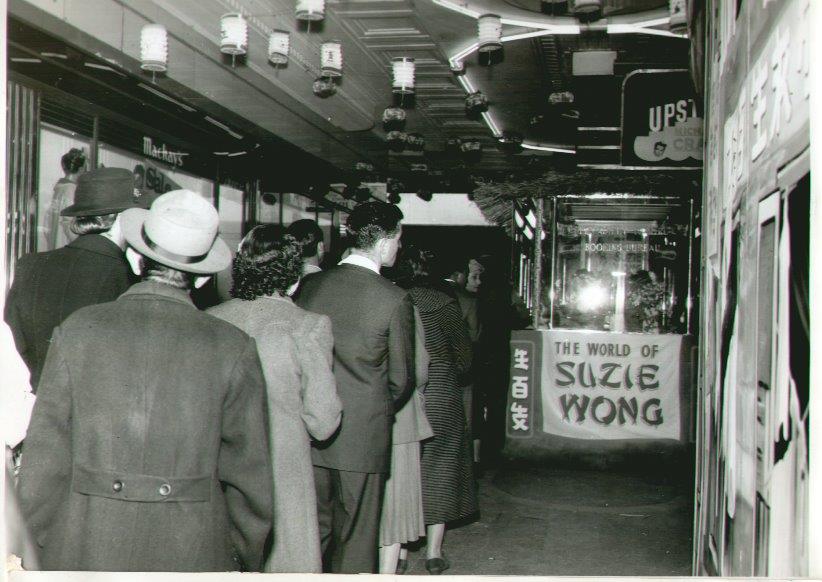
Cinema Web: Perth City
PERTH
ACADEMY TWIN CINEMAS/ACADEMY WEST END ALTERNATIVE CINEMAS/ LUMIERE, Wellington St, Perth
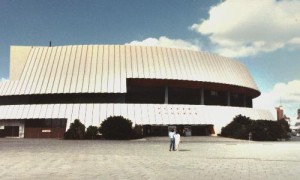
- Entertainment Centre 1981
In the late seventies, TVW Enterprises, the company running the television channel TVW 7, built the huge Entertainment Centre on a large site on the north side of Wellington St near the Perth Railway Station. The complex (which contained a vast entertainment stadium, convention facilities and restaurants) was officially opened on 27 December 1974, and the two cinemas on its ground floor were opened on 17 January 1975. These were named the Academy Cinemas, One and Two, and were leased to City Theatres, which had been from February 1973 owned by a consortium of which TVW Enterprises was a major shareholder. In August 1978 TVW Enterprises bought out the other shareholders, leaving the management of the Academy Cinemas with those employed previously by the consortium.
Three-D was shown briefly in 1985, then in June 1986 the cinemas became the Academy West End Alternative Cinemas, programming for the “film buff”, the kind of audience catered for by the Perth Film Festival and the Windsor (Nedlands) and New Oxford (Leederville). However, the arthouse policy survived only for a short time, and the cinemas closed 1 July 1988, after Hoyts took them over. They were then taken on in 1989 by James Woods and leased to the Film and Television Institute (WA), which had formerly screened only in Fremantle.
They renamed the venue the Lumiere. In 1993 it was listed as having 405 seats in Cinema 1 and 373 in Cinema 2, and to be presenting live performances as well as films. However, it closed on 28 June 1996, and the lease was not again taken up. In 2002, there were rumours of demolition, bitterly apposed by heritage lobbyists. In 2003, it was reported that ‘Multiplex (the company) has secured an option to buy the mothballed Entertainment Complex for $25 million. A $40 million redevelopment is proposed.’ (Kino no.86, p.42) Further reports suggest that any redevelopment will no longer accommodate cinema: ‘A $50 million redevelopment of the closed Perth Entertainment Centre has been proposed which will feature a retractable roof to allow the centre to compete for more tennis and other big events.’ (Kino, no.87, p.38)
Sources: Max D. Bell, Perth: a cinema history, The Book Guild, Lewes, Sussex, 1986, p.73
Jack Honnibal, ´The theatres of Perth 1939 – 1993′, Kino, no.45, September 1993, p.29
Bob Parkinson, ´Field report’, Kino, no.41, September 1992, p.13
Kino, no.17, September 1986, p.24; no.25, September 1988, p.23; no.29, September 1989, p.23; no.31, March 1990, p.23 no.38, December 1991, p.27; no.45, September 1993, p.31; no.57, September 1996, p.31; no.62, Summer 1997, p.35; no.80, Winter 2002, p.54; no.81, Spring 2002, p.39; no.86, Summer 2003, p.42; no.87, Autumn 2004, p.38
West Australian, 27 December 1974, 1974 – 1997
Interview (Ina Bertrand): Arthur Stiles (1985)Photos: 1 exterior, colour, 1981 (Bill Turner)
1 exterior, 3 interiors, b&w, West Australian, 27 December 1974AMBASSADORS/HOYTS CINEMAS TWO AND THREE (AND FOUR)/HOYTS CENTRE, 629 Hay St, Perth
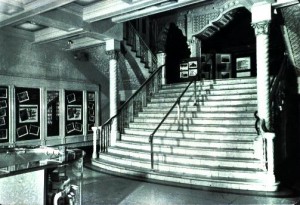
- Perth Ambassadors 1963
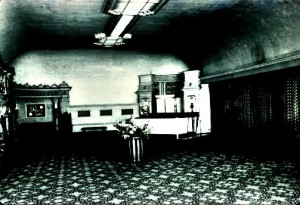
- Perth Ambassadors 1963
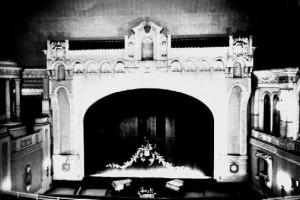
- Perth Ambassadors 1963
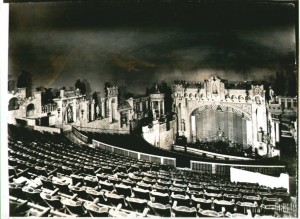
- Perth Ambassadors Theatre
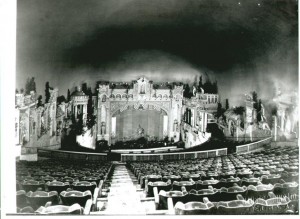
- Perth Ambassadors Theatre
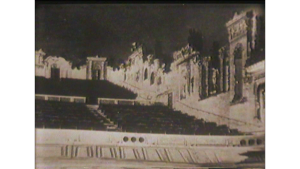
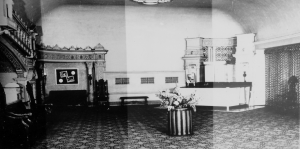
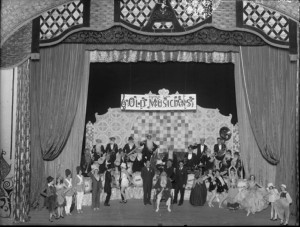
The programme of the opening night of the Ambassadors, on 29 September 1928, proclaimed:
There is but one Ambassadors. Never was a theatre so beautiful, or its glory so dearly bought but that it fades into insignificance beside this Florentine garden of music, of picture, of song which you see tonight for the first time.
This purple prose overlooked the fact that the Ambassadors was the third, and the smallest, of the atmospheric theatres built by Union Theatres in the state capitals of Australia in the twenties, the others being the Melbourne State and the Sydney Capitol. It was designed by Bohringer, Taylor and Johnson, who had also designed the Melbourne State.
Nevertheless, it was a first for Perth, and the theatre was able to compete successfully with Perth’s other great picture palaces of the decade – the Regent, the Capitol and the Prince of Wales. It was built under the guidance of Sir Thomas Coombe, the last thing he contributed to Union Theatres’ empire in Western Australia, before retiring.
To prepare those first-night patrons, the programme explained what an ´atmospheric’ theatre was, and what they might expect from this particular example:
Overhead in the sky you see stars twinkling in between the clouds that float, light as thistledown, across the heavens. It will be hard for you to believe that above them is a roof and that walls really surround you. For the ´atmospheric’ theatre, as its name implies, creates an atmosphere – an atmosphere where there is a very desirable feeling of intimacy and illusion to calm excited nerves, and prepare one and all to receive entertainment in ease and comfort. To secure this atmosphere, that you see here now, sculptors, painters, color artists and students of history, and many others, have been organised in Australian workshops.
Despite the appreciation shown to the local craftsmen who installed the interior, much stress was also placed on the widely scattered sources of the decorations themselves, from Paris, New York, Vienna, Berlin, Rome, Madrid, Chicago, Naples and London, among others. The exotic decor included stuffed pigeons and peacocks from Durban, South Africa, and reproductions of statuary from the great museums of Europe. Care was taken in the programme to point out the bona fides of these works of art, such as the Venus de Medici, ´signed by Cleomenes, son of Apollodorus, the Athenian, and …at present in the Uffizi Museum, Florence’: perhaps the patrons needed to be re-assured of the respectability of an environment in which they were surrounded by nude statues.
As well as the picture programme, the patrons could expect fine musical accompaniment, both from Bert Howell’s orchestra and from the Wurlitzer organ played on opening night by Les Waldron, in the glare of a spotlight as he rose on a stand from below the orchestra pit. The Ambassadors ballet, of eight local dancers under the direction of Estelle Anderson from the J.C.Williamson’s company, worked in conjunction with the orchestra to present prologues and other terpsichorean interludes.
Like most theatres in Perth, the Ambassadors claimed to be the coolest, and if the temperature was too unpleasant you could even walk up onto the roof and sit among the potted trees and shrubs of the Florentine Roof Garden. Much stress was also placed on the technical installations, both for the safety and comfort of patrons (lighting, ventilation, fire precautions) and for the quality and ease of viewing of the picture. A particular feature was the red velvet curtain, embossed with a peacock (now held by Ivan King).
Continuous pictures were no longer fashionable by 1928, though they continued at some of the cheaper venues like the Majestic and the Grand. Instead, the Ambassadors advertised four sessions daily. The doors opened at 10 a.m., with patrons entertained by the Wurlitzer till the 11 a.m. session, referred to as the ´early shopping session’. At 2.15 a session identical with the evening one commenced, then at 5 p.m. came a slightly shorter session ´for those remaining in town’. The main night session contained all the elements of the Unit entertainment – double feature films (or main feature and short features), with orchestral accompaniment, perhaps a stage prologue or interludes, and the Wurlitzer before the show and at interval.
The first sound films at the Ambassadors were on disc, opening about a year after sound had arrived in Perth. On one occasion, nearly 300ft of film was mangled in the projector and it was necessary to add exactly the right amount of replacement film, so that synchronisation with the disc was not lost. An ingenious solution was found. Instead of the piece of black film that was traditionally used, local film producer ´Dryblower’ Murphy was asked to make up the appropriate length of the words of the song that Colleen Moore was singing on the disc, and the audience never realised that it was meant to be any other way.
However, the theatre had sound-on-film equipment from the beginning as well, as they screened Movietone News. So it was comparatively simple to switch over to that system entirely when it became the accepted standard. The Ambassadors also maintained its orchestra and stage shows to accompany films longer than did other city theatre, and the mighty Wurlitzer remained a drawcard, even after the Ambassadors Orchestra was finally disbanded.
During 1931, when Union Theatres was in financial difficulties, a decision had to be made which of their two large showcase cinemas in the central city area would be closed – the Ambassadors or the Prince of Wales. The company opted to leave the Ambassadors open, despite it being the less profitable and the smaller of the two, because it contained four shops dependent on the income generated from cinema patrons and returning rents to the company, compared to only one shop associated with the Prince of Wales. So the Ambassadors joined the General Theatres group in 1932. Hamilton Brown, Union Theatres’ manager in Western Australia at the time, and noted for his entrepreneurial skills, tried very hard to rescue the ailing theatre. One gimmick was a wedding on stage before the opening of the film Lovers Courageous in July 1932. Live acts were also presented in support of the featured film on some occasions. But to continue to maintain a theatre as large as the Ambassadors, with nearly two thousand seats, was extremely difficult during the depression years.
Towards the end of the decade, Hoyts took over the theatre, and in 1938 it was remodelled, losing in the process much of the atmospherics which had contributed to its distinctive character:
Money has not been spared to make this theatre equal to the best in Perth. The entire front of the house has been modernised, the latest neon signs being incorporated on the facade of the building with charming simplicity, and the whole front, with its light treatment and modern lines, has a pleasing effect. Gone is the heavy, florid atmosphere of the old Ambassadors and in its place reigns a cheerful colour-scheme, combined with a maximum of comfort and restrained luxuriousness. The specially imported English carpet, upon which over 20 West Australian workers have been employed in sewing, is of a graceful pattern with an harmonious blending of colour. Comfortable, modern seating has been installed throughout in a tasteful deep green, the seats incorporating the latest scientific improvements in armchair comfort. (West Australian, 22 December 1938)
These alterations had probably been stimulated by the competition from the other theatres recently built – Hoyts’ own Plaza in 1937 and the Grand Theatre Co’s Piccadilly in 1938. It was a period when modernity was expected, and the Ambassadors lost some of its unique quality as a result. The theatre continued to screen regularly, though with mixed success, until it closed on 2 February 1972. The building was immediately demolished and its furnishings dispersed by auction.
HOYTS CINEMAS TWO AND THREE (AND FOUR)
Three years later, the City Centre was built on the site, containing the Wanamba Arcade – a complex of shops and restaurants, including a theatre, known as Hoyts Cinema Two, with 859 seats:
Hoyts Cinema 2 will be one of Perth’s jazziest cinemas…
Be prepared for the decor – tri-striped and exciting, with wall hangings.
Former WA interior decorator Neville Marsh has chosen deep blue upholstery for the seats, blue carpeting and walls painted in blue, maroon and beige stripes….big ones!
Part of the carpet area is striped too…
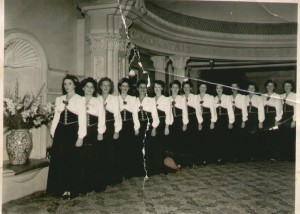
Usherettes will wear long blue skirts and beige blouses.
The cinema also features unique spot-lighting.
Seating in Cinema 2 is comfortable. There is plenty of space between rows and the vinyl upholstery features tiny holes which allows the fabric to breathe. This keeps the seat cool.
The seats are also broad enough to give excellent shoulder support.
Cinema 2 has a 56ft screen.
The walls are acoustic – some even covered with felt.
(Daily News, 20 March, 1975)
This ultra-modern cinema opened on 20 March 1975, but even with only 859 seats it proved too big for the audiences of the late seventies. In 1978 it was divided down the middle, and re-opened 13 December as Hoyts Cinemas Two and Three, each seating 400. As well as new Philips projectors and Dolby sound system, the new theatres boasted historic photo-murals of Perth as it used to be, and pin-ball machines in the foyer.
In 1984 a third cinema (Cinema Four) was added to the complex, sharing the foyer and administration block with the other two cinemas. Cinema Four was built, however, like a Chinese box – inside the lounge of the old Theatre Royal, which had been next door to the Ambassadors in earlier days. An access door was knocked through the shared side wall, without interfering with the shops and offices now occupying the lower levels of the building.
HOYTS CENTRE
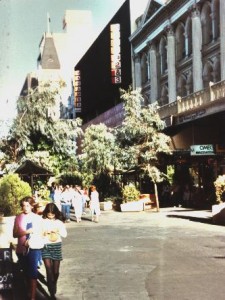
- Perth Hoyts Hay 1981
In 1988 Hoyts took over Cinema City, and after Hoyts Cinema One was closed the Cinema City theatres became Hoyts Cinema City (holding Hoyts Cinemas 1 – 4), and Hoyts Cinemas 2 – 4 (on the old Ambassadors site) became Hoyts Centre (holding Hoyts Cinemas 5 – 7): in 1997, the latter provided seating for 600, 400, and 400 patrons, but in April 1999 Hoyts Centre closed and the business was transferred to the Cinecentre (formerly Greater Union’s flagship).
Sources: Building permit, Battye 1459 (Folio 2)
Max D. Bell, Perth: a cinema history, The Book Guild, Lewes, Sussex, 1986, pp.68-72, 77
Rodney I. Francis, ‘Thomas Melrose Coombe: a pioneer from vaudeville to talkies in Western Australia’, Kino, no.81, Spring 2002, pp.36-38
Vyonne Geneve, ´William Leighton, architect’, Kino, no.25, September 1988, pp.7-15
Jack Honnibal, ‘The MGM years at Perth’s Theatre Royal’, Kino, no.68, Winter 1999, pp.6-9; no.85, Spring 2003, p.43
Stage, Screen and Stars, West Australian, n.d. (1997?), p.12-4
Ross Thorne, Cinemas of Australia via USA, pp.74-76
Daily News, 28 September 1928; 23 July 1932; 20 March 1975; 24 August 1976; 13 December 1978
Everyone’s, 27 July 1927; 10 October 1928, p.22; 7 November 1928, pp.8-9; 14 November 1928, p.42; 21 November 1928, p.56; 29 January 1930, p.18
Film Weekly Directory, 1943 – 1971
Film Weekly, 18 January 1934, p.6, 4 July 1957, 2 December 1965, p.6
Kino, no.25, p.8, 14;
Post Office Directory, 1928 – 1949
The Showman, 15 February 1964, p.10
Sunday Independent 21 November 1976
West Australian, 1929 – 1997; 8 February 1972; 20 March 1975
Interviews (Ina Bertrand): Eric Nicholls (1985), Arthur Stiles (1985)
Interview (Ina Bertrand & Bill Turner): Jack Gynn (1981)
Interview (David Noakes): Keith Reddin (1978)Photos: 2 architect’s designs, b&w, 1927, Everyone’s, 27 July 1927, p.84
interiors & exteriors, b&w, 1928, Everyone’s, 7 November 1928, pp.8-9; 14 November 1928, p.42; 21 November 1928, p.56; 20 February 1929, p.14 (stage show)
3 interiors (Ambassadors), b&w, 1929 (Battye 8292B/166-3 Series A; 4634P; 8292B 161-5)
2 exteriors (Ambassadors), b&w, 1932 (Battye 4587P, 4593P)
4 interiors, b&w, c.1970, Max D. Bell, Perth: a cinema history, pp.68-72
1 exterior (Wanamba Arcade), b&w, Sunday Independent, 21 November 1976
4 interiors (Hoyts Cinema 2), b&w, 1975, Daily News 20 March 19753 interiors (Ambassadors), b&w, 1963 (Ken Booth)
8 interiors, n.d, courtesy of Bill and Joan Gaynor
1 exterior (Hoyts Cinemas 2 & 3), colour, 1981 (Bill Turner)
BEVANS AND GARDENS/ CRYSTAL AND GARDENS/ ALBION THEATRE AND GARDENS, 143-147 Wittenoom St, Perth (East)
This theatre and gardens, though located on the corner of Hill St on the outskirts of the City of Perth, was more like a suburban venue than a city one. It was built in 1935, and for several years (approx. 1945-1949), while it was conducted by N.J. (Noel) Bevan, it was known as Bevans Theatre and Gardens. There was provision for 500 patrons in the theatre and a further 500 in the gardens. In 1955, when it was taken over by Mrs S.Ray, it was renamed the Albion. When it closed in 1961, the building was converted for use by an automotive supplies company.
Sources: Max Bell, Perth – a cinema history, The Book Guild, Lewes, Sussex, p.56
Film Weekly Directory, 1943/4 – 1960/61
Post Office Directory, 1935/6 – 1949
West Australian, 1937 – 1960BRITANNIA/HOYTS CINEMA ONE, 676 Hay St, Perth
The third purpose-built hardtop cinema in Perth was the Britannia, which opened on 1 April 1915. It was built by a local businessman and managed by local showman Hamilton Brown in its formative years. Like the Pavilion, which initiated this policy, it was small, cheap and screened continuously from 11 a.m. till 11 p.m., and again like the Pavilion it occupied a shop-front and looked rather like the nickelodeons of earlier years in America:
The new premises are designed to form an up-to-date picture theatre. The length from the street front to the rear is 165 ft., with a breadth of 23ft. 6in. The hall is an exceedingly lofty one, provided with a large sliding roof and a maximum amount of fan and other ventilation, thus ensuring a low temperature even in close weather. Accommodation is provided in comfortable seats for 880 persons, of whom the dress circle will take about 260. An ornate vestibule is the external feature of the place, a door each side giving entrance to the stalls, and a double staircase leading to the dress circle and to the lounge and offices in front of the building. (West Australian, 2 April 1915)
The Britannia had a good reputation for quality programming. But with prices at 6d and 3d, it shared the Pavilion’s reputation for ´cheapness’, with the advantages and disadvantages which such a reputation brought with it. Nevertheless, it is not clear why the cinema closed on 18 May 1918, only three years after its optimistic opening. The premises were converted into shops.
HOYTS CINEMA ONE
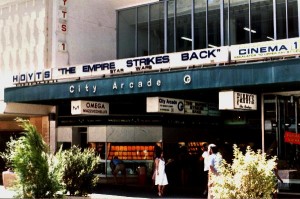
- Hoyts Cinema 1981
No films were shown on the site for five decades. Then in 1970 the ultra-modern City Arcade was built, incorporating among its shops and offices a cinema which was leased by Hoyts to become their Cinema One:
Hoyts’ new air-conditioned Cinema 1 atop City Arcade will be one of the most modern in Australia and will be in keeping with the colourful vitality of the arcade complex. Patrons will be able to buy their tickets either at the ticket office on the central arcade area on the Hay-St level or in the cinema foyer off the carpeted upper Hay-St level. The ticket box on the Hay-St level is a polygon shape…
The architects conceived the many-sided glass and laminated capsule, with its eye-catching reflecting surfaces, as a technological symbol. It harmonises with the nearby glass-sided lift and escalators that will take cinema patrons up to the next level to the foyer. In the foyer patrons will be greeted by usherettes wearing the theatre’s official colours – royal blue and lime green – and shown to their places inside the luxuriously finished 850-seat auditorium. Confronting them will be a 65ft. screen curved to a depth of 25 ft. It is designed for the screening technique called Cinerama, which Cinema 1 will be introducing to Perth. (Daily News, 11 November, 1970)
It opened on 23 February 1971. Cinema Two (and later Three, and, still later, Four) was built on the opposite side of the road, on the site of the former Ambassadors Theatre (and Theatre Royal). Cinema 1 was closed in 1990: the auditorium is still there, but the foyer and entrances were converted into shops in the arcade.
Sources: Max D. Bell, Perth: a cinema history, The Book Guild, Lews, Sussex, 1986, p.73, 77
Daily News, 11 November 1970
Film Weekly Directory, 1971
Kino, no.38, December 1991, p.27
David Coles, Letter to the editor, Kino 74, Summer 2000, p.5
Post Office Directory, 1916 – 1919
Sunday Times, 8 November 1970
West Australian, 2 April 1915, 1915 – 1991
Interview (Ina Bertrand): Arthur Stiles (1985)Photos: 1 exterior (City Arcade), colour, 1981 (Bill Turner)
CHINATOWN CINEMA, Piccadilly Square, Perth (East)
This cinema was opened in 1991, with 224 seats, and in 1992 was reported to be doing well, mainly with films imported from Hong Kong.
Sources: Jack Honnibal, ´The theatres of Perth 1939 – 1993′, Kino no.45, September 1993, p.28
Kino, no.34, December 1990, p.24; no.40, June 1992, p.26CINECENTRE/CITY CINEMAS/CINECENTRE, 139 Murray St, Perth
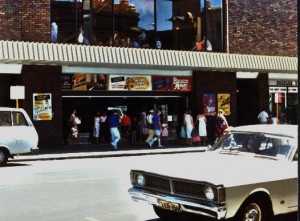
- 1981
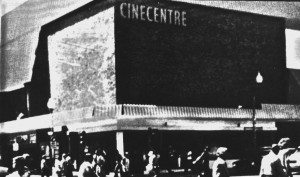
- Perth Cinecentre 1970’s
After the success of the Town Cinema, Ace Theatres’ next city venture in collaboration with Greater Union was to purchase the old taxation building on the corner of Barrack and Murray Sts, and to build Perth’s first multi-cinema complex, the Cinecentre, at a cost of more than $2 million. As well as shops on the ground floor, and offices in the floors above, the building contained a coffee lounge and restaurant, and three cinemas, two with 500 seats and one with 300. These shared projection facilities, which could provide for 16, 35 and 70mm films. All three cinemas were entered through an imposing foyer in Murray St. The complex opened on 12 February 1974.
In the mid-nineties, seating was provided for 228 in Cinema 1, 500 in Cinema 2 and 507 in Cinema 3. In 1997 the complex was known as the Perth City Cinemas, but by 1999 it had reverted to the old name of Cinecentre.
Sources: Building permit, Battye 1459, Folio 2
Bob Parkinson, ´Field report’, Kino, no.41, September 1992, p.12
Jack Honnibal, ´The theatres of Perth 1939 – 1993′, Kino, no.45, September 1993, p.29
West Australian, 12 February 1974, 1974 – 2000
Interview (Ina Bertrand & Bill Turner): John Pye (1981)Photos: 1 exterior, b&w, n.d. (70s?) (Arthur Stiles)
1 exterior, colour, 1981 (Bill Turner)CINEMA CITY, 580 Hay St, Perth
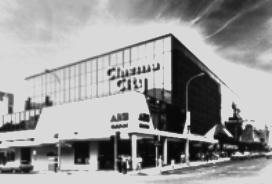
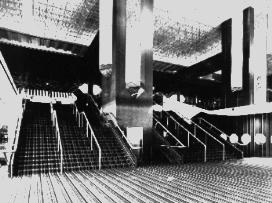
- Cinema City 1980
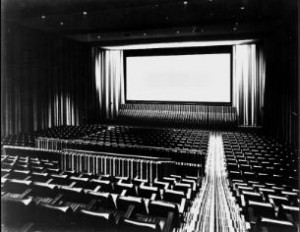
- Cinema City 1980
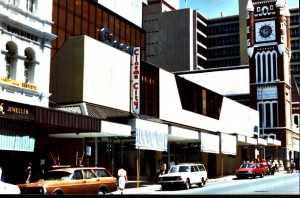
- Cinema City 1981
In February 1978, TVW Enterprises Ltd completed purchase of the interests of City Theatres from the consortium which had bought the company in 1973. Soon after this, they announced plans to build a multi-million dollar shopping complex containing several new cinemas, on the old Haymarket site in Hay St, opposite the Town Hall.
At the time, this was the largest of the multi-cinema complexes, deisgned by architect Anthony Brand, and containing four new cinemas and provision for a fifth to be added in the future. Following tradition, a souvenir programme was issued for the opening, on Thursday 6 November 1980, providing the following description of the new building:
Cinema City was built at a time when almost every economic forecast said don’t. However, shrewd foresight and a bold decision by the TVW Board of Directors has seen Cinema City become a sensational new landmark of Perth…
Designed with extreme care, its reflective walls allow the old Town Hall to enjoy pride of place next to the new complex.
Rich multi-coloured carpets cover floor, steps, stairs and carry up for the full height of the inner walls.
The coffered ceiling increases the apparent height and suspended from it are fluorescent tubes sheathed in a glittering chromium plate…
Cinema City’s lobby opens into an enormous space over 14 metres (46 ft) high. The stunning effect of unlimited space is multiplied by each wall being sheathed by mirrors.
Chrome plated space frames adorned with lights, hang from the ceiling. The mirrors pick up the glitter and glamour of these features and reflect them on into what seems like eternity.
Another feature of the building was the shopping arcades, providing fashion shops, eating places, and services such as banks and hairdressers, with exits to Murray St and Barrack St as well as to Hay St. Dolby stereo sound systems were installed from the beginning. Also, as the souvenir programme describes:
For those unable to negotiate the stairs, a lift soars into the huge space, landing the elderly at foyer level and the incapacitated at a higher level gallery with wheelchair access to the backs of all cinemas.
This was one of the City Theatres properties taken over by Hoyts in 1988, and immediately put on the market (for leaseback). It was sold for a reputed $10 mill in 1994. The fifth cinema was never added, and in the mid-nineties, the four cinemas (still known as Cinema City, but now holding Hoyts Cinemas 1 – 4) held 494, 580, 394 and 790 seats. In 1999, Max Bell reported that: ‘The Cinema City shopping arcade and theatre complex has been sold to Perth investor Westpoint Corporation for approximately $13m. There are plans to develop the property for the third time.’ In 2002 it was reported that “a 20-storey hotel and residential complex” would be built above the cinemas, which would be retained.
Sources: Max D. Bell, Perth: a cinema history, The Book Guild, Lewes, Sussex, 1986, p.78
Max D.Bell, ´Perth Cinema City’, Kino, no.33, September 1990, pp.16-17
Max D.Bell, ´Perth’s Cinema City’, Kino, no.78, Summer 2001, p.51
Jack Honnibal, ´The theatres of Perth 1939 – 1993′, Kino, no.45, September 1993, p.29
Australasian Cinema, 5 December 1980, pp.8-22
Kino, no.38, December 1991, p.27; no.49, September 1994, p.31; no. 67, Autumn 1999, p.31; no.80, Winter 2002, p.54
Sunday Times, 11 June 1978
West Australian, 7 November 1980; 1980 – 2000
Interview (Ina Bertrand & Bill Turner): Ray Cooper (1981)Photos: interiors & exteriors, Australasian Cinema, 5 December 1980, pp.8-22
7 interiors, b&w, 1980 (Arthur Stiles)
1 exterior, b&w, 1980 (Arthur Stiles)
1 exterior, colour, 1981 (Bill Turner)
1 exterior (side entrance from Barrack St), colour, 1981 (Bill Turner)
1 exterior, b&w, 1980, Kino, no.33, p.17 (Max Bell)CLUB ADULT CINEMA/CINE 1/SAVOY/CLUB X, 114 Barrack St, Perth
This was one of two cinemas run by Club Adult Cinemas, specialising in R-rated sex films, and offering live striptease three times a day. It opened in 1982, and was so successful that a second was later opened in Fremantle. These return to the small shopfront cinemas of the very early days, holding only 40-50 people. In 1991, when the Savoy cinema closed because of redevelopment of the Savoy Hotel site, the equipment of the Savoy was moved into these premises in the basement of the Club Emporium and screenings began again, though they were advertised only irregularly after that – as the Savoy in 1994-5 and as Club X in 1993 and 1996.
Sources: Kino, no.38, December 1991, p.26
Perth Telephone books, 1983-5
West Australian, 1982 – 1996CREMORNE/BIJOU/ CREMORNE/PALACE/ CREMORNE, 111 Murray St, Perth
The complicated history of the name changes on this site is extremely difficult to disentangle. The first address for the Cremorne Theatre was ´off 31 Howick St’, at the time when Howick St was the name for Hay St, east of Barrack St. No.31 Howick St was the rear of 111 Murray St, and this was where the theatre entrance was situated till 1897, behind the Criterion Hotel. After that, entrance was from what later became Cremorne Arcade, running through from Hay St to Murray St.
Though it was called a ´theatre’, it was primarily an open air venue, of stalls and stages, in a garden setting similar to Ye Olde Englishe Fayre, at the other end of Hay St. There was an outdoor stage and a small indoor theatre, both used for musical and theatrical performances. The gardens adjoined the bungalow verandah of the saloon bar (of the Cremorne Hotel), and contained:
…palms, rockeries and a fountain, and the whole area was surrounded by a high wall painted with woodland scenery…
Spaced at intervals around the gardens were small roofed and latticed rustic kiosks, each lit up at night with coloured fairy lights, and each having a table and chairs inside for the convenience of private parties.
Over the front opening of each kiosk was painted the name of some well-known goldmining town such as Coolgardie, Boulder, Kanowna, Kookynie and many others.
Two German waiters in evening dress hurried to and fro with their trays of drinks, clinking glasses which always rattled with the broken ice blocks inserted before the drinks were served. (West Australian 3 January 1953, p.12)
In late 1896, the theatre was owned by Mrs Annie Oliver, and leased to King Hedley, who offered traditional vaudeville programmes. It was the second venue in Perth to present films, three weeks after Ye Olde Englishe Fayre. ´THE GENUINE CINEMATOGRAPHE and COMBINATION PICTURES’ ran for a season of five weeks from 12 December 1896 to 18 January 1897. The programme was presented twice each evening, starting at 8.30 and again at 9.30 p.m., and there was a matinee on Saturdays at 3 p.m. The machine was probably a Lumiere, as the films listed in the programme were from among those distributed by the Lumiere Company: Soudanese Diving, Grand Steeplechase, Buckjumping horse, Arrival of a train at a station, A Game of Cards, Paris Street Scene. Entrance to the films could be obtained either directly through the main theatre entrance or through the gardens attached to the theatre, where the usual vaudeville performance was continuing. The season was successful, but, like the Fayre grounds, the Cremorne Gardens closed during the off-season, and the theatre returned to traditional vaudeville shows.
The following summer, both Carl Hertz and Charles Harper successfully presented their films at the Cremorne before going on to Fremantle, Hertz from 16 to 28 August 1897, and Harper from 1 to 6 November 1897. After the hiatus of 1898-9, film programmes in summer seasons resumed, with Clarke’s Royal Biograph in August 1899, followed by other presentations over the next three summers. These included, among others, the Royal Biograph from 19 to 28 August 1899, and again 17 March to 2 April 1900, Heller’s Mahatma Co 13 to 19 October 1900, American Biograph 28 to 31 October 1901, and coronation pictures by Optigraph 18 October to 15 November 1902. For a few months in the summer of 1902-3, the theatre was advertised as the ‘Bijou’, but the Cremorne Gardens opened on Boxing Night 1902 as usual. Jones and Lawrence were associated with the venue from early 1900 till 1903. It appears to have been unoccupied for some time, and to have re-opened late in 1904:
Under the title of ´The Palace Gardens’ what was once the most popular place of outdoor entertainment in Perth, viz. Cremorne Gardens will be thrown open to the public next Saturday evening when the first of a series of entertainments will be presented.
The ´Palace Gardens’ will be under the direction of Mr Leonard Davis…An attractive item will be the pictures projected by Edison’s latest invention for producing moving pictures and known as the Chronojector. (West Australian, 29 October 1904)
Davis presented films as part of the vaudeville offering of the gardens, with weekly changes of programme, till 3 February 1905. Before the end of the season, Daudet’s Parisien Living Pictures presented a short season, then the gardens closed again till the following summer. Before the next season a major refurbishing took place:
On Thursday next the Palace Gardens and Theatre will be re-opened for the summer season by Mr Leonard Davis. For some time past a large staff has been engaged in beautifying the gardens, and at the present time there are ample evidences of the work bestowed upon them. The lawns are beautifully green, the small garden plots are gay with flowers and shrubs, and the interior of the teahouses presents an attractive appearance. For the occupation of patrons who purchase 3s and 2s tickets, the whole of the lawn space will be available, while the gallery and promenade will be reserved for purchasers of 1s tickets. Venetian deck chairs, with canvas backs, specially designed for ease and comfort, and painted white, are being manufactured, the dais for the orchestra is enclosed with handsome red curtains, hung on nickel railings, and the members of the orchestra, and the attendants, will be attired in white uniforms. The theatre will also be opened on Thursday next, and will be conducted on similar lines to those which obtain in the American music halls. A large number of novelties, including a waxworks exhibition of 50 figures, penny-in-the-slot machines of all descriptions, stereophones, picturegraphs, and two boxes of radium have been imported and will be on view in the theatre.. (West Australian, 11 November 1905)
The stereophone provided a short film of a singer performing, synchronised with a gramophone reproduction of the singer’s voice, and in a later advertisement it was made quite clear that among the moving novelties available in the theatre (called the ´Palace of Amusements’) was also a traditional cinematograph (West Australian, 11 December 1905).
The summer seasons of 1905-6, 1906-7, 1908-9 all appeared to be very successful, and all employed a cinematograph as a part of the varied offering for some or all of the time. In December 1906 Harry Rickards had taken over the lease, but Leonard Davis remained as sub-lessee and the policy of the management did not appear to change. A correspondent in the West Australian praised Rickards for withstanding the temptation to open on Sunday, a practice which was considered by the writer to undermine the conditions of the working man (West Australian, 1 January 1909).
From 1910 onwards, films seemed to fade out of the theatre’s programmes, appearing less and less often among the vaudeville offerings.
In July 1910, the Cremorne Theatre suddenly re-appeared in advertisements, apparently concurrently with the Palace Gardens. This confusion of names cannot be sorted out from extant references, but it seems likely that in the earlier years the venue had depended mainly on the summer season in the gardens, and that the indoor theatre had existed just as an adjunct to the gardens, open for special seasons during the winter months, but apparently not consistently. During this period, the gardens gave its name to the theatre, even though the original ´Cremorne’ was named after the adjacent hotel, which continued to operate under the same name throughout the period. Round 1910 it appears that the theatre began to have an independent life, perhaps under the expert guidance of Harry Rickards. So it took its own name again as the Cremorne, and then the whole venue returned to the original name.
Leonard Davis had had a long association with film as a part of vaudeville offerings, and in December 1911 had announced his intention to ´merge the entertainment into one of vaudeville and biograph variety’ (West Australian, 23 December 1911). However, when he opened the Palace Gardens for the summer season on Christmas night 1912, he had changed his mind, and announced that he would now programme only vaudeville, without films. It is possible that as, by this time, films had purpose-built cinemas for their presentation, he felt that audiences expected a full programme of one or the other. In any case, from that time films no longer appeared at the Cremorne Theatre or the Palace Gardens, though the venue continued till the summer season 1917-18.
Sources: Stage, Screen and Stars, West Australian, n.d. (1997?), p.20
Post Office Directory, 1897 – 1928
West Australian, 11 November 1905, 3 January 1953 p.12, 17 January 1953 p.15, 14 January 1956 p.23, 1896 – 1920Photos: 1 exterior (Cremorne gardens), b&w, 1896, West Australian no.4224 (17 January 1953, p.15)
1 exterior (Cremorne gardens) b&w, 1866? Alexandra Hasluck & Mollie Lukis, Victorian and Edwardian Perth from Old Photographs John Ferguson Pty Ltd, St Ives, 1977, plate 57EMPIRE PICTURE PALACE/KING´S PICTURE PALACE/MELBA PICTURE HALL, 227 Murray St, Perth
Empire Pictures, directed by F. C. Clarke-Cottrell, had been screening very successfully in the Perth Town Hall from May 1910. They announced, towards the end of 1911, that they intended to build a new picture palace in the city, and ran a competition for a name for the new building: the suggestion that they had made their name with ´Empire’ and that they could do no better than stick with this, was accepted. During 1911, Shierlaw and White constructed the building, valued at £2,625, for owner H.Cochrane, and on 16 December 1911 this first purpose-built hardtop cinema in Western Australia was opened:
The Empire Pictures management gave the first entertainment in their new premises – the Empire Picture Palace, central Murray St – on Saturday evening. The new theatre is built of brick, and can comfortably accommodate 1,500 people. The walls are finished with white plaster, and the ceiling is of stamped metal. Apart from a host of other good points, the premises are fitted with a sliding roof, a lounge, ladies’ retiring rooms, and a refreshment hall. Provision, too, has been made in case of fire for the rapid exit of patrons, by a number of side escape doors, which lead into a commodious right-of-way and thence into the street. The attendance on Saturday night was a highly-gratifying one, a circumstance which the programme well justified. …Features of the initial performance were the musical numbers given by the Empire Orchestra of ten players under the baton of Conductor T.G.Williams. During the evening, too, Miss Pearse gave one of her popular songs. (West Australian, 18 December 1911)
Despite this glowing review, which concluded with a promise that performances would continue nightly, no further advertisements for the Empire Picture Palace can be found. Instead, by April 1912 it appears that the theatre has been taken over by another company and renamed.
King’s Picture Gardens, which opened in December 1908 at the foot of William St, was conducted by the King’s Picture Co Ltd, originally under the direction of Charles Sudholz, then, from late 1910 by Brown and Dease, and from December 1910 by Dennis Dease alone. King’s Pictures also screened every Monday from 13 February 1909 at Midland Junction, and then extended their provincial exhibition to weekly screenings at Fremantle on Saturdays, York on Tuesdays, Northam on Wednesdays, Bunbury on Thursdays and Collie on Fridays. By the end of the year this provincial circuit, though still known as King’s Pictures, seems to have been conducted independently of the Perth operation.
All of these were highly successful, despite the changes in management – sufficiently successful for Dease to decide to venture into permanent exhibition in the city, rather than be satisfied with the summer seasons available through the gardens. The last performance by the company at the King’s Picture Gardens was in April 1911, and the gardens did not re-open till January 1912, now under the direction of Cozens Spencer, and with a new name – the Esplanade Picture Gardens. Meanwhile, Dease had acquired the lease of what had been the Empire Picture Palace in Murray St, and he opened here in April 1912, advertising variously as King’s Picture Palace or King’s Theatre. He obtained his product through J.D.Williams, and presented the output of the Melbourne-based Lincoln-Cass Company very successfully during 1912. The sliding roof of the hall was a selling point during the hot summer, but early in 1913 presentations again ceased.
The hall was re-opened, ´under entirely new management and redecorated throughout’ (West Australian, 7 June 1913), in early June, under the direction of H.H.Cockram, and now known as the Melba Picture Hall. The new management continued to feature Australian productions, including a West Australian film of the Kalgoorlie Cup Meeting in September 1913, and Life of a Jackeroo in January 1914. However, there is no record of how successful the enterprise was, nor of why it closed permanently on 2 August 1914.
Sources: Perth City Council records, PTL F14, 1911
Post Office Directory, 1912 – 1914
West Australian, 18 December 1911, 1911 – 1914FLIGHT DECK, 154 James St, Perth
This adult cinema advertised for a short time in 1984 only
Sources: West Australian 1984
GRAND, 164-168 Murray St, Perth
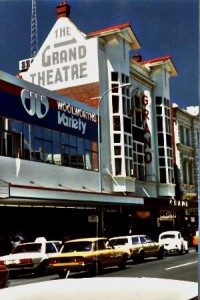
- Grand 1981
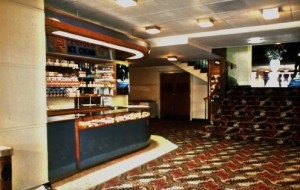
- Grand interior 1980
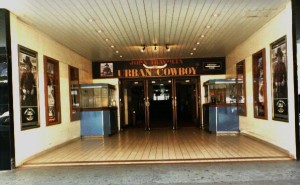
- Grand front 1980
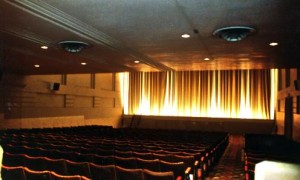
- Grand interior 1980
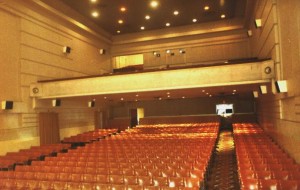
- Grand interior 1980
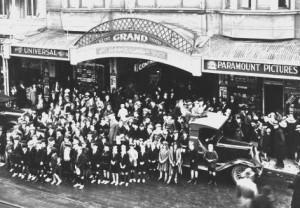
- Grand; Orphans picnic 1930’s
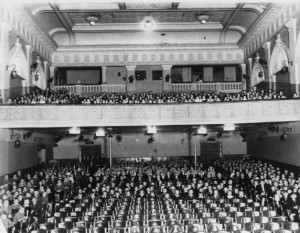
- Grand interior 1930’s
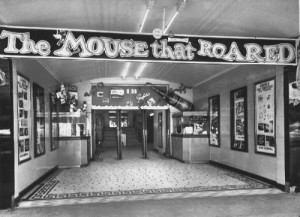
- Grand foyer 1960’s
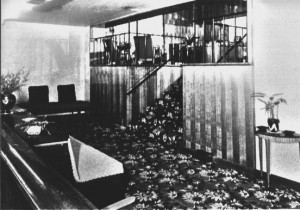
- Grand foyer 1960’s
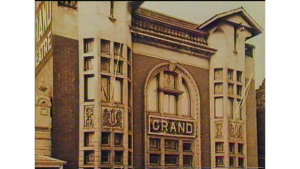
- Grand Cinema
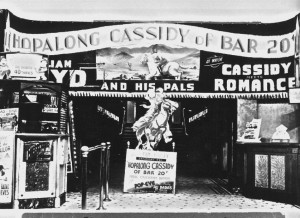
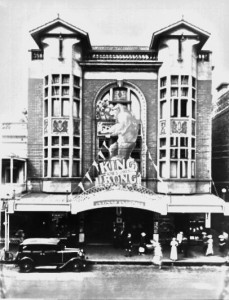
- Grand; exploitation campaigns various dates
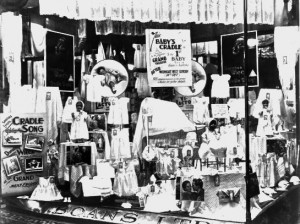
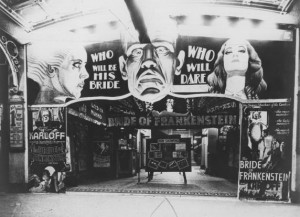
This theatre was built by entrepreneur Thomas Coombe and purchased from him by his sons Thomas Melrose (later Sir Thomas) Coombe and James
Lean Coombe. It opened with a charity gala performance in aid of Wounded Soldiers, and with a ´Soldiers Orchestra’, on 20 September 1916. The manager was Thomas Coombe (jnr), a lawyer, who had entered the film business in Perth as a partner in the local firm of Empire Pictures with F. C. Clarke-Cottrell and Thomas Shafto. The company had screened in the Perth Town Hall in 1910, and at Subiaco (in the King’s Hall and on the oval) during 1910 and 1911. The partners had then gone their own ways, each into a career in the film industry, Thomas Coombe beginning as attorney for West’s, managing the Melrose Gardens and later the Melrose Theatre. The Grand was his first independent venture, and he quickly made a success of it.
In comparison with the live theatres of the time it was small – 1100 seats, about the same size as its competitors, the Pavilion, the Palladium, the Britannia and the Majestic. All five opened during World War One, and followed similar policies of continuous screenings and cheaper admission than the live shows. The Grand, however, from the beginning aspired to a rather more lofty image than the others. It had a windlass-operated sliding roof, like the more prestigious live theatres, and also shutters on the side walls which could be removed for ventilation like the semi-open-air theatres.
When Coombe went into partnership with Union Theatres’ West Australian branch, the Grand became an important part of the Union Theatres chain.
Around 1920 Coombe had employed a young man named Hamilton Brown to manage the Princess (Fremantle) for him. Brown did so well in this position that as Coombe involved himself less and less in the daily affairs of the theatres he passed over more and more to the younger man, finally making him manager of all Coombe’s various theatrical concerns. When Coombe retired, Brown was appointed manager for all Union Theatres’ interests in the state. It was under his management that the Grand was wired for sound in 1929 (and abandoned its orchestra), and in April-May 1932 became an all-British house, a showcase for the most prestigious of the British films.
However, in 1929 at the height of the depression, the theatre had been sold for £82,000 as a speculation to Town and Suburban Properties Ltd, and leased back to continue to run as a Union Theatre. By the beginning of 1932, the financial crisis which was to force Hoyts and Union Theatres into an amalgamation as General Theatres, was being felt in Western Australia also. Union Theatres fell behind with the rent for the Grand, the bailiffs were called in and their tenancy was abruptly halted. This was a decision of James Stiles, on behalf of the owners of the property, of which he was a partner.
Town and Suburban Properties Ltd was a company owned by four families – the Stiles, Taylor, Davenport and Vivian families. Stiles, who had an interest in suburban theatres in South Perth, was the only one with any experience in film exhibition, but he was noted also for his resourcefulness and energy, and when he urged the company to take the risk, in the belief that he could sustain the theatre during the hard times ahead better than any tenant could, they agreed. On 25 August 1932 a new company, formed substantially of the same shareholders as Town and Suburban Properties, was formed – the Grand Theatre Co – specifically to manage the Grand Theatre as a functioning cinema. And, instead of appointing a manager, Stiles took on the task himself. He was so successful that the company went on to lease and build other theatres, eventually becoming for a time the largest local chain, and even larger in the state than the eastern-based national chains of Hoyts and Union Theatres.
As promotion for the film Little Orphan Annie, the Grand Theatre Company held an ´orphans picnic’: they invited the residents in all the orphanages in Perth to a day out, including a film screening at the Theatre Royal. This was such a success that it continued annually for many years, with the film presentation usually at the Grand.
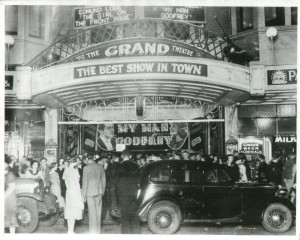
Over the years, very little change was made in the façade of the Grand: brickwork was painted over, a neon sign added in the manner traditional to cinemas (down the length of the façade), and the ornate metal verandah replaced with one of cleaner, more modern lines.
Inside there was more change. The first major reconstruction took place in 1938:
The supporting pillars in the stalls have been taken away, and throughout the theatre provision has been made for the comfort of patrons by considerably widening the space between the rows of seats. What were previously two small landings upstairs have been joined together and enlarged to make an attractive smoking lounge. Extensive alterations have been made to the walls which have been repainted in pastel shades predominantly green. A feature of the new theatre is the lighting system, which is done with neon lights. The Grand is the first theatre in Australia entirely illuminated by neon lights, and the effect is most pleasing. (West Australian, 17 December 1938)
When it was re-opened on 16 December 1938, after only four weeks’ work had completely transformed the interior, stress was placed on its reputation as a ´family theatre’ and the ´homely’ design and comfort it offered. There was considerable pride expressed in the fact that the renovations had been done using as far as possible West Australian labour and materials. By now, however, it had to compete against the picture palaces of the thirties, and its reputation had sunk to that of a ´churn house’ – one of the continuous theatres that ´churn’ out sessions.
By the time of the second major renovation in 1959, the Grand Theatre Company had been transformed into City Theatres Pty Ltd, in recognition of the wider activities of the company, though the management, in personnel and policy, had not substantially changed. This renovation was extensive:
The Grand Theatre, home of British pictures in Western Australia, has been modernised and refurbished at a cost of £15,000 to make it one of the attractive showcases of the West Australian capital. In the modernisation scheme planned by architects Hobbs, Winning and Leighton a new lounge foyer has been created.
Lounge foyer is attractively carpeted and painted, with decor set off by the wood panelling of the walls.
Seating has been provided and there is also a modern and well-stocked candy and soft drink bar.
A cooling system operating on an air filter system has also been installed, while a new suspended ceiling in the theatre lends a modern touch to the building and has improved sound throughout the theatre.
Similar style ceiling has been fitted in the lounge foyer and in the theatre’s entrance lobby. (Film Weekly, 15 January 1959)It was not fully air-conditioned till 1961.
In 1973 City Theatres was taken over by a consortium consisting of local television company TVW Ltd, Swan Television and Michael Edgley International Ltd. In August 1978 TVW Ltd bought out the other partners, though again there was little change in management, as Arthur Stiles, nephew of James Stiles, remained as Managing Director under the consortium and as Manager under TVW.
By now, the theatre which had changed hands for £80,000 in 1928 was worth £900,000, not so much for the building, which had long since become outmoded, as for the prime position in the central city. Each modernisation, providing more spacious accommodation for patrons, had also reduced the number of seats available, till by the end it could only accommodate 721. Fortunately, the trend in cinema building in the seventies was towards smaller, more intimate theatres anyway, which was probably all that kept the Grand going in its later years. It closed on 6 November 1980, the day that the company opened Cinema City. City Theatres retained their offices in the front of the building upstairs, while the foyer and auditorium was used for a complex of restaurants and fast food outlets. The building was demolished in March 1990.
Sources: Building permits, Battye 1459, Folio 2
Max D. Bell, Perth: a cinema history, The Book Guild, Lews, Sussex, 1986, pp.78-79
Rodney I. Francis, ´The Coombe family of Perth’, Kino no.34, December 1990, pp.12-17; ‘Thomas Melrose Coombe: a pioneer from vaudeville to talkies in Western Ausrtalia’, Part 2, Kino no.80, pp.46-48.
Jack Honnibal, ‘Perth’s Grand Theatre in its heyday’, Kino, no.64, Winter 1998, pp.26-29
Stage, Screen and Stars, West Australian, n.d. (1997?), p.20-21
Ross Thorne, Cinemas of Australia via USA p.163
Australasian Exhibitor, 15 July 1954, 5 December 1980
Everyone’s, 23 January 1929, p.24; 20 February 1929, p.6,14; 4 September 1929, p.32
Film Weekly, 15 January 1959, p.1
Film Weekly Directory, 1943/4 – 1971
Kino, no.32, June 1990, p.23
Post Office Directory, 1917 – 1921, 1929 – 1949
Sunday Times, 17 April 1932, 24 April 1932, 11 January 1959
West Australian, 20 September 1916, 24 May 1932, 15 December 1938, 17 December 1938, 1916 – 1980
Interview (Ina Bertrand): Arthur Stiles (1985)
Interviews (Ina Bertrand & Bill Turner): Ray Cooper (1981), John Pye (1981)
Arthur Stiles scrapbook
Hamilton Brown scrapbookPhotos: 1 exterior, b&w, 20s, West Australian no.3394
1 exterior, b&w, c.1921/2, Battye 3183 11811P
1 interior (auditorium – orphans picnic audience), b&w, 1930s (Arthur Stiles)
2 exteriors (orphans picnic audience), b&w, 1930s (Arthur Stiles)
2 interiors, 2 exteriors, b&w, 1930s, Jack Honnibal, ‘Perth’s Grand Theatre in its heyday’, Kino, no.64, Winter 1998, pp.26-29
3 interiors (foyers), b&w, 1960s (Arthur Stiles)
33 exteriors & interiors, colour, 1980 (Roy Mudge)
1 exterior, b&w, n.d., Australasian Cinema, 5 December 1980, p.8
1 exterior, colour, 1981 (Bill Turner)
exploitation campaigns, b&w, various dates, Arthur StilesGREEN LAWN PICTURE GARDENS, 489 Hay St, Perth
This must have been the shortest-lived of all the picture businesses in the state. It opened on Saturday 21 October 1916, conducted by J. F. Mulqueen, with accommodation for 2000, and screening Clement Mason Super Features. The orchestra of six professional musicians was under the direction of the “Musical Gardiners”, and prices were the standard rates for picture gardens of 6d and 1/- for adults, children 3d. Veteran showman Norman Cunningham remembers it as being on the south side of Hay St, near Irwin St (West Australian, 4 September 1980), which possibly means that it occupied the site used in the summers of 1897-8 and 1898-9 by the Olde Englishe Market Place and Fayre in aid of the Children’s Hospital (not to be confused with ´Ye Olde Englishe Fayre’ at the corner of Hay and King Streets – or that at 66 South Terrace, Fremantle).
On 4 November 1916, prices were reduced to 3d for adults to all parts, and 2d for children, and on Wednesday 8 November the advertisements claimed that the venue was winning patrons with excellent programmes and prices “the lowest in the city.” This may, however, have been a desperate bid to boost a flagging enterprise – it was not again advertised in the city papers, and apparently faded away not long afterwards.
Sources: Post Office Directory, 1917
West Australian, September – November 1916, 4 September 1980
Interview (Ina Bertrand & Bill Turner): Norman Cunningham (1981)KING´S PICTURE GARDENS/ ESPLANADE PICTURE GARDENS/CAPITOL, 2-10 William St, Perth
On 26 December 1908, the first premises in Perth designed and built exclusively for the presentation of moving pictures were opened – King’s Picture Gardens, on the Esplanade, at the foot of William St:
The seating capacity is 2,000 and it is stated that every effort has been made to secure the comfort of intending patrons, in the way of refreshment kiosks, retiring rooms, etc… The grounds have been tastefully laid out and are surrounded by tinted walls surmounted by artistic trellis work. The auditorium has a well-graduated slope towards the south end, thus ensuring a good view of the large enamelled screen from all parts. (West Australian, 19 December 1908)
…the walls are kalsomined in a delicate shade of salmon pink, topped by artistic trellis work treated in a sky blue medium… the refreshment rooms have been designed in the manner of Swiss Chalet architecture and the tout ensemble may be regarded as highly artistic. (West Australian, 22 December 1908)
Despite the appreciation shown by patrons of the delightfully cool open-air environment in another hot Perth summer, and of the right to smoke their pipes during a performance, the first screening still left something to be desired:
An appreciable improvement might be made by altering the screen, which is of tin, white painted. The shine of the paint created unnatural and undesirable effects in many of the pictures. It may be added that the noise effects produced behind the screen to give realism were an unnatural exaggeration and an aggravation to the audience. (West Australian, 28 December 1908)
These problems, however, were soon overcome, and the premises were open for three summer seasons, with increasing success. For the third season, a gallery was added, increasing the capacity of the gardens to 2,900. But still the papers reported capacity houses: ´…seating capacity taxed to the utmost.’ (West Australian, 21 November 1910)
Charles Sudholz had been the first managing director of the King’s Picture Company which had built the gardens, but by the next summer he had been replaced by Brown and Dease, and from 19 December 1910 by Dennis B.Dease alone. Despite (or perhaps because of) this success, Dease moved on, and opened at the King’s Picture Palace (formerly Empire Picture Palace) in January 1912.
By then, Cozens Spencer had bought the gardens at the foot of William St. These were dark for the start of the 1911-12 summer season, but re-opened in late December, 1911, as the Esplanade Picture Gardens:
The management of the Esplanade Picture Gardens (recently acquired by Spencer’s Pictures, Ltd) announces that it is their intention of opening this popular open air place of entertainment at the beginning of next week if not sooner.
The premises have been entirely rebuilt, and the whole arrangement altered in such a way that every person seated will have a clear and uninterrupted view of the screen. For the most part leather cushions will be provided, and the accommodation as a whole will, it is stated, be infinitely superior to anything of the kind yet provided for out of door entertainments. (West Australian, 18 December 1911)
After four visits to the state, Cozens Spencer had leased the Theatre Royal in 1911 for a permanent exhibition venue, and he used the Esplanade Gardens for a short season each summer to take advantage of the warm weather. During the Gardens season, patrons could see the same programme either there or at the Theatre Royal, as they preferred.
The Gardens continued to advertise as Spencer’s Esplanade Gardens until early 1920, long after Spencer himself had left the state. By then, it was the last open-air venue left in the city area, though others opened later, including the Rialto Cinema Gardens, and the Olympia Gardens in Hay St.
In 1912 Spencer’s Pictures had become a part of the Union Theatres group, and in 1920 this group had announced its intention of building showcase cinemas in Melbourne and Sydney first, then Brisbane and Adelaide. In May, Stuart Doyle, managing director of the company, visited Perth to announce plans for a similar building in the West Australian capital. The Prince of Wales was not completed till 1923, but meanwhile the Esplanade Gardens was not re-opened, and the site remained vacant for several years.
CAPITOL
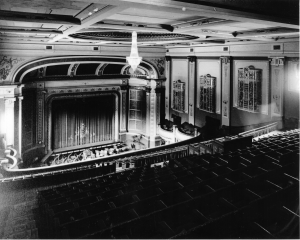
Capitol, interior 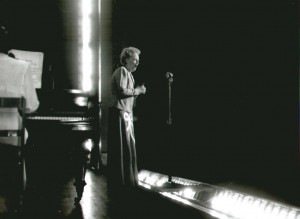
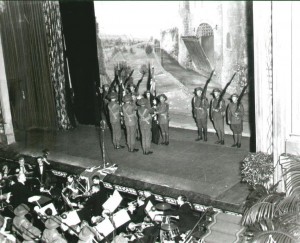
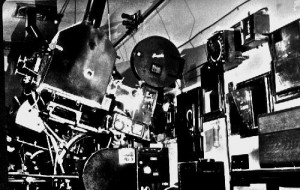
- Capitol Bio Box 1935
In 1926, plans were lodged with the West Australian Board of Health for a complex on the site, designed by architects Poole and Mouritzen. In addition to a theatre, the four-storey building was to house two garages, shops and offices, as well as a cabaret and a winter gardens (Everyone’s, 15 May 1929, p.26): the theatre was located on the northern side of the site, facing William St, while Temple Court buildings occupied the southern section, curving around into the Esplanade.
Total cost was over £100,000, and the building was not completed till 1929. The whole scheme was the brainchild of entrepreneur Dr A. J. Wright, who formed Temple Court Buildings Ltd expressly for the purpose. Stanley L. Wright then leased the theatre from the company, and appointed Jack Coulter as manager, Harry Cross as Director of Music, J.J.Collins as presentation manager (in charge of the live presentations) and Miss Leah Miller ballet mistress. The Capitol opened 4 May 1929, to enthusiastic reviews:
An impression of chaste solidity is conveyed to the observer from outside, and the interior’s grand splendour confirms it. Space is abundant. The mezzanine becomes not a passageway, but a roomy ante-chamber, the lounge is a luxurious drawing-room apart, and in the auditorium the seating accommodation has suffered by an attempt to give adequate room for all. Acoustics, ventilation and conveniences – are all well-nigh perfect, and a close examination of the interior reveals master craftsmanship worked out to the merest detail of decoration. (West Australian, 1 May 1929)
Built on solid, massive lines, with lofty roof-top supporting a marvellous chandelier, the decorative embellishments are on refined lines. Blue and gold, mostly gold, furnish the colour scheme. The ventilation is controlled by massive shutters on each side of the auditorium, covered by beautiful ornaments which house many lighting effects. It is from these side panels, standing out from the walls, that come the spotlights which give the light-painting effect to the chandelier, which is capable of illuminating the whole auditorium without aid from side or other lighting.
Lounge and mezzanine floors vie one with the other. On the passage ways to the lounge brilliant colours are illuminated by hidden lighting, and the transformation to a delightful drawing room is remarkable. Comfort is everywhere. There are corners where the light is a bit dim, cozy corners with soft rounded seats, coloured windows above the head.
The boudoir, the cloakrooms, all the appointments of the upper portion of the theatre, invite comfort. (Everyone’s, 15 May 1929, p.26)
However, eighteen months later Wright was forced to admit failure. Despite claims in early publicity that he had secured contracts with RKO for a supply of films for the theatre, he was never able to obtain sufficient first-class product to keep a cinema of over 2,000 seats viable in the city centre, even though he continued to advertise as ´Westralia’s premier extended season talking picture theatre’ (West Australian, 2 January 1930).
In addition, the Photophone sound system was the only one of its kind in Western Australia, causing problems of servicing and increasing expense. This had eventually to be replaced with a standard Western Electric system for the sake of economy. By then, however, the lease had been taken over by Hoyts.
For the next few years, the theatre shared the mixed fortunes of that company, becoming one of the General Theatres chain in 1934, and of Westralian Cinemas in 1936. In the forties the lease was taken over by Fullers, and then by General Amusements Pty Ltd, Garnett Carroll’s firm, and so it ceased to be programmed exclusively as a cinema. Its design, fully described by Ross Thorne, included a stage, and so it was used for concerts and theatrical performances:
…from Laurence Olivier to Jazz Jamborees, from the Chinese Classical Theatre to the Harlem Blackbirds, from Ice Capades to Ralph Richardson. The theatre has housed dancing school concerts, religious meetings, magicians, hypnotists and a variety of one-man shows. (Film Weekly, 19 November 1959, p.9)
The auditorium was ornate and lavish, aiming at the ultimate in comfort, even luxury. But the stage provision was not adequate for the larger companies and presentations, so in 1961 Edgleys, who by now had taken over the lease, decided to improve this aspect of the theatre. A fire in 1962, which destroyed stage and fittings, ended this plan, and in 1966 the premises were bought by the then Lord Mayor of Perth, T. E. Wardle. He announced plans to re-open the theatre, but accepted a further offer within months of purchase, and the theatre was demolished in 1967, to make way for a multi-storey office block.
From the very beginning, this site seemed dogged with misfortune, and not able to realise its potential. There were many sorry to see the magnificent building torn down, but few of those who had been actively involved in its history had found the experience really satisfying.
Sources: Tom Austen, The streets of old Perth, St George Books, Perth 1989, pp.104-5
Max D. Bell, Perth: a cinema history, The Book Guild, Lewes, Sussex, 1986, pp.74-77
Stage, Screen and Stars, West Australian, n.d. (1997?), pp.15-17,38
Ross Thorne, Cinemas of Australia via USA, pp.102 – 109
Daily News, 12 September 1966
Everyone’s, 11 July 1928, p.20; 18 July 1928, pp.15,21; 15 May 1929, p.26; 27 August 1930, p.7; 27 March 1929, p.18; 8 May 1929, p.20; 15 May 1929, p.26
Film Weekly, 19 November 1959, p.9
Film Weekly Directory, 1943/4 – 1964/5
Post Office Directory, 1911 – 1949
West Australian, 22 October 1962, 1908 – 1958
Interviews (Ina Bertrand): Ken Booth (1978), Chris Spivey (1978)Photos: 2 exteriors, b&w, 1906/191?, George Seddon & David Ravine, A city and its setting: images of Perth, Western Australia, Fremantle Arts Centre Press, 1986, pp.182-193
1 exterior (Esplanade gardens), b&w, c.1912, West Australian no.5956
1 exterior (Esplanade gardens), b&w, c.1912, Alexandra Hasluck & Mollie Lukis, Victorian and Edwardian Perth from Old Photographs John Ferguson Pty Ltd, St Ives, 1977, plate 61
1 exterior (Esplanade Gardens), b&w, n.d. (Ross Thorne)
1 interior (Capitol during construction), b&w, 1928, Everyone’s, 18 July 1928 p.15
8 interiors (Capitol), b&w, n.d., Ross Thorne, Cinemas of Australia via USA, pp.102 – 109
1 interior (Capitol biobox), b&w, 1935 (Ken Booth)
1 exterior (Capitol), b&w, 1930s, Tom Austen, The streets of old Perth, St George Books, Perth 1989, p. .105
2 exteriors (site of Capitol), b&w, 1981 (Bill Turner)2 photos of shows, n.d. donated to AMMPT
LIBERTY/CITY CINEMA/KIMBERLEYS CITY CINEMA/KIMBERLEY/LIBERTY, 81 Barrack St, Perth
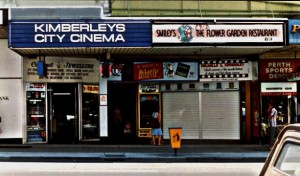
- Liberty 1981
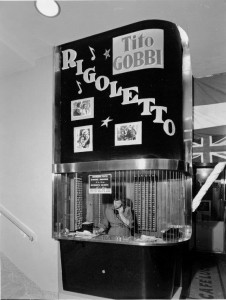
Liberty opening 1954 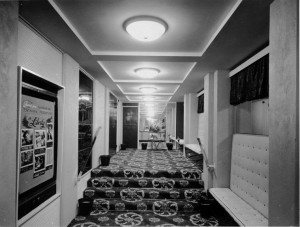
Liberty interior 1954 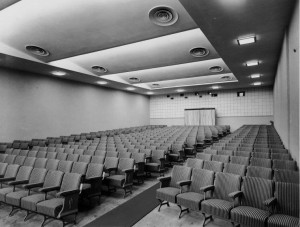
Liberty interior 1954 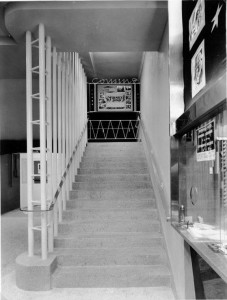
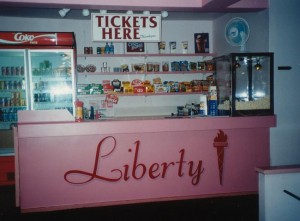
- Liberty 1992
Lionel Hart first visited Western Australia in his capacity as salesman for Universal Pictures. He later, however, accepted the position of director of the orchestra at the Prince of Wales. In the fifties he attempted to distribute ´continental’ films in Western Australia. At that time, cinemas such as the Sydney and Melbourne Savoys were sustained by the huge post-war influx of European migrants and by the growth of the film society movement which created an audience for what the trade called ´art’ films. Neither of these audiences was as strong in Perth as in the east. But Hart saw a potential market, and decided that, rather than try to break into the established circuits with such films, he would open a specialist cinema comparable to those in the east.
He converted the first floor of an office building into a small theatre, seating 450 patrons, and the Liberty opened 4 March 1954, with a charity premiere of Rigoletto, followed in later weeks by mainly Italian and French films. The premises were also used by the Perth Film Society for Sunday night screenings. In 1955 there were three screenings a day, and by 1958 this had grown to four, with more varied programming in the later years.
The cinema survived the arrival of television in Perth in 1959, then on 1 February 1961 the building was completely gutted by fire. It was rebuilt and re-opened in June that year, continuing with the same policy. A distinctive feature of the new building was the ´garden lounge’:
Situated at the rear of the 450-capacity theatre, the lounge will give patrons inside the impression of being seated in a garden.
They will be able to smoke and watch the film through a special glass partition window. (Sunday Times, 28 May 1961)
This did not, however, protect the theatre from fire, which again struck in 1971, requiring less extensive restoration, but still closing the premises for several months.
By now, the company that Hart had established, Independent Film Distributors (W.A.), was running the Savoy and the Windsor (Nedlands) as well as the Liberty, and was importing films for these theatres and distributing them in the rest of the state as well. This company was taken over in the late seventies by Frank Lloyd, whose background in the Savoy cinemas in Melbourne and Sydney ensured that the policy of continental programming would continue. However, the cinema industry depression finally made its presence felt, and even the fortunes of the specialist cinemas fluctuated till on 9 February 1978 the Liberty closed. Of Frank Lloyd’s chain, the Windsor survived as a prestige suburban cinema showing mainly ‘art’ films, and the Savoy became an R-movie house.
On 7 July 1978 the City Cinema opened on the Liberty/Kimberley site with a return season of A Star is Born, and from the end of July the theatre was known as Kimberleys City Cinema. It became first another R-movie house, then a repertory cinema for the Valhalla company, which was doing well in the east with classical revivals and specialist first runs.
By 1985, it was being run by a partnership of Bob Yelland, John Marsden and John Parker. It was still slightly seedy, known simply as the Kimberley, and presenting second runs of recent and popular films, and seasons of children’s films in the school holidays. In 1986 a freshening up of the venue included recarpeting and repainting the entrance, hanging a new sign outside, and re-siting the ticket box. However, patronage continued to decline, and in January 1987 a consortium took it over, to screen first-run Asian (Chinese-language) films. Then it closed for renovations.
In December 1992, the renovated cinema was re-opened, with 390 seats and reverting to the old name of Liberty. For a while, Malcolm Leech (who was running similar screenings at the Piccadilly) was screening Hong Kong movies there, on week-nights and at weekends from about 2 p.m. till 1.30 a.m. The candy bar was completely rebuilt in the small foyer. The first years were successful, but Chris Simmonds attributes the decline to ‘the black market in Asian Moveis and the Asian love of Western Movies’. A short-lived excursion into live theatre did not rescue the venture, which reverted to screening Chinese-language films in early 1997, but by October this closed and the cinema was again available for lease.
Sources: Building permits, Battye 1459 (Fol.2)
Max D. Bell, ´Liberty/Kimberley’, Kino, no.20, June 1987, p.4; ´Perth Liberty’, Kino, no.60, June 1997, p.11.
Max D. Bell, Perth: a cinema history, The Book Guild, Lewes, Sussex, 1986, pp.82-83
Jack Honnibal, ´The theatres of Perth 1939 – 1993′, Kino, no.45, September 1993, p.29
Australasian Exhibitor, 1960 – 1968
Film Weekly 1957 – 1961; 9 February 1961, p.1 (photo of Lionel Hart)
Film Weekly Directory, 1953/4 – 1971
Kino, no.15, March 1986, p.22; no.19, March 1987, p.23; no.40, June 1992, p.26; no.43, March 1993, p.31; no.44, June 1993, p.36; no.58, December 1996, p.31; no.59, March 1997, p.31; no. 62, Summer 1997, p.35
Post Office Directory, 1947, 1949
Sunday Times, 28 May 1961; 26 February 1978 (photo of Frank Lloyd)
West Australian, 1955 – 1997
Interview (Ina Bertrand): John Marsden (1997)
Informant: Chris Simmonds (2002)
Photos: 1 interior (renovated concession), colour, 1992 (Chris Simmonds)
1 exterior, colour, 1981 (Bill Turner)photos, 1954, b & w, Roy Mudge
MAJESTIC/PLAZA/PARIS, 656 Hay St, Perth
MAJESTIC
P.A (Paddy) Connolly owned the Grand (later the Perth) Hotel, and there is an industry legend about his early involvement with films: Dennis Dease is said to have screened from the balcony of his hotel across Barrack St to a screen mounted on the wall of a shop opposite, till the police were called in to control the traffic jam which resulted, and Dease found himself in court on a charge of obstructing traffic (Weekend Magazine, 21 May 1966, pp.21-23).
I have been unable to confirm this story, but Connolly certainly became actively interested in the film business when a syndicate he headed built the Majestic Theatres, in Perth and Fremantle. They were in direct competition with the other cinemas opened during the First World War – the Palladiums (Perth and Fremantle), the Britannia, the Pavilion and the Grand. Like them, the Perth Majestic had a policy of cheap admissions and continuous programming. It opened on 21 December 1916, with accommodation for nearly one thousand people.
The auditorium will be furnished with the latest and most comfortable leather tip-up seats, and similar seats are provided in the gallery, but upholstered in Utrecht velvet. The proscenium is very fine, being specially moulded in fibrous plaster, with a striking ornamental mounting. The balcony front is also figured out in fibrous plaster, is most imposing, and forms a most artistic decoration. The whole of the ceilings are covered with Wunderlich metal, picked out in pleasing designs and charmingly painted. The vestibule is very lofty and commodious, and the lounge upstairs is roomy and bright and tastefully furnished. The operating cabin is built of brick and cement, and absolutely fireproof, and the very latest and improved biograph machines will, it is stated, be installed, reducing the risk to a minimum. Mirrors abound on the walls, vestibule and landings, and nickel-plated rails give the interior a very bright effect. The building is well-ventilated, and, in addition to a large number of oscillating fans, there are two very large sliding roofs, one over the auditorium and one over the gallery, which should make the building cool on the very hottest days and nights. The premises will be brilliantly lit with electric lights within and without. (West Australian, 9 December 1916)
On 27 July 1918 the cinema was taken over by J.C.Williamsons and in 1927, it became part of the Hoyts chain. Sound was installed in 1930 (it was the last of the city cinemas to join the trend), and in 1932 it became part of the General Theatres group when Hoyts and Union Theatres temporarily amalgamated.
In later years, a popular feature of the cinema were the working models constructed by R.W.(Dick) Burch for the foyer to advertise new programmes, bringing children in particular to gawp at the display.
PLAZA/PARIS
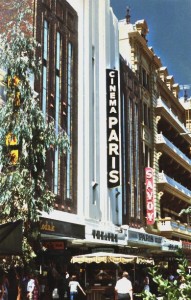
- Savoy and Paris 1981
Hoyts’ main city cinemas in the decade from their entry to the Perth scene in 1927 were the Majestic and the Regent. In 1937 the Majestic was demolished and a new, modern arcade was erected on the site, with shops on the street level and a cinema seating 1,313 – the Plaza – above. Shortly after, Hoyts relinquished the lease on the Regent, which became the Metro, so the Plaza took on the role of flagship for the company in Western Australia.
Architecture historian Ross Thorne describes it thus:
The facade to Hay St had a symbolic skyscraper effect. There were tall strips of windows; the centre third was taller than and projected from the remainder. Stepping from the centre of this central bay was the vertical sign which projected above the roof and curved back and down into the modern ziggurat roof form.
The auditorium was rather simple in fibrous plaster, striated lines and straight ceiling coves accentuated the long dimension of the room.
The slightly lower sections each side of the ceiling, as well as incorporating indirect lighting coves to wash light across upper ceiling levels and down the walls, probably boxed in the air conditioning ducts. (Ross Thorne, Cinemas of Australia via USA, p.274)
Further renovations, including the refurbishing of the interior and the installation of a Todd-AO sound system, were completed before the opening of South Pacific in 1960, which established a new long-run record for Perth of 45 weeks. The seating capacity of the theatre was reduced to less than one thousand in 1961.
On 17 August, 1965 the theatre closed, and re-opened two days later as the Paris. There were no major structural alterations this time, though later that year the entrance was resited in the Plaza Arcade. It was finally closed permanently in 1984, and the building was later converted into a disco.
In 1997 the cinema was derelict: the owners leased its entrances and exits for conversion into shops in the arcade, and access to the unused auditorium was only through a rear entrance on the laneway.
Sources: Building permits, Battye 1459, Folio 2
Max D. Bell, Perth: a cinema history, The Book Guild, Lews, Sussex, 1986, pp.83,89-90
Vyonne Geneve, ´William Leighton, architect’, Kino, no.25, September 1988, pp.7-15
Vyonne Geneve, ´The vulnerability of our Art Deco theatres’, Kino, no.28, June 1989, pp.6-8
Vyonne Geneve, Significant buildings of the 1930s in Western Australia, Vyonne Geneve, June 1994, National Trust of Australia (WA)/ National Estate Grants Programme, vol.1
Stage, Screen and Stars, West Australian, n.d. (1997?), pp.22, 41
Ross Thorne, Cinemas of Australia via USA, p.274
Everyone’s, 29 January 1930, p.18
Post Office Directory, 1917 – 1971
West Australian, 9 December 1916, 22 December 1916, 14 October 1960, 10 August 1961, 25 October 1965, 1916 – 1984
Interviews (Ina Bertrand & Bill Turner): Ray Cooper (1981)John Pye (1981)
Interviews (Ina Bertrand): Ken Booth (1981), Arthur Stiles (1985)Photos: 1 exterior (Majestic), b&w, 1922, Battye 3187 11816P
2 exteriors (Majestic), b&w, 1936, West Australian, nos 1662/1753
1 interior, b&w, Ross Thorne, Cinemas of Australia via USA, p.274
1 exterior (Paris & Savoy), colour, 1981 (Bill Turner)
1 exterior (Plaza), b&w, 1988, Kino, no.28, p.10 (Vyonne Geneve)
1 exterior (Plaza), b&w, undated, Wolanski collection ACTS, Kino no.72, Winter 2000, p.24MAYFAIR/CAPRI, 721 Hay St, Perth
MAYFAIR
The Times Theatrette was the first small newsreel theatrette to be built in Perth, but it did not last very long: the Mayfair Theatrette was the second, opened on 25 June 1947 with only 380 seats. It was built by Joel Moss in the basement of Sheffield House, under Levinson’s, in Hay St.
The main programming of such theatrettes was the newsreel, and as the distributors refused to supply Moss with the major newsreels available at the time (Cinesound Review and Movietone News), he decided to produce a local newsreel, christened the Westralian News. One advantage of doing this was that both the existing newsreels came from Sydney and concentrated on news from the eastern states: a West Australian newsreel should have had more drawing appeal for the people of Perth. He formed a company (Southern Cross Newsreels Pty Ltd, later Southern Cross Films Pty Ltd), with himself and accountant John Macauley as directors, and Bill Duff as company secretary. Leith Goodall, who had worked as a stringer for Movietone, became chief cameraman, and arrangements were made for processing to be done by Herschell’s in Melbourne. The difficulties and cost of maintaining a regular schedule without local processing facilities eventually defeated the project, and when Cinesound Review was offered to the Mayfair Moss accepted and closed the Westralian News in October 1947.
The theatrette continued, quite successfully. Prices were cheap – in 1948, 1s plus 6d tax for adults, and 6d without tax for children. Sessions began at 10 a.m., and lasted approximately an hour, hence the popular label ´hour show’. There would usually be eleven each day, before the theatre closed around 10 p.m. or later, as most programmes were slightly longer than the advertised hour. The programme for 1 January 1949 could be considered typical: a topical short film on the Royal Christening, an overseas and an Australian gazette, a cartoon, a sporting film, a Fitzpatrick travel film, and a nature film entitled Mirror of Submarine Life.
Television, however, provided such programmes within the home, making newsreel theatrettes redundant. The Mayfair maintained its policy of continuous programming longer than its competitor, the Savoy, which had opened in 1955. When it finally succumbed, it followed the Savoy’s lead and ran six to eight sessions daily, of shorts and a feature in almost continuous programming, still appealing to the same audience – shoppers and others with a couple of hours to kill in the city.
After Moss’s death the cinema was managed by Mr Monahan, who married Joel Moss’s widow, Esme Moss: after Monahan’s death, Esme Monahan managed the cinema herself. The Mayfair closed 25 May 1968.
CAPRI
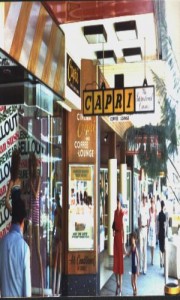
- Capri 1981
The venue re-opened, however, on 10 June 1968, as the Cinema Capri, now owned by Ace Theatres, but still managed by Esme Monahan:
Entrance to the theatre has been resited, cutting out what was previously a rather ‘tricky’ spot, and taking it close to the candy bar and coffee lounge, thus bringing these to the immediate attention of patrons.
The coffee lounge has telephones at every table, allowing patrons to place their orders without having to wait for service.
This section of the theatre is open from 10 a.m. until 11 p.m. to members of the general public who may not want to attend a screening on that particular occasion. (Film Weekly, 20 June 1968)
It was now programmed as a conventional city theatre, and continued with this policy till the late seventies, when Ace were feeling the effects of the cinema slump. They closed the Paris, but wanted to retain the Capri as an outlet for some of the films they were distributing, so made an arrangement with Peter Thomson, then managing the venue, to take over the lease but to continue to get his film supply through Ace.
The building was still owned by National Mutual, and at the end of the first three-year lease they wished to raise the rent to market value. Thomson pointed out that the lease required them to charge cinema rent, that is, the rent currently being charged on a similar cinema venue, so he was able to contain the rent rise at this point. By the time the second lease ended, he was already working towards opening in Fremantle, so offered to leave the Capri if National Mutual bought him out of the lease, which they did – to the satisfaction of both parties: National Mutual were now able to charge market value to the next tenant, and Thomson had some capital towards the Fremantle venture. In April 1986, the coffee lounge had been converted into a second cinema and the venue had begun operating as a twin cinema, but it all closed in September 1987, and the whole venue was immediately gutted for conversion.
Sources: Building permits, Battye 1459, Folio 2
Barrie King, ‘Westralian News: a postscript to Ray Edmondsen’s “The last newsreel”’, Cinema Papers, no.13, July 1977, pp.38-9
Australasian Exhibitor, 16 May 1968 p.8
Film Weekly, 18 April 1968 p.3; 6 June 1968, p.16; 20 June 1968
Film Weekly Directory, 1948/9 – 1971
Kino, no.15, March 1986, p.22; no.22, December 1987, p.23
Post Office Directory, 1947, 1949
West Australian, 25 June 1948, 1948 – 1987
Interviews (Ina Bertrand): Peter Thomson (1997), Arthur Stiles (1985)Photos: 1 exterior (Capri), colour, 1981 (Bill Turner)
1 interior (Capri), b&w, 1968, Film Weekly 20 June 1968, p.7MELROSE GARDENS/MELROSE THEATRE/PRINCE OF WALES, 254-258 Murray St, Perth
MELROSE GARDENS/ MELROSE THEATRE
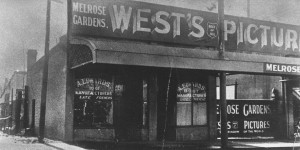
- Melrose gardens
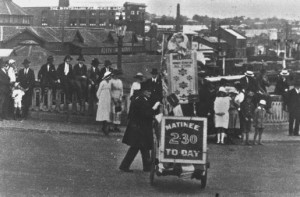
- Melrose Gardens exploitation campaign 1911
In 1908 West’s had opened the first permanent film presentation in Perth, starting at His Majesty’s but moving on six weeks later to the Queen’s Hall, where they were still operating with considerable success at the beginning of 1911. Thomas (later Sir Thomas) Coombe then constructed the Melrose Gardens, an open air pavilion capable of accommodating two thousand people, on land which had previously been Foy’s stables. J.Masel & Sons’ three-storey brick building with a tower impressively occupied the north-east corner of the junction of William and Murray Sts. Melrose Gardens was separated from this structure by only a narrow laneway: the entrance to the gardens was located between two shops and the gardens itself was behind these. West’s were the first tenant, and opened there on 11 February 1911, continuing to give their matinee performance in the Queen’s Hall.
The Queen’s Hall was used whenever the weather prevented screening in the gardens, and the whole enterprise transferred back there at the end of the summer season, the last screening in the gardens being Friday, 28 April 1911.
Instead of re-opening for the next summer season, the site was converted and advertised as ‘Perth’s leading vaudeville theatre’. It opened on 23 December, 1911:
The seating accommodation is ample, the theatre being able to accommodate over 2,500 people. The lighting, decoration, etc have been carried out in a superb style. West’s Pictures and Harry Rickards’ Tivoli Co., of English and continental artists, have joined forces and will present what is said to be the strongest vaudeville and picture entertainment ever shown in Australia. (West Australian, 3 December 1912)
The theatre, which will seat over 2,000 people, is practically semi-open air, having large louvre frames in the side of the walls, which are taken out on summer nights. The front part of the building will be four storeys high, when finished, and the whole of one of the floors will be turned into a winter garden. The theatre is fitted with every convenience, including ladies’ retiring rooms and hat and cloak rooms. For the convenience of patrons the management have arranged for an exit to the railway station. (West Australian 23 December 1911)
Only three stories can be identified from the photographs, and there is no information about the fate of the proposed winter garden. Various vaudeville managements, including Fuller’s, Rickards’ and the Brennan-Fuller Company, continued to use the venue until the early twenties. West’s, however, had been so successful that the company had launched into the suburbs, with programmes exclusively of films, so after 14 August 1914 they withdrew from the Melrose. From then on, vaudeville was offered there more often than films, and by 1920 films seem to have been confined usually to Sunday Concerts. Patrons were enticed with the reminder that even in the heat of summer this was a venue ´where the heat is dispersed with up-to-date fans and ventilators’ (West Australian, 24 January 1920).
PRINCE OF WALES
Coombe was not the sort of man to let an opportunity slip. When the building boom of the twenties was in full swing, he realised the potential of his prime site in Murray St, and so the Melrose was converted into a more modern structure – the Prince of Wales Theatre. The Prince of Wales never set foot in the building named after him, but it was appropriately regal in its architecture and decoration.
Hamilton Brown, employed by Coombe as manager for the new theatre, early put his entrepreneurial talents to work on its behalf. For several weeks before the theatre opened a mysterious one-liner appeared in the advertisements columns of the daily paper – ’22 22′. Everyone, including those who considered themselves on the inside of the entertainment business, was curious, and the public was suitably mystified. Then came the announcement of the grand opening of the Prince of Wales, and the mystery was cleared up – this was the telephone number of the new theatre, already familiar to all Perth, and that much more likely to be used for the booking of seats.
The theatre was the largest in Perth at the time, still with over two thousand seats. The front facade was retained, but it was now a fully-enclosed theatre, with major changes also made to the interior. The auditorium now had two levels, a stalls and a dress circle with private boxes at the back. Other touches of luxury were the upholstered seats, the marble staircases and the scent spray in the upstairs lounge, for the use of dress circle patrons only. On a more pedestrian note, there was a refrigerator in the foyer for the storage of perishables while shoppers attended a screening: an attendant in immaculate apron and cap would issue a ticket for parcels lodged, just like lodging your coat in a cloakroom.
Brown was equally successful in his programming policy. As the theatre was the most prestigious in Perth when it opened, and as Brown also managed the rest of Coombe’s theatres (which at that time included the Palladiums – Perth and Fremantle – as well as the Theatre Royal), he had considerable bargaining power with the distributors, and the theatre was able to obtain some of the most popular of the first-release product, including films like The Lost World and The Covered Wagon. The Australian blockbuster For the Term of His Natural Life had its Perth premiere here, and was widely advertised, including on a special tram which ran around the city streets entirely enclosed in a huge poster for the film.
But the theatre was not used exclusively as a cinema. The usual practice was for the first half to be vaudeville, perhaps introduced by a newsreel film and followed by a short film comedy or cartoon. Then, after interval, came the featured film.
The Prince of Wales was one of the two cinemas to introduce sound film to Perth: on 6 April 1929, while the Regent screened The Red Dance using sound-on-film, the Prince presented Warner’s The Jazz Singer, using sound-on-disc.
With the lowering of the lights and the parting of the stage curtains one saw on the screen a row of trumpeters and simultaneously heard their brazen fanfare, introducing what the programme set out as ‘the first Vitaphone entertainment with cinesound presentation.’
…For nine tenths of the performance the synchronization was perfect and amazing. This orchestral presentation did leave the impression that one should have heard a greater body of tone from 60 players – the number stated – were they actually present; but the matter of volume, one understands, can be regulated by those controlling the reproduction, in which case experience should soon discover the right quantities. It was noticeable that the orchestral score of ‘The Jazz Singer’, heard later, came across with a distinctly greater sense of the close actuality of a large body of musicians… (West Australian, 8 April 1929)
In the same review, an Italian operatic aria impressed the reviewer, not only for its ‘flawless’ synchronization, but also because ‘the all-important illusion of the voice issuing from the seen singer and not from some adjacent mechanism was perfectly maintained.’ But the highlight of the evening was undoubtedly the feature film, The Jazz Singer, despite the fact that there was only one brief spoken scene. This whole film the reviewer found touching and dramatic, and much enhanced by the musical score. It was such a success that it lasted several weeks, not only because of the novelty of sound. Other sound films followed, not quite so successfully once the novelty wore off, and once the deficiencies of the Vitaphone process in comparison with sound-on-film had become apparent. It was finally necessary for the theatre to bow to the obvious worldwide trend, and convert to sound-on-film.
Meanwhile, Coombe had gone into partnership with the West Australian branch of Union Theatres, so at the start of the depression the theatre was a part of a larger empire. When economies had to be made, the decision was taken that the Ambassadors (which had four shops dependent on the custom from the theatre and returning rent to the company) should be kept open rather than the Prince, which had only one shop. So, for several months in 1931 the Prince was dark. Then it came under the General Theatres banner at the time of the amalgamation of the interests of Hoyts and Greater Union in 1933. Finally in 1935 the theatre was closed permanently, and the site was absorbed into the Myers store.
Sources: Tom Austen, The streets of old Perth, St George Books, Perth 1989, pp.84-85
Max D. Bell, Perth: a cinema history, The Book Guild, Lews, Sussex, 1986, pp.87, 90-91
Rodney I. Francis, ´The Coombe family of Perth’, Kino no.34, December 1990, pp.12-17
Stage, Screen and Stars, West Australian, n.d. (1997?), pp.26-30
Mirror, 18 June 1928, 12 March 1930
Post Office Directory, 1913 – 1926
West Australian, 18 December 1911, 23 December 1911, 8 April 1929, 1910 – 1936
Westralian Worker, 11 September 1931
Interview (Ina Bertrand): Chris Spivey (1978)
Interview (Ina Bertrand & Bill Turner): John Pye (1981)Photos: 1 exterior (Masels corner, with West’s visible beside it), b&w, 1911, Tom Austen, The streets of old Perth, St George Books, Perth 1989, p.85
1 exterior (West’s Melrose Gardens), b&w, n.d.
exploitation campaigns, b&w, 1911, 1930s, 1940s, Arthur Stiles (example given here is 1911)
1 exterior (crowd), b&w, 1929, Everyone’s 21 August 1929, p.18
1 interior (foyer refrigerator), b&w, 1920s, Battye 4641P
1 exterior (Prince of Wales), b&w, 1926, West Australian no.6587
1 exterior (Prince of Wales), b&w, c.1921, Battye 616B/3182 11810P
1 exterior (Prince of Wales), b&w, n.d., Battye 4671P
1 interior (foyer), b&w, n.d., Battye 4647P
1 exterior (night), b&w, n.d., Battye 4650P
5 interiors (vestibule showing entrance to stalls, vestibule showing entrance to dress circle, portion of the auditorium, view from the lounge looking into foyer, view from dress circle entrance looking into lounge) b&w, n.d. (1923?), in The Western Australian Tourist Guide and Hotel and Boarding Directory, Govt. Tourist Bureau, n.d., p.56.NORTH PERTH PICTURE THEATRE/PICTURE PALACE/EMPIRE, 40 Monger St, Perth
On 23 June 1917, the North Perth Picture Theatre opened in Monger St, off William St. Two months later it was advertising under the name of the Empire Picture Theatre, North Perth, though apparently screening on weekends only – afternoon and evening on Saturdays, and Sunday evenings. In January 1920, it was advertising in the city papers, but at prices more like those in suburban cinemas (6½d, 5d and 3d). It appears to have been owned by Connolly, who built the Princess (Fremantle) and the Majestics (Perth and Fremantle), but it was apparently less successful than these, as by February 1920 it was advertised for sale, and did not re-open as a cinema.
Sources: Post Office Directory, 1918 – 1920
West Australian, 12 February 1920, 1917 – 1920OLYMPIA THEATRE/OLYMPIA GARDENS, 800 Hay St, Perth
Edward Branscombe opened the Olympia Theatre on 31 October 1911, as an open air venue for the summer seasons of his vaudeville company. Till just after World War 1, this thrived, introducing to Perth audiences such companies as the Dandies and the English Pierrots, though it does not appear that any of them screened films. The venue continued, though more modestly, in the twenties, and was revived briefly in the thirties by Allan Jones, who had made his mark on exhibition in the south-west of the state, particularly at Busselton. In 1932 he opened the New Olympia Open Air Talkies, the only open-air venue for films at that time in the city centre. After one successful season, Jones decided to concentrate on his country circuit. Another operator took over the lease, but the venture closed soon after, before the end of the 1933-4 summer season.
Sources: Max D. Bell, Perth: a cinema history, The Book Guild, Lewes, Sussex, 1986, p.87
Post Office Directory, 1912 – 1934/5
West Australian, 1911 – 1925, 1932 – 1933
Interview (Ina Bertrand & Irma Whitford): Allan Jones (1978)PALLADIUM, 723 Hay St, Perth
William Lean opened both his Palladium Theatres in 1916 – the first in Fremantle and the second on 15 December in Hay St, Perth. The Perth Palladium was slightly larger than the Pavilion and the Britannia – its main competition – extending across almost three shopfronts, and with a more imposing decorative facade. It was in obvious reference to the competition that Lean advertised:
Just remember my prices are ALWAYS 3d and 6d and you don’t have to listen to a mechanical pianola either. (West Australian, 1 January 1917)
Indeed the Palladium could boast of a full orchestra at evening performances, right from the beginning, and by 1925 it was the ´Palladium Symphony Orchestra at evening sessions, under direction of Mr F.Spargo, late of Walter George’s Sunshine Players’ (West Australian 2 January 1925). It could also boast a ´Sliding Roof and Elaborate Cooling System’ which made it ´Without Doubt THE COOLEST THEATRE IN PERTH’ (West Australian, 2 January 1925).
Lean was a book-maker, who had built the Pavilion in 1914 but never run a cinema, and after eighteen months he preferred to sell his interests in the Palladiums to Sir Thomas Coombe, who installed as manager Hamilton Brown, then manager of the Britannia. In February 1919, the cinema became a Union Theatre, part of the West Australian chain that Coombe was now directing for the national company. Brown continued as manager until he was transferred to the Prince of Wales when that theatre was built by Coombe in 1923.
The Palladium was never wired for sound, but this cannot be blamed for its demise, as its last screening was in 1926, well before the impact of sound was felt in Perth. Perhaps the financial pressures of the late twenties, and the spread of the picture palaces, made continuing with the Palladium uneconomic for Union Theatres, when they also had the more prestigious Prince of Wales and Ambassadors.
Sources: Max D. Bell, Perth: a cinema history, The Book Guild, Lews, Sussex, 1986, p.87
Stage, Screen and Stars, West Australian, n.d. (1997?), p.23
Theatre Magazine, 1 January 1917
Post Office Directory, 1917 – 1926
West Australian, 1916 – 1926Photos: 1 exterior (Lean’s Palladium Pictures), b&w, c.1918 (Battye?)(also in Alexandra Hasluck & Mollie Lukis, Victorian and Edwardian Perth from Old Photographs, John Ferguson Pty Ltd, St Ives, 1977, plate 65)
1 exterior (Palladium), b&w, c.1921/2, Battye 816B/3188 11817PPAVILION, 709 Hay St, Perth
On Monday 9 February 1914 the second purpose-built hardtop cinema in Perth was opened – built by W.H.Roberts for W.F.(Bill) Lean (who later ran the Palladium) and leased to J. D. Williams Amusement Co. The Pavilion was small in comparison with the grand live theatres in operation such as the Theatre Royal or His Majesty’s, or with the gardens like the Melrose or the Shaftesbury or the Palace: only one thousand seats. It was comparatively narrow, approximately a double shopfront wide, but it had a small entrance foyer like a conventional theatre, where patrons could congregate before the show or during interval. Engraved on the facade in the middle of the third (topmost) storey was the insignia ´The Cinema’ – as the Empire/King’s/Melba was no longer operating, the Pavilion could legitimately claim that exclusive title.
Not more significant, but certainly more noticeable, was the sign picked out in light bulbs across the entire width of the building just below the insignia. It proclaimed ´Continuous Pictures’, the trademark of Williams’ exhibition policy, which had already proved popular in America and in the eastern states of Australia. The policy had been introduced to Perth in 1908 by the World’s Touring Car, and had also been used in the theatres for the daytime sessions from noon to 5 p.m., but the Pavilion was the pioneer among the permanent theatres in using the system from 11 a.m. to 11 p.m. At first prices depended entirely upon where you sat, but by the twenties it was cheaper to enter for daytime screenings: ´all day sixpence, night sessions ninepence’ (West Australian, 7 January 1926).
Cheapness was indeed a feature of the whole enterprise. Continuous screening maximised the number of patrons, and cheap entrance was intended to encourage frequent visits. So, though the very best seats in the house could cost up to 2s, the regular prices were 3d for the stalls and 6d for the circle, about half the rates charged even by the open-air shows and a great deal below those of the live theatres. So it was possible to advertise as ´the People’s Theatre’ (West Australian, 2 January 1925), with ´…family prices – the workers’ prices’ (West Australian, 3 January 1927).
At its opening it could justly claim to be ´Perth’s most palatial photo-play palace’ (West Australian, 2 March 1914), but as the decade progressed and other cinemas were built, this was no longer the case. It acquired the reputation which often goes with low prices – a metaphorical as well as a literal ´cheapness’.
From June 1919 J.D.Williams’ interests were absorbed within the Union Theatres group, and the Pavilion continued as a Union Theatres house. The exhibition policy, however, continued as Williams had established it – continuous programming and cheap admissions.
But the twenties was the decade of the picture palace, and the Pavilion was less and less able to compete. Spraying water on a hessian screen near the stage may have been effective in cooling the interior of the theatre, but it somehow lacked the style of the sophisticated air-conditioning systems being installed in theatres such as the Prince of Wales or the Capitol. The Pavilion did convert to sound – it was advertising talkies in January 1930 – but soon after this the property was sold and became shops.
Sources: Max D. Bell, Perth: a cinema history, The Book Guild, Lews, Sussex, 1986, p.88
Stage, Screen and Stars, West Australian, n.d. (1997?), p.23
Post Office Directory, 1914 – 1926
West Australian, 1914 – 1930
Interview (Ina Bertrand): Chris Spivey (1978)Photos: 1 exterior, b&w, c.1921/2, Battye 3189 11818P
PERTH OVAL, Loton Park, Lord St, Perth
Screenings on behalf of the East Perth Football Club had been conducted on the Perth Oval in Lord St as early as February 1912. These continued, sometimes twice a week (Wednesday and Saturday), sometimes only on Saturdays, till the twenties, at first in the south east corner of the oval, then later in the north-west corner, with patrons sitting in the grandstand. They were very successful, but, like all open-air shows, they could only continue while the weather held, so were limited to the summer months.
Nevertheless, they continued till the East Perth Premier Theatre was opened in 1924.
Sources: West Australian, 1911 – 1920
Interview (Ina Bertrand & Bill Turner): Graeme Norton (1981)PERTH TOWN HALL, cnr Barrack & Hay Sts, Perth
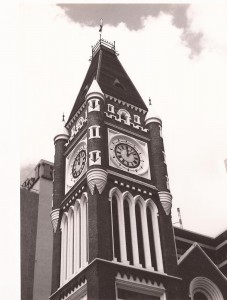
- Perth Town Hall 1981
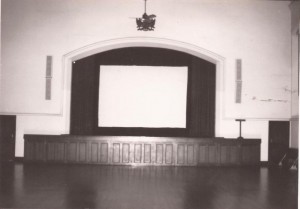
- Perth Town Hall interior 1981
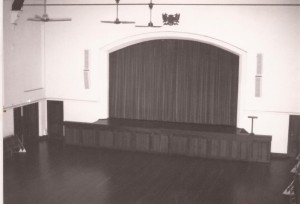
- Perth Town Hall interior 1981
This prestigious building, commenced May 1867 and opened 1 June 1870, had been occasionally used for limelight performances in the nineteenth century. The first biograph display advertised in the hall was a season of the Royal Bioscope Co. from 29 September to 6 October 1900. Other itinerant biograph shows used the premises over the next few years, including the Vivagraph in December 1903 and March 1904, Stevenson’s Biograph in February 1904, Spencer’s American Theatrescope in April 1906, the New York Bioscope Co from December 1906 to January 1907, Leonard Davis’ “Our World” in June 1907, “Olympia – the Passing Show” in July 1907, and Lefebres’ Paris Biograph Co in October and December 1908.
Then came the first of the ´permanent’ shows, when King’s Pictures, already screening at the Midland Junction Town Hall and in the new King’s Picture Gardens, took on a lease of the Perth Town Hall for the winter of 1909. Their season began, as advertised, on 9 April, but was abruptly terminated on 19 June, without explanation, as the manager of King’s Pictures, Mr C.Sudholz, became involved in one of the wrangles that pursued him through his career in film exhibition. The hall, however, did not long remain dark.
It was used for occasional visiting film shows, and on 25 December 1909 for a demonstration of “Transmitting photographs over telephone wires”. Then on 2 May 1910, Empire Pictures began screening there, at first on Saturday nights only, but from 10 September for six nights each week. The company advertised aggressively, determined to withstand the fierce competition by now operating in the city centre. They re-decorated the premises with two hundred pot plants, ferns and palms, provided electric fans, and claimed that, though small in comparison with the live theatres or the picture gardens, the Town Hall was the ´cosiest’ hall in Perth (West Australian, 3 December 1910).
They featured singers or instrumentalists performing live at appropriate moments in dramatic films, such as Miss Lulu Benstead singing the Jewel Song during the screening of Faust. They ran beauty competitions for shopgirls, and for children from eight to twelve years old, filming the finalists in familiar Perth settings and inviting the citizens of Perth to be part of the proceedings and to see themselves on screen in the finished product. They insisted in their advertisements that their weekly changes of programme were all new to Perth, specially imported on their behalf, and under their exclusive control. And they stressed repeatedly that they were a local (i.e. West Australian) show, not connected (except for a short while at the very beginning) with showmen from the eastern states. They featured local (i.e. Australian) productions, particularly those produced by their main supplier, Pathe Freres, like Captain Starlight and The Miner’s Daughter. Finally, they astounded the citizens of Perth, and the representatives of the City Council and the Fire Brigades Board, by presenting, in conjunction with Pathe, a demonstration of the latest in non-flammable film (West Australian 19 July 1911).
But then they announced an intention to open their own premises, and the lease passed into the hands of Ideal Pictures from December 1911 to August 1912. In September, October and December 1912, other showmen took the hall over for short seasons, but by the end of the year competition from the picture gardens, opening again for the summer season, was too much, and screenings in the Town Hall ceased. In the winter of 1916, regular films screenings resumed on Friday and Saturday evenings. But then the hall reverted to public use, and as purpose-built cinemas proliferated in the next few years it was never again called upon to act as a full-time cinema.
Sources: The Heritage of Western Australia: the Illustrated Register of the National Estate, Macmillan 1989, pp.34-36
Max D. Bell, Perth: a cinema history, The Book Guild, Lewes, Sussex, 1986, p.88
Sir Hal Colebatch C.M.G. (ed), A story of a hundred years: Western Australia 1829 – 1929, Government Printer, Perth WA, 1929, p.438
West Australian 1900 – 1916 (also ´Perth Town Hall’, 21 October 1922; ´Our Town Hall’, 25 April 1936)Photos: 1 exterior, b&w, n.d. (before electricity), West Australian, no.1019
1 exterior, b&w, n.d., The Heritage of Western Australia: the Illustrated Register of the National Estate, Macmillan 1989, p.362 interior and 1 exterior, b&w, 1981, Roy Mudge
PICCADILLY, 700-704 Hay St, Perth (Hay St Mall)
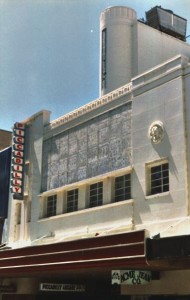
- Piccadilly 1981
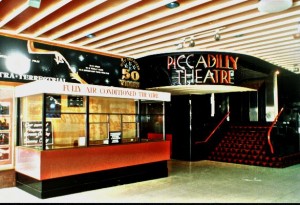
- Entrance after 1985
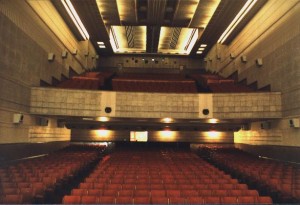
- Piccadilly circa 1985
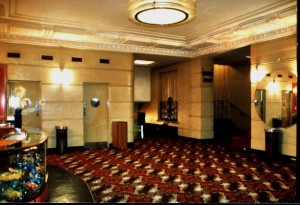
- Piccadilly circa 1985
- Piccadilly circa 1985
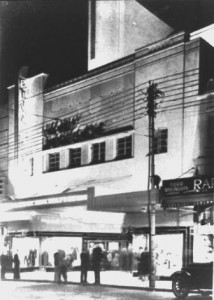
- Piccadilly circa 1930’s
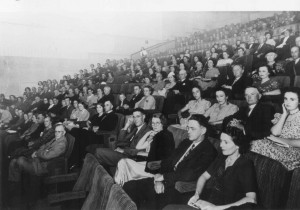
- Piccadilly , date unknown
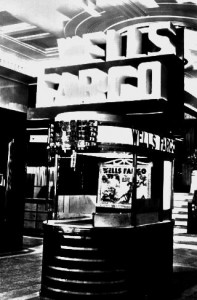
- Piccadilly ticket box advertising Wells Fargo
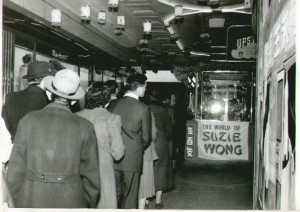
- Piccadilly advertising Suzie Wong
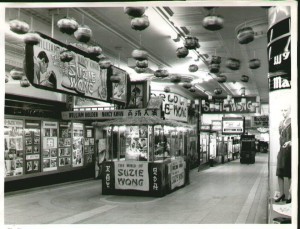
On 10 March 1938 the first theatre especially built for the Grand Theatre Co opened in Perth – the Piccadilly. It was situated above the Hay St end of the Piccadilly Arcade, which was a shopping arcade through to Murray St. It was designed in Art Deco style by William Leighton of Baxter-Cox and Leighton, and originally seated over one thousand, but repeated renovations over the years reduced that capacity to just over nine hundred.
The building is fully described by Ross Thorne (Cinemas of Australia via USA, pp.265-267). The rather severe exterior looked more like a fifties suburban cinema than one opening in the thirties, and survived into the eighties still appearing comparatively modern.
A policy of first-run releases, and a stress on the modernity of the building and its fixtures were the key images presented by the cinema. Carrier air conditioning cost £6,500 and provided automatic thermostatically-controlled temperature within the building, regardless of the temperature outside, or the number of patrons in the auditorium. A twenty-five passenger lift transported patrons to the foyer and was advertised as the only such lift in operation in any cinema in Australia:
‘The furniture, in addition to being locally-made, has been specially designed here to suit the theatre and fit in with its colour schemes. From the 24 ducoed flower pots to the low divans in the foyers everything is original.
‘The panel treatment of the walls, too, fits in with the general plan of the modern architecture of the theatre. A pastel green shade has been used in keeping with the coolness of the theatre.
‘The lighting is on an elaborate scale and the drapings and carpets were imported for the theatre.
‘The stage curtains have come from New York and there are many beautiful mirrors.’ (Film World, 11 March 1938)
The Piccadilly could charge higher admission than the Grand: it was airconditioned from the start, and screened first run product in longer seasons than the weekly-release Grand. However, despite its superior position in the Grand Theatre Company hierarchy, it could not compete in prestige with the older and more luxurious Royal. All three were taken over in 1973 by the consortium which bought out City Theatres, and in 1978 by TVW Enterprises which took over complete control from the consortium.
In 1983 a thorough renovation transformed the cinema. The lower level was converted into a shopping arcade, and the lounge into a four hundred seat cinema, still called the Piccadilly. In deference to the origins of the theatre in the thirties, and in keeping with cyclical fashions in architecture, the whole remodelling was in Art Deco style, and much of the atmosphere of the original Piccadilly was retained. In fact it won the 1986 Architect’s Design Award for Excellence in Renovation.
Chris Simmons describes the renovations like this:
‘…the main screen was brought forward 10m. The upstairs section was brought forward and a new floor put in. The screen frame and gold velvet curtains with the original lifting gear were put in place. The curtains lift up not out like on most screens. They recreated the Art Deco look around the screen so you can’t tell the difference unless you know.’
In 1989 the venue was sold by Hoyts to Glen Darlington, of Classic Cinemas, and closed briefly in early 1990. Malcolm Leech then took over the lease, and converted a section of the disused stalls into a small cinema, making the Piccadilly into a twin, seating 443 in Cinema 1 and 165 in Cinema 2. He continued, screening Hong Kong movies in Cinema 2, but the lease of Cinema 1 went to Greater Union in the summer of 1991-2. Then Malcolm Leech turned the venue into a triplex (seating 443, 110 and 103), by adding Cinema 3 behind the main screen.
Chris Simmons again:
‘Cinema 2 is on the left side of the old stalls and Cinema 3 is sideways behind the main screen with the left side siting above Cinema 2. So I guess it is in the stalls but it is right down in front of where the main screen was originally. The right side of the stalls is now a small foyer. The area was left unusable… fter the renovation in the 80s. Malcolm found it fairly easy to build Cinema 2 although it has a small screen and he was able to get a Projector from the closed Town Cinema. Cinema 3 had to have large steel beams put in for the steep floor which appeals to the younger ones more. Each row is .5m higher than the one in front so you always get an uninterrupted view. The air con is situated in the basement of the arcade and it is ducted up to the cinema through brick ducting. There are 2 large compressors that are the originals. They were rebuilt and converted to run on the newer gas. The main problem it had was gas leaks but since being rebuilt you could cool the cinema with only 1 compressor… The Piccadilly has heaps of character and is quite a contrast to today’s large complexes.
‘I was a projectionist there and also did a lot of repairs including painting and I can tell you that there is a ghost. Several people saw it but it was harmless if not a little creepy… I was replacing the curtains with doors on the entry to cinema 1 late one night when my friend and I took a break. I was in the candy bar getting a drink when I saw a shadowy figure move across the entry to the lift. My friend didn’t believe me until he saw the same thing 15m latter. I’m sure it was a ghost as it gave us that kind of feeling that several other people have had there. The cleaner had to have all the lights and music going in order to do his work and when I was doing any late night repairs you would always hear noises but you got used to it. Apparently some years ago a customer was locked in and in the dark fell down the stairs and was found dead in the morning.’
The Piccadilly continued to operate into the new century, but Malcolm Leech leased it to Dennis McKenna in May 2001.
Sources: Building permit, Battye 1459, Folio 2
Max D. Bell, Perth: a cinema history, The Book Guild, Lews, Sussex, 1986, pp.88-89
Vyonne Geneve, ´The vulnerability of our Art Deco theatres’, Kino, no.28, June 1989, pp.6-8
Vyonne Geneve, ´William Leighton, Architect’, Kino, no.25, September 1988, pp.11-12
Vyonne Geneve, Significant buildings of the 1930s in Western Australia, Vyonne Geneve, June 1994, National Trust of Australia (WA)/ National Estate Grants Programme, vol.1
Jack Honnibal, ´The theatres of Perth 1939 – 1993′, Kino, no.45, September 1993, p.29
Jack Honnibal, ‘The Piccadilly, Theatre of Distinction’, Kino, 74, Summer 2000, pp.24-28 (erratum Kino no 75, Autumn 2001, p.34)
Bob Parkinson, ´Field report’, Kino, no.41, September 1992, p.12
Stage, Screen and Stars, West Australian, n.d. (1997?), pp.31, 42
Ross Thorne, Cinemas of Australia via USA, pp.265-267
Film Weekly Directory, 1943/4 – 1971
Kino, no.18, December 1986, p.24; no.26, December 1988, p.23; no.28, June 1989, p.23; no.32, June 1990, p.23; no.33, September 1990, p.23; no.36, June 1991, p.24; no.39, March 1992, p.25; no.40, June 1992, p.26; no.59, March 1997, p.31; no.62, Summer 1997, p.35; no.72, Winter 2000, p.43.
Post Office Directory, 1938/9 – 1949
West Australian, 10 February 1938, 10 March 1938, 11 March 1938, 1938 – 2000
Interview (Ina Bertrand): Arthur Stiles (1985)
Interview (Ina Bertrand & Bill Turner): Ray Cooper (1981)
Informant: Chris Simmons (2002)Photos: 1 exterior, b&w, 1930s? (Arthur Stiles)
1 exterior, colour, 1981 (Bill Turner)
3 exteriors, 2 interiors, b&w, n.d. Ross Thorne, Cinemas of Australia via USA, pp.265-267
21 exteriors & interiors, colour, after 1985 (Roy Mudge)
1 exterior, 1 interior, b&w, 1986, Kino, no.25, September 1988, p.13 (Byron Geneve)
1 exterior, b&w, n.d. Kino, no.28, June 1989, p.7 (Vyonne Geneve)
1 interior (ticket box advertising Wells Fargo), b&w, n.d., Arthur Stiles1 interior of audience, n.d, from the AMMPT archives
PREMIER AND GARDENS, 293 Stirling St, Perth (East)
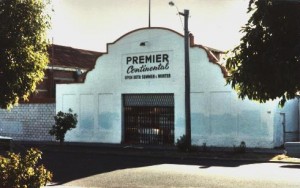
- Premier and Gardens 1981
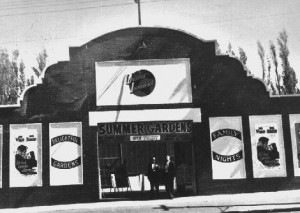
- Premier and Gardens 1950
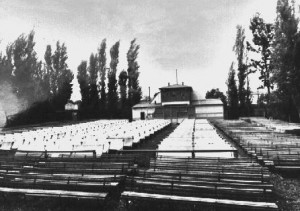
- Premier and Gardens 1950
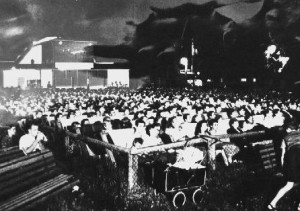
- Premier and Gardens 1950
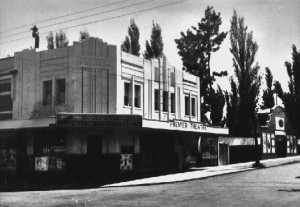
- Premier and Gardens 1924
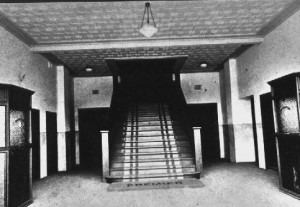
- Premier and Gardens 1924
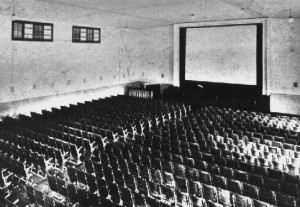
- Premier and Gardens 1924
Although this building is technically within the City of Perth, it was known for all its history as the East Perth Premier Theatre and Gardens. This probably began because of its early association with the East Perth Football Club.
Screenings on behalf of the Club had been conducted on the Perth Oval in Lord St as early as February 1912. These continued, sometimes twice a week (Wednesday and Saturday), sometimes only on Saturdays, till the twenties, at first in the south east corner of the oval, then later in the north-west corner, with patrons sitting in the grandstand. They were very successful, but, like all open-air shows, they could only continue while the weather held, so were limited to the summer months.
While Cyril Norton was secretary, the club decided to embark on commercial screenings, and W.R.(Bill) Haynes, who was the patron of the club, put up the money for the first permanent premises. This was the East Perth Premier Theatre on the corner of Bulwer St and Stirling St, which opened in 1924, with a capacity of nearly 1500. The tiles on the facade were in the club colours of blue and black, and the club’s investment was protected by the building being without a slope to the floor, so that if the venture was not a success it could be converted into a dance hall.
The club had an arrangement with Haynes to pay off the debt out of the profits, but despite the success of the theatre this was slow in being achieved. In 1927, Haynes paid a further £1,000 to the club in return for them relinquishing their rights entirely. He appointed Cyril Norton as manager, and arranged that when Haynes died Norton would inherit the building if he accepted responsibility for organising probate on the will. So, when Haynes died, Cyril Norton took over the business.
Talkies were first presented, using Australian-made Raycophone sound equipment, on 30 September 1929. In 1937 a gardens was built alongside the theatre, in Stirling St, with a capacity of 1800. Admission to the central section of the gardens, with its canvas-covered deck-chairs, was more expensive than to the outer sections with wooden seats. The whole was surrounded by poplars, and attractive gardens.
At the same time major renovations were made to the theatre, removing the side windows which had previously been used for ventilation. In 1940, new projectors were installed in the theatre.
This was one of the few suburban venues which switched between the theatre and the gardens for prestige shows, starting the gardens about an hour later than the theatre, rather than opening only one of them on any one night. It was considered one of the most successful and attractive suburban venues, and the design was used also as the basis for the Broadway Theatre in Victoria Park. Cyril Norton’s astute buying usually won his venue the first suburban release screenings, and this played a part in the theatre’s popularity with audiences.
Cyril Norton became managing director for the Grand Theatre Company in 1944, after the death of James Stiles, but he continued to also run the Premier in his own right. He died in 1953 and his son Graham took over as manager of the Premier.
After television arrived, Graham Norton kept the theatre alive by showing Italian-language films. But keeping the theatre building operating was expensive, so he seized the opportunity to lease it for conversion as an ice skating rink, and the Italian films were moved into the gardens next door. To enable these to be screened throughout the year a small covered section was then built over part of the seating area, accommodating about 500 people. However, the supply of films was dependent on the importers in Melbourne. Though some of the American block-busters, dubbed into Italian, were very successful, it was difficult to obtain enough films and in 1975, when the flat iron screen was blown down in a storm, it was decided to close the gardens permanently.
The rink was leased in 1982 to Selwyn Ward, who had purchased the ice skating business, but when a larger rink opened in Mirrabooka the Premier closed, and the venue was turned into a disco. After twelve months this, too, closed, but it was re-opened by Steve Pietracatella, who leased the venue from 5 October 1984. Despite restoration work on the theatre building in 1985, it closed permanently on 27 April 1987 and was demolished soon after. All through this time, the site was owned by Graham Norton and his sister (Corinne Kobelke), and they still own the site – including the two-storey building tenanted by the National Australia Bank, which opened in 1987.
Sources: Max Bell, Perth – a cinema history, The Book Guild, Lewes, Sussex, 1986, pp.40-41, 62-3
Max Bell, ´Premier Theatre and Open Air Gardens, Perth WA’, Kino no.22, December 1987, pp.4-5
East Perth Movie Magazine, 1927 – 1929
Everyone’s, 18 September 1929, p.12; 12 February 1930, p.25
Film Weekly Directory, 1943/4 – 1971
Kino, no.21, September 1987, p.22
Post Office Directory, 1924 – 1949
West Australian, 1924 – 1970; 16 September 1964
Interview (Ina Bertrand/Bill Turner): Graham Norton (1981)
Informant: Graham Norton (2001)Photos: 4 exterior (gardens), b&w, 1905s (Graham Norton)
2 exterior (theatre), b&w, 1924/1937 (Graham Norton)
3 interior (theatre, b&w, 1924/1937 (Graham Norton)
1 exterior, n.d., Stage, Screen and Stars, West Australian, n.d. (1997?), p.43
1 exterior (gardens), colour, 1981 (Bill Turner)
2 exterior (theatre), colour, 1981 (Bill Turner)
1 exterior (theatre), b&w, 1982, Kino no.22, December 1987, p.5 (Max Bell)
1 interior (theatre), b&w, 1985, Kino no.22, December 1987, p.5 (Max Bell)
1 exterior (gardens), b&w, n.d., Kino no.22, December 1987, p.5 (Max Bell)
1 exterior (theatre), b&w, n.d., (Max Bell, Perth – a cinema history, p.40)QUEEN´S HALL/ REGENT/ METRO, 91 William St, Perth
QUEEN’S HALL
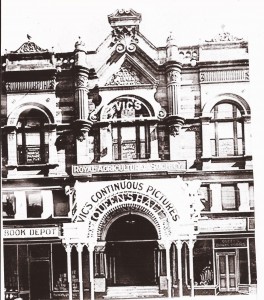
- Queens Hall
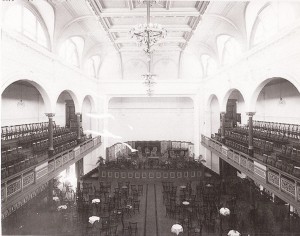
- Queens Hall interior
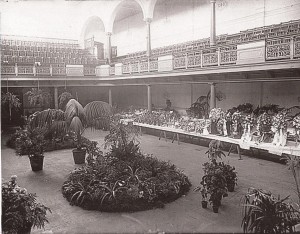
The Wesleyan Methodist Church had had its West Australian headquarters on the corner of William and Murray Streets since their first chapel was built there in 1830. Alterations and additions and replacements took place over the remainder of the century, until on 19 April 1899 the Premier, Sir John Forrest, opened the grandest of all their buildings just around the corner in William Street, next to the church which still stood on the corner site itself. This new building was the Queen’s Hall:
The style of architecture is Romanesque, and it is very effective. Attention was confined principally to the hall, entrance to which is obtained from William-Street, through a marble-tiled vestibule 15ft wide. The ascent of a dozen marble steps leads to the corridor, which runs to the hall…At the end of the corridor mentioned are the staircases which branch off at either side, and which lead to the galleries of the hall, while a few yards further along three large double-swing doors admit to the body of the hall. At a cursory glance it can be noted that this is by far the largest, and, to all appearances, the most commodious hall of its kind in Perth. Its measurements are – length, 100 ft; width, 60ft; height from floor to roof, 42 ft; and stage 35ft by 24ft. The ceiling of the hall is coved, lined with wood, with heavy cornice moulds, panels, and centre flowers; while the windows on either side through which abundant light streams, are built in the coves. At night the light will be supplied by six electroliers, each containing 25 lights, while scattered around the hall are numerous single incandescent lights. The galleries, which run round three sides of the hall, are 12ft wide, and from any part of them a perfect view of the stage can be obtained. The galleries are supported by iron pillars, and another set of pillars from the galleries supports a series of arches, which, in addition to imparting a picturesque appearance to the hall, have, together with the pillars, an important effect on the acoustic properties of the hall, in that they break the sound waves. Seats are provided for 1,500 people, while an additional 500 could be accommodated without any degree of discomfort. (Daily News, 19 April 1899)
Provision was made to clear this large audience quickly in the event of fire or other emergency, through escape doors fitted with ‘Chubb’s Patent Locks’ which could be easily opened from the inside, and which gave access to rights-of-way to both William and Murray Streets. Ventilation and fire precautions were also considered to be of the most modern design. In addition to the main hall, the building contained classrooms and offices, and provided for eleven shops along the street front.
It was intended that the hall would be used for Church purposes on weekends, and hired out for lectures and musical presentations for the rest of the time. The first film exhibition was only months after the official opening, and would have been considered eminently suitable, though presented by a representative of another denomination: on August 16, 1899, Commandant Booth opened a special campaign to inform the citizens of Perth of the operations of the Salvation Army, through his ‘Wonderful and Thrilling Lecture, assisted by Limelight, Kinematograph and Graphophone’ (West Australian, 14 August 1899).
Mrs Booth conducted a further series of limelight lectures in the hall in September 1900, and in October 1901 this was where Perth witnessed the remarkable Melbourne production of Soldiers of the Cross, two hours of films, slides, exhortations, prayers and music.
The Methodists were perhaps stimulated by this use of a modern invention in the service of the Lord to introduce something similar themselves, starting with limelight lectures from 6 to 9 July 1900 on ´The Melbourne Mission: Lights and Shades of City Life’, and continuing throughout the rest of the year with lectures on many subjects, by many different lecturers, ranging from travelogues of Britain to explanations of the progress of the Boer War.
This high-minded programming did not prevent more commercial exploitation of the venue by regular cinematograph entrepreneurs, who presented seasons at the hall in the usual way, before or after their country tours and visits to Fremantle. But the Church also expanded its own use of the moving picture during the period of office of Rev. G.E.Rowe. This gentleman introduced the ´Sunday night after church’, a programme from 8.45 to 9.30 on a Sunday evening, advertised as ´Bright. Brief. Brotherly.’ (West Australian, 16 April 1904)
Rowe played an active part in the presentation by performing the ´descriptive sketches’ which accompanied the films or slides. A new subject was presented each night, sometimes in serial form over several weeks. The most popular of these was apparently that entitled ‘Ben Hur – the life of Christ’, which Rowe was exhorted to present complete in the hall on a week night, as the effect of the serialised version had been so profound. He also introduced the ‘Children’s Nights’, again of films and slides with ´descriptive sketches’, and these too were well-supported, so that ´There was barely standing room for the children’s entertainment’ (West Australian, 14 October 1905).
By the end of 1905, however, Rowe must have moved on as the frequency of the Sunday lantern services diminished noticeably and the degree of entrepreneurial effort in their presentation slipped dramatically. Perhaps, like the Salvation Army, the Wesleyan Methodists had second thoughts about employing a medium which was obviously becoming increasingly commercialised. They did not, however, feel compelled to limit the hiring of their hall, which had already become one of the major venues for moving pictures in the city. Cozens Spencer presented some of his early seasons there (September 1905, October – November 1905, March 1907), as did local entrepreneur Charles Sudholz (December 1905, April 1907), the Taits (April 1906, May 1908), and the Corrick family (February 1907, August – September 1907), as well as numerous other lesser lights in the business.
Then, on 20 June 1908, West’s Pictures were transferred from His Majesty’s, where they had been running continuously, six nights per week, for five weeks. This was the first truly ´permanent’ film show in the state, intended to continue indefinitely, though still not in purpose-built premises. West’s success was unprecedented in the state. The company (represented between visits from T. J. West himself by B. A. Leix, who had formerly worked for the Taits) had access through its contacts interstate and overseas to an apparently inexhaustible supply of films, enabling a weekly change of programme and a confident claim that all pictures presented were exclusive and had not been screened in Perth before. They were, for instance, the exclusive outlet for Pathe Art Films, including the very successful The Red Hand, and The Assassination of the Duc de Guise, and they stressed the high artistic quality of everything presented under their name.
The response from the public was overwhelming:
Every Saturday evening the management is compelled to proclaim the ‘House Full’ some time before the entertainment is commenced… This satisfactory position is a reward for excellent screening, complete changes of varied subjects every week and excellent incidental music provided by a large and efficient orchestra. (West Australian, 28 September 1908)
The policy of renewing the bill without waiting for popular interest in a programme to wane is bringing its reward by making the lovers of moving pictures frequent instead of occasional patrons. (West Australian, 16 January 1909)
This success prompted West to expand, into Fremantle, and within the city into Melrose Gardens, which opened in February 1911. Despite reassurances that both city venues would continue, for the rest of the summer Queen’s Hall was used only for the matinee or if the weather was unsuitable for an outdoor performance. However, on 3 May the regular West’s programmes returned to the hall, when the gardens closed for the winter. An experiment in continuous screening from noon till 5 p.m. was attempted with the Coronation Films in July 1911, but at the end of the season the management reverted to evenings only, except for the Saturday matinee.
Then, at the end of 1911 the lease was transferred from West’s to Vic’s Pictures, a company owned by four partners, one of whom was T. J. West’s former secretary Victor Newton. Another of the partners, Jack Coulter, later to be manager of the Capitol, was the projectionist. This company had been screening for some time in the Fremantle Town Hall, and now added screenings in the Queens Hall from 27 January 1912. They continued with the policy established by West of night screenings, and weekly changes, till the competition of the opening of the Pavilion Theatre in 1914 forced a change to continuous screenings from 11 a.m. to 11 p.m. six days a week.
It was probably the rash of purpose-built cinemas in the rest of the decade that forced the closure of the Queen’s Hall as a venue for moving pictures, in January 1919. The hall reverted to casual hire, including being used as a department store for a year after the former premises of Economic Stores were burnt down in January 1920.
REGENT
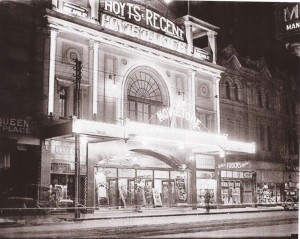
- Hoyt’s Regent 1927
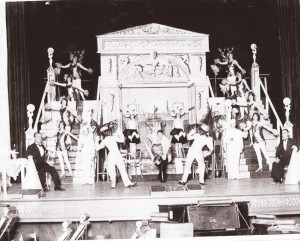
- Show, date unknown
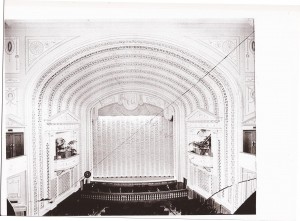
- Hoyt’s Regent interior 1927
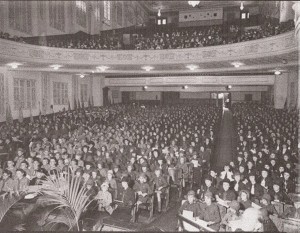
- Audience
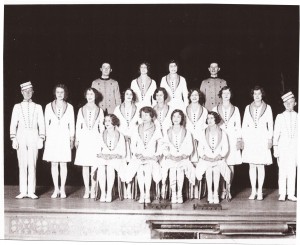
- Hoyts Regent c 1927
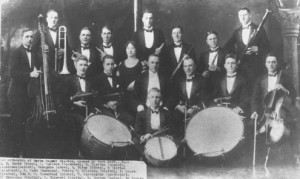
- Perth Regent Orchestra
But its connection with films was not to be entirely severed. In 1927 Hoyts secured the lease as a site for their Perth Regent, one of a chain of major cinemas to be built in each state capital. The hall was rebuilt by the Methodist Church for this purpose, which perhaps explains the conservatism of the architecture, criticised by Ross Thorne (Cinemas of Australia via USA, pp.306-307).
However, if Hoyts’ management were disappointed they did not allow the public to know. The tone of the official opening programme for Saturday, 10 September 1927, was as fulsome as such publications always were:
Hoyts Regent makes history for Perth, in the shape of the landmark that has arisen….
The most modern equipment and ventilation inventions will enable the Regent to be the cosiest of rendezvous in winter, and a cool theatre in the summer months. A typhoon system will flush the whole of the interior with fresh air, but the discomforts of drafts will not be felt. Another feature of the system is that it has been made possible for the huge panels on the side walls to be operated on the shutter principle. Without being designed as an open-air theatre, the Regent will yet embody all the attributes of such…
Every part of the theatre is fireproof, and every modern appliance has been installed…
Foremost, and most interesting of the apparatus, is the patent dimming machine, the first of its kind in Australia…
It will control the whole of the illuminations throughout and vary the shading of the concealed lighting in such a manner that visions of an Aladdin’s cave will be conjured up…An orchestra of 15 members, embracing musicians of unquestionable talent and experience in their art will add its share to the enjoyment of patrons.
…Accommodation has been provided for nearly 2,000 people… The principal colour scheme is formed of a neatly interwoven combination of mauve, cyclamen and gold, giving a charm of beauty and brightness, and an artistic magnificence unparalleled in theatre construction in the Antipodes…
Comfortable upholstered chairs have been fitted throughout…
The more than ordinarily pronounced slope given to the floor level throughout ensures a clear and uninterrupted view of the stage and screen from whatever angle they are regarded…
Beautiful crystal glass chandeliers – they are fitted at intervals throughout – illuminated pillars, and bevelled glass mirrors stretching the length and breadth of the spacious foyer, throw their dazzling reflections before the eye: a fascinating and fairylike scene.
The furnishings are as luxurious and tasteful as they could possibly be made. (Official Programme, 10 September 1927)
The opening programme was a charity performance for the Children’s Hospital, including a screening of Three Bad Men (advertised as “a Fox masterpiece”).
At first, the familiar continuous screenings were presented, but by January 1928 these were limited to the daytime, from 11 a.m. to 5.30 p.m., with a special screening advertised to start at 2.30 for those patrons who wished to attend a full daytime screening. Then the usual evening session commenced at 8 p.m. On 4 August 1928 a Wurlitzer Theatre Organ was installed, which survived the various renovations and alterations of the theatre, till it was removed before the theatre’s demolition in 1973. In early 1928, Hoyts’ circuit in Perth consisted of the Regent and Majestic in Perth, the Majestic in Fremantle, and the Majestic and Cremorne in Kalgoorlie.
The first sound films in Perth opened simultaneously at the Regent and the Prince of Wales on 6 April 1929: the Regent screening The Red Dance using the sound-on-film process, and the Prince of Wales The Jazz Singer on Vitaphone sound-on-disc. The Regent’s programme was enthusiastically received by the capacity audience, and by the critics:
The clearness and realism of the sound films was remarkable; it was as though persons clothed in warm flesh and blood were speaking or singing to the audience. (West Australian, 8 April 1929)
However, the reception was not entirely uncritical:
All the films were not of equal merit. All the voices did not record equally well. While there was perfect harmony between action and sound in every case, some of the voices did not sound out clearly, and some of the speakers had such an American twang that they were difficult to understand. (West Australian, 8 April 1929)
The featured film, The Red Dance, had no spoken dialogue at all, just a musical score, and was of very ordinary standard apart from the novelty of the soundtrack. It moved on after only a week, the management insisting that the decision was simply to maintain the service of frequent programme changes which regular patrons of the theatre had come to expect. After that, there were often weeks without a sound feature, though the newsreel was regularly accompanied by sound from then on.
However, within a year, the changeover had been made to full talkie programming, and the nature of film presentation had dramatically altered. On opening night, an overture to the first half and a ´novelty entr’acte’ in the second half had been presented by the ´Hoyts Regent Orchestra of 16 Master Musicians’. In addition, an acted prologue called ´The Spirit of Motion Pictures’ had been presented as the prelude to the film in the first half, and the theatre also had its own small ballet company which performed in similar prologues in other programmes. The introduction of the Wurlitzer had not affected this, just added an extra element, as Percy Burraston performed both with the orchestra, and solo during intermission. But sound films changed all this. The week commencing 12 October 1929 was the last when the orchestra, the ballet and the organ combined their talents – from then on only the Wurlitzer remained, reduced to playing overtures and at interval, except on special occasions.
METRO
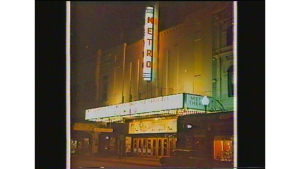
- Metro Cinema, date unknown
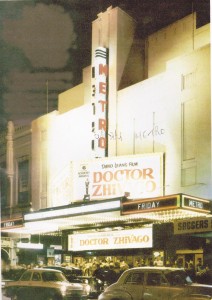
- Metro 1965
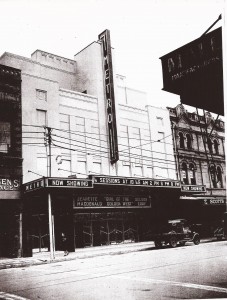
- Metro Theatre Opening Show 1938
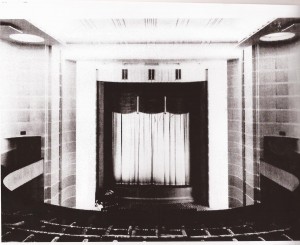
- Metro Interior
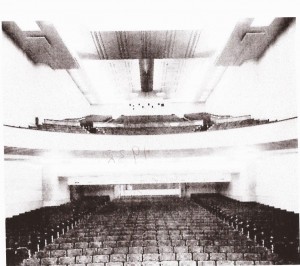
- Metro 1938
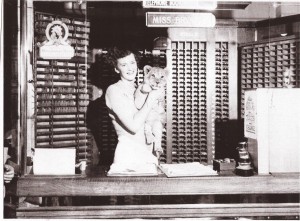
- Metro Box office 1938
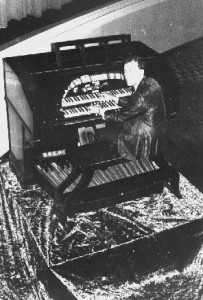
- Perth Metro Wurlitzer
Hoyts’ fortunes in the West were mixed, and in 1938 they relinquished the lease on the Regent, even though it had been intended as the flagship for the company in the state. On 13 May 1938, Metro-Goldwyn-Mayer Theatres Pty Ltd took over the lease, and opened the theatre under its new name – the Metro, as a showcase for MGM films. These had previously been exhibited through James Stiles’ Theatre Royal, which continued to screen the overflow, and sometimes negotiated a deal for simultaneous release (as with Gone with the Wind). But later that year the theatre was closed for extensive remodelling.
At a cost of £30,000, ´the whole of the interior was gutted and redesigned and the front elevation was stripped of its former decoration and remodelled in moderne Art Deco style.’ (Thorne, p.307) The theatre became the first in Perth to install an electrified air-conditioning system, and the seating was made more comfortable, thus reducing accommodation from nearly 2000 to less than 1500.
With perhaps understandable bias, a former Metro usherette
recalls the theatre as ´the most glamorous in Perth’:
The usherettes were chosen for their figures, hair and general glamour. They didn’t have to be beautiful, as long as they had ‘oomph’, but I must admit most of them were beauties. How we loved our job. We were very conscious of our prestige. Nearly all our wages were spent on hair do’s, make-up and clothes.
The shifts were long. Sometimes we would work from 10.30 a.m. until 11.30 p.m. but we didn’t care. We would have a break during the day and spend it walking around the shops. Heads would turn and shop girls would whisper: ´They work at the Metro.’
We were quite aware of the sensation we were creating and our perfectly coiffured heads would be arrogantly angled….
Those uniforms! Every year we would have a new design. The new style would be the most closely guarded secret in Perth….
Nearly twenty girls would be on the floor on Saturday nights, all smiling and relaxed, showing none of the strain of coping with thousands of screaming, yelling children who attended the Saturday shows. The foyer would be filled with prams on weekdays and this is where we proved we were not just glamour girls. Half the prams would be filled with sleeping babies and it was quite common to see a glamorous blonde, redhead or brunette giving a baby a bottle so the mother could enjoy the show. (Mrs Jean Allen, West Australian, 9 December 1981)
The Metro continued to screen under the MGM banner, as ´Theatre of the stars’, till 1970, when Roadshow took over the lease:
Sad to relate, the Metro Theatre finally closed in October 1973, the final film being the immortal classic Gone with the Wind, which was screened before a capacity audience. As the last few feet of film went through the projector gate, a slide of ´Leo the Lion’ was superimposed on the screen and the lights came up slowly, the sound of a lone piper then being heard as he slowly walked down the aisles playing The Last Lament. This truly was a wonderful tribute to this warm, friendly cinema that had always been popular. Many patrons were seen leaving with tears streaming from their eyes, remembering the good old days when they had sat in the theatre watching many a silent and sound melodrama through the years. (Max Bell, Kino, no.9, p.13)
Jack Honiball’s reminiscences are a good example of the affection with which the cinema was remembered. However, within hours of the closing images on the screen, the wreckers moved in, and the theatre made way for yet another shopping complex.
Sources: Jean Allen, ‘The way it was’, West Australian, 9 December 1981
Max D. Bell, Perth: a cinema history, The Book Guild, Lewes, Sussex, 1986, pp.83-7
Max D. Bell, ‘Perth: Regent/ Metro’, Kino, no.9, pp.11-15
Stage, Screen and Stars, West Australian, n.d. (1997?), pp.24-25, 42
Ian Hanson, ‘Perth’s Metro: Theatre of the Stars’, Kino, no.84, Winter 2003, pp.6-8
Jack Honiball, ‘Metro: more great moments of Perth’s Theatre of the Stars’, Kino, no.86, Summer 2003, pp.28-29
Ross Thorne, Cinemas of Australia via USA, pp.306-7
Daily News, 19 April 1899, 8 September 1927
Everyone’s, 5 September 1928, p.16; 20 March 1929, p.30; 30 October 1929, p.28
Film Weekly Directory 1943/4 – 1971
Kino no.25, September 1988, p.14
Post Office Directory, 1912 – 1949
Sunday Times, 8 October 1973
West Australian, 11 September 1905, 9 April 1906, 5 May 1938, 1899 – 1973
Interview (Ina Bertrand): Arthur Nielsen (1978), Chris Spivey (1978), Arthur Stiles (1985)Photos: 1 interior (Queens Hall), b&w, c.1900, Battye 2588B/P17?
1 interior (Queens Hall), b&w, 1911, West Australian no.5932
1 exterior (Queens Hall/ Vic’s Pictures), b&w, 1917, West Australian no.1012
1 exterior (Queen’s Hall), b&w, 1899, Alexandra Hasluck & Mollie Lukis, Victorian and Edwardian Perth from Old Photographs John Ferguson Pty Ltd, St Ives, 1977, plate 62
1 interior (Queen’s Hall), b&w, 1903, ibid, plate 63
1 ´Melody Lane Girls’, b&w, n.d., Sunday Times, 8 October 1973
1 Regent orchestra, b&w, 1927
1 exterior (Regent), b&w, 1928, Kino, no.9, p.14 (Ian Hanson)
1 interior (Regent), b&w, 1928, Kino, no.9, p.14 (Ian Hanson)
1 exterior (Regent), b&w, 1938, Ross Thorne, Cinemas of Australia via USA, p.306
1 exterior (Regent), b&w, 1928, Everyone’s, 8 August 1928, p.14; also see 5 September 1928, p.16
1 exterior (Regent), b&w, n.d., Battye, 8292B/ 8723 – 1
1 exterior (Regent), b&w, 1938, West Australian no.2093
1 exterior (Metro), b&w, n.d., Kino, no.9, p.15 (Ian Hanson)
1 interior (Metro), b&w, n.d., Kino, no.9, p.15 (Ian Hanson)
5 Metro Wurlitzer, b&w, 1973 (Roy Mudge)
2 exteriors (Metro), b&w, n.d., Kino, no.84, pp.6-7 (ACTS archive – Ian Hanson)
5 interiors (Metro), b&w, n.d., Kino, no.84, pp.6-8 (ACTS archive – Ian Hanson)1 exterior , colour, 1965, Roy Mudge
1 exterior, date unknown from AMMPT archives
1 exterior and 3 interior, 1938, b&w, Roy Mudge
SALVATION ARMY FORTRESS, Pier St, Perth
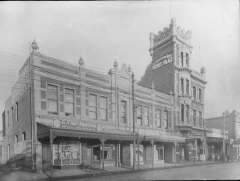
- Salvation Army circa 1920
Limelight lectures on religious themes were popular from late in the nineteenth century, and it was a natural development that moving pictures should be added to the armoury of the evangelists, of all denominations. So, Adjutant Perry brought the cinematograph to the Salvation Army in Perth, with a screening in the Fremantle Town Hall in April 1897. Commandant Booth toured through the suburbs in August 1899 after a season at the Queen’s Hall in the city, with ´…his Wonderful and Thrilling Lecture, assisted by Limelight, Kinematograph and Graphophone, Living Pictures of the Army and its Operations’ (West Australian, 16 August 1899).
The most famous of the Army’s programmes was Soldiers of the Cross, a multimedia presentation including limelight views and moving pictures produced by their own Limelight Department in Melbourne and presented in Fremantle Town Hall on 15 October 1901, and in the Queen’s Hall the next night. The Salvation Army in Perth did not have a production team, but from this time on films were an important part of their missionary work among the citizens of Perth. Their film programmes (as had the limelight lectures before them) presented aspects of the Army’s social work, religious subjects (particularly the life of Christ), and also general educational material such as travelogues from visiting missionaries. In support of these, and to leaven the mixture a little, were presented the more innocuous of the general programme fillers available at the time – humorous and ´pathetic’ items, and plenty of ´scenics’.
The first Fortress Hall, on the east side of Pier St, between Hay and Murray Streets, was opened officially in August 1899 during Booth’s Westralian tour.
The building is of brick with white stone facings. To the left a square tower rises above the main entrance, bay windows intervening in the second and third storey. The entrance is excellent, the large iron gates taking the place of the outer door, being decorated with pretty Army crests. The stairway and corridor leading to the main hall are spacious, light and inviting, the auditorium itself being a model hall for comfort, convenience and good taste. The ceiling is unique and very pretty. The windows are unusually striking, being glazed with a special glass. The platform and seating arrangements cannot be excelled. (War Cry, 16 August 1899)
It was not large enough to accommodate the audience for Soldiers of the Cross, so it was some time before it was used for public film exhibitions. On 20 August 1902, a programme was offered consisting of music and films, including scenes from the Boxer Rebellion, the turnout of the Chicago Fire Brigade, the Duke of York’s visit to Hot Springs in New Zealand, High Diving in Paris, Kicking Cow, Pillow Fight, Fishing Fleet in full Sail, etc. It is hard to imagine how such titles could contribute to the evangelical effort, but they certainly helped to promote the image of the Army as part of the ordinary community, and brought to its premises people who might otherwise not have come, people who were than available to be helped or converted.
Till 1908 the Army had several Biorama Companies touring extensively throughout Australia and New Zealand. Western Australian tours took place in September to November 1900, and again in September 1902. In 1904 the company was described as consisting of ‘SIX SKILLED OPERATORS, MUSICIANS and VOCALISTS, with the latest ENGLISH and AMERICAN BIOSCOPE PROJECTOR’ (West Australian, 10 February 1904), originating from the production unit in Melbourne. Their first West Australian performances were in Fremantle and at the Perth Fortress in January 1904, then for the next two months they toured the country districts. After visiting New Zealand they returned in September 1904 to Fremantle and later the Perth Fortress, and this time presented their own production of The Early Roman and Scottish Martyrs (West Australian, 1 October 1904), which probably meant a programme combining productions such as Soldiers of the Cross with short films of the Scottish martyrs. It was a programme of films and music advertised as taking two hours for ‘the most up-to-date entertainment’ (West Australian, 3 October 1904). The final visit of a Biorama Company to the West was in July-August 1906, when they again performed in Fremantle and Perth and toured the country areas.
Between visits of the Army’s own Biorama Company, short seasons of other cinematograph programmes were presented at the Perth Fortress, for instance in September 1905, January 1907 and August 1909. But after this the Army in Perth reverted to the use of limelight views for illustration, perhaps discouraged, as they had been in the eastern states where the Biorama Company was officially disbanded in 1910, by the increasing commercialism of the medium, and the presumed ill effects on viewers of the poorer class of moving pictures so frequently presented.
The Army’s premises expanded over the years, and a new Fortress Hall opened in 1930, but public film screenings were never presented there. The original Fortress Hall building is still there, now converted for use as offices for legal firms.
Sources: War Cry, 26 August 1899, p.9, 14 October 1899, p.3
West Australian, 1899 – 1909
http://www.abc.net.au/limelight/docs/tours
Informants: Bill Booth (2001), Lindsay Cox (2001)Photos: 1 interior, b&w, 1899, War Cry, 14 October 1899, p.3
1 exterior, b&w, 1899, War Cry, 14 October 1899, p.3
1 exterior, b&w, 1920s?, Salvation Army archives, MelbourneSAVOY, 636 Hay St, Perth
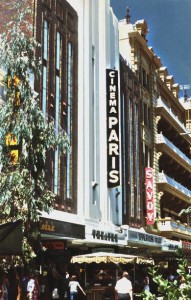
- Savoy 1981
On 23 December 1955, Lionel Hart opened the second of his Perth venues, after the Liberty in 1954. This was a newsreel theatrette, in the basement of Betts and Betts in Hay St, where there had formerly been a billiard saloon. The 300 seat Savoy ran continuous ´hour shows’, that is programmes of not less than an hour (though frequently slightly more), starting at 10 a.m. and continuing without a break till approx. 11 p.m., allowing patrons to enter and leave as they pleased, and to stay as long as they wished. Its appeal was particularly to shoppers and others with a short time to kill in the city, so it advertised ´nursery, powder rooms, free cloak and parcel depository’ (West Australian, 23 December 1955).
For a while, Perth sustained two such shows – the Mayfair as well as the Savoy, but television brought this to an end, by providing similar programmes free in your own lounge room. So, at the Savoy, continuous programming of re-runs of successful feature films replaced the newsreel format: for instance, in January 1964 seven sessions per day of a ´3 Stooges’ film, in January 1965 eight sessions per day of East of Eden. But even this was difficult to sustain, and the cinema drifted more and more into sensational programming, after the success of films such as London in the Raw, presented in June 1965, to which children under 16 were not admitted. By the time of the ´R’ certificate legislation in 1972, the Savoy had a reputation for rather risque programmes, and was one of the first to convert to a policy of screening only R-rated movies, a policy with which it was very successful until the early eighties.
It closed briefly in 1983, then reverted to more conventional programming when taken over by John Marsden later that year, re-opening on 17 November 1983. When Marsden had difficulties with film supply, he sold it to Ken Hill who installed video projection and in February 1987 began to run it as a sex cinema, with topless usherettes. In 1991 it was closed temporarily and its equipment moved to Club X Cinema in the basement of the Club Emporium in Barrack St.
In 1997, the building that housed the old Savoy was still there, but the cinema staircase and entrance had been demolished, and shops extended across these gaps: access was still possible from the laneway behind to the derelict interior, as it was with the rest of the Savoy Hotel.
Sources: The Heritage of Western Australia: the Illustrated Register of the National Estate, Macmillan 1989, pp.42-3
Building permit, Battye 1459 (Folio 2)
Max D. Bell, ´Perth Savoy’, Kino, no.23, March 1988, pp.14-15
Max D. Bell, Perth: a cinema history, The Book Guild, Lewes, Sussex, 1986, p.92
Film Weekly, 6 July 1961, p.6, 2 December 1965, p.6
Film Weekly Directory, 1958/9 – 1971
Kino, no.20, June 1987, p.23; no.37, September 1991, p.27; no.38, December 1991, p.26
Sunday Times, 26 February 1978
West Australian, 1955 – 1997Photos: 1 exterior (Savoy & Paris), colour, 1981 (Bill Turner)
2 interiors, b&w, 1986 (Kino no.23, p.25)
1 exterior (Savoy Hotel), b&w, n.d., The Heritage of Western Australia: the Illustrated Register of the National Estate, Macmillan 1989, p.42SHAFTESBURY PICTURE GARDENS/SHAFTESBURY THEATRE/LUXOR THEATRE/ LUXOR PICTURE THEATRE/TIVOLI, 49 Stirling St, Perth
On the fringes of the city proper, in Stirling St near the corner of James Street, the Shaftesbury Gardens was built on the site of a woodyard and officially opened on Saturday 11 March 1911, exactly one month after the more central Melrose Gardens. The new gardens was even larger than its competitor – three thousand seats to the Melrose’s two thousand – and began with particularly low prices, 1s for front stalls, 6d for back stalls and 3d for the gallery.
These prices were greatly increased for a special season, commencing on 18 February 1911, of the 6,000 ft complete film of the Johnson-Jeffries prize fight. For this short season, prices rose to 3s, 2s and 1s, and the West Australian reported that:
Prior to the commencement of the entertainment several scores of persons who had only paid for admission to the cheaper parts of the house found themselves without seating accommodation, and as one man these suddenly scaled the barricades and occupied the 3s seats to the evident delight of the galleryites and some concern on the part of the management. (West Australian, 21 March 1911)
Twice weekly changes of programme also helped to keep the enterprise afloat, but it was not long before the regular prices had to be revised – to centre stalls 1s, front stalls and gallery 6d, with children half price.
Unlike West’s at the Melrose, the management had no hardtop to retreat to in case of unsuitable weather, so 29 April was the last screening in the open gardens, and the premises were re- opened on 10 June after construction of a roof. The venue was now variously known as the Shaftesbury Gardens, Shaftesbury Theatre and Shaftesbury Picture Palace, and in the absence of a detailed description it can only be assumed that it was another of the ´semi-open-air’ constructions, like the Star Skating Rink and the Pierrot Pavilion.
Though from the first the main feature was film screenings, these were regularly supported by vaudeville acts, or by musical items, sometimes in conjunction with a film. Around 1913, this balance was reversed and the theatre became primarily a vaudeville house, with films sometimes in support, except for the regular Sunday film programmes. From May 1918, film screenings ceased altogether, and the theatre became exclusively a vaudeville venue till it closed in 1924 and re-opened as the Luxor in 1925.
For about ten years from 1936, it was known as the Luxor Picture Theatre, and screened regularly, taking advantage of the wartime boom in film exhibition.
In the forties it was known as the Tivoli, then it was converted for dancing and became Canterbury Court. It was purchased in 1953 by a consortium, headed by L.A.Brewer who at the time owned the Windsor, Claremont, Swanbourne, Broadway and Graylands cinemas, and had been managing the Luxor for many years. They planned to erect a modern shopping mart (still containing a theatre) on the site, but with the advent of television these plans fell through and the building was demolished.
Sources: Max D. Bell, Perth: a cinema history, The Book Guild, Lewes, Sussex, 1986, pp.92-93
Stage, Screen and Stars, West Australian, n.d. (1997?), p.32
Everyone’s, 31 July 1929, p.20
Film Weekly, 22 October 1953, p.9
Post Office Directory, 1913 – 1949
West Australian, 1911 – 1938ST GEORGE´S HALL, 569-571 Hay St, Perth
In the central shopping district of Hay St, opposite the Criterion Hotel, was St George’s Hall, or rather ´halls’ as the building contained two – the main one seating 500 and the lesser seating 200. They were opened on 4 December 1879, and were still in regular use when the new century began. In comparison with the later larger theatres, these were modest enough premises, but they were advertised as suitable for ´biograph, cinematograph and other shows’ (West Australian, 8 Nov.1907), as they were provided with the necessary electric wiring.
The halls were available on short or long-term lease, though usually used for short seasons or single performances of concerts, limelight shows or lectures, such as the regular University Extension lectures during 1904.
In December 1907, J.C.Blanchard advertised the start of a new venture – ´Sixpenny Picture Pops’ – to take place in the hall, which became known for the duration as the ´Sixpenny Picture Palace’. For Perth, this was an experiment:
SIXPENNY PICTURE PALACE
Beginning tomorrow evening and continuing for three nights this week will be inaugurated what has become so popular in the large cities of the world – a sixpenny picture entertainment…
Every effort will be made to make this such a success that it will continue through the season…If successful, the institution is likely to be permanent. (West Australian, 9 Dec. 1907)
The hall was re-decorated, including the hanging of Japanese lanterns from the balcony, and the enthusiastic reviews suggest that the success of the venture was all that its promoters could have hoped:
A really good attendance marked the opening of the ´Picture Pops’ last night. (West Australian, 11 December 1907)
It would be hard to find a more delightful evening than that afforded at St George’s Hall. Within the reach of all… (West Australian, 17 December 1907)
The sixpenny ‘pops’ drew the largest audience of the season last night, which may be regarded as proof positive of merit. Beautifully decorated…the hall is now established as a home of moving pictures. (West Australian, 2 January 1908).
Picture Pops still drawing very satisfactory audiences. (West Australian, 19 February 1908).
Two things were new about this venture – its intention to provide a permanent venue for a programme entirely of films, and the low prices in comparison with live theatres, including the vaudeville programmes in which films were usually shown at this time. It was advertised as ´Pictures for the masses’ (West Australian, 9 December 1907), and the masses seem to have appreciated the opportunity, much as they did with the nickelodeons in American cities around the same time. The programme was changed weekly throughout the season, and the management boasted that as it entered its 9th week over 18,000 people had purchased tickets (West Australian, 3 February 1908).
However, despite this success, the ´Picture Pops’ lasted only one season: towards the end of April the hall reverted to its previous occasional usage, and by August 1909 was being advertised as ´Best floor and dance music in W.A.’ (West Australian, 21 August 1909). By then, other theatres had begun screening entire programmes of films, and the first of the purpose-built premises had appeared: St George’s Hall simply could not compete.
In 1997, only the facade still stands, the rest demolished a couple of years before.
Sources: Stage, Screen and Stars, West Australian, n.d. (1997?), p.33
West Australian, 1907 – 1917, 14 January 1956Photos: 1 interior, b&w, n.d. Battye 481B
STAR SKATING RINK/TIVOLI, 875 Hay St West, Perth
Charles Sudholz was one of the earliest Perth exhibitors, but he must have been a rather difficult person to deal with, as indicated by his frequent changes of employment, sometimes after very public disagreements. He was connected with J.C.Williamson’s Bio-Tableau in 1905-7 and set up with a partner in April 1907 at the Queen’s Hall and the Midland Town Hall. In 1908 he became manager of King’s Pictures, which opened King’s Picture Gardens in December 1908 and screened at the Town Hall in the winter, but he parted company with them in 1909.
His next venture was management of the Star Amusement Co, which converted the Star Skating Rink in Hay St, at a cost of £2,000, ´transforming this Palatial Pleasure Resort into the best Open-Air Picture Palace in the Southern Hemisphere’ (West Australian, 27 Nov.1909), and providing seating accommodation for four thousand patrons. Musical accompaniment for the silent films was provided by the Orpheus Orchestra of twenty professional performers, and the promise was made that ´All patrons, no matter what part, will be accommodated with a backed seat giving a clear view of the aluminium screen’ (West Australian, 29 Nov.1909).
A feature of the first season, which opened on 4 December 1909, was the AUXETOPHONOSCOPE, an early attempt at synchronising sound and image. This was not altogether successful:
The new machine did not create a very favourable impression for it was difficult to associate the singing with the pictures. After the interval, however, an impediment was removed and indeed there was a perceptible improvement. A chorus from the second act of ´Boccaccio’ went exceedingly well. (West Australian, 4 Dec.1909)
No attempt was made to make this a permanent feature of the programme, however, probably because of the limited number of films available with appropriate recorded sound, and the machine finished its part of the season three weeks later, on 22 December 1909.
Soon after, Sudholz opened the Olympia, Fremantle, which was also a converted skating rink: his management of the Star Pavilion, however, did not survive the first season. From 7 January 1910 the owners of the Perth rink resumed management of the picture show, and kept it going till 21 February, when the building reverted to skating once more.
In October 1910, Vic’s Pictures began their rise to prominence in the West Australian film scene, opening at Fremantle Town Hall. When the Star Skating Rink re-opened with films on 3 December 1910, it was under their management, through Victor Newton. Cozens Spencer provided the films for the enterprise, so, typically, the opening programme included the Australian production The Life and Adventures of John Vane the Notorious Bushranger. Vic’s continued to feature the orchestra, and were able to claim during the controversy with theatre musicians which erupted during that season, that theirs was ´the only UNION orchestra in Perth’ (West Australian, 11 Jan.1911). They also introduced structural improvements, including a ´Summer Parallel Sliding Roof’ (West Australian, 3 Dec.1910). I have been unable to find a description of the premises, but as it was advertised as ´open air’ long before the innovation of the sliding roof, it appears that it may have been one of those structures which became popular in the eastern states also, with a permanent roof, but removable panels on the walls, providing adjustable access to the fresh air.
In any case, when the second season ended on 31 March 1911, the traditional end to the summer entertainments season, the site reverted once again to a skating rink. It was apparently not used for films over the next summer, but opened briefly in December 1912 as Salter’s Photoplays, which were also operating at the Olympia Rink in Fremantle.
In Melbourne and Sydney, the Tivoli Theatres held a pivotal place in the entertainment scene: not so in Perth, where the Tivoli was the Tivoli Skating Rink, the old Star Rink renamed. Veteran film publicist, Norman Cunningham, remembers it thus:
Further along Hay St was the Tivoli skating rink. Newman House now stands there. The rink went right through to St George’s Terrace and I remember watching a lumper’s rally there during a strike and hearing the strains of Glory Hallelujah to the words ´We’ll hang old Colebatch to a sour apple tree’ – times haven’t changed much. (West Australian, 4 Sept.1980)
On Saturday, 15 March 1913, the Tivoli once again began functioning as a theatre, with a season of Rickards’ Vaudeville and West’s Pictures – a combination already presented at the Palace Gardens and the Melrose Theatre.
For some time past a small army of workmen has been engaged in converting the Star Rink into a theatre, and to the large audience which attended the new place of amusement on Saturday night to witness the formal opening, it was plainly seen that success had attended the effort. A handy-sized stage, with all the customary appurtenances necessary for a theatrical production, has been erected opposite the entrance from Hay St, while the walls of the old rink have been covered with brightly-painted scenes or toned down with the aid of lattice. A plentiful supply of greenery leant a pleasing touch. Shortly after 8 o’clock, long before which scores of people had to be turned away from the building, which will accommodate a very large audience, Mr W. Kingsmill, M.L.C., appeared on the stage, and, in a brief speech, formally declared the Tivoli Theatre open for the gratification and pleasure of the citizens. (West Australian, 17 March 1913)
But the Tivoli was not as firmly connected with films as its predecessor had been. In August 1913 it re-opened under new management, and in October faded out again. In December, Rickards’ vaudeville re-appeared, but without films, and from then on, till its closure in 1915, few films were screened there. It became first a dance hall, then a motor garage.
(This venue is not to be confused with the Shaftesbury/Luxor, which was called the Tivoli in the forties)
Sources: Perth City Council Building Records
Post Office Directory, 1910 – 1940/41
West Australian, 1909 – 1949 (17 March 1913)SUNSET CINEMA, Kings Park, Perth
Opened 4 February 1999, by ‘an independent operator who also screens at Yallingup. Screening Classic, Cult and Art House films, the cinema is set up alongside a picturesque lake. The mosquitoes have been a problem, causing much hand waving and swatting during the screenings.’(Max Bell)
The 1999/2000 season opened on 2 December 1999, and the proprietors applied for a liquor licence.
Sources: Max Bell, Kino, no.67, Autumn 1999, p.31
Kino 70, Summer 1999, p.35THEATRE ROYAL, 639 Hay St, Perth
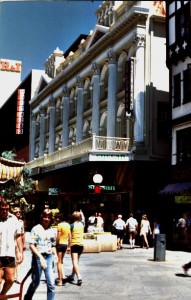
- Perth Theatre Royal 1981
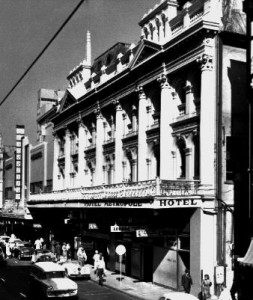
- Perth Theatre Royal 1930
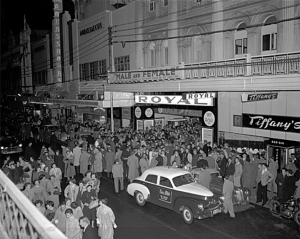
- Perth Theatre Royal 1955
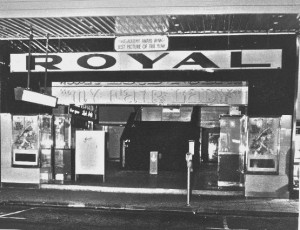
- Perth Theatre Royal 1965
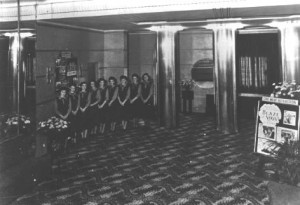
Royal Interior c 1960 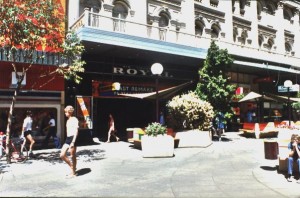
- Perth Theatre Royal 1978
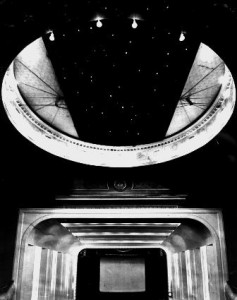
- Royal interior sliding roof
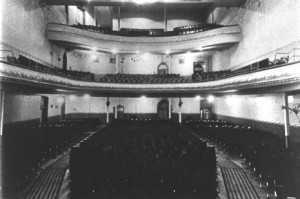
- Royal interior 1930
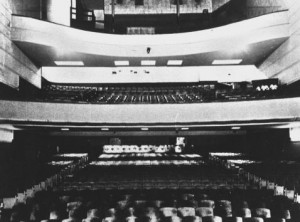
- Royal interior 1940
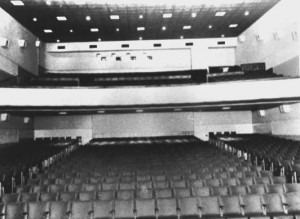
- Royal interior 1965
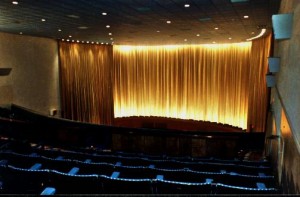
- Royal interior 1978
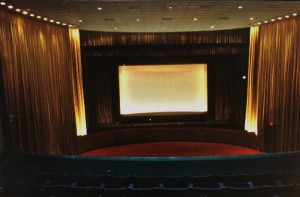
- Royal interior 1978
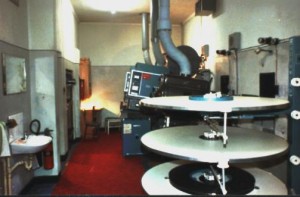
- Royal interior Bio Box 1978
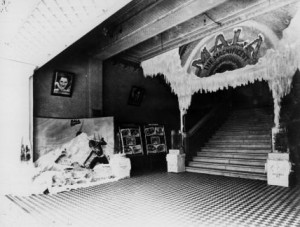
- Exploitation Campaigns, Mala The Magnificent
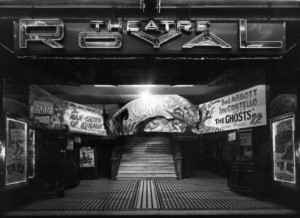
- Exploitation campaign
Former Mayor of Perth, T. G. A. Molloy, built the Theatre Royal in 1896-7, with financial support from Alexander Forrest. Although films had appeared on the entertainment scene by late in 1896, and well before the theatre was completed, their importance was certainly not recognised, and Molloy felt no need to make concessions to the new medium in his plans for the theatre. It was to be Perth’s grandest and most comfortable place of entertainment, with seating for two thousand patrons. The imposing facade, shared with the Metropole Hotel in a fashion common at the turn of the century (cf. for instance the Cremorne Hotel and Theatre, and His Majesty’s Hotel and Theatre), was of massive columns and arches in three stories fronting onto Hay St. It opened on 18 April 1897 with the staging of Robbery under Arms, by Alfred Dampier’s company.
However, a long association with film commenced before the year was out, as the theatre became the fourth venue used for moving pictures in the state, and the first to devote a whole programme to film: from 26 December 1897 to 2 January 1898, Jones and Lawrence presented a season of the film of the Corbett- Fitzsimmons prize fight. Soon after, Harry Rickards secured the lease, which he maintained for the next ten years. His vaudeville company presented the first of many seasons in the theatre from 23 January to 12 February 1898, and from 1900 to 1909 other Rickards companies arrived in Perth late each year to take advantage of the popularity of theatrical entertainment during the summer season, then returned to the east by late March or early April. All included moving pictures at some stage, and some were built around a particular cinematograph programme. The rest of the time the theatre was sub-let, so there was room for others also to present films, among them the Taits and Charles Anderson.
In September 1906, the theatre became the first to present a continuing season of Sunday ´concerts’ containing, and later devoted entirely to, films. This was the first of the permanent film seasons, leading on to the screening of entire programmes of films for seasons throughout the week. The latter was tried at the Theatre Royal by a company calling itself ´Royal Pictures’ in May 1910, but their attempt fizzled out, and in September they dropped back to two nights per week, and soon after that the theatre closed for its first major renovations.
Also in September 1906 the whole Perth community had been distressed to learn of a fire at the theatre during a cinematograph performance, extinguished fortunately without loss of life and with minimal damage to property. In the 1910 renovations, a ´fireproof operating chamber’, that is – a bio-box, was built completely outside the auditorium, thus separating the audience from the projection apparatus, and eliminating the risk of further fires. Like other Perth theatres, the Royal had a windlass-operated roof opening, to provide ventilation on hot nights. This feature was retained, but the ventilation system was claimed to have been improved by the renovations, in which the theatre had been ‘practically rebuilt’ (West Australian, 8 July 1911). It re-opened on 12 July 1911:
…tastefully decorated, sumptuously furnished, and completely equipped with the latest appliances for the perfect reproduction of SPENCER´S PICTURES, Already Supreme in Sydney, Matchless in Melbourne And predestined to be the quintessence of Perfection in Perth. (West Australian, 1 July 1911)
This advertisement is an example of the showmanship of Cozens Spencer, who had already visited the state several times with touring companies, but who now established his company with a continuing lease of the Theatre Royal that lasted till 1916, that is, after he had personally left the business, and gone to live in Canada.
Here were screened the films produced in Spencer’s Rushcutter’s Bay studios, to which were added some made in Western Australia as part of a programme of filming on behalf of the Government of Western Australia to promote the state overseas. As in the eastern states, Senora Spencer’s talents as a projectionist were used as part of the company’s promotion. The result of all this was the continued success of Spencer’s Pictures, not only in the Theatre Royal, but in other venues (see, for instance, Spencer’s Esplanade Picture Gardens).
In February 1918 Thomas (later Sir Thomas) Coombe took over the lease, so it became one of those theatres brought by him into Union Theatres. It had, however, not been designed for films, and by 1926 it was not possible for the Royal to compete with the new picture palaces, particularly the Prince of Wales, built in 1923, and so it closed for a short while. It re-opened as a Fuller’s house, presenting live shows and vaudeville, as well as some film seasons, from 1927 to approximately 1931, then the lease was taken over by Hamilton Brown. During this time the theatre was wired for sound.
In July 1934, James Stiles negotiated a lease of the Theatre Royal on behalf of the Grand Theatre Company, and a contract for first release in Perth of all MGM product. The theatre became virtually a showcase for MGM till the latter company secured the Regent in 1938 and renamed it the Metro. Even after this, the Royal continued to screen MGM films for some time, though no longer exclusively.
Under the Grand Theatre Company, the Royal underwent several renovations. The first was completed before the theatre re-opened in August 1934. At this time the central pillar in front of the theatre was removed to enlarge the lobby, and extensive redecoration and refurnishing took place. In 1937 the stage was taken out and the screen set further back, and in 1939 a major reconstruction was undertaken:
The front and lounge foyers, which have been enlarged by the elimination of the old staircase, have been given the appearance of being considerably more spacious by the careful use of mirrors. The tesselated marble flooring has been retained in the foyer, but the decorative treatment has been improved by the use of plain and fluted vitrolite, the glossy blackness of this material contrasting with chromium bands, which are liberally used. The staircase, which is set at the side and not the centre of the foyer, to give added space, is carried out in flush panelling of light, figured maple. The walls are finished in a restful, grey texture.
The lounge foyer, with carpeting and upholstered furniture in warm colours, gains considerable space from the elimination of one of the side staircases and extension in the direction of the balcony, and is set off by stainless steel pillars. The cosmetic room has been soundproofed and finished in a tasteful silver-grey.
The auditorium and proscenium have been completely changed in appearance, although the structural plan has been unaltered. The sliding roof, which was a popular feature of the old theatre in summer, has been retained, and in addition air conditioning has been installed. A porous, fibrous material, coloured to harmonise with the general treatment, is used on all walls opposite the screen to prevent echoing.
The sides and roof have been carried out in a restrained ´modernist’ style, with tonings of grey-blue, cream and salmon. Indirect neon lighting is used throughout.
The seating in the lounge and dress circle has been completely changed. The stage has been enlarged, and the main curtain is treated in alternate shades of wine. The alterations are reported to have cost £11,000. (West Australian, 22 Sept.1939)
The theatre was closed for ten weeks while this renovation took place, but the bio-box remained one of the worst in Perth. It had originally been a ´spotting box’ for live shows, so it was very small: once two projectors and ancillary equipment were installed there was very little working space for the operator. But after the 1939 renovations there was a new problem. The steel girder that now supported the lounge was positioned so that the light beam from the projectors ran just underneath it. But the architects had forgotten that the projectionist’s port was best placed just above the light beam, and when the mistake was discovered it was too late to change the construction. A periscope to see above the girder would have been unreliable (how was the projectionist to know if the problem was in the periscope or on the screen?), so the projectionists chose to sit on a stool, which brought one side of their face always next to the carbon arc. Ray Cooper developed serious skin cancer from this, an industrial health hazard that would not have been tolerated in later years.
But at the time it was considered no more than an irritation, and the theatre re-opened with great publicity on 22 September 1939 with continuous screenings during the day and a separate programme at night.
On 15 July 1954 the theatre (but not the adjoining Metropole Hotel) was purchased from the estate of the late T. G. A. Molloy by Town and Suburban Properties Ltd on behalf of the Grand Theatre Company, which the following year was renamed City Theatres, in recognition of its growth from holding a single city cinema (the Grand) to being Perth’s largest independent chain.
Another major reconstruction of the Theatre Royal took place early in 1965, prior to the opening of the Western Australian season of the blockbuster My Fair Lady. By this time the seating capacity had dropped from the original two thousand to 1,102, and in the reconstruction this was further reduced to 970, making it a ´modern, more intimate showcase’ (Film Weekly, 11 Feb.1965). The 25 ft wide stage in front of the screen was removed, signalling the building’s final conversion from a theatre, capable of presenting live performances, to a cinema. A floating ceiling reduced the dimensions of the old auditorium, and eliminated the roof opening. A new bio-box and screen were installed, capable of presenting 70mm. In addition to the five banks of speakers located behind the screen, sixteen speakers were placed around the walls of the house, and a new foyer contained toilet blocks which had previously been located on either side of the screen.
My Fair Lady opened in April 1965 and ran for a record sixty weeks. The Royal was among those theatres purchased by the consortium which bought out City Theatres in February 1973, and by TVW 7 when they bought out the other partners in the consortium in 1978. By this time, the theatre had succumbed to the industry depression of the seventies. It was closed on 9 February, 1978, and sold to developers, who constructed shops inside the stalls of the old building. Then in 1984/5 a hole was punched in the wall adjoining the old Ambassadors theatre, where the Wanamba Arcade, with its two Hoyts theatres now stood (see 629 Hay St). Hoyts Cinema Four was then built inside the lounge of the Theatre Royal, with its entrance in Wanamba Arcade next door. The shops continued on the street level, underneath the new cinema, and later the whole complex became known as Hoyts Centre, with Wanamba Arcade renamed St Martins Arcade. By 1999, the former Hoyts Cinema Four was known as Hoyts 7, and was closed with the rest of Hoyts Centre in April that year.
Sources: Max D. Bell, Perth: a cinema history, The Book Guild, Lewes, Sussex, 1986, pp.91-92
Jack Honnibal, ‘The MGM years at Perth’s Theatre Royal’, Kino, no.68, Winter 1999, pp 6-9
Stage, Screen and Stars, West Australian, n.d. (1997?), pp.36-37
Australasian Exhibitor, 15 July 1954
Film Weekly, 11 February 1965
Film Weekly Directory, 1943/4 – 1971
Kino, no.60, June 1997, p.35
Mirror, 21 July 1934
Post Office Directory, 1898 – 1949
Sunday Times, 1897 – 1898
West Australian, 28 July 1939, 22 September 1939, 5 May 1953, 2 July 1954, 14 January 1956, 1900 – 1977
Interviews (Ina Bertrand): Doug Anderson (1985), Chris Spivey (1978), Arthur Stiles (1985)
Interview (Colleen Pead): Ken Alexander (1986)
Interview (Ina Bertrand & Bill Turner): Ray Cooper (1981)Photos: 1 exterior, b&w, 1897, West Australian no.1297
1 exterior, b&w, 1920s, Battye 3190 11819P
1 exterior, b&w, 1950s (Arthur Stiles)
1 exterior, colour, 1978, Roy Mudge
1 exterior, colour, 1981 (Bill Turner)
1 exterior, 3 interiors, Jack Honnibal, ‘The MGM years at Perth’s Theatre Royal’, Kino, no.68, Winter 1999, pp.6-9
1 interior (foyer, advertising Man-eater of Kumaon), b&w, 1948 (Arthur Stiles)
1 interior (foyer, advertising My Fair Lady), b&w, 1965, Arthur Stiles
1 interior (sliding roof), b&w, 1930s (Arthur Stiles)
1 interior (horseshoe lounge, before first renovations), b&w, 1930s, Arthur Stiles
1 interior (auditorium after 1940 renovations, pillars removed from stalls and lounge), b&w, approx. 1950 (Arthur Stiles)
1 interior (auditorium after My Fair Lady renovations – gallery removed, false ceiling added), 1964?, Arthur Stiles
2 interiors (bio-box), colour, 1978, Roy Mudge
3 interiors (auditorium), colour, 1978, Roy Mudge
exploitation campaigns, b&w, various dates, Arthur Stiles (example here is for Mala the Magnificent)TIMES THEATRETTE, 645 Hay St, Perth
The Times was built in a basement under the Hay St end of London Court, for Hamilton Brown, who was then managing the Theatre Royal next door for Union Theatres. Brown also managed the Times, but employed a projectionist and sometimes an assistant projectionist to run it for him. Powers projectors were installed, with local sound heads – first X-L Tone, then Toughtone – because the theatre was so small that a lease and maintenance contract with the big firms like Western Electric would have been uneconomic. It held only 150, and opened in 1934 as a newsreel theatrette, screening continuously from 10 a.m. till late at night, on the ´hour show’ principle: patrons could enter and leave at any time and stay as long as they wished for the price of one admission.
It survived only eighteen months, partly as a result of poor presentation and partly because of the general economic problems of the time. The next attempt to establish such a theatrette in Perth was the Mayfair in 1948.
Sources: Post Office Directory, 1934 – 1935
Interview (Ina Bertrand): Doug Anderson (1985)TOWN, 776 Hay St, Perth
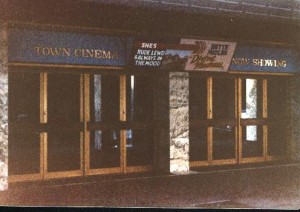
- Perth Town 1981
By the sixties, Australian Cinema Enterprises, renamed more simply ACE, had been involved for some time in the development of a circuit of drive-in theatres in the metropolitan and country areas. They had taken over the lease of the ailing Mayfair theatrette after the introduction of television and had converted it into the Cinema Capri. In 1969, in conjunction with Greater Union Theatres, they built the multi-storey Town Centre, which housed the huge Town House Hotel, with its 81 units, convention rooms and a garden and swimming pool on the roof, overlooking the river. It also contained the Town cinema, the first cinema built by Ace in the city area.
In keeping with the trend towards smaller, more intimate cinemas in the seventies, the Town held only 636 patrons. This was, however, still the biggest cinema to open in Perth since 1939, as in the interim only the very small newsreel theatrettes and specialist cinemas had been opened. This was neither of these, but a regular, first-release city cinema:
The Town Cinema will be a single floor theatre – new overseas trends have swung away from those with balconies.
Heated and cooled for climatic comfort, projection equipment will permit the screening of 16, 35 and now popular 70mm films on a screen 40ft wide by 17ft high.
The cinema itself is 47ft wide and 90ft long.
A dished floor will give each person in the audience a full and unrestricted view of the screen.
Comfortable seats with padded armrests will permit complete relaxation.
The cinema will be fully carpeted and draped. In fact the carpets will extend up the walls to dado height.
Six-track stereophonic sound will flow from 20 speakers around the walls and behind the screen.
The sound design will also permit the constant flow of soothing mood music or the film sound track into the foyer of the hotel. (Sunday Times, 2 November 1969)
And so the era of ´Muzak’ had arrived in Perth cinemas. The complex opened in November 1969, the official opening of the cinema being on 12 December, with the screening of For love of Ivy, starring Sidney Poitier. Thus, the wheel had returned full circle to the beginning of the century, when the common practice was to build a theatre in conjunction with a hotel for their mutual benefit (for instance, the Cremorne, the Melrose, or the Theatre Royal).
But the Town Cinema closed in 1992, and its equipment was moved to the second screen in the Piccadilly when that cinema was twinned. The venue was gutted in preparation for extending the hotel into the former cinema space.
Sources: Max D. Bell, Perth: a cinema history, The Book Guild, Lews, Sussex, 1986, pp.92-93
Film Weekly Directory, 1969/70 – 1971
Kino, no.40, June 1992, p.26
Sunday Times, 2 November 1969
West Australian 1969 – 1992Photos: 1 exterior, colour, 1981 (Bill Turner)
UNITY THEATRE, 70 Beaufort St, Perth
Films were regularly screened in the Trades Hall from 1940 to 1949, under the name of the Unity Theatre. There is also a tradition that films were screened here back in the silent days, but I have been unable to find out any details of this.
Sources: Interview (Ina Bertrand & Bill Turner): Norman Cunningham (1981)
WORLD´S TOURING CAR, 681 Hay St, Perth
Despite the growing public appetite for stories on film, the ´scenics’ – the animated equivalent of picture postcards of places of historic interest or intrinsic beauty – remained popular throughout the first decade of the century. One reviewer, for instance, regretted their absence from a programme at the Theatre Royal in 1910:
Industrial studies and travel scenes always command a lot of attention and a picture programme can scarcely be regarded as being complete unless there is a fair proportion of such views interspersed with the comic and dramatic subjects. (West Australian, 16 May 1910)
They were even occasionally presented as a full programme in their own right, for instance in the ´Round Trip through Australia’ presented at His Majesty’s in 1906.
Taking advantage of this popularity, the WORLD´S TOURING CAR was Perth’s contribution to an exhibition genre which enjoyed a world-wide vogue around this time, appearing in different forms in most of the major population centres with considerable success: it was known in later discussion as Hale’s Tours, after one of the best-known American examples of the genre. A typical advertisement can give some flavour of the show:
Central Station – Hay St
The World Tours
A new trip starts today from the Central Station to the Austrian Alps.
Scenes of Grandeur, Mountain Monarchs, Deadly Glaciers.
6d. children 3d.
AUSTRALIAN TOURING COMPANY (West Australian, 11 February 1908)
An earlier review of the show explains further:
The ‘World’s Touring Car’ entertainment, which is located at 681 Hay St, was liberally patronised on Saturday. In connection with the show a large car is worked so as to create the illusion that it is attached to a train that is journeying up the Colorado Mountains, the scenery of which is very fine, being furnished by means of a bioscope. The trip lasts about 20 minutes and is repeated from 10 a.m. to 10 p.m. (West Australian, 10 February 1908)
The premises appear to have been open from early February (at least from 7 February) to the middle of April 1908, when they reverted to their former use as shops. During this time, ‘tours’ were offered to the Austrian Alps, the Colorado Mountains, the Cinnamon Gardens of Ceylon, and the Ardennes in France, all with considerable success:
Today the last trip will be made through the beautiful Cinnamon Gardens of Ceylon, during which a wealth of magnificent tropical scenery is reproduced in natural tints before the speeding passengers, whose interest is held throughout by various novel and humorous travel incidents, that quickly follow one another. Besides the great novelty of this ingenious amusement there is sustained excellence of entertainment, which is the reason of its big success and undiminishing popularity in Perth. (West Australian, 24 March 1908)
Despite the short season (only seven weeks), this presentation was important for breaking new ground in two ways: it was the first time that premises were converted for the exclusive use of a film presentation, and it was the first use in Perth of what became known later as ´continuous’ performances. This description was given to a show which repeated its programme throughout a given period, starting again as soon as the last screening was completed, without advertised starting times for each new session. Though such shows became the trademark of entrepreneur J.D.Williams, who popularised them first in the eastern states in 1909, it was several years before he arrived in Perth and before the idea took off as a standard form of presentation, and so the ´Touring Car’ must be given the credit for pioneering the form in Perth.
Sources: West Australian, 1908
YE OLDE ENGLISHE FAYRE/HIS MAJESTY’S, 825 Hay St, Perth
YE OLDE ENGLISHE FAYRE
This was a pleasure gardens of stalls and stages providing entertainments and refreshments of many kinds, and allowing patrons to wander or to settle to the activity of their choice. In the 1890s, it was one of several such establishments in Perth, where the climate provided an ideal environment for open-air entertainment for several months each year. It was the custom of the Fayre to open on 1 November, and to close at the end of April. Though the season was comparatively short, the premises were popular, and the costs of overheads, even in the centre of the state capital, were low enough to sustain the venture.
Films were screened here for only one season, the summer of 1896-1897. This was a most significant season, however, for it was here, on Saturday 21 November 1896, that the first moving pictures were presented in the state, only three months behind the Australian premiere of films in Melbourne in August.
Jones and Lawrence were the lessees of the Fayre at the time, and they presented their first season from 21 November to 15 December, using an Edison cinematograph ‘especially brought from Sydney …notwithstanding enormous expense’ (West Australian, 20 November 1896). Over the three and a half week season the cinematograph dropped from top billing in the mixed vaudeville programme to fourth, but advertisements claimed that the whole programme continued to produce ‘Encore after encore. Applause after applause.’ (West Australian, 14 December 1896).
In early January 1897, teaser advertisements began to appear in the West Australian warning patrons of the approach of the Melbourne Cup, which was shortly to be ‘run’ at the Fayre. The season began on 1 February, and for four weeks, till 27 February, West Australians flocked to watch a horse race that had been conducted more than three months previously. A peak patronage of 3682 on a Saturday during the first film season had been advertised proudly, but now even a Thursday crowd reached 5213 (West Australian, 5 February 1897), and this increased to over 6000 on the first Saturday of the season (West Australian, 8 February 1897).
The machine was now a Lumiere and the programme included, in addition to the Cup film, the usual Lumiere offerings, such as the arrival of a train at a station. A brief return season of this programme from 20 to 29 February 1897 was the last appearance of films at the Fayre. Though the grounds opened again for the summer of 1897-8, and briefly as the Continental Gardens in the summer of 1898-9, no further films appear to have been screened there.
HIS MAJESTY’S
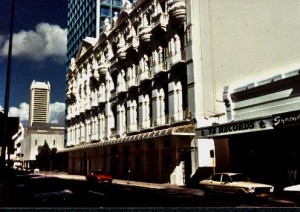
- His Majesty’s 1981
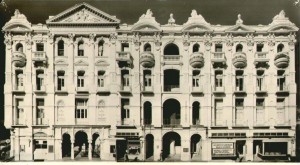
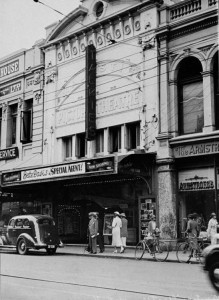
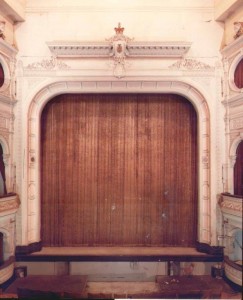
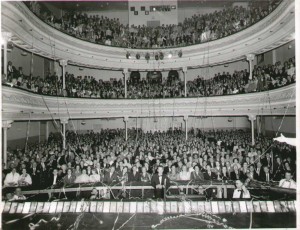
- His Majesty’s 1981
After 1902 construction began on a new theatre on the site, for Councillor (and three times Mayor of Perth) T. G. A. Molloy, who already owned the Theatre Royal and had interests in many other real estate and entertainment ventures. The architect was William Wolf, who:
was born in New York City and trained as an architect in Germany. He migrated to Australia in 1877 and worked in Melbourne and Sydney before setting up a successful practice in Perth in the mid 1890s. (Perth Theatre Trust Command Performance Souvenir, 28 May 1980)
The size and splendour of the theatre impressed all who saw it. The four stories contained not only a magnificent theatre, but also a hotel providing:
65 bedrooms, six bars, half a score of parlours or lounges, a large billiard room in the basement, and a spacious dining-room on the first floor. (West Australian, 8 March 1904)
It was possible, therefore, for patrons to slip next door for a drink before or after the show and at interval, though stress was also placed on the fireproofing of the whole building, and particularly the capacity to lock off the theatre from the hotel – with fireproof doors.
The facade was described as follows:
The massive grey walls are relieved with long rows of balconies and deep-set windows, and are set off with ornamental cement modelling of great variety of design. The architecture is of the Italian school.
Two tiers of balconies, carried out in the Doric order, run around the whole front, while the windows on the top floor have annexed to them balconettes which form a happy blend with the rest of the facade.
Roman columns, piers and pilasters support the outside fabric. The main pedament bears the Royal crest, while the minor pedaments, which are set in a series of segment arches, are surmounted by the models of six lions. (West Australian, 8 March 1904)
Inside, the ‘renaissance style’ was employed throughout, and the result was as spectacular as the outside. The vestibule and the foyers were tiled, with ceilings of stamped ornamental steel, and the staircases were constructed of ‘marble treads and rises, and cement balustrades, and handrails of alabaster white’ (West Australian, 8 March 1904). 2,584 patrons could be seated on the three levels of the main auditorium, and the stage was claimed to be the largest in the Southern Hemisphere, equipped to provide the kind of spectacle that was becoming standard practice in the more prestigious theatres of the world. For instance, during a performance of The Favourite, the stage collapsed under eight cantering horses: three were killed when they fell through the floor to the basement beneath, and their jockeys were badly injured (West Australian, 5 March 1960).
A feature of the auditorium was its four waterfalls, close to the proscenium, and designed to be revealed and to operate automatically whenever the asbestos curtain was dropped. These also contributed to the ventilation system of the building, which included a hundred different flues, a sliding roof over the auditorium, and a fume shaft over the stage’ (West Australian, 8 March 1904).
The public was invited to inspect the theatre, brilliantly lit-up for the occasion, on 15 November 1904, and it was officially opened on 24 December with a performance of Forty Thieves. Molloy was amply repaid for his 42,000 outlay on the building (excluding the land) as it became a landmark for the city and an important part of the continuing theatrical scene.
It had never been intended for use as a cinema, but the practice of theatrical presentation of the time made it inevitable that films would eventually appear there, if only as part of a vaudeville programme. And so, the first films were part of the Federal Vaudeville Company’s season which opened on 10 June 1905, and depicted incidents from the Russo-Japanese war. From then on there were frequent seasons containing films, usually lasting only a week or two, and often with gaps of several filmless months between. Under William Anderson as lessee, Sunday film shows were inaugurated in March 1907, sometimes presented by the same company as that offering the weeknight entertainment, but equally often by a quite different company brought in for one or a series of presentations. These became a standard feature of film presentation in the city, and an important step in consolidating the medium in the state.
A season of West’s films was presented by Edwin Geach at His Majesty’s in June 1906, then, starting on 21 September 1907, T. J. West’s films and the Brescians were presented to Perth audiences. Their season of 44 shows created a Perth record, and West went on to become one of the major entrepreneurs presenting films in the state, though this was after his company had moved to Queen’s Hall and had begun to screen also in Fremantle.
Despite the fire precautions built into the structure, the Superintendent of the Fire Brigades Board had expressed concern at the possibility of fire in the building if there was any interference with the water supply from Hay St, something which apparently could be expected to occasionally occur. His fears were allayed at the time of the opening of the building, but public concern was raised again when a fire actually broke out in the projection apparatus during a film screening in April 1908. The cause of the blaze was not reported in the press, but the actions of the fireman in smothering it with his jacket and a chair and other fittings brought praise from threatened patrons, and puzzled enquiries about the adequacy of fire precautions that could lead to such an incident and to such bizarre methods of extinguishing the blaze.
During the twenties the theatre was taken over by Fullers Theatres Ltd and was used mainly for concerts and live drama. Then for a short period in the forties it once again presented films, supplying the insatiable demand from troops on R & R as well as from war-weary locals. In 1951 it was bought by Westralian Wheat Buildings Pty Ltd, and leased to Edgley and Dawe Enterprises, who returned to a policy of live presentations, using the theatre for the more spectacular of their imported seasons.
But the size and splendour of the theatre had by now begun to operate against it. Its fittings and facilities, which had been of the very latest design at the time of its construction, were now outmoded and costly to maintain. After proposals for extensive renovations fell through, it appeared for a time in the early seventies that the building would be demolished. But the protests of the people of Perth convinced the State Government and the City Council to combine to sponsor a complete renovation of the building.
Peter Parkinson, the architect in charge, called this a ‘recycling’, i.e. a policy of retaining what was possible of the former building, but providing 1980s-style facilities. The Hotel was incorporated into the theatre, providing more spacious foyer accommodation, better backstage facilities and rehearsal rooms, new bars and a restaurant. Some of the fittings were repaired and re-used, others were created to the design of the old building, and still others were created new but in a compatible style. Repainting was in the type of colours used at the initial construction, but muted to suit 1980’s tastes. The pillars under the circle were re-sited further back to eliminate the earlier problems of back-stalls sight-lines. The Perth Theatre Trust was created to administer the building and other publicly-owned theatrical venues such as the Perth Concert Hall, and the refurbished His Majesty’s was officially opened with a ‘Command Performance’ of variety presented by West Australian artists on 28 May 1980.
Under the Trust, the theatre continued to provide a splendid service to the theatre patrons of West Australia, but it was not considered suitable as a major venue for films. Then on 11 December 1996 a small cinema was opened in the Green Room under His Majesty’s. Named the Bombora, it was a casual venue with seating in couches and beanbags, but seems to have been short-lived. In 2004, it was reported that the theatre was being cleaned up for its 100th anniversary (Kino, no.87, p.38)
Sources: The Heritage of Western Australia: the Illustrated Register of the National Estate, Macmillan 1989, p.37
Max D. Bell, Perth: a cinema history, The Book Guild, Lewes, Sussex, 1986, pp.80-82
Jack Honniball, Kino, no.90, Summer 2004, pp.9-10; ‘His Majesty’s: Perth’s brilliant theatrical gem’, no.91, Autumn 2005, pp.10-13
David Hough, A dream of passion: the centennial history of His Majesty’s Theatre, His Majesty’s Theatre Foundation, Perth 2004
Perth Theatre Trust, Command Performance Souvenir Programme, 28 May 1980
Stage, Screen and Stars, West Australian, n.d. (1997?), p.1
Film Weekly Directory, 1943/4 – 1964/5
Kino, no.58, December 1996, p.31; no.59, March 1997, p.31; no.60, June 1997, p.35; no.83, Autumn 2003, p.4; no.87, Autumn 2004, p.38
Post Office Directory, 1904 – 1949
West Australian, 8 March 1904, 5 March 1960, 1896 – 1897, 1904 – 1997Photos: 1 front elevation sketch, b&w, George Seddon & David Ravine, A city and its setting: images of Perth, Western Australia, Fremantle Arts Centre Press, 1986, p.157
1 exterior, b&w, c.1922, Battye 3191 11820P
1 exterior, b&w, Arbor Day 1906, Alexandra Hasluck & Mollie Lukis, Victorian and Edwardian Perth from Old Photographs John Ferguson Pty Ltd, St Ives, 1977, plate 58
2 exteriors, colour, 1981 (Bill Turner)
exteriors & interiors, colour, n.d. (Perth Theatre Trust, His Majesty’s Theatre, souvenir booklet, n.d.)
1 interior, b&w, 1960?, West Australian, 5 March 1960
1 exterior, b&w, n.d.,The Heritage of Western Australia: the Illustrated Register of the National Estate, Macmillan 1989, p.37
1 exterior (1970), 1 interior (1958), 1 stage performance of ballet (1968), b&w, Kino, no.90, Summer 2004, pp.9-10
4 interiors 2004, 1 interior undated, 1 exterior 1904, Kino, no.91, Autumn 2005, pp.10-132 exterior , date unknown, b & w, Roy Mudge
2 interior, date unknown, b&w, colour, Roy Mudge
-

TVW Opening – October 16th 1959
TVW Opening – October 16th 1959. Compiled by Richard Ashton.

When it was announced that television would start in Western Australia there was much interest in the community. Many people had seen television or had been told of it by friends living in Victoria and New South Wales. Because of the interest in the 1956 Olympics which was televised, and largely reported in those states television media, it had sparked interest. Many Eastern States people had bought television sets and it was reported they were becoming avid TV viewers. This too had sparked interest in other non TV states, Queensland, South Australia as well as here in the West. TV History http://tvw%20opening%20-%20october%2016th%201959/
Newspapers too were interested in the new medium, especially in connection with news in which of course they already had a great interest, and very good links across Australia and throughout the world. West Australian Newspapers, the morning paper in the Western Australia were interested to the point in which the managing editor James McCartney the editor requested that West staff member Jim Cruthers should be sent east to investigate the new medium.
Mr Cruthers went Melbourne in the January 1958. He contacted many people in the new established television stations as well as other television engineering companies and consultants. In his report back to the board of WAN, he pointed out that certainly Perth and Western Australia definitely needed television and West Australian Newspapers should be the people who should sponsor the project.
In the progress making a complete feasibility study for TV in WA much initial survey work was carried out, which included the sighting of a television transmitter, so as to reach a maximum audience. On May 1 it was announced the Bickley Hill had been chosen as the best site for television transmitters for both the national broadcaster the ABC, and future commercial stations. Up to four transmitter towers and buildings could be accommodated on the site, then Postmaster General Sir Giles Chippendale announced. The elevated area was 1130 feet above sea level and 14 miles from Perth. He also announced that the new ABC studio for both radio and TV would on the Rosehill site on Adelaide Terrace.
In a press story on June 14, headed “TV COY FOR PERTH,” the Board of West Australian Newspapers announced that they would sponsor a company called TVW Ltd who would go ahead and prepare the license application to operate a commercial TV station for the Perth region. And, that details would be announced shortly. It also said that a substantial interest in the company will be taken by this newspaper and shares would be offered to the public on very generous terms. Mr Cruthers detailed report that went forward to the WAN Board on May 29, estimating that the establishment of the company would be £500,000, comprising £150,000 for buildings, £250,000 would be needed for equipment and a further £100,000 for establishment costs. This included purchase of land for the studio’s and transmitter. The TV consultants had recommended the purchase of land on the Tuart Hill scarp as the ideal site for the studio and an offer to purchase the 10 acre site for £10,000 per acre was made to Herb Graham the Minster of Lands. Much behind-the-scenes work had been carried out by Mr Cruthers and was detailed in the application. The name of the new company would be called TVW Ltd. It was named by the West Australian Newspaper solicitor Mr Ainsley who would act for TVW’s application at the hearings in Perth.
On June 26 TVW Ltd was registered. The Company would raise £1,000,000 comprising 2 million shares at 10 shilling each. On the same day a long article was published in the West Australian by journalist Lloyd Marshal discussing the good and bad of overseas television. This item together with another the following day only helped to heighten the interest in television starting in WA. This second article suggested that the Broadcasting Control Board should always keep a tight control on TV programming, “Early evenings and weekend screenings must be good and wholesome programs the whole family could enjoy.” The control board stated that TV stations had an obligation to ensure that TV is used for the welfare of the community and that strict control of time should be devoted to religious programs. The article went on to quote that eastern states program TV percentages. They were found to devote approx. 60% to adventure, western and drama programs. 10% to comedy, 12% to children and 10% to panel programs.
By June 27, 1958 license application was finish and approved by the interim board then forwarded to the Broadcasting Control Board.
In the Saturday mornings West Australian of June 28, in another small article on television viewing habits, it noted the enthusiasm of Melbourne and Sydney viewers had taken to their TV sets. The growth of licence numbers in Melbourne from May 1957 to 1958 climbed from 34,700 to 133,391. And in Sydney much the same pattern, 22,475 to 128,678. It is interesting to note the difference of television ownership numbers between the two states. I couldn’t help remembering that perhaps it was that advertising campaign run in Victoria had helped. My work place in Melbourne at the time was Noel Paton Advertising they had devised a series of press ads, featuring cartoonist Peter Russell Clark’s humours drawings of people at the front door of there homes, under the heading. “Were we embarrass when the TV licence inspector called.”
Another small item in the paper of the 28th noted that, “TV filled a big gap in many people’s lives.” Despite, it said, what was described as the relativity high cost of TV sets, at an average of £200 each.”
On page 2 of the West Australian of Wednesday July 2 came the announcement of the float and share issue. On page 15 was an advertisement with the details. The advertisement listed amongst other details, the directors of TVW Ltd. who were all prominent West Australians. Mr C G Friend as Chairman of the Board and the other Directors Mr M Fry, Mr R Long and Mr E D McCartney, Editor of the West Australian. The General Manager would be Mr J W Cruthers.
The next day an article appeared stating. “TVW Ltd NOTES ATTRACTS INTEREST. The issue of £300,000 of 7% registered unsecured notes being offered for public subscription at par by TVW the new TV company initiated by West Australian Newspapers had attracted interested investors.” 10% payment now, 40 % in November and the balance next year in May 1959.
In the first week of July the letter was received back from the Post Master General’s office in Canberra stating that two applications TV licences for WA had been received.
The other license application was from a company called Western Television Ltd. The PMG also announced that public hearings regarding the license applications would be held in Perth on July 28.
There was much interest in many issues regarding the license applications. One issue was that Western Television would not be truly a Western Australian company with a great majority of shares being held outside West Australian. It was thought that Western Television was perhaps really in eastern states company, controlled by News Ltd of Adelaide and under the control of Rupert Murdoch. Other issues were that newspaper companies “…might not be able to be trusted to do the right thing in sending programs into the confines of people’s living rooms.” This was the tenor of the questioning at the hearing of the two Adelaide license applicants. However, the two were granted licences in that state, after lengthy hearings. Two licences were also granted in Queensland.
Public hearings were held in Perth commencing on July 28. And both license applications submissions were heard by the visiting Broadcasting Control Board officials. Various opposition groups concerned were also listened to, including those who oppose the introduction of television. Both applicants questioned each on their suitability to hold a TV licence, and some on the question of share ownership. It would be three months before the outcome of the board’s deliberation would be known. But this didn’t stop work going ahead for the establishment of TVW Ltd. It went ahead on the basis that they would be granted the license. It wasn’t just a matter of sitting waiting and hoping.
Western Television also went ahead commencing to issue a prospectus for the raising of funds. However they stated that if the shares were not fully taken up Western Press proprietors of the Sunday Times would lead them a further £300,000 to counteract the shortfall.

On October 14 news was announced by WA Newspapers that TVW Ltd had been granted the license for the Perth viewing area.
TVW Ltd. Gets The Licence For Perth. CANBERRA. Mon. the Federal Cabinet today authorised the issue of two commercial television and licences for Brisbane and Adelaide and one each for Perth and Hobart. The Perth license was granted to TVW Ltd. Post Master General – Davidson announced tonight that the license that would be issued for an initial period of five years. The Minister said that the companies in the main comprised interests closely associated with the communities which their stations would serve. Provision was made in each case for the public to become shareholders if they so desire.
Davidson said that the government had authorised him to grant the licences after it had considered reports from the broadcasting control board which conducted public hearings on the applications received.
Cost and Income.
The board reported that it would cost £479,370 to establish the station and it was estimated that the income would amount to £132,977 during the first year, £232,538 during the second year and £378,976 during the third year.
It was stated that the £600,000 to £700.000 capital which it was proposed to raise would be sufficient to establish the station on a profitable basis. If necessary, further capital would be secured via borrowing and by the issue of the shares or registered unsecured notes.
Programmes.
The company proposes, as a minimum, on to provide programs for 35 hours a week during the first year, 42 hours a week during the second year and 50 hours during the third year.
For the first period of the station’s operations it would operate 5:30 p.m. to 10:05 p.m. on Mondays and Wednesdays 2 p.m. to 9:30 p.m. on Tuesday 2 p.m. to 10:05 p.m. on Thursday 5:30 p.m. to 10:10 p.m. on Friday 6 p.m. to 11 p.m. on Saturday (plus afternoon sessions as warranted) and at 5:30 p.m. to 10 p.m. on Sunday.
The transmitter will be at Bickley and the studios at a site on Mount Yokine on which an option to purchase has been secured. There will be power of 100 kW for vision and 20 kW for sound.
99 Per Cent A Local Company.
Chairman of TVW C G Friend, said last night that he could not make a statement on the company’s plans until the board of directors had studied the conditions detailed in the letter. It was expected that the letter would arrive on Wednesday. TVW Ltd has an authorised capital of £1,000,000. The company was initiated by West Australian newspapers Ltd which undertook to take up 600,000 shares at par. The nominated capital is £1,000,000 in 10 shilling shares.
At the three-day inquiry at Perth in July to hear applications for the license it was stated that 99% of the applicants for shares or notes in TVW Ltd were the West Australian.
Another applicant for a license in Perth was Western television services Ltd.
On Wednesday, October 15, 1958 the Chairman of TVW Ltd announced some further of the details of the new TV station. Mr Friend said that as many as possible West Australians would be trained and employed; some selected staff would be sent to the eastern states the training. And in the Friday addition of the paper the Chairman stated that Perth was well cited for TV reception, and that it expected that 420,000 people would be able to get a first-class picture. The area covered would be from Yanchep to Mandurah and out to Wundowie in the hills. Fringe area reception would be as far north as Gin Gin and out to Clackline. Bunbury people with proper aerials would receive a good reception. Mr Friend also said that the TVW transmitter would be sited on Lawnbrook Road in Bickley.
Well, that was that. All the hard work had come to fruition.
It was also announced that the ABC’s new building in Adelaide Terrace had been started and that £680,000 had been spent up to date. The ABC’s TV officers and studio would be on Terrace Drive. The ANZ bank advertised in that day’s newspaper saying that people could start a TV savings account with the bank.
Amid much excitement, work on the new company would now start in earnest. It was announced that TVW 7 would be on the air in October 1959. There was much work to do. Plans to be finalised, land to be purchased, contracts and quotes for equipment to be received scrutinised and approved, and the work given out.
The main contract for TV equipment was given to the English Company PYE of Cambridge through Television Engineering Company of Melbourne at a cost of £270,000. They would supply the transmitters, studio equipment including cameras and support film and electronic equipment. Some of the relay link equipment was purchased from RCA of America.

TVW Transmitter Tower and Transmitter Hall building under construction In January 1959 work had started on the transmitter site at Bickley with the construction of the 475 foot high transmitting tower and building. The land purchases at Tuart Hill at the end of the roughly and quickly prepared Osborne Road off Flinders Street had been finalised. And the first clearing of the site east of the giant water tower commenced on April 4. Perth architect Bob Day of Hobbs, Winning and Leighton designed studio buildings and construction work on it now commenced.
The television equipment purchases in England were now well under way and some had been completed. The first £70,000 worth of equipment had been shipped and arrived at Fremantle on June 13 on board the P&O liner Oronsay, announced TV and Radio column writer Keith Flannigan. Some of the first news film shot of early work at Bickley and at Tuart Hill, and of the arrival and transportation of this English equipment was filmed by two young chaps using newly purchased 16 millimetre film cameras.

Keith ‘Digby’ Milner Tom Hall and Digby Milner who were part of the West Australian photography staff took on this work; they would eventually join the staff of TVW as part of the TV newsroom.

George Baker (Sound) and Tom Hall (Camera) Flannigan also announced that this TV equipment would be unpacked over the weekend and the technicians will probably start installing it on Monday. He also wrote that. “West Australians who had been working overseas and had gone to the eastern states to work, are beginning to drift back here for the start of TV.” He also said. “Rolf Harris will be coming back from London to produce and entertain for TVW 7, and Lloyd Lawson will be returning from Melbourne to take over as program manager and technician Phil Salinger, who has been working with TCN 9 in Sydney, is already working at the Bickley transmitter site.”

The West Australian announced that the technical team had been employed and all of 13 were now working unpacking the electronic equipment, and were working at 12 hour day. Graham Davey the chief engineer, who headed the team commenced installing the transmitters at Bickley, he was pictured in the paper, testing the just installed Sync Pulse Generator the heart of television electronic equipment of all TV stations. The transmitters were being tested too, into an initially a dummy load, but were expected to be ready for trade transmissions at the end of August.
For interest, a small picture of life and conditions in Perth in June 1959 showed that. Wild weather swept a wide area of southwest Western Australia. 56 mph gales lashed the metropolitan area. Farmers welcome the rain. The State Football Team was going to Melbourne for the big clash against Victoria; the team included a young John K. Watts. British stage star Sabrina was entertaining and His Majesties, and Jack Cassidy was putting the finishing touches to his new 16 foot skiff Evelyn VIII. Hillman cars were selling for £999 including tax. Radiograms were selling for £195.
Women’s shoes were selling for 59/11 and Paul Rigby Cartoons were selling for 10/6d at the Daily News Bookshop.
June 16 1959. A picture of Lloyd Lawson appeared in the West, and the accompanying small article Lloyd said that TVW will call for production staff this coming week. He also announced the daily evening TV news broadcast would commence at 6:45 p.m. And the first live TV programmes would be for children, panel shows, and programmes of women’s interests. There would be 56 TV programmes a week. The paper also noted that TVW Ltd shares were selling of 15 shillings and TVW options were 13 shillings. So I suspect the float was fully subscribed.

Beverly Gledhill, Coralie Condon, Lloyd Lawson and Penny Hoes
Auditioning process at Newspaper HouseIn a small piece in the West Australian of Wednesday, July 1 it was announced that TVW seven will hold their own auditions starting the following Monday. At this stage as there were no TV cameras, talent that showed promise would be call back later for a further on camera audition. Audition in the television must have been popular because by mid August in Keith Flannigan’s Radio and TV column it said that TVW7’s director Beverly Gledhill and producer Coralie Condon, and had sat through non-stop variety for a whole week. They had reviewed 300 acts of the actors, singers, instrumentalists, comedians, even a rope spinner and a performing dog.
There was also another note in the paper said that Musgrove’s Ltd was announcing the float for shares on a one-for-one basis at five shillings per share. This was to finance a venture into television sets sales, and service for the company. Musgrove’s had been in the music business in Perth for over 30 years.
It was also announced that country TV licensees would be released on the State by State basis and that the southwest of WA may have television as early as 1962. And in a meeting of about 60 country electrical retailers it was thought the television would reach about a 100 to 150 miles. Signals at Busselton would be good, Bunbury may have troubles because of the hills nearby and that signals could reach as far as Cunderdin and Merredin.
On Friday July 4 the West Australian announced that the TV tower at Bickley had reached its halfway building point. But three days later trouble struck. In a front-page article and pictures, it announced that four men in had fallen in a steel building cage from the 40 foot level and had been taken to Royal Perth hospital. It was announced later that none of the riggers had suffered any significant injuries. Mr Cruthers said there may be a delay in the starting of the trade transmissions scheduled for August because of the mishap. Damage had occurred because of the fall, at the top section of the half constructed mast, at the 220 foot level. The Melbourne firm that had fabricated the tower said that work on new steel parts had already been started. These would replace the damage sections, the delay may be only two weeks. At daylight survey was made yesterday however it revealed less damage than expected the West Australian announced on July 8.
On July 11 it was announcement that there would be five hours TV per day seven days a week. And Perth antennae firms were installing the first aerials around Perth and in the country, preparing for TVW7’s trade transmissions. Thinking was that viewers will be able to receive good pictures as far down as Busselton using 100 foot high telescopic antennae’s which would cost £148 it was estimated.

David Farr audition at Newspaper House On August 4 the first on camera auditions commenced using a pretty primitive specially rigged camera at Newspaper House. Auditions were held for entertainers, singers and dancers, TV hosts and newsreaders. The other news that day included a photo taken at Perth airport showing Qantas Super Constellation aircraft arriving from London. Instead of landing at Darwin as usual, on its way to Sydney, it was diverted to Perth to do deliver £10,000 worth of TV equipment for the studios at Mount Yokine. It was noted that the freight charges for this equipment was £2875, quite a bill for those days. The aircraft was fitted with special extra freight doors and especially reinforced floor to take heavy loads. Parts included were, talkback equipment and parts for cameras and the control room. The photograph showed equipment being unloaded by forklift.
In the West Australian on Saturday, August 8 was a small article about a speech which had been delivered by TVW’s new advertising manager Brian Treasure. He was addressing the Liberal and Country Party State Women’s League Council. In his remarks to the group he said. “The first TV signals given by TVW will be on full power…the signals will ensure that the public would not be disappointed with poor reception.” He was obviously indicating that country people that were relatively close to the metropolitan area would also receive good television signals. And that more distant people with a good aerial would not be disadvantaged.
On August 12 another article appeared under the heading, Announcer. A 22-year-old radio announcer who has never seen TV would be WA’s first TV announcer. TVW7 program manager Lloyd Lawson announced last night that David Farr an announcer with 6PM-AM had been appointed to TVW. His appointment was made following the auditions last week. Two more appointments to the announcing staff would be made later on.
By Friday August 14, Keith Flannigan’s radio and television column had now a well-established readership. It announced that TVW will screen news films from all over the world in its quarter hour news service when it comes on air in October. A quote from Mr Cruthers said, that they had signed an agreement with CBS and ITN news services to receive an overseas service from America and England. News films would be flown in daily. TVW would also receive news from TV stations in other states from an exchange service. For state and local news TVW has two news cameraman and stringers in many big country areas. There was news about the tower construction. If the fine weather continued, work on the 475 foot tower at Bickley would be finalised next week, and finishing touches to the aerial and feeder lines would be then commenced.
August 15 saw the first of the telecine equipment installed and run in a side room at the Bickley transmitter. It was the first time that moving picture image were shown through a television close circuit system.
The first film was shown in the Telecine Section to the chairman and board of TVW Ltd. Mr C G Friend was pictured in the paper watched a documentary on this occasion. This equipment would show to air the film trade transmissions which it was hoped would start on August 31.

Mr C G Friend and fellow TVW Board member Mr M Fry see first TV images. On August 17 a picture in the paper showed giant reels of cables which had been made in Germany had arrived and unloaded for the ABC’s transmitter tower. These thousand foot cables would feed the signal to the transmitter aerials on top of the tower from the transmitters housed in buildings below.
Two days later on Wednesday, August 19 the paper showed a picture of a man with his children looking at the blank television screen. The accompanying article noted that Mr J. A. Redmond was the first holder of the TV license in Western Australia. An Irish migrant, Mr Redmond recently visited overseas relatives with his Australian wife and the saw TV for the first time. He was so impressed that he bought a set immediately after returning, even though TV had not yet started, he paid his TV license in advance before seen a program. The article went on to say that TV licences could be secured from the GPO or any Post Offices’ within 50 miles of Perth. Beyond that distance a receipt may be issued for the £5 and the license would be sent by post.
In another small article a Federal Parliamentary Senator called for television films to be classified in the press and flashed on the screen before transmission. He suggested that G would be the general exhibition, A for adults only, and AO for programmes not to be shown on television before 8:30 in the evening. Interestingly there was a half page advertisement showing Graham Kennedy Melbourne TV entertainer wearing an advertising Glove Weave shirts!
On Friday August 21, Keith Flannigan in his TV and Radio column announced that the transmitter tower and been finished. He also announced that TVW7 now had three men who will be on camera regularly when TV starts on October 16. The latest appointment is ABC news man Geoff Walker who will read the news. The other two will be announcers, Phil Edgley a stage and radio actor and David Farr formerly from Radio 6 PM. He also noted that TVW7 studios at Mount Yokine had now found themselves to be in the Tuart Hill postal district.
In Queensland Brisbane’s new QTQ9 was ready and was on the air on August 16 1959, it was an American RCA packaged station. The two Adelaide stations NWS9 and ADS7 would come on air seven weeks later.
On Saturdays West of August 22, on the front page were to pictures taken with telephoto lenses of the toppled the TVW transmitter tower. The caption stated. “It’s There – 475’ High.” The last nut and bold were tightened on the last section of TVW’s transmitter tower which had started being constructed just over six months ago. The photo showed the Riggers had done their work. Soon the aerials themselves facing north, south, east and west would be added and coupled to the feeder cables which would run down the 500 odd feet to the transmitter hall below.

475 foot high transmitter tower completed. ABC TV Transmitter site at picture top. Things were well underway now but in the next two months much work had to be done. The newly employed technicians both at Bickley and Tuart Hill were hard at work installing all the technical equipment that makes up the heart of the television system. It’s interesting to note and advertisement in the same paper inserted by Thorne Atlas a TV set manufacturing company.
Apart from extolling the virtues of their TV sets it listed the Do’s and Don’ts for TV watching. In another section of the same Saturday’s paper it announced the first annual report of TVW Ltd. The report for the period up to June 30 in which the directors noted covered the period of development and that no trading income had yet been earned. The company had made a loss of £39,405. It noted among other things that the land at Yokine Hill had been purchased. The 4 acres which contained the transmitter and buildings at Bickley had been purchased freehold. TVW was expected to open on October 16 1959 the report concluded.
On Monday, August 24 a full-page advertisement for Boans Ltd appeared in the West Australian. The banner headline announced Boans TV show today, in the Fashion Hall on the first floor. 12 trusted names in top television sets would be on show. The advertisement went on to indicate that Boans would offer you WA’s best TV deal, and that a free information booklet was available to help you make your choice.
The advertisement also announced that the official opening of their TV Show would be at 12:30 today and it would be opened by the Chairman of Directors of TVW Mr C G Friend. The TV show would continue till September 5.
In later pages in the same paper, a full-page Nicholson’s TV advertisement appeared. It suggested that they would deliver fair trading as they had done the last 70 years, and they were not flyby nights, and could supply high-quality television, and quality after sales service. The paper also had an advertisement for PYE television sets and service. The illustration showed a studio television camera elevated on a camera crane.
On Tuesday morning’s paper of August 25 on page two, a paragraph heading said. Monday TV-Outlook Fine. The sub heading said. “The prospect of TVW7 beginning trade transmission on Monday (next) is like the weather, fine. The Weather Bureau predicts fine weather until Wednesday, that should give TVW technicians time to hoist the 525 foot feeder cables to the top of the television tower at Bickley.” The article went on to say that once the cables are in place they will not be a mercy to the weather. In yesterday’s warm weather the last of the 24 aerials, six on each face were clamped to the 70 foot top section of the tower today. Graham Davey TVW chief engineer and his team of technicians will now hoist the feeder cable. Moisture will affect the £3000 feeder cables. When they are fitted, specially dried air will be pumped through the feeder’s aluminium casings. As the cable goes up they will be pulled through a box which will straighten out the cable. Both must be the same length to within 1/16 of an inch. The article continued. “An engineer will arrive by plane today with a Diagraph which will measure the cables electrically. When everything is fitted an engineer for the Broadcasting Control Board will check to see if the transmitter meets the prescribed standards and TVW7 will be ready to go on air.”
On page seven was a further announcement. “TV Sweeps the City.” One of Perth’s greatest sprees got underway today when wholesalers delivered 2000-2500 TV sets to city dealings, the paper announced. It also reported that. “At lunch hour exhibition in a city store, 500 jostled shoulder to shoulder to see a variety of TV sets. A closed-circuit chain gave an idea of what TV would be like.” On Friday, August 28 there was a picture showing the cables leading up the tower.
In the classifieds there was a smaller ad saying. “John Allen’s requires a TV salesman with own car. We offer a large incentive scheme.”
The following day in a small paragraph on page one it said that there would be a 46 page supplement about the introduction of trade transmissions and that TVW would switch on to full power on Monday, August 31. In the same Saturday paper. “Hotels Rushed TV Sets.” The article said that city and suburban hotels had been rushing to install TV’s in bars and lounges in readiness for the start of trade transmissions on Monday. It went on to say, some other hotels will wait till they could accurately gauge the demands of patrons. Some publicans predicted of falling off of trade and some others said there would be no great attraction expected.
The following Monday August 31, the West Australian showed on page one under the heading. “Test shows a wide TV coverage in WA.” The article said, the first preliminary transmitter test had been made about 5 p.m. on Saturday afternoon and within five minutes the first viewer reports came in, first from a viewer at Lesmurdie. Numerous reports from the metro area were then also quickly received. Further initial unofficial tests by TVW over the weekend indicated a good coverage could be expected. At Bruce Rock 140 miles away, at Kellerberrin 100 miles away, and that Bunbury 92 miles away a good signal strength had been received and reported in by viewers.
The chief engineer Graham Davey had made the tests to make sure that everything was right to start the trade transmissions at 11 a.m. on the Monday August the 31. TVW general manager Mr J Cruthers tuned in at his Como home and watch the first test transmission, a TV test greyscale came on the air with music. He report of the happening to the Bickley transmitter, he said that tests results at his home were good right from the start. On Sunday TV tests were on again from 1 to 2:30 pm, and further technical tests and field strength’s were tested and nearby areas.
Today, the Monday paper announced, WA would feel the first big impact of television. More than 5000 television sets worth over £1,000,000 will be on sale as TVW started its trade transmissions for the next six weeks. Most transmissions would be off test patterns and commercial films. The program for today would be from 11 am to noon with test pattern, from 12 till 2 pm, films. Test flight 263, the History of Big Ben, Barrier Reef Fishermen, and Ice Carnival would be shown.
The excitement over television was further carried on with the 46 page TV supplement, published to coincide with the start of trade transmissions.
The West Australian offered an editorial comment about the commencement of TV in WA. It noted the profound changes TV would make to everyone’s lives. It also told of the opportunity for local talent and of commercial enterprise. It also said that a lot of rot had been talked about TV’s power to pervert young minds and dull were sensors of the old, and concluded by saying. “We should remember that when all is boiled down TV will be as good or bad as we make it.”
In the TV supplement advertisements appeared for nearly every electrical retailer in Perth, both large and small. The editorial content too was most comprehensive and included many articles, from what TV set to buy, viewing reception areas, technical facts, viewing habits in other states and program guides for the next few weeks.
Channel 7 General Manager Jim Cruthers contributed an article on the introduction of television, announcing that. “Today begins the new year of entertainment in Western Australia.” Other contributors included the background story of the chief engineer Graham Davy. Program manager Lloyd Lawson and news editor Darcy Farrell also told of their history and plans for the future. The Postmaster General Mr C W Davidson offered congratulations to the new TV Company, TVW Channel 7.
Another supplement article indicated that Australians had so far outlaid over £113,000,000 in buying new TV’s, the article suggested that taking £190 as an average cost of a television set, and almost 600,000 television sets would have been sold. To the end of March 1959, 52% per cent of households in Sydney had television, and in Melbourne the percentage rose to 58%. Three out of every four televisions were of the 21 inch size. The article also said that there were now 16 TV stations in Australia. 10 Commercial and 6 National. It also noted that the Perth ABC TV would be on the air by next March or April next year. Another interesting statistics noted that 11 miles of film would be used each week in bringing TV programs to the screen.
Many television companies and retailers advertise strongly in the supplement. The biggest probably was Phillips, they had four full pages. Other companies such as Healing, PYE, Simpson, HMV, AWA, Pope and Admiral all contributed with large advertisements. Insurance against TV faults reared its ugly head; £10 a year would cover you for a service contract. There was a comprehensive buyer’s guide including prices for all makes of TV sets that would be available for sale.
It was like the floodgates being opened, television was underway, and it would change our lives forever.
In the West Australian September 4 it was noted that television was likely to be on full power for trade transmissions today. Both transmitters would be feeding power into the aerial at Bickley. The PMG announced that so far 495 TV licences had been issued, more than 100 for each of the last two days. Two days later TVW 7’s first night transmissions started. The first evening transmissions included The Cisco Kid, up till now only documentary programs had been shown. Two days later on Thursday September the 17, programs were transmitted to air from the Tuart Hill studios. The microwave link system to the transmitter had been established. The evening’s trade transmission will be screened at the studio and flashed by microwave link to the transmitter at Bickley the newspaper announced.
The West Australian’s press launch the Hiawatha a trial was held with television set on board. Good pictures where received on the Swan River except when the vessel turned. In Blackwall reach ghosting had affected the picture, but at Rottnest the picture came in very well. I suspect those on board had a pleasant day during the tests.
On Monday, September 21 the paper announced that discounting had started, it said that top TV dealers would act on cut rates for TV sets. Five of Perth biggest dealers said yesterday that they would band together to cut down on price cutting. This move came after a published report that TV discounts had been offered to purchases of up to 12% to 15% on certain makes of television.
They claimed certain wholesalers were selling directly to the public and the big dealers were forced to follow suit. The following day it was announced that TV licences in Perth had exceeded 2000. By the Wednesday it was announced that the two TV dealers W. J. Lucas and Ron Shaw who had been disciplined for alleged breaches of the Television Retailers Association rules had been reinstated, and would again be supplied by wholesalers. It was also interesting to see a big Rothmans cigarette advertisement which depicted couples smoking and showed a television camera in the background of the picture.
As the third week of trade transmissions concluded the Postmaster General’s representative said that 7702 TV license had now been issued. Further TV programs had been shown during this period included a short cartoon feature called Crusader Rabbit, and regular shows such as Casey Jones, Bold Adventure, and Wings to Alaska had also been shown.
By the end of September the News, Graphic and Production departments had moved from their temporary offices in St Georges Terrace to the newly completed studio at Tuart Hill. By Sept 25 full-time trade transmissions were commenced, 1 till 4 test pattern and music, 6:45 to 7 pm test pattern and music, then from 7:00 film programs till 8:45.
By September 29 the studio was in there solo role, TV broadcasting. At one o’clock the studio’s clocks were set four 5:30 p.m. and programs were run to time in rehearsals some complete with commercial content. Children’s programs including Children’s Channel 7 were rehearsed. I Love Lucy, Maverick, Highway Patrol and many other programs scheduled for the first week were also run.

TVW 7 newsreader Geoff Walker rehearses the evening news broadcast
Left to right: Jim Healy floor manager, Richard Ashton camera and at the back of the picture is Vin Walsh, the weatherman.At 6:15 studio time Geoff Walker read the evening news and the weather was also presented by Vin Walsh, a retired met officer from the RAAF. He had he drew up the weatherboards from detail supplied from the Bureau of Meteorology. The purpose of the real-time rehearsals was to exercise and gain experience for the studio, presentation and production people, they were rehearsals for the real thing. All following week the studio would rehearse the full program’s daily including the live content. The opening of the station was two and a half weeks away.
In the Weekend Mail newspaper of September 12 much of the editorial was devoted to television. The paper featured many items and articles about programs and station personalities. They also included many interesting paragraphs on the backgrounds of senior staff members. Storylines were often printed about program content, news and children’s programs, and items about Wirley Birds, Mickey Mouse Club, Rin Tin Tin, and some to become favourite Efrim Zimbalist junior and Roger Smith starring in 77 Sunset Strip. Pretty dancer Judy Schonnell, soon to be seen on TVW’s variety programme Spotlight, was photographed and featured sitting inside a large television set.
The Weekend Mail also produced TV guide, listing night by night, whole week’s television programs. There was also a supplement in the West, again supporting the opening of the station. In his welcome editorial Mr Cruthers commented about the many advantages of television to the community. He appreciated the strong support that had been received from Western Australians. He said we had been able to build a TV station which at the present time is as modern as any other states of comparable size in Australia. The quality of the pictures ranks with the best in the world. In commenting about opening the station on a Friday he said, that the Board of TVW were not superstitious, but simply because Friday it was felt, would make a better opening night. Mr Cruthers went on to say, TV may be a novelty here, but in other parts of the world it is simply a way of life. In the United States I saw television in every hotel room, in bars and clubs, many homes had two sets he said. Already in Sydney and Melbourne 60% of all homes had a television set. In conclusion he said we sincerely hope you enjoy TV and we at TVW will seek to bring you our viewers the very best in the world’s entertainment.
The Opening.
The two studio doors opened outwards and the cool night air rushed in. Trumpeters from the Fifth Military District took up their places of each side of the doors. Into the studio now came the general manager of TVW Jim Cruthers and the Chairman of the Board Mr C G Friend. They took their places at the back of the four chairs in the upstaging area of the quite small studio 2. We had rehearsed this opening a number of times so our positions and shots were well practised. But now it was the real thing, rehearsals were over.
Penny Hoes, director’s assistant in the Studio 2 control room voice could be heard in our earphones. We also recognise the familiar voice of Beverly Gledhill our TV director for the opening. The technical director was John O’Callohan, he was in the control room too, he was talking to the camera control unit operator’s, making last minute nervous corrections, they were all downstairs in the Master Control area. You could sense a few nerves were showing by the last minute instructions which could be heard for all those who had the earphones on in the studio. They include TVW’s floor managers Brian Williams and Frank Evans. Steve Lumsdaine who was on the microphone boom, he was another experienced chap from Sydney. There was a voice in my other ear, it was my camera controller Paul Kinna, he whispered. “Good luck mate.” I couldn’t reply, but gave the camera a little nod up and down on the pan and tilt head to say thanks.

John O’Callohan, Beverly Gledhill and Penny Hoes in the Studio 2 Control Room Penny Hoes announced in our earphones. “Standby on the floor.” I looked across at Gordon McColl who was on camera two on my left, he seemed okay, he was also an experienced cameraman and had done this all before, as he was also one of the chaps from ATN 7 in Sydney. I looked back into my viewfinder as Bev Gledhill said. “15 seconds to air, focus up camera one and two.” On those early cameras you couldn’t keep them in sharp focus from fear of what was known as an image stick, an image retention in the taking tube. So to prevent this happening one always kept their camera either defocused or moving slowly backwards and forwards, I quickly focused up, my shot showed the opening Studio 2 doors at which, in the next few seconds the black Daimler of the Governor would appear.
The seconds ticked away. Finally Bev said. “Stand by two.” My camera came to rest and I checked focus again. “Dissolved to camera two.” and the little red light appeared in my viewfinder indicating that my camera was on the air. The Daimler doors opened and the Governor appeared and walked with his ADC to the studio door.

Studio 2 doors open to reveal the Governor Sir Charles Gairdner his ADC and members of the 5th Military District Band with the fanfare. The trumpeters from the Fifth Military District Band played their Fanfare followed by the recording of God Save The Queen. Everyone was at attention. At the end the Governor and his ADC then moved towards Mr Friend and Mr Cruthers. Beverly dissolved to camera one, Gordon was the camera for the shake hands and he followed them to the chairs. Mine was the cut away of the seating. Gordon then had the close up on Mr Cruthers. I repositioned for Mr Friend’s medium close-up.
Bev took Gordon’s camera shot too air, and to the many thousands of people watching their new TVs in their homes, no doubt with many friends who had dropped in to see the TV opening. Many others were watching Gordon’s picture of the opening in shop windows of electrical retailers all throughout the Perth area, who had kept their TVs on in the display windows for the opening, with little loudspeakers playing the sound out into the crowd street. Many sitting on chairs the blankets, such as was the enthusiasm for this new medium TV. Brian “cued” Mr Cruthers to camera and then dropped his hand indicating for him to commence.

The Governor announces “I declare TV officially open.” Jim Cruthers said. “Good evening, on behalf of all of us here at TVW I am very pleased, and I must admit a little bit relieved to say at long last, welcome to television in Western Australia.”
He continued. “Because most of you haven’t seen regular TV before our aim tonight is to show you a selection of the type of programs we will present to you in the future. Some from overseas, some local. For instance, later on in the evening our staff will present a live variety show, written and produced especially for opening night, and there will be some news and weather information prepared and presented locally.”
Mr Cruthers went on to talk of the overseas programs that would be shown. Firstly you will meet the Beaver he said, then, Father Knows Best, Sea Hunt, Perry Mason, and Marshall Matt Dillon from Dodge City in a program called Gunsmoke. There’s a further 197 episodes of Gunsmoke to follow, he said.
Jim Cruthers then said. “Now I’d like you to meet Chairman of Directors of TVW Mr C G Friend who will introduce his Excellency the Governor Lieutenant-General Sir Charles Gairdner.”
Bev in the control room cut to my camera, a close up of Mr Friend. Mr Friend said. “On behalf of the Board of TVW can I say how much we appreciate and recognise having his Excellency with us this evening.” Mr Friend went on to say how pleased and proud he was to see television here in Western Australia. It had been a long and highly involved process, and that he was also proud that TVW Ltd was truly a Western Australian company with over 2000 shareholders 99% of which were Western Australia’s. Mr Friend said that the General Manager and most of the staff were Western Australia’s. He then went on to introduce his Excellency Sir Charles Gairdner and invited him to officially open television in Western Australia.

Photographed off air TV set showing the Governor opening speech Gordon’s close-up was of the Governor. Bev in the control room cut to camera two. The Governor said. “Tonight is a very important one for us in our State, certainly a milestone in our progress which would have profound effects on the lives of all of us.” The Governor went on to say that some people said that television would pervert the mines of the young and dull the mines of the not so young. But he didn’t count on himself as one of those.
He went on to say that television would enhance the appreciation of sport, its appreciation of world figures and happenings, and, it would increase our knowledge of world events. He also said that it would also be a helpful relaxation in the home. The Governor then declared television officially open in Western Australia.
It was all go, we are off and racing.
On page one of Saturday mornings west of October 17 1959 one of the main paragraphs read. “TV plays to thousands to its biggest audience yet.” The paper went on to say that crowds blocked foot paths for the gala night, free TV shows in shop windows, kids in pyjamas and dressing gowns in the main city block, the paper continued.

There were now 3387 licensed TV homes. However it was estimated that each household had the least 12 to 15 watching the opening this would amount to some 40,000 viewers.

Newsreader Geoff Walker had come on to introduce a film history of TVW from the signing of the licence agreement, the building, the auditions and final rehearsals, up to the opening, the newspaper reported. A period of three years in one month since TV had started in Australia on September 16, 1956. There was a festive atmosphere at Tuart Hill the paper said. 150 guests in formal dress were in Studio 1 to watch the opening on 11 TV sets placed around the walls. Telegrams had been received from all parts of the world conveying best wishes for the opening. Local news was televised following the opening program. There were flashbacks of local stories which included one in witch a young boy called Graeme Davies of Mandurah who had accidentally fallen down the bore hole and who was successfully rescued in January 1957.

Rolf Harris sings and plays his accordion during the opening variety show “Spotlight.” I’m on camera 1 and Gordon McColl to my right on camera 2, Steve Lumsdaine on boom microphone, Harry Bluck on piano in fore-ground, Floor manager Frank Evans behind Gordon, Properties man Bill Smeed behind.
A variety show called “Spotlight” introduced by Phillip Edgley supported by actress Colleen Clifford was telecast. The show featured songs and dances from Diana Briggs, Edgley and Brian Card. Harry Bluck and his orchestra accompany them. Local singer Maureen Coreless entertained as well. Rolf Harris sang and played his accordion too. About the late news segment the paper said. “TVW reported just how Perth had received television with a newsreel coverage filmed while the studio was on air.” The evening’s program finished at midnight with the televising of the Perry Mason program.
Yes, we were certainly all off and racing, the whole 90 odd of us TVW Channel 7 people! Tomorrow, Saturday it was on again, as well as live news and film television programs, Syd Donovan and Frank Bird would present a live sports program called “Sport at Seven.” The first program would feature interviews of East Perth’s football captain Jack Sheedy as well as other sports results and interviews. Jack became quite a regular TV guest into future sports programs.
Then on to the first week. As well as nightly news broadcasts at 6:45 pm, television would show, on Monday nights a half hour live show called “Relax with Rolf.” It featured a pretty young mystery guest called Astrid Spargo. Rolf invented his wabble board and in Studio 2, and we sound recorded his, to become famous song “Tie Me Kangaroo Down Sport.” Live children’s program Children’s Channel 7 on Tuesdays and Thursdays at 5:30 pm the program would feature Rolf Harris and many of his drawings, paintings and puppet characters one included was Oliver Polip the Octopus. There would be many guests on all sorts of subjects including Pet Care with Pat Thomas, Vincent’s Seventti talking and showing animals. There were also many hobbies segments hosted by Len McKenna, and graphically illustrated children’s stories, many illustrated by Rolf himself. The weekly variety show “Spotlight” would be on air live on Thursday nights at 10 o’clock.
Television was on the air in Western Australia. TVW had spent £600,000 getting it there. Now the Board and the shareholders were hoping to get some of that back!

Richard Ashton 1959 
Richard Ashton 50 years later


